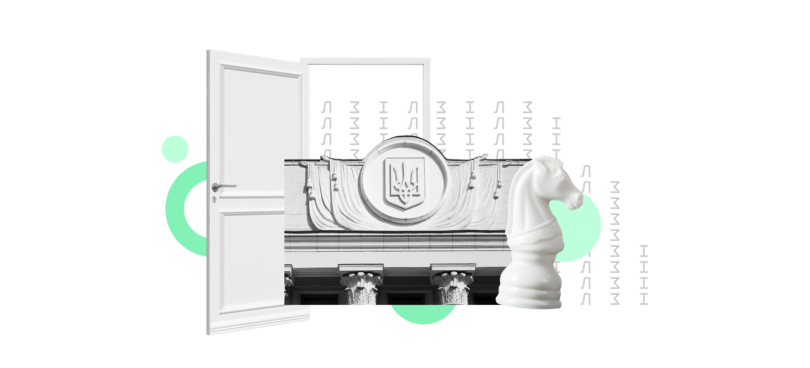

On 23 July, immediately after the vote to extend martial law and general mobilisation, the rostrum of the Verkhovna Rada of Ukraine was blocked by representatives of the parliamentary opposition and some members of the Servant of the People faction. They demanded that a draft law banning religious organisations linked to Russia, i.e. the Ukrainian Orthodox Church of Moscow Patriarchate (UOC-MP), be included in the agenda.
“Thus, the Verkhovna Rada cannot vote on other draft laws, as the rostrum will remain blocked until the aforementioned law is considered,” says Roman Lozynskyi, MP from the Holos faction.
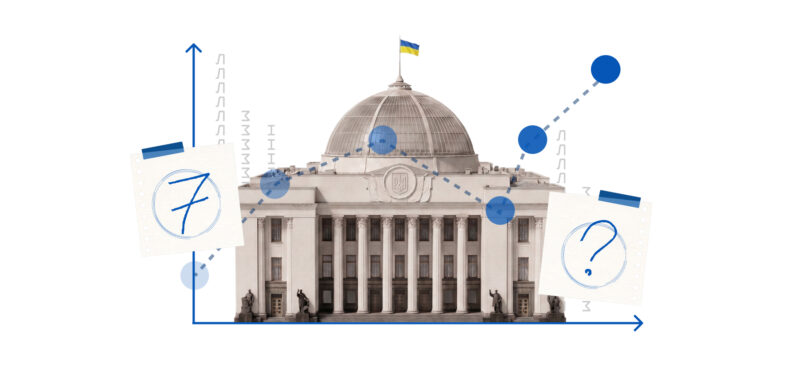
Subsequently, Speaker of the Verkhovna Rada Ruslan Stefanchuk said that the parliament would convene for the next session as soon as MPs had prepared the final version of the draft law on the activities of the UOC-MP and deniedrumours that the parliament had gone on “holiday”. But the Verkhovna Rada remains blocked for now. Below, we explain what this means.
Is the very fact of blocking the rostrum of the Verkhovna Rada a problem?
Despite the scandalous nature of this phenomenon in the media, blocking the parliamentary rostrum is a traditional form of political struggle in the Ukrainian parliament. In the case of the Verkhovna Rada, this may indicate the next stage of normalisation of parliamentary activities.
Blocking the rostrum is not the only way for the opposition or a dissenting group of MPs to influence the parliament. Parliamentarians can often use parliamentary obstruction – the abuse of formally permitted procedures to delay the work of the Verkhovna Rada.
In contrast to obstruction, rostrum blocking is formally prohibited but is, in fact, a legitimate and common means of parliamentary struggle. Despite the sanctions for blocking the rostrum prescribed in the Rules of Procedure, they are not applied in practice.
Rostrum blocking is a common practice in the Ukrainian parliament. Recall the vote on the infamous “Kharkiv agreements” in April 2010, during which not only was the rostrum blocked in the session hall, but massive clashes involving dozens of MPs took place, the vote on the “special status” of Donbas in August 2015, where clashes took place both in the session hall and ended in a tragedy outside the Verkhovna Rada building, or the vote in 2017 on the draft laws that also addressed the issues of the temporarily occupied territories of Ukraine.
In addition, the draft law on the activities of the UOC-MP has already caused the blocking of the parliamentary rostrum in May this year. The meeting was closed that day, and Ruslan Stefanchuk, Speaker of the Verkhovna Rada, called the blocking of the rostrum contrary to the VRU Rules of Procedure.
Political opportunities for some and problems for others
Banning the UOC-MP is a sensitive issue for Ukrainian society. Of course, both the government and the opposition are taking into account various arguments related to the need to ban the UOC-MP. However, both are politicians, so they have additional considerations for the expediency of voting to ban the UOC-MP.
The mono-majority’s delay in bringing draft law No. 8371 to the session hall can be explained by its unwillingness to demonstrate the lack of political will to ban the UOC-MP in Ukraine if it fails in the second reading. On the other hand, it also takes into account the risk of losing the electorate or destabilising Ukraine on religious grounds. The presence of MPs’ signatures in favour of the draft law does not guarantee the votes in the session hall, especially if the number of potential votes for the draft law barely exceeds the minimum required to pass the law.
For the opposition, banning the UOC-MP is an opportunity, among other things, to gain additional electoral benefits by showing their voters both the weakness and uncertainty of the mono-majority representatives and their own determination and efficiency in fighting pro-Russian religious organisations.
However, the assessment of the draft law adopted in the first reading is not unanimous, even among expert institutions and international partners. Last year, the Ukrainian Council of Churches and Religious Organisations supported the ban on the activities of religious organisations controlled by the Russian Federation. At the same time, the VRU Main Legal Department criticised the document. Its opinion, published on the parliament’s website, says that the protection of national security cannot be a basis for restricting religion, pointing to legal inaccuracies in the draft law’s text.
Furthermore, the VRU Committee on Humanitarian and Information Policy recommended that the draft law be passed.
Representatives of the U.S. government also criticised the draft law in the context of the religious dispute. At the same time, opinion polls among Ukrainians showed a decline in trust in the UOC-MP and growing support for a complete ban on this religious organisation in Ukraine. However, it is worth remembering that, according to the latest data from the SSUEPFCthe State Service of Ukraine for Ethnopolitics and Freedom of Conscience, the UOC-MP still has the largest network of parishes in Ukraine.
Parliamentary rostrum blocking should not be taken as a sign of a crisis in the work of the Verkhovna Rada of Ukraine.
This is a legitimate and common form of political struggle, although there is something unusual about this blockade: the VRU rostrum was blocked not “against” something but “for” the adoption of a specific draft law. After all, the Verkhovna Rada is not paralysed, and important laws on the extension of martial law and general mobilisation were voted before the blockade. This means that MPs may find compromise solutions to pass key laws alongside the political struggle.