
Parliamentary Reform in Times of War: What Is on the Agenda?
Paradoxically, the full-scale invasion has given impetus to the acceleration of many reforms in Ukraine. And the unfortunate parliamentary reform, launched back in 2016, has also been revived. The war has intensified the implementation of certain recommendations of the Roadmap for Internal Reform of the VRU prepared by the European Parliament’s Needs Assessment Mission led by Pat Cox. According to the latest estimates of the Agency for Legislative Initiatives, the reform is 45.7% complete. We will tell you where the parliamentary reform is heading now and what the difficulties are on the way.
New challenges
The martial law has made its own adjustments to the parliamentary reform. Everything related to amending the Constitution is currently impossible to implement (due to Article 157 of the Constitution, which prohibits amending the text of the Basic Law during the period of this legal regime). Therefore, all possible improvements can be divided into two categories as of today:
- Urgent, where their development and implementation do not require amendments to the Constitution. Accordingly, their implementation is currently a priority. For example, these may include the improvement of the Law “On Committees of the Verkhovna Rada of Ukraine”, the Law “On the Status of an MP of Ukraine”, and the adoption of the Code of Ethics;
- Those that should be discussed now but whose implementation and constitutional consolidation should be postponed until after the victory. These are amendments to the Constitution regarding the status of the opposition, restrictions on the legislative initiative of parliamentarians, regulation of the interaction of the power triangle “Parliament – Government – President”, etc.
However, it is important to take into account that after the end of the war, some legislative proposals and developments may become irrelevant.
Where is the reform heading now?
During the full-scale invasion, the Parliament has continued its internal reform and is working to improve its institutional capacity. For example, MPs have already held three meetings in the format of the Jean Monnet Dialogues during the full-scale war (in May and November 2023 and in April 2024), which were attended by the leadership of the Verkhovna Rada and representatives of parliamentary factions and groups.
As a result of these discussions, parliamentarians agreed that it was necessary to:
- update the VRU Resolution on measures to implement recommendations on internal reform;
- adopt the Code of Ethics;
- adopt the Law “On Parliamentary Service”;
- develop amendments to the legislation to regulate the status of the opposition;
- work to reduce “amendment spam”;
- return to holding “question hours” with the Government;
- ensure the adaptation of national legislation to EU law.
Some of these proposals, together with the developments of the pre-war Jean Monnet Dialogues, were embodied in the concepts for reforming the Parliament prepared by the Working Group on Amendments to the Laws of Ukraine in Parliamentary Law.
To implement certain developments, in late 2022, the Verkhovna Rada registered draft law No. 8242, aiming to improve legislative work in terms of adapting Ukrainian legislation to EU law. It is expected that consideration of this draft law will not be delayed, as it is currently on the agenda of the 11th session of the Parliament, which is expected to last until September 2024.
A significant part of the developments also relates to strengthening cooperation between the legislative and executive branches of government. So, in addition to preparing a concept for reforming this area, an Interagency Working Groupon Improving Legislative Work, Assessing Legislative Impact and Improving the Results of Laws Implementation was established at the end of 2023. At the founding meeting of this group, representatives of the Parliament, the Government and NGOs discussed the interaction between the VRU and the executive branch in terms of developing draft laws aimed at adapting Ukrainian legislation to the EU acquis, improving the procedure for submitting draft laws by the Government and strengthening the role of the Cabinet of Ministers in devising proposals for the agenda of VRU’s plenary sessions.
A no less important achievement on the path to European integration is the development of draft law No. 8327on the Code of Ethics for MPs at the end of 2022. ALI experts were also involved in this process. A year after the draft law was registered, in December 2023, the main provisions were presented and discussed at a meeting of the Working Group on Amendments to the Laws of Ukraine in Parliamentary Law.
In addition, in early 2024, to implement one of the points of the Conclusions adopted during the ninth Jean Monnet Dialogue, proposals were submitted to update the version of the VRU Resolution on measures to implement the recommendations on the internal reform of the Parliament, which include:
- improving the legislative process and adapting Ukrainian legislation to the provisions of the EU acquis;
- improving the interaction between the Verkhovna Rada and the Cabinet of Ministers;
- parliament digitalisation;
- strengthening the VRU’s institutional capacity;
- developing changes to the constitutional dimension of the parliamentary reform.
In general, parliamentary reform did not stop but became more relevant and active during the full-scale war. The acceleration of this process seems particularly noticeable compared to the several years preceding the full-scale invasion. This consolidation of the Verkhovna Rada’s efforts demonstrates its willingness to change even in the face of war.
So, the only thing that remains on this path is to take a responsible approach to implementing the changes outlined in the concepts developed so that the reform of the Ukrainian Parliament does not remain only a “promising project” but is actually implemented.
Read more about the parliamentary reform in times of war in our Journal.
Blocking the VRU Rostrum: Why No “Betrayal” Occurs?
On 23 July, immediately after the vote to extend martial law and general mobilisation, the rostrum of the Verkhovna Rada of Ukraine was blocked by representatives of the parliamentary opposition and some members of the Servant of the People faction. They demanded that a draft law banning religious organisations linked to Russia, i.e. the Ukrainian Orthodox Church of Moscow Patriarchate (UOC-MP), be included in the agenda.
“Thus, the Verkhovna Rada cannot vote on other draft laws, as the rostrum will remain blocked until the aforementioned law is considered,” says Roman Lozynskyi, MP from the Holos faction.
Subsequently, Speaker of the Verkhovna Rada Ruslan Stefanchuk said that the parliament would convene for the next session as soon as MPs had prepared the final version of the draft law on the activities of the UOC-MP and deniedrumours that the parliament had gone on “holiday”. But the Verkhovna Rada remains blocked for now. Below, we explain what this means.
Is the very fact of blocking the rostrum of the Verkhovna Rada a problem?
Despite the scandalous nature of this phenomenon in the media, blocking the parliamentary rostrum is a traditional form of political struggle in the Ukrainian parliament. In the case of the Verkhovna Rada, this may indicate the next stage of normalisation of parliamentary activities.
Blocking the rostrum is not the only way for the opposition or a dissenting group of MPs to influence the parliament. Parliamentarians can often use parliamentary obstruction – the abuse of formally permitted procedures to delay the work of the Verkhovna Rada.
In contrast to obstruction, rostrum blocking is formally prohibited but is, in fact, a legitimate and common means of parliamentary struggle. Despite the sanctions for blocking the rostrum prescribed in the Rules of Procedure, they are not applied in practice.
Rostrum blocking is a common practice in the Ukrainian parliament. Recall the vote on the infamous “Kharkiv agreements” in April 2010, during which not only was the rostrum blocked in the session hall, but massive clashes involving dozens of MPs took place, the vote on the “special status” of Donbas in August 2015, where clashes took place both in the session hall and ended in a tragedy outside the Verkhovna Rada building, or the vote in 2017 on the draft laws that also addressed the issues of the temporarily occupied territories of Ukraine.
In addition, the draft law on the activities of the UOC-MP has already caused the blocking of the parliamentary rostrum in May this year. The meeting was closed that day, and Ruslan Stefanchuk, Speaker of the Verkhovna Rada, called the blocking of the rostrum contrary to the VRU Rules of Procedure.
Political opportunities for some and problems for others
Banning the UOC-MP is a sensitive issue for Ukrainian society. Of course, both the government and the opposition are taking into account various arguments related to the need to ban the UOC-MP. However, both are politicians, so they have additional considerations for the expediency of voting to ban the UOC-MP.
The mono-majority’s delay in bringing draft law No. 8371 to the session hall can be explained by its unwillingness to demonstrate the lack of political will to ban the UOC-MP in Ukraine if it fails in the second reading. On the other hand, it also takes into account the risk of losing the electorate or destabilising Ukraine on religious grounds. The presence of MPs’ signatures in favour of the draft law does not guarantee the votes in the session hall, especially if the number of potential votes for the draft law barely exceeds the minimum required to pass the law.
For the opposition, banning the UOC-MP is an opportunity, among other things, to gain additional electoral benefits by showing their voters both the weakness and uncertainty of the mono-majority representatives and their own determination and efficiency in fighting pro-Russian religious organisations.
However, the assessment of the draft law adopted in the first reading is not unanimous, even among expert institutions and international partners. Last year, the Ukrainian Council of Churches and Religious Organisations supported the ban on the activities of religious organisations controlled by the Russian Federation. At the same time, the VRU Main Legal Department criticised the document. Its opinion, published on the parliament’s website, says that the protection of national security cannot be a basis for restricting religion, pointing to legal inaccuracies in the draft law’s text.
Furthermore, the VRU Committee on Humanitarian and Information Policy recommended that the draft law be passed.
Representatives of the U.S. government also criticised the draft law in the context of the religious dispute. At the same time, opinion polls among Ukrainians showed a decline in trust in the UOC-MP and growing support for a complete ban on this religious organisation in Ukraine. However, it is worth remembering that, according to the latest data from the SSUEPFCthe State Service of Ukraine for Ethnopolitics and Freedom of Conscience, the UOC-MP still has the largest network of parishes in Ukraine.
Parliamentary rostrum blocking should not be taken as a sign of a crisis in the work of the Verkhovna Rada of Ukraine.
This is a legitimate and common form of political struggle, although there is something unusual about this blockade: the VRU rostrum was blocked not “against” something but “for” the adoption of a specific draft law. After all, the Verkhovna Rada is not paralysed, and important laws on the extension of martial law and general mobilisation were voted before the blockade. This means that MPs may find compromise solutions to pass key laws alongside the political struggle.
“One-time” Yet “Perpetual”: Has the Term of the Verkhovna Rada of the 9th Convocation Expired?
The Verkhovna Rada of the ninth convocation is unique in numerous aspects. It is the first time in the history of the Ukrainian parliamentary system that the majority is in the composition of one ruling party, i.e., a mono-majority.
Approximately 80% of newly elected members of parliament are people without any prior experience in politics. For more than two years, they have been working under martial law without any break, although, at the moment, it is unknown how long this office will last. This last fact is highly ironic if we recall some narratives in the media and in the public space after the changes in the newly elected president’s team were made: the people around, in particular, MPs, were perceived as “one-time.”
Life definitely was not preparing the newbies for the problems and shocks they finally faced. The first was the COVID-19 pandemic, and since 24 February 2022 – the biggest ordeal for the Ukrainian statehood since its independence – the full-scale invasion of the Russian Federation.
Although under ordinary circumstances, the term of the ninth convocation should have already expired, it is currently extended for an indefinite term. But there is still a question of how long it will be able to work. The parliament has been incomplete from the very beginning (424 MPs took the oath instead of 450), and in connection with the full-scale war, it continues to lose its MPs. Previously, the ALI analysed who of the members of parliament could be the following candidates to leave. Now, we will consider how the Verkhovna Rada has changed in quantity within five years, what this means, and how unique this situation is for the Ukrainian parliament.
So, 51 members of parliament have already resigned prematurely. This is about 12% of the primary composition of the Verkhovna Rada in August 2019. Instead, 30 new members of parliament have come to the Verkhovna Rada. That is, vacancies were filled by 2/3.
Today, there are 401 members of parliament in the Verkhovna Rada. And this is the historical minimum over the total history of Ukraine’s independence. MPs see problems in the strengthening of this trend, as it is unknown how long the term of this convocation is going to last under the conditions of war. In addition, according to Davyd Arakhamia, leader of the Servant of the People faction, at least 17 representatives of his faction have applied to resign.
This trend bears certain threats. One of the biggest ones, which MPs constantly emphasise, is changes in the factional affiliation of MPs.
How has the faction composition changed over the five years?
Although most factions manage to replace the party-list MPs even in wartime quickly, they still lose their MPs due to internal conflicts or corruption scandals. Although the Servant of the People has replaced almost all of the resigned MPs, its number has decreased by 14 over the five years. The number of the MP group, which during the convocation traditionally supported the mono-majority – “For the Future” – decreased too, and the number of non-factional members of parliament almost halved.
Besides, MPs, whose usefulness equals zero, still “work” in the Verkhovna Rada (or are rather included in the list). For example, although he is a member of parliament, Oleksandr Dubinskyi last participated in the voting in October 2023. Other well-known absentees who do not burden themselves with professional duties are Stepan Ivakhiv (absent during voting since August 2022), Anzhelika Labunska (absent almost for the entire period of the ninth convocation), and Fedir Khrystenko (absent almost during the entire period of the ninth convocation and last registered for voting in February 2022). But these are just a few names. There are many more absentees in the Verkhovna Rada.

Numerous conflicts in the largest faction led to the destruction of the mono-majority: the Servant of the People has been experiencing difficulties with collecting votes to adopt certain draft laws, and the adoption of draft laws using the votes of party members only is not even discussed. As a result, they had to set up coalitions with previously “non-handshake” MPs of the former Opposition Platform – For Life, who, however, later started supporting the mono-majority in many cases the ban of this faction. One of the telling examples is voting for the law on fair lobbying. It would not have been adopted in the second reading without the votes of the Platform for Life and Peace (PLP) and the Restoration of Ukraine MP group because, except for them, only 210 MPs voted for it. Or voting for the draft law on medical cannabis, where MPs of these two groups could be used just for support: without which exactly 226 members of parliament voted for this document in the second reading (and PLP and the Restoration of Ukraine accumulatively gave another 22 votes).
So why did MPs resign prematurely?
A member of parliament can resign prematurely at their request if they file a respective application. This usually happens because they were appointed to a position in the government, central or local governments, etc., or due to personal circumstances. Other grounds for prematurely losing a mandate may be a guilty verdict, the member’s incapacity status, loss of citizenship, disappearance, death, or departure for permanent residence abroad.
Although the legislation offers an extensive list of reasons for the premature termination of MP powers, in 40 out of 51 (i.e., 78%) cases, the formal reason is the filing of a personal written statement: hence, some MPs of the banned Opposition Platform – for Life resigned “at their request,” and so did the controversial “servant of the people” Oleksandr Trukhin. At the same time, the most prominent officials of the Opposition Platform – for Life lost their mandates, namely after Volodymyr Zelenskyy had deprived them of their citizenship. These are Viktor Medvedchuk, Taras Kozak, Ihor Vasylkovskyi, Renat Kuzmin, Andriy Derkach, and Vadym Rabinovych. Besides, in 2020, Sviatoslav Vakarchuk filed an application for a premature termination of his mandate, but it did not receive the required number of votes. For this reason, he had to apply the provision of law on the loss of mandate due to leaving the Holos party faction from the list to which he had been elected.

However, let’s have a more profound look at what was behind the “filing of written applications for terminating the powers” by MPs. We identified six main reasons (most of them coincide with those prescribed by the law) for the premature dismissal of members of parliament.
The most frequent is obtaining a position in the government, central governments, law enforcement agencies, or local governments. Due to this career advancement, 20 members of parliament of the current convocation resigned. Ten more members of parliament resigned for personal reasons. The next nine members of parliament were representatives of the pro-Russian Opposition Platform – for Life faction which is banned. Their long-term systemic anti-Ukrainian activity provoked a radical public demand to deprive them of their mandates, but the Verkhovna Rada was limited in its ability to do so because the Constitution does not stipulate any grounds for such cases. So, although they left the Verkhovna Rada formally of their own free will, in fact, they did so under compulsion: the ostracism of other members of parliament and the possibility of getting real criminal sentences while remaining in Ukraine.
Six members of parliament lost their mandates automatically due to the loss of citizenship. The powers of the other three members of parliament were terminated because of tragic circumstances – death.
The only member of parliament, Mykhailo Zabrodskyi, resigned as he decided to focus on helping the General Staff of the Armed Forces.

Who was replaced?
According to peacetime regulations, if a member of parliament resigns prematurely, another MP shall take their place. The method of electing a member of parliament matters: if they came as part of the party list, they will be replaced by the next candidate from the same list; if the candidate represents the majority district, then in the event of their dismissal, the district must hold elections of the next representative. However, as the Constitution of Ukraine does not stipulate elections during martial law, all seats of candidates from majority districts who left the Verkhovna Rada after the beginning of a full-scale war shall remain vacant until it ends.
So, as of the end of July 2024, 30 new members of parliament had joined the Verkhovna Rada since the beginning of the tenure. Almost all of them were party-list members, namely 23 MPs. In addition, before the beginning of a full-scale war, they managed to elect seven majority district candidates: most (four persons) were from the Servant of the People faction, two persons were from the then-existing Opposition Platform – for Life, and another MP, Yulia Svitlychna, won the elections as a self-nominated candidate and remained non-factional.

So, although the Verkhovna Rada managed to fill about 2/3 of the vacant seats as of the end of April this year, the total number of members of parliament, nevertheless, decreased by 23 persons (that is, by about 5%) compared to the beginning of the convocation.
Premature termination of mandates: is the ninth convocation unique?
Although the circumstances under which the ninth convocation is forced to work are unique, the problem with the premature dismissal of many MPs is not new. In reality, the Verkhovna Rada has been in an even worse situation (and this happened even during relatively peaceful times).
The situation was still worse in the first convocation when it was possible to replace only about half of the members of parliament who resigned. It is also worth taking into account the peculiarities of data: in some convocations, the number of MPs who took the oath later than others is greater than the number of those who resigned prematurely. That is, newbie MPs did not necessarily replace those who resigned but could come later due to, for example, additional elections in some districts, the availability of technical obstacles, or court proceedings (in the ninth convocation, Serhii Rudyk took the oath later than others due to the latter reason). In general, the resigned members of parliament could be fully replaced only in the sixth convocation (with the 100% Proportional Representation Voting System).

Instead, the most critical moment occurred in the fifth convocation. This situation is known as the 2007 parliamentary crisis. It had been developing gradually since 2006, when the parliament of the fifth convocation started working, but was still unable to form a capable and effective coalition. For this reason, President Viktor Yushchenko issued a decree on the dissolution of the Verkhovna Rada but got protests due to the unconstitutionality of such a decision. After that, members of parliament who failed to create a new coalition started leaving the factions en masse to lose their mandates. The situation peaked in the summer of 2007: as of 15 June, there were 151 MPs, while, according to the Constitution, the Verkhovna Rada shall lose its legitimacy if at least 150 members of parliament are deprived of their mandates prematurely.
Although the ninth convocation is still far from a disaster (it is at least 69 possible dismissals away from the complete loss of the capacity to make decisions), the tendency to the reduction in the number of MPs, against the background of a lack of a distinct prospect that martial law will end, bears its threats: from loss of efficiency to loss of legitimacy.
Currently, it is unknown how many members of parliament are very close to leaving the Verkhovna Rada. Still, potentially, those who have already expressed their desire to resign or are thinking about it will have less motivation to work effectively because they are kept only by the unwillingness of others to vote for such applications.
However, we must credit the ninth convocation: it is still holding on and retaining its decision-making power. In addition, the President’s Office factor shall be taken into account: in recent years, on the one hand, it has been increasing its pressure on the Verkhovna Rada, and on the other, there is control (starting with the agenda up to the provisions of individual draft laws). This undermines the already shaky credibility of the most important democratic institution, which is happening at the height of a great war. Although the President’s Office may be impressed by the idea of a controlled parliament that will support any decision “from above,” such a situation would not benefit anyone. An incapable, and what is still worse, an illegitimate parliament is a verdict for the total system of making and legalising decisions still existing and functioning. By the way, external critics of the parliament and its political management should remember this: it is impossible to tolerate the purely harmful activities of individual members of parliament and individual representatives of the political leadership team because the price for this may be the institution that embodies Ukrainian independence and Ukrainian democracy.
Temporary Parliamentary Commissions in Ukraine: Efficiency Problems
The Verkhovna Rada, like most parliaments in the world, has a system of parliamentary commissions. The current system of commissions in the VRU was formed during the second convocation, and they have been divided into temporary special and temporary investigative commissions since 1996.
In this text, the Agency for Legislative Initiatives describes the activities of the VRU’s temporary investigative commissions (hereinafter referred to as “TICs”) and the results they have achieved, as well as the main problems that affect their efficiency. The full research results are included in the new Parliament Journal publication prepared by ALI.
What is a temporary investigative commission of the Verkhovna Rada?
The TIC is one of the main instruments of parliamentary supervision, which is formed to investigate issues of significant public interestA high-profile criminal case, cases of embezzlement or corruption, or other violations of the law. At the same time, the TIC operates separately from the investigation and cannot replace it, administer justice instead of a court, or establish a person’s guilt or innocence in committing a crime.
MPs can establish such a commission at their own initiative. To this end, they must register a commission establishment resolution in the parliamentAt least 150 MPs must vote in favor of the commission, which specifies the name, purpose and main tasks of the future TIC.
The TIC may consist of MPs from all factions and groups on a proportional basis, which is important to ensure the participation of both the coalition and the opposition in parliamentary supervision. Each faction independently decides whether to participate in the TIC or who should be its representative in the commission.
The powers of such a commission are broad: it has the right to receive information, documents and materials from public authorities, local governments, law enforcement officers and others. The commission may seize the requested documents or receive copies thereof, invite witnesses to testify or provide explanations, and engage third-party experts and law enforcement officers.
Temporary investigative commissions report to the Verkhovna Rada. They have to draw up a report on their performance results. The commission describes the results of its work in the document, namely the measures taken, conclusions, proposals and recommendations to the authorities.
The Verkhovna Rada must consider the TIC report at its next meeting out of turn. After hearing the report and adopting (or rejecting) it, the parliament can terminate or extend the commission’s work.
TIC: statistics
During the period under review, from the 3rd to the 9th convocations, MPs resorted to parliamentary investigations quite often – a total of 164 temporary investigative commissions operated in the VRU during this period. In the 6th convocation2007-2012, the Verkhovna Rada established the most TICs – 37. Since the beginning of the current 9th convocation in 2019, the parliament has already established 29 investigative commissions.

For which investigations did the Verkhovna Rada establish commissions most often? The leader is 25 TICs to investigate corruption offences ranging from bribery to mismanagement of state property and public expenditure. During its term, the parliament of the 9th convocation established seven TICs to deal with corruption cases. One of the most high-profile examples is the TIC, which investigated embezzlement and mismanagement at Ukrzaliznytsia.
Crimes against public figures (activists, journalists and others) rank second. Twenty-two commissions were established during the period under review. Among the most famous cases are the commission on the murder ofIn total, three TICs of the III, IV and V convocations worked on this case journalist Georgiy Gongadze, the poisoning ofIn total, two TICs of the IV and VI convocations worked on this case Viktor Yushchenko, and the contract killing ofTwo TICs were established in the VIII and IX convocations Kherson activist Kateryna Handziuk.
Another 12 investigative commissions were established to investigate electoral fraud. Ten of them dealt with issues related to the economy and trade.

TIC: existing problems
The report and its consideration by the Verkhovna Rada are the main indicators of the work of the temporary investigative commission. Although this requirement is contained in the legislation, only a minority of the temporary investigative commissions’ reports are, in practice, approved by the parliament.
Out of 164 commissions that operated during the period under review, at least one report was approved in 55 cases, i.e., less than a third of the commissions. In addition, no report was registered in 66 cases (and this is the most common result of TICs’ work), and it was not approved by the Verkhovna Rada in another 33 cases. Another ten commissionsWe are talking about the current convocation of the parliament have prepared reports, but they are awaiting consideration in the session hall.

The main problem with the efficiency of TICs is the absence of a report, as it is in this report that it should set out the facts that it has found out during the parliamentary investigation, recommendations, or instructions to the authorities. The report itself should, in most cases, be sent to the judicial bodies and law enforcement agencies for review.
It is also important that recommendations to the authorities, law enforcement agencies and judicial bodies are binding. As part of the official investigation, law enforcement agencies must review the facts established by the commission in the course of its work, search for property and persons involved, and provide procedural documentation of the information received.
However, even after the commission presents its conclusions and recommendations, law enforcement agencies implement them only formally or even ignore them, as there are no effective tools for implementing such instructions and recommendations. This negates the work of MPs and reduces the effectiveness of the investigation as a whole. Therefore, the only method left to parliamentarians is political and reputational pressure.
According to MPs, the legislation must provide for the follow-up of the execution of orders received from the TIC. For example, as mandatory reports by law enforcement agencies or other authorities.
On the other hand, the fact that reports are not available or not approved by the Verkhovna Rada is no less negative, as it is impossible to assess the efficiency of the TICs’ work, and the authorities do not receive information and recommendations.
MPs themselves complain that, despite the requirement to consider the report at a VRU session out of turn, this provision is ignored, and the reports may not be put to a vote.
For a long time, the only documents that regulated the activities of temporary commissions in the Verkhovna Rada were articles of the Constitution and the Rules of Procedure of the parliament. In 2019, the VRU adopted a separate law on TICs, which defined the legal status of parliamentary commissions and the organisational framework for their activities.
However, parliamentarians criticise the document because of its fragmentation. In particular, MPs cannot procedurally formalise the evidence and information they have received within the TICs. Currently, this can only happen after the report is approved, if the VRU decides to send it to law enforcement and investigative agencies.
However, the argument against this is the constitutional provision that TICs cannot replace the investigation. On the other hand, according to MPs, this provision can be circumvented by engaging a special prosecutor who would, at their request, procedurally formalise the evidence found.
The law also does not establish uniform requirements for preparing this document, and temporary commissions prepare it at their own discretion rather than according to a certain established structure. This can lead to fragmented information in the reports and formal preparation and registration of this document.
Another problem is the unwillingness of the authorities, including law enforcement officers, to cooperate. Despite the obligation under the relevant law to respond to requests from TICs and attend their meetings if necessary and the liability for refusal, in practice, public officials respond with formal replies. To remedy the situation, parliamentarians consider it necessary to introduce penalties for non-cooperation into the Ukrainian Criminal Code.
In conclusion, we should add that over all the years, the Verkhovna Rada has only once adopted a document (in 2006, during the 4th convocation) analysing the activities of TICs. The text of the VRU resolution shows that the problems remain the same: imperfect legislation (in particular, the commissions’ lack of powers), poor logistics, and cooperation with the authorities. Despite the fact that additional powers for TICs have since been added to the VRU Rules of Procedure, the situation has not improved significantly.
Temporary commissions in the Parliament: oversight without the ability to influence
Temporary commissions (usually called “committees” in other countries) are one of the most important and interesting work formats in modern parliaments. While standing committees are established at the beginning of each regular convocation, work until its completion and usually have a clear scope of competencies, temporary commissions can be created by the parliament at any time to address any urgent issue. As soon as the issue is resolved, the temporary committee reports on it and ceases its work.
The Verkhovna Rada of Ukraine has its own analogue of temporary committees. These are temporary special and temporary investigative commissions. They operate based on similar principles: the Rada can establish temporary ad hoc commissions to address specific issues or work on draft laws, while temporary commissions of inquiry are engaged in parliamentary inquiries.
In this study, ALI tried to analyse in detail what MPs did within the framework of temporary ad hoc and temporary investigative commissions, what was the effectiveness of their work, and what problems prevent temporary commissions from being an effective tool for solving the problems that concern voters the most.
Reform of the Verkhovna Rada of Ukraine: Status and Implementation Potential
Parliamentary reform began in 2016. However, by the end of the eighth convocation, the Parliament had not managed to implement all components of the reform. There were no tangible changes in the ninth convocation either.
However, in 2022, a new phase of the reform began. In particular, work has begun on a new reform design, which does not yet have a consensus among all stakeholders. This makes the whole process of reform implementation look chaotic to outside observers. Therefore, the Laboratory analysed the current state of the reform to assess its future prospects, identify the main shortcomings and record the level of implementation in various areas.
MPs and officers of the Verkhovna Rada’s Secretariat believe that continuing the reform is relevant and necessary even in times of martial law. However, not everything can be reformed during a time of martial law. This is because certain improvements might require amendments to the Ukrainian Constitution, which cannot be implemented under this legal regime. In view of this, all necessary improvements can be divided into two categories:
- those that are urgent and whose development and implementation do not require amendments to the Basic Law;
- those that should be discussed now but whose implementation and constitutional consolidation are postponed to the period after the end of martial law.
Read more about the current state of the reform in our Parliament Journal.
Workshop on Legislative Impact Assessment and Its Application in the Context of Defence and Security Sector Reform
The legislative impact assessment is a tool for identifying and assessing the future consequences and likely impacts of proposed public policies. The Agency has been promoting this tool for a long time and helps the Parliament and the Government integrate it into their work, namely by organising specialised workshops and trainings for representatives of various government agencies.
On 21 June, an online workshop on legislative impact assessment and its application in the context of defence and security sector reform was held. The purpose of the workshop is to discuss the principles and practices of impact assessments with those directly involved in the development of legislation.
Workshop attendees:
- representatives of the Legal Support Department of the Ministry of Defence of Ukraine;
- representatives of the State Special Transport Service;
- representatives of the National Defence University of Ukraine;
- representatives of the Reforms Support Office of the Ministry of Defence of Ukraine.

The event was part of the project “Parliament and Accountability of the Security Sector in Ukraine” (PASS Ukraine), which the Agency implements jointly with the Parliamentary Centre of Canada, in cooperation with the Verkhovna Rada of Ukraine, and with the support of Global Affairs Canada within the framework of the Peace and Stabilization Operations Program (PSOPs).
Military Parliamentarism: Features of the Work of the Verkhovna Rada of Ukraine under Martial Law
This issue of the “PARLIAMENT” Journal demonstrates how the Verkhovna Rada of Ukraine has adapted to the conditions of a full-scale war and martial law. The Ukrainian Parliament faced unprecedented challenges and the need to restructure its work. These were challenges of a security, political, technical and administrative nature.
The text describes the mechanisms by which the Verkhovna Rada tried to overcome them and analyses the extent to which it succeeded. To prepare the study, the authors conducted a regulatory assessment, analysed open sources, and interviewed key parliamentary stakeholders. The process of this adaptation was divided into thematic blocks for a detailed description and analysis of all aspects of the Parliament’s work. Based on the findings of the analysis, some recommendations were made to correct the problematic processes faced by the Verkhovna Rada.
Monitoring Report of the Activity of the 10th Session of the 9th Verkhovna Rada
For the Verkhovna Rada, the fourth half-year of the full-scale Russian invasion ended with the appearance of such crisis signs in the work of the parliament, which were not observed even in the first half-year of the war.
In our monitoring report of the 10th session of the parliament’s 9th convocation, we detected five principal trends:
- a complete change of the agenda,
- the president formally distancing himself from domestic policy issues,
- further strengthening of the role of the Cabinet of Ministers in the legislative process
- a rise in legislative spamming,
- and an increase in the number of violations of the constitutional procedure.
Overall, 464 draft laws were registered during the 10th session.
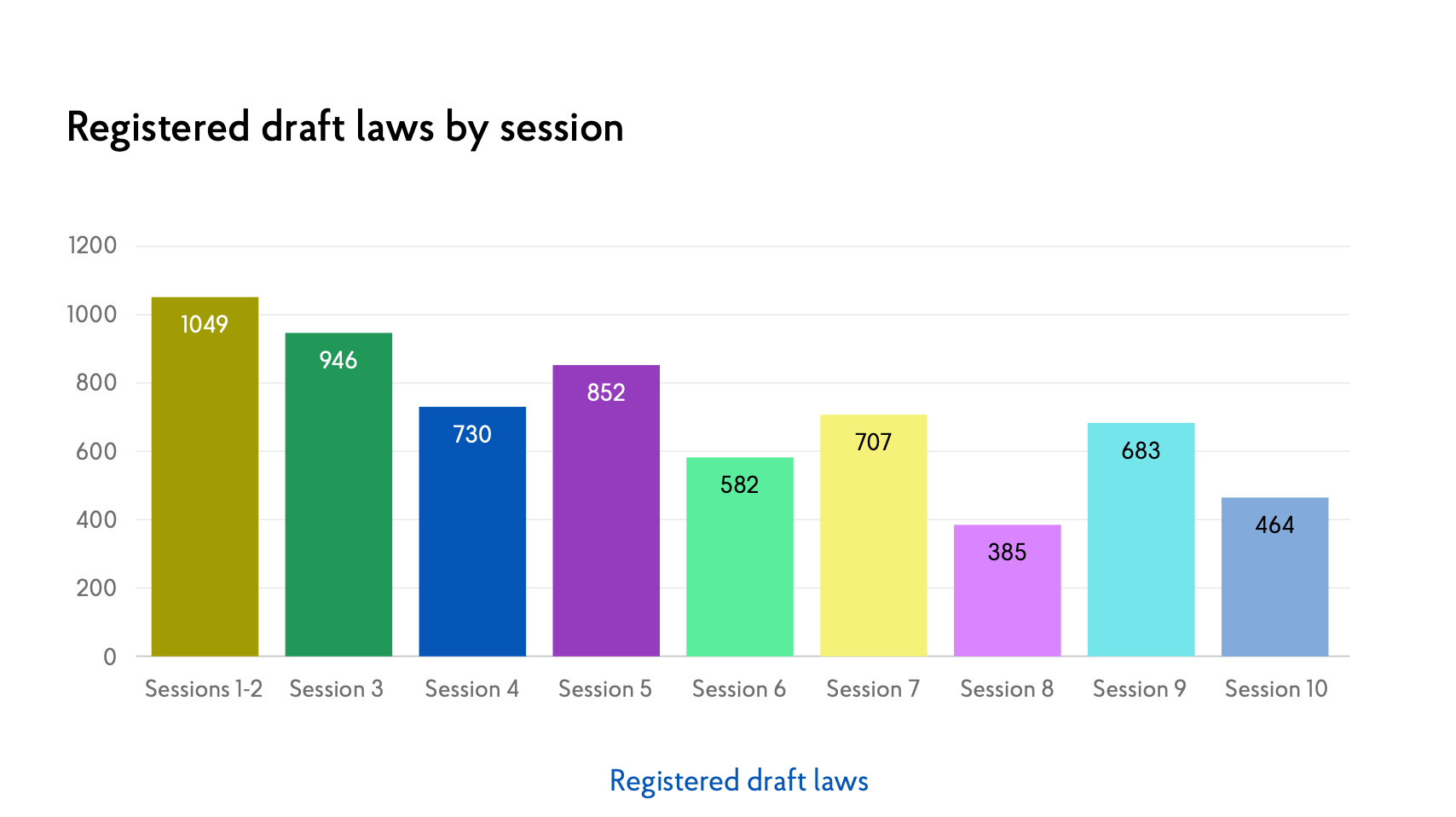
During the 10th session, the agenda of the parliament underwent a complete change. 97% of all draft laws passed during the session were registered already after the start of the full-scale invasion.
The new agenda currently focuses on finance, security and order, and welfare issues.
The busiest committees of the parliament during the 10th session were the Finance Committee, the Legal Policy Committee, the Organisation of State Power Committee, the Law Enforcement Committee, the National Security Committee and the Social Policy Committee.
In the same period, the president formally distanced himself from domestic policy issues. Even against the background of a small total number of adopted laws, the share of the President as their originator is low. During the 10th session, the number of adopted presidential draft laws was the lowest for the entire studied period of the 9th convocation: just one “regular” law was adopted, with other six concerning ratifications of treaties and decrees.
The only law going against this trend was adopted in the second reading and in its entirety. This draft law was adopted in the first reading back in the summer of 2021, and it “sat on the shelf” waiting for the second reading throughout that time.
During all the sessions held during the martial law period, the president remained detached from domestic policy issues and concentrated on international politics and defence.
An equally prominent feature of the 10th session is the Cabinet of Ministers of Ukraine strengthening its positions in the legislative process. The Cabinet of Ministers increased its share of registered draft laws to 17.2% and showed the second-highest share of registered governmental draft laws for all sessions of the 9th convocation.
For the third session in a row, the Cabinet of Ministers had more success promoting its draft lawsThis applies to the second reading in the Verkhovna Rada than Ukrainian MPs.
The monitoring study of the 10th session also picked up signs of a resurgence in legislative spamming.
There are three main signs of it:
- an overall increase in the number of registered draft laws;
- an abnormally high number of draft laws registered by one of the parliamentary groups;
- an increase in the share of draft laws with a small number of sponsors.
The 10th session demonstrated an increase in the number of registered draft laws compared to the previous similar session8th session, September 2022 – February 2023.
This, in turn, is one of the signs of legislative spam – the registration of many poorly developed draft laws that have no real prospect of being adopted. This unbalances the agenda and increases pressure on the expert and analytical units of the Verkhovna Rada Secretariat.
Among parliamentary groups in this session, one may single out the indicators of the Restoration of Ukraine, which, despite having few MPs, registered 86 draft laws, surpassing most factions and groups and even the Cabinet of Ministers of Ukraine. This group improves its performance for the third session in a row.
This session also continued a trend set by the previous ones, as the share of draft laws with one, two or three signatories increased. Also, for the second session in a row, draft laws with one signatory outnumbered all other draft laws. These trends are indirect evidence of the increased legislative spamming.
The number of violations of the constitutional procedure kept growing during the 10th session as well. During this session, the deadline for signing (or submitting proposals) was missed for 34% of the adopted laws22 of the total 64 drafts passed. In addition, five more laws were neither signed by the President nor vetoed or returned with proposals for improvement.
In total, violations were recorded for 42% of the approved draft laws, that is, four out of ten laws were passed with violations of the constitutional procedure.
Meanwhile, the volume of “usual” violations of the VRU Rules of Procedure neither increased nor decreased. The situation resembles that of the last session when violations were committed during the consideration of 54% of laws.
A positive development is that the practice of adopting draft laws “on the fly”, when draft laws are adopted in the first reading and in their entirety on the day of their registration, was not used during the 10th session.
Overall, our monitoring of the 10th session of the parliament’s 9th convocation recorded several signs of crisis processes unfolding in the VRU. Only 64 laws were adopted during the 10th session.
This is the fewest number of laws adopted in a session during the entire 9th convocation, half the number compared to the previous similar autumn session and much lower than the previous “anti-record” of 111 laws passed during the 6th session, the last one before the full-scale invasion.
At the same time, the number of passed laws is at its lowest despite the increase in the registration of draft laws and legislative spamming. Another sign of the crisis is the lowest-ever rate of draft law registration by MPs from the Servant of the People faction.
The president’s distancing from domestic policy issues is quite understandable against the background of a full-scale invasion when the head of state deals primarily with international politics and defence issues. On the one hand, it is possible that the president “surrendered” the domestic policy issues to the discretion of the government and parliament.
At the same time, this may indicate that the Cabinet of Ministers and MPs act according to the president’s political vision, making only decisions that suit him because the president has a decisive influence on domestic political processes. That is why the President does not even need to exercise the formal right to submit legislative initiatives. This allows the President to avoid being formally involved in unpopular legislative initiatives in the field of domestic policy.
More details on the Ukrainian parliament’s activity under conditions of the full-scale invasion are available in the ALI analysts’ monitoring report.
Monitoring Report for the Activity of the 9th Session of the 9th Verkhovna Rada
The Verkhovna Rada continues to work under conditions that emerged after the start of the full-scale Russian invasion, which put the very existence of the state and the state administration system in particular at risk. But despite all the challenges faced by the parliament, we are seeing stabilisation of legislative processes, which allows MPs to respond to the demands of the times.
Overall, our monitoring of the 5th session of the 9th convocation of the Ukrainian Parliament detected five key trends:
- agenda being updated,
- the President of Ukraine distancing himself from domestic policies,
- stronger role of the Cabinet of Ministers in the legislative process,
- legislative spamming revival,
- and an increase in the number of violations of the constitutional procedure.
Six hundred eighty-three draft laws were registered during the 9th session.
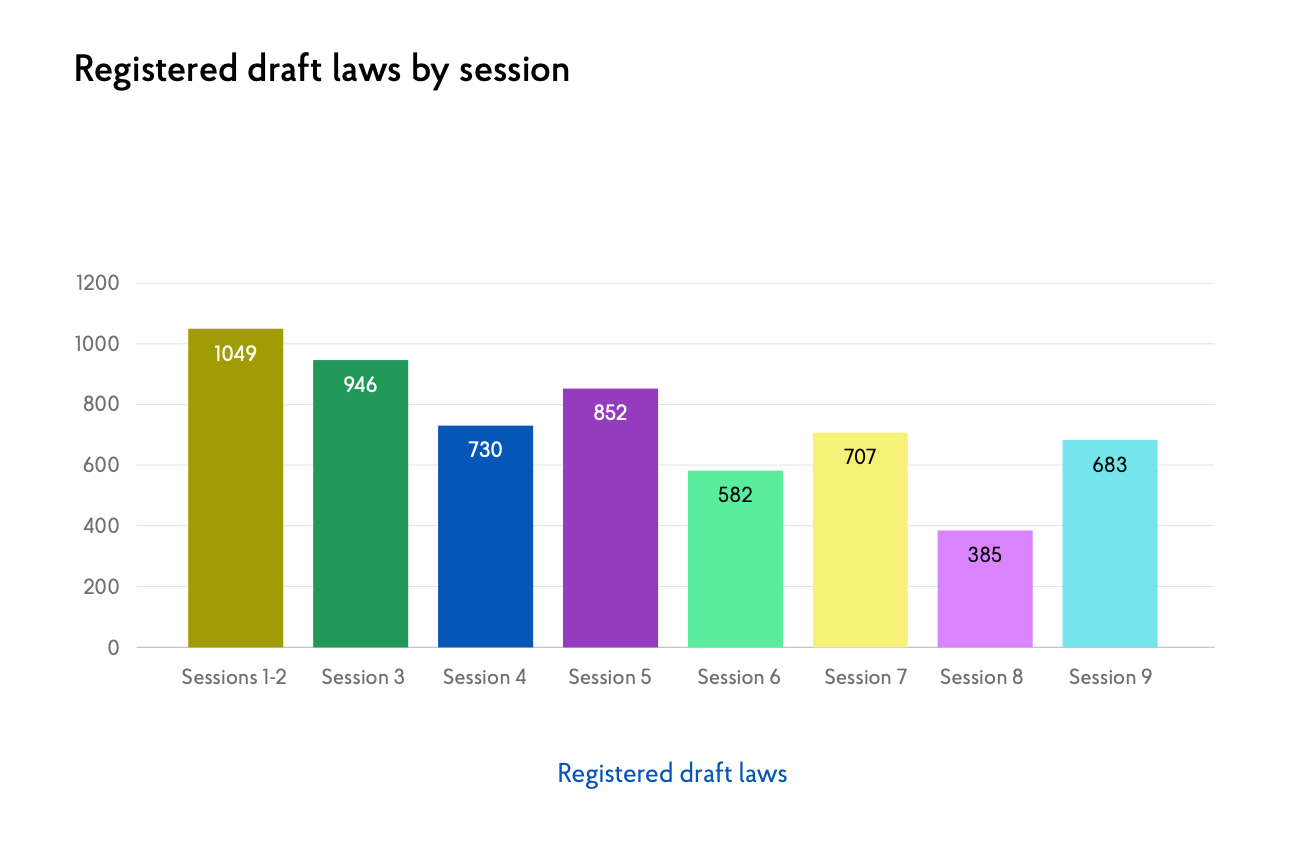
The new agenda can be determined by looking at which parliamentary committees were the busiest. There are five of them: the Law Enforcement Committee, the Finance Committee, the Legal Policy Committee, the Social Policy Committee, and the National Security Committee.
That is, after the initial financial and economic adaptation to martial law and full-scale war conditions, lawmakers focused on adapting the legal system, as well as on establishing new and amending old sanctions for violations of the law. This situation clearly demonstrates which domestic policy instruments MPs favour most: they regulate the level of punishment for unlawful behaviour by amending the Criminal Code and the Code on Administrative Offences.
During the 9th session, it became clear that the president formally distanced himself from influencing domestic policies, as the parliament did not adopt a single ”ordinary” presidential draft law. All laws initiated by the president involved ratifications, approval of decrees, or changes in the calendar of important dates.
The president’s focus on defence and foreign policy is increasingly typical for the martial law period.
During this session, the Cabinet of Ministers of Ukraine strengthened its positions in the legislative process. For instance, the Cabinet of Ministers registered 114 draft laws16.7% of the total, one of the highest numbers for the entire 9th convocation. The share of laws initiated by the Cabinet among adopted laws is the highest ever at 37.1% of the total.
Government draft laws also moved from registration to adoption in the first reading and in their entirety rather quickly: on average, it took 71 days. This is the fastest passage of government-sponsored draft laws in the period encompassing the 4th to 9th sessions. Furthermore, the speed of passage from registration to adoption in the second reading and in their entirety for government-sponsored draft laws was the best in the period encompassing the 6th to 9th sessions.
Overall, these processes align with the idea of a cabinet-centric model of decision-making.
Legislative spamming seems to have revived during the 9th session.
Even against this background, the activity of the Restoration of Ukraine MP group is particularly noticeable, as they were twice as active asThe figure is 5.18 drafts per MP. On average, 1 MP initiates between 1 and 1.44 drafts. For MPs who are members of parliamentary groups, this figure is less than 0.5 drafts per MP. This situation is quite standard any other faction or group during the previous sessions. This number of draft laws per MP is another sign of legislative spam.
Another indirect feature is the increase in the number of draft laws with one, two, or three signatories. For the first time since the 4th session, the share of draft laws with only one signatory is higher than all other draft laws combined.
Also, in contrast to the previous session, we again saw the ultra-speedy adoption of draft laws, both in the first reading and in their entirety on the day of their registration.
During the 9th session of the 9th Rada, a record number of violations of the constitutional legislative procedure were committed.
For instance, almost a third of the adopted draft laws (that is, 61 of themThis is 31% of cases) were not signed by the president on time. Another eight draft laws were neither signed by the president nor vetoed with appropriate proposals, and one was not even signed by the Chair of the Verkhovna Rada. Combining all the aforementioned violations, 36% of all laws adopted during the 9th session were signed in violation of the Constitution. That is, it concerns every third law.
The Rules of Procedure were violated for 56% of all laws adopted during the 9th session.
Overall, the ninth session of the current parliament’s convocation can best be characterised as “adaptive”. In the third half-year of the full-scale war, the Verkhovna Rada finally started working steadily. The number of adopted laws, which is among the highest in this convocation, shows that the parliament is trying to respond to the changing circumstances associated with martial law and the increasingly active process of Ukraine’s European integration.
The government’s role also increased, as the speed of adoption of the government-sponsored draft was the best over the last sessions, and their share among the adopted laws hit a record.
More details on the Ukrainian parliament’s wartime activity are available in the ALI analysts’ monitoring report.