Material by the Agency for Legislative Initiatives for Ukrainska Pravda
Lawyers have a long-standing joke: ‘Crime is organised, but you are not.’ Events of the past few days have added an entirely unfunny reality to that joke — one of ‘systematised corruption’ that the Office of the President apparently wants, at the very least, to ‘control’ and, better still, to ‘lead’.
These were the messages Ukrainians heard on the morning of 19 August in the latest recordings concerning high-level corruption. The National Anti-Corruption Bureau of Ukraine (NABU) and the Specialised Anti-Corruption Prosecutor’s Office (SAPO) then launched a special operation ‘to expose a criminal organisation led by current and former Members of Parliament, involving high-ranking officials from the Office of the President of Ukraine and other individuals’.
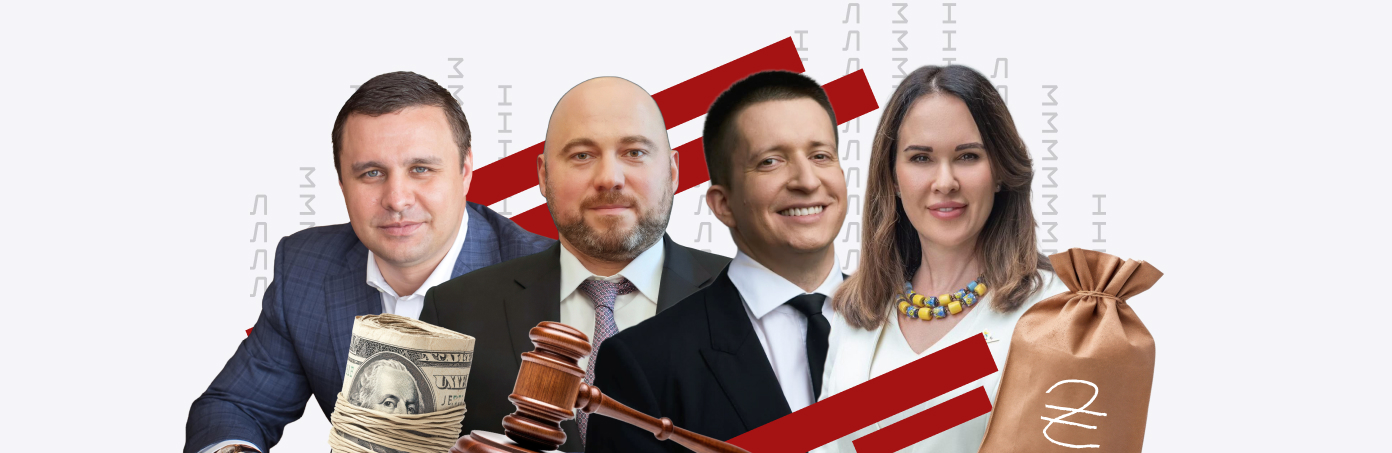
Over the following two days, videos appeared containing transcripts of recorded conversations involving members of the criminal organisation. Among those named by SAPO prosecutors were Maksym Mykytas, a former MP and businessman who headed Ukrbud and is now involved in a number of high-profile criminal proceedings; Vadym Stolar, a current MP from the banned Opposition Platform – For Life (OPFL) and a businessman with long-standing interests in Kyiv real estate and property development; Iryna Mudra, Deputy Head of the Office of the President of Ukraine from March 2024 to August 2026, who had previously served as Deputy Minister of Justice of Ukraine; Viktor Dubovyk, Director General of the Directorate for Legal Policy at the Office of the President, who until 2024 headed the Anti-Raiding Office of the Ministry of Justice of Ukraine; several officials of Sense Bank JSC, as well as a number of less well-known individuals holding less senior positions. The names of several Ministry of Justice officials were also mentioned.
The published recordings point to the alleged influence of members of the criminal organisation over the Ministry of Justice, the courts and Sense Bank, as well as schemes involving money laundering and corporate raiding against companies owned by third parties, including the use of forged documents. It has all the flavour of the 1990s, except that this is 2026. Hackers have therefore been added to the list as well.
Mykytas, Mudra, Valentyn Yelizarov — Mykytas’s right-hand man — and Dubovyk have already been remanded in custody, with alternative bail set at UAH 30 million, UAH 20 million, UAH 20 million and UAH 7 million respectively.
The High Anti-Corruption Court (HACC) will give a legal assessment of the published recordings in accordance with the applicable procedural rules. Given, however, that Iryna Mudra and Viktor Dubovyk had been responsible for judicial reform at the Office of the President since March 2024, we will examine where these figures have taken Ukraine over the past two and a half years. More importantly, what should happen next?
Smirnov’s Legacy
In March 2024, after President Volodymyr Zelenskyy dismissed Andrii Smirnov, who had served as Deputy Head of the Office of the President, Iryna Mudra was appointed to the position. Almost immediately afterwards, NABU and SAPO notified Smirnov of suspicion of illicit enrichment. The criminal proceedings against him were later expanded to include allegations of laundering illegally acquired funds and offering a bribe.
Mudra was notified of suspicion before being dismissed from office, placing the Presidential Office in a very delicate position. Both deputy heads, who were supposed to uphold the rule of law, are now experiencing the criminal justice system first-hand. They also have the opportunity to greet one another on the steps of the HACC, just as two other well-known defendants, Vsevolod Kniaziev and Pavlo Vovk, recently did.
Yet in March 2024 it was difficult to imagine anyone less connected to the judiciary than Mudra taking up the position of Deputy Head of the Presidential Office responsible for this area. After Smirnov, who had not dealt with judicial reform at all, the position required someone with genuine expertise. That was precisely why Mudra’s appointment created tension.
At the same time, her lack of knowledge and connections in this sphere also gave some hope that there would be no networks of control over the judiciary of the kind that Vovk, Smirnov, Kniaziev and, to some extent, Oleh Tatarov had already tried to build at national level. At regional level, almost every president of an appellate court has a similar network of their own.
So when, in one of her first public appearances, Mudra said that she sorted judges into ‘baskets’ — those vetted by the new compositions of the High Council of Justice (HCJ) and the High Qualification Commission of Judges of Ukraine (HQCJ), and those inherited from the old compositions of those bodies — the judicial system erupted. This was an obvious breach of safeguards for judicial independence and undisguised interference by a political body in the judicial appointment procedure, and it reinforced the behind-the-scenes view that Mudra was an accidental choice for the position.
The same applied to Viktor Dubovyk. Yet it was precisely the two of them who were expected to develop a new reform strategy for the judiciary, since the strategy for the previous period had failed on every count.
The President’s Powers over the Judiciary
A brief digression is warranted here to recall once again that, following the 2016 constitutional amendments on justice, the President was left with almost no powers over the judiciary. The President retains a ceremonial role in appointing judges and swearing them in. The Venice Commission has repeatedly stressed that this role should indeed remain ceremonial, without sorting judges into ‘baskets’ or otherwise interfering with the powers of the HCJ.
The President also has the power to appoint two HCJ members and, following consultations with the HCJ, to submit draft laws to Parliament on the establishment, reorganisation and liquidation of courts. During Zelenskyy’s presidency, we have already seen examples of this: the liquidation of the notorious District Administrative Court of Kyiv (DACK) and the establishment of other courts in its place — one to consider administrative cases involving Kyiv residents and two more to hear high-profile cases concerning central executive authorities. The HQCJ is currently selecting new judges for all of them.
Historically, however, the Office of the President has retained a tradition, dating back to previous Presidents, of defining the strategy for judicial reform. While that may once have been justified by the President’s formerly broad powers, after the 2016 constitutional reform — which was assessed quite positively by the Council of Europe in its 2019 report — such strategies should arguably be developed by the HCJ, following consultations with the Supreme Court (SC). The HCJ is, after all, the constitutional body of judicial governance, modelled on the higher judicial councils that exist in most countries whose reform experience may also be useful for Ukraine.
Perhaps this is why, when Mudra and Dubovyk began working on yet another version of the Strategy for the Development of the Justice System and Constitutional Court Proceedings, the process repeatedly reached a dead end. Initially, this was because the first version of the document was weak and, in many respects, misguided and harmful, forcing the Presidential Office, both officially and behind the scenes, to turn to the judiciary itself for help in developing well-founded proposals for the necessary changes. Later, even a relatively sensible document remained on the President’s desk for a year and a half without any explanation of what exactly Volodymyr Zelenskyy found unacceptable in it.
After yet another failure to secure the President’s signature on the relevant decree, Mudra publicly stated that the Strategy’s non-approval did not prevent its implementation. Yet even the draft submitted to the President has not been made public. It is rather difficult to implement something that does not formally exist. There must be approved indicators, deadlines, responsible actors and all the other elements that distinguish reform from PR about reform. But defining those indicators, and above all being able to monitor implementation, requires real powers — either through a legislative framework or through a power vertical. As we have already established, following the 2016 reform the President, and therefore the Presidential Office, has almost none. That leaves only one option: building a power vertical.
Mudra, Dubovyk and the Power Vertical
In light of recent events, it is becoming clearer what the Presidential Office’s ‘reformers’ were actually doing. First, there were attempts to place their own people in key public positions. But with the Presidential Office having long since run out of a reserve bench, Viktor Dubovyk personally entered most competitions for top positions. Owing to the principled stance of representatives of international partners — with three such representatives currently sitting on each of the relevant selection commissions — he failed to secure any of them.
Second, Mudra and Dubovyk appear to have tried to use their positions to influence individual court decisions. Serhii Stasiuk, a judge of the Commercial Court of Kyiv, whose name was mentioned during the hearing on the preventive measure for Maksym Mykytas, proved to be far from the last judge to be named.
During the hearing on the preventive measure for Valentyn Yelizarov, the names of judges Pavlo Horbasenko of the Northern Commercial Court of Appeal, Roman Boiko of the Commercial Court of Kyiv, Serhii Narizhnyi of the Commercial Court of Kyiv Region, Anatolii Ivchenko of the Commercial Court of Kyiv and Olena Kuzmyshyna of the Sixth Administrative Court of Appeal were also mentioned.
Admittedly, while Stasiuk, Boiko, Ivchenko, Narizhnyi and Horbasenko were mentioned in the context of decisions in specific cases, Kuzmyshyna simply ‘didn’t get a scarf’, even though she had invited Mudra to her birthday celebration, where ‘all the court presidents’ were supposed to be present.
During the hearing on the preventive measure for Iryna Mudra, conversations between Mudra and Mykytas were read out in which she said: ‘I got him the ruling’ and ‘the appeal was fully upheld; we changed the bankruptcy practice’.
We are likely to learn the names of at least some judges of the Pecherskyi District Court of Kyiv as well, most of whom have been obstructing the qualification assessment of their suitability for office. Attempts by the current HQCJ to conduct that assessment ended with searches by the State Bureau of Investigation (SBI) and pressure on the HQCJ from the Temporary Investigative Commission associated with Serhii Vlasenko and Maksym Buzhanskyi.
Some courts were also searched, but it is for NABU and SAPO to decide whether and when to make that information public.
Third, our own sources have told us about informal contacts between Mudra and certain representatives of the HCJ and HQCJ. If those discussions concerned the reform Strategy or deadlines for the judiciary to fulfil particular international commitments, there is no problem. But if Mudra or Dubovyk mentioned specific names or expressed wishes during those meetings — for example, regarding the appointment of particular individuals to specific judicial positions — then there is a serious problem. That would amount to unlawful influence on decisions of judicial governance bodies, which those bodies should have reported.
Fourth, in one of the recorded conversations, a voice resembling Mudra’s can be heard saying that corruption should not be fought but rather ‘systematised and controlled’. Coming from a person whose responsibilities included building a rule-of-law system in Ukraine, this sounds like a verdict not only on her, but on the very existence of a dedicated Deputy Head of the Presidential Office responsible for the judiciary.
Yet this is not only about particular words. There are also concrete actions that are easy to see if one looks closely: President Zelenskyy’s decrees appointing judges. Most such decrees in recent years have been INDIVIDUAL. Under Poroshenko — and even Yanukovych — individual decrees existed but were more the exception than the rule. Under Zelenskyy, individual decrees have become the norm.
Naturally, no one in the Presidential Office was prepared to take such risks in competitions such as the one for the High Anti-Corruption Court. Judges vetted by international experts could quite easily have reported offers of personal contact with representatives of the Presidential Office. The President’s decrees appointing judges to the HACC and its Appeal Chamber are therefore collective decrees, even though HCJ submissions concerning those judges reached the Presidential Office at different times.
By contrast, the 13 presidential decrees appointing first-instance and appellate judges, signed on the same day as the decrees concerning HACC judges, were individual. More interesting still, not every appointment submission resulted in a decree. In some appellate courts, for example, decrees appointing one or two judges were not signed. What prevented all of them from being appointed? One might try to explain this by saying that it was impossible to process all the submissions at once. But there is a catch: the unsigned decrees concern judges whose appointment submissions were among the first to reach the Presidential Office.
For example, the HCJ considers candidates for a particular appellate court over the course of a month and sends appointment submissions to the Presidential Office as each candidate is considered. Yet, strangely, submissions concerning the last candidates are acted upon before those concerning the first. Administratively and technically, this is impossible, because documents are processed in the order in which they arrive. So, for a document to stop moving inside the Presidential Office, somebody has to halt it manually at some stage, according to the principle of who ‘made it through’ and who ‘didn’t’.
In one of the conversations recorded by NABU, Mykytas said that he knew how Andrii Portnov had ‘kept judges in line’: by issuing or withholding appointment decrees. He summed it up as follows: ‘Whoever got to her got released; whoever didn’t is still running.’
Other recorded conversations appear to confirm this as well. One example is a conversation between Mykytas and Mudra on 19 February.
Mudra: Why are you so hung up on Horbasenko? What, do you want to bribe him or something?
Mykytas: Yeah, yeah, there is. I’ll tell you later. Vasya and Vadym really pushed for it. Well, he did them a favour. They really asked. Fine.
Mudra: Could we make it so that he owes me, not Vasya and Vadym?
Mykytas: Sure. That’s basically how it is. He owes you too. Trust me. He owes you… He’s ready to come and bow to you, even get down on his knees. That’s why I asked you to invite him, so he could swear his loyalty to you again.
As the SAPO prosecutor explained, Judge Horbasenko intended to transfer to an appellate court, and Mudra was facilitating the transfer.
Mykytas: Well, Tuesday then. It’s fine, she’ll let him through… But he shouldn’t forget about her, you know.
Astion: Just think of him as her guy — and ours too. One signal and he’ll do exactly what he’s told…
Mykytas: Is he going to the Kyiv appeal court?
Astion: Well, he’s got a job to do there. He’s got people there who are on the same wavelength. He wants to build up the Barsuk–Khripun connection in a big way. That’s in our interests too. So, yeah, he’ll be coordinated.
In another conversation, Mykytas says: ‘She’s just letting them through as a batch, by Tuesday. She’s doing them as a batch. She says, “I can’t just let one person out of the whole batch.” She’s holding some of them back — around 30 people.’
On Tuesday, 24 February 2026, President Zelenskyy appointed 26 judges. Among them was Pavlo Horbasenko, appointed as a judge of the Northern Commercial Court of Appeal. Judging from the context, Mudra had been holding decrees concerning 30 judges and released 26 of them; four judges had ‘failed to make it through’ to her.
Another recorded conversation worth noting concerns Mudra’s predecessor, Andrii Smirnov, who also communicated with Horbasenko in relation to Mykytas’s cases.
Astion: Andriukha spoke to Horbasenko this morning.
Mykytas: You mean Smirnov?
Astion: Smirnov, yeah. He spoke to Horbasenko. I’ve got the first instance covered, and this judge or whoever… He went to Pasha Horbasenko and said, ‘Pasha, look, this one’s important. You need to put this guy in his place…’ And Horbasenko came down hard on Boiko, even though Boiko was actually trying to help me in that situation… And now, through Pasha, we’ve sorted out all your issues.
In other words, Smirnov, whose criminal case is being heard by the HACC, continues in his spare time between court hearings to ‘fix little problems for businessmen’ with judges.
What Should Be Done?
There is no simple choice between two pills: choose the red one and corruption continues; choose the blue one and it comes to an end. But there are some mechanisms from recent years that have actually proved effective.
First and foremost, despite all the complexity and difficulties involved in engaging international experts in competitions for key public positions, there is currently simply no alternative if Ukraine wants to select competent people of integrity.
The number of MPs notified of suspicion by NABU and SAPO is measured in dozens. The number of judges, advocates and prosecutors is measured in dozens. The number of senior managers in the executive branch is measured in dozens. The number of Presidential Office officials is now measured in dozens too. And some of them have also tried to place their own people in key public positions.
Allowing selection commissions to operate at this stage without international experts — or Ukrainian experts delegated by international partners — would allow corrupt power verticals to reproduce themselves and even extend their influence into newly created institutions.
International experts with a decisive vote should remain involved in key selection commissions at least until Ukraine joins the European Union.
It is also extremely important to regulate how far back candidate vetting should go. Younger candidates now taking part in competitions often find it very difficult to obtain documents confirming their parents’ property acquired or received in the 1990s, when the candidate was, at best, still at school and, at worst, not yet born. Moldova, for example, has limited judicial vetting to the previous 12 years and considers this sufficient. Ukraine could follow that example, or set a period of 15–18 years for candidates under 45 and 20–22 years for older candidates.
The second, equally important change is that the Office of the President should finally abolish the position of Deputy Head responsible for the judiciary and end attempts to influence judges or use them within its own power verticals.
The law provides that the President must appoint judges within 30 days of receiving an HCJ submission. In practice, this should mean that once a month a single decree is submitted to the President for signature, listing all judges whose appointment submissions reached the Presidential Office during the previous 30 days. Two competent lawyers are sufficient to prepare such a document.
The development and implementation of the Strategy for the Reform and Development of the Judiciary should be left to the HCJ and the SC. After all, under the Constitution they are the institutions with the relevant powers concerning both judicial independence and the unity of case law.
When the President addresses the development of a new network of local general courts, he can establish an ordinary working group to prepare proposals and turn them into a draft law. This is not something that has to be done every month, but perhaps once every 20 or 30 years. The need to liquidate or establish an individual additional court can readily be identified by the HCJ, which can then submit the relevant proposal to the President.
The President and the Head of his Office could then say calmly on international platforms: we do not put pressure on the courts; we simply appoint judges on time and swear them in once a quarter. That would be preferable to having to make excuses for deputy heads responsible for the judiciary who, for more than six years, have tried to use this position for their own unlawful interests. And, as Smirnov’s example shows, even dismissal from office did not end his corrupt links with judges.
This could start immediately by signing all the decrees that have been awaiting the President’s signature for anything from several weeks to several years. No sorting judges into ‘baskets’ of the loyal and disloyal, no calls to presidents of appellate courts asking which judges should be held back without a decree and no requests to resolve particular court cases.
Third, once the competitions for appellate courts and the most heavily burdened first-instance courts are completed, the HQCJ should focus on finishing the qualification assessment that has been dragging on since 2017. This is necessary so that first-instance judges who have successfully dodged assessment for almost ten years finally either pass it — or fail it — or leave the judicial system of their own accord. Most judges of the ‘Pechera’ may well resign of their own accord if they know that assessment really awaits them tomorrow, rather than another favour from their ‘friends’ in the form of, say, yet another ‘urgent’ search of the HQCJ.
Instead of Conclusions
It is perfectly natural for any political authority to want controllable courts and pliant judges. Every decision it makes may, at some stage, need the support of a court. That is where stories come from in which some judges are approached with requests and allowed to pocket ‘ten’, while others receive a scarf as a birthday present so that a loyal judge is available for the next steps.
The only possible ‘windows of opportunity’ for separating the political and judicial power verticals are situations such as the one we have today.
The first choice now lies with the courts: will presidents of appellate and cassation courts and members of the HQCJ and HCJ begin running to the new deputy heads and department heads appointed by Zelenskyy or the Head of the Presidential Office? The second choice lies with Zelenskyy himself: he has to decide whether the prospect of future elections is a more attractive carrot than another attempt to build corrupt links with the courts by appointing a new deputy, or through Tatarov, who still works in the Presidential Office. A story about corporate raiding by a criminal organisation that includes officials of the Office of the President is a story about losing an election, whenever that election eventually takes place. That is true regardless of whether the President knew what Mudra and Dubovyk were doing right under his nose. For a President, competence and integrity are equally important values.