Announcement: Expert Discussion of Study Results Concerning the Impact of Judicial Intervention
On 14 September 2023, ALI will hold a discussion of the existing ALI study “Impact of Judicial Intervention: Role of Judges of General Jurisdiction in Reforms in Ukraine” for an expert environment. The study was prepared as part of the project “Civil Society for Ukraine’s Post-War Recovery and EU-Readiness”, funded by the European Union.
The event will take place at 16:00 in the office of the Agency for Legislative Initiatives (Kyiv, 45 Vozdvyzhenska Street, office 404).
Context. Today, it is obvious that even such long-awaited and promising reforms as those that commenced following the Revolution of Dignity do not always work out as successful cases. There are many reasons for this. Judicial intervention is one of them. To achieve Ukraine’s aspirations of Eurointegration, however, Ukraine must fulfil its obligations regarding reforms and harmonising Ukrainian legislation with EU laws. And here, the sustainability of law adoption and reform commencement, rather than the mere fact of them, will be an important criterion. Therefore, quality reforms must be developed without legislative gaps and deficiencies.
The goal of the presentation is to discuss the study results and recommendations for legislators, including the phenomenon of judicial intervention, its impact on the reform progress and possible steps to improve future reforms and cooperate with different branches of power.
What?
Expert discussion of the study “Impact of Judicial Intervention: Role of Judges of General Jurisdiction in Reforms in Ukraine.”
Where?
Kyiv, Office of the Agency for Legislative Initiatives (Kyiv, 45 Vozdvyzhenska Street, office 404)
When?
14 September 2023, 16:00–18:00
Participants:
Alina Makhno, involved analyst of the Agency for Legislative Initiatives; Oleksii Tseliev, Candidate of Legal Sciences, Associate Professor, expert of the Rule of Law Research Centre of the National University Kyiv Mohyla Academy and representatives of the National University Kyiv Mohyla Academy; Volodymyr Chaban, Chief National Expert (Judiciary component) of the EU Project “Pravo-Justice” in Ukraine. Oleksandr Zaslavskyi, Director of the analytical sector of the Agency for Legislative Initiatives, will act as the event moderator.
We invite representatives of expert circles to participate in the event.
Event language: Ukrainian. Contact person: Mariia Hereles, Communications Director at the Agency for Legislative Initiatives, mg@parliament.org.ua.
At a Meeting with Pat Cox, the Agency Discussed the Continuation of Parliamentary Reform During the Full-Scale War
These days, the Agency for Legislative Initiatives has been participating in meetings with Pat Cox, former President of the European Parliament and Head of the Mission to promote the reform of the Verkhovna Rada of Ukraine. Discussions were devoted to further steps to continue parliamentary reform during the full-scale war.
The reform of the Ukrainian Parliament began in 2015 with the launch of the Assessment Mission of the European Parliament under the leadership of Pat Cox. The Mission has developed a Roadmap with specific recommendations on how to strengthen the Verkhovna Rada of Ukraine institutionally and solve the existing problems of Ukrainian parliamentarism – the lack of political dialogue, constant “legislative spam” from MPs and replacing the quality of legislative initiatives with quantity, the weakness of the Apparatus of the VRU and the lack of understanding the importance of this structure and parliamentary officials.
The Agency for Legislative Initiatives supports the parliamentary reform from the very beginning and monitors its implementation. As of mid-2021, we estimate that the reform of the parliament has been completed less than half. And although at the beginning of 2022 the priorities of both the Verkhovna Rada and the entire Ukrainian society have changed, we are convinced that the reform of the parliament must be continued.
The Verkhovna Rada of Ukraine is the centre of Ukrainian democracy. Even in the darkest times, we cannot allow the institutional capacity of the parliament to be forgotten and the democratic gains of the last 30 years to be jeopardized. Of course, parliamentary reform during the war cannot be so comprehensive, but there are concrete actions, the implementation of which will strengthen the Verkhovna Rada and, as a result, will help Ukraine to endure and retain the support of partners.
During the full-scale invasion, we propose to concentrate, first of all, on the following areas of reform:
Business continuity management and disaster recovery planning
Before the start of the full-scale invasion, the Ukrainian parliament was definitely not ready for the challenges of wartime. If the parliament could not, however chaotically, continue its work in February-March 2022, the capacity of the Ukrainian authorities in the eyes of partners and enemies would be in serious danger.
Therefore, the Verkhovna Rada of Ukraine should have an appropriate plan to ensure business continuity management and disaster recovery planning in case of crisis situations. The Ukrainian parliament should develop of such a plan, taking into account the existing experience of the VRU after February 24, 2022, as well as the experience of parliaments of other countries with similar plans.
New Digital Strategy
The fact that the VRU continued to perform its functions after the beginning of the full-scale invasion is largely due to the achievements of the VRU Apparatus, and in particular the Computerized Systems Department, which was, just one example, able to provide the remote and secured functions of various systems and subsystems very quickly. This is the result of the implementation of the previous digital strategy.
Now is the time to create a new, more up-to-date strategy that will take into account experience with the most modern technologies, including machine translation.
Parliamentary Сode of Сonduct
At the end of 2022, draft law No. 8327 was registered in the parliament, which introduces the Code of Conduct for MPs with clear principles, rules, and, most importantly, sanctions for their violation, as well as mechanisms for monitoring their compliance. The Agency for Legislative Initiatives was also involved in preparing this draft law.
The adoption of the Code of Conduct is an extremely important step both for the Verkhovna Rada as a sign of the independence and legitimacy of the institution, and for our partners and allies, because it is a direct recommendation of the Roadmap of Parliamentary Reform, OSCE/ODIHR, GRECO and the Council of Europe.
Development of parliamentary diplomacy
With the beginning of the full-scale invasion, every member of parliament had turned into an ambassador of the Ukrainian people. At the same time, there are several issues that require an adequate solution now, so that the general public diplomacy of Ukraine would become more coherent.
Improving the quality of legislation
The low level of expert-analytical support and, as a result, not very well written legislative initiatives, which then turn into conflicts in legislation or simply non-working laws, is a long-standing problem of the Ukrainian parliament.
Currently, MPs lack the practice of assessing the legislative impact of draft laws before their adoption, as well as understanding why this analysis is needed.
At the same time, improving the quality of laws produced by the parliament is a priority task now, both so that wartime legislative initiatives do not undermine the legitimacy of the Verkhovna Rada, and in order to create a quality framework for future legislative initiatives related to the restoration of post-war Ukraine.
We are grateful to the current convocation of the Verkhovna Rada for their willingness to continue parliamentary reform even during a full-scale war, and to Pat Cox and international partners, including National Democratic Institute in Ukraine, for supporting important changes and dialogue with civil society.
The Agency for Legislative Initiatives will always support the Ukrainian Parliament on this path.
Event “Toward Ukraine’s Membership in NATO: Strengthening Euro-Atlantic Security”
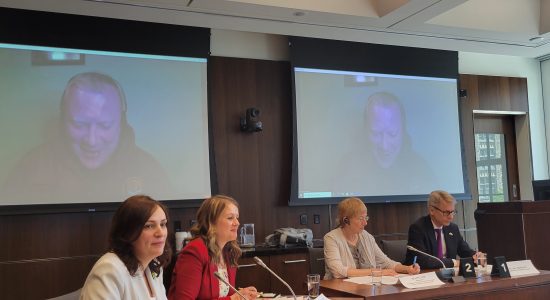
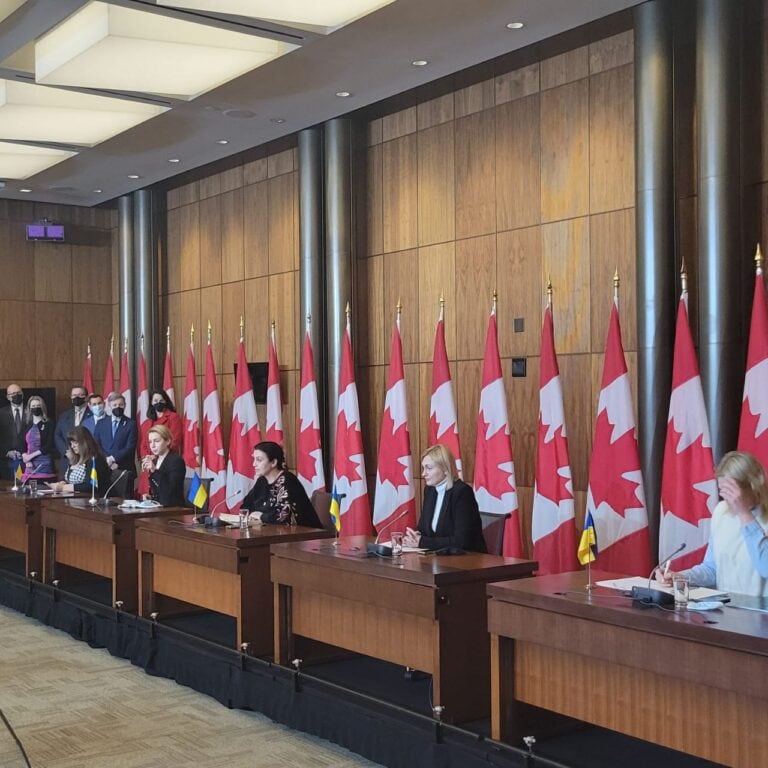
The Agency has always contributed to the Euro-Atlantic integration of Ukraine and makes a lot of efforts to develop parliamentary diplomacy. This week, together with the Embassy of Ukraine in Canada / Посольство України в Канаді and the Parliamentary Centre, we organized a panel discussion, “Toward Ukraine’s Membership in NATO: Strengthening Euro-Atlantic Security” at the Parliament of Canada.
The event’s main goal was to discuss the future of Ukraine, its security and the security of the entire Euro-Atlantic community. Considering Ukraine’s path to NATO – how fast we are progressing, what reforms are being implemented and which are just being planned, what kind of support, in terms of legislation, we need from allies and how Ukraine’s accession to NATO will strengthen the Alliance and Euro-Atlantic security in general.
The event was attended by Canadian parliamentarians, the deputy chairman of the VRU Committee on National Security, Defense and Intelligence, the Head of the Permanent Delegation of Ukraine to the NATO Parliamentary Assembly Yehor Chernev, Deputy Minister of Defense for European Integration Andriy Shevchenko and representatives of the diplomatic corps, including Ambassador Extraordinary and Plenipotentiary of Ukraine to Canada Her Excellency Yuliya Kovaliv and Ambassador Extraordinary and Plenipotentiary of Finland to Canada His Excellency Roy Eriksson.
The event was held as part of the project “Parliament and Accountability of the Security Sector in Ukraine” (PASS Ukraine), which the Agency implements jointly with the Parliamentary Centre (Canada), in cooperation with the Verkhovna Rada of Ukraine, and with the support of Global Affairs Canada within the framework of the Peace and Stabilization Operations Program (PSOPs).
Visit to Canada by Ukrainian MPs under the PASS Ukraine Project
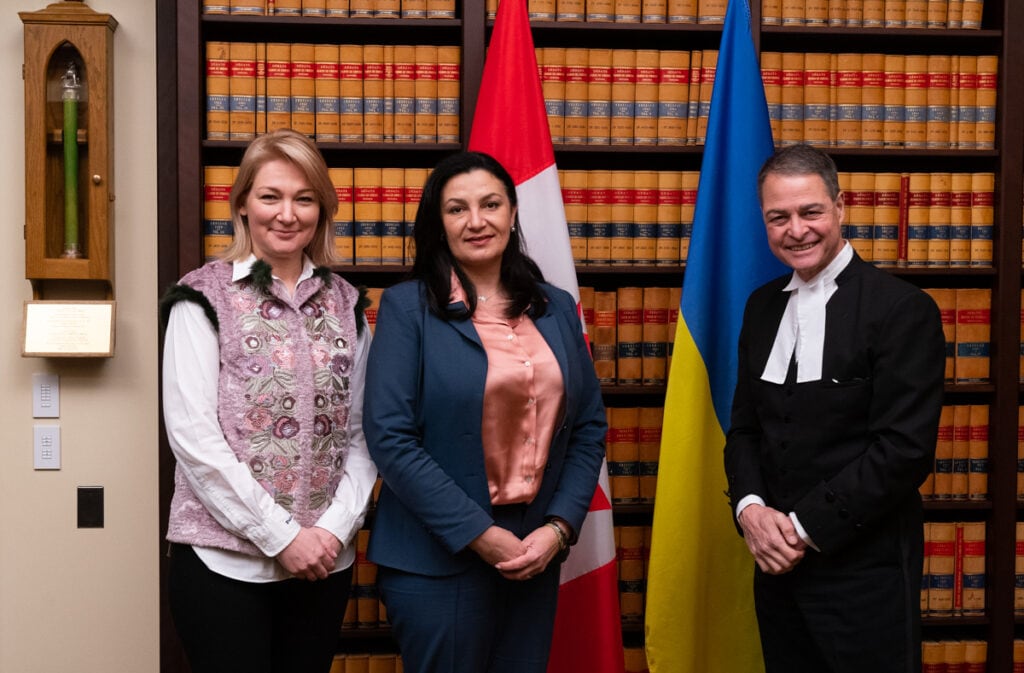
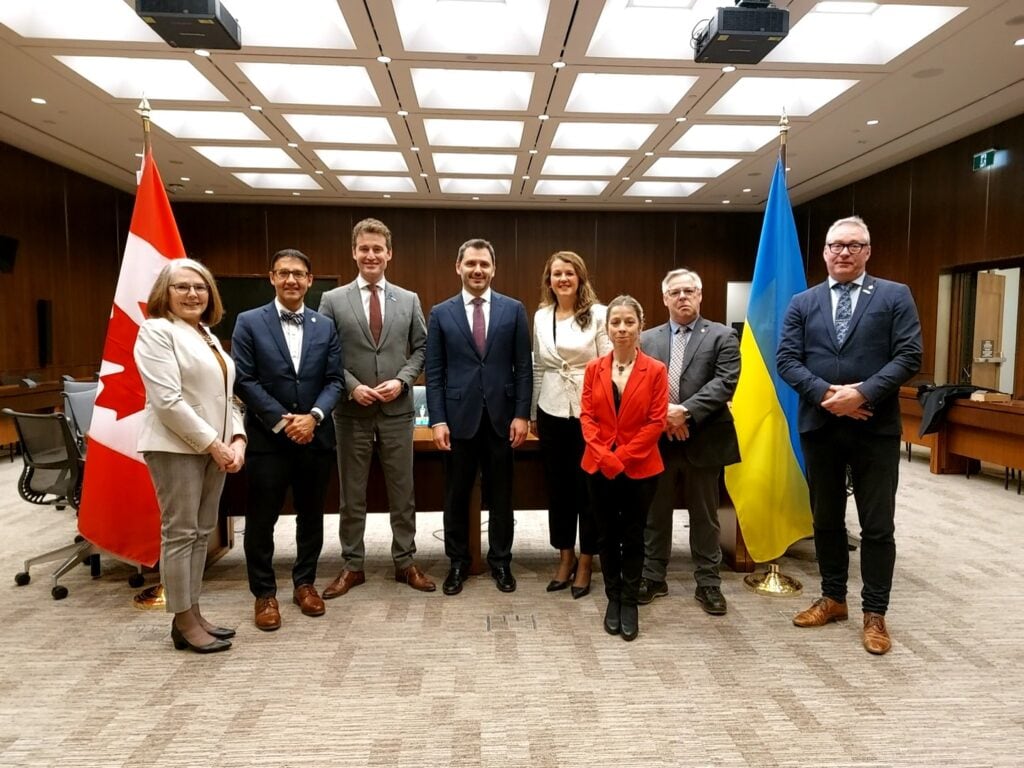
As part of the PASS Ukraine project, Ukrainian MPs Ivanna Klympush-Tsintsadze, Mariia Ionova and Yehor Cherniev visited Canada to strengthen ties with Canadian parliamentarians.
Canada is an important partner of Ukraine, whose role and support has grown significantly since the start of the full-scale invasion. Therefore, it is crucial to maintain a dialogue and share views on how exactly Canadian support to Ukraine can be kept and aligned with today’s needs. The cooperation of the Verkhovna Rada with the parliaments of other countries plays a particularly meaningful role in this area for the purpose of telling our partners the truth at the highest level, convincing them of the importance of supporting Ukraine and preventing the crimes that Russia commits against the Ukrainian people from being ignored.
“We managed to lay foundations for the strategic priorities that Canada is shaping up for the future regarding the continuation of assistance to Ukraine. Canada is now working on prioritising further aid, and not just short-term one, such as arms, continued financial support and aid in the energy sector. Therefore, we tried to convey to our colleagues that in the medium-term run it isprofound and important to continue to support the development of democratic processes and independent full-fledged institutions in Ukraine”
Ivanna Klympush-Tsintsadze
Ukrainian MP, Head of the Parliamentary Committee on Ukraine’s EU Integration
During the visit, Ivanna Klympush-Tsintsadze and Mariia Ionova already met with members of the Canada-Ukraine Parliamentary Friendship Group to tell about the development of the situation in Ukraine and specific steps being taken by the Parliament for non-military resistance to the Russian aggression. The parliamentarians also had the opportunity to talk with the Speaker of the Canadian House of Commons, the Honourable Anthony Roth, and the Canada’s Ambassador for Women, Peace and Security, Jacqueline O’Neill.
“We must end this war with victory as soon as possible. As a powerful member of the G7, Canada has a very loud voice in the world, and its position matters. We are convinced that Canada can help Ukraine get more military support. For example, with the military training of our brave new recruits of the Armed Forces of Ukraine, as well as with diplomatic lobbying in other countries, including in Germany regarding tanks, in the USA regarding F-16 jet fighters”
Mariia Ionova
Ukrainian MP, a member of the Committee on Foreign Policy and Inter-Parliamentary Cooperation
Russia’s aggression can be a threat to the whole world even after Ukraine’s victory in this war. That is why Ukraine is now looking for ways to strengthen the country’s defence capabilities and create conditions for stability and security when the war is in place and after it’s over.
One of these ways is Ukraine’s accession to NATO, which Ukrainian officials are talking about with the international community at all levels. Last week, as part of the PASS Ukraine project, Head of the Permanent Delegation of Ukraine to the NATO Parliamentary Assembly, Ukrainian MP Yehor Cherniev discussed the security and defence agenda with Canadian counterparts.
“The main obstacle on Ukraine’s path to NATO is the war, and this obstacle will disappear after our victory. So will the West’s fears about the response of Russia, which will be weakened and plunge into internal destabilisation and contradictions. An ideal window of opportunity will open, and our accelerated accession to NATO will be supported both by Canada and our neighbours, as well as by most of the Alliance member countries”
Yehor Cherniev
Head of the Permanent Delegation of Ukraine to the NATO Parliamentary Assembly, Ukrainian MP
Strengthening inter-parliamentary ties allows Ukraine to mould powerful lobbying groups in Western parliaments and to seek an increase in military, financial and humanitarian aid to us. For this, Ukrainian MPs and civil society are doing their utmost.
The Agency for Legislative Initiatives will have continued cooperation with Canadian partners to help with reforms and refine the dialogue between the Parliaments of Ukraine and Canada.
The Ukrainian MPs’ visit to Canada took place as part of the Parliamentary Accountability of the Security Sector in Ukraine (PASS Ukraine) project, a joint project of the Agency for Legislative Initiatives and the Parliamentary Centre (Canada), which is being implemented with the support of the Ministry of International Affairs of Canada and the Peace and Stabilization Operations Programme (PSOPs) in partnership with the Verkhovna Rada of Ukraine.
Ukrainian CSOs Call EU Member States to Grant Ukraine EU Candidate Status Promptly, as Recognition of Joint Reform Achievements
Ukrainian civil society organizations call on European Union member states to grant Ukraine EU candidate status in June, without any delays, conditionalities, and possible reformulations. This will be a decisive recognition of Ukraine’s continuous reform achievements endorsed by the EU, as well as a powerful gesture of support to the people of Ukraine, who are now defending freedom and democracy on the frontline. This is especially important, given that Ukraine’s accession to the EU is supported by 91% of Ukrainians and 66% of EU member state citizens.
Ukraine’s ambitious reforms agenda was started in 2014 after Ukrainians took to the streets under EU flags to protest the refusal of the former pro-Russian government to sign the Association Agreement with the EU. Since then, tens of thousands of Ukrainians gave their lives to defend Ukraine’s civilizational choice, first at the Maydan, then during the Russian war in Donbas, and now during the large-scale invasion.
Despite challenges, over eight years Ukraine managed to achieve significant progress in democracy building, serving as a testing ground for innovative solutions for deep-rooted problems such as corruption. The unique Ukrainian experience can be implemented in other countries seeking solutions to problems of justice and rule of law.
In particular, a big number of transparency tools have been introduced in Ukraine. They include the electronic income and asset declaration system for public officials and the electronic reporting about the assets and income of political parties. The public procurements system was transformed into an award-winning online auction system, ProZorro. Information of high interest to the public, such as state registries and beneficiaries of legal entities was open.
The entire anti-corruption infrastructure was built from scratch. This includes the National Anti-Corruption Bureau, the Specialized Anti-Corruption Prosecution, the High Anti-Corruption Court, the National Agency for Corruption Prevention, and the Asset Recovery and Management Agency. More than 800 cases of high-profile corruption are being investigated and 72 verdicts have been made by the court so far. The new agencies continue to operate and deliver results even during wartime. For example, since February 24, around $15,3 million (447,3 million UAH) were directed from bails and seized assets in the high-profile corruption cases to the needs of the Ukrainian Armed Forces.
Moreover, the long-overdue and promising judicial reform was launched and is currently ongoing. This reform foresees the renewal of top judicial decision-making authorities with engagement of independent international experts. Now we are in the final stage of this reform. These days, international experts jointly with Ukrainian judges interview the pre-selected candidates, focusing on their integrity and independence. Importantly, Moldova is now implementing judicial reform following the Ukrainian model.
Since 2014 when the EU-Ukraine Association Agreement was concluded, with overwhelming support from the EU, Ukraine has managed to achieve significant progress in the implementation of the framework and sectoral reforms, namely decentralization, public administration, energy, digital, customs, environmental, and public finance reforms.
Most of these reforms were drastically amplified through advocacy tools provided by the EU Visa Liberalization Plan, EU macro-financial assistance programs, the Association Agreement, IMF conditionalities, etc.
Moreover, the wider impact of Ukrainian reforms was recognized by Russian president Vladimir Putin. On February 21, just a few days before the full-scale attack by the Russian Federation against Ukraine, Putin explicitly named and criticized Ukrainian anti-corruption and rule of law reforms in his speech. With this statement, he confirmed that the successful democratization and our European and Euroatlantic choice are one of the key reasons why Russians aim to destroy our nation.
Ukraine has already earned candidate status by implementing the reforms since 2014. Recognizing that more efforts in continuing fundamental reforms are required, we emphasize that it is exactly the EU candidate status and subsequent accession negotiations process that will be the most effective framework for further reforms promotion, giving Ukrainian civil society real advocacy leverages.
We would also like to stress that the decision on Ukraine’s candidate status should be solely based on progress assessment within EU-Ukraine’s bilateral track and cannot be conditioned on the accession process of other countries.
For the sake of future reforms in Ukraine, as well as in support of our joint efforts to bring victory, peace, stability, and prosperity to the whole region, we urge the EU to officially recognize Ukraine as a candidate country as soon as possible.
Signatories:
International Center for Ukrainian Victory
Anti-corruption Action Center
Transparency International Ukraine
DEJURE Foundation
All-Ukranian Association “Automaidan”
Kharkiv Anticorruption Center
Center for Policy and Legal Reform
Bihus.Info
Anti-Corruption Headquarters
StateWatch
NAKO – the Independent Anti-Corruption Commission
ANTS Network
New Europe Center
Europe Without Barriers
International Renaissance Foundation
Ukrainian Center for European Policy
Institute of Social and Economic Transformation
Center for Civil Liberties
Centre for Global Studies Strategy XXI
Civil Network OPORA
ICO Environment – People – Law
Centre for Economic Strategy
Institute of legislative ideas
CHESNO Movement
Center for Social and Economic Research – CASE Ukraine
Election Council UA
DIXI GroupAssociation Energy Efficient Cities of Ukrainepro.mova
Center of Social Transformations
School for Policy Analysis NaUKMA
Agency for Legislative Initiatives
Ukrainian School of Political Studies
National Association of Cinematographers of Ukraine
Human Rights Center ZMINA
Save Dnipro / SaveEcoBot
Civil Control Platform
Parliamentary Dialogue with Ukrainian Legislators
Participants:
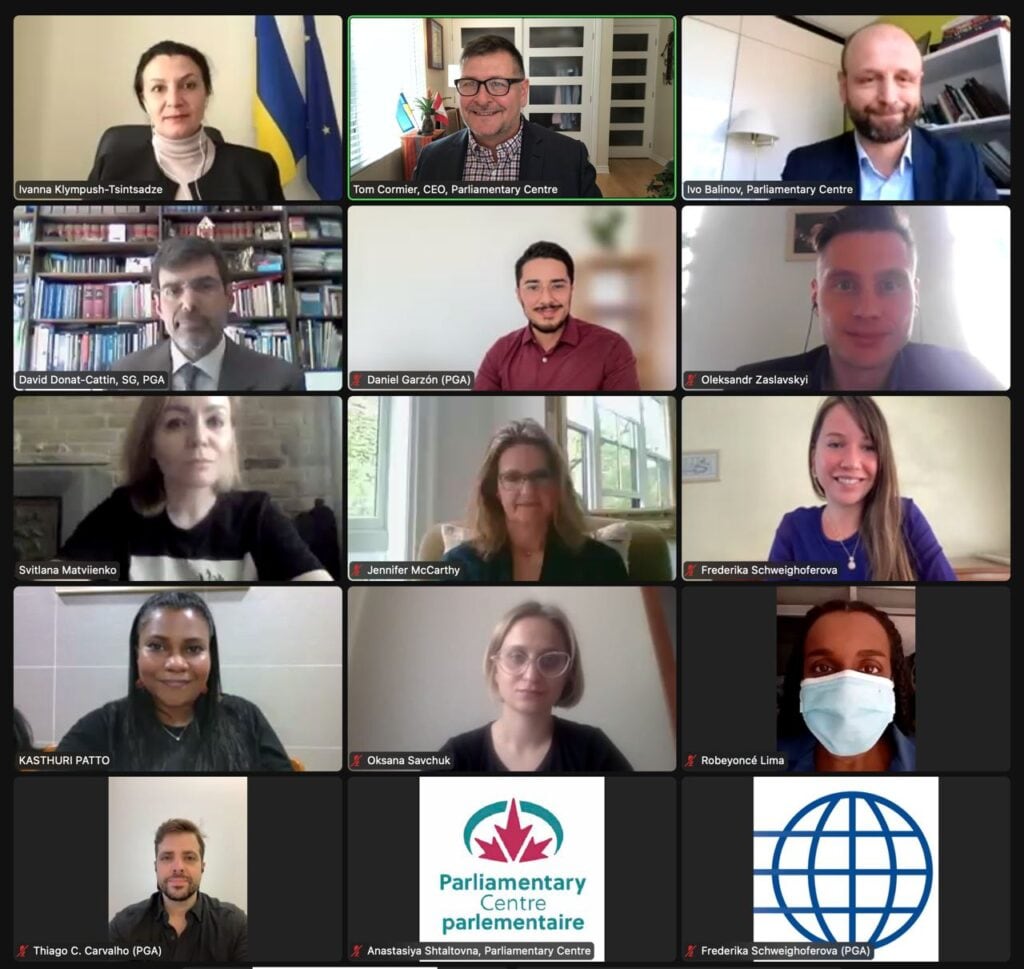
Dr. David Donat Cattin, Secretary-General, Parliamentarians for Global Action;
Mr. Ali Ehsassi, MP (Canada), Chair, All-Party Parliamentary Group for the Prevention of Genocide and other Crimes against Humanity; Chair of PGA Canada National Group and PGA Board Member;
Ms. Anita Vandenbeld, Member of Parliament of Canada, Parliamentary Secretary to the Minister of International Development;
Ms. Yevheniya Kravchuk, MP, PGA member, Deputy Head of the Servant of the People caucus in the Verkhovna Rada, Deputy Chair of the Rada’s Committee on Humanitarian and Information Policy;
Ms. Ivanna Klympush-Tsintzadze, MP, Chair of Rada’s Committee on Ukraine’s Integration into the European Union, Former Deputy Prime Minister for European and Euro-Atlantic Integration of Ukraine (2016 – 2019);
Ms. Maryna Bardina, PGA member, Deputy Chair of the Verkhovna Rada Committee on Foreign Policy and Interparliamentary Cooperation, Chair of the Subcommittee on Ukraine’s Compliance with International Commitments in the Field of Human Rights and Gender Policy;
Ms. Kasthuri Patto, MP (Malaysia), President of PGA.
The event was organized on May 12, the 78th day of the full-scale war waged by the Russian Federation against Ukraine. The purpose of the event was to convey information about the endless war crimes against the people of Ukraine, the current situation, and the position of the Agency for Legislative Initiative and Ukrainian parliamentarians to the world community firsthand.
Therefore, in the context of its activities and taking into account the constitutionally defined role of the Parliament (Verkhovna Rada of Ukraine) in matters of war and peace, territorial change, and ratification of international agreements, the Agency for Legislative Initiative in partnership with the Parliamentary Centre (Canada) within the project “Parliamentary Accountability of the Security Sector of Ukraine” (PASS Ukraine), which is implemented with the support of the Ministry of International Affairs of Canada (Global Affairs Canada), the Peace and Stability Program (PSOPs) together with the international network – Parliamentarians for “Global Action” (PGA) organized and involved Ukrainian, Canadian and other parliamentarians from member countries (PGA) to discuss developments, the work and role of Ukrainian parliamentarians, prospects for countering future threats, and the needs and options for international support during the war.
International Network – Parliamentarians for Global Action (PGA) – a platform that brings together parliamentarians from around the world, as well as many other platforms already in use, plays a role in shaping the only right, the only possible attitude to Russia as an aggressor country, a country that has no place in the modern world, and which must be disposed of to save not only what has already been achieved by world civilization, but also all living things.
Parliamentarians, who are increasingly at risk, now play a key role in bringing together allies and friends from around the world into a common united front: the pursuit of peace, justice, and accountability, and the defense of democracy, its principles, and institutions. To this end, the event was attended by Ukrainian parliamentarians, two of whom are members of the PGA – Yevheniya Kravchuk and Maryna Bardina together with Ivanna Klympush-Tsintsadze told their foreign colleagues about what difficulties they currently face in their work, what are the future plans and what is the key assistance is now needed, both in Ukraine as a whole and in Parliament in particular.
Ukrainian MPs stressed the need for further urgent military and financial assistance to Ukraine, as well as the imposition of additional sanctions against the Russian economy. They also touched on the humanitarian catastrophe unfolding in Ukraine, noting that destruction and casualties are unthinkable for those who observe peace and security from afar, and stressed that the Russian invasion harms, in particular, Ukrainian women, noting that sexual violence is one the of war crimes committed by Russian soldiers.
Svitlana Matviienko, Executive Director, Agency for Legislative Initiatives, informed and reminded all participants about what is happening at this time in our country:
For 78 days now, Ukrainians have been waging a full-scale war with Russia. It is not just 78 days of struggle, it is 78 days of horror, constant crimes, murder of civilians, children, deportation, rape, kidnapping, and torture. Today, CNN released another video of the killing of civilians. Russian soldiers shot two men in the back who shared cigarettes with them. Unfortunately, this is not the first video and probably not the last.
Although Ukraine needs weapons first and foremost, there are other important areas. This is a question of sanctions against Russia, this is a question of imposing a trade embargo against Russia, imposing an embargo on trade in energy, oil, and gas. Oil-producing countries must increase production, thus compensating for oil coming from Russia.
Spreading information and telling the world what is happening in Ukraine is extremely important, especially for countries that still lack an understanding of Russia’s role in the biggest war in 80 years.
To this end, Ukrainian parliamentarians can use the communication and organizational capabilities of the PGA network, which will allow direct contact with parliamentarians from countries whose international position is still unclear in terms of combating unjustified armed aggression by Russia. During this event, parliamentarians have already managed to talk to representatives of Malaysia and Brazil. And we are convinced that the results of our joint work should intensify the pro-Ukrainian discourse among the decision-makers of those countries that still do not have a clear position, which in turn will accelerate our victory in this war.
A Delegation of Ukrainian MPs Called on Canada to Support Ukraine
Five senior members of the Ukrainian Parliament wrapped up a two-day visit to Ottawa, including a series of high-level meetings with the Canadian government and parliamentary officials. In a continued appeal for support from Canada, their message was consistent: an appreciation for Canada’s support for Ukraine and an appeal to do more.
Headed by MP Lesia Zaburanna, MP from President Zelensky’s Servant of the People party and Chair of the Sub-Committee on Public Expenditures of the Budget Committee, the delegation held a private meeting with Prime Minister Justin Trudeau and Deputy Prime Minister Chrystia Freeland. Separate audiences were held with International Development Minister Harjit Sajjan; Canada’s Ambassador for Women, Peace, and Security, Jacqueline O’Neill; senators Boehm (chair) and Harder (vice-chair) of the Senate Standing Committee on Foreign Affairs and International Trade; and with the Canada-Ukraine Parliamentary Friendship Group MPs as a group – an interparliamentary all-party caucus.
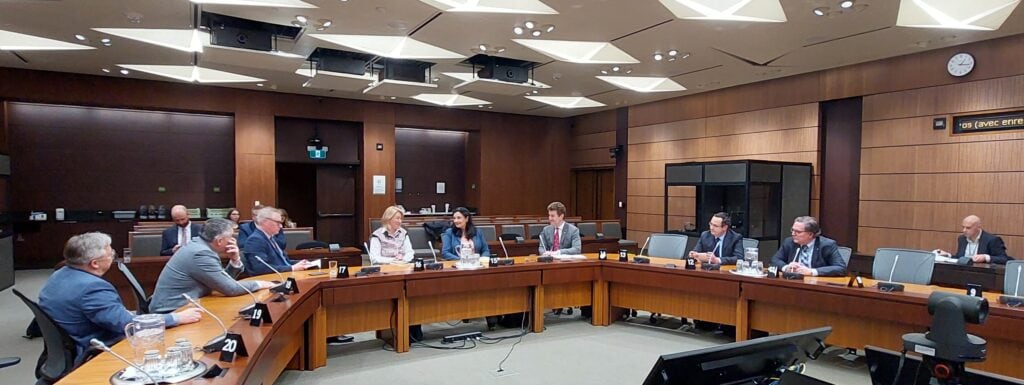
The delegation also attended a special meeting of the House of Commons Standing Committee on Foreign Affairs and International Development, providing a briefing on the wartime situation in Ukraine.
In addition to MP Zaburanna, the delegation consisted of MP Yevheniya Kravchuk, Deputy Head of the Servant of the People party, and Deputy Chair of the Committee on Humanitarian and Information Policy; MP Anastasia Radina, also with the Servant of the People, and Chair of the Committee on Anti-Corruption Policy; MPIvanna Klympush-Tsintsadze, from the European Solidarity party, Chair of the Committee on European Union Integration, and former deputy prime minister of Ukraine; and MP Maria Ionova, also from the European Solidarity, Chair of the Subcommittee on Legislative Support of the Implementation of the Strategic Course of the State for Full Membership in the EU and NATO, and member of the Parliamentary Committee on Foreign Policy and Interparliamentary Cooperation.
At a Friday press conference flanked by Canadian parliamentarians, the Ukrainian MPs stressed the humanitarian catastrophe unfolding in Ukraine, noting the destruction and human toll is inconceivable for a Canadian audience watching from afar in peace and security. The MPs stressed the need to urgently provide Ukraine with further military and financial assistance, and to introduce more sanctions against the Russian economy. The Ukrainian delegation explicitly asked for the expulsion of the Russian diplomats from Canada and from multilateral organizations where Canada is a member.
“Ukraine is very grateful to Canada for the support provided to date, however more aid is needed, and it’s needed fast. Our delegation’s visit to Ottawa is an opportunity to meet with Canadian officials face-to-face and encourage Canada to further support Ukraine with the necessary military equipment, financial aid and impose more severe sanctions against Russia.”
Lesia Zaburanna
The delegation called on stronger support for Ukraine, including more heavy military equipment support, tightened sanctions, and expedited processing of temporary displaced persons. They also called for Canadian vigilance in monitoring and reporting war crimes perpetrated by the Russian armed forces.
The all-woman MP panel stressed the toll the Russian invasion is having on Ukrainian women, in particular, noting that sexual violence is among the war crimes being perpetrated by Russian soldiers.
“They are killing our children, newborn children, raping our women; they are destroying and damaging our hospitals”
Mariia Ionova
“Russia tried to erase Ukraine from the map, but we have the courage and the will to resist this plan. The West must demonstrate courage and unity in the face of Russian aggression and take the necessary steps to do more to support Ukraine”
Ivanna Klympush-Tsintsadze
In addition to official meetings, the MPs fanned out across Canadian media to deliver a concerted message that Ukraine existentially needs additional help and that Canada needs to come forward with more support.
The Parliamentary Centre’s work in Ukraine is supported by PSOPs, Global Affairs Canada. We work in partnership with the Agency for Legislative Initiatives.
This publication was also prepared with the financial support of Sweden.
Briefing of the PASS Ukraine Project before the Historic Address of Volodymyr Zelensky to the Parliament of Canada
On March 15, President of Ukraine Volodymyr Zelenskyy addressed the Canadian Parliament to express his gratitude to Canada for the full support of Ukraine during the war waged by the russian federation against our country.
A special briefing was organized prior to the President of Ukraine’s address to the Canadian Parliament. Its goal was to exchange relevant information on how Ukraine and its democratic institutions continue to resist the military aggression of the russian federation. The briefing took place under the Parliamentary Accountability of the Security Sector in Ukraine (PASS Ukraine) project, jointly implemented by the Agency for Legislative Initiatives and the Parliamentary Centre (Canada). This project is possible with the support of the Peace and Stabilization Operations Program (PSOPs) of Global Affairs Canada | Affaires mondiales Canada.
Dr. Gabrielle Bardall, Vice-President for External Relations of the Parliamentary Centre (Canada), that the impact of Russian aggression on Ukraine is devastating, but that Ukrainians remain united and firm in the face of the enemy. She also mentioned that Canada will support Ukraine and its democratic institutions in all possible ways.
“This is a global confrontation between authoritarianism and democracy: between those who respect the fundamental principles of sovereignty and self-determination, and those who believe only in the power of weapons and destruction. The war in Ukraine is also our battle. Because Ukraine is fighting for the future of democracy, freedom and peace. Today, each of us here is deeply grateful for the courage and strength of Ukrainian men and women who today, at the risk of all, defend Ukraine”
Dr. Gabrielle Bardall
Vice-President for External Relations of the Parliamentary Centre (Canada)
In turn, Oleksandr Zaslavskyy, director of the analytical department of the Agency for Legislative Initiatives, said that despite the martial law and the constant threat to human life, all public authorities continue to work.
“Since the imposition of martial law in the country, the Verkhovna Rada has convened three times. The institution at the heart of Ukraine’s democracy must work. The Verkhovna Rada is a guarantee of legitimate Ukrainian authority. Stopping its work will lead to an unprecedented political crisis, division and disorganization. In case of termination of its work, the ability of the Ukrainian army and state to offer organized resistance will be questioned”
Oleksandr Zaslavskyy
director of the analytical department of the Agency for Legislative Initiatives
Tom Cormier, CEO of the Parliamentary Centre, also expressed his support for Ukraine and assured that the Parliamentary Centre remains a reliable partner for the Verkhovna Rada and civil society in Ukraine.
“Despite the unprovoked aggression of Russia, the Verkhovna Rada remains a strong pillar of statehood, showing the world the value of democracy and the resistance of the Ukrainian people. I share the view that democracy and Ukraine will prevail”
Tom Cormier
CEO of the Parliamentary Centre
After the briefing, while representing the President of Ukraine Volodymyr Zelenskyy, Justin Trudeau, the Prime Minister of Canada, said that Canada will always be a friend of Ukraine
“Freedom, justice, truth, human rights, and international order are the values you defend by risking your lives. You remind us that friends are always stronger together. Canada will continue to support Ukraine with military equipment, financial and humanitarian assistance. We will be there to help rebuild Ukraine once the aggressor is repelled.”
Justin Trudeau
Prime Minister of Canada
In his address to the Canadian Parliament, Ukrainian President Volodymyr Zelenskyy thanked Canada for its credible partnership and long-term support, but noted that more efforts are needed to establish peace in Ukraine, both from Ukrainians and the international community.
“Canada has always been, is and, I am sure, will be our reliable partner. You came to our aid as soon as we asked for it. Unfortunately, however, the war continues. We need to do more for peace. Do more to stop Russia, to protect Ukraine and Europe from the total evil that is destroying everything: memorials, churches, schools, hospitals, neighborhoods and all our businesses. We do not ask for much. We ask for justice. We ask for real support that will help us survive and save our lives”
Volodymyr Zelenskyy
Ukrainian President
State institutions of Ukraine and civil society organizations, including the Agency for Legislative Initiatives, continue to work almost around the clock, daily approaching Ukraine’s victory over the enemy. They are convinced, that Ukraine will withstand. Glory to Ukraine!
This publication was also prepared with the financial support of Sweden.
USPS Alumni Programme
USPS has launched the first training module of our new educational format of two-day thematic courses for alumni.
The Ukrainian school of political studies is, first of all, Community, networking, and unity of differences. We are constantly emphasizing this, but we felt that we could do much more for the Community.
That’s how the USPS Alumni Program came about, a format that brings together alumni of different years and answers their demands for quality education through programs designed specifically for the Community.
To introduce the alumni to the format and test it, we simultaneously launched a set of four courses: literature, philosophy, economics, and political theory.
The first to start was a course on literature from Yevhen Stasinevych, a literary critic, curator, lecturer at many educational sites, and author of the book “The Price of the Question”. During the training module, the group talked about modern literature and the origins of bestsellers.
What do Conan Doyle’s stories have to do with urban development? How do post-war anxieties shape the cult of The Lord of the Rings and Ayn Rand? Why do too serious societies see what was not meant to be in the “Catcher in the Rye”? And how did the challenges of the 21st century, new and complex, fund Joan Rowling’s triumph?
After such a successful start of the new program, we will undoubtedly continue to develop the training format for alumni.
And these two days were very cozy, sincere, and meaningful.
The Second Session of the XV-XVI Program of the USPS
On September 8-12, the Ukrainian School of Political Studies hold the Second Session of the XV-XVI program in Odesa!
The second session is about socio-cultural ties, ethics, aesthetics, and expanding worldview. The program of the Session is always built to encourage participants to further search and reflections. This is a special session in a special place, it brings the group even closer and inspires them to learn new things.
Global art market and its impact on society
Art is first and foremost a culture and experience, but it is also an exclusive that people dream of owning. Therefore, art has become a large industry with its own rules and institutions.
Oleksandr Shchelushchenko – art dealer, founder, and director of contemporary art galleries “Tsekh” in Kyiv and Vilnius, as well as 2010 USPS program Alumnus, opened the art market world for participants and told about the structure of institutions in this field, the role of artist and critic, as well as why in Ukraine this industry still does not work properly. On the example of the gallery “Tsekh”, which is almost the only successful non-governmental cultural institution of contemporary art in Ukraine, Oleksander showed that we have a demand for art, so it is necessary to develop and transform the industry.
Ukraine, Europe, the world: a global view
What is Ukraine’s place in global history? What unites us with the history of Europe and other parts of the world, and what makes us unique?
For a long time, Ukraine in the international arena had the image of empty space – the Great Border. But with what do we identify ourselves? How does the world perceive us today, and what place do we occupy in it? How possible is for Ukraine the balance between liberalism and patriotism, between universal values and identity discourse?
The group discussed this with Volodymyr Yermolenko, a philosopher, writer, journalist, senior lecturer at NaUKMA, director of analytics at Internews Ukraine, and a member of the board of the International Renaissance Foundation.
Culture, politics, and ideology: history and modernity
Calls not to politicize culture are heard everywhere, especially from people for whom supporting a particular position means losing money. However, is it possible to stay out of politics in the eighth year of the war?
Politics is the art of solving problems here and now. It is focused on the present. And culture is aimed at the future. The artist’s goal is to overcome time.
But can culture be outside politics? Can it be just politics? Where are the limits of the artist’s responsibility, and where is the attention of politicians to art needed?
Tetyana Ogarkova, a senior lecturer at the Department of Literary Studies at NaUKMA and a lecturer at the Second Session of the USPS, discussed various concepts of cultural perception in the context of politics with the participants.
Future and liberty
We live here and now. Neither the future nor the past really exists. The past is a memory, the future is an expectation. This is what Augustine of Hippo thought about time. So what determines our future? Is it due to factors independent of us, or are we creating it ourselves, making a free choice? Is there freedom of will that allows such a choice? If free will does not exist, then what determines our actions, and are we responsible for them?
Vakhtang Kebuladze, philosopher, essayist, translator, professor of theoretical and practical philosophy at the Taras Shevchenko National University in Kyiv, held interesting discussions with participants about the future, time, science, our dreams, and fears about human freedom.
Bend Sinister: nature, context, and temptation of political populism
Ivan Gomza, candidate of Political Science, lecturer, and head of the Department of Public Administration of the Kyiv School of Economics and permanent lecturer of the USPS, conducted training for participants, which helped to understand what is the theory of political cleavages, why populism can be called a “subtle ideology” or political strategy, and how the polarization of society inhibits the development of states.
Political populism is a common concept in Ukrainian and world politics that we hear almost every day about. However, a correct understanding of the nature of this phenomenon and the context in which its promises become particularly tempting is not part of the debates on populism.
To better understand this phenomenon, it is necessary to turn to history and trace how and when political parties were born, because they eventually became an environment for the prosperity of populism. Ivan Gomza told the group about all this.
How (not) to read books through political optics?
Regardless of the era, books have always been of particular importance in human consciousness. Not reading and talking about it is always a loss of reputation. However, like culture in general, literature is often politicized by authors or readers themselves, who seek hidden meanings. Therefore, it is crucial to understand how to notice the political side of the book and when the view of the book through the prism of politics is appropriate, justified, and necessary.
Yevheniy Stasinevych, a literary critic and member of the renewed Shevchenko Committee, told our participants how to read rather than search for the political side of books and the author’s intention.
Political forecasting
No system can remain the same all the time, so it is necessary to analyze the systems and cycles inherent in them in order to make decisions and build policies. To predict events in a given system, it is first necessary to understand the difference between politics and policy, investigate which correlations, relationships, and dominants were present in previous cycles, and which markers had the most significant power.
How to approach the forecasting in a particular system? And how to distinguish professional forecasting from the forecasts of “experts” that we hear everywhere? Mykhailo Koltsov, Ph.D., World Bank Analyst, and Head of the Yu-Control Training Department, helped our participants to understand such a complicated issue.
Ukraine: a breakthrough strategy
Pavlo Sheremeta, manager-economist, co-founder of the Schumpeter School of Innovation, and Minister of Economic Development and Trade (2014), is convinced that a breakthrough is impossible without innovations and business development.
However, in Ukraine, business still exists not because of but rather against the state – entrepreneurs have no guarantees that their business will be protected from raiding. The country is experiencing a demographic crisis and an outflow of capital, which also does not contribute to entrepreneurship development, especially innovative. And for development to happen, the state must provide two things – first, security, and secondly, to give freedom of business.
What else needs to happen for Ukraine to make a breakthrough? What is the Creative Destruction and Blue Ocean Strategy? Pavlo Sheremeta discussed these issues together with the participants at the final platform of the Second USPS Session.
The five days full of seminars in Odesa ended, but the participants left even more motivated to study. We are already waiting for the next USPS session in Lviv!
Thank you for subscribing
to our newsletter.
From now on, you will receive
up-to-date analytical pieces
and information on events from ALI.