
Ukraine’s Path to the EU: Coalition of NGOs Holds a Discussion on Key Findings from the Shadow Report on Chapter 23 “Justice and Fundamental Rights”
During the event, the heads of judicial and anti-corruption bodies shared their vision of the current state and next steps in Ukraine’s integration into the EU in terms of justice, fighting corruption and ensuring fundamental rights, and discussed it together with representatives of the civil sector and international partners.
Olha Stefanishyna, Deputy Prime Minister for European and Euro-Atlantic Integration of Ukraine – Minister of Justice of Ukraine, stressed that cooperation with civil society was the basis of reforms bringing Ukraine closer to EU membership.
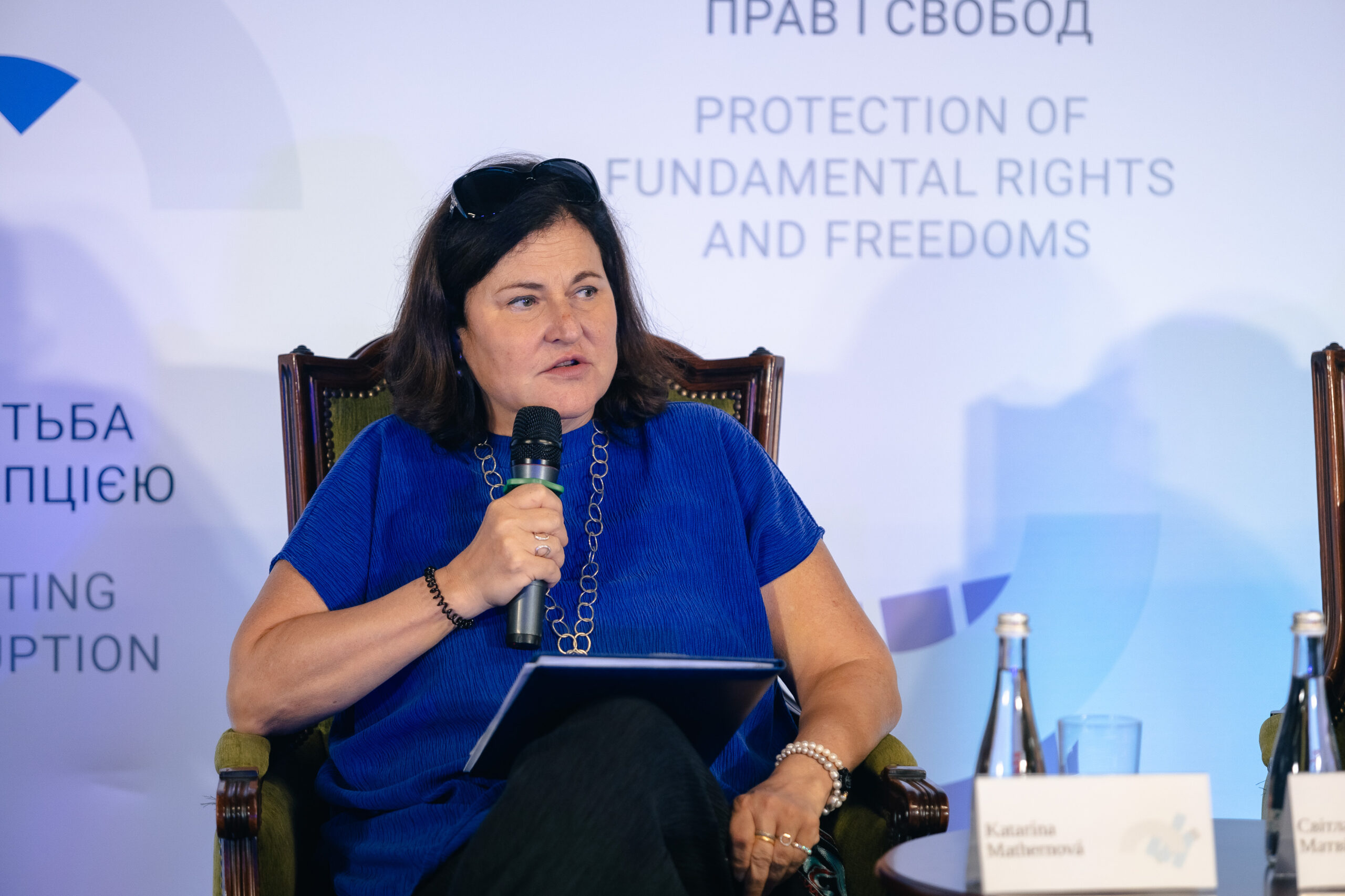
For her part, Katarina Mathernova, Ambassador of the European Union to Ukraine, noted the uniqueness of discussions on Chapter 23’s fundamental issues in the context of Ukraine’s existential war. Ms Mathernova thanked the study’s authors and the organisations that had performed extensive work on drawing up this Report and stressed its role in Ukraine’s European integration process.
Svitlana Matviienko, Executive Director at the Agency for Legislative Initiatives, noted that the ALI and its Coalition partners had done everything to ensure that the bilateral meetings were successful and that everyone had analytical and objective information collected with the involvement of a wide range of experts.
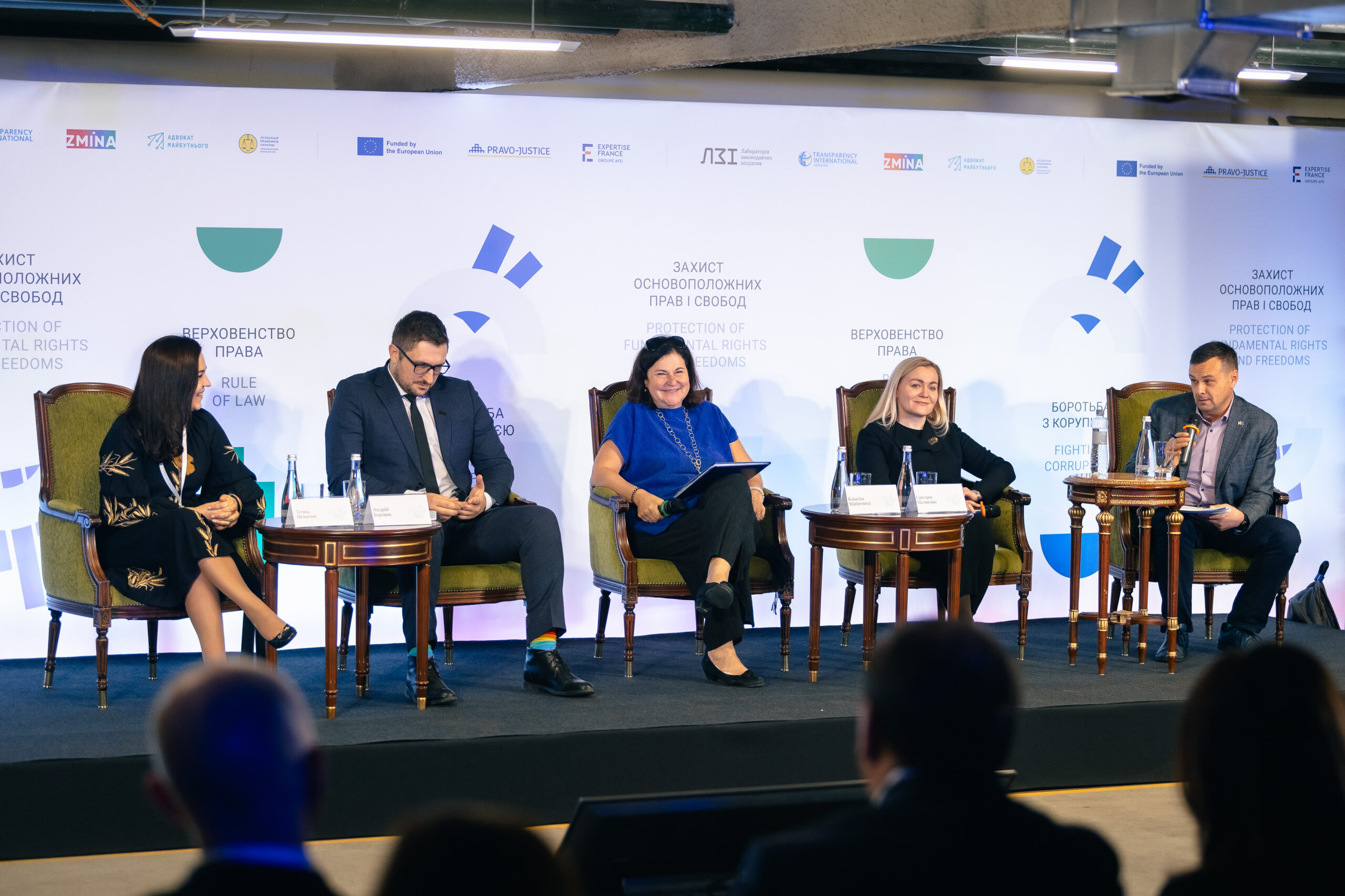
The discussion under the Justice pillar focused on the Strategy for Sustainable Development of the Judiciary, capacity building of key judicial institutions, and cooperation between civil society organisations and governmental authorities to successfully implement the EU integration roadmap. The discussion panel was moderated by Karina Aslanian, Head of the Rule of Law at ALI, and Rasim Babanly, First Deputy Chief of Staff of the Supreme Court.
The speakers of this panel were Stanislav Kravchenko, President of the Supreme Court; Dmytro Lukianov, Deputy Chair of the High Council of Justice; Andrii Pasichnyk, Chair of the High Qualification Commission of Judges of Ukraine; Viktor Horodovenko, Judge of the Constitutional Court of Ukraine; Iryna Mudra, Deputy Head of the Presidential Office; and Viktoriia Litvinova, Deputy Prosecutor General.
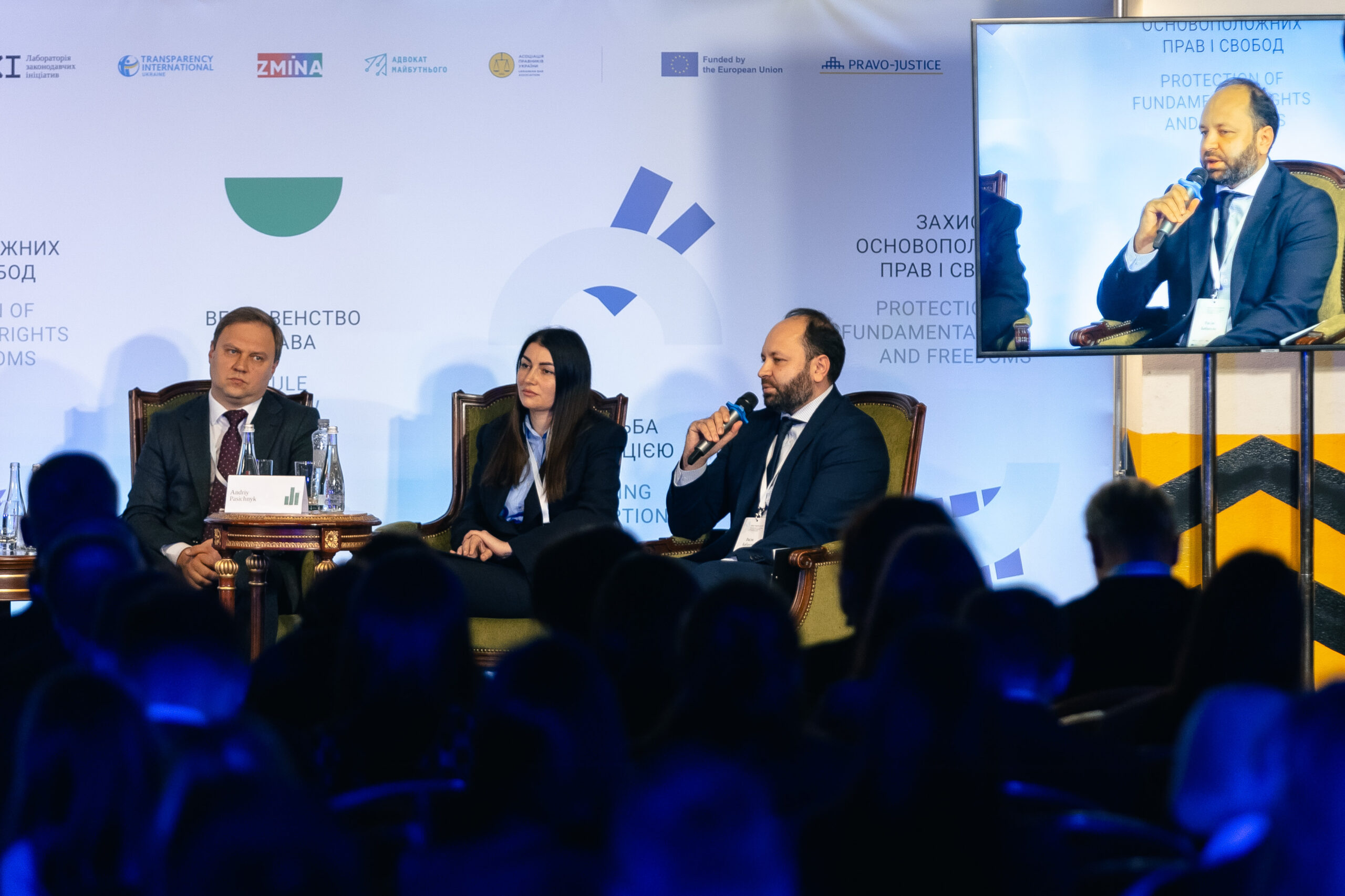
Rasim Babanly spoke about the September EU-Ukraine bilateral session, which was dedicated to negotiating Chapter 23 in Brussels as part of the screening of Ukrainian legislation for compliance with EU legal norms.
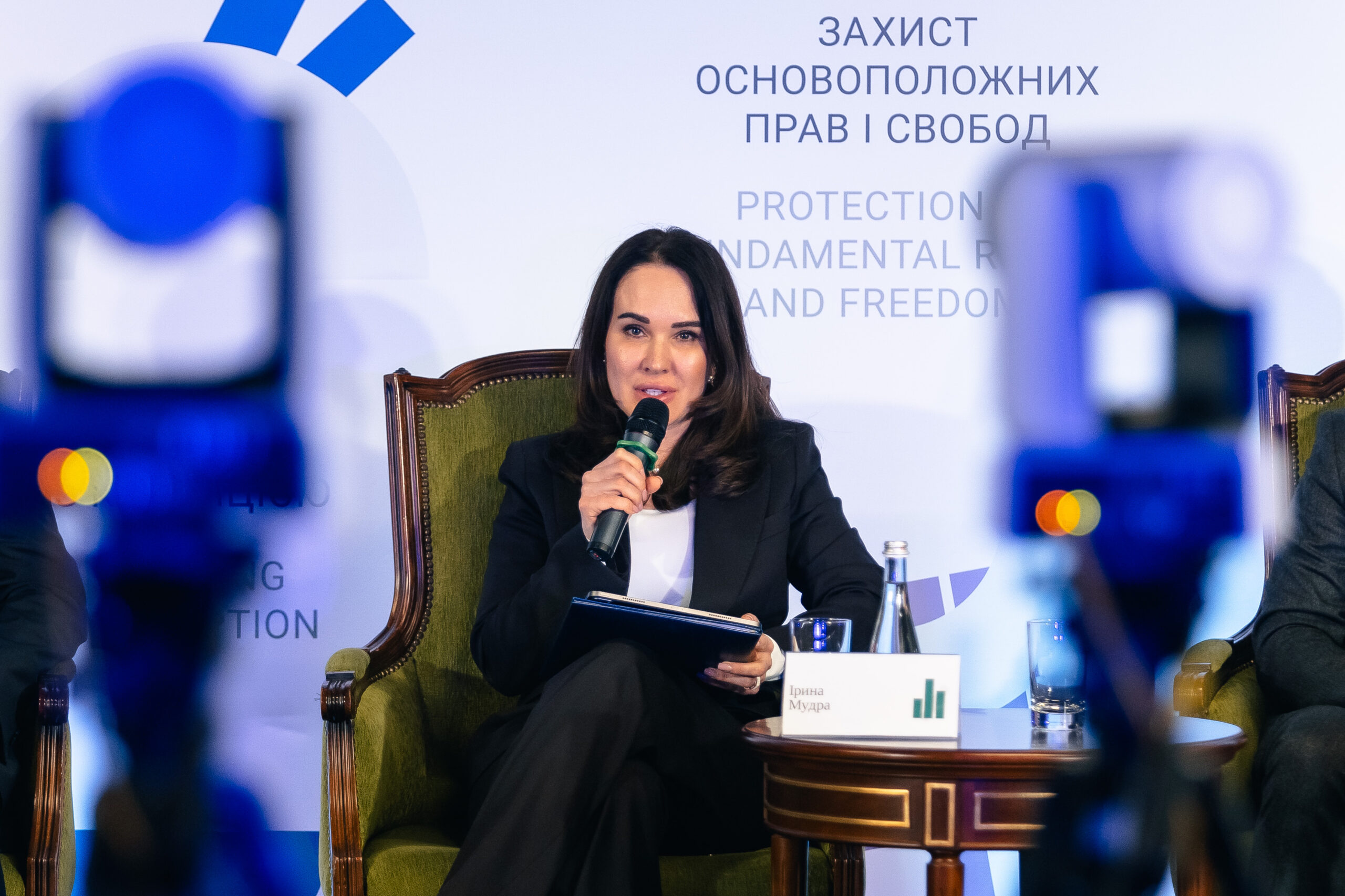
Iryna Mudra emphasised the importance of cooperation between civil society and authorities in moving towards a common goal – the European future of Ukraine. She also highlighted the key points of the draft Strategy for the Development of the Justice System and Constitutional Justice, which was developed based on an analysis of the current state of the judiciary and the justice system as a whole. Iryna Mudra also noted that the Strategy contained measures to address many of the issues highlighted in the Shadow Report.
Stanislav Kravchenko spoke about the readiness of Ukrainian judicial practice to harmonise with European legislation and practice, the role of the Supreme Court in this, and generally about the stage at which Ukraine is in this process.
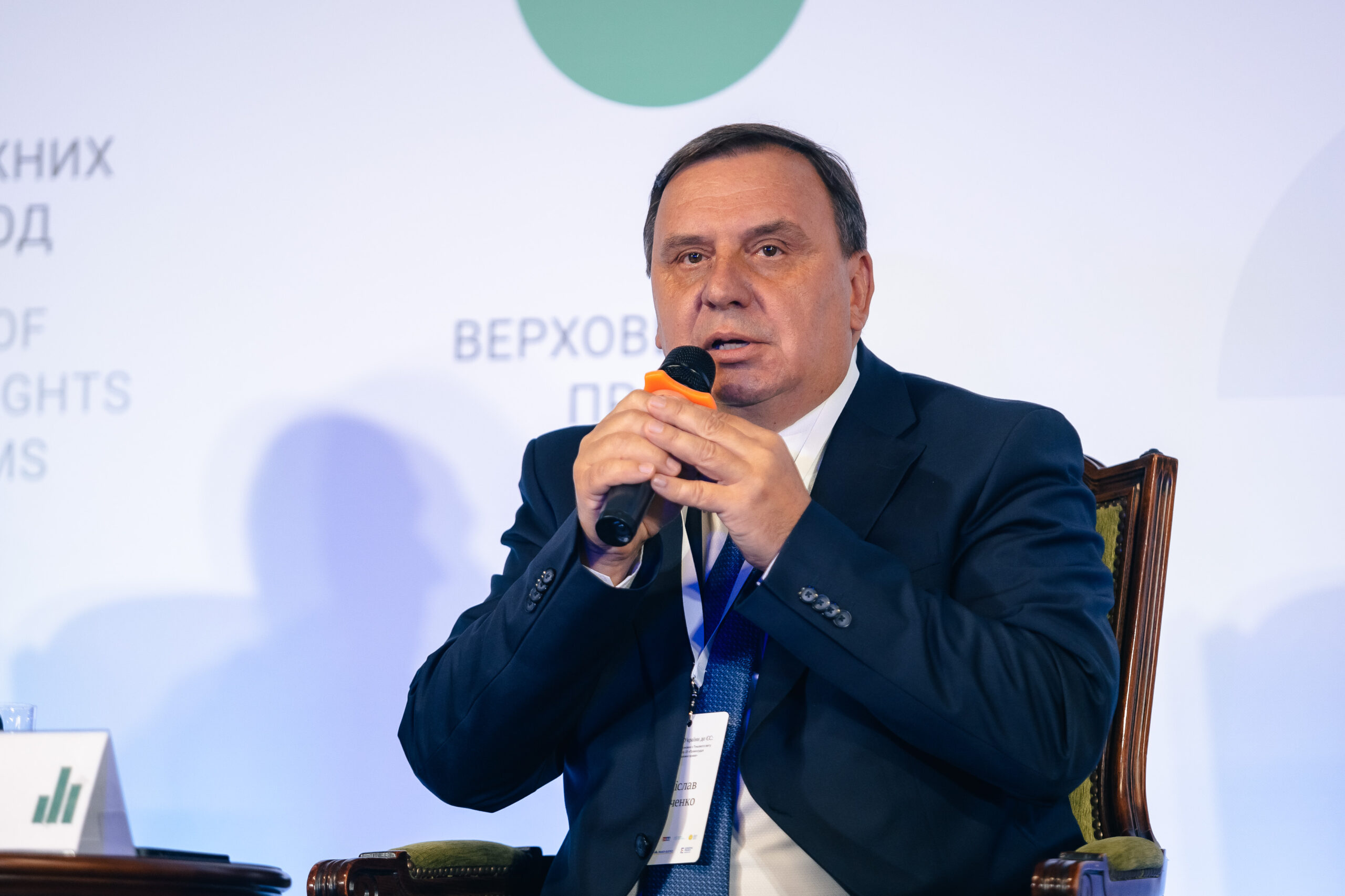
Dmytro Lukianov shared his experience in the EU-Ukraine negotiation process and spoke about further risks faced by the High Council of Justice in its work.
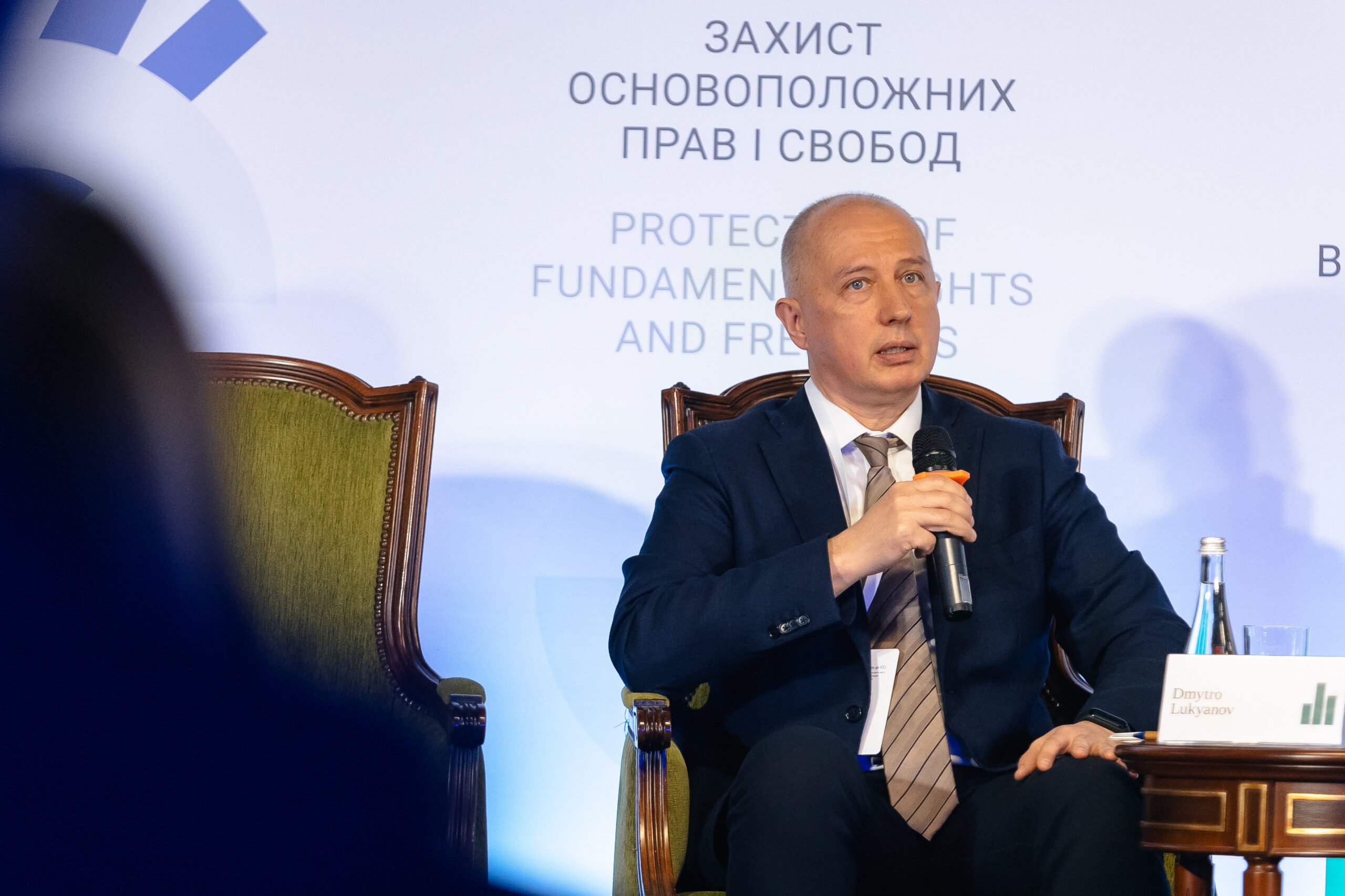
Andrii Pasichnyk spoke about the results of the selection procedure carried out by the High Qualification Commission of Judges of Ukraine to solve the judiciary’s staffing problems and the progress made in fulfilling international obligations in the process of European integration.
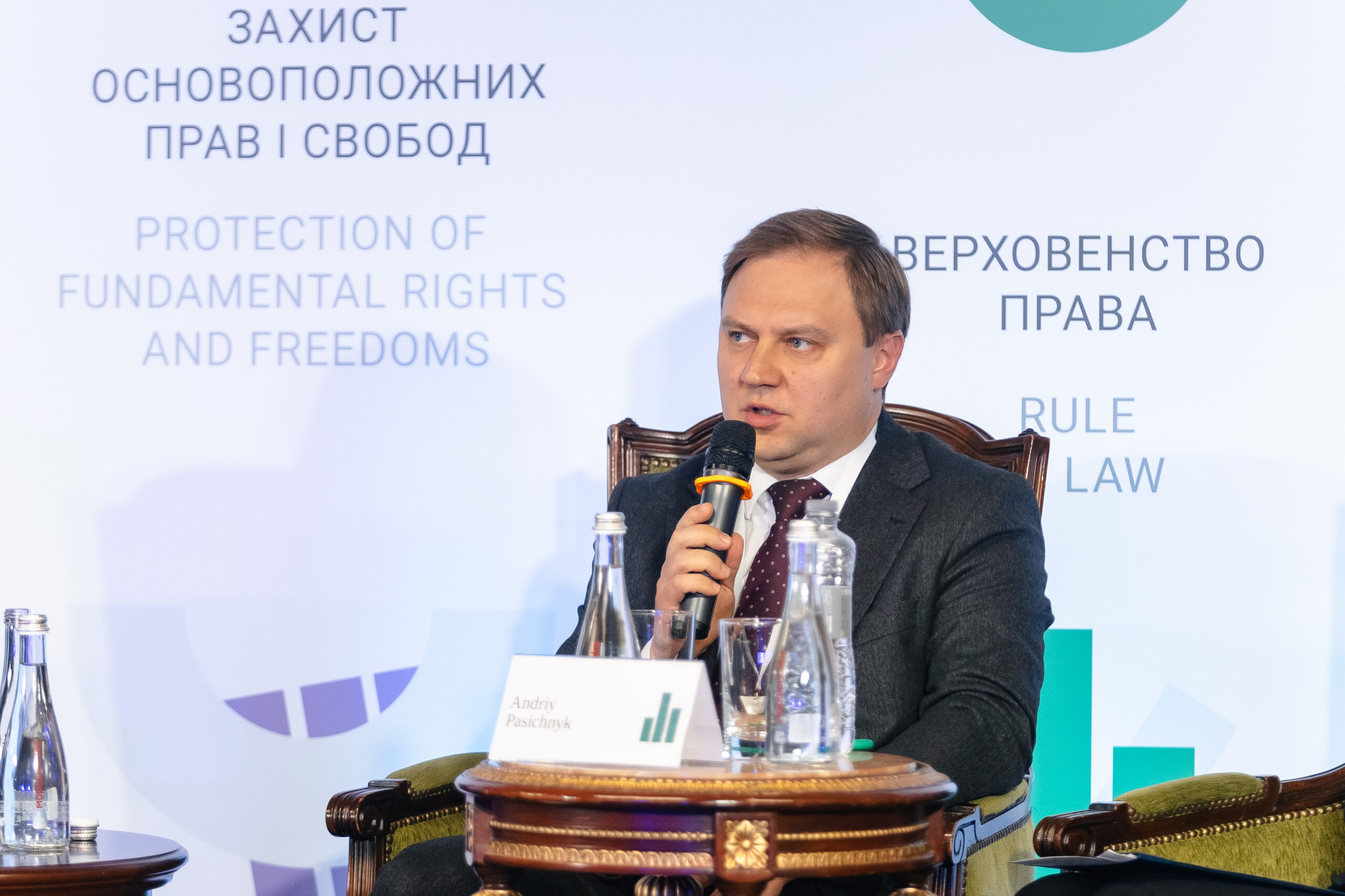
Viktor Horodovenko shared his vision of the role of the Constitutional Court in the process of European integration. In particular, he spoke about the challenges related to the Court’s institutional capacity in the context of a full-scale invasion.
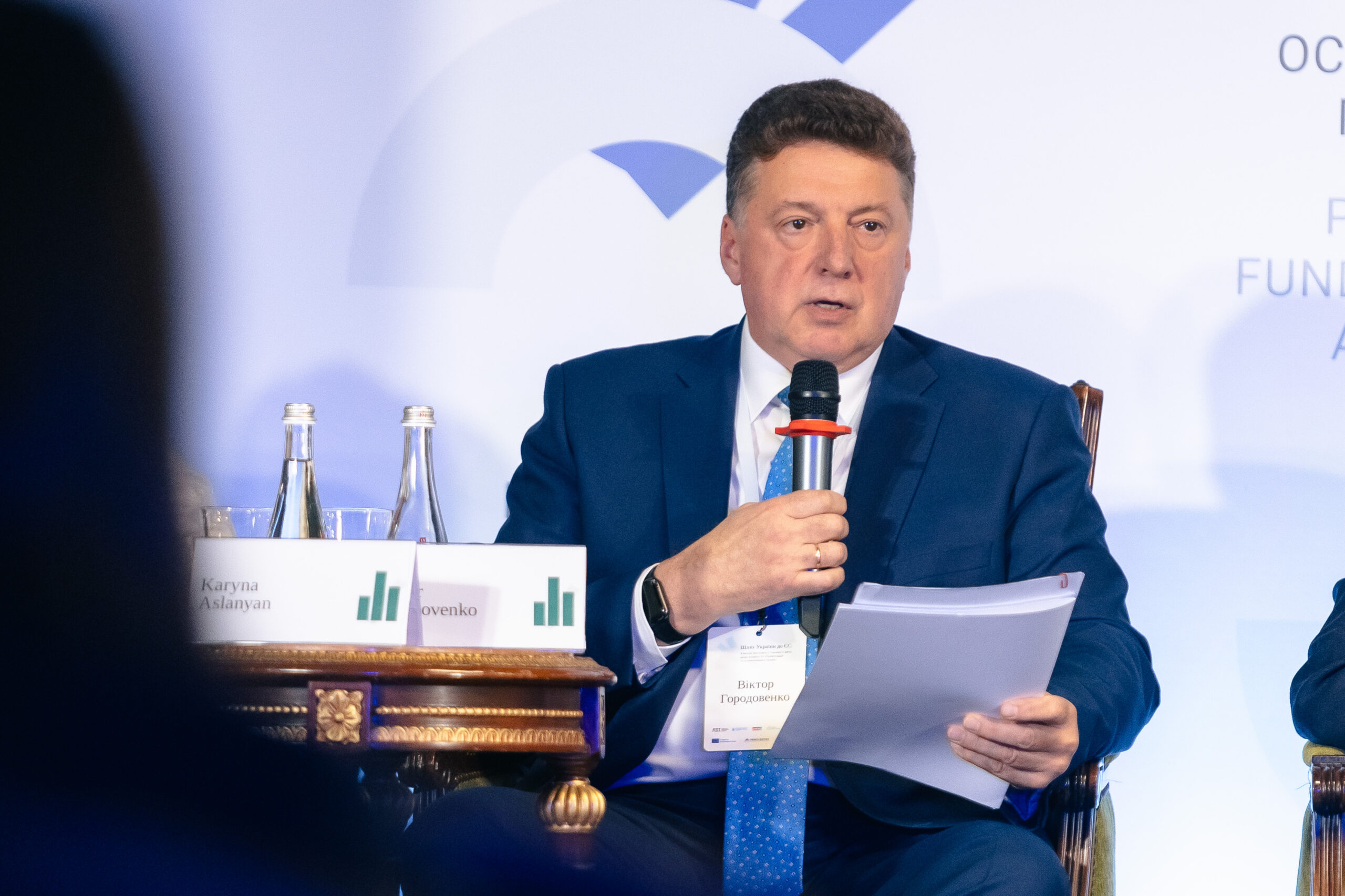
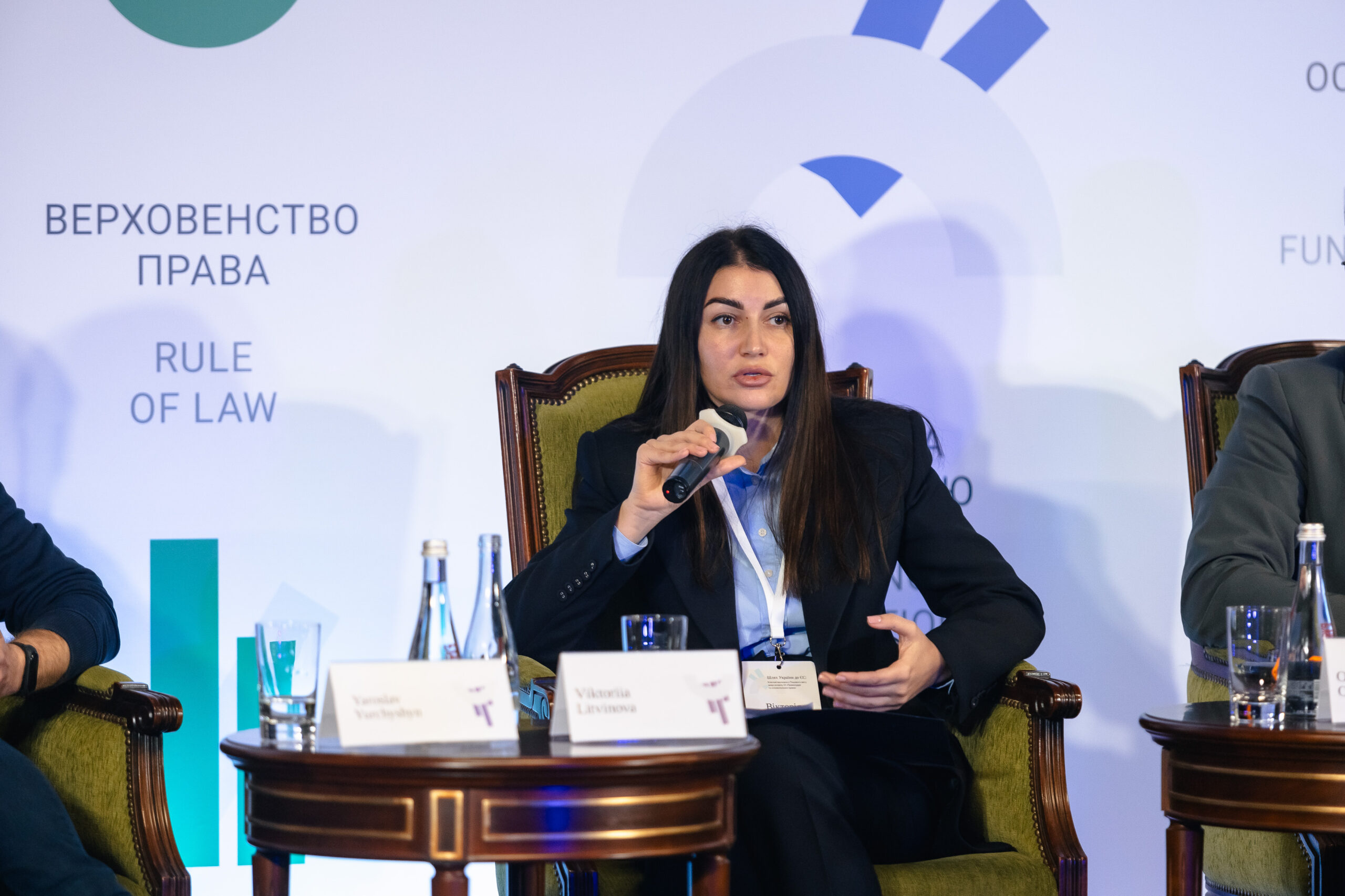
Viktoriia Litvinova highlighted the progress and challenges of the current stage of reforming the public prosecution service and the Prosecutor General’s Office in the context of European integration. In particular, she emphasised the important role of sustainable transformation of the law enforcement sector and prosecution authorities in bringing Ukraine closer to full EU membership.
Yevhen Krapyvin, an expert of the Tomorrow’s Lawyer NGO, shared his vision of prosecution reform. Daria Pysarenko, Executive Director at Tomorrow’s Lawyer NGO, also spoke about the need for systemic reform of the bar.
In addition, during the thematic panel, a Q&A session was held with the participants of the event, namely representatives of organisations from the Coalition of NGOs that drew up the Shadow Report, the expert community and representatives of relevant judicial institutions. The questions covered the following aspects:
- Development and support of prosecutorial self-government;
- Accountability of the bar and bar self-government bodies to the lawyers themselves and to the public;
- Institutional capacity of the judiciary, in particular, the functioning of advisory bodies – the Ethics Council and the Selection Commission for Selecting Members of the HQCJ;
- News on the Unified Judicial Information and Telecommunication System (UJITS).
For reference. The Shadow Report prepared by experts from relevant NGOs led by the Agency for Legislative Initiatives includes the following sections:
- Judicial reform (Agency for Legislative Initiatives);
- Combating corruption (Transparency International Ukraine);
- Protection of fundamental rights and freedoms (ZMINA Human Rights Centre);
- Reform of the public prosecution service (Tomorrow’s Lawyer);
- Reform of the bar (Tomorrow’s Lawyer);
- Legal education reform (Ukrainian Bar Association).
The Shadow Report was monitored, analysed and prepared in February – August 2024.
The report has been prepared with the financial support of the European Union within the EU-funded Project Pravo-Justice. Its contents are the sole responsibility of the Agency for Legislative Initiatives and other NGOs and do not necessarily reflect the views of the European Union.
Parliamentary Reform and Sustainability of Institutions: ALI Discussed Priorities of Parliamentary Reform with Pat Cox
The Agency for Legislative Initiatives joined a meeting of Ukrainian civil society representatives with Pat Cox, former President of the European Parliament and Head of European Parliament’s Needs Assessment Mission to the Verkhovna Rada of Ukraine. Such meetings and discussions are dedicated to the next steps and priorities of parliamentary reform, which continues in the context of a full-scale war.
The internal reform of the Ukrainian parliament began back in 2016 with the launch of the European Parliament’s Needs Assessment Mission led by Pat Cox. The mission drafted a Roadmap with specific recommendations on how to strengthen the Verkhovna Rada of Ukraine institutionally and address the existing problems of Ukrainian parliamentarism.

After the start of parliamentary reform, meetings with representatives of state institutions and civil society allow us to check the current processes and key priorities in the reform process. And, in particular, to convey important messages to the Ukrainian authorities in the context of the ongoing reforms.
The priority topics of this year’s meeting included the following issues:
- protecting state institutions from anti-democratic processes;
- preserving the agency of the parliament, which should be facilitated by the continuation of parliamentary reform;
- further implementation of the legislative impact assessment tool in the work of the Ukrainian parliament.
The Agency for Legislative Initiatives has always emphasised that ensuring the sustainability and capacity of the main democratic institution — the parliament — is a prerequisite for preserving the institutional potential of the state. Indeed, in the context of a full-scale war, it is impossible to continue parliamentary reform in a comprehensive manner, in particular, due to the restrictions established by the Constitution. However, the dynamics of the reform show that the Verkhovna Rada has already made progress in some of the blocks and recommendations of the Roadmap, and this trend should be maintained.
For reference. From the very beginning, the Agency for Legislative Initiatives has been supporting parliamentary reform and monitoring its implementation. According to the latest estimates of the ALI, the reform is 45.7% complete. The war has intensified the implementation of certain recommendations of the Roadmap for Internal Reform of the Verkhovna Rada, prepared by the European Parliament’s Needs Assessment Mission led by Pat Cox.
ALI analysed in detail where parliamentary reform is heading now in the Parliament Journal.
EU Accession Negotiations: Justice and Human Rights
On 17–19 September, a bilateral EU-Ukraine session will be held in Brussels as part of the screening of Ukrainian legislation for compliance with EU legal norms, which will focus on the negotiated Chapter 23 “Rule of Law and Fundamental Rights and Freedoms.”
Approximately 300 representatives of state institutions from the Ukrainian side will attend the meeting, but more than 85% will participate online.
The Ukrainian team is already in Brussels. The team includes Olha Stefanishyna, Deputy Prime Minister for European and Euro-Atlantic Integration of Ukraine – Minister of Justice of Ukraine, representatives of the Supreme and Constitutional courts, members of the High Council of Justice and the High Qualifications Commission of Judges of Ukraine, officers of the Ministry of Justice and other state institutions. “It is important that members of the Ukrainian delegation do not just represent their respective bodies, the Ukrainian delegation acts as a single team representing Ukraine’s position,” says HQCJ member Vitalii Hatseliuk, commenting on the situation from Brussels.
What is Chapter 23?
The official screening procedure is based on 33 negotiating titles (chapters), which are grouped into six clusters (thematic units). The procedure includes two stages, namely explanatory sessions and bilateral meetings. The Ministry of Justice is the main coordinator for negotiating Chapter 23, “Rule of Law and Fundamental Rights and Freedoms,” and 24, “Justice, Freedom and Security,” of the Fundamentals cluster.
Chapter 23 encompasses EU law and policies in the areas of independent and effective judiciary; preventing and combating corruption as a threat to the stability of democratic institutions and the rule of law; fundamental rights and freedoms guaranteed by EU treaties, the Charter of Fundamental Rights of the European Union: children’s rights, protection of persons reporting violations of EU law, personal data protection, procedural rights and guarantees, rights of victims of crime, combating racism and xenophobia, freedom of expression, non-discrimination, protection of Roma rights, gender equality, rights of persons with disabilities and rights of citizens of EU member states.
In essence, Chapter 23 deals with complex topics such as courts, prosecution authorities, the bar, legal education, the fight against corruption, and fundamental human rights and freedoms.
According to the 2020 revised EU enlargement methodology, Chapter 23, “Rule of Law and Fundamental Rights and Freedoms,” and 24, “Justice, Freedom and Security,” are the most important throughout the negotiation process. No EU negotiation chapter will be closed until the benchmarks within these two chapters are met.
“The European Commission pays special attention to preparations for the negotiations under Chapter 23. The Commission has already received from us and analysed the necessary information that our team has carefully developed,” said Olha Stefanishyna, Deputy Prime Minister for European and Euro-Atlantic Integration, following the final meeting of the Ukrainian delegation.
The preparatory process lasted several months and consisted of preparing written responses to the European Commission’s questions (according to our information, more than 700 pages of text were prepared in response to the European Commission’s questions) and oral presentations, which will be presented in Brussels on Tuesday.
What is Brussels concerned about in the context of the judiciary?
During the negotiations, representatives of the judiciary presented the Ukrainian side’s vision of the real state of affairs in Ukraine’s judicial system. We spoke to representatives of the HCJ and HQCJ about their presentations.
Deputy Head of the High Council of Justice Dmytro Lukianov will discuss the work of the HCJ and HQCJ after their functions’ resumption, the state of the judiciary’s independence, the more than 30% staff shortage in the courts, the appointment of new judges and disciplinary action against judges, the formation of the HCJ Disciplinary Inspectors Service, and other issues.
Ensuring the institutional continuity of the High Council of Justice is also important. As of today, no representatives of the President (two members) have been appointed to the HCJ, and no representatives of the Bar Congress (two members) have been elected. While competitions under the presidential quota at least take place, the Bar Congress, which will be the starting point for the competition, has not been announced since 2022.
“The complexity of the system of electing HCJ members is aimed at ensuring its independence but creates risks for its formation and capacity,” says HCJ Deputy Chair Dmytro Lukianov. “In March 2025, the tenure of two HCJ members who are judges will expire, leaving the HCJ with a minimum quorum of 15 members. This poses a threat of a repeat of the situation of 2022 when the HCJ lost its powers and did not perform constitutional functions for a year. Such a situation can occur both due to a combination of circumstances, especially in times of war, and be the result of a deliberate policy of certain actors.”
The HCJ believes that the problem can be solved based on recommendations of the Consultative Council of European Judges (CCJE) and the Venice Commission. The CCJE recommended introducing the following rule into the legislation: “powers of a member of the Council shall be terminated solely as a result of the lawful election of a new member, which will ensure the continuity of the Council’s activities, even if the parliament (or other entity) fails to vote for new members” (paragraph 36 of CCJE Opinion No. 24 (2021). This is how this problem is solved in many European countries, such as Belgium, Spain, Italy and Portugal.
A separate unit in the negotiations is the work of the judiciary during the war. Today, there are 596 courts in Ukraine, including 561 general local/specialised courts and 35 courts of appeal. Since the beginning of the war, 142 premises of 120 judicial institutions have been destroyed or damaged. Fifty-four judges and 389 court staff members joined the Ukrainian armed forces. Four judges and 14 court staff members were killed.
HQCJ member Vitalii Hatseliuk will discuss issues such as regular appraisal of judges, including plans to adopt relevant documents; the functioning of the Public Integrity Council, issues of financing the justice system and issues related to judicial education – the state of affairs of the National School of Judges of Ukraine, its international cooperation, plans for 2025, specific measures to be developed and implemented to meet the challenges facing Ukraine in the framework of European integration. This includes adapting judicial training to the requirements of European integration, i.e., introducing such blocks as the fundamentals of European law and the status of the EU Court of Justice, paying due attention to issues such as the protection of vulnerable populations, and considering cases related to the consequences of armed aggression against Ukraine, among others.
Vitali Hatseliuk emphasises that the European Commission has a good understanding of the situation; it asks questions, the answers to which are very useful for the further development of Ukrainian statehood. “The process itself is also very important. It helps coordinate the direction of further legal reform. I did not see any irrelevant questions from those the European Commission wants to hear answers to. Overall, this is a very useful tool for Ukraine. It is an opportunity to look at ourselves from the outside and plan further actions. Specific deadlines, indicators and measurement tools are required from Ukraine. All this is often used in project management or policy-making, where it is very clear what result we are going to achieve in a particular aspect and when this result is planned.”
Civil society shadow report on Chapter 23
A week before the start of the negotiations, a coalition of civil society organisations, namely the Agency for Legislative Initiatives, Transparency International Ukraine, Human Rights Centre ZMINA, Tomorrow’s Lawyer and the Ukrainian Bar Association presented their report on the state of play under Chapter 23.
This is the first report that Ukraine’s civil society sector has prepared for the European Commission since Ukraine became an EU candidate. Similar shadow (in fact, alternative) reports are prepared annually in all countries on their path to the EU.
“This Shadow Report offers a more holistic and transparent view of the reform process in Ukraine. It is an important tool for preparing for the EU accession negotiations, both for the Ukrainian side and for the EU,” says Oksana Tsymbrivska, Head of the EU Project Pravo-Justice.
The report covers all areas of Chapter 23, and, in addition to information on the state of play, it also contains a description of key progress and challenges in each area, as well as about 350 recommendations. The Shadow Report was monitored, analysed and prepared in February – August 2024.
Representatives of the European Commission highly appreciated the level of preparation of the Shadow Report, noting that its findings would be used.
“I have never seen such a serious report prepared by civil society in any country I have worked in before. We will use this report to formulate our recommendations for the screening report and consider the draft roadmap of the rule of law reforms that Ukraine will need to prepare to move forward on its EU accession path. And, of course, these materials will be used to set benchmarks for the accession negotiations. Therefore, the report is very timely in terms of our work with Ukraine,” said Manfredas Limantas, Sector Manager for Rule of Law and Anti-Corruption with the EU Delegation to Ukraine, during the presentation of the report.
Instead of conclusions
Tomorrow, Ukraine will open a new page in Brussels on our path to the EU and on the path to reforming (or rather, properly streamlining) key areas of the Fundamentals cluster. While there have already been significant achievements in such areas as courts, prosecution and the fight against corruption, as the key requirements for them are mostly known, although, of course, there is still a long and difficult way ahead, the list of requirements for the bar and legal education, which first appeared in the EC’s 2023 report, will be drawn up as a result of negotiations and, probably, the civil society Shadow Report.
After the European Commission publishes its screening report for 2024, Ukraine will prepare a roadmap with a list of key tasks and indicators, which it will follow in the coming years to join the EU.
It is also time for all representatives of the Fundamentals cluster to assess their professional relevance to the tasks facing Ukraine and consider whether they are ready for fundamental reforms and clear implementation of the roadmap. Failure to comply with the requirements will be immediately recorded by the public sector and will become a stumbling block during further monitoring by the European Commission.
Coalition of CSOs Presents Shadow Report to the European Commission on Chapter 23, “Justice and Fundamental Rights”
A coalition of CSOs — Agency for Legislative Initiatives, Transparency International Ukraine, Human Rights Center ZMINA, Tomorrow’s Lawyer Program and Ukrainian Bar Association — presented the Shadow Report to the European Commission on Chapter 23, “Justice and Fundamental Rights” of the European Commission’s Report on Ukraine in 2023.
This is the first report that Ukraine’s civil society sector has prepared for the European Commission since Ukraine became an EU candidate. The Shadow Report highlights the views of Ukrainian civil society, representatives of the legal community and experts active in the field of justice. The report analyses the progress made in the areas of the rule of law, the fight against corruption and the protection of fundamental human rights and freedoms, identifies weaknesses and gaps, and provides recommendations on what needs to be done on the Ukrainian side.
Representatives of the European Commission praised the level of preparation of the Shadow Report, noting that its findings would definitely be used.
In its part of the report, the Agency for Legislative Initiatives emphasised the need to adopt a judicial reform strategy. Today, unfortunately, Ukraine does not have it as a single approved document. The reform is being implemented under pressure from the public and international partners. Only now, the Presidential Office of Ukraine has developed and sent a draft Strategy for the Development of the Justice System and Constitutional Justice for 2024-2029 to the main judicial bodies and some representatives of the non-governmental sector for suggestions and comments. This draft Strategy needs to be substantially revised, and the ALI is already preparing its proposals.
In his turn, Manfredas Limantas expressed hope that the recommendations of civil society would be taken into account by the Presidential Office of Ukraine to improve the Strategy.
Yevhen Krapyvin, an Expert of Tomorrow’s Lawyer Program and the Center for Political and Legal Reforms, focused on problems and recommendations for solving them in Ukraine’s prosecution system. The speaker emphasised the need for the prosecutor’s office and the Prosecutor General to be independent, particularly from political influence, and the development of institutions that should ensure this independence.
Daria Pysarenko, Director of the Tomorrow’s Lawyer Program, presented the main conclusions, problems and recommendations to the section on the Bar reform. In particular, she covered the issues of the legal status of the Bar, bar self-government, disciplinary liability — all aspects that characterise the current structure of the Bar.
A full-fledged reform of the justice system is impossible without addressing the problems with legal education in Ukraine. Every year, Ukrainian universities graduate thousands of lawyers, but the quality of this education does not meet European standards. Ivan Gorodissky, Vice President of the Ukrainian Bar Association, presented civil society’s recommendations on the necessary changes in education.
Kateryna Ryzhenko, Deputy Executive Director for Legal Affairs of TI Ukraine, presenting the section on anti-corruption, stressed the need to improve anti-corruption legislation and the urgent need to take into account the shortcomings of the previous State Anti-Corruption Strategy and the State Anti-Corruption Programme in the process of developing new documents, as this process will begin very soon. As part of her presentation, Kateryna also mentioned the importance of fully restoring e-declaration and reporting by political parties.
Tetiana Pechonchyk, Head of the Human Rights Center ZMINA, spoke about the main challenges to the observance of a wide range of human rights in Ukraine, which Ukraine will have to overcome on its way to the EU.
Tetiana Pechonchyk also drew attention to negative trends in the field of human rights protection, in particular, the intention to restrict access to information and decisions of the Unified State Register of Court Decisions through the draft law No. 7033d, which, despite the criticism of human rights activists, was adopted by the Verkhovna Rada as a basis.
The monitoring, analysis and preparation of the Shadow Report were carried out in February-August 2024. The full text of the report has already been published in Ukrainian and English.
The report has been prepared with the financial support of the European Union within the framework of the EU Project “Pravo-Justice”. Its contents are the sole responsibility of the Agency for Legislative Initiatives and other civil society organisations and do not necessarily reflect the views of the European Union.
Parliamentary Reform in Times of War: What Is on the Agenda?
Paradoxically, the full-scale invasion has given impetus to the acceleration of many reforms in Ukraine. And the unfortunate parliamentary reform, launched back in 2016, has also been revived. The war has intensified the implementation of certain recommendations of the Roadmap for Internal Reform of the VRU prepared by the European Parliament’s Needs Assessment Mission led by Pat Cox. According to the latest estimates of the Agency for Legislative Initiatives, the reform is 45.7% complete. We will tell you where the parliamentary reform is heading now and what the difficulties are on the way.
New challenges
The martial law has made its own adjustments to the parliamentary reform. Everything related to amending the Constitution is currently impossible to implement (due to Article 157 of the Constitution, which prohibits amending the text of the Basic Law during the period of this legal regime). Therefore, all possible improvements can be divided into two categories as of today:
- Urgent, where their development and implementation do not require amendments to the Constitution. Accordingly, their implementation is currently a priority. For example, these may include the improvement of the Law “On Committees of the Verkhovna Rada of Ukraine”, the Law “On the Status of an MP of Ukraine”, and the adoption of the Code of Ethics;
- Those that should be discussed now but whose implementation and constitutional consolidation should be postponed until after the victory. These are amendments to the Constitution regarding the status of the opposition, restrictions on the legislative initiative of parliamentarians, regulation of the interaction of the power triangle “Parliament – Government – President”, etc.
However, it is important to take into account that after the end of the war, some legislative proposals and developments may become irrelevant.
Where is the reform heading now?
During the full-scale invasion, the Parliament has continued its internal reform and is working to improve its institutional capacity. For example, MPs have already held three meetings in the format of the Jean Monnet Dialogues during the full-scale war (in May and November 2023 and in April 2024), which were attended by the leadership of the Verkhovna Rada and representatives of parliamentary factions and groups.
As a result of these discussions, parliamentarians agreed that it was necessary to:
- update the VRU Resolution on measures to implement recommendations on internal reform;
- adopt the Code of Ethics;
- adopt the Law “On Parliamentary Service”;
- develop amendments to the legislation to regulate the status of the opposition;
- work to reduce “amendment spam”;
- return to holding “question hours” with the Government;
- ensure the adaptation of national legislation to EU law.
Some of these proposals, together with the developments of the pre-war Jean Monnet Dialogues, were embodied in the concepts for reforming the Parliament prepared by the Working Group on Amendments to the Laws of Ukraine in Parliamentary Law.
To implement certain developments, in late 2022, the Verkhovna Rada registered draft law No. 8242, aiming to improve legislative work in terms of adapting Ukrainian legislation to EU law. It is expected that consideration of this draft law will not be delayed, as it is currently on the agenda of the 11th session of the Parliament, which is expected to last until September 2024.
A significant part of the developments also relates to strengthening cooperation between the legislative and executive branches of government. So, in addition to preparing a concept for reforming this area, an Interagency Working Groupon Improving Legislative Work, Assessing Legislative Impact and Improving the Results of Laws Implementation was established at the end of 2023. At the founding meeting of this group, representatives of the Parliament, the Government and NGOs discussed the interaction between the VRU and the executive branch in terms of developing draft laws aimed at adapting Ukrainian legislation to the EU acquis, improving the procedure for submitting draft laws by the Government and strengthening the role of the Cabinet of Ministers in devising proposals for the agenda of VRU’s plenary sessions.
A no less important achievement on the path to European integration is the development of draft law No. 8327on the Code of Ethics for MPs at the end of 2022. ALI experts were also involved in this process. A year after the draft law was registered, in December 2023, the main provisions were presented and discussed at a meeting of the Working Group on Amendments to the Laws of Ukraine in Parliamentary Law.
In addition, in early 2024, to implement one of the points of the Conclusions adopted during the ninth Jean Monnet Dialogue, proposals were submitted to update the version of the VRU Resolution on measures to implement the recommendations on the internal reform of the Parliament, which include:
- improving the legislative process and adapting Ukrainian legislation to the provisions of the EU acquis;
- improving the interaction between the Verkhovna Rada and the Cabinet of Ministers;
- parliament digitalisation;
- strengthening the VRU’s institutional capacity;
- developing changes to the constitutional dimension of the parliamentary reform.
In general, parliamentary reform did not stop but became more relevant and active during the full-scale war. The acceleration of this process seems particularly noticeable compared to the several years preceding the full-scale invasion. This consolidation of the Verkhovna Rada’s efforts demonstrates its willingness to change even in the face of war.
So, the only thing that remains on this path is to take a responsible approach to implementing the changes outlined in the concepts developed so that the reform of the Ukrainian Parliament does not remain only a “promising project” but is actually implemented.
Read more about the parliamentary reform in times of war in our Journal.
Judicial Power. What Is Inhibiting the Reform of Local Courts and Courts of Appeal?
For the first time since the beginning of the Great War, 248 new judges took the oath to the Ukrainian people to “independently, fairly, and professionally exercise justice on behalf of Ukraine” on 5 July in the Ukrainian House. The day before, President Zelenskyy appointed 214 judges to local courts and one judge to the Supreme Court. Another 114 judges were appointed in May, waiting to take the oath for almost two months (while receiving a judicial remuneration).
During the oath, Zelenskyy wished the judges that “each “decision in the name of Ukraine” strengthened respect for the courts and Ukraine on the whole.” Ruslan Sydorovych, Deputy Chair of the High Qualification Commission of Judges of Ukraine, which held the competition for local courts, noted that “248 judges account for 5% of the judiciary of Ukraine.” He also expressed hope that this “will have a significant positive impact on citizens’ access to justice throughout the territory of Ukraine.”
We described competitions in detail in the previous article. Now, we are going to consider what generally happens in local courts and courts of appeal during the war and how they perceive the judicial reform, which, at this stage, mostly concerns them.
Spoiler: it is perceived differently and often resisted.
In the Language of Numbers
As of 24 June, there are 3,592 judges working in local courts (out of the fixed number of 5,035 positions). 650 judges are working in the courts of appeal (out of the fixed number of 1,357 positions).
That is, 29% of positions in the first instance and 52% in the second instance are vacant. The situation is even more critical in general courts of appeal, where 62% of positions are vacant.
To recall, the High Qualification Commission of Judges (HQCJ) has recently completed the competition for 560 positions of judges of local courts. However, only 390 candidates received recommendations. HQCJ also launched a competition for 550 positions of judges for courts of appeal. By the end of the year, it promises to announce another competition for local courts for the record number of 1,000+ judge positions.
It is considered that although competitions (most likely) will be taking place for about two years, in 2027, personnel shortages in the courts will be largely overcome, and most vacancies will be filled. At the same time, the system will receive a certain number of outside experts: lawyers and scientists in appellate courts and lawyers and attorneys in first-instance courts. Is that really so?
New Judicial Map
The above figures were calculated before the war when about 700 courts were operating in Ukraine.
The war changed everything, in particular in courts: some of them had to be closed (70+ courts), and judges had to be sent to administer justice in other courts (500+ persons); new categories of court cases appeared in all instances, and jurisdictions (war crimes, military crimes, compensation for lost property, social security of military personnel, etc.); many premises were ruined or partially damaged (15 and 116 premises, respectively).
Over the past two and a half years, there has been a large population migration between regions. In addition, many Ukrainians moved outside the country. Taking this into account, no one can clearly say the number of courts and judges we actually need and in which regions. Unfortunately, there is no detailed analysis of these processes either.
The situation worsened because, before the full-scale invasion, Ukraine failed to develop and approve a new judicial map corresponding to the new administrative and territorial system effective since December 2020. So, currently, even the functioning courts do not correspond to their districts, and the names of more than 50 courts are still Soviet. “Leninskyi District Court of Kirovohrad City” sounds like mockery.
You might think, how is it possible during the eleventh year of the war? But it is: the 2017 reform of local courts, which stipulated their expansion (and discarding Soviet names) and should have been implemented in 2019–2020, stayed a reform on paper. And no new actual map has been approved for four years.
Although there is some progress, during the war, even in Zakarpattia Oblast, which is the farthest from the front line, the launch of a pilot project for court expansion developed with the help of our European partners has failed. They say they are unaware of how many people will live there after the war.
This is a clear argument, but it preserves the situation indefinitely and slows down the “main reform of the country.” After all, it directs new competitions to local courts in the wrong way: if judges are appointed to “old” local courts in 2026–2027, then procedures for transferring these judges to new ones may continue for several more years.
So, what can we do?
The Supreme Court insists on developing and approving a new judicial map as soon as possible, stressing that even if the courts are expanded now “on paper,” without the actual relocation of judges between the premises, this will still be a step forward because it will significantly reduce the number of procedural transfer of court cases between small courts. The number of judges can also be regulated after the victory, and new premises can be built in districts with a shortage of existing ones.
There is also a significant problem with the substantially uneven workload that judges have in different courts. Sometimes, it varies by more than ten times, and then each judge of such a court works for three, five, or even seven judges while receiving the same salary and having the same number of assistants and court hearing secretaries.
The judicial system generally considers 4.5 million cases and case files annually (information for 2023). When it is done by 4.5 thousand judges, not everyone can withstand such a load. Just last week, ten people were dismissed: eight resigned, and two more were fired due to low qualifications and dishonest behaviour within the framework of judicial lustration procedures.
Another important issue is the feasibility of courts considering all cases currently assigned to their jurisdiction. Shall cases concerning the sale of milk or apples at the market without appropriate permission be considered by courts?
Without regulating the jurisdiction issues and the number of courts and judges, it will be impossible to address the matter of workload and, therefore, the quality of justice because an excessive number of cases affects both the terms of their consideration and the quality of court decisions.
Today, the Council of Judges of Ukraine and the Verkhovna Rada Committee on Legal Policy take care of issues related to the new map. However, after amendments were made to the Constitution of Ukraine in 2016 (and taking into account recommendations of the Venice Commission regarding these amendments), “the court shall be set up, reorganised, and liquidated by law,” the draft of which is submitted to the Parliament by the President of Ukraine.
So, the ball is definitely on the presidential office’s side, which will decide when to take this step: whether to approve a new map now, at least for regions where hostilities are not taking place or to leave everything for “after the war.”
“Timeless” Court Presidents
However, the matter is not only on the judicial map. The actions of many presidents of local and appellate courts also inhibit the reform.
Within the 2014–2018 reform framework, new rules were established for the term of office of court presidents. Since 2016, a judge can hold the position for no more than six consecutive years (two three-year terms). This was done, particularly within the framework of fighting corruption in courts, reducing the influence of court presidents on judges and office employees, and reducing the risks of corruption from such influence.
New rules did not satisfy most court presidents because they had been used to rule the courts for decades. Therefore, several ways were invented almost immediately to circumvent these rules, which most court presidents apply quite successfully. This component of judicial reform slowed down.
This way, Yaroslav Holovachov, President of the Kyiv Court of Appeal (the court where four judges were arrested for corruption six months ago), prematurely resigned three months before the expiration of the term of office. Another judge was elected as the court president for two weeks, two weeks after Holovachov returned to his position and started a new six-year term.
Are Kyiv Court of Appeal judges not aware of the fact that these are additional corruption risks? They are perfectly aware of it. Moreover, in court, judges sometimes bring bribes to each other in the middle of the day, wrapped in a package of coffee or hidden in a bottle of cognac.
Why are they doing this? Perhaps it is because Yaroslav Holovachov is a talented leader and an excellent manager. Or maybe because he allows them to bring each other “coffee” and “chocolates.”
The story of the “third term” also occurred in the Halytskyi District Court of Lviv, but there, a judge (Kateryna Kotelva) posted her story on Facebook: “The meeting of judges has just elected the president of Halytskyi District Court in Lviv – Iryna Romanivna Volosko for the third term in a row. I voted ‘against’ the approval of the meeting’s decision.”
Another similar story is the election of the head of Krasnoarmiiskyi City District Court of Donetsk Oblast for a third term. However, there is a catch: the court has been closed for some time, but its president is the same person (Olena Fil) as before the temporary closure. Some judges were against such an appointment, but who cares about the opinion of the minority?
A case that was not less outstanding took place in the Economic Court of Chernivtsi Oblast. According to the judges of this court, Oleh Proskurniak, the court president, received the position in exchange for dismissing the pregnant head of the office. Courts of three instances and two jurisdictions have been dealing with this story for a year because the dismissed head of the office is trying not only to return to her position but also to recognize one of the judges of this court (Volodymyr Baitaliuk) as the father of her child. That is, the meeting of judges allowed the court president to keep his position because he “cleaned up the dirt” after one of the judges. It looks like the Middle Ages and the times of the Inquisition rather than a country trying to become part of the EU and NATO.
Kyiv, Lviv, Chernivtsi, Donetsk Oblast… The list is much longer. Judges do not want to accept this part of judicial reform. Judicial government and self-government bodies are silent.
A few years ago, the Council of Judges of Ukraine even “played along” with court presidents and actually legalized all their schemes. The Supreme Court, on the contrary, believes that there cannot be any third terms. Stanislav Kravchenko, the Supreme Court President, responded to our request to comment on the “third term of court presidents” and said: “The Supreme Court does not accept and does not tolerate such actions of court presidents and meetings of judges. If we strive to develop the judiciary, the rotation of persons holding administrative positions shall take place in compliance with the general logic of judicial reform.”
At the same time, the Supreme Court adds that the problem has another component. Sometimes, there is no one to replace the court president, whose second term is ending because a good judge and a good manager are not identical concepts.
It is evident that the existing situation requires immediate interference of the legislator and a clearer definition in the law of the rules for court president rotation. If the majority of judges in Ukraine still do not realize that the law is not a manual in a post office that says “Do this, don’t do that,” then it will be necessary to supplement the Law of Ukraine “On the Judiciary and the Status of Judges” with a clear norm regarding the number of years of tenure in administrative positions and the number of years of “rest” from them, taking into account the previous years of court management.
The issue of leadership in the judiciary and appropriate training also requires attention (we will devote a separate article to these issues because the judicial reform almost did not affect the National School of Judges of Ukraine).
Front-line Courts
Analysis of the functioning of local courts and courts of appeal would be incomplete without describing the working conditions of courts in the front-line regions. In 2022, the jurisdiction of cases of some courts was changed, and judges were transferred to all corners of Ukraine. Currently, some courts in Donetsk, Kherson, Zaporizhzhia, and Kharkiv Oblasts operate near the line of contact.
The most complicated is the situation in Donetsk Oblast. The premises of some of the working courts have been ruined, so the judges have moved to the “neighbours.” This way, judges from Dymytrovsky City Court of Donetsk Oblast also work in the premises of the already mentioned Krasnoarmiiskyi court.
Several courts work remotely. At the same time, no criteria establish when a court should change its jurisdiction and when it should continue working remotely or in the usual mode.
The situation is made even more complicated by the lack of not only electricity but also water. In Pokrovsk, Selydovo, and Kurakhovo, water is available only two days per week, moreover, by hours. No one knows how the courts should survive the winter under such conditions.
Judges are trying to get transferred to other, calmer regions. However, in most cases, the HQCJ refuses to transfer them, referring to the Supreme Court’s request “not to touch these judges.”
We asked the Supreme Court what is the reason for such a request. Don’t the judges from the frontline regions deserve better living and working conditions? The Supreme Court explains that they are regularly asked by prosecutors, representatives of law enforcement agencies, and lawyers not to close frontline courts.
So, this is a vicious circle. The courts cannot be closed; otherwise, the rest of the processes will stop, too, and it is impossible to ensure adequate and safe working conditions.
So, judges have the same status, salaries, and conditions. Of course, this affects the desire of people from these regions to work in their positions.
Regulating the work of courts in frontline regions is long overdue. There were attempts to do this as early as 2022, but the Verkhovna Rada refuses to vote for the remote operation of courts, motivating this by the fact that the parliament does not work online. However, we are discussing the territories close to the contact line. One cannot see that the parliament holds its meetings in those regions.
It also requires attention that judges and employees of court offices from frontline regions do not receive additional payments for working in hard conditions. At the same time, some representatives of other state bodies get such allowances.
Instead of Conclusions
Currently, Ukraine is in the active phase of reforming the courts of first and appellate instances. The appeal section has not been replenished with new personnel for more than ten years, the first instance section has not yet reached its critical level of renewal that would not permit it to roll back. That is why resistance to reforming at these levels is currently the highest, and corruption cases are, unfortunately, not rare.
The HQCJ started the competition to courts of appeal last year, and it should end next year with the appointment of 500+ new judges. The competition to local courts, which the HQCJ plans to announce at the end of this year, will probably end in 2026–2027 with the appointment of 1,000+ new judges.
They will certainly change the shape of Ukrainian justice. However, new judges will come to courts where the “old” presidents have been ruling for years (with all existing schemes, extra-procedural communication with the parties to cases (the case of the president of the Poltava Court of Appeal, Serhiy Halonkin), the “telephone right” and other attributes of the “old” system).
Therefore, we may not see a new quality of the judiciary, a new outlook, and a significant reduction in corruption risks, even with the appearance of new judges in courts, who will follow the old rules and will not be able to change anything for at least another five years.
This already poses a very important task for Ukraine: to resolve the issue of the reign of the “old” court presidents and to get rid of monopolies at the level of all courts of appeal, which are actively resisting new rules and trying to cement the situation for years. This, of course, also prevents an effective fight against corruption in the judiciary.
Therefore, judicial reform will be completed in Ukraine only when the judges, who understand the laws best of all, are the first to follow them and use their powers to serve society, not the political authorities, oligarchs, or their selfish interests. But until then, more than one war will have to be won within the judiciary.
Reform of the Verkhovna Rada of Ukraine: Status and Implementation Potential
Parliamentary reform began in 2016. However, by the end of the eighth convocation, the Parliament had not managed to implement all components of the reform. There were no tangible changes in the ninth convocation either.
However, in 2022, a new phase of the reform began. In particular, work has begun on a new reform design, which does not yet have a consensus among all stakeholders. This makes the whole process of reform implementation look chaotic to outside observers. Therefore, the Laboratory analysed the current state of the reform to assess its future prospects, identify the main shortcomings and record the level of implementation in various areas.
MPs and officers of the Verkhovna Rada’s Secretariat believe that continuing the reform is relevant and necessary even in times of martial law. However, not everything can be reformed during a time of martial law. This is because certain improvements might require amendments to the Ukrainian Constitution, which cannot be implemented under this legal regime. In view of this, all necessary improvements can be divided into two categories:
- those that are urgent and whose development and implementation do not require amendments to the Basic Law;
- those that should be discussed now but whose implementation and constitutional consolidation are postponed to the period after the end of martial law.
Read more about the current state of the reform in our Parliament Journal.
Judicial Reform. What Is Happening with Competitions to the Courts?
This week marks a year since the High Qualification Commission of Judges of Ukraine resumed its activities after almost four years of suspension. In essence, this means that two bodies of judicial governance, responsible for the implementation of judicial reform, have been working fully for a year – the High Qualification Commission of Judges of Ukraine and the High Council of Justice.
In May, Ukrainian President Volodymyr Zelenskyy appointed 114 judges to courts of first instance for the first time since the beginning of the full-scale invasion. And this is an unconditional victory, first of all, for common sense. After all, after the restoration of the work of the High Council of Justice and the High Qualification Commission of Judges of Ukraine, the main principles of which the electorate does not understand at all, it is necessary to move on to filling the courts with new personnel. And the presence of “living” judges in the courts, where the personnel shortage sometimes reaches 62% (appellate general courts), is a small but real result that can be presented to both strategic partners and voters.
Otherwise, both of them will start asking uncomfortable questions: why are there no judges at all in 11 courts, and only one judge works in 42 courts? Why is it not just difficult to get a court decision on a pension in the capital of our country, but almost impossible? Why was the notorious Administrative District Court of the city of Kyiv liquidated in December 2022, and 33,500 cases of this court in a year and a half are still not distributed among the judges of the Kyiv District Administrative Court, where there is also a significant shortage of judges?
So, in this publication, we will analyze how and where the procedures for appointing judges are moving as a component of judicial reform and whether the political authorities are ready not to interfere in these processes.
Two baskets
The appointment of 114 judges was preceded by a number of events of a political and personnel nature.
At the personnel level, the future judges overcame a seven-year (!) marathon of selection (forcibly stopped for four years due to the dismissal by the parliament in November 2019 of the previous members of the High Qualification Commission of Judges of Ukraine).
It consisted of training at the National School of Judges, several stages of exams (before and after training), choosing a court according to the place in the ranking (the candidate with the highest rating chooses the court first, the second in the ranking – the second, etc.) and a final interview at the High Qualification Commission of Judges of Ukraine. And by the way, about 10% of the winners of the competition did not pass it successfully. As a result, the High Qualification Commission of Judges of Ukraine provided recommendations for appointment to local courts to 390 candidates. Although this commission planned to fill all 560 vacancies for which the competition was announced.
If we take the general numbers of the 2017 selection, then only about 20% of the participants will eventually wear the judge’s robes. At the same time, some of them received recommendations for appointment as judges even during the work of the previous members of the High Council of Justice and the High Qualification Commission of Judges of Ukraine. But this part of the participants “delayed” from 2020-2021 in the office of the President of Ukraine, thus violating the Constitution of Ukraine (according to the Basic Law, the President of Ukraine must appoint judges within 30 days after receiving a submission from the High Council of Justice.
Our sources inform us that these appointments were blocked by Andrii Smyrnov, the profile deputy head of the office of the President of Ukraine at the time, because some of these candidates applied for positions in the “fashionable” Kyiv courts – Pechersk, Shevchenkivsky, District Administrative Courts of the city of Kyiv (that is, those where decisions are made against of central government bodies). Currently the National Anti-Corruption Bureau of Ukraine (NABU) and the Specialized Anti-Corruption Prosecutor’s Office (SAPO) are conducting an investigation against Smirnov on charges of illegal enrichment.
On April 26, the new deputy Iryna Mudra announced that she had conducted an inventory of the applications for appointment to the positions of judges, which had arrived at the office of the President of Ukraine at different times, and had divided the submissions into “two baskets”. The first basket is the judges selected by the new composition of the High Qualification Commission of Judges of Ukraine and the High Council of Justice. The second is the submissions received for updating the composition of the High Qualification Commission of Judges of Ukraine and the High Council of Justice. “I will try to “launch” the submissions proposed by the new composition of the High Qualification Commission of Judges of Ukraine and the High Council of Justice as soon as possible for the President of Ukraine to sign the appointment decrees.”
Iryna Mudra fulfills her promise to process submissions from the “first basket”. 114 judges have moved to local courts, 70 of them are newly appointed judges. Although they themselves cannot administer justice at the moment: the law requires them to take the oath of a judge for this. But it is definitely not worth delaying the swearing-in of the office of the President of Ukraine, because judges are already receiving salaries, and they are not engaged in hearing court cases.
Candidates from the “second basket” are still waiting for appointment, and the situation looks, to put it mildly, strange: they are not appointed, they are not refused appointment, some have already gone to the second competition and independently wrote a refusal from the court that the candidate chose in 2019 , in order to receive an appointment to the court that this candidate chose in 2023.
So it seems that the ceremonial role of the president has acquired some other meaning, not provided for by the Constitution of Ukraine. But the problem is also that the the representatives of the High Council of Justice do not react to this in any way, whose submissions, in fact, were distributed to “baskets”.
The (un)ceremonial role of the President of Ukraine
Even during the development of changes to the Constitution of Ukraine (regarding justice), which were adopted in 2016, Ukraine twice turned to the Venice Commission for the analysis of such changes. The Venice Commission then answered quite unambiguously that the role of the president should be exclusively ceremonial, and all decisions regarding judges should be made by the High Council of Justice. Let us quote one of the quotes of the High Qualification Commission of Judges of Ukraine: “The President of Ukraine plays a ceremonial role: he appoints candidates submitted by the Supreme Council of Justice, whose proposals will be binding on the President. The law will have to regulate possible delays or difficult situations in the appointment of judges by the President of Ukraine.”
Everything is quite clear. However, unfortunately, not for everyone.
In May, the parliament tried to adopt amendments to the law “On the Judiciary and the Status of Judges” (draft law No. 9439) and to give the President of Ukraine the authority to return to the High Council of Justice an application for the appointment of judges in the event of receiving information from the Security Service of Ukraine (SBU) and as the National Anti-Corruption Bureau of Ukraine (NABU) about the person for whom the application was made , which indicates that such a person has committed actions that may threaten the national security of Ukraine or harm national interests.
These attempts did not receive the required number of votes (216 – in favor): the parliament rejected the draft law, but the head of the Legal Policy Committee, Denys Maslov, noted: “This means that such a draft law or a similar one in essence can be re-introduced only at the next regular session of the parliament.” Only one question arises here: for what?
Both the High Qualification Commission of Judges of Ukraine and then the representatives of the High Council of Justice check judges and candidates, particular through such state bodies as the National Anti-Corruption Bureau of Ukraine (NABU), the Security Service of Ukraine (SBU) and almost two dozen other bodies, and if there are no comments (referred to in the draft law No. 9439), they submit an appointment to the President of Ukraine.
It is probably impossible to imagine a situation today when the Security Service of Ukraine (SBU) would have provided information about the cooperation of some person from the Russian Federation, and the plenary composition of the High Qualification Commission of Judges of Ukraine and the High Council of Justice simply took it and ignored it. And this would mean that together with them, the Public Council of Integrity, which checks candidates for appeal courts, or the Public Council of International Experts, which checks candidates for the High Anti-Corruption Court of Ukraine (HACC), would ignore such information.
So if the President of Ukraine and representatives of his office start appointing judges within 30 days, as recommended by the Venice Commission and established by law, then no more than two months will pass from the last round of checks to the moment of appointment.
Therefore, the simple fulfillment of the requirements of the law by all bodies involved in the procedures for the appointment of judges will testify to the success of the judicial reform, Ukraine’s readiness to join the European Union, and will undoubtedly contribute to the independence of the judiciary.
Competitions for appeals and for the High Anti-Corruption Court of Ukraine (HACC)
In addition to the completed competitions of the High Qualification Commission of Judges of Ukraine for courts of first instance, the commission is currently entering the active stages of competitions for appeal courts (for 550 judge positions), the Higher Anti-Corruption Court of Ukraine (HACC) (15 positions) and its Appeals Chamber (10 positions). Candidates who meet the requirements of the relevant laws have passed the admission stage and will soon begin the exams.
At the briefing dedicated to the first year of the commission’s work, the members of the High Anti-Corruption Court of Ukraine (HACC) noted that they had expected a larger number of participants. So, 2,076 people submitted documents to the appeals competition, and 1,840 were admitted. The commission expected that there would be at least 4,000 candidates at the stage of submitting documents.
In short, we have approximately three people for a place in the competition for appeals and six to seven people for a place in the competition for the High Anti-Corruption Court of Ukraine (HACC). Apparently, it is already possible to predict that with a high probability it will not be possible to fill all the vacancies in the appeal courts, where the situation with personnel is already quite difficult. For example, only four judges out of 25 work in the Sumy Court of Appeal. And the competition for the first instance showed that in regions where hostilities continue or that share a common border with the Russian Federation, many vacancies remained unfilled.
In fact, the situation with appeals is even more complicated than it seems at first glance. According to the most optimistic calculations, the High Qualification Commission of Judges of Ukraine will provide recommendations to candidates for general courts of appeal no earlier than July 2025. At the same time, the members of the High Qualification Commission of Judges of Ukraine themselves emphasize that this will happen if the legislator does not add some more urgent work to them (for example, a competition for the Higher Administrative Court, which we will describe separately). So, it is likely that new judges will be appointed to appeals no earlier than the beginning of 2026 (!).
Another challenge for the commission is the testing of the cognitive abilities of candidates for appeals and the High Qualification Commission of Judges of Ukraine, which will be carried out for the first time, and there are currently no tests specifically for judges. They should either be developed separately, or use the same ones as for disciplinary inspectors (where more than 80% of candidates were eliminated) or for the position of the head of the National Agency on Corruption Prevention (NACP).
Some members of the High Qualification Commission of Judges of Ukraine already clearly point out that the law contains a false requirement for candidates to score 75% of the points, because the cognitive ability test involves a slightly different calculation procedure. Therefore, during the briefing, the commission publicly admitted that they do not currently have any decision regarding this innovation.
The situation with testing knowledge of legal norms and preparation of practical tasks is much better. After all, 13 thousand tests and 200 tasks were developed for four specializations. The tests will be released soon so that candidates have time to prepare. The candidate will see the result of the test on the screen immediately after the end of the test, and the commission plans to check the practical tasks of the participants of the competition before the appellate courts by the end of the year.
The works of candidates for the High Anti-Corruption Court of Ukraine (HACC) will be checked more quickly, because the High Anti-Corruption Court of Ukraine (HACC) prioritizes this competition among other personnel procedures. The representatives of the High Qualification Commission of Judges of Ukraine plan to provide recommendations on appointing participants to the competition by the end of this year.
New competitions for positions
At the beginning of this material, we described the situation with the consideration of administrative cases in the capital after the liquidation of the District Administrative Court of the city of Kyiv. Currently, it is assumed that the powers of this court will be divided between two courts: ordinary administrative cases of Kyiv citizens will be heard by the Kyiv City District Administrative Court, and cases against the central authorities will be heard by the Supreme Administrative Court of Ukraine, which will function according to the example of the High Anti-Corruption Court of Ukraine (HACC).
The main question is when will it happen? After all, the resources of the High Qualification Commission of Judges of Ukraine are limited and the addition of new procedures will extend the terms of the existing ones. And although the draft law on the Supreme Administrative Court of Ukraine has not yet been submitted to the parliament for consideration, the creation of this court is provided for by almost all of Ukraine’s international obligations, including the action plan for the Ukraine Facility.
No less important is the further filling of courts of first instance with new personnel. In this way, 390 candidates will essentially simply replace the judges dismissed in 2023-2024, while the vacant positions in local courts are now almost one and a half thousand (and judges are still being dismissed).
The representatives of the High Qualification Commission of Judges of Ukraine promise to announce a new competition for local courts at the end of this year.
Instead of conclusions
The selection of quality personnel is the second difficult stage of any reform (after the institutional one), and the reluctance of potential candidates to participate in such large-scale competitions will undoubtedly slow down the progress of both the judicial reform and all its derivative reforms, because in fact it will require additional competitions (as has happened now with a competition to the Constitutional Court of Ukraine), and therefore it will also require additional time, financial and human resources.
The office of the President of Ukraine notes that the candidates “are put off by the strict criteria for integrity checks.” “Understanding that tomorrow the whole country will find out when you, for example, violated traffic rules or did not pay alimony, people do not want to apply for the competition. In my opinion, in the process of selecting judges, it will be clear whether these requirements need to be revised,” says Iryna Mudra, deputy head of the office of the President of Ukraine.
In fact, it is not the integrity check as such that deters candidates, but the possible consequences of its excessive publicity (as compared to European countries). There are already examples when confidential information about persons who are in a temporarily uncontrolled territory was disclosed live. And such cases affect the desire to participate in the competition. As well as a special montage of videos with the answers of candidates on TikTok or memes on Facebook and Instagram.
Over the past ten years, judges have already become accustomed to various types of inspections, but representatives of other legal professions – lawyers and scientists (of whom there are many times more than current judges) are less willing to apply for competitions (in percentage terms). But they are, in fact, the new blood that everyone wants to pour into the judicial system and without which the system really cannot function properly.
Undoubtedly, the situation was worsened by war and uncertainty, as well as constant new (often ill-conceived) stages of reform. There have been several of these stages over the past five years (but this is a matter for a separate analysis).
Therefore, Ukraine is currently at an important stage of selecting judges for key courts. And they will define the vector of justice for at least the next 20 years. The main task now is not only to choose the highest quality and honest candidates (this is the basis!), but also to do it with the maximum respect for people and the profession, so as not to discourage good lawyers from going to competitions and qualitatively changing this country for the sake of victory and our future in the European Union (EU) and the North Atlantic Treaty Organization (NATO).
One Year Counts as Several Years: 2023 Parliamentary Reform
Ukraine’s acquisition of the EU candidate status started a large-scale reform process in many spheres of Ukrainian life, and the parliament was no exception. The legislative process is characterised by chronic problems that impair the law-making process at all stages of work. The chaos of the legislative cycle results in low-quality legislative initiatives, which then affect changes in all spheres of life. However, the progress of the reform can be described similarly: changes are implemented unevenly and abruptly. Last year, we returned to the parliamentary reform again, so we offer to review key changes that took place in the work of the Ukrainian Parliament during 2023.
The current stage of parliamentary reform started in 2016 when the European Parliament’s mission presented the Roadmap for internal reform to increase the institutional capacity of the Ukrainian Verkhovna Rada. At the same time, the Verkhovna Rada adopted a relevant resolution where the recommendations of the European Parliament’s mission were recognised as the basis for subsequent changes. However, the process slowed down over time. According to the Agency for Legislative Initiatives, progress was only 4% from 2019 to 2021 compared to a total of 45%. The main part of the work was performed only after the resolution was adopted, and no large-scale changes happened until recently.
They returned to the reform again after the beginning of the full-scale invasion. In particular, in 2022, at the Ukraine Recovery Conference in Lugano, a plan for Ukraine’s recovery was presented, with an analysis of the necessary reforms in different spheres. These reforms included the public administration sector, where the parliamentary reform stood out.
Perhaps the most important problem that was attempted to be resolved during 2023 within the framework of the parliamentary reform was the low quality of the large number of registered draft laws. As stated in the Recovery Plan for Ukraine in the field of public administration, “submitting countless conceptually ill-considered, poorly executed and unsubstantiated draft laws, forces the Verkhovna Rada of Ukraine, its bodies and services of the Office of the Verkhovna Rada to spend considerable time, effort and money to properly process the initiatives, which, taking into account their content, have no prospects of becoming laws.” The main changes in this field were related to accompanying documents and the adoption of by-laws.
Among other things, the law “On Law-Making Activity” adopted this year changes the requirements for accompanying documents. The green book, the impact assessment, and other documents are among the compulsory accompanying analytical documents stipulated by the legislative initiative entities. Thanks to this, the problems that need to be addressed will be identified more accurately, and the dialogue will move from the issue of “how to change” to “what to change.” This should fundamentally change the entire legislative process. The law will become effective after the end of martial law, but preparations for implementation of changes are already in progress.
Collaboration between the Cabinet of Ministers and the Verkhovna Rada is going on to improve the process of adoption of the by-laws. In fact, bylaws are currently being developed by the government after the adoption of the law. Therefore, their preparation for draft law adoption is not rational enough — the law may change significantly during adoption, so the work should be started all over again. After all, the situation in which the current law has had no by-laws regulating its implementation for a long time has become normal, and this does little good. That is why the possibility of the Ukrainian Cabinet of Ministers providing a list of laws that need to be amended in advance is being considered. At the same time, this practice has already been implemented for some draft laws, which now have relative lists.
Digitalisation was not the most important guarantee of stability of the Verkhovna Rada at the start of the full-scale invasion. Online meetings and electronic access to documentation enabled Parliamentary entities to function without considerable interruptions during difficult times. The development continues: in 2023, the Docflow in the Verkhovna Rada of Ukraine (DC) was continuously optimised, particularly under increased workload and permanent monitoring. The hybrid data processing centre was created, which stipulates expansion and combination of ground infrastructure at the expense of cloud resources. All these decisions contributed to creating a secure environment, with the Employees of the Verkhovna Rada Office and MPs constantly having access to work processes.
The parliamentary reform does not end here; processes that were started in 2023 can yield positive results in 2024. Amendments to accompanying documents were developed. This way, a comparative note is currently performing its function just formally: in fact, there is no unified system of requirements as to its content. For this reason, processing draft laws requires considerable resources from both the Office of the Verkhovna Rada and MPs. Thus, requirements for explanatory notes were updated in 2023.
In addition, the Interdepartmental Group on Improving Law Drafting Work, Assessing Legislative Impact and Improving the Results of Law Implementation started functioning. Its members include officials from the Cabinet of Ministers and the Secretariat of the Verkhovna Rada, as well as representatives from public organisations, including the Agency for Legislative Initiatives. High-quality collaboration between branches of the government and engagement of independent experts ensures relevant progress in the parliamentary reform.
In 2023, the parliamentary reform returned, and the progress can be called quite tangible. However, it was not without a couple of flies in the ointment: much less productive years hid behind the fruitful 2023, during which the parliamentary reform almost stopped. The only thing is obvious: the reform process lacks systematisation. Without it, we are going to observe jumps followed by increasingly longer pauses. The effectiveness of the previous year in implementing the reform can easily be erased by the subsequent years of stagnation. That is why it is critical to implement changes in 2024. Successful parliamentary reform depends on improving reforms and other areas of life, as high-quality legislation is the key to development, sustainable democracy, and European integration.
Judicial Influence: Role of Courts in Reform Implementation in Ukraine
The primary objective of the report is to draw attention to the phenomenon of judicial influence on the course of reforms within the Ukrainian context.
The process of implementing reforms is always long and complicated, and its success depends on many factors. Regrettably, the experience of reforms in Ukraine has not always been fruitful, as the outcomes of implementing changes are often not deemed satisfactory by either the authorities or the public. The final point in the debate about whether reform is effective is made by the courts that act as arbitrators in these disputes.
Making a particular decision in a particular case allows the courts to have a noticeable impact on the progress of the introduction of innovations. Particularly, the phenomenon of judicial influence was eloquently demonstrated in the resolution of cases pertaining to the lustration of officials who held positions during the tenure of Viktor Yanukovych, the re-attestation of police officers, the purging of courts from “Maidan judges” and the attestation of prosecutors of the Prosecutor General’s Office. Sadly, the results of judicial consideration revealed that innovations in these areas were not without mistakes, which have traditionally been associated with domestic reforms. As a result, there is a striking number of lawsuits and decisions against the Ukrainian government. This indicates that reforms that were meant to improve government institutions and renew personnel did not work out.
466 lustrated officials, 140 prosecutors and 3,931 police officers who failed the certification, 6 “Maidan judges” involved in the suppression of public protests against the Yanukovych regime were reinstated through the courts after the purge of the authorities that started in 2014 (as of July 2023).
Five cases were chosen to systematically assess the phenomenon of judicial influence in Ukraine. These cases reflect massive appeals to the courts against the results of reforms and outcomes of state power purges through a policy of bans. The list comprises cases that represent the most recent high-profile court appeals for the period spanning from 2014 to 2023. Cases were selected so as to reflect the position of various courts regarding certain aspects of assessment of the specified areas. Considering this, the focus of the research was on those cases that had passed through all possible phases of a court appeal. This approach enabled us to capture, as accurately as possible, the general tendencies in the evaluation of reforms and measures to purge state power, which are typical of courts of various jurisdictions.
The list of cases studied by the Agency for Legislative Initiatives includes:
- Appeal against the 2014 lustration procedure.
- Appeal against the 2015–2016 police reform in terms of re-attestation of the personnel of the National Police of Ukraine.
- Appeal against the dismissal of “Maidan judges”.
- Appeal against the results of the 2019 certification of prosecutors of the Prosecutor General’s Office of Ukraine.
- Ban on pro-Russian parties in Ukraine in 2022–2023.
The report does not offer an assessment of whether court decisions are enforceable, substantiated, or based on legitimate motives. Rulings, decisions, and resolutions of courts are used only as factual material to see how much court decisions affect the course of reforms in Ukraine. Moreover, to research the state of preparation of regulatory acts on reforms, draft laws, accompanying documents, provisions of applicable laws and by-laws and regulations that were in force at the time of the disputed legal relations emergence were analysed.
The gathered information forms the basis for the analysis and is current as of July 2023.
It was analysed in order to highlight the typical mistakes made by developers of reforms/lustration and the authorities authorised to implement them, which led to mass appeals to the courts.
Case studies on state power reform/lustration procedures include:
- analysis of reform/procedure design (the essence and goal of the reform/procedure, preparatory work and legal regulation);
- analysis of the process of reform/procedure implementation (implementation of legislation in practice at the national and local levels);
- analysis of entities appealing legal relations;
- study of the procedure for appealing the results of reforms/procedures (identifying reasons that caused such appeal and characteristics of claims filed by the complainants);
- analysis of appeal results containing an analysis of the reasoning for decision-making;
- analysis of responses to appeal results by civil society and government authorities (in particular, in terms of amendments to the legislation).
So, why did courts influence the results of staff purges? What lurks behind it? How can this practice be used in the future so that judicial influence does not transform into the Last Judgement for its developers? Read about it in the new ALI study “Judicial Influence: Role of Courts in the Reform Implementation in Ukraine.”
This report has been prepared as part of the “Civil Society for Ukraine’s Post-Ware Recovery and EU-Readiness” Project, which is implemented with financial support from the EU.
The content of the report is the sole responsibility of the Agency for Legislative Initiatives and does not necessarily reflect the views of the European Union.