Training for Employees of Committees of the Verkhovna Rada of Ukraine
On November 24, Secretariat employees of VRU Committees took part in a training to come to know the beta version of the Portal for Public Discussion of Draft Laws and the Electronic Register of NGOs.
The Portal for Public Discussion of Draft Laws was designed within the USAID RADA Program in cooperation with the Secretariat of the Verkhovna Rada of Ukraine. It was created in accordance with the recommendation of the European Parliament Mission concerning the internal reform and institutional capacity of the Verkhovna Rada. The Portal for Public Discussion of Draft Laws makes it possible for a user to look through the bills being discussed, follow the discussion, and get a link to the card. In addition, the user can discuss not only a document as a whole but also particular articles.
Ihor Kohut, Director of the USAID RADA Program, emphasized the importance of launching these information resources:
“I’m not saying that the work of committees will become easier with these components, but if the public cannot participate in discussing bills, we cannot talk about a law-governed and democratic state”
Oleksii Sydorenko, Head of Computerized Systems Department of the Verkhovna Rada of Ukraine, said,
“There are 80,000 registered users on the Portal of E-Petitions to the Verkhovna Rada, and more than 50,000 underwent the text-message verification. That is, they confirmed their identity and actively interact with the VRU. This implies that there is a great demand for involvement in lawmaking on the part of the public”
Victoriia Baklazhenko, Project Manager of the Agency for Legislative Initiatives, presented the Electronic Register of NGOs containing information on non-governmental organizations that can collaborate with committees. The register, designed by the Agency, provides full information about an organization, its fields of activity, funding, employee information and contact details. If the organization is not in the database, a committee may send a request for cooperation.
The database is enlarged by way of filling in the form by NGOs, while the data provided are carefully checked. The committees can invite organizations to events, hearings, expert discussions, including development of innovative tools such as Shadow Reports and Policy Papers.

Committee employees were actively involved in the discussion. They proposed to add academic institutions to the register of public organizations in order to bring experts from different backgrounds to discussions. In the future, it is planned to expand possibilities of the portal, e.g. involve certain categories of people in a discussion, first of all experts, and set certain filters.
All participants of the event supported the idea of simplifying communication between voters and MPs.
Presentation of E-Tools for the Public in Chernihiv
On November 24, 2016, the Chysta Polityka (Pure Politics) Press Center in Chernihiv hosted a presentation of new electronic resources that help make Parliament more transparent – the Portal for Public Discussion of Draft Laws and the Electronic Register of Non-Governmental Organizations (E-Register of NGOs).

Фото: Олександр Коваленко
Oleksandr Zaslavskyi, Deputy Chairman of the Board of the Agency for Legislative Initiatives, had a 1.5-hour talk with Chernihiv activists and interested residents of the city discussing how these resources could help involve the public in discussing draft laws before they are submitted to the specialized committees of the Verkhovna Rada and contribute to effective cooperation with the committees themselves.

Фото: Олександр Коваленко
The Portal for Public Discussion of Draft Laws was designed and prepared within the USAID RADA Program in cooperation with the Secretariat of the Verkhovna Rada of Ukraine in accordance with the recommendation of the European Parliament Mission on internal reform and capacity building of the Verkhovna Rada.
The Portal will become a communication link between the staff of committees, MPs, expert groups and the public in order to improve the national legislation. The resource provides the opportunity for a committee to initiate a public discussion of a draft law and for the public to initiate a discussion. In the future, it is planned to expand the possibilities of the portal: for example, to involve only a certain category of people, first of all experts, by setting certain filters.
In order to be included in the Electronic Register of NGOs, designed by the Agency for Legislative Initiatives, it is necessary to fill in the form.
Participants took an active part in the discussion asking critical questions and making suggestions on how to improve these electronic tools.
Roundtable: “Reforming Parliamentary Procedures: Constitutional and Legal Analysis”
On November 22, 2016, the Verkhovna Rada Committee on Legal Policy and Justice held a roundtable discussion on “Reforming Parliamentary Procedures: Constitutional and Legal Analysis”.
The event was held jointly by parliamentary Committees on Legal Policy and Justice and on Rules of the Parliamentary Procedure and Support to Work of the Verkhovna Rada of Ukraine in cooperation with the Agency for Legislative Initiatives and USAID RADA Program: Responsible Accountable Democratic Assembly, implemented by the East Europe Foundation.
The roundtable was attended by MPs of Ukraine, representatives of state authorities, NGOs and associations, academics, and experts.

The roundtable discussion focused on the necessity of reforming the Ukrainian Parliament, present-day challenges, and possible ways of improving the work of the Verkhovna Rada of Ukraine.
The event was coordinated by V.P. Yanitskyi, Deputy Chairman of the Verkhovna Rada of Ukraine on Legal Policy and Justice. The People’s Deputy drew attention to the fact that the effectiveness of the legislative function of the Verkhovna Rada in Ukraine tended to be evaluated solely by quantitative indicators.
“At the moment, the prevailing approach is based on the idea that the more laws are adopted and the sooner amendments are introduced (which is not properly enforced), the more effectively Parliament operates. People are trying to solve the problem of the lack of governmental control over the implementation of laws, as well as a failure to apply sanctions for violations, by reviewing adopted legislative acts, creating new supervisory bodies, and increasing punishment for offenses. However, many of these problems can only be resolved by proper enforcement of existing laws”

Ihor Kohut, Director of USAID RADA Program: Responsible Accountable Democratic Assembly, pointed out to the significance of the event which brought together the two Parliamentary Committees to advance the parliamentary reform. He drew attention to donors’ assistance in strengthening the Committees’ capacity, through the use of electronic tools for public involvement in particular.
The following main problems of the legislative process in Ukraine were singled out:
• poor predictability,
• MPs’ abuse of the right of legislative initiative combined with their insufficiently active role in the legislative process,
• increase in the functional load on the Verkhovna Rada’s Secretariat due to the increase in the number of bills being put to the vote,
• “necessity” of prompt adoption of bills, which results in their low quality,
• adoption of instruction-like laws,
• disregard of the provisions of the Constitution when adopting laws, and
• continuous violations of the Rules of Procedure (ad hoc solutions, or even neglect thereof).
The participants exchanged views on the possibility and feasibility of restricting MPs’ right of legislative initiative, as well as setting a maximum fixed number of legislative initiatives which can be considered by the Parliament of Ukraine during its regular session.
Dmytro Lubinets, Secretary of the Committee on Rules of the Parliamentary Procedure and Support to Work of the Verkhovna Rada of Ukraine, said in his speech that the recommendations of the European Parliament Mission served as a basis for improving the institutional capacity of the Verkhovna Rada of Ukraine.
He said the following:
“At the same time, we have repeatedly drawn attention to the fact that the Rules of Procedure of the Verkhovna Rada of Ukraine is a constitutional law which serves as the source of the parliamentary law of Ukraine and specifies relevant procedures to regulate the work of the Verkhovna Rada of Ukraine, its bodies and officials, as well as the practices of fulfilling its functions and different parliamentary procedures. Therefore, the Committee on Rules believes that the reform of parliamentary procedures should begin with bringing the provisions of the Rules in compliance with the relevant provisions of the Constitution of Ukraine. At the same time, although it is necessary to introduce certain measures specified in the above recommendations, some of them can be implemented only by amending the Constitution of Ukraine”
According to the information contained in the report and the Roadmap on Internal Reform of Parliament, from October 2014 to October 2015 MPs registered two thousand draft laws, of which 626 were discussed but only 140 passed. The coefficient of efficiency is only 7%. We can compare this to 45 draft laws submitted by the President with the efficiency coefficient to be 84% and 215 legislative initiatives of the Cabinet of Ministers with the coefficient to be 40%.
Oleksandr Chernenko, MP, said,
“Each of the items discussed has merit, but one needs to proceed from the realities of the VRU of this convocation. Bizarre bills have unfortunately become rather common nowadays. I’m not sure that the tie-in of the number of signatures to the size of the smallest faction (now 19 deputies) will be acceptable for subsequent convocations. Maybe there will be 40-50 deputies in the factions, and it will be extremely difficult to collect signatures. Probably, it is a good idea to take a certain constant value, which will not be discriminatory. In addition, I would not rush to impose the 20 bills limit per session – there will be laws from the President and the Government anyway. This rate is suitable for more stable societies”
During the roundtable, representatives of state authorities, experts, and academics discussed the quality of bills registered by the Verkhovna Rada of Ukraine and expressed their vision of how to improve the legislative process in Ukraine. The roundtable also raised the question of expert opinions on draft laws, as well as the advantages and disadvantages of conducting examination of bills.
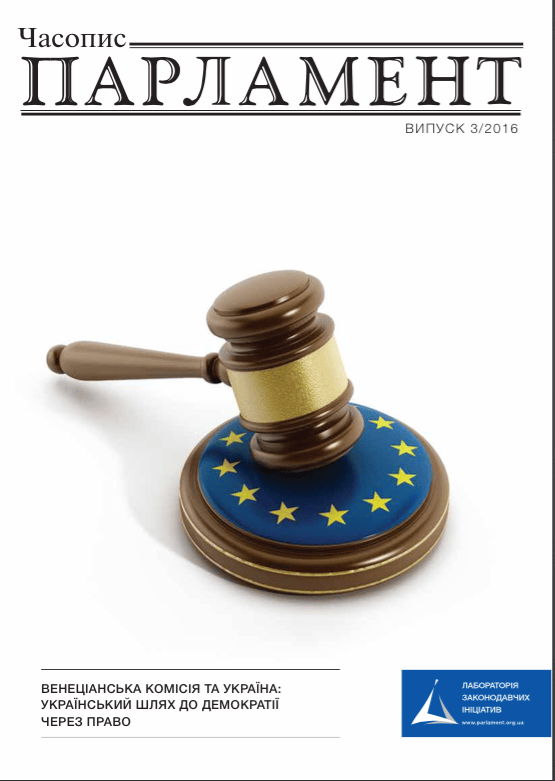
The Venice Commission and Ukraine: the Ukrainian path to democracy through law
The study analyzes the experience of Ukraine’s cooperation with the European Commission for Democracy through Law (Venice Commission), outlines the main areas and philosophy of the Venice Commission, the principles and standards that it guides, and the methods of its work. Particular attention is paid to the importance of studying and incorporating into the preparation and improvement of legislation not only the recommendations given in the Conclusions on Ukraine but also the generalized studies of the Venice Commission as part of the “European Constitutional Heritage”. The author concludes that Ukraine’s readiness to cooperate with the Venice Commission and taking into account the provided recommendations is a certain indicator of the democratic processes that are taking place in the state and Ukraine’s commitment to European values.
The preparation and presentation of Parliament Journal is part of the project embodied by the Agency for Legislative Initiatives, supported by the USAID Rada Program: Responsible Accountable Democratic Assembly, implemented by the East Europe Foundation.
The 6th International Academic Conference “Parliamentary Readings”
On November 18-19, 2016, the Sixth International Conference “Parliamentary Readings” took place at the House of Official Receptions (Kyiv, 22, Hrushevskoho Str.).
The Conference was organized by the Agency for Legislative Initiatives in partnership with the Faculty of Legal Sciences, Faculty of Social Sciences and Social Technologies of the National University of “Kyiv-Mohyla Academy” and the Department of Parliamentarism and Political Management of the National Academy of Public Administration under the President of Ukraine.
Welcome speeches were delivered by Ihor Kohut, Director of the USAID RADA Program, Oleksandr Zaslavskyi, Deputy Chairman of the Agency for Legislative Initiatives, Denys Azarov, Dean of the Faculty of Law of the National University of “Kyiv-Mohyla Academy”, Vasyl Kuibida, President of the National Academy of Public Management under the President of Ukraine.
Serhiy Holovatyi, founder and President of the Ukrainian Legal Foundation, Minister of Justice of Ukraine (1995-1997, 2005-2006), made a presentation entitled “20 Years of the Constitution: Assessment and Retrospective”.
On November 18, thematic sections covered the following issues:
• Parliamentary Reforms (Parliament at the Crossroads)
• Parliamentary Ethics: The Path toward Legitimation
The first section was moderated by Oleksandr Zaslavskyi, Deputy Chairman of the Agency for Legislative Initiatives, while its keynote speaker was Denys Yakovlev, Professor, Dean of the Faculty of Political Science and Sociology, National University “Odessa Law Academy”.
The section devoted to parliamentary ethics was moderated by Svitlana Matviienko, Chairwoman of the Agency for Legislative Initiatives; keynote speakers were Ihor Kohut, Director of the USAID RADA Program and Yuliia Tyshchenko, Head of Civil Society Development Programs at the Ukrainian Center for Independent Political Research.
On November 19, speakers focused on the prospects of development of Ukrainian parliamentarism and parliamentary activity in the context of the enforcement of democratic principles.
Sections were moderated by Olena Ivashchenko, Doctor of Law, Institute of International Relations of Taras Shevchenko National Universiy of Kyiv, and Oksana Shcherbaniuk, Chair of Department, Doctor of Law, Associate Professor of Yurii Fedkovych Chernivtsi National University.
Vsevolod Rechytskyi, PhD, Associate Professor of the Yaroslav Mudryi National Law Academy of Ukraine, discussed the topic “Can Ukraine Have an Official Constitutional Doctrine?”.
Parliamentary Readings 2016 came to a close by announcing the winners of the essay contest dedicated to the memory of Professor of Political Science Yuriy Shveda.
The conference is part of the project implemented by the Agency for Legislative Initiatives with the support of USAID RADA Program: Responsible, Accountable, Democratic Assembly. The RADA program, implemented by the East Europe Foundation, promotes the formation of a responsible, accountable and democratic representative body.
Training on Interparty Dialogue Skills for MPs of Ukraine
On November 16, the Agency for Legislative Initiatives held a Training on Interparty Dialogue Skills for MPs of Ukraine in cooperation with the USAID RADA Program, the Netherlands Institute for Multiparty Democracy, and the OSCE ODIHR in the office of the USAID RADA program.
During the two-hour presentation and interactive discussion on the interparty dialogue, the participants examined the significant differences between the notions of unanimity, compromise and consensus, as well as things that might go wrong in political negotiations in the case of wrong style and goals.
The trainer of the Netherlands Institute for Multiparty Democracy Jerome Scheltens explained the difference between negotiation, mediation, and dialogue and why the latter can ensure sustainable win-win results.
“Concerning the organization of intraparty and interparty processes, confidentiality is good when transparency is ineffective. The real art is to find areas of possible agreement and reduce the risks of agreement breakdown after the formal “handshake””

Фото: Олександр Коваленко
The MPs bombarded the trainer with pointed questions, and to answer them, Mr. Scheltens had to use the entire arsenal of international experience.
The activity takes place in the framework of the project of the Agency for Legislative Initiatives “Support for Democratic Political Culture in Parliament through Political Dialogue and Ethical Standards” implemented with the support of MATRA Program (Netherlands Embassy) and in partnership with the OSCE ODIHR Project “Strengthening Dialogue Among Civil Society and With Key Government Stakeholders in Ukraine on Human Dimension Issues”, the Netherlands Institute for Multiparty Democracy and USAID RADA Program: Responsible Accountable Democratic Assembly.
The project implies creating a dialogue platform for discussion of ethical dilemmas, which will provide for an inclusive process of the elaboration of a Code of Conduct for the Parliament or another mechanism to regulate parliamentary ethics, the approximation to international standards in accordance with the recommendations of the mission of the European Parliament, and the restoration of confidence in the Verkhovna Rada.
Presentation of the Shadow Report at the VRU Subcommittee
On November 16, 2016, at 9:00, the Subcommittee on Energy Saving and Energy Efficiency of the Committee on Fuel and Energy Complex, Nuclear Policy and Nuclear Safety held a meeting where experts of the Agency for Legislative Initiatives presented a preliminary version of the shadow report on the fulfillment of the Activity Plan for the Implementation of the National Energy Efficiency Action Plan for 2020. The full version of the report will be released in early 2017.

We express our gratitude to MP Oleksiy Ryabchyn for his assistance in organizing the event.
New standards for energy efficiency and building insulation are impossible without the revision of building standards based on international norms and standards. At present, different State Standards (DSTU) contain regulations with identical names and different requirements, which results in diverse interpretations.
Shadow reports are an innovation for Ukraine. It is designed for the public sector to communicate information and policy alternatives to parliament and other institutions.
The presentation of Shadow Reports to committees of the Verkhovna Rada of Ukraine is part of the project carried out by the Agency for Legislative Initiatives within the USAID RADA Program: Responsible Accountable Democratic Assembly, implemented by the East Europe Foundation.
Parliamentary Ombudsman Report. Parliament and the Media
Parliamentary Ombudsman Report
The activities of the ombudsman are an indispensable attribute of parliamentary control over the activities of executive bodies. The guarantee of growth of public trust to parliament and public authorities, in general, is appropriate functioning of this institute. Public reports of the Ombudsman are important documents that influence the formation of many areas of government policy.
The Roadmap on Internal Reform and Institutional Capacity Building for the Verkhovna Rada of Ukraine, prepared by the European Parliament’s Needs Assessment Mission (paragraph 21), focuses on the fact that “The Parliamentary Ombudsman should present annual (and where necessary, special) reports to the VRU for consideration and follow up having regard to the provisions of the Law on the Parliamentary Commissioner for Human Rights.”
Parliament and the Media
Parliament is the supreme representative institution because his work is the subject of much public attention and the media in particular. Interaction with the media is the most common and most successful practice of ensuring transparency and accountability in the work of lawmakers.
The Roadmap on Internal Reform and Institutional Capacity Building for the Verkhovna Rada of Ukraine (paragraph 29) says that “…The VRU staff should be exposed to international best practice and exchanges of know-how on effective parliamentary communication.”
The preparation and presentation of Parliament Journal is part of the project embodied by the Agency for Legislative Initiatives, supported by the USAID Rada Program: Responsible Accountable Democratic Assembly, implemented by the East Europe Foundation.
Presentation of E-Tools in the Verkhovna Rada
On November 4, 2016, in the Verkhovna Rada of Ukraine there was held a presentation of new e-resources that will help make Parliament activities more transparent: the Portal for Public Discussion of Draft Laws and the Electronic Register of Non-Governmental Organizations (E-Register of NGOs).
Thanks to these resources, the public will have the opportunity to contribute to the discussion of draft laws before they are submitted for consideration to specialized parliamentary committees.
The Portal for Public Discussion of Draft Laws, developed with the support of the USAID RADA Program and at the initiative of the Computerized Systems Department of the Verkhovna Rada of Ukraine, will make it possible to citizens:
- to get acquainted with draft laws submitted to the VRU for discussion,
- to get acquainted with the work of specialized committees of the Parliament,
- to participate in the discussion of draft laws.
“The potential of civil society has to be used to improve the quality of drafting bills and work of committees. The portal for public discussion of draft laws will provide an opportunity to improve transparency and confidence in committees”
Ihor Kohut
Director of the USAID RADA Program
The Portal for Public Discussion of Draft Laws was designed in response to the recommendations of the European Parliament on internal reforms of the Verkhovna Rada of Ukraine. It is aimed to improve its institutional capacity and step up public involvement in the legislative process.
“Our main goal is to ensure real and effective communication. Owing to the Agency for Legislative Initiatives, all participants in today’s meeting have got an excellent presentation of the electronic database”
Oleksii Sydorenko
Head of the Computerized Systems Department
“The portal is an important step towards the reform of the VRU. Much has been done. According to the rating of the Inter-Parliamentary Union, the VRU was rated 24th. I am confident that the pace of the reform of the Verkhovna Rada will remain very high next year”
Petro Bodnar
First Deputy Head of the VRU Secretariat
The other tool, i.e. Electronic Register of Non-Governmental Organizations (E-Register of NGOs), is designed to ensure public consultation during the work on draft resolutions in VRU committees. The E-Register was created by the Agency for Legislative Initiatives within the framework of the USAID RADA Program.
Thanks to this resource, committees will have up-to-date information on public associations, their expert input, management and expert composition, etc. The committees will be able to use this e-resource, which currently includes more than 80 organizations, to effectively involve non-governmental organizations in cooperation with one another. An application for cooperation can be submitted here.

“Public activity and donor support really influence the work of the parliament. The global trend when the civil society influences the government work continues after the Maidan. I think that we changed the influence of experts, analysts, and intellectuals after 2014. All revolutionary bills – those on the media, civil service, declarations – were adopted under pressure from the public. Therefore, increasing accessibility for citizens is the first and foremost task”

“We must make it clear that most of the MP’s work takes place not in the session hall, but it continues in the committees. Of course, this is not a “Green” or “White” Book. However, this will create an opportunity to increase the presence of experts in the committees. Therefore, it is necessary to popularize this resource in expert communities. Besides, it is important to understand which legislative initiatives are truly top priorities. One of the higher goals is to change the algorithm for reviewing and adopting laws to get rid of “legislative spam””
By the end of 2016, the resources already integrated into the Verkhovna Rada portal would work in a test mode to troubleshoot possible problems.
Expert Comment on Resolution 5000-П (Increase of MPs’ Salaries)
I Problem Description
On October 20, 2016, the Verkhovna Rada of Ukraine adopted the resolution “On Conclusions and Proposals as to the Draft Law of Ukraine on the State Budget of Ukraine 2017” (hereinafter – the Resolution).
Paragraph 4 of the Resolution approved Annex 2 on the increase of salaries of MPs of Ukraine: from 25 minimum wages for members of parliamentary committees to 30 minimum wages for the Chairman of the Verkhovna Rada. Currently the minimum wage is UAH 1450.
Draft Resolution No. 5000-П “On Conclusions and Proposals as to the Draft Law of Ukraine on the State Budget of Ukraine for 2017” was submitted on 20.10.2016. Main Committee: Budget Committee.
Initiators:
• V. Amelchenko (RPL),
• V. Shkvaryliuk (NF),
• O. Horbunov (NF),
• I. Krulko (Batkivshchyna),
• I. Kulichenko (BPP),
• O. Mushak (BPP).
According to Section V of the Rules of Procedure of the Verkhovna Rada of Ukraine (hereinafter referred to as the Rules), the approval of the State Budget is a matter considered under a special procedure.
However, according to Section 1 of Article 153 of the Rules, “Draft Law on the State Budget of Ukraine for the next year shall be considered taking into account the provisions of the Budget Code of Ukraine and these Rules”. Thus, if no special procedure is established for a specific stage of the budget process, the relevant general rule applies.
II Violation of the Resolution Adoption Procedure
The Draft Resolution was submitted and considered with the following violations of the laws of Ukraine:
1. The initiators submitted the draft law without accompanying documents specified in Section 1 of Art. 91 of the Rules, specifically without an explanatory note.
2. The initiators submitted the draft law without a financial feasibility study (including relevant calculations) specified in Section 3 of Art. 91 of the Rules.
3. The Secretariat of the Verkhovna Rada registered the draft law without proper supporting documents, contrary to the requirements of Sections 1 and 2 of Art. 92 of the Rules.
4. There were violations of the terms for consideration of the Resolution specified in the special procedure, namely: in accordance with the requirements of Section 1, Art. 156 of the Rules, the draft resolution was to be distributed among “MPs at least two days before the consideration of the Draft State Budget of Ukraine for the next year in the first reading by the Verkhovna Rada.” Meanwhile, it was distributed on the day of consideration, which made it impossible to properly analyze and discuss it both in Parliament and outside it.
5. The Resolution contains provisions that are incompatible with the requirements for the resolution on the conclusions and proposals for the Draft Law of Ukraine on the State Budget contained in Art. 156 of the Rules.
Given the foregoing, the following violations can be pointed out:
A) Resolution 5000-П was considered without the opinion of the main committee.
According to the requirements of Section 2, Art. 138 of the Rules, “Resolutions of the Verkhovna Rada shall be adopted on specific issues with a view to implementing its constituent, organizational, control and other functions”. Whereas, the Resolution relates to several diverse issues rather than to a specific one. Some of them concern the adoption of the State Budget 2017 and some do not.
Moreover, certain issues even belong to the jurisdiction of different parliamentary committees. Thus, paragraphs 1 and 2 refer to the State Budget 2017, which falls within the jurisdiction of the Budget Committee, while paragraphs 3 and 4 concern the support for MPs’ work, which is within the jurisdiction of the Committee on the Rules of Procedure and the Support to Work of the Verkhovna Rada of Ukraine.
B) The Resolution violates the principle of budget periodization
The resolution violates the principle of budget periodization described in Art. 3 of the Budget Code, which stipulates that under normal conditions the budget period coincides with the calendar year. The Resolution – which is part of the budget process 2017 as specified in its title – goes beyond the stated budget period at both ends because it includes provisions that were put into effect in 2016 and have an indefinite validity term.
B) Extralegal nature of the Resolution
The Resolution on the adoption of the draft law in the first reading also contains regulatory provisions that have a completely different legal nature. This is a gross violation of rule-making techniques and goes beyond the legal culture.
С) Violation of the Constitution
From the submission of the Resolution to its signing, the subjects of the process – the Verkhovna Rada of Ukraine as a state authority, MPs of Ukraine, and the relevant employees of the Secretariat of the Verkhovna Rada as officials of the state authority – repeatedly (see previous paragraphs) acted in a manner inconsistent with the Constitution and laws of Ukraine. Thereby they violated the requirements of Section 2. Art. 19 of the Constitution. In addition, gross systemic legal violations run contrary to the provisions of Section 1. Art. 1 of the Constitution – “Ukraine is a sovereign and independent, democratic, social, law-governed state” – with regard to a law-governed state.
The illegal expediting of the Resolution adoption procedure is unlikely to be in line with this provision. While the scope of MPs’ salaries set by the Resolution (this is not even taking into account the multi-thousand additional payments) is hardly in line with the principle of a social state.
Conclusions
1) The Resolution does not violate the legislation in terms of sources of funding.
The Resolution does not provide for amendments to the State Budget 2016. An increase in MPs’ salaries is possible due to the redistribution of expenditures within the current estimates of the Verkhovna Rada.
The funds necessary to increase MPs’ salaries by 2017 are set out in paragraph 1.17.2. Annex 1 to the Resolution, while funds for the subsequent budget periods, in accordance with the budget law, should be budgeted for when drawing up budgets for the relevant periods. In our opinion, paragraphs 3 and 4 of the Resolution should be completely abolished, and paragraph 5 should be abolished as regards points which concern paragraphs 3 and 4.
According to estimates, the draft budget provides for an increase of nearly 107 million on labor remuneration for the Verkhovna Rada, which completely covers the increase of MPs’ official salaries.
2) The main drawback of the adopted Annex to Resolution No. 5000-П is that these changes were proposed after July 15 when the budget was adopted. The provision of the Rules is the subject of disputes. Moreover, it has been repeatedly violated during the adoption of budgets in different years.
Over the last 10-15 years, there have been numerous cases when Parliament violated this rule, and the number of these violations amounted to dozens. Consequently, almost every such case resulted in the submission of an appeal to the Constitutional Court of Ukraine. Given the history and practice of this Court, only the violation mentioned above may be the subject of consideration by the Supreme Court.