What’s Wrong with the Abolished Parliamentary Immunity?
The abolition of parliamentary immunity was put forward by the representatives of the “Sluga narodu” and the President himself, almost the main achievement of the last year. But the recent story of a bribe to Oleksandr Yurchenko, an MP of “Sluga narodu”, raises doubts about the reality of the abolition of immunity, as it took two days of public pressure to open criminal proceedings, which is a threat to the political party’s ratings ahead of the local elections. When the scandal could not be quietly silenced, the MP was expelled from the faction and promised without investigation and trial that he would “definitely go to prison”.
What’s wrong with revoked parliamentary immunity? We answer by analyzing the changes to the legislation that were adopted at the end of 2019.

How was it before? The old pre-trial procedure of bringing an MP to criminal responsibility provided for the following stages:
- The opening of proceedings against the MP took place in the general order – any prosecutor could do it.
- Investigative actions in the form of search, detention, an inspection of items, violation of the secrecy of correspondence, telephone conversations, application of other measures, including covert investigative actions that restrict the rights and freedoms of a member of parliament by law, could be carried out only if the Verkhovna Rada agreed to bring the MP to justice.
- Detention, arrest, or criminal prosecution of the MP could be carried out only with the consent of the Verkhovna Rada. For this:
- The Prosecutor General filed motions for detention, arrest, and criminal prosecution;
- The nominated MP provided explanations to the Standing Committee;
- The Standing Committee considered the motivation for the submission and prepared an opinion:
- In the absence of sufficient evidence to substantiate the submission, the Speaker of the Verkhovna Rada could return the submission to the prosecutor’s office together with the opinion of the committee;
- The Verkhovna Rada then had to consider the committee’s opinion under a special procedure. If a majority of MPs voted for the decision, agree to start the MP’s prosecution process.
Current procedure. Amendments to the legislation, including the Constitution, excluded the Verkhovna Rada from the process of making such decisions, concentrating procedural powers in the hands of the Prosecutor General. Now (pre-trial) procedure of bringing the MP to criminal responsibility provides:
- Only the Prosecutor General can initiate proceedings concerning a member of parliament.
- Detention or house arrest, search, covert investigative (search) actions can be carried out only with the Prosecutor General’s consent. And at the consideration of the corresponding petitions (except for search and secret investigative actions), the MP has to be present.

The Prosecutor General’s monopoly on initiating proceedings and approving an important part of investigative actions significantly limits independent anti-corruption bodies’ capabilities – the National Anti-corruption Bureau of Ukraine (NABU) and the Specialized Anti-Corruption Prosecutor’s Office (SAPO). In fact, in investigations of MPs, these independent bodies depend on the Prosecutor General. The logic of creating a special vertical of anti-corruption bodies – NABU, SAPO, Anti-Corruption Court, is that these bodies are minimally dependent on other state bodies (including the Prosecutor General’s Office), as anti-corruption bodies are engaged in combating corruption in other state bodies. In the scandal with a bribe for the MP Yurchenko, NABU had to persuade Prosecutor General Iryna Venediktova to start proceedings publicly. Before that, the Prosecutor General did not see sufficient grounds for handing over the suspicion.
Is the immunity, which was so happily announced by the representatives of the “Sluga narodu” party, abolished? There has always been the possibility of prosecuting MPs. Yes, earlier, this required the consent of the Verkhovna Rada. In fact, out of 22 attempts to abolish the parliamentary immunity in the existing constitutional and legal framework for the VII and VIII convocations, 12 were successful – the MPs lost their parliamentary immunity. In some cases, voting in the session hall failed (6 cases). In three cases, the submission was returned to the Prosecutor General’s Office, and in another case, the Prosecutor General withdrew his submission.
The prosecutor’s office has problems with the preparation of submissions, which have been repeatedly “rejected” by the Standing Committee of the Verkhovna Rada (cases against Oleksandr Vilkul, Dmytro Kolesnikov, Serhiy Dunayev, and Oleksandr Ponomaryov). At the same time, it is difficult to say whether the problems were in the un/professionalism or non-/involvement of the Regulatory Committee or the prosecutor’s office and the courts.
Currently, the number of entities that decide on the possibility of bringing an MP to justice has decreased. Now the Verkhovna Rada’s consent is not required, and the powers are concentrated in the hands of the Prosecutor General. But the Prosecutor General is not independent. The President appoints him/her in agreement with the Verkhovna Rada. In Ukrainian practice, the Prosecutor General has always been a person of the President. In conditions when the President has a majority in the Verkhovna Rada, the Prosecutor General is even more dependent on the President. And it seems that the above-described powers of the Prosecutor General, as well as many of his other powers, under the current system of prosecuting MPs, will continue to be used as a tool to support friends and punish enemies.
Why Is a “Turbo Mode” of the Parliament Impossible?
After the first quarter of the Verkhovna Rada, the figures showed that the “turbo mode of the parliament” is a myth! And the results of our two monitorings for 1-2 and 3 sessions of the parliament only confirmed this. The tsunami of “legislative spam” is declining, the number of laws passed in the first year of the ninth convocation did not differ significantly from predecessors – members of parliament of the VIII convocation.
In particular, for the period of 1-2 sessions of the IX convocation (from 08/29/2019 to 01/17/2020) a total of 155 laws were adopted. During the same calendar period of the VIII convocation (from 11/27/2014 to 04/24/2015), MPs managed to pass not much less – 140 laws even though the Verkhovna Rada of the VIII convocation spent the first month of work on forming a coalition.
The third session of the new parliament seemed completely different, and therefore the annual “results” of the Verkhovna Rada are even lower than their predecessors in quantitative terms. But we emphasize that the annual calendar period of the two convocations in this matter is methodologically incorrect to compare – quarantine and pandemic are a significant error for analysis.

In general, the effectiveness of the work of the Verkhovna Rada cannot be measured by the number of bills, adopted laws, and hours spent in the session hall. It is difficult to distinguish between quantitative indicators and the quality of parliamentary work. Moreover, there can hardly be a system of clear KPIs in parliament to measure its performance.
The coordinated functioning of the state mechanism, which is fundamental for the country’s development, depends not on the fact that a certain law has been adopted but on all decision-making bodies’ coordinated interaction.
The state is a system. And a democratic state means procedures and their observance to keep the system balanced.
“Legislative turbo mode” and democracy – these concepts are incompatible, in principle. The procedure for adopting the law is described in the Rules of Procedure. And it involves a rather long process of discussion, refinement, weighing all the pros and cons. Any attempt to speed up this procedure, to fulfill the “five-year plan” for the number of laws in one parliamentary session will lead to a violation of the Rules of Procedure and, consequently, of the declared democratic principles. This is not even about the quality of bills produced by the subjects of the legislative initiative.
The eighth and ninth convocations operated at the marginal capacity of the law-making process. This is not a feature of the new parliament, but only a marketing move, which was coined by the apt name “turbo mode”. The “turbo regime” of the parliament did not happen – and it’s for the best.
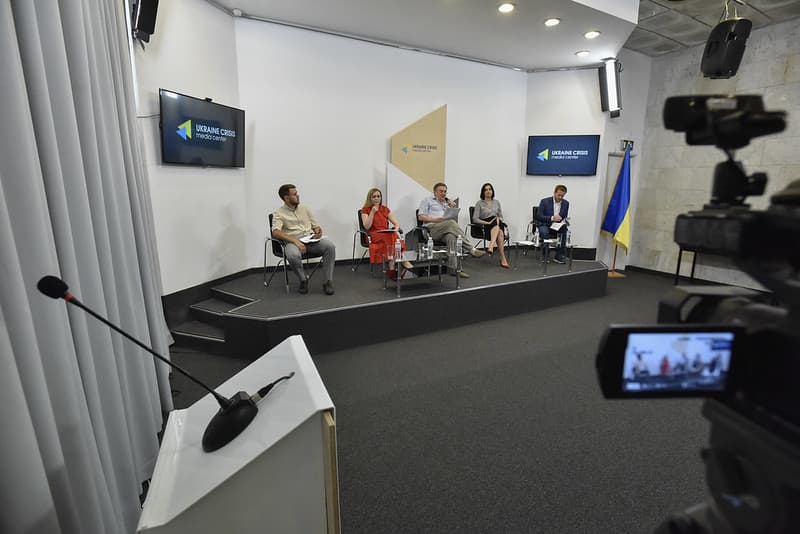
Svitlana Matviienko took part in the presentation of the expert survey “Political Quarter: Summer 2020”
On Thursday, July 30, Svitlana Matviienko, Chairwoman of the Board of the Agency for Legislative Initiatives, took part in presenting the results of the expert survey “Political Quarter: Summer 2020” conducted by the Ilko Kucheriv “Democratic Initiatives” Foundation.
During the event, the speakers discussed the main trends of the political process in Ukraine. Svitlana Matviienko spoke about the observation of the Agency for Legislative Initiatives regarding the work of the parliament and the president. We publish in full the speech of the Chairwoman of the Board of the Agency for Legislative Initiatives.
About the parliament
“There are some positive trends. However, not without a “BUT”. In the first half of the year, there was a noticeable decrease in the number of registered draft laws. That is, the amount of what Pete Cox’s Roadmap calls legislative spam or “legislative tsunami” has decreased. A total of 1,178 draft laws were registered during the 1-2 sessions of the Verkhovna Rada of the IX convocation. Accordingly, the number of registered draft laws decreased by almost a third compared to the same calendar period of the VIII convocation.
During the third session, 13% fewer draft laws were registered than during the first two sessions. Given that during the first two sessions of the IX convocation, almost a third fewer draft laws were registered than during the same period of the VIII convocation. It is tempting to talk about some dynamics of reducing the flow of draft laws. However, it is noteworthy that, along with the decrease in the number of parliamentary draft laws over the past six months, the number of registered government and presidential draft laws has also decreased. And such a synchronous decrease can rather be explained by a long socio-political lockdown during the strict quarantine.
Another positive trend. The share of draft laws adopted in the second reading has increased. In the first and second sessions, this share reached 74% compared to 38% for the same period in the VIII convocation. However, the trend was unstable, and in the third session, their share fell to 49%. We hope that this is due to the peculiarities of the work of the Verkhovna Rada during quarantine restrictions.
Along with this, consideration of draft laws started to take longer. Why is this good? Because the laws passed in the first reading and in general – almost guaranteed – will be of lower quality in terms of legal technique or will not consider all stakeholders’ positions. As a result, it will affect their implementation and effectiveness. Passing almost 75% of the approved draft laws through 2 readings (we don’t mention the third one) is at least a precaution against making people laugh (or rather resent) in a hurry.
Was there a “turbo mode”?
As for the turbo mode, which is still popular to mention among the majority. Six months ago, it was already obvious to us and all those who monitor the parliament’s work that this mode is not so “turbo”. As they say: everything is known by comparison. During the first two sessions (read six months) in the ninth convocation, 155 laws, or 13% of registered resent were adopted. In the VIII convocation for the same calendar period, 140 laws, or 9% of the registered ones, were adopted. At the same time, we must remember that the majority began to pass laws (including on amendments to the Constitution) on the first day, immediately after the opening ceremony, and taking the oath. While the MPs of the VIII convocation spent at least the first month on negotiations, working out a coalition agreement and forming the government. So, forget about the turbo.
We did not compare the 3rd session of the ninth convocation with the same period of the VIII session, because this would be irrelevant given the extraordinary circumstances in the form of strict quarantine. The parliament lost two working months.
About negative tendencies
During the first two sessions, it was noticed that the percentage of adopted laws, the subject of the legislative initiative of which is the government (17% vs. 35% in the VIII convocation) decreased. This trend may indicate a weakening of the role of government in shaping public policies. It also harms the principle of unity of decision-making.
During the 3rd session, the share of the accepted governmental projects is insignificant. Only 7 government draft laws were passed. Is this because the government has a weak position in policy-making, completely subordinate to the President’s Office? Or is it because the government does not see a need to be an independent player, instructing MPs to register the necessary draft laws? Both possible explanations are disappointing. There is a clear distortion of the constitutionally established system of checks and balances against the concentration of powers in one power entity in Ukraine. However, the tendency to weaken the government in the decision-making system is contrary to global trends.
How did the president work?
Volodymyr Zelensky, of the last four presidents, registered the largest number of draft laws in his first year – 76 (or 4% of all registered this year). His predecessors exercised the right of legislative initiative, respectively: 48 times – Poroshenko, 39 – Yanukovych, 50 – Yushchenko. The relative share of legislative initiatives of other presidents was not more than 2%. At the same time, the rate of adopted presidential draft laws during Zelensky’s first year of a presidency is twice lower – 38% – compared to previous presidents, where the share of adopted laws ranged from 76% to 82%. This situation is rather strange because the president had his “mono-majority” in parliament for the most calendar year, which became a unique situation in Ukrainian history. Given the frequent personnel changes during the year, as well as the results of a study by the Sociological Group “Rating”, this situation may indicate the active use of the model “good President – bad MPs / officials”, which in turn, leads to a positive image only of the president. Although it no longer helps. Another explanation may be that the “Sluga narodu” party was formed virtually and from people who were not connected with politics in any way before the election. After a while, this affected the weak factional discipline and led to multiple divisions.
According to Article 94 of Ukraine’s Constitution, the president must within 15 days sign the law adopted by the Verkhovna Rada or return it with his proposals. The average rate (median) of signing bills by Zelensky was 9 days, which is the fastest rate among Ukrainian presidents. For the rest of the presidents, this figure was 15 days. However, some of the laws were signed in violation of the 15-day deadline. Thus, Zelensky signed 13% of all adopted laws in violation of the deadline (for other presidents, the figure ranged from 8% to 17%). And while for many, such a violation may seem insignificant, it is still a direct violation of the Constitution, which may be grounds for declaring laws unconstitutional. It is also worth mentioning the situation with three draft laws that Volodymyr Zelensky “inherited” from Petro Poroshenko: №0975, №0976, №0977. These draft laws were neither signed nor vetoed by the new president for much more than 15 days, which directly violated the Constitution. Zelensky dragged on time until the new parliament was elected to prevent these laws from being passed”.
You can read more about the work of the parliament and the president of Ukraine in the other articles of the Agency for Legislative Initiatives.
Monitoring of the Ukrainian Parliament’s work, IX convocation, 3rd session
The third session of the Verkhovna Rada: What has changed in the work of the parliament?
Agency for Legislative Initiatives continues to monitor the work of the Verkhovna Rada closely. So far, it appears that each session of the ninth convocation is as special as the seasons of a good TV-show: the first lasted a bit over 13 hours; the second was the starting point of the work (and the beginning for each session is unique at the data level); the third session coincided with the coronavirus pandemic and quarantine restrictions, which brought its adjustments to the plans of the Verkhovna Rada. Considering this, we tried not to focus on the comparative analysis of sessions (particularly during the same period of the Verkhovna Rada of the VIII convocation). Still, in some cases, where appropriate, we concluded the possible dynamics.
During the third session, 946 draft laws were registered. 105 laws were adopted.
The number of draft laws registered during the third session is 13% less than in the first two sessions. Besides, we want to recall that during the first two sessions of the ninth convocation, almost a third fewer draft laws were registered than during the same period of the eighth convocation. This indicates the tendency to reduce the “legislative tsunami”. However, along with the decrease in the number of parliamentary draft laws, the number of registered government and presidential draft laws has decreased over the past six months. And such a synchronous reduction can be explained by a long socio-political lockdown during the strict quarantine.
The only political faction that has significantly increased the number of its registered draft laws is Holos. Such a strategy may have some results, as a total of 3 hours were spent on their draft laws in the session hall. And this is three times more than the time spent on draft laws of other parliamentary factions and groups that are not the Sluha narodu faction.
Consideration of draft laws in the session hall is mainly concentrated around the MPs’ draft laws. 107 out of 115 hours of parliament’s sittings were dedicated to the draft laws of the Sluha narodu faction. Government draft laws took just over five hours.
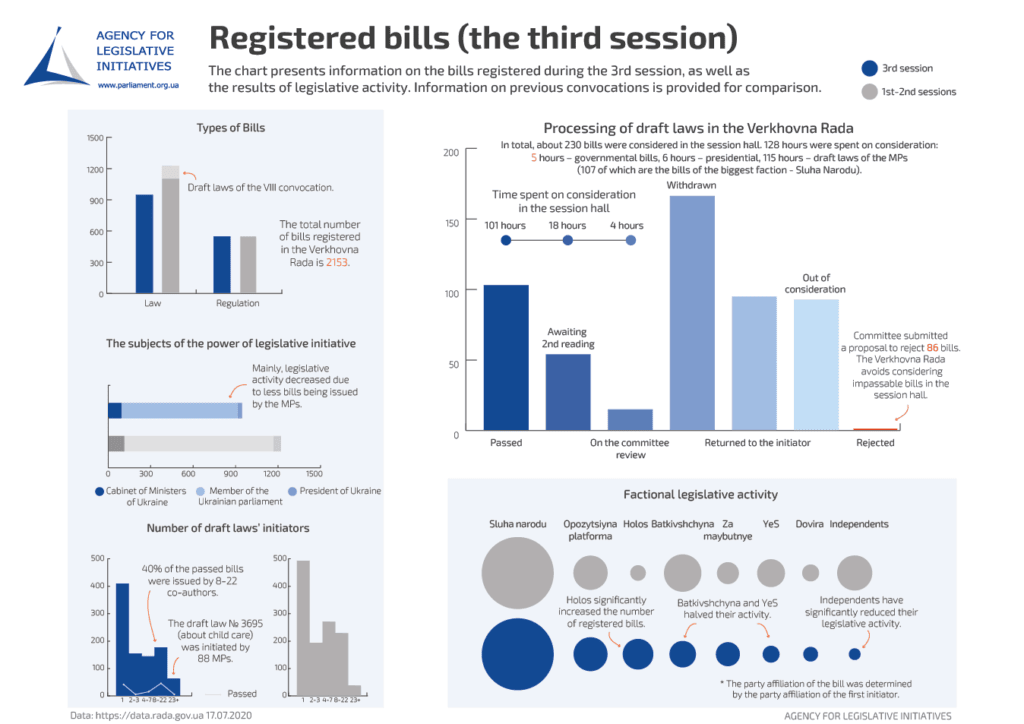
The Verkhovna Rada avoids considering impassable draft laws. During the 3rd session, only one draft law was rejected due to the failure to overcome the President’s veto. In terms of efficiency, in the sense of passing draft laws, it makes sense. At the same time, there are risks associated with weakening the political discussion. The committees issued unsatisfactory conclusions on 86 draft laws (2 of them on government draft laws). There is a trend: the committee’s conclusions to reject become a sufficient reason to stop further consideration of the draft laws. And if in the case of parliamentary draft laws, this is an additional filter of legislative spam, then the consideration of government draft laws should not be stopped even because of the committee’s negative conclusion.
The share of draft laws considered in two readings has decreased. One of the positive aspects of the previous sessions was the increase in the percentage of draft laws that passed two readings – during the first two sessions such draft laws, 74% of adopted laws passed two readings (compared to 38% in the VIII convocation for the same calendar period). Unfortunately, during the 3rd session, their number dropped to 49%. We hope that this is a temporary measure related to the peculiarities of the work of the Verkhovna Rada during quarantine restrictions.
Draft laws that are taken as a basis and in general are slower to pass. In previous sessions, the draft laws adopted as a basis and became laws, on average, 22 days after registration. In the third session, this figure was 32 days. This trend is natural, as MPs gathered in the session hall with long breaks. It is also influenced by the fact that draft laws are often accumulated in the Verkhovna Rada, and their consideration does not always happen during one regular session.
Draft laws adopted in two readings are passed much more slowly. The average speed of adoption of such draft laws is 173 days. But the reason is not that the process stops after the first reading (between the first reading and adoption, on average, passes a little more than 40 days). Draft laws registered earlier are considered in two readings. To sum up, “fresh” registered draft laws are more likely to be passed in the first reading as a whole. And the draft laws, which have already been “lying down” for a while, will most likely be considered in two readings due to the need to update the draft laws under the political agenda.
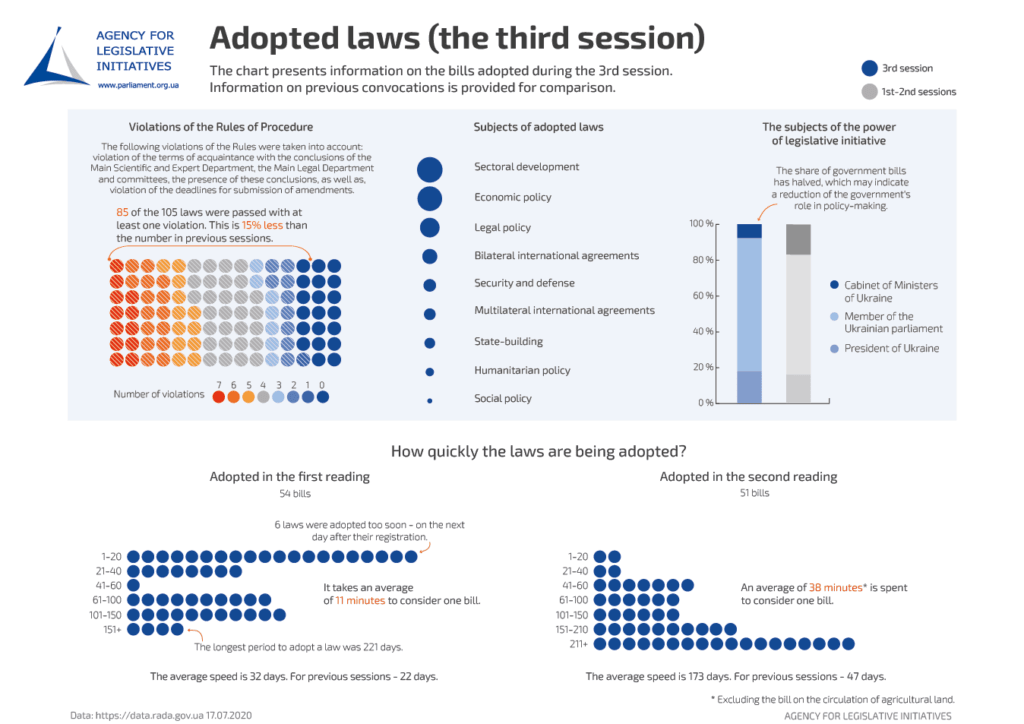
The government loses its position in policy making. The share of adopted government draft laws is insignificant. Of the 105 laws passed, only 7 are government draft laws. Is this because the government has a weak position in policy-making, completely subordinate to the President’s Office? Or is it because the government does not see a need to be an independent player, instructing MPs to register the necessary draft laws? Both possible explanations are disappointing. During the first two sessions of the parliament, the share of approved government draft laws decreased significantly compared to the same period of the previous convocation of the Verkhovna Rada. There is a clear distortion of the constitutionally established system of checks and balances against the concentration of powers in one power entity in Ukraine. However, the tendency to weaken the government in the decision-making system contradicts global trends. You can read more about this in our article “The concept of the legislative process “from beginning to end”.
In addition to these trends, identified based on monitoring and analysis of open data of the Verkhovna Rada, it is worth noting a significant change in the work of parliament during the 3rd session. In particular, it is about the changes to the Rules of Procedure – implementation of a special procedure for draft laws’ consideration in the second reading, which is positioned as a mechanism “to counteract the abuse of MPs’ rights during the legislative procedure”. You can read more about these changes, their consequences and the problem of parliamentary obstruction in general in another article of Agency.
Interpellation: What Is Proposed to Be Introduced in Ukraine?
The effective functioning of any public authority is impossible without establishing an effective system of control over the implementation of its decisions because the very “effectiveness of any decision depends on control”. For example, the parliament is responsible for the supervision of the activities of the executive branch. And soon the Verkhovna Rada may get more tools for this. In May, MPs registered the draft law №3499, which provides the introduction of the newest form of parliamentary control for Ukraine – interpellation.
What is an interpellation?
This is another form of parliamentary control, which is used to discuss the executive branch’s activities. In general, it can be described as follows: members of parliament have the right to invite government representatives to parliament so that government officials or one particular official can explain their policies, specific documents, or actions. Members of parliament can ask questions to government officials or debate the results of a speech by a member of the government. Sometimes, as a result of such debates, parliament can express a vote of no confidence.
An interpellation is a new form of parliamentary control for Ukraine, which was previously exercised only through parliamentary inquiries and an hour of questions to the government. The procedure of the current Rules of Procedure closest to the interpellation is the procedure of considering the answer to the MP’s request, which is established by Art. 226, but still, the interpellation procedure provides a more specific impact of the parliament on the government’s activities.
In particular, Art. 226 also stipulates that the executive branch members may be summoned to parliament (to discuss a response to an MP’s request). But we will consider the differences:
| Interpellation |
Discussion of the answer
at the request of the MP |
| Initiated by 45 MPs or a committee |
Initiated by 90 MPs |
| Appointed by the Speaker of the Verkhovna Rada |
Appointed by the majority in the Verkhovna Rada |
| Ministers or deputy prime ministers represent the executive branch. |
The executive branch is represented by any official who is an inquiry addressed to. |
| Lasts about 2 hours |
Lasts up to 30 minutes |
| According to the interpellation results, a member of the government receives 3 months of immunity, or the procedure of his dismissal begins. |
Based on the results of the discussion, a resolution is adopted, but its content is arbitrary. |

The procedure of discussing an MP’s request requires twice as many MPs to initiate it, the decision of at least 226 MPs to appoint it, lasts 4 times less and has no clear legal consequences. However, it can apply to any official, not just members of the government.
How will the interpellation take place if the MPs pass the draft law №3499?

Considering the interpellation in the Verkhovna Rada’s plenary hall can take about two hours. It includes speeches by the MPs who initiated the interpellation and the “respondent” minister. After that, the discussion takes place in the format of questions and answers. The Prime Minister can also speak.
Based on the discussion results, the Verkhovna Rada may request some additional documents – then, a new date for consideration of the interpellation is set. If there are no additional issues, after discussions, the parliament votes to declare the work of a member of the Cabinet unsatisfactory. If less than 226 MPs voted in favor, then the work of this member of the government is considered satisfactory – and he/she receives “immunity” from interpellation for three months.
Suppose the work of a member of the Cabinet of Ministers is considered unsatisfactory. In that case, the Prime Minister must submit a motion to dismiss such a member of the Cabinet of Ministers within 15 days, or the Verkhovna Rada itself considers the issue of his dismissal.
We emphasize that the interpellation alone cannot lead to the dismissal of a member of the Cabinet. His/her work can only be considered unsatisfactory, and then a new consideration of dismissal of a member of the Cabinet and a new vote on this issue. Accordingly, it is necessary to collect at least 226 votes for the minister’s dismissal once again, after the interpellation vote.
What will the adoption of the law “On Interpellation” change?
The idea of introducing a law on interpellation is valuable. However, it is alarming that the MPs are trying to introduce an interpellation by a separate law, not through changes to the Rules of Procedure. Thus, there may be a problem of compatibility of this law with the Rules of Procedure.
And here are the likely political consequences of the adoption of this draft law:
- First, the adoption of the draft law could lead to increased parliamentary control over the executive branch. MPs’ inquiries are mostly non-public, and the hour of questions to the government is very vague, as MPs ask different questions on different topics to different ministers, while ministers mostly answer something like “did not know about this situation, we will get to it soon” or say general facts. The interpellation should focus the discussion on a specific list of issues, and this will be the subject of public attention. Finally, the interpellation consideration may result in the dismissal of a member of the Cabinet of Ministers.
- Secondly, the factions will receive a new instrument of politics implementation, part of the criticism of the government will be carried out in the form of interpellations.
- Third, there will be a strengthening of the ruling majority, which appoints the Speaker of the Verkhovna Rada, as it is the Speaker of the Verkhovna Rada, who receives the authority to moderate the interpellation process and may refuse to consider it.
- Fourth, suppose the Speaker of the Verkhovna Rada strictly adheres to the Rules of Procedure and the Law on Interpellation and accepts the interpellation initiated by the opposition. In that case, a large part of the plenary time will probably be devoted to the consideration of interpellations.
“Unlike the Others”: Analysis of the First Year of Volodymyr Zelensky’s Work
From the very beginning of the election campaign, Volodymyr Zelensky positioned himself as a “non-systemic” candidate, and while already in office, at least in the media discourse, he tried to maintain such an image. However, the president is not only a media actor but also a subject of legislative initiative and a critical element of the system of power, the system of checks and balances. The president has his powers, clearly defined by the Constitution. He exercises these powers to a large extent, not independently, but in cooperation with the Government and the Parliament. Did the president manage to become “different from the old politicians” in terms of interaction with other subjects of the legislative initiative in the first year? The answer to this question can be given by the analysis of the legislative activity of Volodymyr Zelensky in comparison with his predecessors.

It is necessary to right away make a remark about the correctness of the analysis of the calendar year of the president’s work, as the head of state exercises his powers in cooperation with the parliament. At the same time, Volodymyr Zelensky received “his” Parliament and Government not immediately, but only at the end of August 2019. It should be reminded here that Ukraine is a parliamentary-presidential republic. The key role in Ukraine, according to the Constitution, is played by the parliament. It “determines the principles of domestic and foreign policy” (paragraph 5 of Article 85) and forms the government, which, in turn, ensures “the implementation of the domestic and foreign policy of the state, the implementation of the Constitution and laws of Ukraine, acts of the President of Ukraine” (paragraph 1 of Article 116). That is, the President of Ukraine, as a “guarantor of state sovereignty, territorial integrity of Ukraine, observance of the Constitution of Ukraine, human and civil rights and freedoms,” exercises his powers regardless of the presence or absence of “his” Parliament and Government. Besides, previous presidents have started their first year from diverse positions. Therefore, in our opinion, it is quite relevant to analyze the results of the work of the president’s calendar year, as well as to compare them with the “predecessors”.
President in the legislative process: illusory efficiency
The relationship between the president and the parliament can be discussed in different areas. The most interesting dimension, of course, is the degree of the president’s influence on parliament, but often such considerations are based on facts that are difficult to verify. Instead, we tried to analyze the president’s participation in the legislative process, based on formal indicators, and compare the indicators with previous presidents: with Petro Poroshenko, Viktor Yanukovych, and Viktor Yushchenko.
The right of legislative initiative
Zelensky, of the last four presidents, registered the largest number of bills in his first year – 76 (or 4% of all registered this year). His predecessors exercised the right of legislative initiative, respectively: 48 times – Poroshenko, 39 – Yanukovych, 50 – Yushchenko. The relative share of legislative initiatives of other presidents was not more than 2%. At the same time, the rate of adopted presidential bills of Zelensky is twice lower – 38% – compared to the previous presidents, where the share of adopted ranged from 76% to 82%. This situation looks rather strange because the president had his “mono-majority” in parliament for most of the calendar year, which became a unique situation in Ukrainian history. Given the frequent personnel changes during the year, as well as the results of the survey of the Sociological Group “Rating”, this situation may indicate the active use of the model “good President – bad MPs/officials”, which leads to a positive image of the president. Another explanation may be that the party “Servant of the People” was formed virtually and from people who were not connected in any way before the election. This, after a while, affected the weak factional discipline and led to multiple divisions.
Zelensky used his veto only 12 times in the first year. And this is the lowest number among the four presidents. It is logical given the presence of support in the parliament, which previous presidents could not boast of in the first year of their work. It may also indicate a significant influence of the president on the legislative branch and the lack of polarization of views on legislative activity in the party (at least during the first months of work). Given the possible split in the “majority”, it is likely that in the coming years, the president will use his veto more actively. For comparison, during the first year of his presidency, Poroshenko used his veto power 16 times, Yanukovych 30 times, and Yushchenko 58 times (!). Interestingly, the tactics of vetoing by presidents are quite different. Thus, Yushchenko and Poroshenko periodically vetoed bills two or more times.
According to Article 94 of the Constitution of Ukraine, the president must sign the bill adopted by the Verkhovna Rada within 15 days or return it with his proposals. The average rate (median) of signing bills by Zelensky was 9 days, which is the fastest rate among presidents. For the rest of the presidents, this number is 15 days. However, some of the bills were signed in violation of the 15-day deadline. Thus, Zelensky signed 13% of all adopted laws in violation of the deadline (for other presidents, the figure ranged from 8% to 17%). And while for many such a violation may seem insignificant, it is still a direct violation of the Constitution, which may be grounds for declaring laws unconstitutional. It is also worth mentioning about the situation with three bills that Volodymyr Zelensky inherited from Petro Poroshenko: №0975, №0976, №0977. These bills were neither signed nor vetoed by the new president for much more than 15 days. Zelensky dragged on time until the new parliament was elected to prevent these laws from being passed.

President and government: have two (three)
Another illustrative aspect of the president’s work is how often and under which conditions the government changed. Apart from the prime ministers appointed before the presidency, Volodymyr Zelensky, as of the first year, has the same figures as Viktor Yushchenko (2 newly appointed prime ministers). Zelensky resembles not only Yushchenko but also Kravchuk and Kuchma in the pace of change of heads of government. They all replaced the current prime minister with a new one on 9-11 months of their presidencies.
Eternally imperfect Constitution
Analyzing the activities of Ukrainian presidents, we cannot ignore the fact that every president of the independent Ukraine tried to change the Constitution. Volodymyr Zelensky is no exception.

The first President of Ukraine is Leonid Kravchuk. For Kravchuk, the change of the Constitution of the USSR to the Constitution of Ukraine seemed logical and natural: a new state – a new Constitution. Leonid Kravchuk started working on the new Constitution before his presidency when he was the Chairman of the Verkhovna Rada. The Constitutional Commission was established. The Concept of the new Constitution was developed. However, the turbulent events of the early 1990s prevented the Verkhovna Rada of the Ukrainian Soviet Socialist Republic of the 12th convocation, which was later renamed the Verkhovna Rada of Ukraine of the 1st convocation, from adopting the Basic Law.
Leonid Kuchma continued the constitutional process, and finally, in 1996, the Constitution was adopted. However, Leonid Kuchma did not limit himself to adopting the Constitution alone. At the end of his first term, he began talking about the need to revise the Constitution, and in 2000 held an all-Ukrainian referendum on reducing the number of MPs to 300 and introducing a bicameral parliament (remember how much this initiative was used in the last election race?). However, the results of the referendum were not embodied in the amendments to the Constitution. And in 2002, against the background of a possible election loss, Leonid Kuchma initiated another reform aimed at strengthening the Verkhovna Rada by reducing the powers of the president and moving to a parliamentary-presidential model. A temporary special commission was set up, and at the end of Leonid Kuchma’s term in 2004, the relevant amendments to the Constitution were adopted.
Viktor Yushchenko took office just after the 2004 constitutional reform (which gradually came into force during 2005-2006), so, unlike his two predecessors, he did not initiate constitutional changes in the first year of his presidency. However, without constitutional changes, Viktor Yushchenko could not hold out. In 2007, the National Constitutional Council was established, headed by the president himself. Maryna Stavniychuk became its secretary. However, Yushchenko did not have enough support in the Verkhovna Rada, so he wanted to amend the Constitution through a referendum, but failed to do so. In 2009, a draft amendment to the Constitution was submitted to the Verkhovna Rada. This project, among other things, provided for a bicameral parliament and an increase in the powers of the president. In the end, without the support of the Verkhovna Rada, Viktor Yushchenko could not make any changes to the Constitution.
Viktor Yanukovych has decided not to waste his first year of presidency within the constitutional powers in force at the time, which he inherited from his predecessors. Therefore, at the hands of his fellow party members in parliament, he appealed to the Constitutional Court regarding the illegality of the constitutional changes of 2004. In the fall of 2010, the CCU (the Constitutional Court of Ukraine) declared these changes unconstitutional. At the end of the first year of his presidency, Viktor Yanukovych made his first changes to the Constitution, again using the help of the Party of Regions faction in parliament. Among the significant changes, in particular, the president managed to increase the term of office of the Verkhovna Rada and local councils from 4 to 5 years.
After that, on February 21, 2011, Viktor Yanukovych formed the Constitutional Assembly. The Head of the Assembly was Leonid Kravchuk, and the secretary was Marina Stavniychuk. The Constitutional Assembly was to work out amendments to the Constitution regarding the powers of government and local self-government. The next amendments to the Constitution were the expansion of the powers of the Accounting Chamber, which was allowed to control revenues to the state budget.
The events of late 2013 – early 2014 led to the termination of the Constitutional Assembly. That is, the Constitutional Assembly had no results in the form of comprehensive amendments to the Basic Law.
After the victory of the Revolution of Dignity on February 21, 2014, the Verkhovna Rada restored the 2004 version of the Constitution.
Petro Poroshenko also did not hesitate to amend the Constitution. Already in June 2014, he submitted a draft law amending the Constitution (on the powers of public authorities and local self-government), but he withdrew it. And in March 2015 (in the 10th month of the presidency), he set up a Constitutional Commission. This commission was to work out amendments to the Constitution in three areas:
- Decentralization.
- Justice.
- Rights and freedoms of man and citizen.
The first results of the work of the Constitutional Commission appeared in the summer of 2015. At that time, amendments were proposed to the Constitution regarding the decentralization of power (draft law № 2217a). There were intentions to change the entire vertical of power at the local level and introduce a new administrative-territorial system. However, the bill was withdrawn after the presidency passed from Poroshenko to Zelensky.
The changes proposed by Petro Poroshenko in the field of justice proved to be more productive. As a result, the following was approved:
- The High Council of Justice elects judges.
- Instead of a 5-year term, judges are elected indefinitely.
- Neither the President nor the Verkhovna Rada can dismiss judges.
- A constitutional complaint mechanism has been introduced.
- Only lawyers can defend citizens in court.
At the end of his presidential term, Petro Poroshenko initiated two more amendments to the Constitution – consolidating the course of Ukraine’s integration with NATO and the EU.
The second draft of amendments to the Constitution (draft law № 9310 on renaming the Dnipropetrovsk region, actually initiated by a group of MPs) did not receive the necessary support in the hall and was withdrawn from consideration.
Volodymyr Zelensky has not yet set up commissions or assemblies. Still, in the first year of his presidency, he has already initiated eight draft amendments to the Constitution and made changes to the Constitution initiated by his predecessor.
Petro Poroshenko introduced the bill on the abolition of parliamentary immunity, but it was considered and adopted under Volodymyr Zelensky.
Zelensky’s legislative initiatives have not yet been implemented. Some are now under consideration, and some have already been rejected. Namely – it is:
- Amendments to the abolition of the lawyer’s monopoly (draft law № 1013), according to which citizens can represent themselves in courts, except for representation in criminal cases. The bill is pending.
- Changes in regulatory bodies (draft law № 1014), under which the president will be able to form new regulatory bodies, appoint and dismiss the National Anti-Corruption Bureau of Ukraine (NABU) and the State Bureau of Investigations chairpersons. The bill was rejected.
- Amendments to the legislative initiative of the people (draft law № 1015), according to which the people are given the right of legislative initiative. The bill is pending.
- Amendments to the Commissioners of the Verkhovna Rada (draft law № 1016), which introduce the position of the Commissioners of the Verkhovna Rada of Ukraine in compliance with the Constitution of Ukraine and regulations in certain areas. The bill received a negative opinion of the Constitutional Court. It is pending.
- Amendments to reduce the number of MPs and implement the proportional electoral system (draft law № 1017), which reduces the number of MPs to 300, and the Constitution establishes a proportional electoral system. The bill is awaiting consideration, although it has received an opinion from the Constitutional Court with reservations.
- Changes to expand the grounds for deprivation of an MP’s mandate (draft law № 1027), according to which it is proposed to take away an MP’s mandate in case of impersonal voting or absence of an MP for more than a third of sittings. The bill received a negative opinion of the Constitutional Court, pending.
- Amendments to additional bodies of the Verkhovna Rada (draft law № 1028), according to which the Verkhovna Rada receives the right to establish advisory and consultative bodies. The bill received a positive opinion of the Constitutional Court, pending.
- Changes in the decentralization of power (draft law № 2598), which introduces a new structure of local government and a new administrative-territorial system. The bill was withdrawn.
Thus, in the first year of his presidency, Volodymyr Zelensky submitted the most bills on amendments to the Constitution among all Presidents of Ukraine. But it is important to note that the draft amendments submitted by Volodymyr Zelensky are particular, although some of them have repeatedly been positioned, for example, as a “parliamentary” reform.
Also, unlike his predecessors, Zelensky, at least so far, has not created bodies or open and inclusive platforms for drafting amendments to the Constitution. Legislative initiatives of the sixth President of Ukraine can be summarized as follows:
- Among all the draft laws, only the draft law that was being developed during the time of Petro Poroshenko’s presidency was adopted.
- three draft amendments to the Constitution have already received the conclusions of the CCU. They have been preliminarily approved (although the draft amendments № 1017 received the opinion of the CCU with reservations).
- one draft amendment received the conclusions of the Constitutional Court with reservations and has not yet been considered.
- three draft amendments received negative conclusions of the Constitutional Court and, therefore, cannot be adopted.
- one draft amendment was withdrawn without being considered.
Instead of conclusions
The general conclusion of the comparative analysis is that Volodymyr Zelensky, as president, is not as different from his predecessors as it may seem from media discourse. At least, the frequency of changes in the government, violations during the legislative process, as well as attempts to “quickly” change the Constitution make him similar to other Presidents of Ukraine. And the active reflection of public discontent onto other constitutional subjects evokes an analogy with Leonid Kuchma, which, as a result, is confirmed by a poll by the sociological group “Rating”.
However, the differences that still exist can be reduced to the following aspects:
- Legislative (but not very effective) activity;
- Attempts to act as fast as the procedures allow;
- Attempts to avoid deliberation (discussion) in making important decisions – in particular, about changes to the Constitution.
Which results and consequences these similarities and differences will lead to – we will see and analyze later.
Legislative Puzzle: How to Overcome “Amendment Spam”?
More than 16,000 amendments were submitted to the draft law 2571-d (the so-called “Anti-Kolomoisky bank law”). Anton Polyakov alone proposed 6,000 amendments, which is more than the number of amendments submitted by all MPs to the draft law on the land market. Given the need to obtain a loan from the IMF, the adoption of Bill 2571-d was extremely important, and consideration of all 16,000 amendments is incompatible with the fast-track legislative procedure.
Due to the problematic situation, the media began to report on possible ways to circumvent the amendment spam through Article 119 of the Rules of Procedure of the Verkhovna Rada of Ukraine.
Agency for Legislative Initiatives analyzed the possibilities for the rapid adoption of the bill, with a lot of amendments to Article 119.
What does Article 119 of the Rules of Procedure of the Verkhovna Rada provide?
Why do people believe in the effectiveness of Article 119? Actually, according to part 2 of Art. 119: “The Verkhovna Rada may pass a procedural decision concerning the debate of a draft law in parts (sections) by holding a separate debate and vote for such parts”. Indeed, if we consider Art. 119 in a vacuum, without considering other provisions of the Rules of Procedure, this may look as if amendments to the bill cannot be discussed or voted on. However, other Articles of the Rules of Procedure run counter to this logic.
It will be recalled that consideration of the issues on the agenda in the plenary hall of the Verkhovna Rada consists of discussion and voting. Here we can mention the decision of the CCU (The Constitutional Court of Ukraine) № 2-r/2018.
Article 120 does state that in the case of a procedural decision under Art. 119, the order of discussion may be changed. Article 119 can be interpreted in such a way that instead of “discussing each article in the order of its numbering”, the discussion may concern sections and parts. However, Part 4 of Art. 34 establishes the guaranteed right to speak: “the member of parliament, representatives of other subjects of the right of legislative initiative who have introduced a written motion or amendment shall be granted the floor to support the motion or amendment”. And Art. 34, in contrast to Art. 120 does not contain an exception for Article 119. That is, although the discussion will be conducted by sections and parts, and not by articles, MPs still have the right to justify every amendment. Accordingly, the discussion of the bill, which was subject to “amendment terrorism”, will not be significantly reduced.
What about voting? Part 1 of Art. 121 stipulates that “the Verkhovna Rada shall vote on each proposal, motion, amendment rejected by the main committee, if the author of the motion, a subject of the right of legislative initiative, insists on it”. Art. 121, in contrast to Art. 120 does not provide for another voting procedure for the case of Art. 119. That is, each of the 16,000 amendments may be voted on if the author of the amendment insists. One vote takes at least 15 seconds, which is more than 66 hours for 16,000 amendments (and this is another optimistic scenario if MPs simply press the buttons continuously).
That is, Art. 119 of the Rules of Procedure can be interpreted as:
- Whether as such that contradicts other articles of the Rules of Procedure and allows not to discuss and vote on amendments;
- Whether as such, which does not contradict other articles of the Rules of Procedure and provides for discussion and voting not article by article, but by sections and parts. In this case, the amendments are justified and voted on. Independent discussion and voting do not mean that it should replace other articles of the Rules of Procedure.
For a better understanding of what it means to discuss and vote separately, we will refer to Part 1 of Art. 119: “The articles of a draft law subject to a second reading shall be debated and voted on by the Verkhovna Rada individually and separately. If required, any paragraphs, subparagraphs, clauses, or sentences of an article may be debated and subject to a vote”. Part 2 of Art. 119 stipulates that “the Verkhovna Rada may pass a procedural decision concerning the debate of a draft law in parts (sections) by holding a separate debate and vote for such parts”. Comparing the first and second parts of Art. 119, we can conclude that part two of Art. 119 allows the allocation of discussion and voting of sections and parts in independent discussion and voting, which is to replace article-by-article consideration with consideration by sections. But not a word about the amendments in this article!
Will changes to the Rules of Procedure help?
It seems the MPs themselves understand that Art. 119 will not significantly reduce the time of consideration of the draft-law 2571-d, so the media reported that the Verkhovna Rada plans to amend the Rules of Procedure. Moreover, the bill 3313 dated 08.04.2020, authored by V. Ariev, V. Syumar, and R. Pavlenko, has already been registered. In contrast, the author of 6,000 amendments – A. Polyakov registered an alternative bill – 3313-1 dated 14.04.2020, the text of which at the time of writing this material has not yet appeared.
The problem is that in its current form, the draft law 3313 is unlikely to solve the problem of amendment spam radically. It provides as follows: “If more than 2,000 proposals and amendments are submitted to the second reading of the bill, the Verkhovna Rada may adopt a procedural decision to consider the proposals and amendments rejected by the main committee without discussion. In the event of such a decision, each parliamentary faction, group receives the right to speak for up to 10 minutes, and non-party MPs who have registered amendments up to 3 minutes. However, this bill does not abolish more than 66 hours of continuous voting (since part 1 of Article 121 does not change this bill), and consideration of the bill, as we remember, consists of discussion and voting. Besides, the bill does not explicitly mention a change in Art. 34, which leaves room for debate on the topic – “Should we consider the statement with justification as a discussion?”.
Draft law 3313 thus becomes an (ineffective) tool for resolving the specific situation around the draft law on banks and banking. It is devoid of universality. Instead of comprehensively addressing the issue of amendment spam, the authors of the bill simply propose to create special regulations for bills that have more than 5,000 amendments.
Draft law 1043 of August 29, 2019, which was already adopted in the first reading, looks more interesting, and on April 15, 2020, it was finalized. According to it, the Verkhovna Rada may be able to apply a particular procedure to large bills (which received more than 500 amendments). This special procedure will provide that factions/groups may elect up to 5 amendments rejected by the main committee, and non-party MPs – 1 amendment rejected by the committee. And only these amendments will be discussed in the plenary hall (not all rejected amendments as before). This method can reduce the amount of time required to consider a huge number of amendments, including the bill – 2571-d. However, there are problems with this bill, as well. First, it does not in any way appeal to Article 34 (does not establish exceptions to this article), which provides a “word to justify a proposal or amendment” for the subjects of such amendments. And secondly, such a selective consideration of amendments can be interpreted as a restriction of the right of legislative initiative of members of parliament (through the right to justify their amendments as part of the rights of the subjects of legislative initiative). Thus, the restriction of the legislative initiative of MPs is possible under the current practice of abusing their rights; it is even necessary. However, such restrictions require transparent discussion, which will be based on an analysis of the work of the Verkhovna Rada and in which all internal parliamentary forces will be involved, as other ways to combat amendment spam need to be discussed.
In the ninth convocation, blocking the work of parliament by a large number of amendments becomes a big problem, in contrast to previous convocations. Naturally, the question arises – what is the reason? It can be assumed that there is no inter-factional dialogue in parliament. Although the majority can pass bills by one faction, this does not eliminate the need for dialogue with other factions as a necessary condition for the democratic legislative process. Opposition factions excluded from the dialogue cannot perform their control function in relation to the mono-majority, which is why they acquire a new feature – “sticks in the wheel”.
It is also necessary to consider the peculiarities of the composition of the new parliament. As most MPs do not have a political background, likely, knowledge of institutional work practices has not been transferred to the new parliament (which is generally noticeable in the style of work). Therefore, some MPs act within their idea of ”good” and “bad”, without considering the peculiarities of the institution. While the abuse of rights by opposition factions will eventually lead to significant restrictions on their rights. Restricting the rights of the opposition may be a good solution in a particular situation, but in the long run, it carries significant risks associated with a monopoly on power.
Is the Remote Voting in the Verkhovna Rada Possible?
Ukraine is preparing bills on the introduction of remote voting. Currently, there is also a lot of news that MPs, factions, parliaments are moving to telecommute. If remote work is a discussion of certain issues or even legislative initiatives, which in its legal consequences does not differ from participation in video interviews and TV shows, then indeed many individual parties, factions, groups, or simply members of parliament work remotely. If we talk about the consideration and voting on issues on the agenda, the consequence of which is the adoption of legislation, there will be much fewer such examples.
Foreign experience
Due to the coronavirus epidemic, many parliaments around the world have been forced to change their regimes, all because politicians have a greater chance of contracting the coronavirus because of their publicity. But it is the parliament that is the key institution in democratic governance. Therefore, in order not to block the work of the legislature, many MPs around the world began to talk about the introduction of remote voting in their parliaments. In particular, the speaker of the Georgian parliament instructed to develop an initiative that will allow for electronic discussion and voting on bills. In the UK, the debate on remote voting is quite old. Initially, it concerned women MPs who had recently given birth, but the coronavirus has returned to the issue. In the United States, both congressional and state parliaments have also proposed remote voting.
And the President of Latvia has decided to follow a very original path. After consulting with lawyers, he stated that according to the Constitution, in case of emergency, “the parliament may convene elsewhere”. Another place, according to the President of Latvia, is the electronic space, i.e., the parliament can hold its meetings online. Although currently there are no precedents for remote voting in Latvia.
The vast majority of the world’s parliaments are in no hurry to implement legislative initiatives on remote voting. Leaders of both Republicans and Democrats in the US Congress opposed such initiatives. Other parliaments also favor measures to combat the coronavirus, such as:
- correction of the time of plenary sessions (their cancellation or postponement);
- disinfection of parliament buildings;
- transfer of all non-plenary activities of the parliament to remote mode (offices of MPs, staff members work remotely);
- permission for remote participation of individual MPs in plenary sessions: speeches, observation of the meeting, participation in the discussion (but not voting);
- maximum reduction of time for discussion of issues in the plenary hall and transfer of such preliminary discussion to remote mode;
- Transfer of rules of conduct in public places to the plenary hall (distance between people, wearing masks, etc.).
In Italy, where the coronavirus epidemic has become particularly widespread, lawmakers have limited the number of plenary sessions to just one day a week (on Wednesdays). Also, in the Italian parliament was ensured a distance between MPs of at least 1 meter.
If we talk about the possibility of remote voting, we managed to find only two parliaments, where it is possible, and both parliaments are not parliaments of sovereign states.
In previous statements, the head of the European Parliament stated that only remote participation of MPs in plenary sessions would be possible, but not voting. However, with the rapid spread of the coronavirus, he changed his mind and, according to media reports, on March 26 will be the first session of the European Parliament with the possibility of remote voting. Voting will take place via email.
The second parliament is the Legislative Assembly of the Perm region. On March 19, 2020, MPs supported the amendments that allowed the Legislative Assembly, committees, and commissions to operate remotely for the introduction of high alerts or emergencies. The issues on the agenda will be considered via video link, and absentee voting will be carried out with the help of the “Single Virtual Cabinet of MPs”. Moreover, members of parliament already have experience in using absentee voting.
What is offered in Ukraine?
It is not known whether MPs of Ukraine were inspired by one of the above examples, but bills on remote plenary work were developed in the Verkhovna Rada as well. To achieve this goal, the Verkhovna Rada plans to adopt Bill №3250 “On the grounds and procedure for holding plenary sittings of the Verkhovna Rada of Ukraine and sittings of Verkhovna Rada committees by videoconference for the period of measures aimed at preventing the emergence and spread of coronavirus disease (COVID-19)” (hereinafter – the bill 3250).
The motivation for the adoption of this bill is clear and understandable. But we would like to discuss a few points. The actions of the Verkhovna Rada (especially in emergencies!) must be legal and following the Constitution. And critical and urgent legislative initiatives must be adopted lawfully, as a result of which it is impossible to question the legitimacy of the decisions made or the intentions of MPs (or the pro-presidential majority).
We are also deeply convinced that the legislative process should be open, even in the most challenging situations, and society should be fully informed about legislative initiatives, their purpose, and possible consequences, and if necessary, could respond at least online.
Bill №3250 establishes the possibility of holding plenary sessions in the format of a videoconference.

The Constitution does not contain provisions that would limit the possibility of holding plenary sessions in the format of videoconferences, but such a form should provide for personal voting. The decision of the CCU of July 7, 1998, states that the individual vote of the member of parliament of Ukraine at the sittings of the Verkhovna Rada of Ukraine means his direct expression of will, regardless of the method of voting.
The legislative method of consolidating the procedure for holding such plenary sessions is questionable. The bill itself is new, i.e. it will exist in the form of a separate legislative act, rather than amending other laws. This is important because part 5 of Article 83 of the Constitution of Ukraine stipulates that “the procedure of work of the Verkhovna Rada of Ukraine is established by the Constitution of Ukraine and the Rules of Procedure of the Verkhovna Rada of Ukraine”, and part three of Article 88 states: Rules of Procedure of the Verkhovna Rada of Ukraine. It naturally follows that changes in the procedure of the Verkhovna Rada (for example, the possibility of holding a video conference) must be contained in the Rules of Procedure.
The subjects of the legislative initiative have proposed an option according to which the procedure of the Verkhovna Rada will be determined by a separate legislative act, and not by the Rules of Procedure. The draft law in the final provisions also provides for amendments to Article 1 of the Rules of Procedure, which stipulates that the procedure of the Verkhovna Rada of Ukraine (…) is established by the Constitution of Ukraine, the Rules of Procedure of the Verkhovna Rada of Ukraine and several other laws. It is proposed to add to the list of laws a new law on holding plenary sessions by videoconference. However, such a reference is not sufficient to ensure legality. The Rules of Procedure (approved by the law) are the main act that regulates MPs’ work. The other laws to which Article 1 of the Rules of Procedure refers are complementary to the provisions of the Rules, but cannot contradict it because the Rules have higher legal force, as the provisions of the Constitution refer directly to it. That is, in a situation when the Rules of Procedure and, for example, the Law “On Committees of the Verkhovna Rada of Ukraine” contradict each other, the provisions of the Rules of Procedure shall prevail.
Thus, the proposed changes should be contained in the Rules of Procedure, for example, as an additional Chapter, which will have a temporary effect. Of course, the creation of comprehensive changes to the conduct of plenary sessions by videoconference and the modernization of the Rules of Procedure following them in terms of legal technique is a more prudent and correct option. However, the short deadlines for drafting the bill make such an approach dangerous, as the development of comprehensive changes takes time. At the same time, the Verkhovna Rada’s experience in videoconferencing will make it possible to develop such changes after the expiration of the adopted temporary provisions.
Why is it so important that the provisions on videoconferencing are contained in the Rules of Procedure? Because this is a way to ensure the legitimacy of the decisions of the Verkhovna Rada. Theoretically, the Verkhovna Rada decisions adopted by video conferencing, if such a possibility is not provided by the Rules of Procedure, may be declared unconstitutional. This can lead to many unpleasant legal consequences – such as lawsuits against the European Court of Human Rights, lawsuits against international arbitration, and so on. After all, in such conditions – during a video conference – there may be a vote for the introduction of a state of emergency, which will restrict the rights and freedoms of citizens, which are guaranteed by the Constitution and several international legal acts.
The voting process is fixed in Article 10 of the draft law.

After the appearance of his image on the information board, the member of parliament of Ukraine names his last name, first name, patronymic, the ID number of the MP of Ukraine, registration number of the bill, draft other act under consideration, then personally votes by raising his hand indicating the position “yes”, “no” or “abstained “. The duration of the voting time of each of Ukraine’s MPs is not more than 15 seconds. If necessary, the duration of voting time may be increased by the chairman. This process can be considered sufficient to ensure the will of MPs and prevent abuse. In the absence of appropriate software and previous experience of its use, the proposed option can be considered optimal.
On the other hand, the short deadlines for acquainting MPs with draft law (Article 4 of the draft law) are confusing – at least 24 hours. It is hoped that the Verkhovna Rada will plan its work so that this period is longer.
In a pandemic, there is a need for quick decisions. However, MPs must not forget the need to justify their decisions to society. In such emergencies, this is important for the effectiveness and efficiency of law enforcement in practice. Under normal circumstances, new rules of law tend to evolve in practice to meet social realities. There is no such time now, so MPs need to be able to justify the need for measures to be taken, as well as to predict in as much detail as possible how these norms will work. That is why it is necessary to increase the information and analytical capacity of the Verkhovna Rada, in particular, by involving external think tanks and NGOs. At present, every step of the Verkhovna Rada significantly affects the level of trust in the government. Even if the action is correct, but not refined – it can cause anger and despair.
This should be kept in mind, especially when considering initiatives to strengthen law enforcement to ensure the implementation of rules that restrict the rights and freedoms of citizens during the coronavirus pandemic. If the decisions are as well-founded as possible, and the citizens are informed, then, obviously, the loyalty to such decisions will be much more significant, and, accordingly, there is no need for enhanced control by law enforcement agencies.
Parliaments During the Quarantine
Politicians have a high chance of getting the coronavirus, so maybe it’s worth banning their mass gatherings – parliamentary sessions?
We can talk about at least two forms of protection of MPs from the spread of infections.
Those are restrictions on access to the parliament building for non-MPs and postponements of the sittings.

Restricting access to the parliament building of non-deputies is quite common in the current situation. Many European parliaments have already introduced such measures. They consist of the prohibition of excursions, parliamentary hearings, meetings, seminars, cultural events held in parliament. At the same time, the parliament continues to work as a legislative body – plenary sessions are held there, and legislative acts are adopted. For example, in early March, the European Parliament canceled more than 100 events, postponed committee hearings, and election observation delegations. The only undisclosed event was a speech by Greta Thunberg. At this time, the President of the European Parliament – David Sassoli went on a two-week self-isolation due to a visit to Italy.
The second way is to postpone sittings. At present, sessions of national parliaments in the three countries have been delayed due to the coronavirus.
In Iran, the sittings of the Islamic Advisory Council have been postponed indefinitely, “until further notice.” This happened on February 28 and not without reason, as as of March, about 10% of Iranian MPs were infected with the coronavirus, and several of them died.
The Canadian parliament postponed its sittings for a month, until April 20. Ahead of the decision to delay the meeting, it became known that the wife of Canadian Prime Minister Justin Trudeau, Sophie, had contracted the coronavirus.
In Spain, the prime minister’s wife also has coronavirus. And there, too, parliamentary sessions have been postponed. However, unlike in Canada, Spanish history is more interesting. On March 9, Javier Ortega Smith, leader of Spain’s right-wing Radical party, was hospitalized with a fever. Before that, he took part in a rally of 9,000 people on March 8. There he hugged and kissed dozens of his fans. As a result, all 52 MPs from the Spanish Voice isolated themselves, and Javier Ortega criticized the government for failing to impose restrictions on mass events in time. Finally, on March 12, the Spanish Parliament postponed its sittings from the regular schedule for two weeks. This means that, if necessary, the parliament will convene and make the essential decisions, only the planned agenda is postponed. A meeting is scheduled for March 24 to consider the approval of some regulations. Regional registries also postpone their meetings, as did the regional Parliament of Andalusia, which adjourned the meeting for a week.
What is the difference between the Iranian Majlis and the parliaments of Spain and Canada? In authoritarian Iran, sittings have been postponed indefinitely, where parliament is not the center of decision-making, so it does not matter when the Majlis convenes again. Instead, Spain and Canada are democracies. In democracies, parliament plays an important role – it performs the legislative function and controls the executive branch. Democratic parliaments approve emergency government measures, such as restrictions on fundamental human rights and freedoms or additional budget expenditures. This is necessary to prevent the usurpation of power by the government.
The Canadian parliament postponed its sittings only after giving the government extraordinary budget management powers. The Canadian government can now incur additional costs to fight the epidemic without the consent of parliament. The Spanish Parliament postponed its meetings with the opportunity to convene quickly and adopt the necessary emergency measures or expenditures. The European Parliament did not postpone its sittings because “No virus can block democracy,” according to David Sassoli.
We can also mention the resolution 3218, which was adopted by the Verkhovna Rada on March 17. The Verkhovna Rada postponed parliamentary hearings and plenary sittings, devoting time to April 3 to work in committees. And this is the right decision, because the next day, March 18, one of the Ukrainian MPs was diagnosed with a coronavirus. At the same time, the MP contacted his colleagues when he could have been infected.
If necessary, the Verkhovna Rada may meet promptly by the decision of the Conciliation Council. That is, the adoption of Resolution 3218 can be considered positive.
Thus, the postponement of parliamentary sessions in a democracy is carried out responsibly and carefully, for a clearly defined time. Parliament, which is the center of decision-making, can convene urgently in the event of a crisis, to approve government emergency measures or additional costs.
IX Convocation: Figures Qgainst Myths
The Verkhovna Rada’s vacation is a time for reflection on the work of the parliament. We are ready to share the first results of the comparison of the activities of the VRU of sample 8.0 and 9.0.
What do we know now?
First, the “turbo mode” really was not so turbo. During the period of 1-2 sessions of the IX convocation (from 29.08.2019 to 17.01.2020), a total of 155 laws were adopted. For comparison, for the same calendar period of the VIII convocation (from 27.11.2014 to 24.04.2015) MPs managed to pass not much less – 140 laws. At the same time, as is known, there was no single-faction majority in the parliament of the VIII convocation, and the first few weeks were spent on forming a coalition. As a result, during the first session, which lasted about two months, the VIII convocation managed to pass only 26 laws.
Secondly, if it seemed to you that the MPs of the ninth convocation were abusing the practice of passing laws in the first reading and in general, then this is also not true. Only 41 laws out of 155 (or 26.45%) were adopted in total in the first reading. At the same time, MPs of the VIII convocation passed as many as 87 out of 140 laws (or 62.14%) in the first reading and in general.
However, the ninth convocation had a slightly different trend: 71 out of 114 laws passed in the second reading (or 62.28%) were preparing for the second reading with reduced preparation time. There were only 9 out of 53 (or 16.98%) of such laws in the VIII convocation.
Which of these practices leads to the adoption of better laws? The short answer is none. However, the allocation of even a short time for additional elaboration of the bills makes it possible to consider the remarks made by both the Main Scientific and Expert Department and other parliamentary stakeholders. And let’s take into account that in the ninth convocation was introduced a rather interesting practice of registering alternative laws to process the conclusions of the Main Scientific Expert Department. It turns out that the new convocation at high speed does not cease to care about the laws’ quality.
Third, in the parliament of the ninth convocation, the number of mandatory accompanying documents available in the cards of draft laws has significantly increased. In particular, it is about the presence on the Verkhovna Rada’s website of the conclusions of the European integration (for 49 laws adopted in total), anti-corruption (66), and budget (34) committees. At the same time, for the laws adopted for the same period in the VIII convocation of laws, these figures were much lower: the conclusions of the European Integration Committee were available on the site for 2 laws, anti-corruption – for 38, budget – 0. It’s not necessarily that the new Verkhovna Rada has started to work much more transparently, as improving the work of the committees has been underway for the past 10 years. It is possible, though, that the current data result from considerable previous efforts (including during the VIII convocation). Still, the fact remains: the conclusions available in the maps of the bills have become much more available.
Fourth, the most erroneous practice of the IX convocation, as expected from the results of our previous monitoring, was a violation of the rules regarding compliance with deadlines for MPs to read the accompanying documents and, in fact, the availability of mandatory supporting documents (including comparative tables to the second reading). In total, 144 out of 150 laws (or 92.9%) were passed with such violations (primarily in terms of deadlines). However, it should not be attributed to the same “turbo mode”, because the MPs of the VIII convocation were not far behind their colleagues in similar violations. Thus, with the same violation for the same period, MPs from the previous convocation passed 123 out of 140 laws (or 87.86%).
The only intermediate, for now, is that not everything is what it seems, especially from TV screens.