
Prepared by the Agency for Legislative Initiatives within the framework of the project “Parliamentary Accountability of the Security and Defense Sector in Ukraine” (PASS Ukraine) with the support of the Department of International Affairs of Canada and within the framework of the Peacebuilding and Stabilization Program (PSOPs).
Adaptation of Parliamentary Practices to Working Conditions During the Full-Scale Aggression of the russian federation
Verkhovna Rada is one of the most important state institutions. It was that before, but during the war, the Verkhovna Rada increased its importance even more. If, on February 24, the members of the Verkhovna Rada had dispersed and had not approved the President’s decrees on the introduction of martial law and general mobilization, had not adapted the legislation, and had not redistributed budget funds. It would have made a compelling and centralized state counteraction to Russian aggression impossible.
Oleksandr Kornienko noted that “The beginning of armed aggression and the introduction of martial law created many challenges in the work of the Verkhovna Rada of Ukraine, starting from the danger of holding long meetings of MPs and the difficulty of moving around the territory of Ukraine, ending with the impossibility of using traditional forms of communication […] Despite difficult times, the Parliament continued to be the heart of democracy since the first day of the full-scale invasion. After all, the citizens delegated the MPs the right to make decisions in tough times. And through dialogue between parliamentarians and civil society representatives, this heart beats even stronger in wartime”.
The full-scale invasion, in turn, also affected the MPs and the Verkhovna Rada. A lot of time has passed since February 24, the seventh regular session of the Verkhovna Rada ended, so it is possible to analyze how the full-scale invasion affected the work of the Verkhovna Rada. This analysis can have the following structure:
- Adaptation of legislation to the conditions of a full-scale war
- Reducing the influence of pro-russian politicians
- Security measures of the Verkhovna Rada
- Unexpected effects of war
Adaptation of legislation to the conditions of a full-scale war
| Month | Number of laws per month | Number of laws, breakdown by meeting* |
| February | 1 | 1 |
| March | 51 | 14+21+16 |
| April | 34 | 14+11+9 |
| May | 37 | 7+9+12+9 |
| June | 22 | 15+4+3 |
| July | 65 | 7+8+8+8+6+11+5+12 |
| August | 19 | 10+6+3 |
* Each of the numbers in the lines below represents the number of laws passed in one meeting
March is the most exciting month for understanding how legislation was adapted to full-scale war. To begin with, you can pay attention to the intensity of the adoption of laws. If the MPs usually adopted up to 10 laws per meeting in May-August, then in March – 14-21 laws per meeting. This indicates a greater need for new laws and a greater danger of holding meetings in March.
As for content, the agenda of the Verkhovna Rada was completely updated in March: old draft laws lost their relevance, giving way to those draft laws that were supposed to help in the confrontation with russia. Only 7 out of 51 (13.7%) laws adopted in March were registered by February 24. That is, all other laws related to adaptation to new conditions. For comparison, in just six months of the war (February 24 – September 6), 28.8% of laws were registered by February 24. This is twice the level of March.
The laws adopted in March can be divided into 4 categories according to their content:
- Financial adaptation:
- Redistribution of budget expenditures
- Tax rules
- Reporting rules
- Counteraction to russian influence:
- Antidote to russian propaganda
- Punishment for collaborationism
- Resistance movement activity
- Participation of civilians in defense of Ukraine
- Seizure of Russian property
- Ensuring internal stability and security
- Activities of courts under martial law
- Activities of law enforcement agencies under martial law
- Fight against looting
- Investigative actions under martial law
- Food security
- Fighting cybercrimes
- Ensuring the functioning of registers
- Punishment for selling humanitarian aid
- Labor relations during martial law
- Conscripts and veterans
- Exemption of some categories of citizens from mobilization
- Provision of combat immunity
- Increasing payments and social guarantees for veterans
Many imaginary options can be constructed as to what should be the priority for a state at the start of a full-scale war, but in reality, these four blocs appeared to be the first response to the invasion.
Such was the first month of adaptation of the Verkhovna Rada to the war. However, the adaptation continued even after that. Priority needs have changed to more long-term and less urgent draft laws. But there were still many such needs. From February 24 to the end of the 7th session (September 6), adopted 229 laws (data only on laws adopted by the Verkhovna Rada as a whole. Resolutions, appeals, vetoed laws and proposals of the President were not taken into account).
The number of laws passed during the 7th session during which martial law fell is a record number of laws passed during one session for the third to ninth convocations (data for the first two convocations are not available in the open data format on which the calculation was based).
If we consider the ninth convocation, half as many laws were adopted during the entire 6th session as during six months of the war; another comparison – 229 laws are more than were adopted during the 3rd and 4th session of the ninth convocation together.
The record number of adopted laws is the result of joint efforts of MPs and employees of the Apparatus of the Verkhovna Rada. Achieving political consensus, expert-analytical processing, and processing of draft laws in committees – all these processes have been significantly accelerated. For example, the time for drafting draft laws in committees, compared to the 6th session, decreased by 12-200 days, depending on the committee. The overall speed of adoption of draft laws, in comparison with the 6th session, has also significantly increased. Half of all draft laws passed in the first reading and, as a whole were passed in less than 8 days. For 80% of such draft laws, the time for adoption decreased by 10-100 days. The time spent processing draft laws between the first reading and adoption in the second reading has also decreased. For 70% of such draft laws, the time was reduced by 30-112 days. For 70% of draft laws adopted in the second reading and as a whole, the time from registration to adoption also decreased by 42-168 days.
Moreover, the number of days required for the draft law’s adoption correlates (there is a moderate positive correlation according to the Spearman method, rho = 0.46, p-value = 2.986e-13) with the number of days that have passed since February 24. In the first days/weeks/months after February 24, draft laws went from registration to adoption faster than later.
The rest of the agenda ensured such indicators, that is, the adoption of newly registered draft laws and the mobilization of MPs and employees of the Apparatus of the Verkhovna Rada, which were able to speed up the passage of draft laws significantly.
Another feature of Verkhovna Rada’s adaptation to martial law was the workload division between committees. If we compare the number of submitted conclusions to draft laws for the 6th session and during the six months of the war, the number of submitted conclusions increased the most:
- Committee on National Security (+ 48 provided conclusions),
- Committee on Finance (+ 39 provided conclusions)
- Committee on Economic Development (+ 36 provided conclusions)
The Committee on Social Policy reduced the number of submitted conclusions the most during the six months of the war (-15 submitted conclusions). In addition, the Committee on Law Enforcement was very busy during the 6th session and martial law. This committee provided 71 conclusions during the six months of the war.
Thus, these four busiest committees show the highest priority needs and areas of work of the Verkhovna Rada in conditions of full-scale war: national security, redistribution of finances, maintenance of law and order, and support of the economy.
The situation when a large number of laws are considered and adopted in a short time is what I would like to call a “turbo regime.” At least, such a name will suit the work of the Verkhovna Rada during martial law more than the work of the Verkhovna Rada during 1-2 sessions. After all, during the six months of the war, one and a half times more laws were adopted. Some of the terms of the passage of draft laws were shorter than during 1-2 sessions. However, the number of violations of the legislative procedure during 1-2 sessions was more significant than during martial law. During six months of the war, the share of laws that had procedural violations was 41-67% (depending on the type of violation). And during 1-2 sessions, it was 45-83%. The violation of the procedure is, to some extent, a payment for the high speed of passage and a significant number of adopted laws. Oleksandr Kornienko noted that the violations are directly related to martial law: “what is a violation in peacetime is a normal practice for the work of the parliament under martial law”.
Another negative manifestation of adaptation to martial law conditions is unusual parliamentary practices— for example – «matryoshka» laws. “Matryoshkas” can be called laws, the content of which cannot be guessed from the name alone because one word hides several laws, different in Regulation and content. Usually, such laws have one range and focus at the first reading stage. But then amendments are made to them, which add completely new provisions that were not only not considered during the first reading but also belong to a different area of Regulation. This practice is a violation of Part 1 of Art. 116 of the Regulation:
Proposals and amendments to the draft law, prepared for the second reading, can be made only to the text of the draft law (sections, chapters, articles, parts, clauses, subsections, paragraphs, sentences) that the Verkhovna Rada adopted as a basis. As an exception, the main committee may consider the proposals and amendments made regarding corrections, clarifications, and elimination of errors and/or contradictions in the text of the draft law. Other structural parts of the draft law and/or other legislative acts that were not considered in the first reading if the need for their introduction as indicated in the conclusions of this main committee and/or expert division of the Apparatus of the Verkhovna Rada and announced by the chairman of the plenary session during the consideration of such a draft law in the first reading. Such proposals and amendments must correspond to the subject of legal Regulation of the draft law.
For example, we can mention two cases. The first example – the Research Service of the Verkhovna Rada was created through the adoption of the Law of Ukraine “On Amendments to Certain Legislative Acts of Ukraine Regarding the Peculiarities of Proceedings in Cases of Establishing the Fact of Birth or Death of a Person in Conditions of Martial Law or State of Emergency and in Temporarily Occupied Territories.” Establishing birth or death is quite far from the parliamentary research service. However, these two unrelated issues were merged into one law.
The second example is the Law “On Amendments to Certain Laws of Ukraine Regarding the Functioning of the Civil Service and Local Self-Government During the Martial Law.” The version of the first reading, it referred to the distribution of powers between local self-government bodies and military administrations. And at the stage of amendments to the second reading, provisions were added that expanded the powers of the Verkhovna Rada and the President (in particular, based on these new norms, the Verkhovna Rada Commissioner for Human Rights was dismissed). The new provisions added to the second reading not only did not correspond to the subject of legal regulation of the draft law in the wording of the first reading but also violated the Constitution (in fact, they expanded the powers of the Verkhovna Rada and the President).
According to Oleksandr Kornienko, the need to adopt draft laws is also due to the war: “The practice of introducing the draft into the original text before the second reading is not extremely common, but sometimes it is necessary. Such a mechanism saves time for prompt decision-making or in cases where the issue is consensual and does not require additional procedures of passage and discussion. As in the case of the Research Service […] Therefore, in conditions of war or emergency, this practice is acceptable”.
In addition to “matryoshka”, during martial law, the cases when draft laws are revised after voting on the text of this draft law have become much more frequent. At the same time, the Verkhovna Rada almost always authorizes amendments to draft laws. It isn’t easy to find a case when a draft law is adopted differently. The essence of the revision mechanism is that MPs need to see the final text of the draft law they are voting on. The final text is determined not by people democratically elected and authorized to adopt laws but by the Apparatus employees. These employees may be more qualified in the issues of normative design and technical and legal nuances of the law-making process, but they need a direct mandate to adopt laws. Experts note that in the first months of the functioning of the Verkhovna Rada of the ninth convocation, the practice of authorizing amendments was necessary to ensure the minimum quality of the adopted laws in conditions of lack of experience and knowledge. However, later its purpose was forgotten, and currently (despite the MPs gaining experience and knowledge of standard design), the revision is used everywhere.
The assessment of the practice of universal refinement is different. Some experts consider this practice extremely negative. The negative evaluation of this practice is based on the position that MPs do not see the final text for which they are voting. This means both spaces for violations and manipulations with the final text and the limitation of the MP’s mandate. Other experts consider this practice acceptable. This position is based on the fact that, in most cases, minor technical and legal editing is carried out, and the essence of the law remains the same. Oleksandr Kornienko adheres to this position: “The procedure itself to a greater extent concerns the legal style of the text and the documentary design of the law, ways of constructing its text, requisites, etc. […] And the prescription “technical and legal refinement” is a tool for improving the legal perfection of the text of a draft law or law”.
Reducing the influence of pro-russian politicians
The term “pro-russian politicians” is used for MPs who were part of the “Opposition Platform for Life” faction, taking into account the decision of the National Security Council of March 18, 2022, according to which the activities of the party of the same name were suspended due to “anti-Ukrainian political and organizational activities (…) demonstration of manifestations collaborationism (…) dissemination of information about the justification, recognition as legitimate, denial of the armed aggression of the russian federation against Ukraine”.
The main event that testified to the decrease in the influence of pro-Russian politicians was the dissolution of the “Opposition Platform for Life” (OPFL – ex-party of former fugitive president Yanukovuch). As of the beginning of the full-scale invasion, about a quarter of the MPs of this faction left Ukraine, and some turned out to be state traitors. Gradually, some MPs began to leave this faction. On March 20, it became known about the National Security Council’s decision to ban some parties’ activities, including the Opposition Platform for Life faction. However, it did not discuss the faction’s activities.
On April 14, it was announced that the activity of the Opposition Platform for Life faction was suspended, as it were, based on the decision of the National Security Council. Although neither the decision of the National Security Council nor the version of the Regulations of the Verkhovna Rada in force at that time nor other legislative acts provided the possibility of suspending the activities of the faction, even under the condition of suspending the activities of the party.
As of April 14, those MPs who were still part of the Opposition Platform for Life faction reacted to the announcement of the suspension of the faction’s activities. On April 21, they created the parliamentary group “Platform for Life and Peace”. According to Art. 59 of the Regulations, a MP may belong to only one faction or group. Therefore, the entry of these MPs into the Platform for Life and Peace led to the fact that these MPs ceased to be members of the Opposition Platform for Life faction. This, in turn, led to the fact that the number of MPs in the Opposition Platform for Life faction fell below the minimum set level. And by Part 4 of Art. 60 of the Regulations, on May 12, the dissolution of the “Opposition Platform for Life” faction was announced precisely based on a decrease in its numerical composition.
A month later, on May 22, the MP group “Recovery of Ukraine” was created. It included mainly those MPs who left the Opposition Platform for Life faction before April 14.
On May 3, a law was adopted, according to which the suspension of the party’s activity entails the suspension of the faction’s activity, and the banning of the party leads to the dissolution of the faction. This law entered into force on May 18. That is, the dissolution of the Opposition Platform for Life faction is not related to its activities, the National Security Council’s decisions, or the party’s banning. At the same time, the MPs of this faction are not deprived of mandates because there is an exclusive list of constitutional grounds for this, which still need to be satisfied.
MPs who were part of Opposition Platform for Life faction significantly reduced their parliamentary activity. Before the dissolution of the Opposition Platform for Life faction, MPs of this faction initiated only 2 draft laws during the six months of the war; another 4 draft laws were created by MPs from the newly formed group of the Platform for Life and Peace (i.e., former members of the Opposition Platform for Life faction), and another 10 draft laws were initiated by MPs of the “Restoration of Ukraine” group. The groups “Restoration of Ukraine” and Platform for Life and Peace were created mainly by MPs from the disbanded Tthis Platform. For comparison, MPs from the “For the Future” group initiated 9 draft laws, and from the “Trust” group – 4 draft laws. If we compare these indicators with the indicators of the factions, the MPs of the “Fatherland” faction initiated 24 draft laws; all other factions initiated even more draft laws. The MPs who were part of the Opposition Platform for Life faction continued to create draft laws, although less than at the pre-war level.
Nevertheless, draft laws registered by former members of the Opposition Platform for Life faction remain laws. At the same time, all other factions and groups (their MPs) initiated at least one adopted law. As for the draft laws considered in the hall, only one draft law initiated by the MP from “Restoration of Ukraine” was considered in the session hall. Draft laws initiated by MPs from Opposition Platform for Life faction were not considered in the hall.
The decline in the influence of pro-Russian politicians is partly due to their physical absence from Ukraine. Ilya Kyva, a former MP and member of the Opposition Platform for Life faction, left Ukraine before the war and later lost his mandate as an MP. Another part of the MPs left Ukraine and, during the six months of the war, did not return at all or almost did not return. The most famous are Vadym Rabinovych, Vadym Stolar, Hryhorii Surkis, Serhii Lyovochkin, Nataliia Korolevska, Taras Kozak. And Viktor Medvedchuk escaped from custody, then he was found and arrested, and in the end, he was exchanged for Ukrainian prisoners of war. Of the well-known and influential former members of the Opposition Platform for Life faction, only the head of the faction, Yurii Boyko, remained in Ukraine and continued to work in the parliament.
Security measures of the Verkhovna Rada
The parliament’s most predictable and logical reaction to full-scale hostilities was strengthening security measures. Security in many dimensions: security of plenary sessions, security of the MPs, cyber security, and information protection.
With the invasion’s beginning, the Verkhovna Rada meetings began to be held semi-secret. Meetings are not broadcast live, and the general public needs to be informed about them. The corridors of the Verkhovna Rada are closed to journalists (except representatives of the Rada TV channel). The territory around the Verkhovna Rada is also completed. And the entrance to the “government quarter,” in which the Verkhovna Rada is located, is carried out with special passes.
In the spring, MPs were informed about the meeting 2-3 days in advance to get to Kyiv. Such secrecy is necessary given the danger of rocket attacks on the parliament. In March, the Verkhovna Rada was in the zone of potential impact by russian Multiple rocket launcher, but even after the retreat of the russians from near Kyiv, there is a danger of impact by ballistic or cruise missiles. Despite the threat, MPs held and continue to hold meetings in the building at Hrushevsky 5 St.
The main advantage of such a decision is the high level of legitimacy of the parliament and its decisions because if MPs held meetings in another building (even in Kyiv), it could cause panic regarding the escape of MPs. The disadvantage is the threat of a rocket attack and the killing of some MPs. As a result, Verkhovna Rada may lose the opportunity to make legal decisions. The danger forced the MPs to consider draft laws in the session hall quickly.
For example, 90% of all laws adopted in the first reading were considered in the hall for less than 2 minutes. And if the law passed two readings and both took place after February 24, then for half of such draft laws, consideration took up to 6 minutes.
One reading took 2-3 minutes, which is time for 1 performance and 2-3 lines.
Moreover, the amount of time spent considering the draft law in the session hall correlates (there is a moderate positive correlation according to the Spearman method, rho = 0.57, p-value = 2.2e-16) with how many days have passed since February 24. In the first days/weeks/months after February 24, draft laws were considered in the session hall more quickly than later.
For the physical safety of the MPs, they had the opportunity to obtain firearms. Firearms were distributed in late February, at the beginning of a full-scale invasion. Then there was information that they wanted to “physically destroy the MPs or force them to vote on the surrender documents.” Representatives of almost all factions and groups took advantage of this opportunity.
Another measure for the security of MPs was the closure of information about them. On the website of the Verkhovna Rada, information about MPs (personal pages of MPs) still needs to be made available. In addition, from March to April 21, data is only available regarding the votes of MPs, as changes were made to the settings of the Rada-3 voting system.
The Verkhovna Rada also partially secures information on the work of the Conciliation Council and committees. The Conciliation Council is now meeting in a secure session. Some committees have also switched to a closed work mode – they do not publish protocols, transcripts, or meeting information. Most reports were closed by the Committee on National Security and the Committee on Law Enforcement Enforcement. Such measures make it possible to control information about what Verkhovna Rada is planning in the future.
Unexpected effects of war
The Constitution of Ukraine grants the right of a legislative initiative to three subjects – the President, the Cabinet of Ministers, and MPs of the Verkhovna Rada. All of them used this right during the war. However, the war unexpectedly changed the distribution of roles between these subjects in the legislative process.
War is an emergency, a crisis, and in times of war and emergencies, power is usually concentrated in the hands of a small circle of people for efficient and prompt decision-making.
Therefore, one could expect a strengthening of the Government’s role in the legislative process and a simultaneous weakening of the position of MPs. But this did not happen, at least from a formal point of view.
The Government reduced the share of registered draft laws to 10%, registering 62 draft laws during the six months of the war (usually, the Government registered about 100 draft laws per session). While MPs of the “Servant of the People” faction initiated almost 62% of draft laws, which is a record share for the entire ninth convocation.
The average time to receive the committee’s opinion on the first reading has more than halved, compared to the 6th session, both for the President and MPs. But the average time for obtaining conclusions for the Government has increased. The situation is similar for the passage of draft laws. The time from registration to the adoption of the draft law, in the second reading and as a whole, for MPs decreased by a third, while for the Government, it remained at almost the same level. At the same time, we cannot rule out the possibility that the Government formally registered the most urgent initiatives through MPs. One of the possible reasons is the formalized and complex procedure for developing and approving the text of the draft law by the Government and the absence of formal requirements for the preparation of parliamentary draft laws.
Many more exciting changes occurred with the legislative role of the President. The President has almost wholly distanced himself from domestic politics. 28 of the 30 adopted presidential laws are ratifications, international agreements, and approving decrees (continuation of mobilization and martial law). The other two laws are relatively symbolic:
- Amending Article 73 of the Labor Code of Ukraine regarding establishing a holiday – the Day of Ukrainian Statehood – was adopted in the first reading and as a whole.
- Establishment of legal and social guarantees for citizens of the Republic of Poland who are in the territory of Ukraine – adopted in the second reading and in general.
That is, the President reduced his law-making activity. During the six months of the war, the decision-makers (in terms of legislative changes) regarding domestic policy were the Government and members of the Verkhovna Rada.
However, the draft laws of these subjects still need to undergo approval by the President. His busyness can explain changes in the legislative role of the President with other areas of work, and this should not be perceived as necessarily negative. It is possible that martial law demonstrated (by showing in critical conditions) the distribution of spheres of responsibility in power should be based on what principles the distribution of spheres of power should be.
The President should not be responsible for anything except the sphere of politics. The power system will be unstable if all decisions and policies depend on one person. From this point of view, the President made the right choice and did not interfere in domestic politics, instead concentrating on foreign policy – a traditional niche for heads of state.
Another unexpected effect of a full-scale war is the depoliticization of parliament. The scale of political life and political discussions (political in the sense of politics) has significantly decreased since February 24, especially in the spring. It gradually began to recover in the summer, but it still had insignificant volumes. But the military actions, closure of meetings, and information about the work of the Verkhovna Rada also significantly reduced political statements and discussions in the parliament itself.
Previously, MPs tried to speak from the podium for any reason, using all available time (15 minutes for the first reading and an unspecified amount of time to consider amendments in the second). During six months of the war (as already mentioned), 90% of all laws adopted in the first reading were considered in the hall for less than 2 minutes. And if the law passed two readings and both took place after February 24, then for half of such draft laws, consideration took up to 6 minutes. One reading usually took 2-3 minutes, which is time for 1 performance and 2-3 lines. According to the testimony of the MPs, speeches began to be devoted to the essence of laws and constructive discussion. Meetings of the Conciliation Council were also closed, which led to its members stopping using this platform for political statements. In this unexpected way, one of the recommendations of the Mission of the European Parliament was implemented.
On this occasion, Oleksandr Kornienko noted: “the meeting hall was transformed from a platform for debating political positions into a place for making constructive decisions to ensure the country’s vital activities in conditions of armed aggression. At the same time, most of the discussions, as I already mentioned, moved to the preparatory stage in the format of meetings, active interdepartmental working groups, round tables, and work at the level of subcommittees and Committees of the Verkhovna Rada”.
The Verkhovna Rada spent only 36 hours of total time considering draft laws. This is half as much as in session 6 (84 hours) and three times less than was spent during session 5 – the previous spring session (134 hours). But at the same time, a record number of laws were adopted during the third-ninth convocation of the Verkhovna Rada.
That is, during the six months of the war, the parliament lost some of its functions as a platform for expressing political positions and as a place for political discussions and, in many ways, became a voting machine, that is, a body that adopts many laws in a short period.
Results of the work of the Verkhovna Rada during six months of the war
During the six months of the war, the Verkhovna Rada was able to mobilize, demonstrating a high pace of processing draft laws and a record number of adopted laws. At the same time, high rates and a record number were accompanied by increased violations and questionable law-making practices. At the same time, the key topics on which Verkhovna Rada worked were defense, security, and finance. And the central activity area was the legislation adaptation to the realities of martial law.
The influence of pro-Russian politicians generally decreased but did not disappear entirely and has many exciting nuances.
Security measures have changed many aspects of the activities of the Verkhovna Rada – a large part of the information has become closed, and the consideration of draft laws has become much faster.
An unexpected impact of martial law was the redistribution of roles between subjects in the legislative process. The President left internal politics to the discretion of the Cabinet of Ministers and MPs. At the same time, the Verkhovna Rada turned into a voting machine, reducing political discussions to a minimum.
In general, in their majority, the MPs of the ninth convocation demonstrated a statesmanlike position, ensuring smooth and productive work of the Verkhovna Rada during six months of the war. Ukrainian parliamentarians will win if people in the parliament consider an independent Ukraine an absolute value.
Methodology Handbook on Legislative Impact Assessments
This paper was prepared as part of the project “Parliament and Accountability of the Security Sector in Ukraine” (PASS Ukraine), which the Agency implements jointly with the Parliamentary Centre (Canada), in cooperation with the Verkhovna Rada of Ukraine, and with the support of Global Affairs Canada within the framework of the Peace and Stabilization Operations Program (PSOPs). This was a collaborative effort involving members of the Agency for Legislative Initiatives and the Parliamentary Centre’s teams.A special acknowledgment goes to Rick Stewart, Legislative Impact Assessment Expert, for his continuous support and cooperation on this Handbook.
The information contained in this document draws on the training and guidance provided to Secretariat staff of two Rada committees – the Committee on Law Enforcement and the Committee on Ukraine’s Integration into the European Union – as part of a professional development opportunity to help strengthen their capacity to prepare such analysis.
The purpose behind creating the handbook is to share the experience and knowledge acquired by the staff of these Committees more broadly, so that staff of other Rada committees and the structural units that examine draft laws may also gain a better understanding and ability to prepare good quality analysis of legislative proposals.
The Handbook is structured into four main parts, accompanied by a contextual prologue and epilogue, as well as related appendices.
PROLOGUE – provides a brief overview of the OECD’s best-practice Principles that should guide the tools, practices and institutional arrangements that help support a robust law-making system.
PART 1 – “Nature and Value of Legislative Impact Analysis” – describes the concept of impact assessment in legislative and regulatory processes, the importance of impact assessment of draft laws for the legislative process, and international experience of using impact assessment in legislative and regulatory processes.
PART 2 – “Legislative Approval Process, Role of Impact Assessments” – provides a brief overview of the norms of the legislative process in Canada and Ukraine, respectively, the essence and role of accompanying documents, and expert-analytical support of draft laws by the structural divisions of the Verkhovna Rada of Ukraine.
PART 3 – “Legislative Impact Assessment Methodology” – describes Canadian and Ukrainian practices in developing legislative impact assessment methodology, detailing the assessment stages and structural elements for its implementation. Taking into account the experience with preparing and using legislative impact assessments, brief considerations on ensuring efficiency in the assessment process are also presented.
PART 4 – “Gender-Based Analysis – GBA+” – allows readers to familiarize themselves with the essence and role of gender analysis as an analytical process that assesses the impact of draft laws on different groups of men and women, boys and girls.
EPILOGUE – provides a few observations about challenges in the current legislative system of Ukraine that hinder the ability for effective impact assessment, in order to help raise awareness of the consequences they have for effective decision-making.
APPENDICES – this section provides more detailed information ion the methodology of legislative impact assessment (tailored to both the Canadian and Ukrainian contexts), a list of valuable references to sources regarding impact assessment in legislative and regulatory processes, and examples of legislative impact assessment carried out by staff supporting two Verkhovna Rada of Ukraine committees: the Committee on Law Enforcement and the Committee on Ukraine’s Integration into the European Union.
It is useful to note that the analysis conducted by the Committee on Law Enforcement to the Law “On the Right to Civilian Firearms” was prepared earlier than the legislative impact assessment prepared by the Committee on Integration of Ukraine into the EU to the Law “On Amendments to the Criminal Procedure Code of Ukraine to Improve Activities of “joint investigative groups”. Accordingly, the evaluation methodology used by the respective committees is somewhat different in structure because over the course of the training and development project, Committee staff adapted and changed the way the methodology is applied to better reflect the Ukrainian context and provide more effective support to Ukrainian decision-makers.
Visit to Canada by Ukrainian MPs under the PASS Ukraine Project
As part of the PASS Ukraine project, Ukrainian MPs Ivanna Klympush-Tsintsadze, Mariia Ionova and Yehor Cherniev visited Canada to strengthen ties with Canadian parliamentarians.
Canada is an important partner of Ukraine, whose role and support has grown significantly since the start of the full-scale invasion. Therefore, it is crucial to maintain a dialogue and share views on how exactly Canadian support to Ukraine can be kept and aligned with today’s needs. The cooperation of the Verkhovna Rada with the parliaments of other countries plays a particularly meaningful role in this area for the purpose of telling our partners the truth at the highest level, convincing them of the importance of supporting Ukraine and preventing the crimes that Russia commits against the Ukrainian people from being ignored.
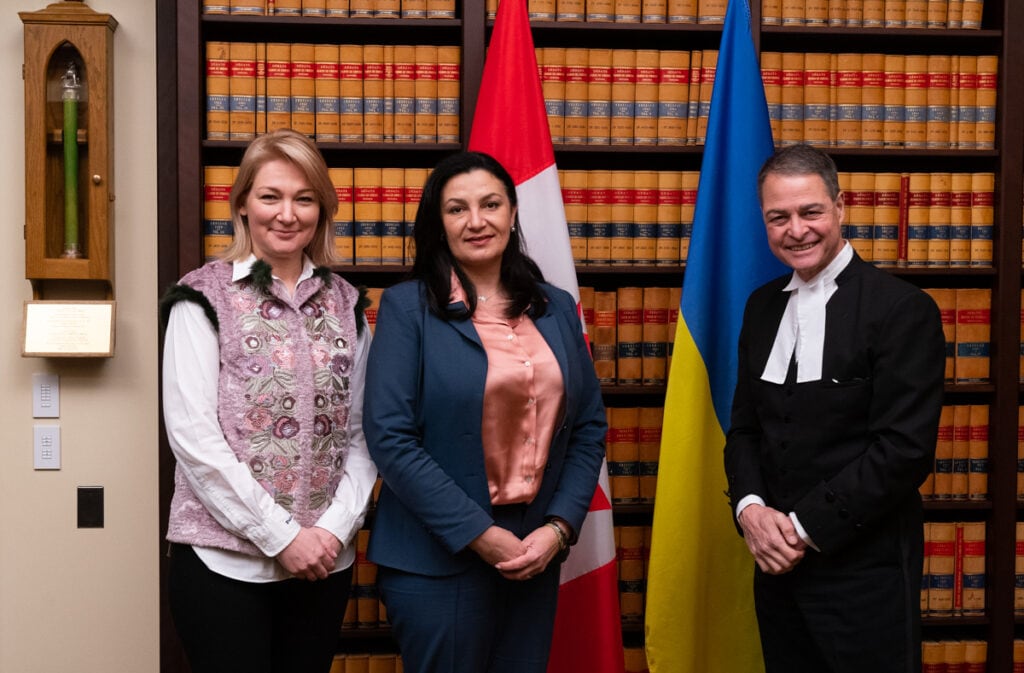
Anthony Rota, Speaker of the House of Commons of Canada, meets with two Ukrainian MP’s / Président de la chambre des communes du Canada, rencontre deux députées Ukrainiennes Ottawa, Ontario, on December 05, 2022. © HOC-CDC Credit: Bernard Thibodeau, House of Commons Photo Services
“We managed to lay foundations for the strategic priorities that Canada is shaping up for the future regarding the continuation of assistance to Ukraine. Canada is now working on prioritising further aid, and not just short-term one, such as arms, continued financial support and aid in the energy sector. Therefore, we tried to convey to our colleagues that in the medium-term run it isprofound and important to continue to support the development of democratic processes and independent full-fledged institutions in Ukraine”
During the visit, Ivanna Klympush-Tsintsadze and Mariia Ionova already met with members of the Canada-Ukraine Parliamentary Friendship Group to tell about the development of the situation in Ukraine and specific steps being taken by the Parliament for non-military resistance to the Russian aggression. The parliamentarians also had the opportunity to talk with the Speaker of the Canadian House of Commons, the Honourable Anthony Roth, and the Canada’s Ambassador for Women, Peace and Security, Jacqueline O’Neill.
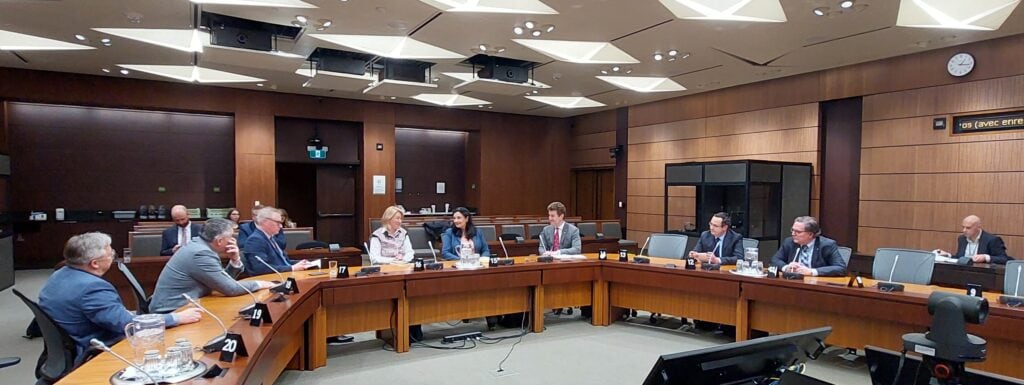
“We must end this war with victory as soon as possible. As a powerful member of the G7, Canada has a very loud voice in the world, and its position matters. We are convinced that Canada can help Ukraine get more military support. For example, with the military training of our brave new recruits of the Armed Forces of Ukraine, as well as with diplomatic lobbying in other countries, including in Germany regarding tanks, in the USA regarding F-16 jet fighters”
Russia’s aggression can be a threat to the whole world even after Ukraine’s victory in this war. That is why Ukraine is now looking for ways to strengthen the country’s defence capabilities and create conditions for stability and security when the war is in place and after it’s over.
One of these ways is Ukraine’s accession to NATO, which Ukrainian officials are talking about with the international community at all levels. Last week, as part of the PASS Ukraine project, Head of the Permanent Delegation of Ukraine to the NATO Parliamentary Assembly, Ukrainian MP Yehor Cherniev discussed the security and defence agenda with Canadian counterparts.
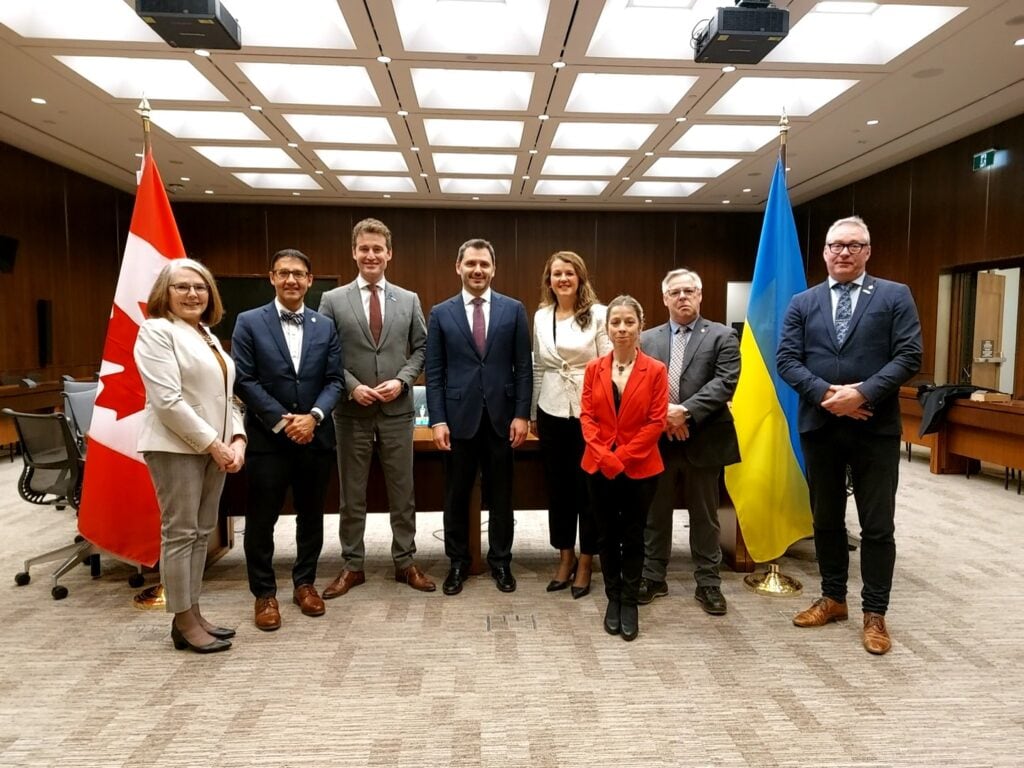
“The main obstacle on Ukraine’s path to NATO is the war, and this obstacle will disappear after our victory. So will the West’s fears about the response of Russia, which will be weakened and plunge into internal destabilisation and contradictions. An ideal window of opportunity will open, and our accelerated accession to NATO will be supported both by Canada and our neighbours, as well as by most of the Alliance member countries”
Strengthening inter-parliamentary ties allows Ukraine to mould powerful lobbying groups in Western parliaments and to seek an increase in military, financial and humanitarian aid to us. For this, Ukrainian MPs and civil society are doing their utmost.
The Agency for Legislative Initiatives will have continued cooperation with Canadian partners to help with reforms and refine the dialogue between the Parliaments of Ukraine and Canada.
The Ukrainian MPs’ visit to Canada took place as part of the Parliamentary Accountability of the Security Sector in Ukraine (PASS Ukraine) project, a joint project of the Agency for Legislative Initiatives and the Parliamentary Centre (Canada), which is being implemented with the support of the Ministry of International Affairs of Canada and the Peace and Stabilization Operations Programme (PSOPs) in partnership with the Verkhovna Rada of Ukraine.
Monitoring of the Ukrainian Parliament’s work, IX convocation, 7th session (for February 2022) (half a year of the war)
The full-scale invasion changed the lives of all of us, and we all experienced the shock of February 24. It was difficult to imagine how the Parliament would continue to function when work in the VRU was directly related to the threat to life for everyone, including MPs. However, the constitutional majority of MPs continued to work, and the Verkhovna Rada continued to function. Regardless of the decisions made, the fact that Parliament continued to operate during full-scale war is an achievement. However, we discovered some other features of the first half of the parliamentary work in wartime conditions.
In particular, even during martial law, there was a tendency to decrease the number of registered draft laws, which indicates a decrease in legislative spam. But what sets this session apart is the amount of legislation passed.
The Verkhovna Rada adopted 229 laws during the 7th session, a record for all convocations. The obvious reason for this is the need for urgent adaptation of legislation to the realities of a full-scale war, and it speaks of a relative consensus regarding the adopted laws. Also, during half a year of war, the President transferred the legislative role in forming internal policy to the Government and MPs while he submitted the ratifications or approval of decrees.
During this session, we saw an actual “turbo mode” because, in addition to a record number of adopted laws, we observed a significant decrease in the time for processing and passing draft laws.
Three factors can explain this:
- political consensus (especially on issues of defence and security, immediate response to the realities of full-scale war);
- security threat during meetings;
- no online broadcasts.
In this way, a full-scale invasion interrupted the trend of increasing the time draft laws pass from registration to adoption at all stages of this passage. The invasion seemed to reset a large part of the agenda. The main concern of the MPs was adaptation to new realities.
It is also interesting that for the first time during the 9th convocation of this session, a draft law was registered, for which the Committee on Freedom of Speech is the main committee.
But there is also a negative side – the share of violations has increased. Procedures for consideration of 2/3 of all laws had violations. Of course, the increase in the number of violations can be justified by a full-scale war, the need for urgent legislation adaptation and the parliament’s extraordinary working conditions. Despite the turbo regime and a large share of violations, these violations are still less than during the first two sessions of their convocation.
Read more about the work of the Verkhovna Rada during the full-scale war in our monitoring.
This monitoring was prepared with the financial support of Sweden.
Military Parliamentarianism: How Parliamentarians Worked out under a Common Threat
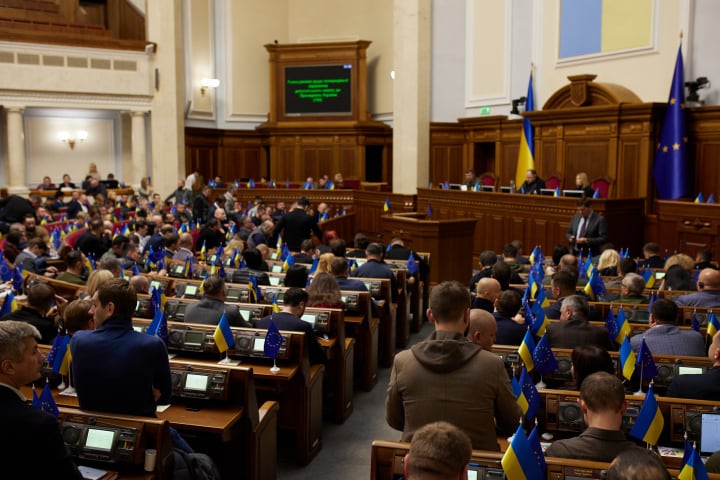
© Verkhovna Rada of Ukraine
Agency for Legislative Initiatives for “Dzerkalo Tyzhnia” (Mirror Weekly).
On the pros and cons of the closed “turbo mode”
Since the morning of 24 February and until now, the Verkhovna Rada — Ukraine’s only legislative body — has continually been exercising its powers in Kyiv, despite the high threat of physical destruction. The constitutional majority of MPs are in Ukraine. Laws are passed. The state is functioning.
Fortunately, it is the first time that the Ukrainian Parliament is going through the unique experience of functioning in a full-scale war. How exactly does the Verkhovna Rada operate with martial law and the real threat of missile strikes being in place? The Agency for Legislative Initiatives analysed the work of the Verkhovna Rada of Ukraine during six months of the war — from 24 February to 6 September (this is part of the seventh session that was taking place when martial law was in effect). Presented below are our brief findings.
Record-setting and real “turbo mode”
Speed, consensus, and efficiency are the three words that can be used to characterise the operation of the Parliament during the war. On the one hand.
During the six months of the war, the Verkhovna Rada of Ukraine accomplished a lot of work indeed. It did so much as to set a record in terms of the number of laws passed in one session. From the beginning of the full-scale invasion until 6 September, 229 laws were passed. This is more than in any other session of the Verkhovna Rada of Ukraine across all convocations (for which data is available).
Why so many, and what are those laws? The lion’s share goes for the laws that govern life in a country during wartime.
The invasion brought to nought a large part of the prior agenda. Since 24 February, a need has emerged to urgently adjust the legislation to the realities of the full-scale war. Relevant laws were developed and passed almost from scratch, and very rapidly.
National security, reallocation of funds, law enforcement and support of the economy became the priority needs and areas of work of the Verkhovna Rada.
During half a year of the full-scale war, the President in fact transferred the law-making role within development internal policies to the Government and MPs. The draft laws submitted by the President during this period were exclusively ratifications, presidential decrees and symbolic law drafts related to the issues of foreign policy, security and defence (which, by the way, clearly corresponds to the distribution of powers under the Constitution).
Half a year of the war can also be called a real “turbo mode”. In addition to the record-setting numbers of passed laws, we see a significant decrease in the time spent on processing and clearing draft laws across all indicators. Parliamentary committees, expert and analytical departments of the Parliament mobilised resources and quickly issued opinions. The processes of political approval of draft laws were also significantly accelerated, and a long-term consensus was in place among MPs in the session hall. Everyone worked in harmony, to the extent possible, and made efficient use of available time and other resources.
Interesting data about plenary time is in our possession: half of the draft laws passed in the first reading were considered for less than 41 seconds; 90% of the draft laws in the first reading were considered by MPs for less than two minutes; half of all the draft laws that were passed in both readings during half a year of the war were considered by lawmakers in the session hall for less than six minutes.
Just to compare: In the last pre-war, sixth session of the Verkhovna Rada, these time indicators were many times higher: half of the draft laws passed in the first reading were considered for up to 15 minutes in the hall; up to 26 minutes of plenary time was taken up by consideration of half of the draft laws that went through both readings during the sixth session.
In fact, for half a year of the full-scale war, what MPs in the Parliamentary Hall did was only press voting buttons – with no scandals, long speeches from the lectern and fights, as it used to be before. This “phenomenal occurrence” can be explained by the following three factors:
- Political consensus was in place — especially so on the issues of defence and security — as well as the need to immediately respond to the realities of a full-scale war;
- Threat to the security of MPs during the sittings of the Verkhovna Rada — Russia has repeatedly “promised” strikes on “centres of decision-making”;
- No online broadcasting for sittings, and thus no need to deliver lengthy speeches targeting voters.
But work efficiency does not equal quality. The new realities of the war and the “turbo mode” resurrected old “bugs” in the law-making system and created new ones.
On “bugs”, “matryoshka laws”, and violations of the Constitution
When lots of laws are passed quickly, the quality of the decisions themselves will suffer, and a certain part of the procedures will be ignored.
A draft law is a crucial document, which, when approved, will determine how the state and citizens shall function in a given area. Before the draft law gets to the session hall, it must be processed at least by the committees and expert departments of the Verkhovna Rada. MPs should familiarise themselves with the text of the draft law and supporting documents. All these procedures are required to ensure at least some quality control of what the lawmakers press the voting buttons for in the session hall, and to shield against hasty and poor (populist, undemocratic or ill-considered) decision-making.
However, with the war being in place, very little time passed from the emergence of an idea to the adoption of laws. Over the six months of the full-scale war, lots of draft laws appeared that were adopted “on the fly”: five draft laws were adopted on the day of registration; 12 more — the following day after registration. Most draft laws (59%) became laws after the first reading.
That said, an opposite trend was in place during the previous two sessions, as two-thirds of the laws were adopted in the second reading. In practice, two readings make it possible to prepare the draft law better, to address shortcomings and errors discovered in the first reading. However, two readings also require more time, which was obviously not available in view of the invasion. Can we be confident that they are all well written and analysed, or at least read? No. Do we know how these decisions will affect the country in the future, especially after the end of the war? This cannot be assessed at this time.
The need to adjust the law-making process to the conditions of martial law created another unusual parliamentary practice, i.e., “matryoshka laws”. These are several laws with different subject matters of regulation, and contents are disguised under one title. Usually, such laws have one content and targeting at the stage of the first reading. Yet then amendments are introduced to them, and in fact, they are supplemented with brand-new provisions that were not only beyond consideration in the first reading but also belong to a different area of regulation.
For example, the Law on Amending Certain Laws of Ukraine regarding the Functioning of the Civil Service and Local Self-Government During the Effectiveness of Martial Law. Its first reading version dealt with the distribution of powers between local self-government bodies and military administrations. Yet at the stage of amendments for the second reading, provisions were added to expand the powers of the Verkhovna Rada and the President. Among other things, based on these new norms, the Verkhovna Rada’s Ombudsperson, Lyudmila Denisova, was dismissed. The new provisions added for the second reading not only related to a completely different topic, but also violated the Constitution, as they expanded the powers of the Verkhovna Rada and the President.
A reminder is that new powers of the Verkhovna Rada and the President may come into being only through amendments to the Constitution, which is prohibited under martial law. Yet the Ukrainian lawmakers ignored the said norm, and this is no singular case during half a year of the war.
Another factual violation of the Constitution is the President’s failure to sign the adopted law drafts within the prescribed 15-day period. This practice existed also before the full-scale invasion, and not only under President Zelenskyi. However, it is particularly visible now — for example, by the beginning of September, more than two dozen draft laws neither signed nor vetoed by the President had accumulated. They have been in limbo for months and do not come into effect. There are no obvious reasons for this phenomenon.
They include:
- The draft Law on Amending Article 3 of the Law on Some Issues of Indebtedness of Defence-Industrial Complex Enterprises that Are Members of the State Concern ‘Ukroboronprom’ and Ensuring Their Stable Development.
- The draft Law on Amending Article 23 of the Law on Mobilisation Training and Mobilisation regarding the postponement of military service conscription of scientific, scientific-pedagogical, and pedagogical staff during the mobilisation.
- The draft Law on Amending Certain Legislative Acts of Ukraine to Improve the Fundamentals of Organisation and Conduct of the Resistance Movement.
- The draft Law on Amending the Law on the Basic Principles of Expropriation of Objects of Property Rights of the Russian Federation and Its Residents in Ukraine regarding the itemisation of certain provisions.
- The draft Law on Amending Certain Laws of Ukraine to Improve the Selection and Training of Prosecutors.
Along with violations of the Constitution, other deviations from the rules do not seem to be so significant, although there were lots of them too. During half a year of the war, up to 67% of the laws (that is, two-thirds) were adopted with violations of the consideration procedures. For the most part, those were violations of deadlines and the lack of required opinions on the draft laws from the Verkhovna Rada’s expert and analytical departments.
In summary, the full-scale invasion did raise many pressing issues, so a significant number of procedural violations are justified, given the situation at hand. Yet this is no adequate practice in the long run.
Currently, an urgent need arises to hammer out special procedures that would enable the legitimate and fast processing and passing of draft laws in conditions of war or other extraordinary circumstances requiring rapid and, at the same time, legal decisions. A clear algorithm of actions is required to ensure the adequate operation of the system, so that the functioning of the Parliament and the entire state in war conditions be not a miracle in which few people believed, but a regularity in the eyes of citizens, international partners and the enemy.
After the abolition of martial law, the Verkhovna Rada and the Cabinet of Ministers, with the involvement of civil society experts, will need to take a stock of the hastily adopted laws in order to eliminate any possible negative aftermaths for the period of peaceful life.
This material was prepared with the financial support of Sweden.
3 Priorities of Parliamentary Reform in Ukraine
The Agency for Legislative Initiatives has been promoting the implementation and monitoring the parliamentary reform for many years. According to our latest monitoring data for 2021, the reform of the Ukrainian Parliament has been completed by 45.7%. In recent years, the rate of implementation of the reform has decreased, but the political leadership of the Verkhovna Rada recognizes the need to fulfil the commitments made regarding the implementation of the parliamentary reform. In addition, judging by the public statements of the political leadership of the Parliament, the authorities are fully aware of the actual state of implementation of the reform and the problems in its implementation. And the very fact of a realistic assessment of the situation gives hope for the solution of these problems and the successful completion of the reform.
Today, the Agency is included in the working subgroup on parliamentary reforms in Ukraine and has the opportunity to actively and constructively cooperate directly with representatives of the Verkhovna Rada in this direction.
What are the current priorities in the implementation of the reform of the Parliament? What should be emphasized to change the situation for the better? Oleksandr Zaslavskyi, Director of the Analytical Direction of the Agency, during the forum “Democratic reforms for the integration of Ukraine into the EU: a dialogue with leading reformers”, voiced for our European partners and Ukrainian colleagues from civil society and the Parliament 3 priorities of parliamentary reform in Ukraine.

1. Increasing the requirements for expert-analytical supporting documents, particularly explanatory notes, in the legislative process.
A well-known problem that complicates the work of the Verkhovna Rada is the production of a large number of legislative initiatives. And this affects the quality of legislative initiatives, as well as the workload of MPs and structural divisions of the Apparatus of the Verkhovna Rada. At the IX convocation of the VRU, there is a steady decrease in the number of, first of all, legislative initiatives by MPs, which is certainly a positive trend. However, it is possible to reduce the amount of “legislative spam” in other ways. In particular, by increasing the requirements for expert-analytical support, generally by increasing the quantity and quality of accompanying analytics in the legislative process. There are global examples when such a step, in particular, increasing the requirements for the preparation of impact assessments of draft acts, reduced the number of these same drafts by many times. This indicates an increase in their quality, as the share of draft laws that change existing laws is radically decreasing.
This also includes strengthening European integration expertise at the parliament level. In particular, by strengthening the capacity of the Committee on Ukraine’s Integration into the European Union. The Verkhovna Rada has three committees whose conclusions are binding on all draft laws: budget, anti-corruption, and European integration. During the convocation, thousands of draft laws pass through these committees. Accordingly, increasing the requirements for accompanying documents, particularly for draft laws related to European integration, and increasing the ability of the Committee on Ukraine’s Integration into the European Union to develop a large number of draft laws will improve the entire European integration direction of legislation. And this, as we understand it, is currently becoming extremely important and relevant.
2. Strengthening of parliamentary control.
The war actualized the issue of democratic control in the sphere of security and defence. Changes to the legislation in this direction have already been adopted in Ukraine, which will come into force next year. In particular, a special control committee unique to the Verkhovna Rada will be created, which will carry out control in the field of security and defence.
In terms of parliamentary control, it is worth giving an example of how the Verkhovna Rada adapted to the conditions of war. Since February 24, we have not had the time of questions to the Government, but a special format was introduced when individual ministers met with the heads of parliamentary factions or with representatives of the majority in the Parliament. Some ministers managed to go through this format several times. As for specific actions to strengthen parliamentary control, we must talk about strengthening the system and the regularity of its implementation. Including at the level of committees.
3. Ensuring the sustainable development of the Parliament as an institution, in particular, increasing the personnel potential of the staff of the Verkhovna Rada Apparatus.
This is also a crucial aspect of the reform. Since the Apparatus is, in fact, a parliamentary service. Although we currently do not have a separate parliamentary public service, the Apparatus of the VRU is the structure that ensures the stability and institutional memory of the Verkhovna Rada. These are people who ensure the work of the parliament even during the war. Among the Apparatus employees, a significant number of those have been working there for more than 15 years. These are high-class specialists. Their experience should be preserved and multiplied, and the status of a parliamentary employee should be strengthened. For this purpose, the draft law on parliamentary service was developed and adopted in the first reading. It would be excellent to adopt it as a whole. The strategy for building the staff potential of the Apparatus of the Verkhovna Rada was also adopted and is already at the final stage of implementation. It should be updated with an emphasis on maintaining the Apparatus employees’ high level of professionalism and preserving institutional memory.
The Agency for Legislative Initiatives will, as far as it can, support these and other areas of parliamentary reform. And we once again emphasize the importance of the stable functioning of such an institution as the Parliament for the implementation of all other reforms and for Ukraine’s progress on the European integration path.
This publication was prepared with the financial support of Sweden.
A Long Way to the Completion of the Parliamentary Reform
Parliamentary reform was initiated in 2016 with the Roadmap for Internal Reform and Increasing the Institutional Capacity of the Verkhovna Rada of Ukraine. This reform is still incomplete and has been implemented in less than half. Therefore, we can welcome the statements of the leadership of the Verkhovna Rada regarding the need to implement this reform by at least 70-80%. But to what extent has the reform been implemented so far?
Our methodology estimates its implementation at 45.7% (95 points out of a possible 208) as of July 2021System monitoring has not been carried out since that time. However, superficial monitoring shows a lack of noticeable progress in reform implementation. On some points, regression is observed, for example, at the end of the 6th session, the Verkhovna Rada once again postponed the transition to electronic document management.. Compared to March 2019, progress has advanced by only 4%. Following the Ukrainian tradition, this can be called “stomping in place”. Therefore, the recommendations given in 2019 are still relevant today:
- Formation of a single coordination centre for parliamentary reform.
- Implementation of systematic work on implementing recommendations: updating the Roadmap and the priority action plan for its implementation.
- Approval of the Concept of ‘End-to-End’ Legislative Process (agreed with all subjects of the legislative initiative), which would show the target system of development and decision-making, would determine the critical stages of the implementation of the reform and would outline the effective ways of implementing individual components of the reform to ensure the coherence of efforts of all subjects of the legislative initiative.
- Ensuring effective communication regarding parliamentary reform within parliamentary factions and groups and between dialogue platforms.
- Establishing communication with the Cabinet of Ministers of Ukraine for better coordination of reformation processes in the parliament and the government.
- Bringing the Regulations of the Verkhovna Rada into compliance with the Constitution of Ukraine.
- Adoption of the Law “On Parliamentary Service” as a whole.
- Adoption of the Code of Conduct.
The main problem is the lack of systematicity in reforming the Verkhovna Rada. This especially applies to the MPs themselves. If the reforms that concerned the Apparatus of the VRU and depended on the decision of the leadership of the Apparatus (as well as on the political leadership of the VRU) were advanced more or less comprehensively and considering the recommendations of the Road Map, then the directions that relate to the rules and formats of the work of the MPs themselves have either deteriorated comparing with 2019 or remained approximately at the same level. And where improvements did occur, they were more a response to current challenges and not overly based on the recommendations of the Road Map.
A clear indicator of this is that the Reform Road Map was not revised in the 9th convocation and was not updated according to today’s challenges. Although in some directions, the Road Map is outdated and has lost its relevance.
The main improvements regarding the state of implementation of the Road Map recommendations concerned the VRU’s Apparatus. It can be noted here:
- Approval of the Personnel Potential Development Strategy;
- Introduction of electronic document management (although still in parallel with paper management);
- Audit of activities carried out by the Accounting Chamber;
- Communication strategy implementation activities;
- Adoption of the draft law “On Parliamentary Service” in the first reading.
The improvement in the overall assessment of the state of implementation of the recommendations can be explained by the fact that the spheres related to the Apparatus improved more than the spheres directly related to the MPs deteriorated.
Some positive changes were also related to the work of parliamentarians: amendments to the Regulations of the Verkhovna Rada and implementation of the practice of preparing the Plan of legislative works, publication of parliamentary requests, reduction of the number of committees (although there are problems with their areas of responsibility), attempts to improve the control function.
It is worth remembering that our methodology considers the process of implementation of recommendations, so the reform is estimated by as much as 45.7%.
However, if we considered only fully implemented recommendations (that is, focused on the result, not the process), then the state of implementation could be estimated at only 10%.
There are only five fully implemented recommendations (that is, less than 10% of the 52 recommendations), and all of them concern the Apparatus of the Verkhovna Rada. These are the recommendations:
- 23 (Implementation of Information and Communication Technologies strategy);
- 26 (the Verkhovna Rada of Ukraine must develop and approve a “digital” strategy);
- 35 (audit by the Accounting Chamber);
- 39 (Implementation in the VRU of the personnel potential development strategy);
- 40 (Short-term internship should be separated from the internship of public servants due to employment conditions).
What to implement in the first place?
The resource for increasing the assessment of the implementation of the Road Map recommendations, with the assistance of the spheres relevant to the Apparatus of the VRU, has been primarily exhausted (since most of the recommendations have been implemented or almost implemented). Therefore, to increase the share of implemented recommendations at the next evaluation, it will be necessary to implement other Road Map recommendations. In particular, the blocks “Legislative capacity and law-making process”, “Coalition, opposition and dialogue”, and “Adherence to ethical norms and standards of conduct” have a significant potential for implementation because less than a third of the recommendations in them have been implemented.
First of all, it is necessary to implement the main recommendations that concern the main function of the Verkhovna Rada – the law-making process. Of course, it is easier to implement the recommendations that concern the form of work of the Verkhovna Rada, such as electronic, instead of paper, form of document circulation.
But such formal recommendations should not replace more important ones – implementation of the Concept of ‘End-to-End’ Legislative Process, improvement of expert and analytical support of draft laws, improvement of the control function and many other recommendations.
Цей матеріал підготовано за фінансової підтримки Швеції.
Another Scandal That Should Not Be Among the Members of Parliament of Ukraine
Every time MP gets into the scandal, it reduces public trust not only to a particular MP but to Parliament in general. Unfortunately, such scandals occur every month, sometimes every week.
It is not surprising that recent polls show public distrust of Parliament in more than 75%.
Last week, August 23, MP from the “Servant of the People,” deputy chairman of the Budget Committee, Olexander Truhin, got in an accident at Boryspil highway. As a result of the accident, six people were injured. Trukhin, according to media reports, was in a state of intoxication.
However, the most interesting part started after the accident.
Mentions of Trukhin’s involvement in this accident began to disappear from the media sites that wrote about it. However, none of these media refuted the information or additions – the news simply disappeared. Some media outlets reported that they got a request from some alleged PR agency to remove articles.
The “Servant of the People” still not commented on the incident.
As a result, we have a situation where the MP of Ukraine tries to avoid responsibility and disseminate information about the accident with his participation, and the party, in turn, conceals it as it is impossible to call it otherwise in such a situation.
Last month, on July 8, an accident involving a member of parliament took place in the center of Lviv. This time the “main actor” was a non-party MP Oleksandr Yurchenko. After the accident, he tried to flee the scene, inflict damage on the injured driver, and that`s all under the influence of drugs, which was confirmed by the test.
What is the problem?
The worst thing in this situation is that the Parliament does not have a mechanism for punishing members of parliament in such cases. Therefore, the Verkhovna Rada Regulatory Committee stated that it could not punish Yurchenko. This again indicates the need to introduce a code of conduct for MPs.
Of course, the problem is not only the lack of the Code of Conduct for parliamentarians but also the problem of a broken justice system. Members of parliament sometimes seem to be outside the legal field, ignoring any rules and regulations and not being responsible for it. After all, there is no clear mechanism for influencing deputies who violate the law.
The law is the same for everyone, but MPs have a special procedure for bringing justice. Only NABU or the central office of the State Bureau of Investigation can conduct investigations of members of parliament, and only the Prosecutor General can carry out amendments to the Unified register of pre-trial investigations. Only after investigations, the trial, and, indeed, the judgment, authorities of the MP could be terminated.

How can we solve these problems?
Public attention to the problems of reforming law enforcement and prevent MPs privilege in matters of justice – its first steps.
However, the introduction of the Code of Conduct may also provide mechanisms for the prevention and resolution of problems when MP`s uses their power for selfish purposes, their behavior does not meet professional requirements, and so on. It is important to note that the Code should be the set of rules that members of parliament will use in their daily activities. That is, it should regulate relations in both legislative and parliamentary activities, as well as non-parliamentary activities related to the performance of the functions of the MP.
The scandals in which parliamentarians get involved are most often relate to their extra-parliamentary activities. For the Code to be effective, every parliamentarian must feel responsible for activities that run counter to his or her professional requirements and understand the legitimacy of the Code.
The development of professional and ethical standards for deputies has many advantages:
First, accountability is improved, and trust is strengthened. Society will understand the system of regulating ethics, and it will be easier for it to trust parliamentarians because it will know that any violations will be detected, and violators will be punished. In turn, parliamentarians will feel responsible, as the Code will provide for sanctions, possibly even in the form of termination of office.
Second, the Code can be a means of combating corruption. The established standards will help prevent abuse of office and other forms of corruption, as they establish clear rules of conduct for parliamentarians, mechanisms for monitoring their work, and provide for penalties for violations. These standards will help MPs better understand what society expects of them, especially after certain scandals that may potentially arise.
Third, the Code can be a tool for policy professionalization. Often the behavior of members of the Parliament of Ukraine in the workplace does not meet ethical and moral norms (for example, verbally insulting another MP, fights, sexist behavior, etc.). Unethical behavior in the Parliament undermines the professionalism in the public’s eyes, not only of an individual member but of the Parliament as a whole. Once in parliament, MPs must follow the same rules of conduct in the workplace. Unified standards will also help unite members of parliament themselves and resolve certain political differences constructively.
Thus, developing a Code of Conduct for MPs remains open and it is especially relevant in scandalous situations when members of parliament abuse their professional position. Ukrainian legislation contains many norms concerning MPs ethics, sanctions in case of committing offenses, however, on the one hand, they are unregulated, and on the other hand – there are no principles of conduct of MPs outside the parliament. Therefore, the Code of Conduct could become the basis that would form the internal social responsibility of members of parliament, unify ethical standards and guidelines for all parliamentarians, and as a result – strengthen citizens’ trust in the parliamentary corps.
Educational Online Event for Parliamentarians within the Project Parliamentary Accountability of the Security Sector in Ukraine
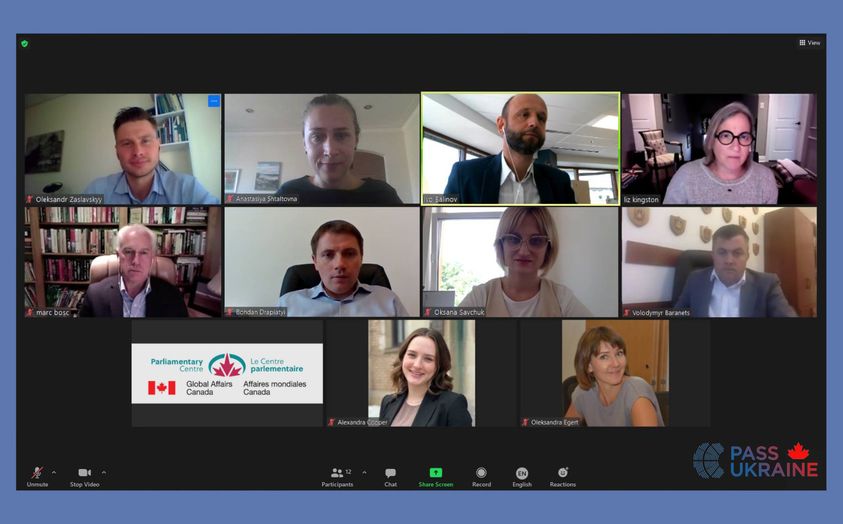
As promised, the Agency for Legislative Initiatives and the Parliamentary Centre (Canada) has launched activities to provide practical support for the development of knowledge and skills of MPs and staff of secretariats of Verkhovna Rada Committees on how to better structure and manage committees and develop formalized procedures. These activities are carried out within the framework of the project “Parliamentary Accountability for the Security Sector in Ukraine” (PASS Ukraine).
An online meeting was recently held between the staff of the Secretariat of the Verkhovna Rada Committee on Law Enforcement and representatives of the House of Commons of Canada, where they exchanged knowledge, experience, and practices on building and managing the work of secretariats.
The meeting was attended by: Head of the Secretariat of the Verkhovna Rada Committee on Law Enforcement Bohdan Drapyatyi and his deputies from the Ukrainian side and former Clerks of the House of Commons – from the Canadian side.
This meeting was the first in a series of dialogues between colleagues from the Verkhovna Rada of Ukraine and the Parliament of Canada, aimed at the practical support of Verkhovna Rada committees to improve the management of their work.
During the meeting, the secretariat learned about the organizational structure and administrative support of the House of Commons – the types of committee staff and their roles, their interaction with the committee head and other staff, and the career rotation system.
Representatives of the Ukrainian and Canadian parliaments discussed the connection between the work and experience of the staff of the secretariats of the committees in the Verkhovna Rada and the House of Commons and exchanged views on the challenges and ways to address them.
The Parliamentary Accountability for the Security Sector in Ukraine (PASS Ukraine) project is a joint project of the Agency for Legislative Initiatives and the Parliamentary Center (Canada), supported by the Canadian Ministry of International Affairs under the Peacebuilding and Stabilization Program (PSOPs) and in partnership with the Verkhovna Rada of Ukraine.
Training Seminar for Parliamentarians within the Project Parliamentary Accountability of the Security Sector in Ukraine
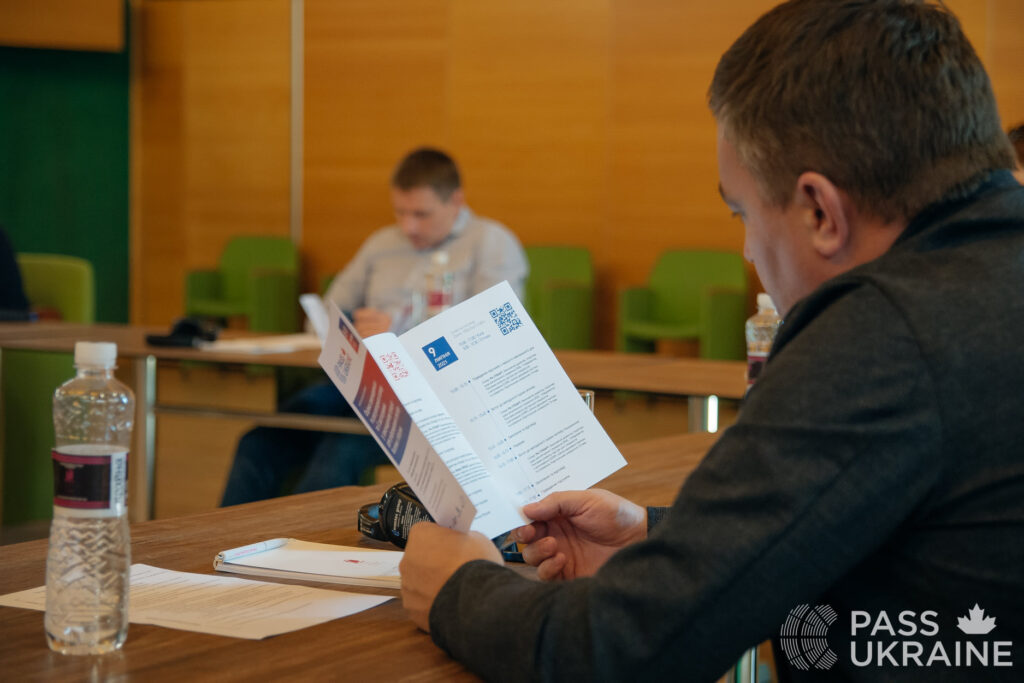
The security and defense sector is certainly one of the most important, especially in a country that has been at war for eight years. Therefore, the Agency for Legislative Initiatives is trying its best to familiarize parliamentarians and staff of the secretariats of the Verkhovna Rada Committees with new tools and methods for reforming the sector.
Last week, as part of the Parliamentary Accountability of the Security Sector in Ukraine (PASS Ukraine) project, the Agency for Legislative Initiatives, in partnership with the Parliamentary Center (Canada), held a training seminar on “Legislative and Regulatory Impact Assessment and its Application in the Security Sector Reform Legislation and defense”.
Members of the Verkhovna Rada Committee on Law Enforcement, the Verkhovna Rada Committee on National Security, Defense and Intelligence, and the Verkhovna Rada Committee on Ukraine’s Integration into the European Union were invited to participate in the seminar. Staff from the secretariats of the above-mentioned committees were also invited.
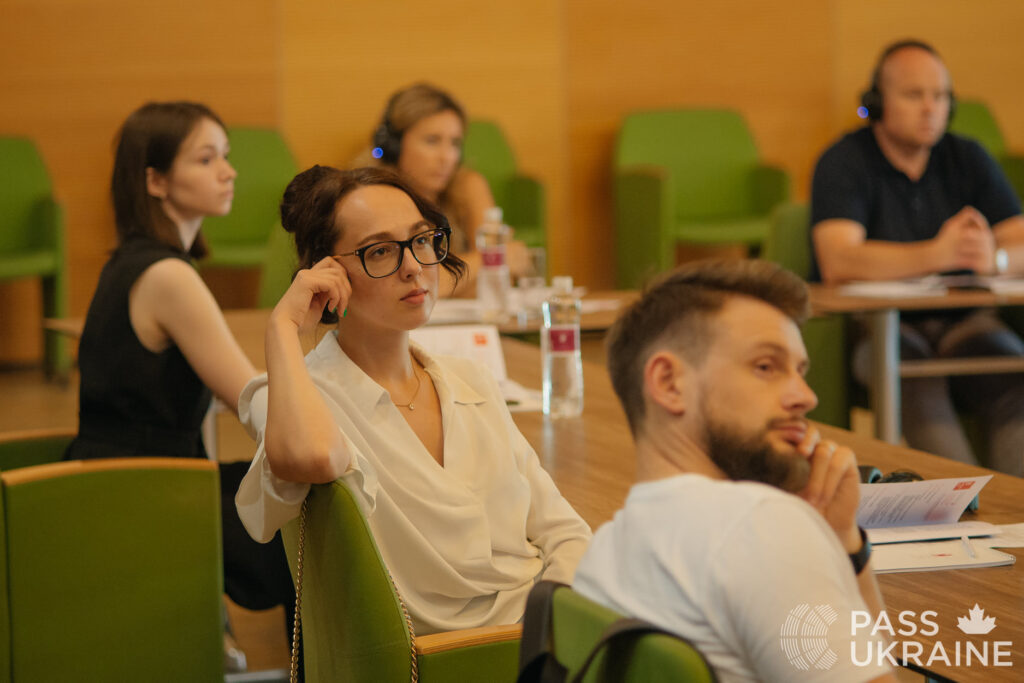
The purpose of the training seminar was to familiarize MPs, committee members, and their staff with Canadian and international experience in assessing legislative and regulatory impact and its application in the legislative process of security and defense sector reform, including assessing the different effects of legislation on women and men.
Nicola Kim, First Secretary, Embassy of Canada in Ukraine, made a welcoming speech at the opening of the training seminar.
The speakers of the training seminar were Canadian experts with many years of experience in regulatory and legislative influence:
- Daniel Trnka, Deputy Head, Regulatory Policy Division, Public Governance Directorate, Organisation for Economic Co-Operation and Development (OECD);
- Rick Stewart, Executive Director of the Regulatory Governance Initiative (RGI) and Co-Director of the Career Development for Regulatory Professionals (CDRP) Program in the School of Public Policy and Administration at Carleton University, Ottawa;
- Michael Presley, Director, Certificate Program in Regulatory Leadership, Centre for Public Management and Policy, University of Ottawa; Former Assistant Deputy Minister (Regulatory Affairs) at the Treasury Board Secretariat, Canada.
- About the experience and practice of Ukraine in applying legislative and regulatory impact assessment in the legislative process, participants were told by Ivanna Klympush-Tsintsadze, MP, Chairwoman, Verkhovna Rada Committee on Ukraine’s Integration into the European Union, Member of the Interparliamentary Relations Group with Canada.
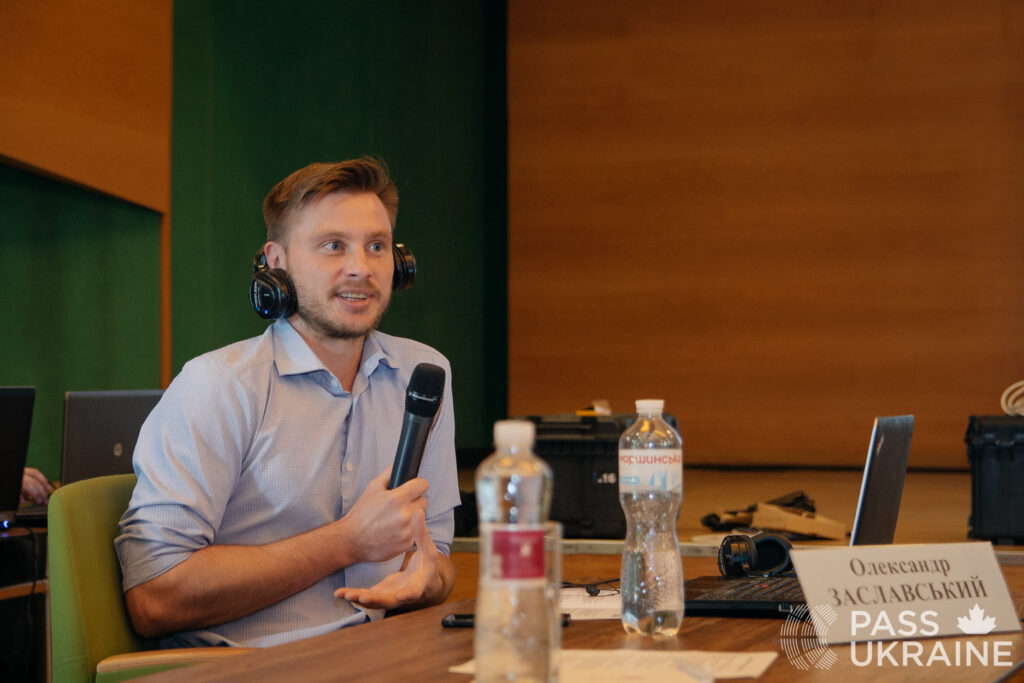
The seminar was held in an unusual format – combining offline and online, which allowed to simultaneously engage Canadian partners who shared their experiences and establish communication between members of different committees.
As part of the project, we plan to hold more such meetings in order to continue involving MPs and Canadian partners in close cooperation in various formats.
The Parliamentary Accountability of the Security Sector in Ukraine (PASS Ukraine) project is a joint project of the Agency for Legislative Initiatives and the Parliamentary Center (Canada), supported by the Canadian Ministry of International Affairs under the Peacebuilding and Stabilization Program (PSOPs) and in partnership with the Verkhovna Rada Of Ukraine.