
Workshop on Principles and Practices of Legislative Impact Assessment
On Thursday, 30 May, ALI, with the participation of the VRU Committee on National Security, Defence and Intelligence, held a workshop on the principles and practices of legislative impact assessment.
The Agency continues to emphasise the importance of legislative process assessments as a tool for improving the quality of draft laws prepared by the Verkhovna Rada of Ukraine (VRU). Therefore, we actively work with committees and help them implement it in their work.
The visit was part of the project “Parliament and Accountability of the Security Sector in Ukraine” (PASS Ukraine), which the Agency implements jointly with the Parliamentary Centre (Canada) in cooperation with the Verkhovna Rada of Ukraine and the support from Global Affairs Canada within the framework of the Peace and Stabilization Operations Program (PSOPs).
Military Justice in Ukraine: ALI Joined the Discussion in the Committee of the Verkhovna Rada
On May 21, 2024, the Agency for Legislative Initiatives participated in the round table on “Military justice: Canada’s experience and possible options for regulation in Ukraine“, organised by the Committee on Law Enforcement Activities of the Verkhovna Rada of Ukraine.
The event was attended by the head of the Law Enforcement Committee, Sergii Ionushas, Representative of the President of Ukraine to the VRU/Deputy Head of the Committee Galyna Mykhailiuk, Deputy Heads of the Committee Maksym Pavliuk and Hryhorii Mamka, Subcommittee Chairmen Oleksandr Danutsa and Vladlen Neklyudov, Committee member Volodymyr Zakharchenko, Canadian experts on military justice — Ms Robyn Hynes, Director General of Operations, Office of the DND/CAF Ombudsman, and Colonel Todd Murphy, Deputy Commander, Office of the Canadian Armed Forces. The roundtable was also attended by representatives of the Parliamentary Accountability of the Security Sector in Ukraine (PASS Ukraine) project, the Ministry of Defence of Ukraine, the General Staff of the Armed Forces of Ukraine, the Military Law Enforcement Service of the Armed Forces of Ukraine, the Prosecutor General’s Office, the Security Service of Ukraine, and the State Bureau of Investigation.
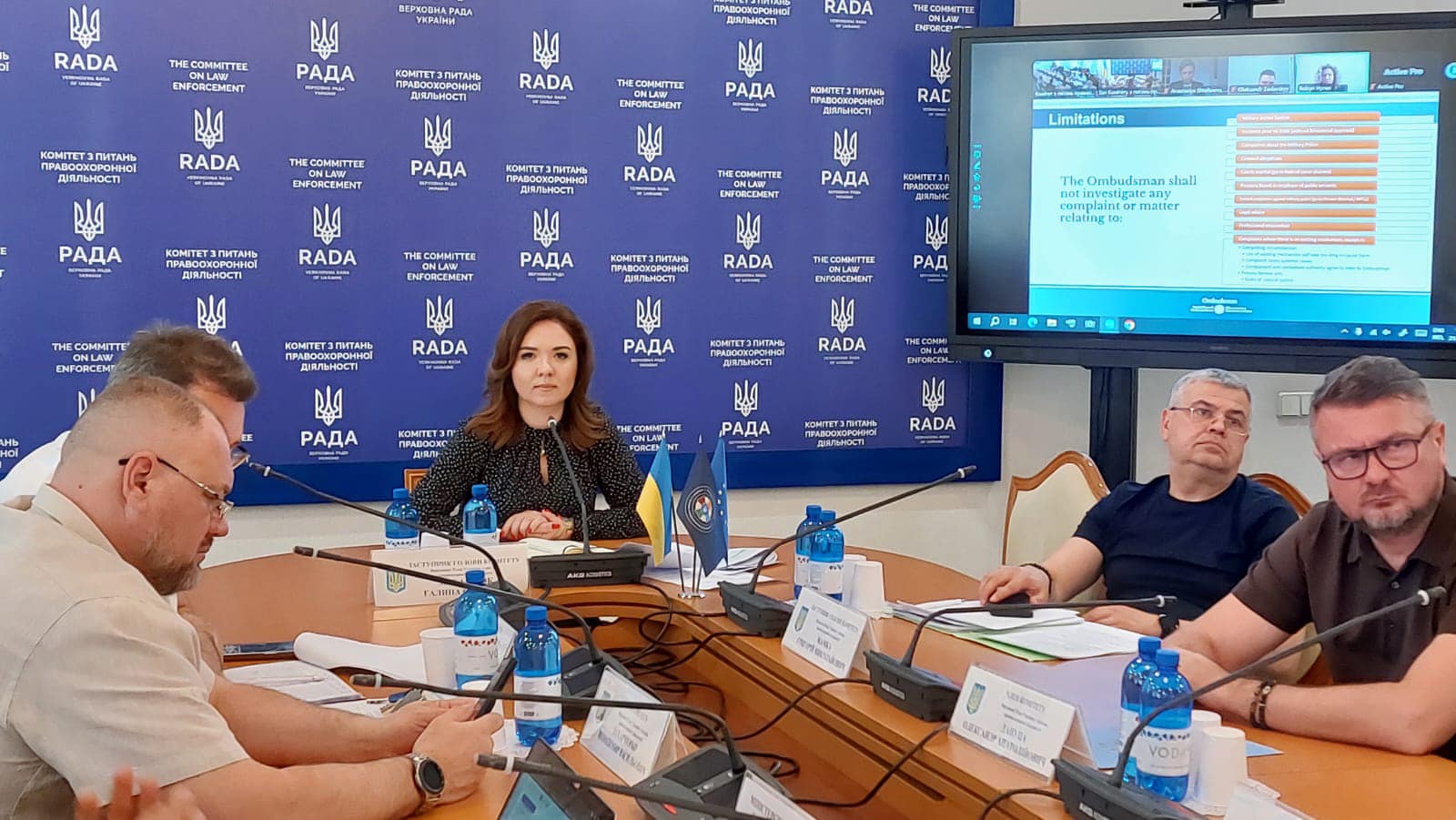
The issue of the functioning of the military justice system in Ukraine has become particularly acute since the beginning of Russia’s full-scale aggression against Ukraine. After all, creating a clear and fair legal mechanism designed to perform the law enforcement function in military formations and the function of justice for military personnel is one of the important components of the combat capability of the state’s armed forces. That is why studying the experience of Ukraine’s strategic partners and updating the relevant legislation is a priority in this area.
During the panel discussions, the participants discussed the following themes:
- Overview of the Canadian military police system.
- Powers and functions of the Canadian Armed Forces Ombudsman.
- Canada’s experience in respecting the rights of servicemen and women when they are brought to justice.
- Problems of functioning of military justice in Ukraine.
- Problems of creating new bodies of the military justice system and military courts.
In addition, the event featured a presentation of the Green Book on Military Justice in Ukraine, which was prepared by the Agency for Legislative Initiatives in cooperation with the Parliamentary Centre (Canada) as part of the PASS Ukraine project and with the support of Global Affairs Canada under the Peace and Stabilization Operations Program (PSOPs).
The web version of the document will soon be available on the ALI website.
Temporary Special Commissions: a Solution to All Problems or an Imitation of Frenzied Activity
The establishment of temporary special commissions in the Verkhovna Rada is not a new practice of MPs of the ninth convocation: most world parliaments provide for the opportunity to create such bodies, and they have been working in the Verkhovna Rada since its second convocation. In particular, MPs established the largest number of temporary special commissions, eleven, during the fourth and current ninth convocations.

1. Why are temporary special commissions established?
The main purpose of temporary special commissions is to study and resolve a specific issue that cannot be referred to any standing committee. For example, temporary special commissions have been operating at various times in Ukraine to develop legislation for reforms (in particular, administrative reform in the third convocation, the reform of the Security Service of Ukraine in the sixth convocation, etc.), address national security issues, or monitor compliance with electoral legislation. Temporary special commissions are convenient for MPs because they expand their powers (a TSC acts as a main committee) and allow them to “cover” areas that are beyond the competence of the standing committees. At the same time, TSCs serve as an additional platform for discussing problems since their main format of work is meetings to which representatives of central and local authorities, experts, representatives of NGOs and others may be invited.
During the analysed convocations (from the third to the ninth ones), most special commissions dealt with national security issues: protecting Ukrainian territories from external threats (primarily from Russia) and supporting the Armed Forces of Ukraine.
The second most important area for MPs was public administration. This category includes commissions established to develop legislation aimed at implementing reforms.
Social security issues rank third. They include control over payments to privileged populations, social protection of veterans and internally displaced persons (such commissions emerged in the Verkhovna Rada after the annexation of Crimea and the outbreak of war in eastern Ukraine in 2014, and their number only increased after the full-scale invasion in February 2022).
The Verkhovna Rada established six commissions to draft laws amending the Constitution of Ukraine and five more to monitor the observance of citizens’ voting rights during national and local elections.

The tasks assigned by the Verkhovna Rada to temporary special commissions were to investigate certain issues (the largest number of special commissions was established for this purpose) and to inform the Rada of the results.
Temporary special commissions often dealt with legislative work: drafting laws and other regulations (nine cases); revising already developed draft regulations, e.g., introducing changes, amendments, etc. (eleven cases); and preliminary review of draft laws and their preparation for the first or second reading (fourteen special commissions).
In nine other cases, the Verkhovna Rada tasked special commissions with developing recommendations for the authorities (in particular, the Cabinet of Ministers). Finally, in eight cases, the Verkhovna Rada established temporary special commissions to exercise parliamentary oversight: compliance with laws, budgetary spending, or social benefits.

2. Reporting of temporary special commissions
Temporary special commissions report to the Verkhovna Rada. At the end of their term of office, they must draw up and submit to the Verkhovna Rada a written report, which is registered as a corresponding draft resolution. The Verkhovna Rada, in turn, must hear such a report first at its next meeting and accept or reject it.
A report of the temporary special commission summarises its work and main outcomes, i.e., information collected, events held, draft laws developed, recommendations to the authorities, etc. Such a document is the main “measure” of the special commission’s efficiency, thanks to which the parliament and the public can get acquainted with the results of its work and evaluate them.
Although, according to the law, the development and submission of a report by a temporary special commission is a mandatory final stage of its operation, in practice, this is often not fulfilled. Out of forty temporary special commissions that worked in the Verkhovna Rada from its third to its ninth convocation, only thirteen (i.e. a little more than a third) registered a report following their work, and only seven of them adopted at least one report. During three convocations (the third, fourth, and seventh), temporary special commissions did not register any reports with the Verkhovna Rada.

At the same time, the absence of a temporary special commission’s report does not always mean that there were no outcomes of its work. In our research, we found cases when temporary special commissions have not registered a report, but reported the results of their work in the media or in official parliamentary communications. Moreover, the success of some special commissions can be assessed by the existence of adopted legislation, the development of which was the purpose of the relevant commission.
However, the absence of reports from the vast majority of commissions that operated in the Verkhovna Rada of previous convocations is still a negative phenomenon since it complicates the analysis of the efficiency of such bodies. Moreover, some commissions have not registered their reports precisely because of inefficient work and lack of results as such.
The reasons for the inefficiency of many temporary special commissions are quite different. For instance, MPs have noted that such bodies often lack sufficient logistical and human resources, which means that they have to use their own resources (e.g., lawyers or their assistants) to address the issues at hand. Moreover, MPs may not register reports as the Verkhovna Rada has higher priority issues to consider or is unable to collect enough votes to adopt them. Last but not least, the efficiency of special commissions depends on the MPs’ personal willingness to make all necessary efforts to address the tasks assigned to them.
However, it is worth noting that the ninth convocation experienced a certain positive shift: almost all temporary special commissions registered at least one report with the Verkhovna Rada. Instead, reports are missing mainly from those special commissions that have recently started their work and have not yet reached the reporting deadline (the exception is the Temporary Special Commission on Developing and Implementing State Policy on the Restoration of the Territorial Integrity and Sovereignty of Ukraine, established in May 2020, which has not submitted a single report, although its term of office has long expired). Moreover, five reports of temporary special commissions are still pending.
The quality of reports in the ninth convocation has also improved: these documents are quite detailed and mostly follow a similar structure. In addition, some special commissions use additional means to inform about their activities: they have their individual pages on the Verkhovna Rada’s website or even create separate websites, Facebook pages, etc. For example, the Temporary Special Commission on the Protection of Investors’ Rights has registered six reports (two of which were adopted by the Verkhovna Rada), informs about its activities on a separate website and has a Facebook page.
The Agency for Legislative Initiatives Joins a Meeting with a Delegation of Swedish Parliamentarians
The Agency for Legislative Initiatives joined a meeting with a delegation of Swedish parliamentarians on 14 May 2024.
A delegation of the Swedish Parliament and Ambassador Extraordinary and Plenipotentiary of Sweden to Ukraine, Martin Åberg, met with representatives of Ukrainian civil society to discuss Ukraine’s progress in certain areas of reforms.
In particular, Swedish MPs noted the processes of implementing the parliamentary reform, in which the ALI is actively involved in the development, implementation, and regular monitoring.
We appreciate such feedback on important reforms, as the Embassy of Sweden in Ukraine is an institutional partner of the Agency for Legislative Initiatives, which supports us in strengthening democratic institutions in Ukraine. Improving the quality of the legislative process and the institutional capacity of the parliament as a whole is one of the key areas of the Agency’s work.
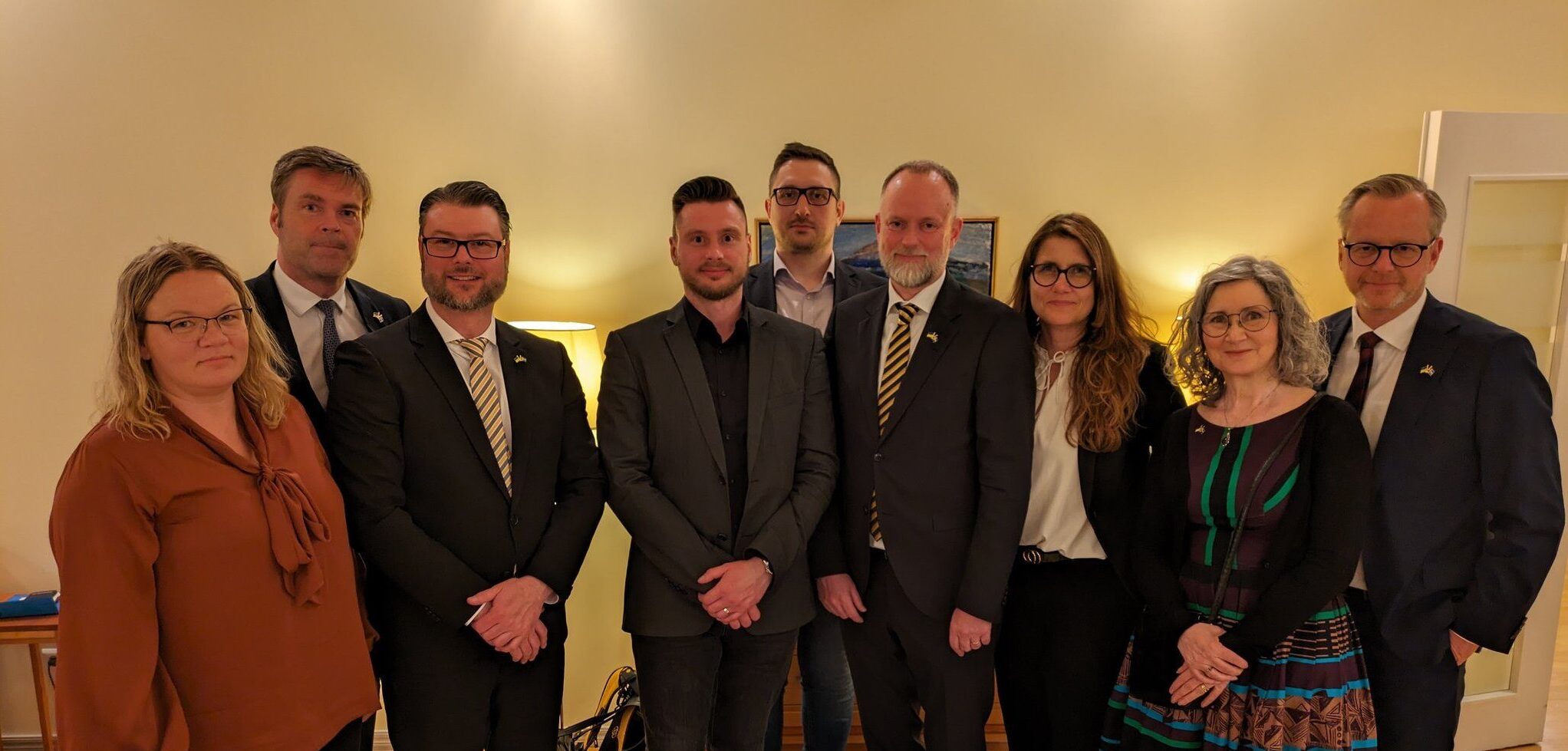
So, we once again thank Sweden for its comprehensive support at various levels – our joint efforts create opportunities for Ukraine’s further development and recovery.
Oleksandr Zaslavskyi, Head of Analytics, represented the Agency at the event.
Working Visit to Canada for MPs from the VRU Committee on Law Enforcement
In the last weeks of April, the PASS Ukraine team helped organise a working visit to Canada for MPs from the VRU Committee on Law Enforcement.
The main purpose of the visit was to exchange experience in the field of military justice and law enforcement. In particular, participants visited the Petawawa military base, where they learned about the principles of organisation and functioning of the Canadian Armed Forces and discussed issues related to training the Ukrainian military.
In addition, during a meeting with Bill Blair, Minister of National Defence of Canada, the delegation of Ukrainian MPs discussed the supply of ammunition and investment in the Ukrainian defence industry.

As Halyna Mykhailiuk noted: “It was important for our delegation to have the opportunity to communicate not only with the leadership of the military law enforcement agencies but also directly with the military personnel during the visit to the Petawawa military base.
In addition to the principles of implementing military justice “on-site,” we had the opportunity to discuss the activities of Canadian instructors in training Ukrainian servicepersons as part of Operation UNIFIER.”
During the visit, MPs also worked on strengthening parliamentary diplomacy, in particular at meetings with the Standing Committees on Public Safety and National Security and National Defence of the House of Commons of Canada, members of the Canada-Ukraine Parliamentary Group, and Greg Fergus, Speaker of the House of Commons.
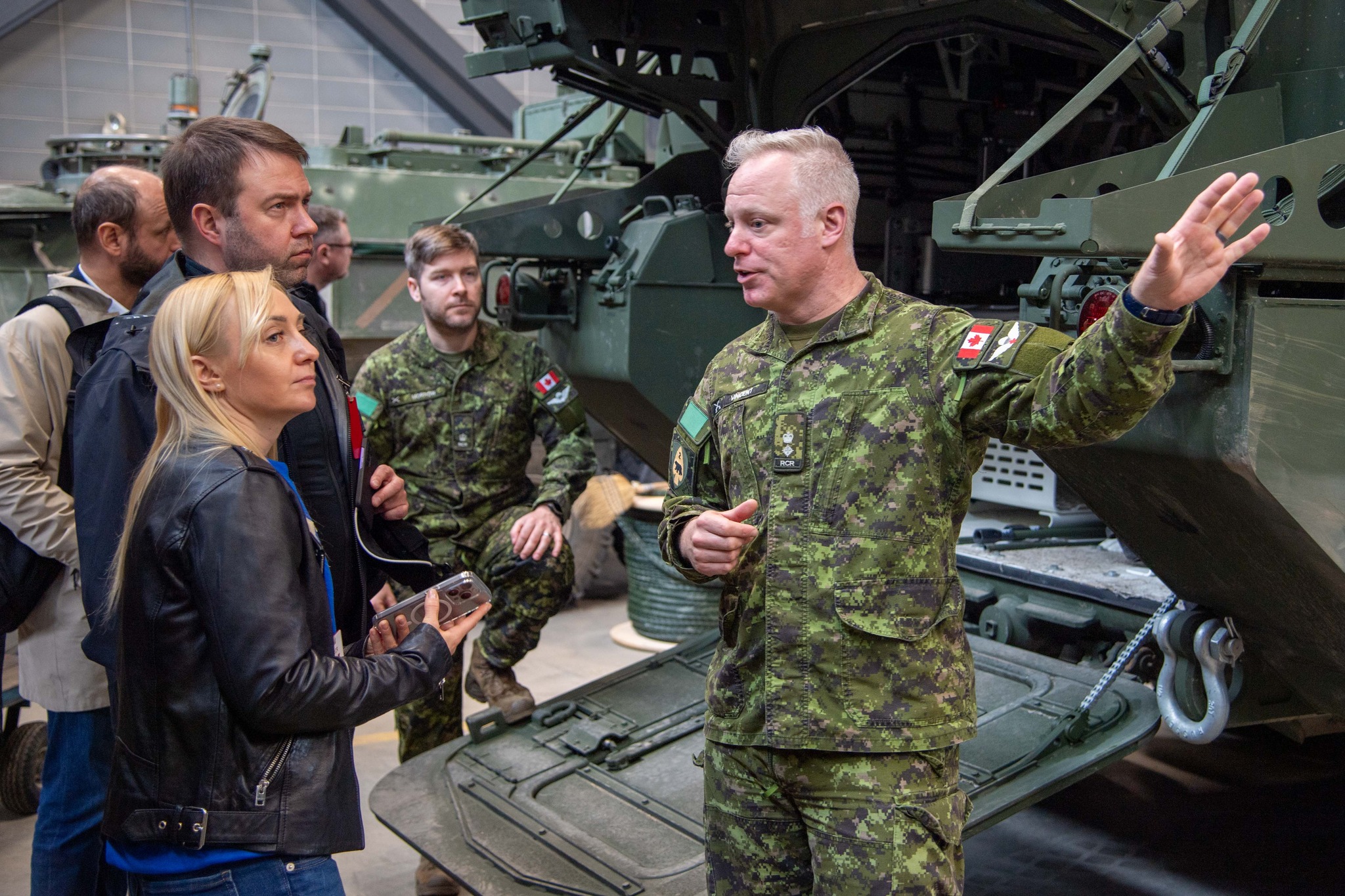
Moreover, Ukrainian MPs attended an event at the Embassy of Ukraine in Canada, where they once again stressed the need to increase military assistance to Ukraine.
Following the visit, Oleksandr Danutsa said: “I would like to note the high professionalism of the PASS team in organising the visit. A lot of quality material was processed, which is necessary for us, as MPs of Ukraine, in our future work on drafting the law on the establishment of the military justice institution in Ukraine.”
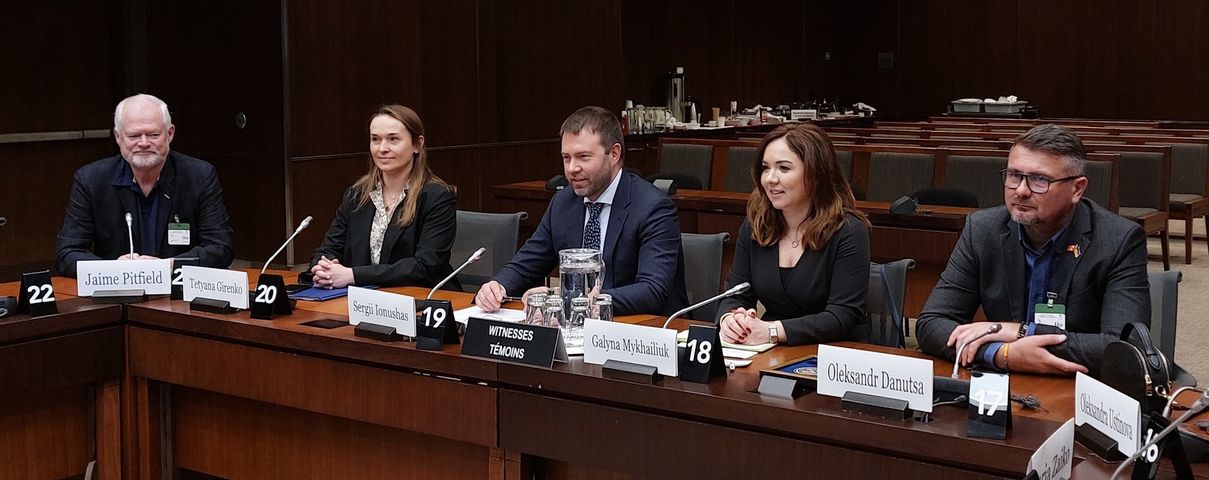
The visit was part of the project “Parliament and Accountability of the Security Sector in Ukraine” (PASS Ukraine), which the Agency implements jointly with the Parliamentary Centre (Canada), in cooperation with the Verkhovna Rada of Ukraine, and with the support of Global Affairs Canada within the framework of the Peace and Stabilization Operations Program (PSOPs).
Why Is the Adoption of the Code of Ethics a Political Issue?
This winter, we wrote about the heavy fate of the draft Code of Ethics for MPs, which could have become a tool for strengthening the subjectivity of the Verkhovna Rada (Parliament) of Ukraine (through the introduction of effective self-regulatory mechanisms) and increasing the level of trust in the single legislative body (by strengthening the requirements for MPs behaviour and introducing effective sanctions and control mechanisms).
At that time, we could only talk about semi-public debates around this Draft Law (No. 8327 “On Amendments to Certain Legislative Acts of Ukraine Regarding the Rules of Ethical Behaviour of MPs of Ukraine (Code of Ethics)”), as well as the attempts of the Standing Committee to propose its own version with much less potential — in keeping with the tradition of “Ukrainian-style reforms with no real changes”. However, at the end of January, the opinion of the MSED (Main Scientific and Expert Department) was released. Many of the comments made by the experts of the Verkhovna Rada Secretariat somehow echo the arguments against the provisions of Draft Law No. 8327, which the Chairperson of the Standing Committee voiced at various venues throughout the year (meetings of the Working Group on the Reform of the Verkhovna Rada of Ukraine, political meetings of the representatives of factions and groups in the Jean Monnet Dialogues format).
We cannot but take this opportunity to provide comprehensive responses and counter-arguments to the criticisms, which we believe are mostly politically motivated. We will further provide a step-by-step summary of the comments and our responses thereto. The full text of the MSED’s opinion is available here.
Comment No. 1
The MSED notes that a code […] is a collection of rules within a single instrument and governs a homogeneous sphere of social relations. Therefore, the proposal to call a law amending several instruments a “code” seems incorrect from a legal point of view. Therefore, we believe that the reference to a code of ethics should be removed from the title of this Draft Law.
Article 10 (Part 2) of the Law “On Lawmaking” defines the forms in which a law is adopted. If to use this classification, then Draft Law No. 8327 falls under the definition of a “law on amendments” (as indicated in the title of Draft Law No. 8327), and not a “code of Ukraine”.
However, the logic behind this Draft Law title is that the development and adoption of a Code of Ethics (or Code of Conduct) for MPs is a specific recommendation of several international organisations (OSCE/ODIHR, Group of States against Corruption (GRECO), Council of Europe, European Parliament’s Assessment Mission). Such a document exists in many countries (including those where codes “are a collection of rules contained within a single instrument and regulating a homogeneous sphere of social relations”, and is called exactly that. The peculiarity of the Ukrainian case is that the implementation of this recommendation (following many rounds of discussions) is possible only through amending a number of existing instruments, and not by adopting one holistic, completely new one. At the same time, it is quite standard and even common practice for Ukrainian legislators to add the following bracketed wording at the end of the standard formula: “on amending certain legislative acts of Ukraine regarding”. For example, a number of currently effective acts contain the clarification — (COVID-2019) — in their titles.
At the same time, the presence of the phrase “Code of Ethics” in the title of the Draft Law is not crucially important, so the Draft Law title can be changed at the stage of its finalisation before the second reading.
Comment No. 2.1
The MSED notes that the establishment of rules for the creation of certain committees that differ from the general procedure seems somewhat controversial.
This comment would be justified if the current parliamentary law instruments did not already provide for special rules for a committee creation that differ from the general procedure for the committees’ formation. However, Article 33-2 of the Law of Ukraine “On Committees of the Verkhovna Rada of Ukraine”already contains such rules. The title of the article literally indicates this: “Powers and peculiarities of formation of the membership of a committee of the Verkhovna Rada of Ukraine, scope of which includes the issue of ensuring the control functions of the Verkhovna Rada of Ukraine over the activities of special purpose bodies with law enforcement functions, special purpose law enforcement agencies and intelligence agencies”.
Moreover, the Main Legal Department (MLD) in its opinion on the Draft Law that created Article 33-2 notes that the provisions on the peculiarities of formation of the membership of one of the committees should be set out in Article 6 of this Law, thus confirming the very possibility of introducing special rules for the formation of the membership of a separate committee.
We can also consider a broader context. The parliamentary reform in Ukraine envisages, among other things, the regulation of the status of the opposition. And one of the main issues of regulating the status of the opposition is the distribution of some committees (and/or positions in these committees) between the coalition and the opposition. In other words, parliamentary reform in this regard can only be implemented if rules for the formation of certain committees that differ from the general procedure are established.
Comment No. 2.2.
The MSED notes that it can be concluded that the Draft Law implies the creation of a separate parliamentary committee to perform one function, i.e. control. It seems that such an approach is not fully consistent with the provisions of Article89 of the Constitution of Ukraine, which stipulates that the Verkhovna Rada of Ukraine shall establish committees “to perform the work of legislative drafting, prepare and conduct the preliminary consideration of issues ascribed to the authority of the Verkhovna Rada of Ukraine, and to perform control functions in accordance with the Constitution of Ukraine”, and shall not take into account that parliamentary committees are currently established by sectoral rather than functional criteria.
Draft Law No. 8327 provides for the establishment of a Committee responsible for monitoring compliance with discipline and standards of deputies’ ethics (hereinafter referred to as the Committee). Indeed, this Committee will be functionally integrated into the general system of committees. This Committee, as well as other committees of the Verkhovna Rada of Ukraine, is subject to the provisions of Articles 1 and 11–14 of the Law of Ukraine “On Committees of the Verkhovna Rada of Ukraine”, which define the status, tasks and functions of committees, i. e. drafting, organisational and controlling ones. Nothing in Draft Law No. 8327 restricts this Committee from performing legislative work, as well as preparing and preliminary consideration of issues within the VRU’s authority. Both the legislation drafting and control functions of this Committee will be performed in accordance with the scope of its competence. The Draft Law itself does not set out the scope of competence of this Committee. They must be established by adopting a relevant resolution. In other words, the content of Draft Law No. 8327, in the context of the Committee’s establishment, stipulates that the Standing Committee will not deal with issues of deputy ethics, but a separate sectoral committee will be established for this purpose.
It should be added that Article 33-2 (regarding the committee responsible for ensuring the control functions of the Verkhovna Rada of Ukraine over the activities of special purpose bodies with law enforcement functions, special purpose law enforcement agencies and intelligence agencies), despite their existence in the Law of Ukraine “On Committees of the Verkhovna Rada of Ukraine” for more than three years, have not yet been challenged by anyone in the Constitutional Court. Moreover, these provisions were adopted by the ninth convocation of the Verkhovna Rada of Ukraine, and it is the current Parliament that is responsible for implementing such provisions in Ukrainian legislation.
Finally, the Verkhovna Rada already de facto has at least one committee with a priority controlling function. The Verkhovna Rada Committee on Freedom of Speech is, in fact, a controlling committee. Since the Verkhovna Rada of the ninth convocation started its work in September 2019, until May 2022, not a single draft law has been assigned to the Committee on Freedom of Speech as a main committee. As of February 2024, only 3 (three) draft laws were assigned to this Committee as the main committee. That is, the Committee on Freedom of Speech received its first assigned draft law in the third year of its existence, and in five years, there have been three such draft laws, which is less than 1 per year. Instead, the Committee on Freedom of Speech dealt with issues of censorship, attacks on journalists, false information, etc. In other words, it performed a controlling function.
Comment No. 3
The MSED notes that vesting the Chairperson of the Verkhovna Rada of Ukraine with a number of powers related to the imposing of disciplinary sanctions on the MPs raises certain doubts in terms of compliance with the Constitution of Ukraine.
Currently, the Chairperson of the Verkhovna Rada of Ukraine already has such powers. Article 33 (Part 5) of the Law of Ukraine “On the Status of the Member of Parliament of Ukraine” provides that the reimbursement of a member of parliament expenses related to his/her performance of parliamentary powers shall be terminated by the order of the Chairperson of the Verkhovna Rada of Ukraine, which is issued based on a decision of the committee responsible for the MPs ethics. Such powers of the Chairperson of the Verkhovna Rada are in line with the powers defined in Article 88 of the Constitution, according to which the Chairperson of the Verkhovna Rada of Ukraine […] organises the work of the Verkhovna Rada of Ukraine and coordinates the activities of its bodies.
The rules on granting the Chairperson of the VRU such powers (to stop reimbursement of expenses…) were adopted already in the ninth convocation of the Verkhovna Rada. The opinions of the MSED and the Standing Committee on the draft law introducing such provisions do not contain any comments on the unconstitutionality of granting the Chairperson of the VRU the relevant powers. Moreover, the Standing Committee of the ninth convocation not only did not make such comments but also directly called for support for the proposal of the authors of the Draft Law to adopt it as a basis and thus supporting the granting of the power to terminate payments to the MPs to the Chairperson of the VRU.
Comment No. 4
In terms of the rule proposed by Draft Law No. 8327, according to which a member of parliament does not submit parliamentary inquiries and appeals on issues of no public interest, the MSED notes that in their opinion [MSED’s opinion], this provision is poorly formulated and needs to be improved. Firstly, the public interest criterion is of an estimative nature, and the relevant provision can be applied quite subjectively. Secondly, according to Article 15 (The Right of a Member of Parliament to File a Parliamentary Inquiry) and Article 16 (The Right of a Member of Parliament to File a Parliamentary Appeal), the requirement of compliance with the public interest is not imposed for the parliamentary inquiry and appeal.
The introduction of the rules on the relevance of inquiries and appeals to the public interest by Draft Law No. 8327 is due to the frequent use of such tools for the personal benefits of the MPs.
The use of the member of parliament’s mandate in the public interest follows from many provisions of the laws and the Constitution of Ukraine. The text of the member of parliament’s oath of allegiance to Ukraine, as set out in Article 79 of the Constitution, clearly demonstrates the importance of the public interest: “I swear allegiance to Ukraine. I commit myself with all my deeds to protect the sovereignty and independence of Ukraine, to provide for the good of the Motherland and for the welfare of the Ukrainian people. I swear to abide by the Constitution of Ukraine and the laws of Ukraine, to carry out my duties in the interests of all compatriots”. At the level of the law, e. g., Article 1 (Part 1) of the Law of Ukraine “On the Status of the Member of Parliament of Ukraine” stipulates that a member of parliament is a representative of the Ukrainian people.
Concerns about the estimative nature of the public interest, raised by the MSED, are based on the fact that the relevant provisions will be used to punish political opponents. Draft Law No. 8327 provides that this problem should be resolved by the relevant Committee, which is formed on a parity basis, and therefore requires a consensus of the opposition and coalition representatives to establish the absence or presence of public interest in requests or appeals, which turns a value judgement into a consensus opinion. The problems of inconsistency with Articles 15 and 16 of the Law of Ukraine “On the Status of the Member of Parliament of Ukraine” can be resolved by amending these articles at the second reading stage. For example, by supplementing these articles with relevant requirements.
Comment No. 5
In terms of the procedure for consideration of complaints on violation of the parliamentary ethics standards and the procedure for appealing against decisions on a member of parliament’s responsibility for violation of the parliamentary ethics standards, the MSED notes that the provision of the Draft Law on the possibility for the relevant parliamentary committee to independently establish the procedure for consideration of complaints on violation of the parliamentary ethics standards and the procedure for appealing against decisions on a member of parliament’s responsibility for violation of the parliamentary ethics standards is not consistent with the current constitutional provisions, the Rules of Procedure and the Law of Ukraine “On Committees of the Verkhovna Rada of Ukraine”. The very approach that entrusts a parliamentary committee with establishing the rules of its own activities, i.e. its own rights and obligations, also provokes objections. After all, this is a violation of the fundamental principles of control, according to which the activities of the controlling body should be limited by the law and subject to procedural rules. The controlling authority cannot act on the basis of independently established rules since this may adversely affect the objectivity of control measures and create grounds for abuse and subjectivity in the exercise of its control functions and decision-making.
These comments may well be taken into account at the stage of preparing the Draft Law for the second reading. For instance, these provisions could be amended so that the procedure for considering complaints and the procedure for appealing decisions on liability are determined by the Verkhovna Rada or the Chairperson of the Verkhovna Rada. In addition, such provisions could be set out in the Regulation on the Committee’s Secretariat, which is approved by the Chairperson of the Verkhovna Rada.
At the same time, the grounds for abuse and subjectivity in the Committee’s activities should be eliminated by ensuring parity of representation of the opposition and the coalition.
Comment No. 6.1
The MSED provides comments on the Draft Law with regard to the removal of Parts1 and 2 from the current Article 51 of the Rules of Procedure, which prohibits the brining into the parliamentary chamber and use of posters, slogans, loudspeakers, and other items not intended to support legislative activities during the plenary session, and the inadmissibility of interfering with the presentation or perception of a speech at a plenary session (by shouting, applause, standing up, talking on a mobile phone, etc.), using offensive language and obscene words, and calling for illegal actions. This approach is objectionable since the relevant regulations are designed to ensure the creation of the necessary conditions for the normal work of parliamentarians in plenary mode, and their removal from the text of the law will worsen the regulatory regulation of the relevant issues. Moreover, such provisions are in a stable logical connection with the following parts of the said Article and have the appropriate legal detail.
The above-mentioned provisions of Parts 1 and 2 of Article 51 of the Rules of Procedure are essentially declarative or “dead” norms. MPs, both representatives of the coalition and the opposition, constantly bring into the parliamentary chamber objects that are not intended to support legislative activity, often, these are posters, which are explicitly prohibited in Article 51 (as seen in the materials of Unian, LB and Glavkom). MPs also often shout, applaud, stand up, and talk on mobile phones in the parliamentary chamber. Among the recent events, we can mention the events of 10 January 2024, when the Chairperson of the VRU terminated the session early due to shouting and noise in the chamber (as seen in the transcript and video). In general, it is difficult for a regular viewer of the Verkhovna Rada of Ukraine sessions to imagine the work of the MPs without shouting and applause during the presentation or perception of a speech, although this behaviour is recognised as unacceptable by the current Rules of Procedure. All of these actions have long been part of parliamentary behaviour and do not result in sanctions against violators. Therefore, their exclusion from the Rules of Procedure is unlikely to change the actual behaviour of the MPs.
The rules proposed by Draft Law No. 8327 to replace the existing but ineffective ones, such as non-use of physical force, respect for colleagues, non-use of obscene words, etc., are more general rules that aim to ensure the same goal (maintaining order during the work of the MPs), but in combination with other logically related rules of the Draft Law (in particular, the system of sanctions and the mechanism for bringing violators to justice), they seem to be a much more effective tool.
In other words, the Draft Law replaces the existing but ineffective rules with a new holistic system of rules and mechanisms for their implementation, which, in essence, corresponds to the meaning of the “code” concept, although it is implemented in the form of amendments to a number of acts.
Comment No. 6.2
The MSED notes that it is unclear which issues related to the appeal procedure may be subject to legal regulation of the procedure to be approved by the committee.
The procedure may contain a detailed appeal procedure, while the Draft Law contains only general rules and principles thereof. As noted above, such a procedure may be approved by the Verkhovna Rada of Ukraine or the Chairperson of the Verkhovna Rada of Ukraine. In any case, such things may be finalised at the stage of preparing the Draft Law for the second reading.
Comment No. 6.3
The MSED notes that the provisions of Part 6 of the new Article 51-1 of the Rules of Procedure stipulate that the Verkhovna Rada may cancel a decision on the member of parliament’s responsibility for violating the norms of parliamentary ethics in case of appeal thereof. This means that the Verkhovna Rada of Ukraine may cancel the decisions of a parliamentary committee. However, according to their constitutional and legal status, parliamentary committees are working bodies of the Parliament (Verkhovna Rada) established to perform legislative work in certain areas, prepare and preliminary consideration of issues within the powers of the Verkhovna Rada of Ukraine, and perform controlling functions (Article 1 of the Law of Ukraine “On Committees of the Verkhovna Rada of Ukraine”). When making its own decisions, the Verkhovna Rada of Ukraine takes into account the decisions of parliamentary committees but cannot amend or cancel the decision of a committee of the Verkhovna Rada of Ukraine. In view of the above, the mechanism for reviewing and cancelling these decisions of parliamentary committees proposed in the Draft Law appears to be legally incorrect. The possibility of cancelling the decision of the Chairperson of the Verkhovna Rada of Ukraine on the relevant 7 issues is also questionable, as the construction of such a legal mechanism, in our opinion, has no constitutional grounds.
This MSED’s comment seems to be based on an incorrect interpretation of the provisions of Draft Law No. 8327. The latter actually stipulates that the Committee to be established recommends to the Chairperson of the VRU to make a decision on the responsibility of a member of parliament. The MSED used this interpretation (it is the Chairperson who imposes sanctions) in the third paragraph of its opinion. As for the mechanism of cancellation of the decision of the Chairperson of the VRU by a majority vote of the MPs, such a mechanism is already available in the Rules of Procedure (Part 2 of Article 78): the orders of the Chairperson of the Verkhovna Rada of Ukraine may be amended or cancelled by a decision of the Verkhovna Rada adopted by a majority vote of the MPs from the constitutional composition of the Verkhovna Rada. Based on the provisions of the Rules of Procedure, the Chairperson of the VRU makes decisions that are formalised in the form of an order. In other words, an order is a way to formalise a decision. In order to avoid further misinterpretations (whose decision may be cancelled by the VRU), the relevant provisions of the Draft Law can be finalised before the second reading.
Comment No. 6.4
The MSED notes that the right of a member of parliament to appeal against decisions to hold him/her liable for violating ethics standards is not currently stipulated in the basic provisions of the Law of Ukraine “On the Status of the Member of Parliament of Ukraine” and the Draft Law does not propose any relevant provisions as well.
This quite reasonable MSED’s comment can be considered by amending the Draft Law appropriately when preparing it for the second reading.
Comment No. 7.1
The MSED notes that impeccable reputation and exceptionally high moral qualities are estimative concepts, the meaning of which can be interpreted in different ways and which should be avoided in lawmaking. Thus, the implementation of these novelties of the Draft Law seems problematic.
An impeccable reputation and high moral qualities are indeed estimative concepts. They should serve as a guideline for the MPs in determining the candidacy of the Committee’s Chairperson and Secretary. It is expected that MPs will independently assess the extent to which the candidates meet these criteria. Morality and ethics are concepts that, by their nature, cannot always be interpreted unambiguously. This applies both to other proposed rules of Draft Law No. 8327 (e. g., what exactly constitutes discriminatory expressions, what does the economical use of property mean, what does respectful treatment mean, etc.) and to the existing provisions of the Constitution and acts of parliamentary law. The above-mentioned member of parliament’s oath of allegiance to Ukraine contains many concepts that are not unambiguous, such as “loyalty to Ukraine”, “good of the Motherland”, “welfare of the Ukrainian people”, and “interests of all compatriots”. Article 8 of the Law of Ukraine, “On the Status of the Member of Parliament of Ukraine”, which currently regulates the issue of parliamentary ethics, also contains concepts that can be interpreted in different ways: “1. In his/her activities, a member of parliament shall adhere to generally recognised rules of morality; always preserve his/her own dignity, respect the honour and dignity of other MPs, officials, and citizens; refrain from actions, statements and deeds that compromise him/herself, voters, the Verkhovna Rada of Ukraine, and the state. 2. It is inadmissible for a member of parliament to use his/her parliamentary mandate contrary to generally recognised rules of morality, human and civil rights and freedoms, and the legitimate interests of society and the state. 3. A member of parliament should not use his/her parliamentary mandate for personal, in particular deceptive, purposes”.
In fact, the law cannot but leave room for interpretation of its provisions depending on the context. Self-assessment of candidates for compliance with the above criteria is at the same time: 1) a manifestation of the Verkhovna Rada’s subjectivity, and 2) a link between MPs and their voters through shared values.
Comment No. 7.2
The MSED notes that the new Article 33-3 (Part 4, para. 4) of the Law proposes to provide that a complaint regarding a violation of the parliamentary ethics standards shall not be anonymous. However, the new Article 33-3 (Part 5, paras. 3 and 4) of the Law stipulates that an officer of the Secretariat of the Verkhovna Rada of Ukraine shall address the persons authorised by the committee if such an officer fears pressure from a member of parliament and if the appeal of the officer of the Secretariat of the Verkhovna Rada of Ukraine substantiates the violation of the parliamentary ethics standards, such authorised persons shall register the complaint on their own behalf and act as the complainant. Therefore, the Draft Law provides for both the inadmissibility of anonymous complaints and simultaneously regulates the possibility of filing a complaint by other persons (authorised persons) against the actions of a member of parliament against an employee of the Secretariat, who will remain anonymous. Moreover, the proposed mechanism does not seem to be clear and understandable, at least in terms of which entity and in what way should establish the “validity” of the appeal of the employee of the Verkhovna Rada of Ukraine in order for the authorised person to register the complaint on his/her behalf and act as the complainant.
Draft Law No. 8327 stipulates that an authorised person registers a complaint on his/her own behalf, acting as a complainant. This makes the complaint non-anonymous, as the complaint has a specific author and a specific complainant, i. e. the authorised person.
Draft Law No. 8327 stipulates that the complaint submission mechanism should be detailed in the complaint procedure. In particular, this procedure may clearly establish which entity and in what manner must establish the “validity” of the appeal of an employee of the Verkhovna Rada of Ukraine Secretariat in order for the authorised person to register the complaint on his/her behalf and act as the complainant. Again, such a procedure may be approved by the Verkhovna Rada or the Chairperson of the Verkhovna Rada, and the relevant amendments may be made to the Draft Law at the stage of its finalisation.
Comment No. 7.3
In terms of the closed meetings of the Committee, the MSED notes that the approach used in the Draft Law to determine the grounds for holding closed meetings of the relevant Committee cannot be welcomed given that the cases it considers are of public interest. […] Accordingly, the “agreement” of the complainant and the person whose behaviour is being challenged on closed meetings of the Committee or the absence of such an “agreement” (as proposed in the Draft Law) cannot be considered sufficiently adequate grounds for holding a closed meeting of the Committee to consider the complaint.
The logic of introducing the possibility of closed consideration of violations of the rules of conduct is based on the idea that the very fact of filing a complaint and its consideration may damage the reputation of a member of parliament. This mechanism can be used by political opponents for reputational attacks, which is explicitly stated in the OSCE Background Study: Professional and Ethical Standards for Parliamentarians (Section: Safeguards during an investigation). Moreover, there was a consensus on this mechanism among the relevant parliamentary subgroup of the Work Group on the reform of the Verkhovna Rada of Ukraine. Therefore, in some cases (Draft Law No. 8327 generally provides for open meetings), the possibility of closed meetings is proposed to reduce the potential for using the Code of Ethics as a tool for reputational attacks.
Nevertheless, we believe that the mechanism can be improved and detailed at the stage of preparing the Draft Law for the second reading.
Comment No. 8.1
The MSED notes that the normative material of each part should be rephrased so that the content of the principle is explained in one sentence. Moreover, it is not correct to define the content of the principle through the same term (the rule of prohibition of a circle). In particular, Part 5 “Leadership” is an example of a violation of the relevant rule: “5. Leadership. A member of parliament, by his/her leadership and example…”.
This quite reasonable MSED’s comment can be easily considered at the stage of preparing the Draft Law for the second reading. It requires editorial amendments to certain structural elements of the Draft Law, without changing its content, purpose or the relationship between its individual structural elements.
Comment No. 8.2
The MSED notes that according to the Rules for Law Drafting and Compliance with the Basic Requirements of Legislative Technique (Guidelines) of 27.11.2014, “if it is necessary to emphasise the motives of the legislator, the historical context or other circumstances that serve as a reason for the adoption of the law and/or should be taken into account in the subsequent law enforcement or interpretation of the law to understand the tasks set by the legislator and the ways of achieving them chosen by him in the law, a preamble is placed at the beginning of the draft law. However, legal provisions are not included in the preamble”. It appears that the preamble of the Draft Law under consideration does not fully comply with the above regulatory principles. It should also be noted that the preamble to a law usually begins with the words: “This Law defines…”. At the same time, the preamble to the proposed Draft Law states that “The MPs of Ukraine, in order to strengthen respect, authority and public trust in the MPs of Ukraine and the Verkhovna Rada of Ukraine, … adopt these amendments to the legislative acts of Ukraine on the rules of ethical conduct of the MPs of Ukraine (Code of Ethics)”. This wording is not correct, as the only legislative body in Ukraine is the Parliament, i. e. the Verkhovna Rada of Ukraine (Article 75 of the Constitution of Ukraine). The powers of the Verkhovna Rada of Ukraine include “the adoption of laws” (Article 85(1)(3)).
This comment can be easily taken into account at the stage of preparing the Draft Law for the second reading. It requires editorial amendments to the preamble of the Draft Law, without changing its content, purpose or the relationship between its individual structural elements.
Can Draft Law No. 8327 be adopted?
In general, the MSED’s comments can be divided into two groups. The first group is conceptual comments (comments Nos. 2.1, 2.2, 3, and 6.3), and the second group is technical and legal comments (all other comments).
Article 102 (Part 2) of the Rules of Procedure of the Verkhovna Rada of Ukraine gives us a hint as to what the further fate of the Draft Law should be, which states that “Consideration and adoption of a Draft Law under the procedure of three readings includes: 1) the first reading, i.e. discussion of the basic principles, provisions, criteria, and structure of the draft law and its adoption as a basis; 2) the second reading, i. e. article-by-article discussion and adoption of the draft law in the second reading”. In other words, if the basic principles, provisions, criteria, and structure of the draft law are satisfactory, it can be adopted in the first reading and certain article-by-article changes can be finalised by making amendments at the second reading stage. The MSED’s opinion and analysis thereof is an excellent basis for refining the text of the Draft Law and proves that it is possible to adopt Draft Law No. 8327 as a basis, with its further refinement at the stage of preparation for the second reading.
Important conceptual issues highlighted by the CSE O include, in particular, the issue of a new Committee establishment, the mechanism for imposing sanctions for violations of the rules of ethical conduct, and their cancellation. It is important to note that similar mechanisms and instruments already exist in the current legislation. Moreover, they were introduced by the current, ninth convocation of the Verkhovna Rada, and the MSED, the MLD and Standing Committee agreed to the introduction of these amendments or even directly supported them.
All other comments can be finalised at the stage of preparation for the second reading. In accordance with the Rules of Procedure, it is at this stage that draft laws must undergo detailed technical and legal revision, considering amendments and proposals from the MPs. Moreover, the Verkhovna Rada has recently been actively using the mechanism of adopting draft laws as a basis with further refinement under Article 116 (Part 1) of the Rules of Procedure, which provides for consideration of proposals and amendments to correct, clarify, eliminate errors and/or contradictions in the text of the draft law, other structural parts of the draft law and/or other legislative acts that were not considered in the first reading. There are already more than 60 such draft laws approved in the first reading. Each individual amendment that can be finalised at the stage of preparation for the second reading may be excluded from the text of the draft law. However, if all such amendments are excluded, this may unbalance Draft Law No. 8327. Therefore, it is important to find the right balance between finalising certain amendments proposed by the law and excluding those that are fundamentally opposed by key stakeholders.
In any case, the lawmaking process has never been a set of norms and technical and legal rules. It has always been a combination of political will a desire to change the current state of affairs and legal constructs. Draft Law No. 8327 is the result of extensive discussion, consultations, and the work of a work group chaired by a member of the ruling Sluga Narodu (Servant of the People) faction, which included representatives of most factions of the Verkhovna Rada and extra-parliamentary experts. This demonstrates multi-factional political support for the introduction of rules of ethical conduct for MPs. At the same time, the current legislation contains many tools and mechanisms similar to the conceptual instruments proposed by Draft Law No. 8327. Its technical and legal revision can be carried out at the stage of preparation for the second reading. In fact, the analysis of the CSE’s opinion showed that the adoption of this Draft Law is a matter of political will. After all, the introduction of ethical rules of conduct for parliamentarians is primarily the responsibility of Ukrainian MPs.
How Much Do MPs Earn, and How Can They Earn More?
When the Unified State Register of Tax Returns reopened in early 2024, it was discovered that MPs’ declared income was sometimes half that of the top officials of the Verkhovna Rada’s Secretariat. Thus, dissatisfaction with this situation began to spread in the media as part of society, and MPs considered it unfair. Is this distribution fair? Where did this salary ratio come from? Let’s try to study the issue consistently.
How is the salary of MPs and employees of the VRU Secretariat formed?
The salaries of MPs and employees of the Secretariat have one thing in common: they consist of a salary and supplements. But this is where the similarity ends, as the salaries of civil servants (employees of the Secretariat) and MPs are calculated differently. It is more appropriate to compare salaries since supplements are often individual (for example, for length of service).
The Cabinet of Ministers determines the salaries of the Secretariat’s staff by its resolution, which sets out the levels of state bodies, as well as the categories and types of positions for all civil servants. The Secretariat is the highest-level state body and has the highest salary level in the public sector. Quite logically, the Secretariat’s top officials receive almost five times higher salaries (up to UAH 40,100 per month) than its ordinary employees (from UAH 8,700 per month). In other words, top Secretariat officials receive large salaries as managers, and these salaries are higher than those of top officials of other state bodies because they work at the highest level of the state body.
The Cabinet of Ministers does not set the salaries of MPs. According to the law, MPs’ salaries are set by the Verkhovna Rada by adopting a relevant resolution. For example, the salary of an ordinary MP is 10 subsistence minimums (UAH 24,810 per month in 2022), and the salary of the Chair of the Verkhovna Rada is 12 subsistence minimums (UAH 29,772 per month in 2022). The difference between the salaries of an ordinary MP and the Chair of the Verkhovna Rada is only 20%.
Important: We provide data for 2022 because this year was used to compare the salaries of MPs and civil servants, which led to dissatisfaction with this ratio in other files. In 2023 and 2024, the wages of MPs exceeded the 2022 level. Thus, in 2023, the salary of an MP amounted to UAH 26,840, and in 2024, it will be UAH 30,280.
However, in addition to their salaries, MPs receive several other types of compensation: for example, for travel expenses (approximately UAH 90,000 per MP in 2022) or rent (in 2022, an average of 100 MPs received compensation, which amounted to approximately UAH 290,000 per MP per year). Of course, not all MPs receive them. For example, only MPs who do not live in Kyiv are eligible for compensation for rent.
Is the ratio of MPs’ salaries to those of the Secretariat staff fair?
The situation in which independent and professional civil servants receive higher salaries than politicians is not unique to Ukraine. In particular, the EU is interested in attracting professionals to the civil service, so it provides its independent and professional civil servants with high salaries. A comparison of salaries of top civil servants in the EU and members of the European Parliament, or the highest-paid parliamentarians in EU member states (Italy and Germany), shows that civil servants receive twice as much as members of parliament. If we compare the salaries of top officials with the more common salaries of members of national parliaments in EU countries (EUR 2-3K), the difference is tenfold.
Both European experience and common sense show that the logic of setting salaries for both civil servants (including employees of the Verkhovna Rada Secretariat) and MPs should not be based on their mathematical comparison. This logic should be based on ensuring decent salaries proportional to the level of responsibility, which will allow attracting professional and talented people to state management rather than stimulating corrupt practices.
The 2023 SIGMA Public Administration Assessment shows that civil servants’ salaries are not competitive with the private sector, and staff turnover has risen to a critical level during the war. Naturally, the salaries of MPs do not look competitive either against this background. This is undoubtedly a problem, but there is a solution for MPs.
Who and how can change the level of MPs’ remuneration?
The paradox is that MPs, unlike civil servants, can increase their salaries by simply changing the relevant resolution. This step requires neither the approval of the Cabinet of Ministers nor the signature of the President of Ukraine. This is an issue to be solved exclusively by the Verkhovna Rada of Ukraine. Moreover, this also means that other bodies do not have the authority to increase the salaries of MPs. Neither the President nor the Cabinet of Ministers, the regional council, the public council, or the garage cooperative have the authority to increase their salaries. Only MPs themselves can rectify the situation, which they believe to be unfair. And this is a real problem.
Ukrainian MPs cannot agree on potentially unpopular decisions. No one wants to take on such responsibility in the context of populist discourse. To explain complex and unpopular decisions to voters, one must be sufficiently subjective and demonstrate leadership and responsibility that are uncommon in Ukrainian politics. This applies to many decisions that are important for public administration.
Moreover, the unwillingness to make these decisions actually makes the Parliament dependent on other branches of power. MPs failed to create a separate parliamentary service, so the government sets the salaries of the VRU Secretariat staff. Relatively low wages of MPs create conditions for extra-parliamentary interest groups to convert their informal support of MPs into influence on parliamentary decision-making.
In conclusion, one cannot help but notice the most interesting details. The rules for calculating salaries (and, accordingly, their ratio) of the Secretariat’s staff and MPs have not undergone any significant changes in recent years. If we compare the tax returns of the Secretariat’s staff holding senior positions and MPs, we can see that the ratio of salaries was approximately the same in 2019, 2020, 2021, 2022, and 2023. However, for some reason, the problem became more relevant in the public space in early 2024. MPs’ public dissatisfaction with this issue was also revealed only in early 2024. So, maybe it’s time to take responsibility and try to solve the problem: if not for themselves, then at least for the next convocation.
Expenditures of the VRU Secretariat in 2023
The Secretariat of the Verkhovna Rada of Ukraine plays a key role in ensuring the work of the Parliament. Financial resources allocated annually from Ukraine’s state budget are needed to maintain its activities. In February 2024, the Secretariat reported on how it spent state funds in 2023.
In 2023, the state budget amounted to UAH 4,014,418.1 million. From this amount, UAH 2,717.3 million was allocated to the needs of the Verkhovna Rada’s Secretariat. This is only 0.07% of the total budget expenditures.

Let us consider in more detail how the Secretariat of the Verkhovna Rada of Ukraine used these funds in 2023.
First, UAH 1,208.4 million was allocated to legislative activities (this is 44.47% of the Verkhovna Rada’s expenditures in 2023). Of the spent funds, approximately UAH 770 million was allocated for the remuneration fund (salaries + single social contribution) for 401 MPs and their assistants, about UAH 12 million for the payment of services (except for utility services), and social benefits for MPs (travel, housing rent, expenses, related to the performance of MP powers).
UAH 823.7 million (this makes 30.31% of all expenditures of the VRU in 2023) was spent on the management of the affairs of the VRU’s Secretariat [Needs for implementation of organisational, informational, analytical, and logistical support of the VRU activities]. These expenses were mainly directed at maintaining the employees of the VRU Secretariat (1,063 people according to the staffing list), i.e., 1) approximately UAH 816 million for remuneration (salaries + SSC), 2) UAH 2.6 million for other services (except utilities), and 3) ≈ UAH 51,000 for transborder business trips of two employees of the Secretariat, as well as some other expenses related to the performance of the functional duties of the Secretariat.
UAH 242 million was allocated for the maintenance and servicing of administrative buildings of the Verkhovna Rada of Ukraine in 2023 (this makes up 8.91% of all expenses of the Verkhovna Rada of Ukraine in 2023). These funds covered a wide range of expenses, including salaries for administrative building management employees (about UAH 176 million), payment of utilities and energy sources (approximately UAH 57.1 million), services not related to utilities (≈ UAH 9 million), and other social benefits. The total area of administrative buildings is 80,608.3 square metres.
UAH 536,000 was allocated for the current repair of structures and buildings with a total area of 68.7 square metres. Among the repair works, there were such projects as the repair of balconies at 3a Sadova and 4 Shovkovychna Streets (UAH 142.3 thousand), emergency repair of the drainage system and asphalt covering within the territory of the administrative building at 6–8 Bankova Street (UAH 136,000), emergency repair of cold water supply pipeline at 11 Velyka Zhytomyrska Street (UAH 94,500), as well as restoration and arrangement of the well at the “Koncha-Zaspa” recreation centre to provide it with water supply (UAH 163,200).
UAH 157.5 million was allocated for transportation support for the VRU in 2023 (this makes up 5.8% of all expenses of the VRU in 2023). As of late 2023, there were 160 cars on the Carpool register. Early this year, the Carpool had 182 vehicles on its register, of which 24 vehicles were transferred to the Ministry of Defence of Ukraine, but the Carpool received one Volkswagen car and one Agados special trailer. The total run of the fleet was 2,475.1 thousand km, which indicates the intensive use of vehicles. The cost of one hour of car operation is established at UAH 492.4.
The main motor transport expenses included the remuneration and extra charges of the Carpool employees, which amounted to approximately UAH 108 million, the use of goods and services, which cost about UAH 36 million, and other expenses.
UAH 119.6 million was allocated to create audiovisual works for the round-the-clock information marathon, in particular, the United News #UArazom programmes (this makes up 4.4% of the VRU’s expenditures in 2023). This became part of the Rada TV channel’s efforts to integrate into the state’s unified information policy during martial law, which started in 2022 when UAH 107.8 million was spent on the participation of the Rada TV channel in the TV marathon.
In 2023, almost all the allocated funds (UAH 120 million) were used — UAH 119.6 million (the cost of the contract with KinoKit company, which provided services). As part of the TV marathon, the Rada channel was on air for 1,247 hours, while the cost of one hour of airtime amounted to UAH 95,900. For reference, the Rada channel accounts for about 4 hours of 24/7 broadcasting).
However, funding such significant costs may raise questions about the intended use of the money. The main purpose of the budget programme and the Rada channel is to cover the VRU’s activities and inform the public about them. However, the TV marathon’s reporting does not always focus on the Parliament’s work. This may fall under inappropriate use of budget funds and potentially violate the budget legislation. An extremely large volume of content created greatly complicates the audit process. It makes it impossible to establish exactly how many hours of broadcasting were devoted to information about the activities of the Verkhovna Rada. The irony is that expenditures from the budget for content creation by the Rada channel increased by several hundred per cent during the years when the Verkhovna Rada stopped broadcasting its meetings.
UAH 43.5 million was financed for the Verkhovna Rada’s scientific and legal support (1.6% of the Rada’s expenditures in 2023). These are funds for maintaining the VRU’s Research Service (the legal successor to the VRU’s Legislation Institute). Most of these funds, approximately UAH 42.8 million, were used for the salaries of the service employees. The Research Service provided professional and advanced training for 1,325 people, namely MPs of Ukraine, their assistants, advisors, and employees of the VRU Secretariat. In addition, the service prepared 691 information and analytical resources.
UAH 43.1 million was spent on the production and distribution of television programmes covering the activities of the VRU (this makes up 1.59% of all VRU expenditures in 2023). These are expenses for funding the Rada TV channel, which ensures the creation and broadcasting of other informational materials on foreign and domestic policy issues.
UAH 28.4 million (1.05% of the Verkhovna Rada’s expenditures in 2023) was allocated to the financial support of the “Holos Ukrayiny” newspaper. These funds covered various newspaper needs, including printing costs, which amounted to UAH 6.1 million for the production of 262 issues during the year, with a total annual circulation of 7,547,000 pieces.
Also, UAH 23.5 million was spent on the payment of bonuses and scholarships of the Verkhovna Rada of Ukraine (0.86% of all VRU’s expenditures in 2023). Of these, UAH 7.7 million was allocated to scholarships for 48 recipients: young doctors of science. In 2023, the amount of each scholarship was UAH 161,040 per year. UAH 15.8 million was spent on prizes for 94 recipients (50 prizes for young scientists and 44 for teaching staff of preschool, general secondary, vocational (vocational-technical), and out-of-school education institutions).
UAH 13.8 million was allocated to cover expenses for visits of MPs parliament abroad (0.51% of all expenditures of the Verkhovna Rada in 2023). This money funded 123 visits, during which 307 MPs visited other countries as part of business trips.
UAH 7.3 million (0.27% of all expenditures of the Verkhovna Rada of Ukraine in 2023) was paid as membership fees to international organisations in which the Verkhovna Rada of Ukraine acquired membership. There are six such organisations in total: the OSCE, the Parliamentary Assembly of the Black Sea Economic Cooperation (PABSEC), Inter-Parliamentary Cooperation (IPC), the Geopolitical 12+ Group within the IPC, the ACP–EU Joint Parliamentary Assembly, and the Association of Southeast Asian Nations (ACEAH). Based on the decision adopted during the 42nd session of the ACEAH Inter-Parliamentary Assembly, the Verkhovna Rada of Ukraine was granted Observer status in the MA ACEAH.
UAH 3.3 million was spent on maintaining protocol events at the VRU (0.12% of the VRU’s expenditures in 2023). In 2023, 1,096 such events were held in the committees of the VRU, and the average costs for organising one event amounted to approximately UAH 3,000. These expenses are aimed at paying for services provided by the State Commercial Enterprise “Canteen of the Secretariat of the Verkhovna Rada of Ukraine,” which serves international events held in the Verkhovna Rada of Ukraine.
UAH 2.2 million (0.08% of the VRU’s expenditures in 2023) was spent on holding the PABSEC Sixty-second General Parliamentary Assembly, of which UAH 305.9 thousand was spent on purchasing equipment (4 units) to prepare the assembly. The PABSEC 62nd General Assembly was held in a mixed format and online in connection with the martial law in Ukraine and security issues. This resulted in the savings of UAH 3.1 million since UAH 5.3 million was allocated for the event. As part of this event, it was planned to meet 130 people from 13 member PABSEC countries, but only 38 came (92 people less).
The organisation and holding of official receptions of the Verkhovna Rada cost UAH 0.9 million (0.03% of VRU’s expenditures in 2023). Twenty-three receptions were arranged for delegations of international organisations, foreign parliaments, and guests of the VRU. In total, 304 people visited Ukraine at the VRU’s invitation, and the average cost of receiving one delegation was UAH 37,300.
Workshop on Principles and Practices of Legislative Impact Assessment
The legislative impact assessment is a tool that helps analyse and forecast the potential impact of formulated public policies. The introduction of this toolkit will help improve the quality of draft laws being prepared in the Verkhovna Rada. Its main goal is to pay more attention to the possible consequences of adopted laws and conduct a comprehensive analysis of the proposed changes.
On Friday, 23 February, the Agency, together with the Committee on the Organisation of State Power, Local Self-Government, Regional Development and Urban Planning, held a workshop on the principles and practices of legislative impact assessment.
The Agency remains a staunch supporter of the popularisation of the legislative impact assessment tool. That is why it promotes the organisation of educational events and training involving representatives of lawmakers.
The event was part of the project “Parliament and Accountability of the Security Sector in Ukraine” (PASS Ukraine), which the Agency implements jointly with the Parliamentary Centre (Canada), in cooperation with the Verkhovna Rada of Ukraine, and with the support of Global Affairs Canada within the framework of the Peace and Stabilization Operations Program (PSOPs).
Regulating Parliamentary Ethics: How It Works in the World
Many countries of the world regulate the ethics of MPs by means of appropriate regulatory acts. So-called codes of ethics or codes of conduct are the most widespread. Their availability has a number of advantages: MPs understand and can objectively assess their own ethical behaviour and the behaviour of their colleagues. In contrast, the parliament has clear tools to influence discipline violators.
According to the Inter-Parliamentary Union Parline, as of January 2024, codes of conduct for MPs are in force in 85 countries worldwide. In the most general form, this document contains a list of ethical rules and standards of behaviour that a member of parliament must follow in their professional activity and sanctions for violating them. In practice, however, the format of this document may vary by country: in some countries, it is a detailed document with a list of rules, areas of their application and sanctions for violations, and in others, it is a summary of the main professional values and norms of conduct.
Some countries do not have a code of conduct as a separate law or other regulatory act approved by the parliament. Instead, the norms of ethical behaviour can be enshrined in legislation governing parliament’s activities.
Here are some examples of the implementation of codes of conduct in different countries:
- The USA. The code of official conduct for Senate members (the upper house of the US Congress) is part of the regulations. Besides, Senate members may be expelled for disorderly behaviour by two-thirds of the votes in accordance with the Constitution.
- Germany. The code of conduct for members of the unicameral parliament (Bundestag) is an appendix to the regulations.
- Great Britain. The Code of Conduct for Members of the House of Lords (the upper house of Parliament) is outlined in a resolution.
- Malta. The Code of conduct for Members of the House of Representatives (unicameral parliament) is outlined in the form of the law.
- Ireland. The Senate Code of Official Conduct (the upper house of parliament) is outlined in the resolution.
- Lithuania. The Code of Conduct of State Politicians (applies to MPs of the unicameral parliament — the Seimas, the president, members of the European Parliament, representatives of municipal councils and mayors) is outlined as the law.
- Poland. The Rules of Ethical Behaviour for MPs of the Sejm (the lower house of the National Assembly of the Republic of Poland) is outlined as a resolution.
- France. The Code of Conduct for Members of the National Assembly (the lower house of parliament) is a resolution of the Bureau of the National Assembly.
- Georgia. The Code of Conduct for Members of the Unicameral Parliament is outlined as a declaration.
These regulatory acts establish the rules of conduct for MPs both in the meeting halls and outside them. The list of violations established by the ethical codes of different countries may vary, but the following are the most common: improper behaviour, personal insult (in particular, of other high-ranking officials) or slander, prolonged absence from work, and other actions incompatible with the concept of parliamentary dignity.
Violations may be subject to the following sanctions:
- calls to order with entry into the parliamentary protocol, as well as official condemnation;
- deprivation of the right to speak, temporary suspension from participation in meetings;
- demand for a public apology;
- financial sanctions: penalties, salary cuts;
- loss of the mandate.
In practice, punishment for violating parliamentary ethics may be quite severe in some countries. For example, the Republican George Santos was expelled from the US Congress in December. One of the charges, in addition to embezzlement, was unethical behaviour: Santos lied to his voters about his past—career and education — which misled them. Expulsion from the parliament for unethical behaviour is also possible in India. A similar type of sanction also exists in Great Britain and Canada.
Compliance with ethical conduct may be monitored in different ways. Researchers single out three models existing in the world: 1) setting up an appropriate parliamentary committee that investigates cases of unethical conduct (self-regulation model); 2) setting up an extra-parliamentary judicial or quasi-judicial body that monitors compliance with ethical norms; 3) setting up an independent body accountable to the parliament and providing it with advisory assistance on ethical issues, but sanctions for violations shall be imposed by the parliament.
Although legislative regulation of ethical norms in MPs’ professional activities cannot completely eradicate some of their unethical, unprofessional actions, it makes it possible to hold them to account. In addition, approval of the code of conduct makes the work of the parliament more transparent (since the society has clear criteria for evaluating the ethics of certain actions of MPs) and increases its subjectivity, allowing it, as the main democratic institution, to distance itself from the consequences of scandals for the reputation that can be created by its individual members.