

Preparation of the analytical materials is a part of a project implemented by the NGO Agency of Legislative Initiatives with the support of USAID RADA Program: Responsible Accountable Democratic Assembly, implemented by East Europe Foundation.
Presentation of the Concept of the Green Paper on the Information Security of the Electoral Process at the Committee Hearings “Principles of E-Governance in the Election Process”
The event was organized by the Agency for Legislative Initiatives in partnership of the Committee for Informatization and Communications and International IDEA.

Oleksandr Danchenko, Chair of the Parliamentary Committee for Informatization and Communications said at the Committee Hearings:
“As Ukraine is on the path of democratization, not only the society as a whole, but all its state institutions, need to make the appropriate changes. In particular, when it comes to the electoral process, it is expected that the use of modern information technology and the standardization of mechanisms during its conduct will be widely used.
The development of e-democracy and e-governance is impossible without the introduction of electronic will”
The development of e-democracy and e-governance is impossible without the introduction of electronic will”

Olena Matuzko, Secretary of the Committee for Informatization and Communications of the Verkhovna Rada of Ukraine mentioned:
“The current legislation of Ukraine does not yet support the introduction of electronic voting, but the foreign experience of democratic states regarding electronic elections should become the basis for the development and adoption of legislative acts aimed at developing e-elections and digitization of the electoral process.
The introduction of information technology in the domestic electoral process should take into account the best legal experience of the countries in the context of both progressive expression of will and protection of the results of expression of will during the electronic voting”
The introduction of information technology in the domestic electoral process should take into account the best legal experience of the countries in the context of both progressive expression of will and protection of the results of expression of will during the electronic voting”

Svitlana Matviienko, Chairwoman of the Agency for Legislative Initiatives, noticed that the changes which occur around the whole world induce developments also in Ukraine. In particular, this refers to the possibility of electronic voting to be implemented in Ukraine in 2024. Nonetheless, it is quite an exaggeration to insist on the preparedness of the state. The Green Paper on the Information Security of the Electoral Process, which will be finalized taking into account today’s discussion and recommendations, aims to accelerate this progress.

“In our opinion, the introduction of electronic voting, the challenges and risks, which accompany this process, as well as a number of other related and important issues, is matter of great urgency in Ukraine.
Electronic voting is not only a tool to learn the results of people’s will. We believe that this is a tool that makes the election process more effective and increases confidence in it.
Appropriate decisions pertaining to electronic voting could improve security of voting, speed up vote counting, and simplify the voting process. Nevertheless, such decisions involve many problems. They need to be carefully planned and developed; otherwise, they will shatter confidence in the election process as a whole”
Electronic voting is not only a tool to learn the results of people’s will. We believe that this is a tool that makes the election process more effective and increases confidence in it.
Appropriate decisions pertaining to electronic voting could improve security of voting, speed up vote counting, and simplify the voting process. Nevertheless, such decisions involve many problems. They need to be carefully planned and developed; otherwise, they will shatter confidence in the election process as a whole”
Electronization of the electoral process: establishing an interinstitutional dialogue and developing common vision

Danylo Mialkovskyi, Head of the Department of the Administration of the State Service for Special Communication and Information Protection, spoke of up-to-date mechanisms for information security in the election process. Mr. Mialkovskyi emphasized the fact that the introduction of electronic voting could motivate youth to take part in elections, which indicates the stage of democracy development in the country. The introduction of electronic voting requires not only the reassessment of the election infrastructure but also revision of institutional and resource capabilities of Ukraine. Considering the practices for building confidence in electronic voting, Mr. Mialkovskyi claimed that it is very important to accurately identify a person who votes. This is possible to do by using the Ukrainian passport as ID-card as well as by implementing the technology of digital signing with mobile terminals – mobile ID. On the other hand, we need to pay special attention to the legal regulation of these technical tools.

Oleksandr Stelmakh, Director of the Disposer Service of the State Register of Voters, Central Election Commission, said that since 1998 the Central Election Commission has a data analytics system “Elections”, which embraces all stages of the election process. Mr. Stelmakh pointed at issues and challenges to the high-quality election process, which are the following: the replacement of the electoral legislation every election; the absence of regular election commissions; the neglect of new election technologies; unreasonable cutbacks to funding for information programs; the poor status on the state register data accumulation and ID-card distribution.

Yevhen Yakovenko, Deputy Head of the Division as part of the Department of the Counterintelligence Protection of the State Interests in the Field of Information Security of the Security Service of Ukraine, noticed that the Central Election Commission was one of the first institutions in Ukraine that built two of the most important information systems – a system of election automatization and system of the state register of voters. These systems are under constant cyberattacks of hostile intelligence agencies. Two main types of attacks are the following: information field, which is a creation of a bad reputation for the state, and intrusion into the work of these systems with the aim to block information or distort it.

Oleksandr Ryzhenko, Head of the State Agency on e-Governance of Ukraine, emphasized the importance of the adoption of the Law of Ukraine “On Electronic Trust Services”, which can help to introduce new election technologies and election services for citizens that will simplify the exchange of electronic documents for citizens. Nevertheless, there are some questions that persist. Those are the following: access to information; digital inequality between the citizens who live in big cities and those who live in Ukrainian regions; improvement of the electronic identification of citizens. Mr. Ryzhenko agreed with previous speakers on the fact that informatization needs citizens’ confidence.
International experience of using information and telecommunication technologies in the election process

Peter Wolf, Technical Manager and Expert on Elections, Constitution-building, ICTs in elections, International IDEA, gave attention to electoral technologies and main trends in cybersecurity. Peter Wolf named main problems with cybersecurity during elections, which are the following: DDoS attacks, web hacking and manipulation with content; system hacking; information leaks; information and data accumulation; distribution of disinformation. Appropriate measures to undertake would be national interdepartmental coordination, detailed analysis of all processes, resource enhancement for protection, control, detection and counteraction to dangers.

Prof. Carsten Schürmann, IT University of Copenhagen, told how to provide elections with information and communication technologies and how to protect election systems. Prof. Schürmann paid attention to the fact that it is necessary to carefully prepare legislature and technologies to make elections transparent and effective. In addition, he specially emphasized the fact that the very technical system of elections is vulnerable to cyberattacks, no matter how much it is protected from hackers. You need to have hard evidence, such as bulletins, which you can verify after the publication of results. It is usually best to use both technologies and bulletins because only technologies guarantee transparency, and confidence in elections is formed by a conducted audit.

Peter Erben, IFES Ukraine Senior Country Director, IFES Senior Global Electoral Adviser, laid bare the specifics of the use of electoral technologies in Ukraine. Mr. Erben pointed out that ten years ago people were optimistic regarding the use of technologies in the election process, while today they have become very sceptical because of constant cyber threats and attacks. There has been a regression in the use of electoral technologies because of the confidence issues. Thanks to technologies we can promptly process big data, but they cannot replace old ‘manual’ methods. They can only complement and improve them. Mr. Erben mentioned that the state register of voters in Ukraine is very good. And traditionally, it is the most problematic election tool in the whole world. Nonetheless, Ukraine is not up to speed on the election result management.

Oleksii Koshel, Head of the Committee of Voters of Ukraine, emphasized the importance of a high-quality and clearly spelled out legislative framework to avoid additional risks while using new technologies. Mr. Koshel indicated the risks for the Ukrainian electoral system, which are the following: constant Russian interventions and distrust in election results.
Roadmap for the introduction of the e-Governance in the election process

Yegor Aushev, Project Director at Cyber Guard, Co-founder of HACKEN, during the presentation of the conception of the Green paper for information security of the election process, made a point that this document is created to present some aspects of information security of the election process, detect problems, assess the scope, dynamics and acuteness of detected problems, and propose possible solutions.
“We can make a general conclusion that, despite risks, known technical solutions are confirmed in practice. In addition, after the systematic reviewing of all questions, it has become obvious that cyber threats which can influence the election process are only in part related to technical issues. Inadequate perceptions of threats and vulnerability are also dangerous and even more difficult to counteract”

Ihor Malchenyuk, Technology Strategist, Microsoft, Associated Member, Ukrainian Information Security Group (NGO), Co-founder of City Innovation Platform (NGO), emphasized that the Green paper gave attention to the analysis of important components of the election process, such as the state register of voters, vote counting, personal data protection. Cyberattacks of foreign countries is a challenge to national sovereignty, and they are threatening the political system, ruining confidence, damaging data, and hindering the use of technologies.

Victor Zhora, Director of Infosafe IT, analysed the evolution of the “Elections” system; investigated into how the Ukrainian electoral system changed from 2002 till 2017; revealed main phases of attacks on the electoral system of Ukraine, such as non-sanctioned interventions, distortion of results, and DDoS attacks; in addition, told about ways how to make the election process in Ukraine safer. Mr. Zhora emphasized that Ukraine was a testing platform to cyberattack an electoral system. Cybersecurity is a stumbling block in regards to the confidence in the election process.

Volodymyr Flonts, Head of SCO “Electronic Democracy”, made a point that the term ‘Internet-voting’ is already present in the Ukrainian legislation. Mr. Flonts mentioned that there are no hindrances to introduce open Internet-voting. It is harder to implement ballot voting. Without trust in the voting process we do not have the legitimacy of election.


At the end of the committee hearings, prof. Carsten Schürmann showed an example of a cyberattack on the electronic voting system – hacking of a voting machine. With the help of his computer, information search in the Internet, and simple tricks, prof. Schürmann could enter in 5 minutes in the system of the voting machine and changed the saved data.

Presentation of the Concept Paper “Concept of End-to-End Legislative Process” at the conference “Role of Parliament, Heads of State, Government and the Public in Improving the Quality of the Legislative Process”
During the period from October to November 2017, the USAID RADA Program held five discussions on parliamentary reform involving MPs of Ukraine, the staff of the Secretariat of the Verkhovna Rada of Ukraine, representatives of Government, experts and the public, aiming to develop recommendations for their further implementation within parliamentary reform. Specifically, the discussion covered such issues as performing parliamentary oversight functions, interaction of the legislative and executive branches of power in the legislative process, strengthening of the role of committees and the VRU Secretariat, creation of a separate parliamentary service, tackling of the problem of the voting procedure, and the role of support documents in the legislative process.
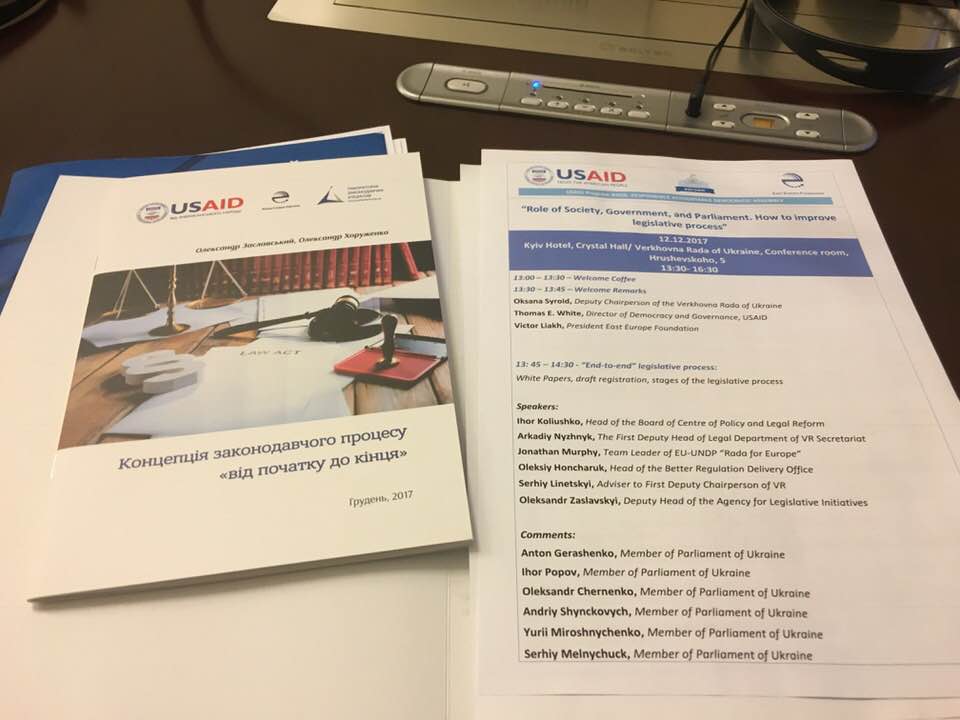
Based on the results of discussions on parliamentary reform, the USAID RADA Program organized the conference “Role of Parliament, Heads of State, Government and the Public in Improving the Quality of the Legislative Process”.
Within the framework of the conference, the Agency for Legislative Initiatives presented the paper “Concept of End-to-End Legislative Process”.
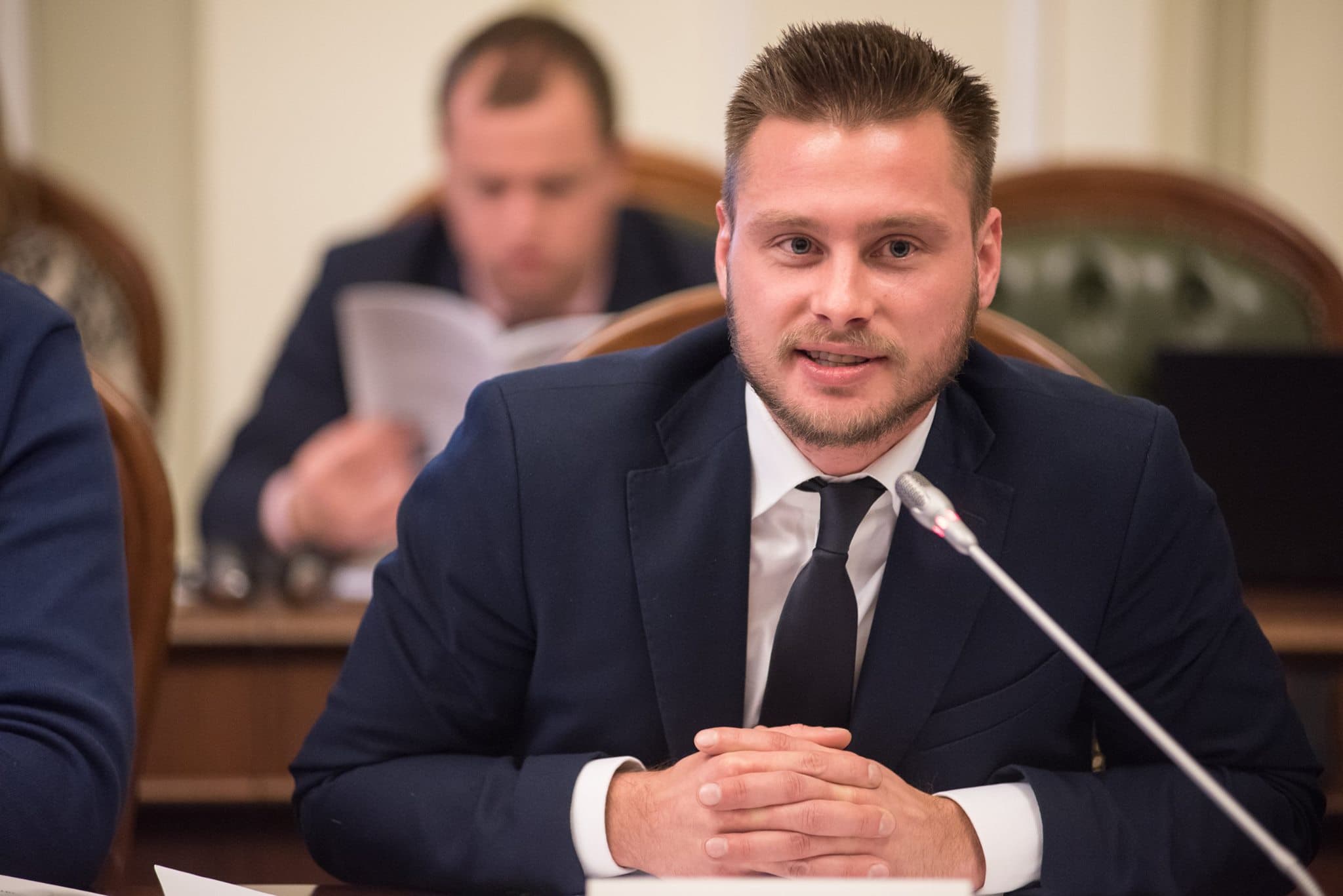
Oleksandr Zaslavskyi, Deputy Chairman of the Board of the Agency for Legislative Initiatives:
“Of all the flaws of the legislative process, the most conspicuous are the ones associated with the consideration of draft laws in the session hall. I am not talking about “piano voting”. For instance, the widespread practice of considering bills under an abridged procedure (which according to the rules of procedure should be an exception rather than the “standard”) in the first reading degrades the level of discussion of legislative initiatives. Moreover, sometimes at the proposal of the initiator of the bill or the Chairman of the Verkhovna Rada there is no discussion whatsoever, that is, even the abridged procedure is not observed”
Thus, the first reading as a key stage in the consideration of bills is reduced. However, according to the logic of the Rules of Procedure the VRU, it is the first reading stage that should guarantee a comprehensive discussion of the problem, its relevance, proposed solutions, and expected results. The flaws of draft laws start becoming manifest during the further work on preparing it for the second reading which, due to its limitations, does not allow for opportunities to improve the key idea of the bill, making possible only pinpoint and technical changes.
Moreover, during the 4th and 5th sessions (February 2016 – January 2017), most of the bills were adopted in the first reading, and in total 116 out of 187 were approved as a whole (62%). At the same time, 51 out of the 116 above bills (44%) were adopted contrary to the opinions or comments of the Central Scientific Experts Office of the Verkhovna Rada of Ukraine, which prepares expert opinions for the first reading. Obviously, this attests to the poor quality of the bills, at least in terms of the regulation design mechanism, internal consistency of the text of acts, or compliance with the current laws, the Constitution or international agreements. What’s more, these bills are adopted almost without discussion and without prospects of improvement during the second reading.
This is coupled with the situation around transitional provisions of bills adopted as a whole. Such provisions often contain instructions for the Government to align relevant subordinate acts in pursuance of the adopted laws. Such transitional provisions with instructions (specific or general) are contained in 91 laws approved as a whole during the 4th and 5th sessions (47%). Obviously, the Government should be ready to comply with the laws. However, it is difficult to imagine how one can prepare for such a situation when it is impossible to predict stage and form of adoption of a draft law.
As a result, the Government faces the problem of enforcement of “imperfect” or poorly-prepared laws, which spawns the need to initiate more changes to the already adopted legislation. As a result, these parliamentary practices are one of the reasons why 60% to 75% of the bills adopted as a whole during the 8th session are secondary, that is, they amend existing laws. For the presently registered bills, this figure is even greater. To sum up, it can be argued that the lack of thorough work on draft laws and attempts to quickly adopt them without comprehensive discussion produce the need to register even more bills. This, in turn, is one of the sources of the very “legislative tsunami” referred to in the Roadmap of the European Parliament’s Needs Assessment Mission.
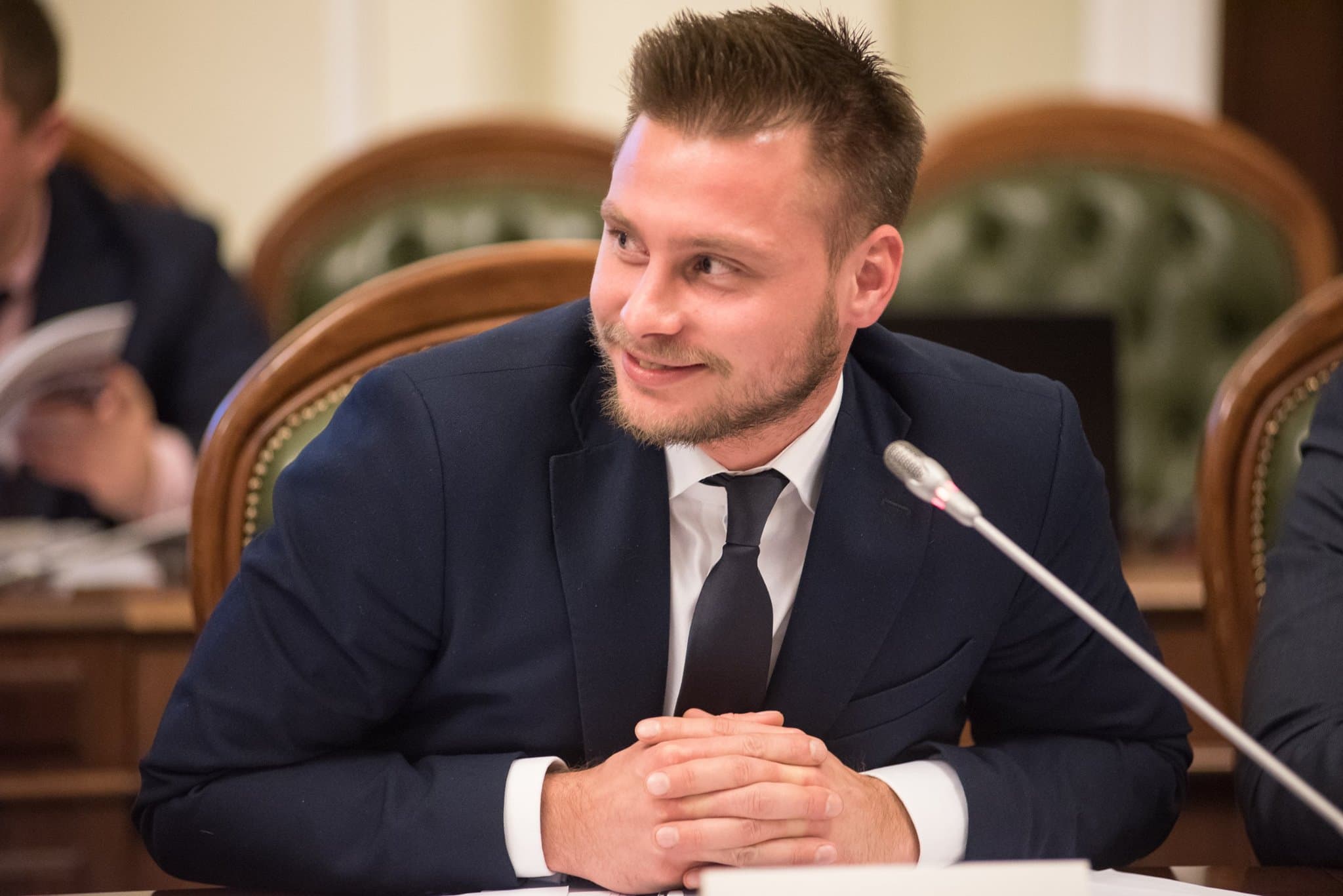
Mr. Zaslavskyi also focused on the recommendations that need to be implemented to improve the law-making process.
Including:
- drafting and adopting the Law “On Regulatory Acts” introducing appropriate amendments to the Constitution of Ukraine in order to ensure the effective distribution of the sphere of regulation of laws and by-laws, as well as to establish common rules for drafting bills, their coordination among the involved parties, the procedure of interaction of the entities of legislative activity, enactment of laws, enforcement, monitoring and evaluation of the enforcement of laws, etc. Moreover, this will help to introduce the procedure of voting for ordinary laws by a majority of those present in the session hall;
- setting forth in the Rules of Procedure of a certain number of 20 MPs’ signatures necessary to register bills or introducing letters of support for registered bills for them to be considered in the session hall (Draft Law No. 6640);
- introducing the mechanism of MP’s individual legislative proposal;
- limiting the right of MPs’ legislative initiative in financial and economic matters;
- review of the status of the Government’s Program of Activity. In the event of the Government’s failure to provide this document, it should resign (introduction of a constructive confidence vote). The session agenda should be drawn up on the basis and in pursuance of the Government’s Program of Activity;
- limiting the number of bills to be submitted for discussion within a week. For example, up to 10 bills. In this context, priority should be given to the government initiatives aimed at implementing the Government’s Program of Activity;
- introduction of a mechanism for political co-ordination (first of all with regard to compliance with the Coalition Agreement and the Government’ Program of Activity) of legislative initiatives (submitted as a brief analytical note containing primary information on the current policies in a particular area or symptoms of a problem). Only after examining this initiative for compliance with the government’s program of activity (and, possibly, the coalition agreement) and its approval by representatives of political factions and groups, can preparation of analytics be launched and the text of the bill be drafted;
- ensuring that the Government should prepare regulations for the enactment of the law before the law is adopted as a whole or that Government should give a reasoned explanation why no such regulations need to be drafted;
- ensuring that bills should be discussed under the full procedure in the first reading and that bills should be considered under the full-fledged procedure of three readings (as stipulated by the Rules of Procedure of the VRU);
- introduction of monitoring and evaluation of the enactment of a particular law or the state of legal regulation of a particular field of social relations based on any legislative initiative. Any legislative initiative should come with a monitoring and evaluation plan that should be agreed with the Main Committee of the Verkhovna Rada;
- introduction of a single platform for all legislative initiative entities to register, log and track all regulations. The Computerized Systems Department is developing a resource tentatively entitled “Electronic Draft Law” – a single platform for all legislative initiative entities to register draft acts, which will make it possible to track the status of the bill.
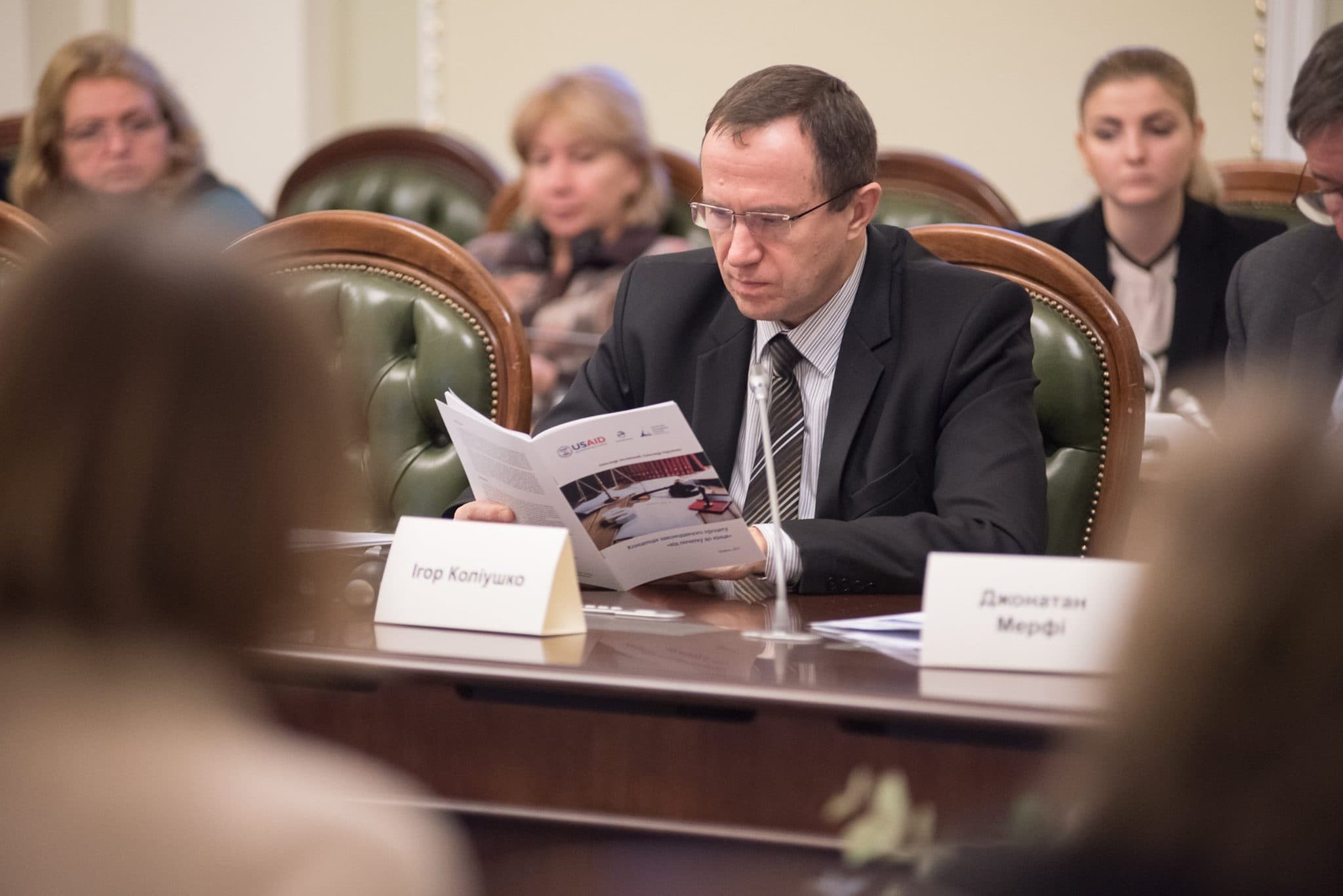
Presentation of the policy paper “Concept of ‘End-to-End’ Legislative Process”
On December 06, 2017 the Ukrainian Crisis Media Center (2, Khreshchatyk Str.) hosted a presentation of the Policy Paper “Concept of ‘End-to-End’ Legislative Process”.
The event was organized by the Agency for Legislative Initiatives within the framework of the USAID RADA Program: Responsible, Accountable, Democratic Assembly implemented by the East Europe Foundation.
The event was attended by:
- MP Dmytro Lubinets, Secretary of the Verkhovna Rada Committee on Rules of Parliamentary Procedure and Support to Work of the Verkhovna Rada of Ukraine;
- Oleksandr Zaslavskyi, Deputy Chairman of the Board of the Agency for Legislative Initiatives.

During the 4th and 5th sessions of the Verkhovna Rada of Ukraine of the VIII convocation, 1506 bills were registered, of which only 12% have been approved. This testifies to the fact that the parliament is overwhelmed by the “legislative tsunami”, i.e. a situation where so many bills are registered that deputies are physically unable to deal with them.
The ease with which MPs of Ukraine can register bills, regular violations of parliamentary procedures, lack of established long-term planning practices and stable communication between the legislative power actors result in the wide-ranging chaos of policymaking that hinders Ukraine’s sustainable and steady development.
Thus, the development of an effective system for policy formulation, approval, harmonization, assessment, and review remains extremely topical for both the political leadership and Ukrainian society as a whole.
The policy paper “Concept of ‘End-to-End’ Legislative Process” contains an analysis of existing practices, an overview of international experience, as well as proposals as to the concept of the “end-to-end” legislative process reform focused on strengthening coordination between legislative initiative actors. This is set out in the first recommendation of the Roadmap on Internal Reform and Capacity-Building for the Verkhovna Rada of Ukraine prepared by the European Parliament’s needs assessment mission led by Pat Cox.

MP Dmytro Lubinets, Secretary of the Verkhovna Rada Committee on Rules of Parliamentary Procedure and Support to Work of the Verkhovna Rada of Ukraine, argues that “legislative spam” is a result of every MP’s desire to submit his personal legislative initiative, because for the public perceives the number of bills registered by an MP as the indicator of his effectiveness. One way out of this situation is to restrict the legislative initiative so that a bill could be submitted only by a group of MPs consisting of at least as many persons as the smallest faction of the current convocation of the Verkhovna Rada.
“This safeguard will automatically ensure a decrease in the number of draft laws, hence the effectiveness and quality of the Verkhovna Rada will ipso facto increase”
“The problems of the legislative process in Ukraine to a large extent stem from wrong practices of enforcement of framework regulations rather than from imperfections of these regulations”
According to Mr. Lubinets, one of the factors undermining the effectiveness of the legislative process is political PR – a situation where committee hearings (especially when attended by the media) turn into a political show instead of a meaningful discussion. This results in significant delays in the process of reviewing bills, taking years for a bill to be submitted to the session hall after its registration. As a result, a large number of critically important draft laws are ping-ponged from one deputy committee to another for years. Another problem is posed by the process of considering amendments when amendments already approved for voting are again put to vote in the session hall by MPs.
“There are no mechanisms to prevent this MP “spam”, hence important bills are not adopted, as a result people expect radical changes from parliament but the changes do not happen”

Presenting the study, Oleksandr Zaslavskyi, Deputy Chairman of the Board of the Agency for Legislative Initiatives, pointed out that from October 2015 to January 2016, European Parliament’s needs assessment mission headed by Pat Cox had been working in the Verkhovna Rada and had come up with the Report and Roadmap on Internal Reform and Capacity-Building for the Verkhovna Rada of Ukraine. On March 17, 2016, the Verkhovna Rada adopted the Resolution based on this document containing 52 recommendations for improvement of the work of the Verkhovna Rada of Ukraine in terms of its institutional capacity, improvement of the quality of the legislative process, ensuring compliance of the legislation with the EU regulations, etc. The first and most important recommendation is to develop an “end-to-end” concept of the legislative process.
The policy paper “Concept of ‘End-to-End’ Legislative Process” examines the legislative process in the context of communication of legislative initiative entities. Special attention is given to the problem of delimitation of the powers of legislative initiative entities, as well as gradual disturbance of the balance of the constitutionally mandated design of policy development. The study analyzes the mechanisms of cooperation of legislative initiative entities in the legislative process, as well as observance of procedures for consideration of bills. It examines the role of committees and mechanisms for monitoring, assessing and reviewing approved decisions. Much attention is given to alternative variants of improving the legislative process.
Mr. Zaslavskyi elaborated on the changes needed to improve the legislative process “end-to-end”, including:
- drafting and adopting the Law “On Regulations” involving the introduction of relevant amendments to the Constitution of Ukraine in order to ensure the effective distribution of the sphere of regulation of laws and by-laws;
- stipulation in the Rules of Procedure of the requirement to get the set number of 20 signatures of MPs for the registration of bills or introduction of letters of support for registered bills so that they could be considered in the session hall;
- limiting the number of bills to be submitted for discussion during the week, for example, to 10 bills;
- introduction of a mechanism of the political harmonization (first of all for compliance with the Coalition Agreement and the Government’s Program of Activity) of legislative initiatives;
- ensuring that Government should draft regulations for implementation of the law before the law is adopted as a whole or that Government should give a reasoned explanation why no such regulations need to be drafted;
- ensuring that any legislative initiative should include a monitoring and evaluation plan approved by the Main Committee of the Verkhovna Rada;
- introduction of a single platform for all legislative initiative entities to register, log and track all regulations.
Presentation of the paper “Problem of Creating Parliamentary Service. Principles of Reform, Foundation of Functioning, Guarantees of Activity”
The event involved 10 procedural discussions aimed at promoting the implementation of parliamentary reform.
The discussion covered the following issues:
- Analysis of current practices and international experience in regulating the parliamentary service.
- The problem of creating a parliamentary service. Principles of reform, foundation of functioning, guarantees of activity.
- Legislation on parliamentary service: the preferred format:
- a separate law;
- a section of the law on civil service.

Presenting the paper, Tetyana Chernukha, Program Coordinator of the Agency for Legislative Initiatives, drew attention to the principles of reforming the parliamentary service, including reinforcement of the institutional autonomy of the Secretariat of the Verkhovna Rada of Ukraine; development of a staffing strategy of the Secretariat; codification of internal parliamentary policies; and drafting of the law “On Regulatory Legal Acts”.
Outlining the functions of the parliamentary service of Ukraine and its role in decision-making, Ms. Chernukha noted that the VRU Secretariat carried out organizational, expert and analytical, financial and technical support of the work of the Verkhovna Rada of Ukraine; prepared draft decisions important in planning the work of the VRU (i.e. estimates, plans of legislative work, draft agenda, draft assessment of bills for the main committees, draft opinions of the Scientific and Expert Department and Legal Department, and registration of draft laws).
Ms. Chernukha emphasized that based on the results of the survey of Secretariat employees (anonymous poll of the expert department and committee secretariats), 100% of respondents indicated that their political views did not affect their work in the VRU). However, 40 % of respondents noted that they had witnessed political pressure on their colleagues.

According to Ms. Chernukha, the possible ways of reforming the parliamentary service include designing an effective mechanism that would enable the Main Scientific and Expert Department and the Main Legal Department to suspend inadequate bills; development and introduction of a mechanism of protection against political pressure on employees of the relevant departments; as well as creating an anonymous online platform for employees to complain about political pressure on themselves or their colleagues. Each complaint should be dealt with and investigated.
Having analyzed the current personnel policy of the VRU Secretariat, Ms. Chernukha proposed a number of ways to improve the work of the parliamentary service, including elaboration of clear job descriptions; standardization of the form and establishment of clear-cut requirements for the expert opinions and legal reviews prepared by the Secretariat, the relevant job descriptions must contain references to them; classification of professional positions; appropriate training of the members of the competition commissions; elaboration of test tasks, which should vary depending on the job description and the grade level of the job. The selection of the VRU Secretariat employees and their further work may greatly benefit from the following: arrangement of selection planning so that specific requirements should be checked at each stage of the selection; reducing the scope of subjective assessments of commission members by introducing answer-keys to situational tasks; improving data collection and reporting on human resources in the civil service with a view to effectively supporting HR planning, HR management activities and monitoring can also significantly improve the process of selecting the staff of the Verkhovna Rada staff and their further work.

As of today, 37 % of the polled representatives of the Verkhovna Rada Secretariat state that they do not think that the regulations and procedures of the organization of the work of the Verkhovna Rada of Ukraine are clear and understandable. 52 % of the representatives of the Verkhovna Rada Secretariat emphasize that they do not consider the legislative process in the VRU to be of high quality and effective (at the same time, 48 % consider it to be sufficiently effective).
According to Ms. Chernukha, the measures aimed at improving the legal framework for the work of the VRU Secretariat include consolidation of the legal and regulatory framework for the documents regulating the work of the VRU Secretariat into a single set of internal rules, including those on the implementation of personnel policy (Roadmap on Internal Reform and Capacity-Building for the Verkhovna Rada of Ukraine); as well as adoption of a law on regulatory legal acts that could facilitate the regulation of the status of regulatory acts, as well as acts adopted by officials of the VRU Secretariat.

Preparation of the analytical materials is a part of a project implemented by the NGO Agency of Legislative Initiatives with the support of USAID RADA Program: Responsible Accountable Democratic Assembly, implemented by East Europe Foundation.
Oksana Syroyid’s Lecture “Legality for Legislators”
Lecturer: Oksana Syroid, Deputy Speaker of the Verkhovna Rada of Ukraine.
More than 40 participants took part in the event: students of Kyiv universities (National University of Kyiv-Mohyla Academy, Borys Grinchenko Kyiv University, National Pedagogical Dragomanov University), graduates of the Verkhovna Rada Internship Program, MPs’ aids, and representatives of NGOs.

Photographer: Oleksandr Kovalenko
Tetiana BIBIK, Deputy Director of the USAID RADA Program: Responsible Accountable Democratic Assembly, outlined the opportunities provided by the RADA Youth Program, focusing on the tools and mechanisms of the Program that promote parliamentary reform, such as the service of electronic petitions, the portal for public discussion of draft laws, the internship program in the Verkhovna Rada as well as educational components for youth.

Photographer: Oleksandr Kovalenko
“Disseminating information on the activities of the Verkhovna Rada of Ukraine and the Government, as well as on available mechanisms for communication of civil society and authorities, we are trying to strengthen the public control over these institutions by increasing the monitoring capacity of NGOs and active youth. It is necessary to do this because the not-so-pleasant image of the government created in the media due to the statements and actions of some politicians dramatically diminishes trust in the authorities. However, people who represent the Verkhovna Rada of Ukraine, VRU secretariat, committees, and committee secretariats do not deserve such a low level of trust. This is exactly why we organize such events in order to raise awareness about what is actually happening in the Verkhovna Rada of Ukraine”

Photographer: Oleksandr Kovalenko
Oksana SYROYID, Deputy Speaker of the Verkhovna Rada of Ukraine
Why do people unite in states?
The state emerges as a social contract between people in order to protect three fundamental rights: life, liberty, and property. In natural circumstances that precede the state, a person cannot individually enforce these rights.
Why do people need government authorities?
People can protect their fundamental rights only by imposing penalties for their encroachment. For example, the protection of the right to life is ensured through the delegation of representatives to the relevant bodies that, on behalf of the people and in the interests of the entire society, establish what a crime is and how it should be punished. Courts must ensure that the fundamental rights and rights derived from them be protected in accordance with laws adopted on behalf of the people.
When we create a state and delegate our rights to it, we must maintain it. To ensure protection of our rights, we allocate resources and create a government.
The function of the government is to collect and redistribute people’s money. Governments have no function other than that. They have to redistribute the funds in such a way as to perform the functions of the state and ensure fulfillment of what people agreed upon. The government is closed by its nature; under such conditions, it is very convenient to spend money.
Therefore, an extremely important function of the parliament is to control how the government collects and distributes money.

Photographer: Oleksandr Kovalenko
When does the parliamentary control over the government emerge?
The prime minister reads a report in parliament: Can we view it as a kind of control over the government? Perhaps we cannot. Both the current and the previous Prime Minister actually believe that just by coming to the Parliament and telling something from the rostrum, they report on their work.
The Ukrainian Parliament does not fulfill its control function and cannot fulfill it because it does not know what the government spends money on.
A vivid example of the government’s non-transparency is the vote on the state budget. The lack of a detailed budget, various inherent preferences, and non-transparency give rise to the phenomenon of the budget night when MPs vote for the state budget at night because they do not trust each other. Since everything is non-transparent and described in “broad-brush terms”, MPs sit at the table and agree on the allocation of funds. If they go to sleep, overnight, all arrangements may be reshuffled and in the morning everyone can come up with new wishes. That is why they vote for the budget “hot on the trail”.
This will continue until there is a detailed and very specific budget.

Photographer: Oleksandr Kovalenko
How do people in power make money?
The people who were in power in the first years of independence created a number of preferences for themselves:
– privatization and management of state-owned enterprises;
– non-transparent extraction of natural resources;
– non-transparent government contracts (budget).
These are the origins of the oligarchic economy of the 1990s.
Corrupt schemes will continue to function until people start to control their money themselves. The first step to this objective is local self-government that teaches people to manage their money and resources.
The next step should be personal tax payment. People seem to believe that the state gives them money without realizing that in reality it is they who maintain the state.
Taxes are a tool that guarantees the state unity and the quality of state institutions. The only mechanism for ensuring the payment of taxes is the inevitability of punishment for a failure to pay them.
The state will cease to exist if people stop paying taxes and controlling how their money is spent.

Photographer: Oleksandr Kovalenko
The quality of the Constitution and the quality of laws
The statement that we have one of the best constitutions in the world is a myth.
From laws people expect information on how they should regulate their behavior and predict consequences for themselves and others in case of non-compliance. If a law meets these requirements, it is of high-quality.
People suffer because of the state. Laws are written to protect people from violations by the authorities and to curb the state’s tyranny.
Laws have to protect human rights and must contain information about the responsible authority that should protect these rights and specify the ways to do this. A law is bad if it does not contain these elements.
Laws are voted in violation of the procedure; laws are not discussed beforehand. The process of voting laws as a whole has many defects; laws adopted based on this principle always contain a lot of mistakes. The main research and expert administration might be politically biased and dependent.

Photographer: Oleksandr Kovalenko
Key tips for young people:
- always look for the nature of things;
- always ask “Why?”
- never take anything at face value;
- study philosophy, think.

Photographer: Oleksandr Kovalenko

The event was organized by the Agency for Legislative Initiatives together with the Internews Ukraine and the Interns’ League, supported by the USAID Rada Program: Responsible Accountable Democratic Assembly, implemented by the East Europe Foundation.
The Policy Proposals to Regulate the Status of the Local Council Members (Policy Paper)
The local elections in Ukraine conducted in October 2015 under a new law caused a number of problems and quite distorted the representation balance. In addition, the innovations introduced by the Law on the Status of Local Council Members into the council members recall procedure and mechanism based on the people’s initiative instigated tensions and conflicts on the ground. By analyzing the modern Ukrainian practices, the authors propose the way out of the current complicated situation through amendment of the legislation and development of efficient instruments to regulate the representation problem with one of the proposals being assignment of each local council member to a certain constituency and making them accountable to its voters.

The preparation and presentation of Policy Proposals is part of the project embodied by the Agency for Legislative Initiatives, supported by the USAID Rada Program: Responsible Accountable Democratic Assembly, implemented by the East Europe Foundation.
Civil Service Reform in Ukraine: Specialised Law Implementation in 2016–2017 (Shadow Report)
The Shadow Report assesses implementation of key civil service reforms in Ukraine as defined by the new version of the Civil Service Law adopted on 10 December 2015 and enacted on 1 May 2016. It focuses, primarily, on the civil servants’ political neutrality and professionalism, as well as their remuneration and performance.
The paper traces the progress made in the implementation of the above public policy measures between May 2016 and May 2017, as well as suggests certain further steps in this area.
This report is based only on the current civil service laws and regulations valid in the period between May 2016 and May 2017, in particular the Civil Service Law.
Even though the civil service associated bills and draft regulations, as well as related laws, such as on the Cabinet of Ministers and on the Central Executive Authorities, the legislation on local administrations and local self-governance were not in the focus of this publication, a comprehensive and high quality civil service reform is not possible without their amendment.
The preparation and presentation of analytical reports in the Shadow Report format is part of the project embodied by the Agency for Legislative Initiatives, supported by the USAID Rada Program: Responsible Accountable Democratic Assembly, implemented by the East Europe Foundation.
Training “Youth in Governmental Programs”
On 15 May, 2017 the Training “Youth in Governmental Programs” took place.
Development and implementation of informal interactive youth trainings is part of the project implemented by the Agency for Legislative Initiatives under the USAID RADA Program: Responsible Accountable Democratic Assembly, implemented by the Eastern Europe Foundation.
During the training, the participants got acquainted with the components of the state and regional youth policy in Ukraine, as well as learned about the possibilities of an organised youth movement to influence the formation of the state youth policy agenda.

Photographer Oleksandr Kovalenko
“We are working to make the parliament more transparent, to establish communication between citizens and individual MPs, committees, etc. The scope of responsibility of the Agency for Legislative Initiatives includes a range of activities: development of a register of non-governmental organisations for the committees of the Verkhovna Rada of Ukraine for their better communication with the public sector. We also strive to strengthen the control functions of the committees by introducing a mechanism such as the Shadow Report, i.e. reports prepared by public experts upon the request of committees for the implementation of individual programs, individual laws, etc. We carry out events in the format of Town Hall Meetings to provide communication between MPs and voters. We also actively work in the area of education to involve young people in the legislative process, in the process of decision-making, in monitoring policy development and its implementation. This framework includes four trainings for young people, and this is the third training directly related to young people in government programs”

Photographer Oleksandr Kovalenko
“The Ministry of Youth and Sports of Ukraine is building an open policy to involve young people in the decision-making process at different levels: from the regional (local) to the highest national level.
The Ministry of Youth and Sports of Ukraine seeks to be more transparent and to receive feedback from young people.
The priority of the work of the Ministry is to strengthen the areas of cooperation between the state, civil society and business, as well as to create a platform for the implementation of various youth initiatives”
The Ministry of Youth and Sports of Ukraine seeks to be more transparent and to receive feedback from young people.
The priority of the work of the Ministry is to strengthen the areas of cooperation between the state, civil society and business, as well as to create a platform for the implementation of various youth initiatives”

Photographer Oleksandr Kovalenko
Media gallery here.
Shadow Report “Public Service Reform in Ukraine: Implementation of the specialized law in 2016-2017”
On May 17, 2017 Shadow Report “Public Service Reform in Ukraine: Implementation of the specialized law in 2016-2017” rpesentation took place.
The Shadow Report “Public Service Reform in Ukraine: Specialized Law Implementation in 2016-2017” is an alternative to the governmental report on the implementation of the key results of public service reform in Ukraine. The report examined the development and adoption of the Law On Public service; exhaustively analysed the provisions of the law with a focus on potential shortcomings and recommendations; formulated a new vision of public service in Ukraine; and suggested modern tools of personnel management in the public service.
“USAID RADA Program continues to monitor the situation around the draft law On Public Service. Today the format of this meeting of the committee in terms of performing the control function is of critical importance to us. The Report prepared by the Agency for Legislative Initiatives represents a politically neutral position that balances those of the government, of the committee, and the position of independent experts. The practice of such reporting format is very useful and we would like to introduce it in the contemporary Ukrainian parliament. Such reports should take place at meetings of this kind”

“Amendments to the Law on Public Service came into force a year ago, but we can already talk about the first successes, as well as single out the main directions for further work. These include determining a comprehensive vision of the target model of the public service of Ukraine (career-based or position-based), harmonisation of the public service reform with other elements of the public administration reform and improving communication and public awareness of competition for senior civil service positions”
Preparation of the Shadow Reports is a part of a project implemented by the NGO Agency of Legislative Initiatives with the support of USAID RADA Program: Responsible Accountable Democratic Assembly, implemented by East Europe Foundation.
Transparency International has published an article on the state of the fight against corruption in Ukraine, based on the study “National Integrity System. Ukraine 2011”, which was created with the participation of experts from the Laboratory of Legislative Initiatives
Since the Orange Revolution of 2005, fighting corruption has been high on the political agenda in Ukraine. But Transparency International’s (TI) recently published National Integrity System assessment (NIS) shows little progress in halting the tide of corruption.Published by TORO, TI’s partner in Ukraine, the NIS assessment is a comprehensive analysis of the country’s anti-corruption system in law as well as in practice. Ukraine scores 2.4 in the 2010 Corruption Perceptions Index, which indicates widespread perceptions of corruption.
NIS assessments evaluate the key institutions and actors of a country’s governance system in terms of their internal corruption risks and their contributions to fighting corruption in society at large. When all the components of the National Integrity System function properly, corruption remains in check. Where there are gaps and weaknesses, corruption is likely to thrive.
The report shows that overall Ukraine’s integrity system is weak. The main political parties show little political will to tackle corruption through legal reforms or by addressing citizens’ concerns. There are four main areas of concern:
- Lack of financial and human resources to fight corruption
- Limited legal framework
- Limited enforcement
- Poor interaction between institutions
The one bright spot is the Supreme Audit Institution, which outperformed all other institutions primarily because it has sufficient resources, a will to promote transparency and close relationships with similar organisations in other countries.
The report features a number of key recommendations, including stricter party financing rules and electoral reforms.