
Read the interview with Svitlana Matviienko in the Novoie Vremia.
Town Hall Meeting “Organization of the Urban Space in Mykolayiv”
On November 21, on the premises of the restaurant “Stargorod Nikolaev” in Mykolayiv-city was held a Town Hall Meeting on the topic “Organization of Urban Space in Mykolayiv. How to Make Soborna Street More Comfortable for Residents of the City”. The event was organized by the Agency for Legislative Initiatives with the help of Mykolayiv Development Agency and Interns’ League, with the support of Western NIS Enterprise Fund and USAID.
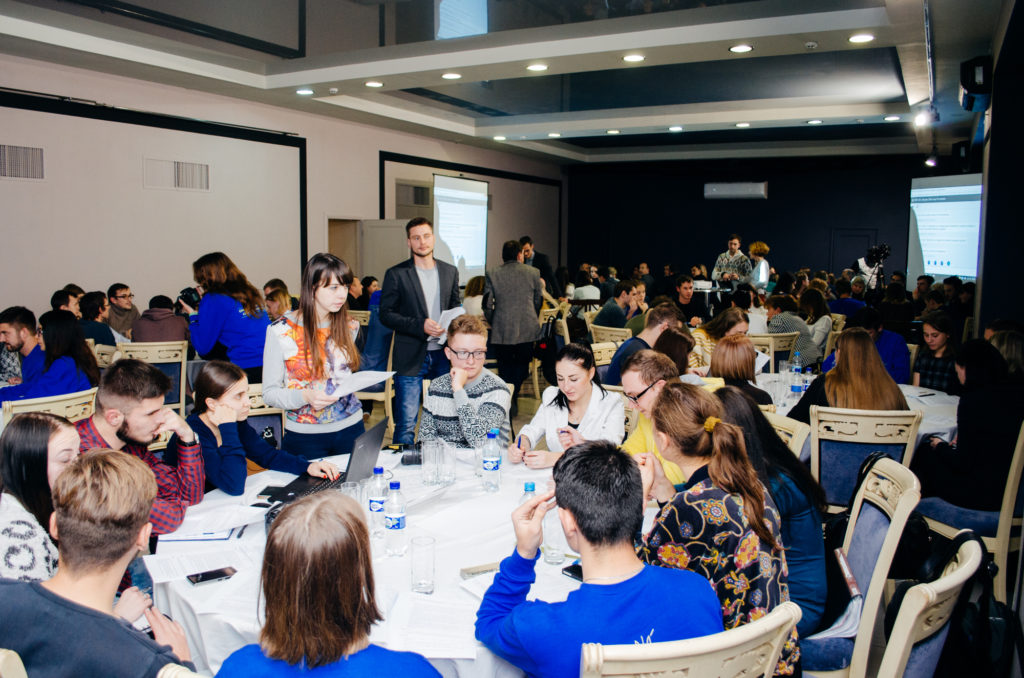
Photo: Oleksandr Kovalenko
Almost 150 residents of the city were looking for answers to the following questions:
- setting up temporary constructions for trade and entertainment services,
- setting up various types of advertising inventory (bill-boards, street lights, banners, posters, mobile stands, etc.),
- changing the original facade appearance in violation of the State Building Regulations.
Opening the event, Oleksandr Zaslavskyi, Deputy Chairman of the Agency for Legislative Initiatives, spoke of experience with Town Hall Meetings, which come from the US, and practical cases of its application in Ukraine.
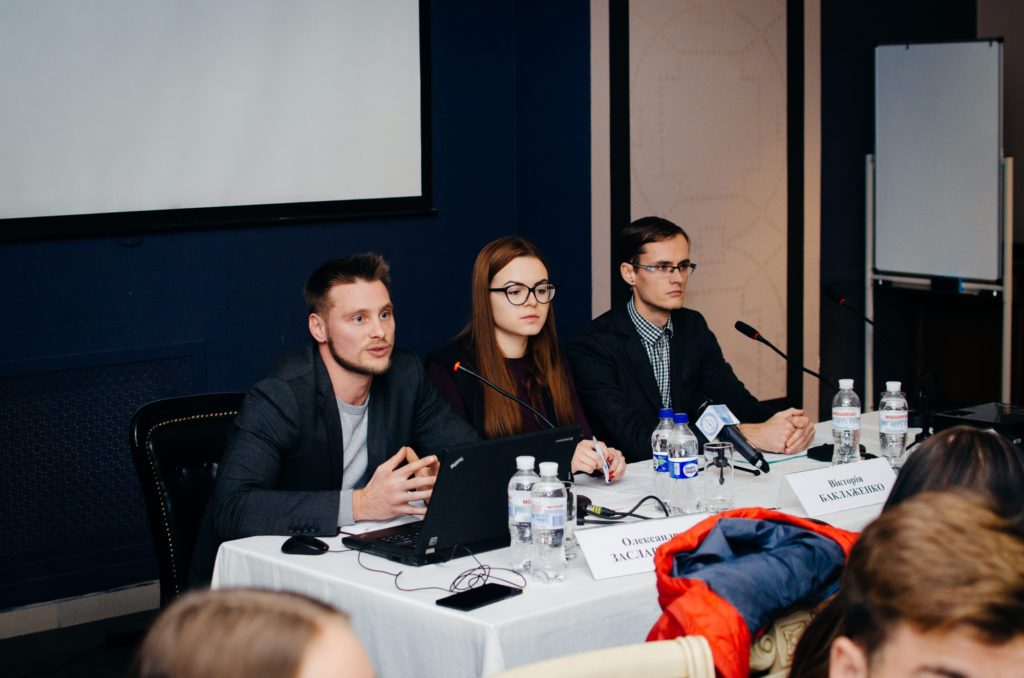
Photo: Oleksandr Kovalenko
The participants worked in small groups at the desks, accompanied by moderators and note-takers (secretaries), and analyzed opinions via the local network – comments and suggestions were displayed on screens.
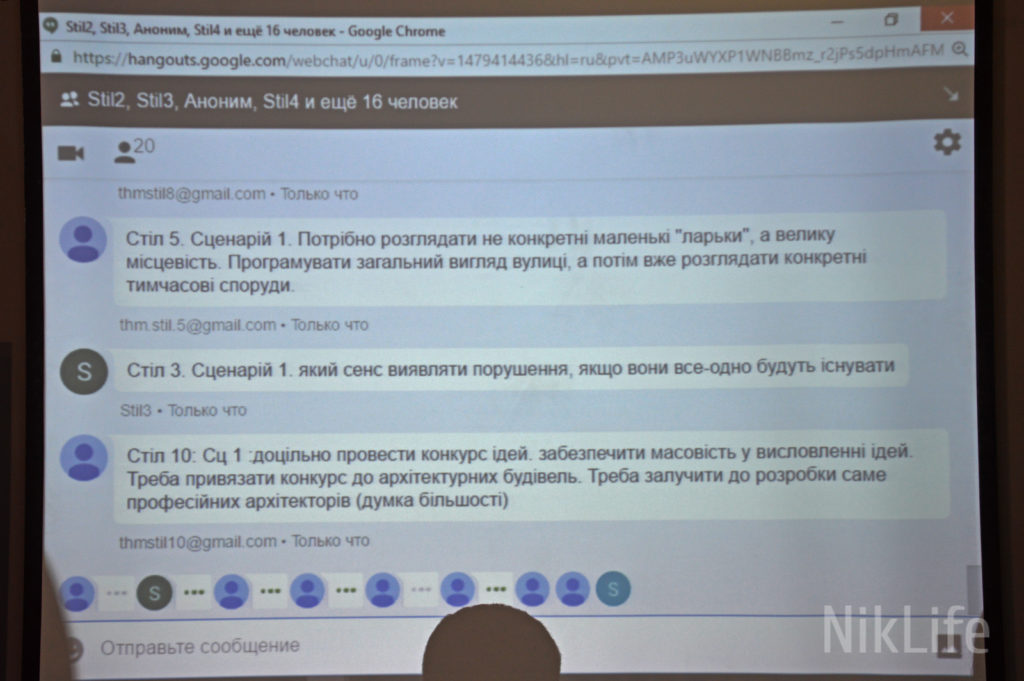
Photo: Oleksandr Kovalenko
They discussed scenarios that had been developed with the assistance of Yevhenii Poliakov, expert from the State Architectural Construction Inspection in Mykolayiv oblast, who actively contributed to the work by helping the participants understand all the city-planning intricacies.

Photo: Oleksandr Kovalenko
Yevheniya Dulko, Project Manager at Mykolayiv Development Agency, said the following:
“The scenarios are not that fundamental because we, together with experts, tried to draw up something realistic rather than re-invent a wheel; we relied on the experience of other cities and legislation of other countries. It is impossible to demolish, dismantle, and ban everything; it does not work that way. Therefore, the scenarios are realistic and close to the real Mykolayiv, which has its own history and traditions”

Photo: Oleksandr Kovalenko
Сценарії до обговорюваних проблем
Scenarios for discussion
Problem No. 1
Excessive number of randomly located temporary constructions for trade and entertainment services on Soborna Street
• Option 1
• Option 2
Problem No. 2
Advertising on Soborna Street
• Option 1
• Option 2
Problem No. 3
Change of original facades by private owners of apartments and premises
• Option 1
• Option 2
Voting results:

Problem No. 1

Problem No. 2

Problem No. 3
Медіа – галерея заходу




Presentation of E-Tools for the Public in Kharkiv
On November 10, 2016, the press center of Khakriv Today hosted a presentation of new electronic resources that help make Parliament more transparent – the Portal for Public Discussion of Draft Laws and the Electronic Register of Non-Governmental Organizations (E-Register of NGOs).
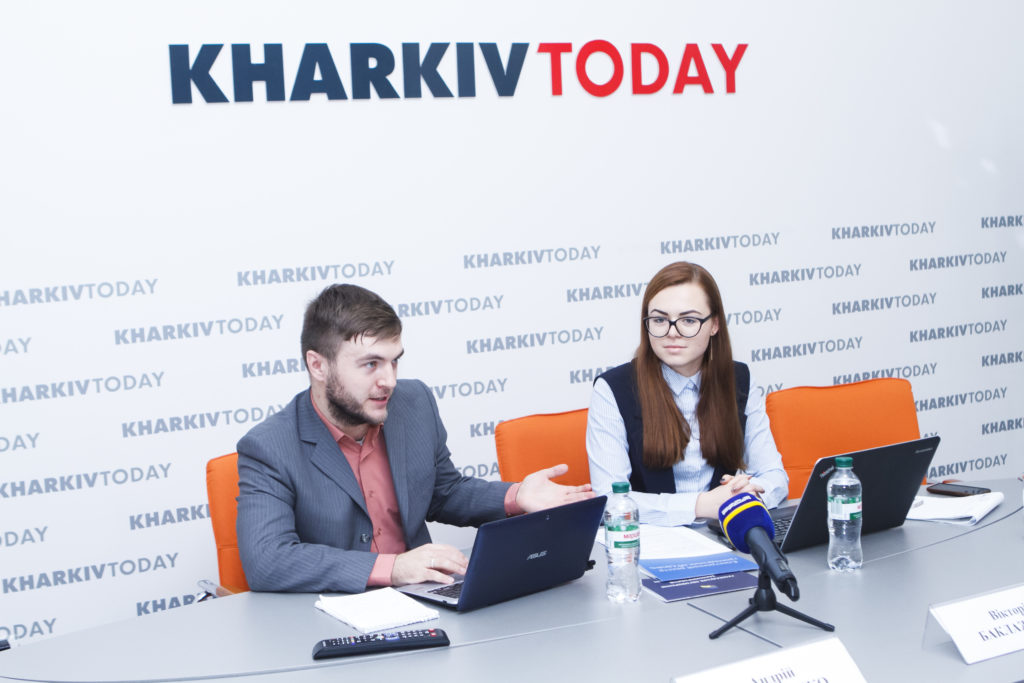
Victoriia Baklazhenko, Project Manager of the Department of Parliamentary Reform of the Agency for Legislative Initiatives, and Andriy Pylypenko, PR-manager, told how these resources could involve the public in discussing draft laws before they are submitted to specialized parliamentary committees and help to cooperate effectively with the committees.
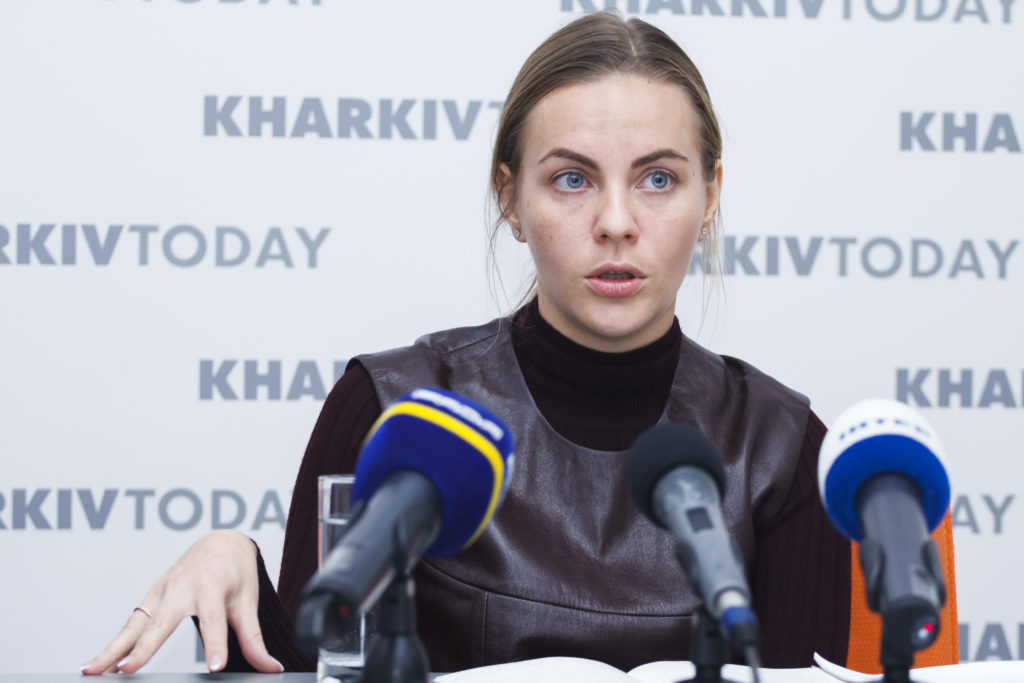
Olena Sotnyk, MP, pointed out to the importance of such tools not only in Kyiv but also in all regions of Ukraine. Kharkiv became the first city, and subsequently the new e-tools would be made known to the public in other parts of the country.
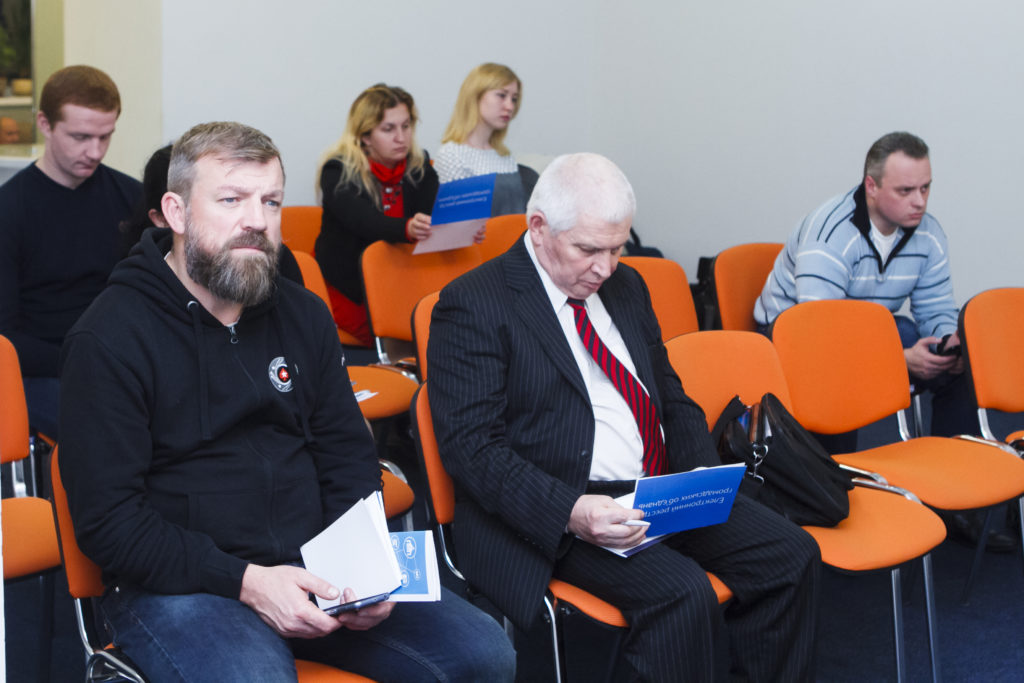
Participants took an active part in the discussion of the new electronic tools. Their proposals will be included in the Terms of Reference for further improvement of the Electronic Register and the Portal.
You can register your NGO in the Electronic Register by filling in the form.
By the end of 2016, the resources already integrated into the Verkhovna Rada portal would work in a test mode to troubleshoot possible problems.
Colloquium Presentation of Teaching Materials on Social Studies
The event consisted of the presentation of methodological guidelines for secondary school teachers concerning the introduction of civic education in school curricula and testing of the role-playing game “AGORA: Democratic Procedure of Law Adoption in the Parliament of Ukraine” which simulates the legislative process in Ukraine.
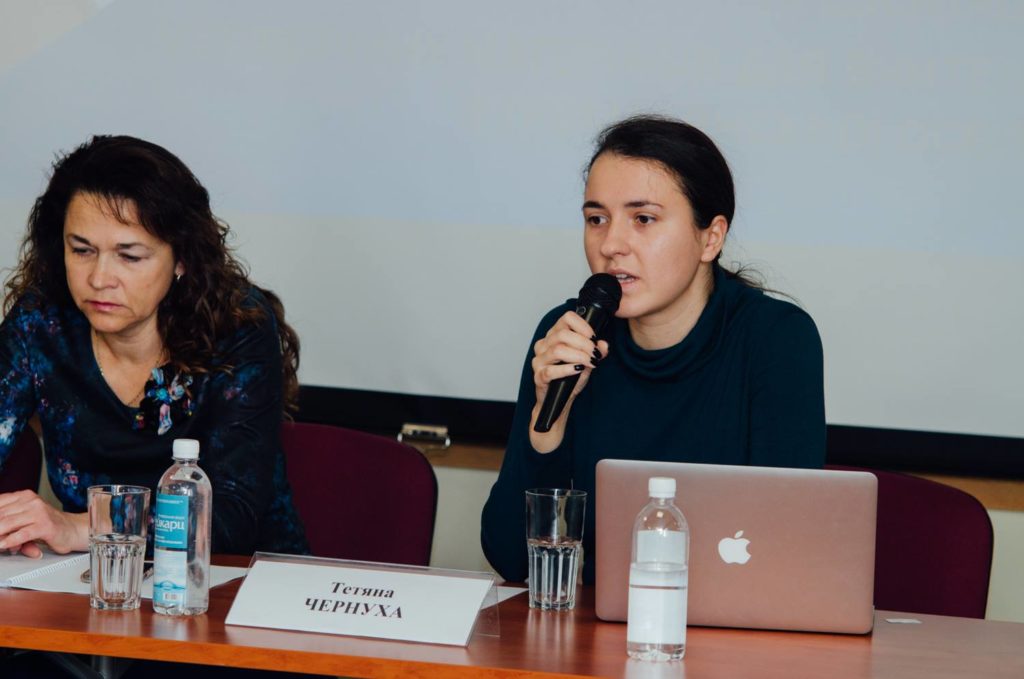
Фото: Олександр Коваленко
Tetiana Chernukha, ALI Program Coordinator, presents guidelines for teachers of senior forms:
“Only by changing the perceptions and expectations of young people concerning government institutions can we influence the quality of the government’s operation and ultimately improve political culture”
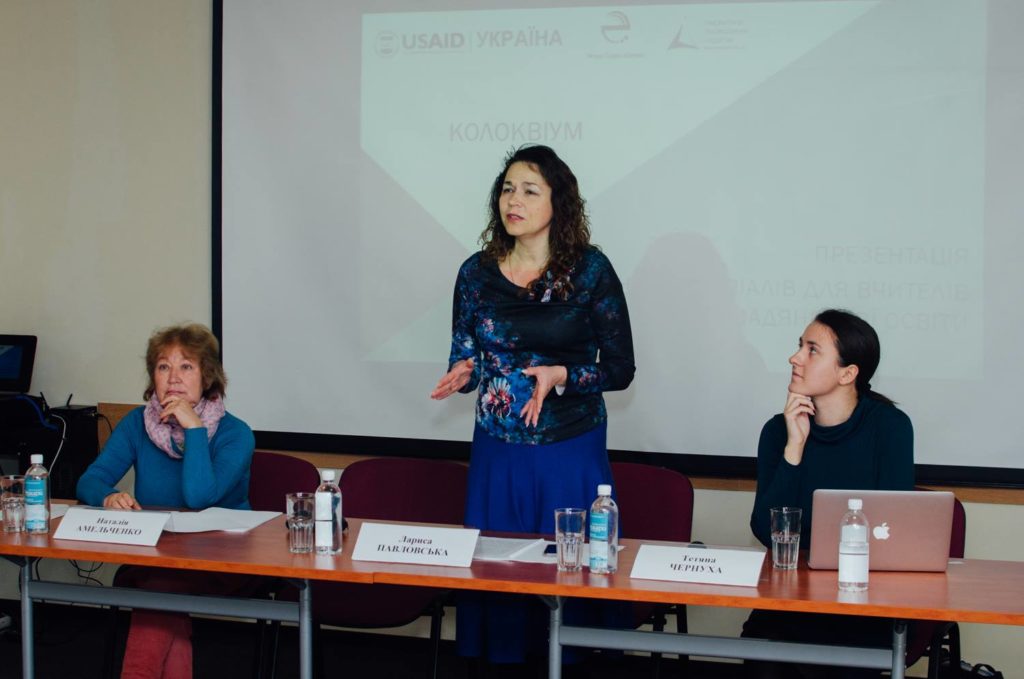
Фото: Олександр Коваленко
Larysa Pavlovska, Head of the Division of Pre-School and Secondary Education of the Department of Education and Science of the Sumy Oblast Administration, said the following:
“Today when the country is facing difficult times, the issues of civic activity, protection citizens’ basic rights and duties are especially relevant. The innovative teaching methods offered by civil society, especially the role-playing game “AGORA”, involve the simulation of the democratic decision-making procedure in the Verkhovna Rada of Ukraine. This will allow students to penetrate the legislative process and contribute to improving the quality of perception and mastering theoretical information. The initiative allows for introducing new elements and methods into the educational process, such as training in different structural subdivisions of the government authorities from the level of the city and district deputy corps to the level of the Verkhovna Rada”
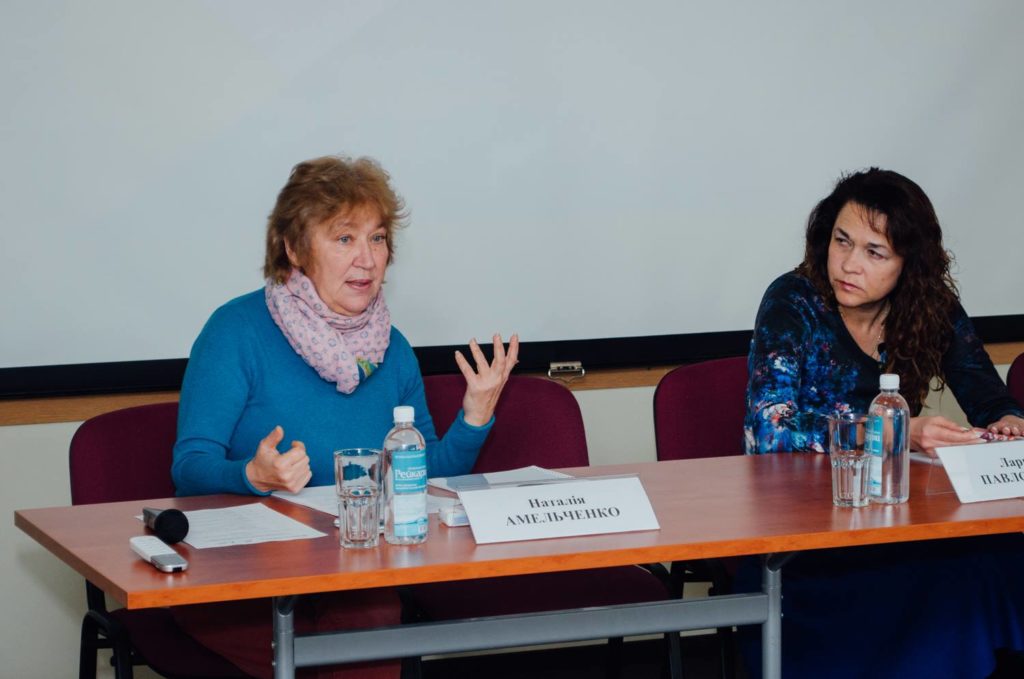
Фото: Олександр Коваленко
Natalia Amelchenko, PhD, professor of political science (NaUKMA), discusses with Sumy teachers the issues of facilitating students’ understanding of the legislative process, including through the role-playing game “AGORA”.
The discussion of the concept of the New School and testing of the role-playing game “AGORA” aroused lively interest among the teachers of Sumy oblast.
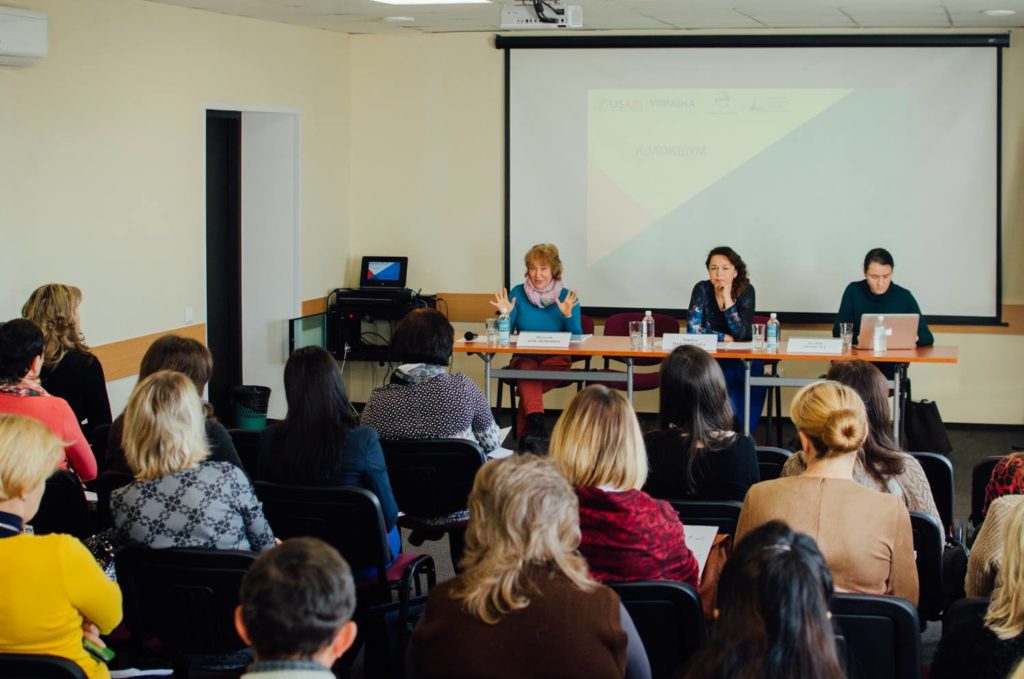
Фото: Олександр Коваленко
The methodological guidelines for the Colloquium were prepared by the Agency for Legislative Initiatives within the framework of the USAID RADA Program: Responsible Accountable Democratic Assembly, implemented by East Europe Foundation.
Dialogues on Civic Education and the Concept of the New School in Poltava
On October 27, 2016, Poltava hosted the Colloquium Presentation of Teaching Materials on Social Studies.
The event included the presentation of methodological guidelines for secondary school teachers of senior forms concerning the introduction of civic education in school curricula and testing of the role-playing game “AGORA: Democratic Procedure of Law Adoption in the Parliament of Ukraine”, which simulates the legislative process in Ukraine.
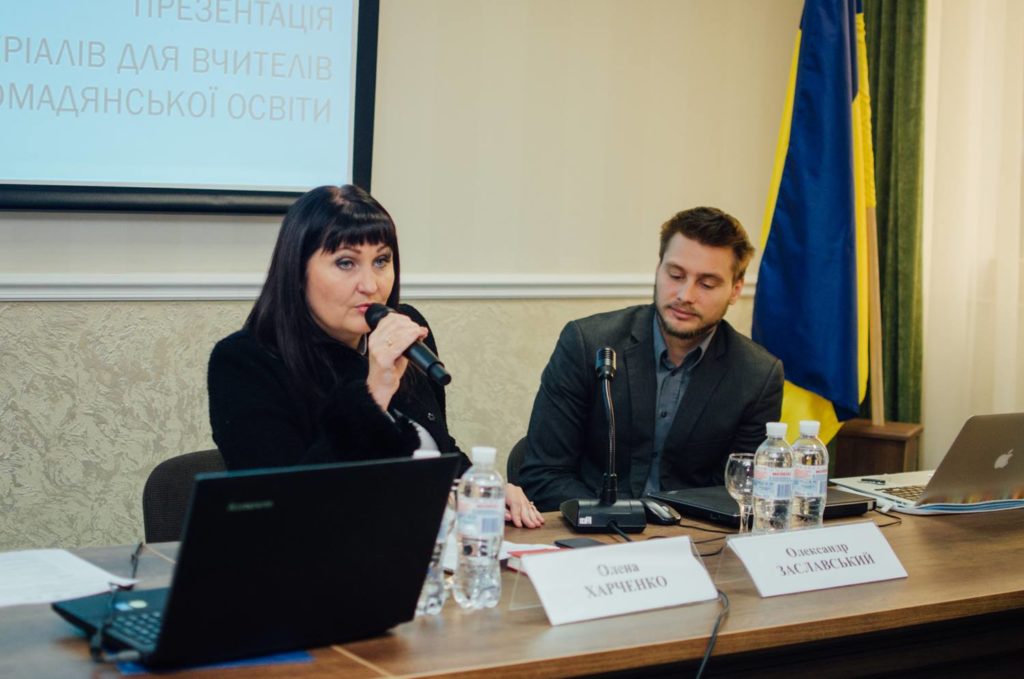
The opening speech was delivered by Olena Kharchenko, Director of the Department of Education and Science of the Poltava Oblast State Administration. Ms. Kharchenko observed that it was extremely important to update the curriculum that provide students with knowledge about the place of the citizen in society, the role of citizens in state governance, and the fundamental rights and duties of a person and of a citizen. She said the following:
“We, educators, cannot fail to notice to what extent today’s curricula are out of touch with reality, and teachers’ efforts are inefficient when it comes to the civic consciousness of students. Therefore, we are pleased to support the initiative for introducing a mandatory course or courses of civic education based on new approaches and methods of teaching. Undoubtedly, a role-playing game that will give students an idea of the real work of legislature should contribute to improving the quality of teaching, and will increase students’ interest, their performance, and, consequently, their level of internalization of the information. We will be glad to continue our cooperation with the Agency for Legislative Initiatives in this sphere”
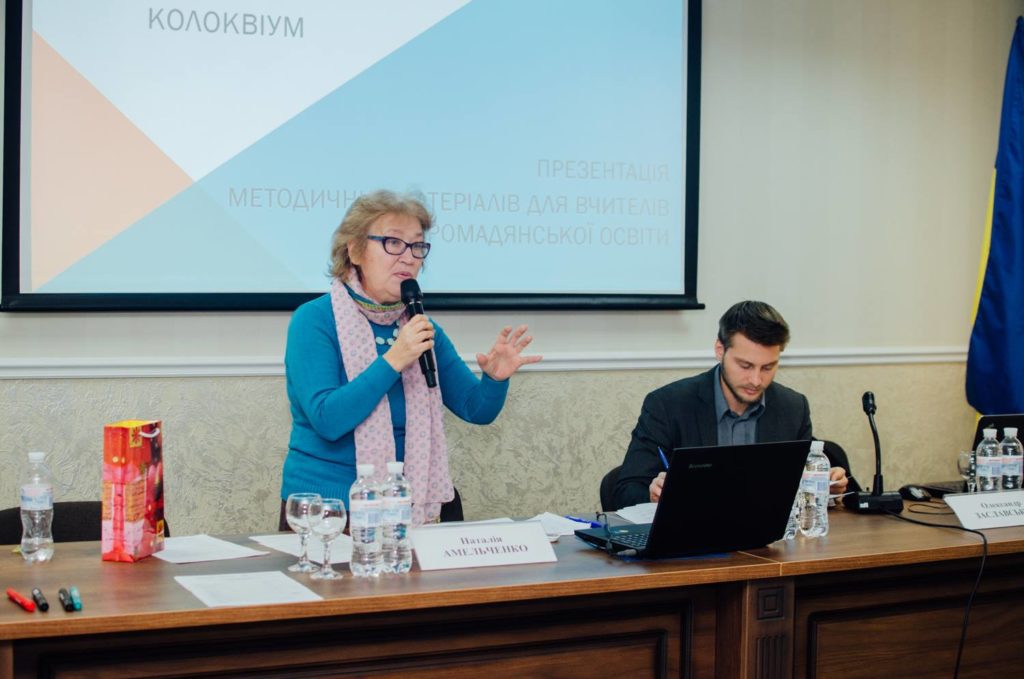
Natalia Amelchenko, PhD, professor of political science (NaUKMA), explains the essence of the Agora game that simulates the legislative process in the Verkhovna Rada.
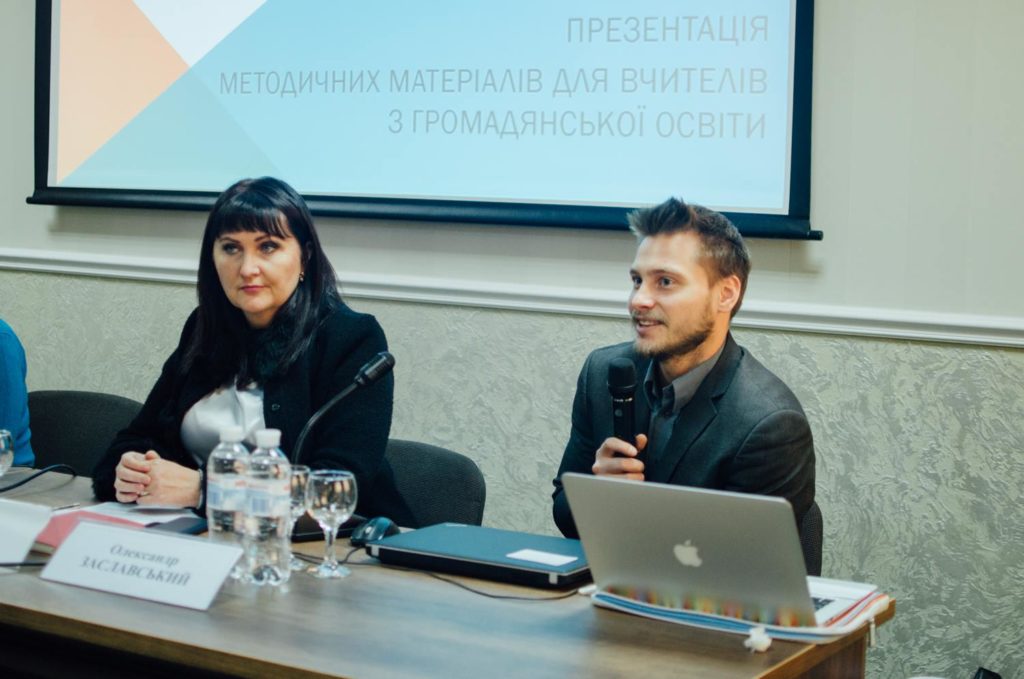
Oleksandr Zaslavskyi, Deputy Chairman of the Agency for Legislative Initiatives, emphasized that the introduction of civic education in schools would neutralize unreasonably high expectations of the Parliament and will raise the political culture in general. He argues that ever since the early 2000s the improvement of the functioning of the Verkhovna Rada – which the Agency for Legislative Initiatives has been working upon – had been problematic in view of the problems that lied outside the Parliament and distorted the legislative adoption process:
“Manifestations of the so-called “lack of political culture” include imperfect legislative procedures, non-compliance with these procedures as such, and lack of transparency in the work of committees and individual MPs. Nevertheless, it is precisely the domain of distorted public perceptions about the work of Parliament, corrupt practices of interaction between voters and MPs, and, consequently, unreasonable expectations that give rise to the problems of the Ukrainian Parliament, which experts can see with the naked eye”
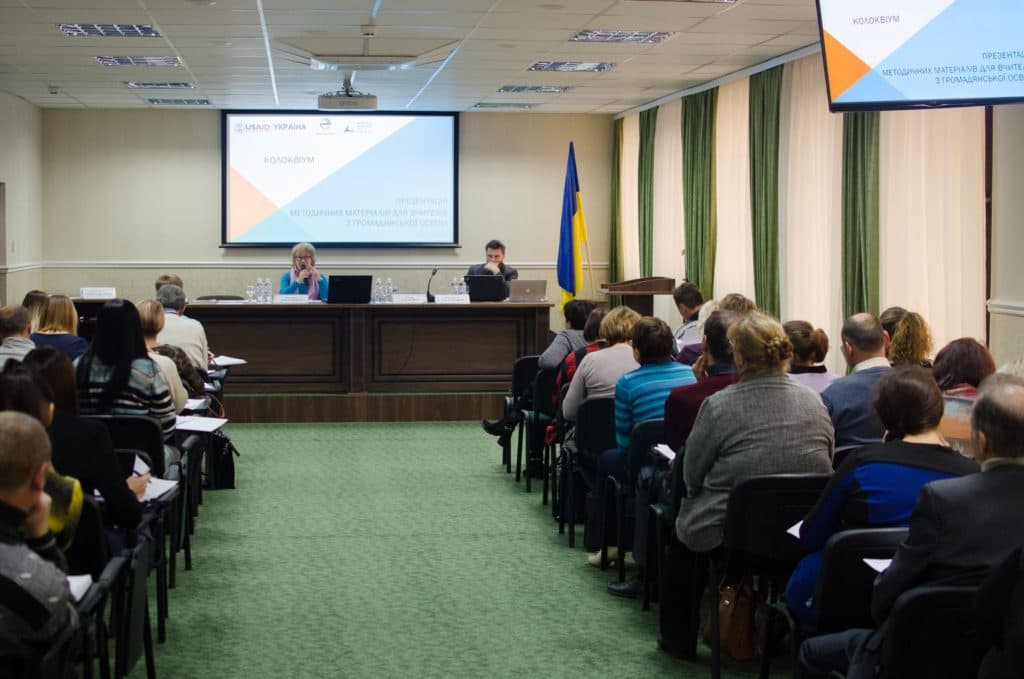
The project is aimed at strengthening the political culture, making basic information and skills of “citizenship” available to the widest possible range of people, consolidating new practices of interaction between citizens and institutions of governance. It is only under such conditions one can expect qualitative changes in the activity of authorities themselves. Changes in the political culture should begin with the secondary school when the basic ideas of future citizens emerge.
Guidelines for the Colloquium are prepared by Agency of Legislative Initiatives with the support of USAID RADA Program: Responsible Accountable Democratic Assembly, implemented by East Europe Foundation.
Meeting of the Working Group on Development of Guideline for Conducting Public Consultations in Ukraine
The purpose of the meeting is to develop a guideline on the draft law on public consultation with regard to the objectives, scope, target audience, format, approval, performance and other aspects of consultation and public participation in policies and decisions.
Alice Thomas, Chief of ODIHR’s Legislative Support Unit, told about the experience in implementing the guideline of the OSCE in Moldova, Armenia and Kyrgyzstan.
“Often the same representatives of civil society are involved in discussing various issues. Unfortunately, in many cases, citizens learn about the negative effects of a new law only after its adoption”

Deputy Chairman of the Agency for Legislative Initiatives Oleksandr Zaslavskyi presented the study concerning the involvement of NGOs in the work of parliamentary committees, which was used as a reference document for discussions in the working group. Mr. Zaslavskyi pointed out,
“It is important to move from discussing ready draft decisions and legally finalized documents to discussing the problems themselves. At the stage of reviewing texts, the public is faced with legal “casuistry”. Very often, the problem that the law is supposed to deal with is quite different. Therefore, it is necessary to involve the public in public discussions at the stage of problem identification rather than to the final discussion of ready texts”

Based on the results of the study, O. Zaslavskyi identified the following problems with public consultations in Ukraine:
- Lack of systematicity;
- Lack of professional and technical support of the authorities for conducting public consultations, as well as of means for communicating information;
- Synchronization of work between different authorities;
- Citizens need to learn existing tools. Very often, citizens address various authorities to issues that are beyond their jurisdiction;
- Lack of statistics concerning advocacy results. Citizens do not know the real impact of public consultation, and whether there are any results of taking into account the “voice of the people”;
- The illusion of “fast solutions”. On average, it takes several months to get a message across.
As a result, the working group decided to work out and discuss the guideline. The first version of the guideline will be written online by the experts of the Agency for Legislative Initiatives.
Presentation of Methodological Guidelines for Teachers in Chernihiv
On October 21 at 10:00, Chernihiv hosted a discussion of civic education and the Concept of a New Ukrainian School. More than 30 teachers discussed the competency-based learning and the key competences which a school-leaver ought to have.
Natalia Amelchenko, PhD, Professor of Political Science in NaUKMA, presented methodological guidelines for teachers of civic education and the role-playing game Agora which simulates the legislative process in the Verkhovna Rada of Ukraine.
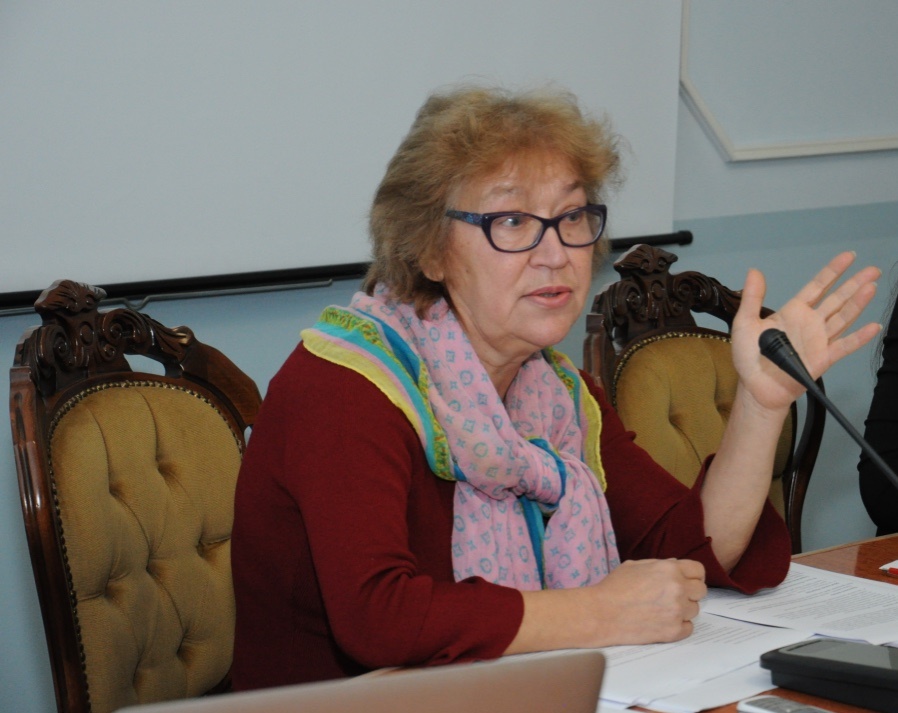
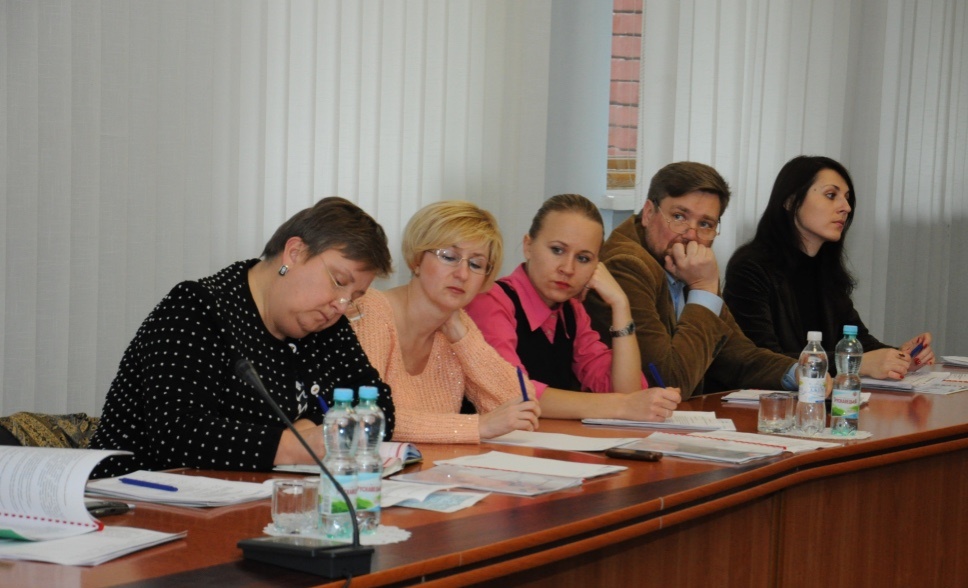
The event was devoted to the presentation of methodological guidelines for teachers of senior forms in order to introduce components of civic education in Ukraine, such as in particular “Legislative Power for Youth”, “Youth in State Programs”, “Political System of Ukraine”, and “Election Process”. The guidelines were prepared by the Agency for Legislative Initiatives within USAID RADA Program: Responsible Accountable Democratic Assembly, implemented by East Europe Foundation.
The significance of the integration of civic education into the curricula is stipulated in such documents of the Government of Ukraine as the draft Concept of the State Target Social Program ‘Youth of Ukraine’ for 2016-2020 and the draft Concept of Education Development by 2025.
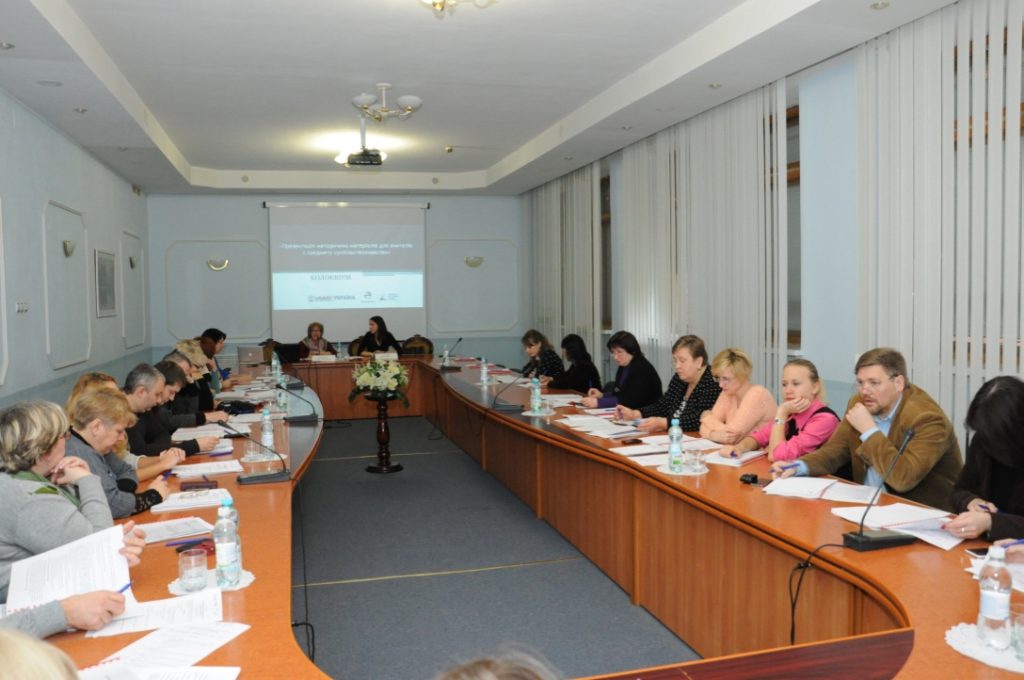
Town Hall Meeting “School Education: Budget and Parents’ Funds”
A town hall meeting on “School Education: Budget and Parents’ Funds” was held in Kharkiv on July 20th.
The event was organized on the initiative of MP Olena Sotnyk by the Agency for Legislative Initiatives in cooperation with the Interns’ League within the Model District project under the aegis of USAID RADA Program: Responsible Accountable Democratic Assembly implemented by the East Europe Foundation.

Oleksandr Zaslavskyi, Deputy Chairman of the Board of the Agency for Legislative Initiatives, familiarized the participants with the methodology of the event and told about the tangible results of the previous Town Hall Meetings within the Model District project.

The author of the scenarios, Iryna Kohut, expert at the CEDOS Center, told the audience that the public education subvention is currently one of the “cheapest” public subventions. Recently, there has been a change in attitude towards parents’ contributions throughout Ukraine – from legalization and “unshadowing” of the funds offered by parents to educational institutions monthly to their full ban. The expert stressed the importance of an active public stance as regards settling the issue of parental contributions:
“In order to get the maximum effect from state funding, the topic of today’s discussion should be in the focus of the Kharkiv community”

The discussion was held at ten desks and involved more than a hundred representatives of the Kharkiv community: teachers, parents, activists, and representatives of local authorities. The participants considered the pros and cons of each of the 5 alternative solutions to the problem of school budgets and legalization of parental contributions.

Eventually, 27 participants (majority of those who took part in the voting) chose the option of imposing a total ban on parental contributions. One of the alternatives was not supported by anyone at all, and only 7 people chose the option “do not change anything”.

At the end of the event, all interested persons had an opportunity to express their ideas concerning the format and content of the event, to briefly comment on it, and ask questions.
Olena Sotnyk is convinced that a complete ban on parental contributions is too radical a decision. The MP expected some more willingness in terms of personal initiative and responsibility. Therefore, based on the results of the discussion, the best proposals and ideas will be collected to be used for amendments to the law On Education.
Materials of the Town Hall Meeting:
Description of the problem
Option 1. Arrangement and collection of parental contribution should be left to the discretion of school administrations and parents (status quo)
Option 2. Creation of a charitable foundation
Option 3. School administration opens an account at a state bank (or treasury) and independently manages its own school fund
Option 4: Local authorities make it obligatory to transfer all parental contributions to special accounts in the State Treasury
Option 5. Completely ban parental contributions at schools
Town Hall Meeting “Looking for Ways of the Further Use of the Landfill in the Village of Korzhi”
A town hall meeting on “Looking for Ways of the Further Use of the Landfill in the Village of Korzhi” was held in the town of Baryshivka on June 30th.
The event was organized by the Agency for Legislative Initiatives in cooperation with the Interns’ League within the Model District project under the aegis of USAID RADA Program: Responsible Accountable Democratic Assembly on the initiative of MP Pavlo Rizanenko.

In his opening speech, MP Pavlo Rizanenko emphasized the urgency and importance of finding a consensus concerning the further use of the landfill. He encouraged representatives of the communities of the villages of Berezan, Baryshivka, and Korzhi, as well as representatives of local self-government bodies, to discuss the issue in detail in order to break the impasse arising out of one of the most urgent problems of the region.

Oleksandr Zaslavskyi
Oleksandr Zaslavskyi, Deputy Chairman of the Board of the Agency for Legislative Initiatives, familiarized the participants with the methodology of the event, giving examples of the application of the Town Hall Meetings format abroad and in Ukraine.

The expert of the event, Valeriy Mykhailenko, Associate Professor of the Department of Physical Geography and Geo-Ecology of T. Shevchenko National University, Candidate of Chemical Sciences, spoke about the modern scientific methods of landfill management and shared the relevant experience of the Baltic countries and Scandinavia in order to prepare the participants for discussion of the scenarios.

More than 50 participants spent hours discussing different options concerning the future landfill management from setting a sorting line to building a waste recycling plant.

Policy option 1 (to retain the status quo) proved unacceptable for both community representatives and local deputies. Therefore, they together decided to skip this alternative. Eventually, most of the participants voted for policy option 3, which implies the construction of a mini-processing plant funded by an investor.

Photo credit: Oleksandr Kovalenko
At the end of the event, representatives of the investor, who attended the event, made a presentation of concrete projects that can be fulfilled in the landfill of the village of Korzhi.
TOWN HALL MEETING “Ways to Organize Comfortable Urban Space in Kyiv”
On May 25, the NSC Olimpiyskiy hosted the Town Hall Meeting “Ways to Organize Comfortable Urban Space in Kyiv”.
The event was organized by the Agency for Legislative Initiatives on the initiative of MP Yehor Sobolev, in cooperation with the Interns’ League, in the framework of the Model District Project with the support of the USAID RADA Program: Responsible Accountable Democratic Assembly implemented by the East Europe Foundation.

Ihor Kohut, CoP of the USAID RADA Program, expressed his gratitude to all those present for the time they devoted to the town hall meeting and pointed out:
“The format of Town Hall Meetings gives politicians an opportunity to get feedback from the community and, having the necessary arguments and legitimacy, to solve community problems at both city and parliamentary levels”

MP Yehor Sobolev supported this idea:
“Our meeting is about providing active citizens with an opportunity to consider all points of view and all alternatives in order to overcome the “historical curse” of chaotic construction practices in Kyiv and jointly identify ways how and where we should move on”

More than 150 active participants split into small groups and took part in a three-hour discussion of the crisis of urban planning documentation and alternatives of decentralization of the urban development industry management. Kyiv residents expressed their support for the scenario that involved drafting a Kyiv City Strategy, introduction of changes to the General Plan 2015, and drawing up clear zoning regulations. Besides, most participants voted in favor of the option involving new unified state building standards (DBN) for the whole of Ukraine instead of the local level regulation of construction standards.
Voting results

Problem No. 1 “Crisis of Urban Planning Documentation”

Problem No. 2 “Decentralization of the Urban Development Industry Management"
Crisis of urban planning documentation. Description of the problem
Problem I. Option 1. Adopt the draft of General Plan-2025 and zoning of the central part of Kyiv
Problem I. Option 2: Continue public discussion and professional discussion with a view to finalizing the zoning project and creating conditions for adoption of a General Plan and a zoning plan that would be acceptable for Kyiv residents
Problem I. Option 3. Conduct an independent audit of the General Plan-2025 and make a decision following the audit
Problem I. Option 4. Create a Kyiv City Strategy, amend the General Plan 2025 and develop clear zoning regulations
Problem I. Option 5. Commission a completely new General Plan from a foreign institute
Problem II. Option 1. New unified state building standards (DBN) for the entire country
Problem II. Option 2. Regulation of building standards at the local level, the state sets only accessibility and security requirements
Society of the poor is the best ground for political corruption. Where is the way out from the government crisis? – interview with S. Matviienko

Svitlana Matviienko and Mustafa Dzhemilev
The Chairperson of the Agency for Legislative Initiatives believes that before the first personnel decisions are announced, there is no reason to say that one of the candidates for the post of prime minister is better.
When people need to make a choice between their own purses and democracy, it is difficult to persuade them to “tighten the belts” for the sake of reforms according to Svitlana Matviienko, Chairwoman of the Board of the Agency for Legislative Initiatives.
The Analytical Center of the Agency for Legislative Initiatives was created 16 years ago at the initiative of graduates of the Kyiv-Mohyla Academy. It focuses on democratic transformations and political and legal issues of parliamentarism, as well as functioning of political institutions and electoral processes; its experts are directly involved in the parliamentary legislative process.
In an interview for NV, Svitlana Matviienko, Chairwoman of the Board of the Agency, supported by the Council of Europe in Ukraine, talks about the lack of trust between politicians and in politicians as the main cause of the parliamentary crisis and explains why early election is inevitable and disastrous.
What ways out of the political crisis can you see today?
First, we need to elaborate on the reasons. The roots of the current crisis are twofold. First of all, this is the lack of trust – both between those involved in the political process and people’s trust in the institutions of power. Secondly, it is the unwillingness of politicians to assume responsibility.
Unfortunately, the number of “rigged game” cases and the history of relations between the current politicians in the parliament and government makes any renewal of mutual trust seem unlikely. The best argument to force politicians in power to assume responsibility is the threat of elections. However, given the geopolitical and security challenges, common sense urges us to be very careful with this instrument. In addition, surveys show a significant increase in populists’ ratings; therefore, we can hardly expect the next Verkhovna Rada to be more responsible and better in terms of quality. That is why we can pin our hopes only on pressure: if the public and experts can “put the squeeze on” the current politicians, we must use the entire arsenal of available means, to make sure that the processes underway cannot be halted.
Nevertheless, if there is a change of the government today, what should a new government be like?
Recently there have been a lot of discussions about the government’s renewal and its new format: whether there will remain the “evil” of political quotas, or whether the executive power can be headed by nonpartisan professionals – so-called “technocrats”.
I believe that the “technocratic” government is a transitional stage too, because any government must sooner or later get a mandate of confidence via election. However, under conditions of a political crisis, experts and activists support the idea of a “technocratic” government, which Natalie Jaresko ultimately agreed to head. The idea is simple: to compile a short list of priority reforms, to find an experienced non-partisan manager for each of the priorities and set strict deadlines for assessment of their implementation. The lack of political ambitions of the members of such a government is supposed to ensure support of the Parliament and to “calm down” politicians. Obviously, the key players did not like this approach.
The second option is to restore the Coalition in this or that format, which in turn will restore a “political” government. Unfortunately, this option will only postpone the political crisis, as the seats in such a government will be distributed by the quota principle or political loyalty rather than by professional criteria. The only alternative candidate for such a government was the acting speaker. However, Groysman’s announcement that his government will include some “technocratic” ministers (for example, some of the current deputy ministers of economy) does not make it consolidated and independent in decision-making. Therefore, this option also does not remove the issue of early elections from the agenda. Whatever the actions of such a government, most of the responsibility for everything that will happen will be borne by the Coalition that delegates it.
Do you personally see among the people discussed as PM candidates a person capable of leading reforms, as well as withstanding the political pressure and resistance of the system that wants to self-preserve?
In the current economic conditions, we need a candidate who will ensure results. If the degree of resistance to political influences and the independence of the PM will mean blocking his initiatives in parliament, one may ask the question: Will this situation differ from the current one, with Yatsenyuk? If the new head of government will serve as another “lightning rod”, wasting time on explaining why there are no reforms, the effectiveness of any ministers’ team will be low.
At the moment, the greatest fear of our Western partners is concentration of power in the hands of one political group. Therefore, of course, investors and creditors are more accepting of Jaresko as a candidate.
Whoever heads the government, if the new prime minister fails to communicate with the parliament in support of reforms, the prospect of early elections will reappear. The parliament perceives Groysman as a more predictable political figure, although some draw attention to his proximity to the president. Society in general can view this situation as usurpation and alternation of the “old faces”, even if a representative of the Popular Front is appointed new speaker for the balance. Under the present conditions, any PM must conduct rapid structural reforms and establish a dialogue with society. Restoration of public confidence is the only resource that can be relied upon in the current parliamentary situation.
Is there any reason to believe that Groysman or Jaresko can be such a prime minister?
No, not until we see the first decisions of the new prime minister, for example, personnel decisions.
If early parliamentary elections are announced, when can it happen and how will parliament change?
I have already mentioned the crisis of trust and responsibility. If they are not restored, early election are unavoidable. Some politicians say it can be held this autumn. If politicians can restore the interaction between the government and the Verkhovna Rada and demonstrate real changes to society as a result of their synchronized work, the term of office of this parliament might be longer than the pessimistic forecasts.
However, from what we see, so far the discussion is at the level of personalities and political slogans. This applies not only to the government, but also to political forces. The third sector should encourage citizens to demand that politicians should communicate with society not only in the language of populism and the rhetoric of separation. Otherwise, the next parliament will be of the same quality, and will turn into a source of destructiveness even sooner.
When East European countries went through a similar reform period, they also plunged into political instability and elections were held every two years. Will the same happen in Ukraine and will it change the political landscape? Could a series of short-term elections help clear Ukrainian politics and give rise to a new, better generation of politicians?
It is impossible to examine the situation out of context: as if there is no war, no Russia’s desire to see Ukraine bleeding and helpless. Frequent elections could work out well amid economic growth and well-being. But when people need to make a choice between their own purse and democracy, it will be increasingly more difficult to persuade them to “tighten the belts” if there are no tangible results of reforms. Grassroots democratic parties can evolve only if people have money for this, and small and medium-sized businesses see that such parties can protect their interests and become ready to finance them. In the end, citizens themselves should not sit and wait for a new generation of politicians – they have to struggle for seats of authority and become the “new faces” in contrast to the ballyhooed political brands.
Ukrainian parties should be referred to as political projects rather than parties. People tend to accuse them of a lack of real ideology and struggle for power to get access to the shareout, rather than to implement their programs. Can you think of any Ukrainian political parties, rather than projects, with real ideology, internal party democracy and other attributes of a mature and responsible political force?
Parties become parties not because of their registration and participation in elections, but because of the common stance of many active people and leaders who can agree on joint actions and organized participation in elections. Without powerful horizontal self-organization, Ukraine has no chance to develop democratic parties. It’s good that Ukrainians already have such experience in view of the two Maidans. It’s bad that it is a union against someone, often against a certain person, rather than systematic defense of common interests and work at the level of your own home and street. I can think of but a few parties with intraparty democracy, debate and respect for minority opinions that are actively present in the public field. If you can become a member of such a party, democracy has a chance.
The law on the financing of political parties, which enters into force in the second half of 2016 – will it deprive the big business of its influence on political parties?
The Law on State Financing is a positive phenomenon, but it will only work when all information about those who finance political parties is open. It can potentially stimulate intraparty democracy, if regional centers receive an adequate share of the “financial pie” instead of being bit-part actors for the party leadership. Parties should have real regional centers, create vertical mobility means for active citizens, and serve as a channel to “big politics” for their active members.
At the same time, without restrictions on election campaigning and tightened control of paid journalism, the prospects of entirely getting rid of the influence of big business on politics seem unlikely. Public activism, independent media, and other monitoring mechanisms are integral components of the greater transparency and accountability of political parties, regardless of their budget financing.
Before the local election, the electoral legislation was amended, but this did not make the electoral system any more transparent, on the contrary, it is even more confusing now. Today, there are calls to change the electoral law. What should it be like to make the electoral process truly transparent, so that decent politicians could come to power instead of oligarchs’ puppets?
When this law on local elections was adopted, experts had already prepared an alternative version of the law in line with the best world practices. However, politicians did not support it and fixed everything behind the scenes. We have not yet really tested the system of open lists in conditions where we have a mixed proportional-majority system.
Of course, every electoral system has its disadvantages and susceptibility to corruption risks. As long as society is affected by the “epidemic” of corruption and poverty, education and perfect legislation are not enough to improve the situation.
The society of poor people is the best ground for political corruption, unconscious choices, and populism. Political parties and the government should resolve the main ethical dilemma: to take care of the public welfare and face the constant threat of conscious choice or to keep the public in the cold poverty trap and always be sure to reap a splendid harvest fertilized with populism