
It was a valuable experience for the Agency. We hope that not the last one.
The Agency for Legislative Initiatives presented the organization at the Atlas Weekend Festival
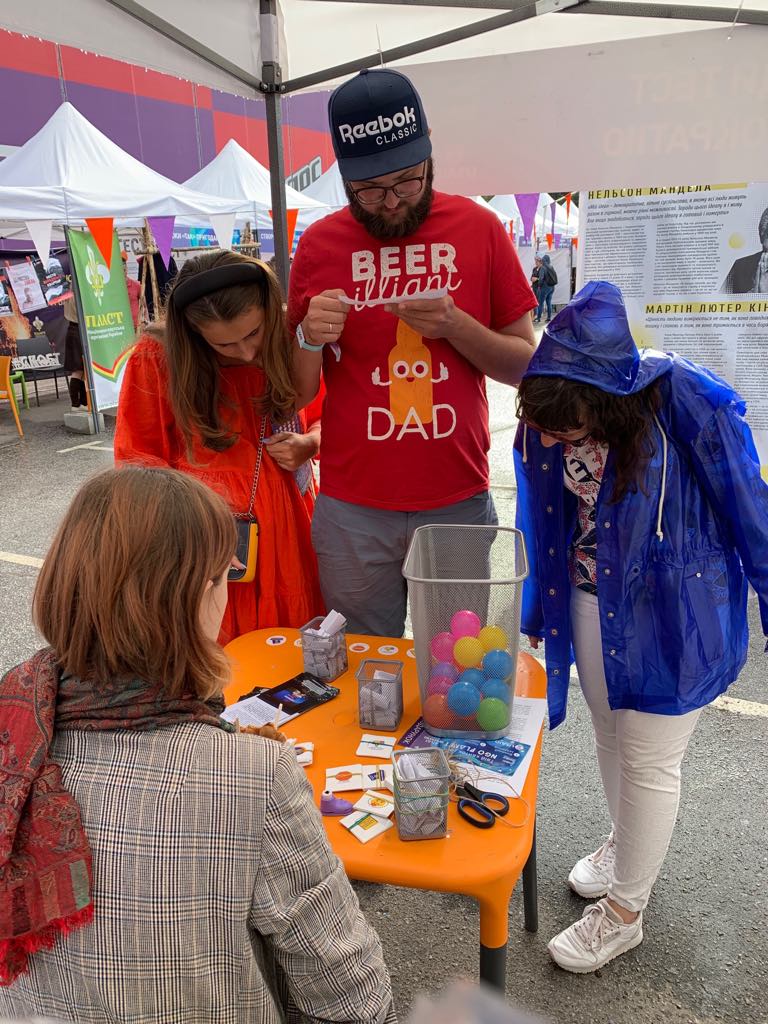
This year, the Agency for Legislative Initiatives presented the organization at the Atlas Weekend Festival. Our team carried out rapid testing for those who are interested in democracy.
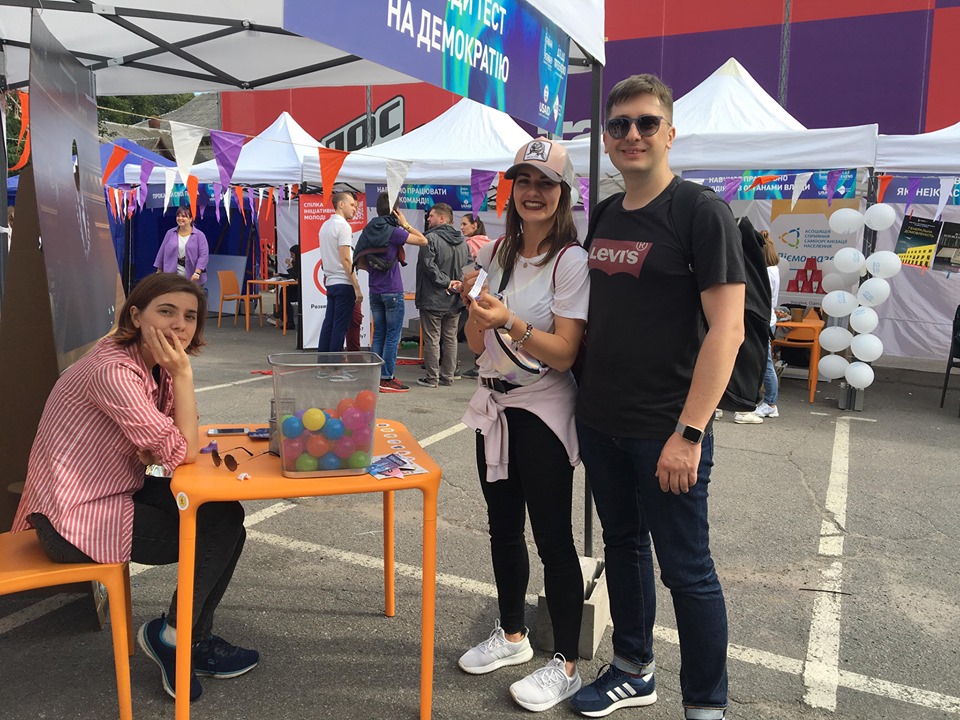
From now on, more Ukrainians will know how democracy really works, who decides and how to overcome difficulties. Indeed, democracy is not only the freedom of speech and deeds. First and foremost, this is an instrument that should be used correctly: if there is a problem, then it is necessary to initiate its solution by yourself, instead of waiting until someone else, higher in the vertical power will do it.
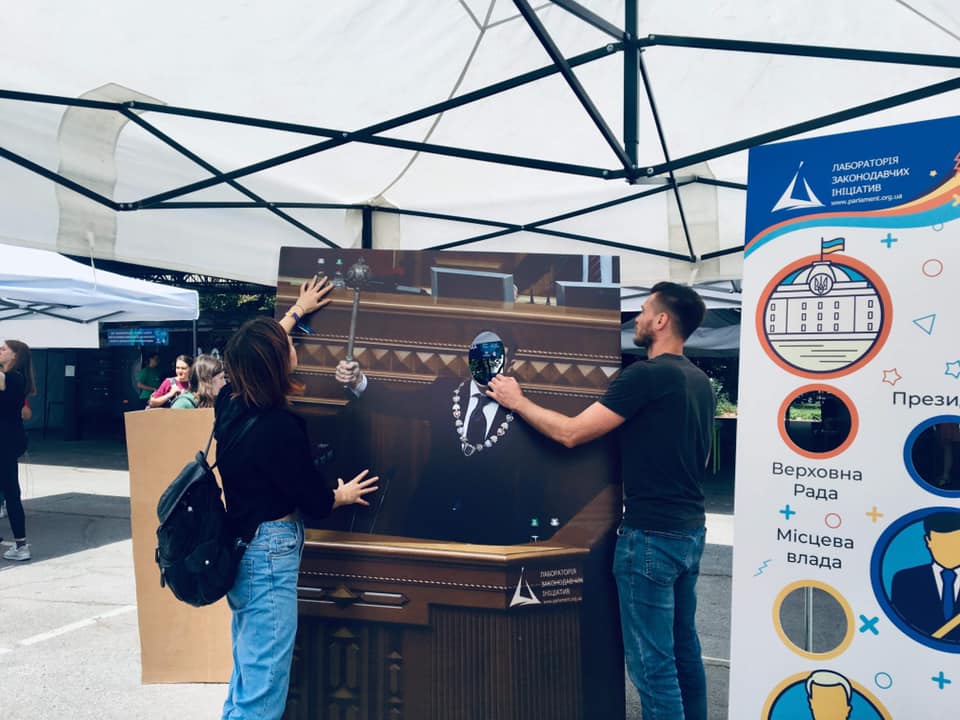
Civic education, even if it is during the festival, is a vaccine against populism for teenagers and young Ukrainians who liked our activities.
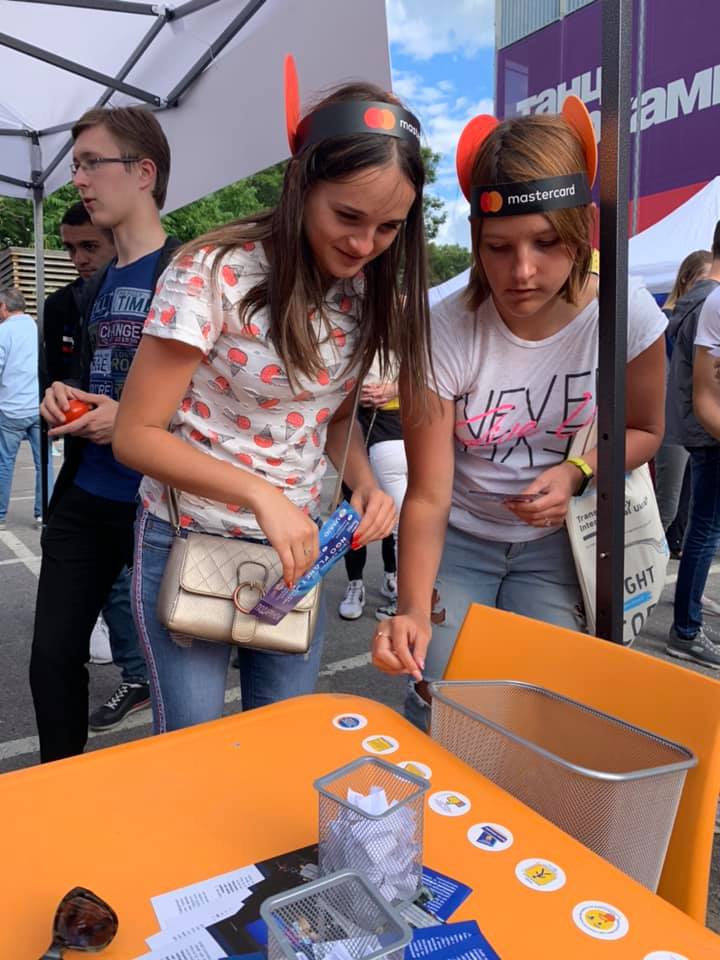
During the festival, we met many active and knowledgeable people – Ukrainians and foreigners, open to knowledge and ready for action. We understood more of what the youth needs in order to be interested in social and political processes. The youth, in turn, has learned how to find the right way out of the situation and to distinguish power of the Government and Parliament.
New Leaders – 2: ideas of change
This year, voting takes place for 50 leaders who present their policy ideas that contain a specific action plan in a particular area. 25 of the leaders will be selected by Internet voting, the other 25 will be selected by the professional jury. Chairwoman of the Council of the Agency for Legislative Initiatives and the curator of the Ukrainian School of Political Studies Svitlana Matvienko is part of the jury.
8 leaders that will have the most points will go onto the live shows. The project will last for four months.
For 14 years, Agency for Legislative Initiatives and the Ukrainian School of Political Studies have been building up a network of successful and dedicated representatives of various spheres (civil servants, lawyers, businessmen, academics, politicians, journalists, public figures) who are leaders in their respective fields and define the future of Ukraine.
As part of its mission, the Agency and the School are participating in the “New Leaders” project. This project is designed to find active, energetic and ambitious leaders who know how to change Ukraine and are ready to implement these changes today. The public watchdog of the project, transparency of the rules and their observance by all the participants is the Civil Supervisory Board, created by the leading civil society organizations of Ukraine. The Civil Supervisory Board is an independent and impartial supervisory body and has formed the Selection Committee of the project.
Last season, the project “New Leaders” was watched by every fourth young Ukrainian, and the total audience of the project amounted to 26.3 million viewers.
Town Hall Meeting “Implementation of the Law of Ukraine “On Legal Aid”
The event was organized by the Agency for Legislative Initiatives within the project “Ensuring Access to Justice in Ukraine: Ethical Standards and Institutional Aspects” with the support of the Law Enforcement Section of the US Embassy in Ukraine. The project aims directly at the comprehensive provision of the rule of law principle in Ukraine by strengthening the institutional capacity of the advocate’s self-government and strengthening the place of ethical norms and standards in the work of lawyers for the better protection of human and citizen rights.
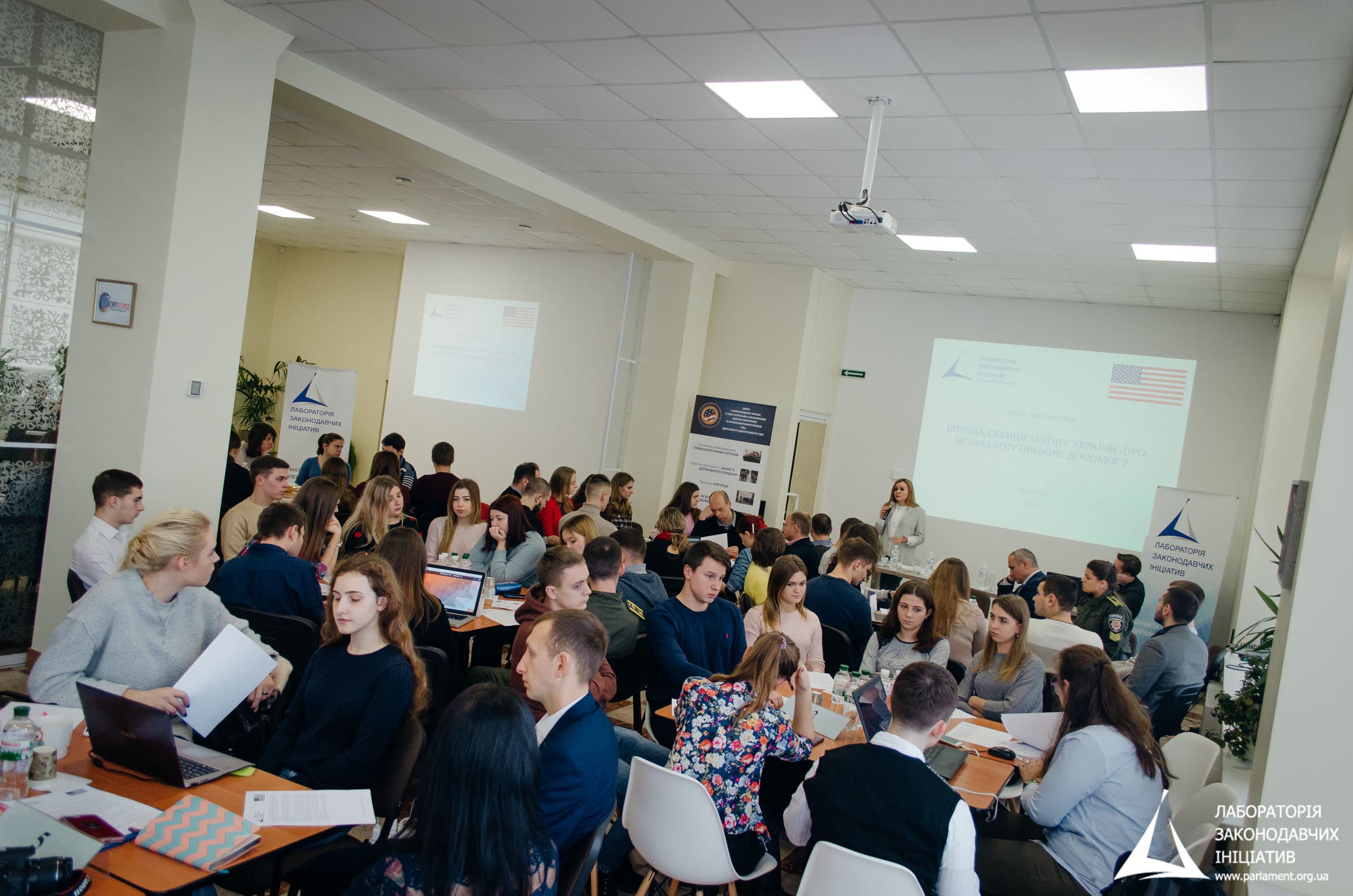
The urgency and necessity of the event for Chernihiv residents was confirmed by a large number of participants, more than 70, who expressed their desire to participate in the discussion of a number of problems of provision of legal aid. Among the participants were: lawyers, human rights activists, public activists, representatives of the Novozavodsk District Court, Chernihiv Appeal Court, Chernihiv Regional Council, Chernihiv Regional State Administration, Main Directorate of the National Police in Chernihiv Oblast, Desnianska District Council in Chernihiv city, legal advisers of Chernihiv City Council, students and lecturers of Chernihiv National Technical University, cadets of the Academy of the State Penitentiary Service, as well as ordinary citizens, who are not indifferent to the state of the legal aid system in Ukraine.
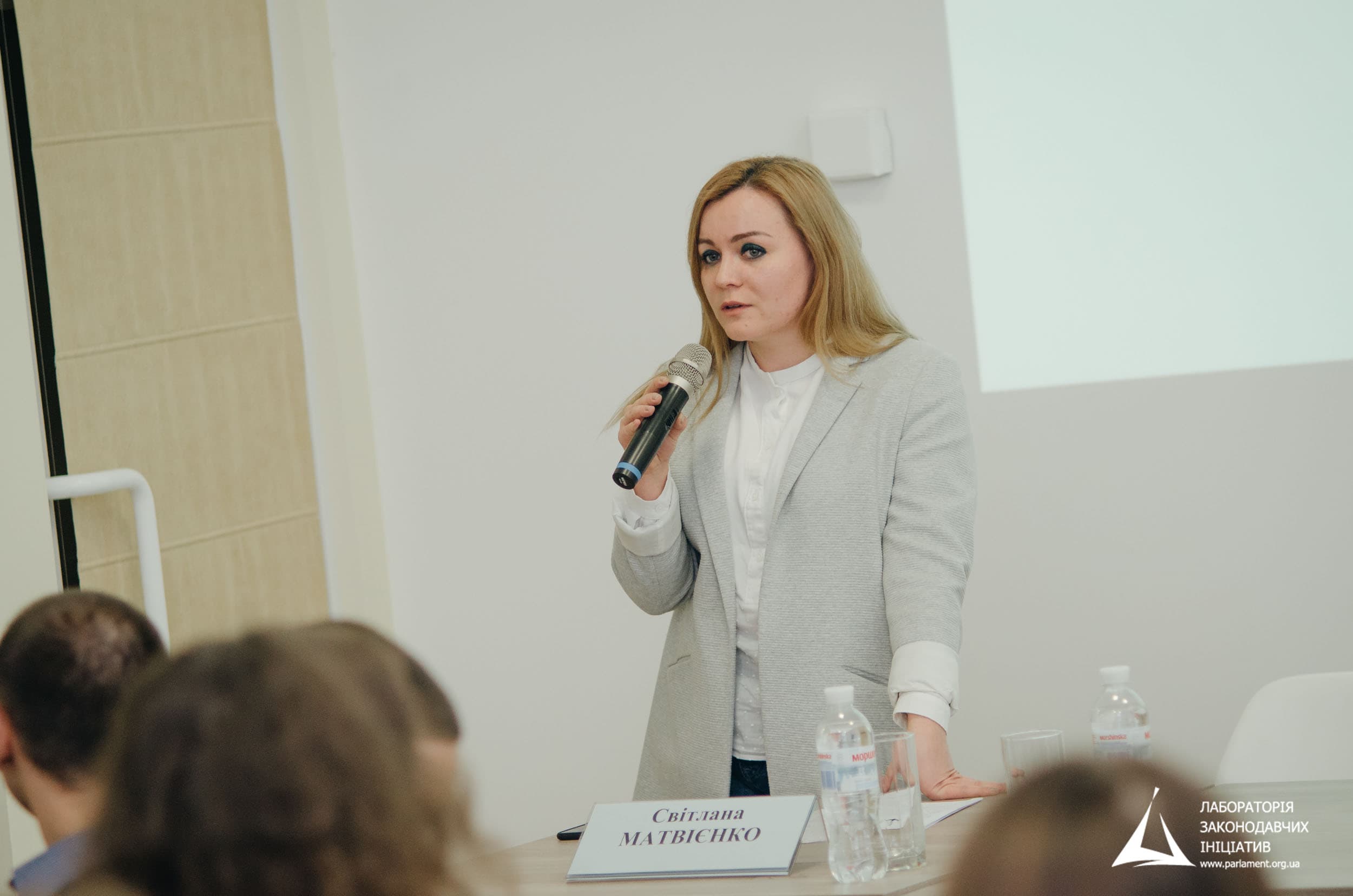
During her introductory speech Svitlana MATVIIENKO, Chairwoman of the Board of the Agency for Legislative Initiatives, stressed the need to bring up the discussion of providing legal aid to a new level in order to develop effective and efficient mechanisms for the provision of this type of service.
“Legal aid provides access to legal protection for a society, since the right to professional legal assistance, including free of charge, is guaranteed by article 59 of the Constitution of Ukraine, and provided by a number of conventions and international documents, which are part of the international system of ensuring human rights. Sometimes, legal aid is the only opportunity for insecure groups of people to get legal protection and representation of their interests in court or during communication with other state bodies”
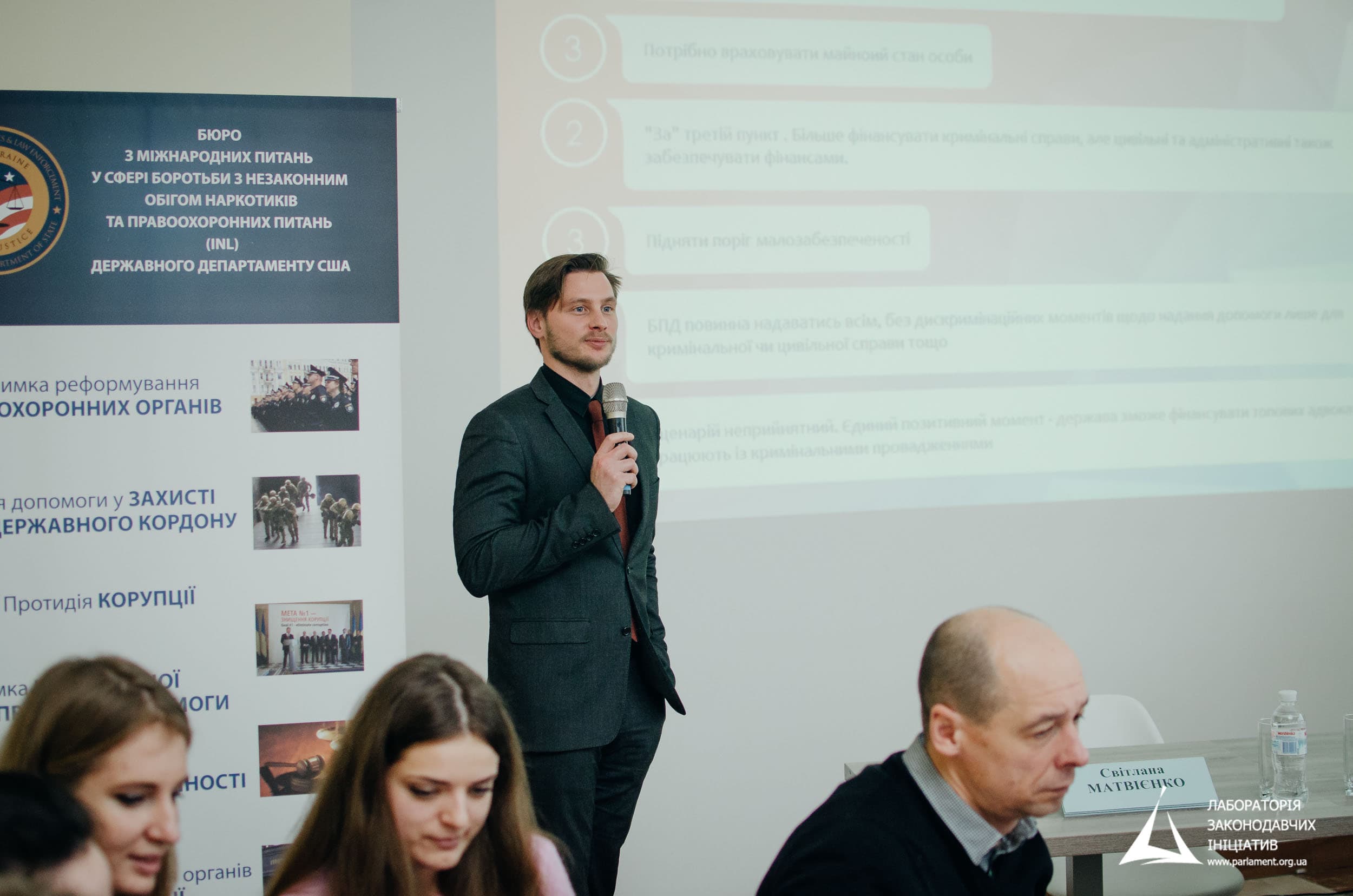
Oleksandr ZASLAVSKYI, Deputy Chairman of the Board of the Agency for Legislative Initiatives, introduced to the participants the Town Hall Meeting (THM) format, and also emphasized the importance of such formats in decision-making both at the national and local levels:
“The THM format is primarily intended for public participation in decision making at the local level. In particular, it is great for finding out the community’s priorities when forming a local budget. However, this format can also be used to discuss options for solving more complex problems, and even draft legislation”
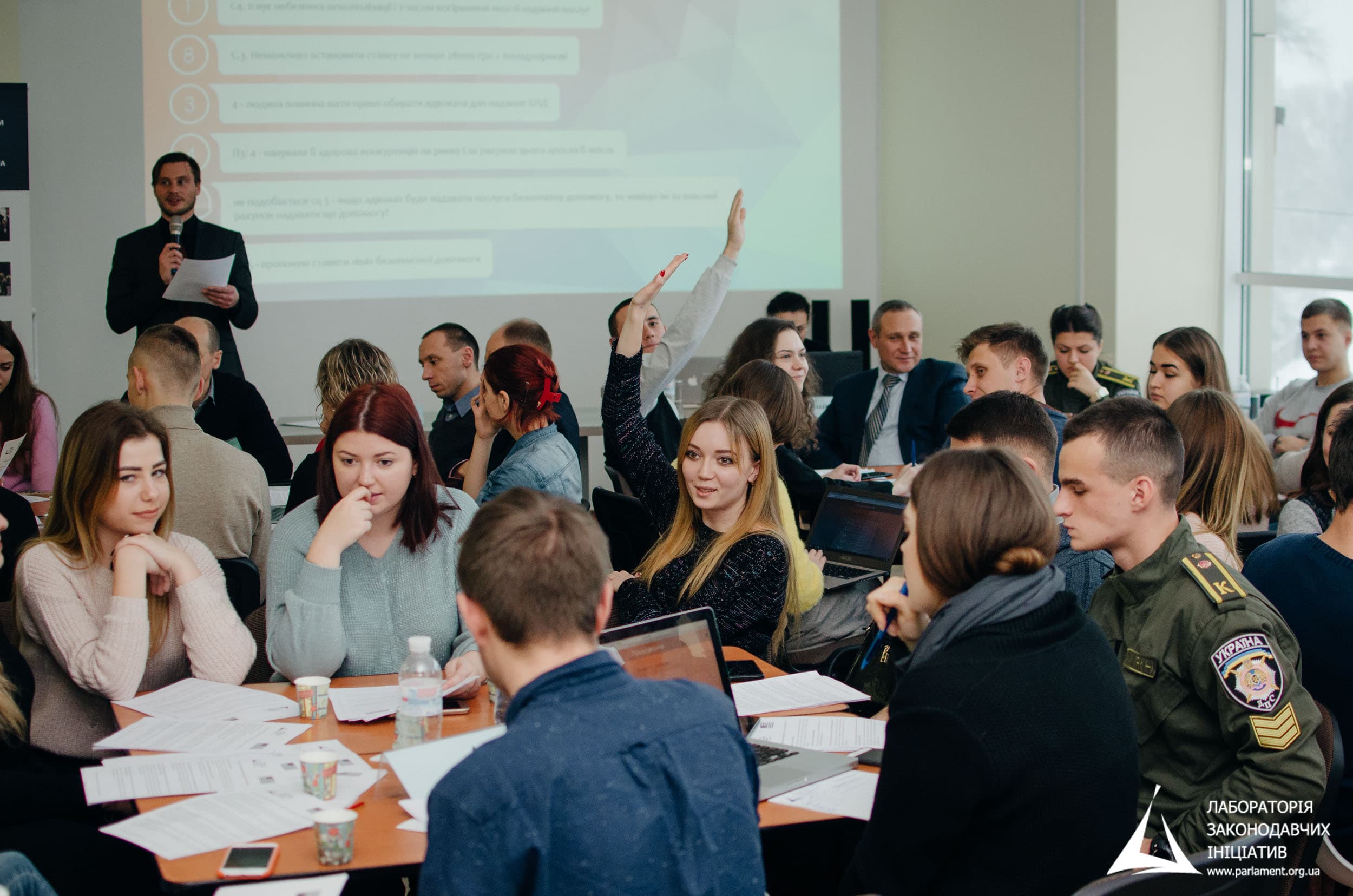
Participants of the event got acquainted with the main aspects of legal aid provision, the grounds for its provision, and peculiarities of primary legal aid and secondary legal aid.
During an active two-hour discussion the participants discussed the proposed scenarios and developed their own approaches to the issues of the financial and organizational basis for providing services in legal aid system, the subordination of legal aid system, as well as improving the accessibility and quality of the provision of these services.
As a result of lively discussions, voting on scenarios took place. The scenarios address the main issues of providing legal aid.
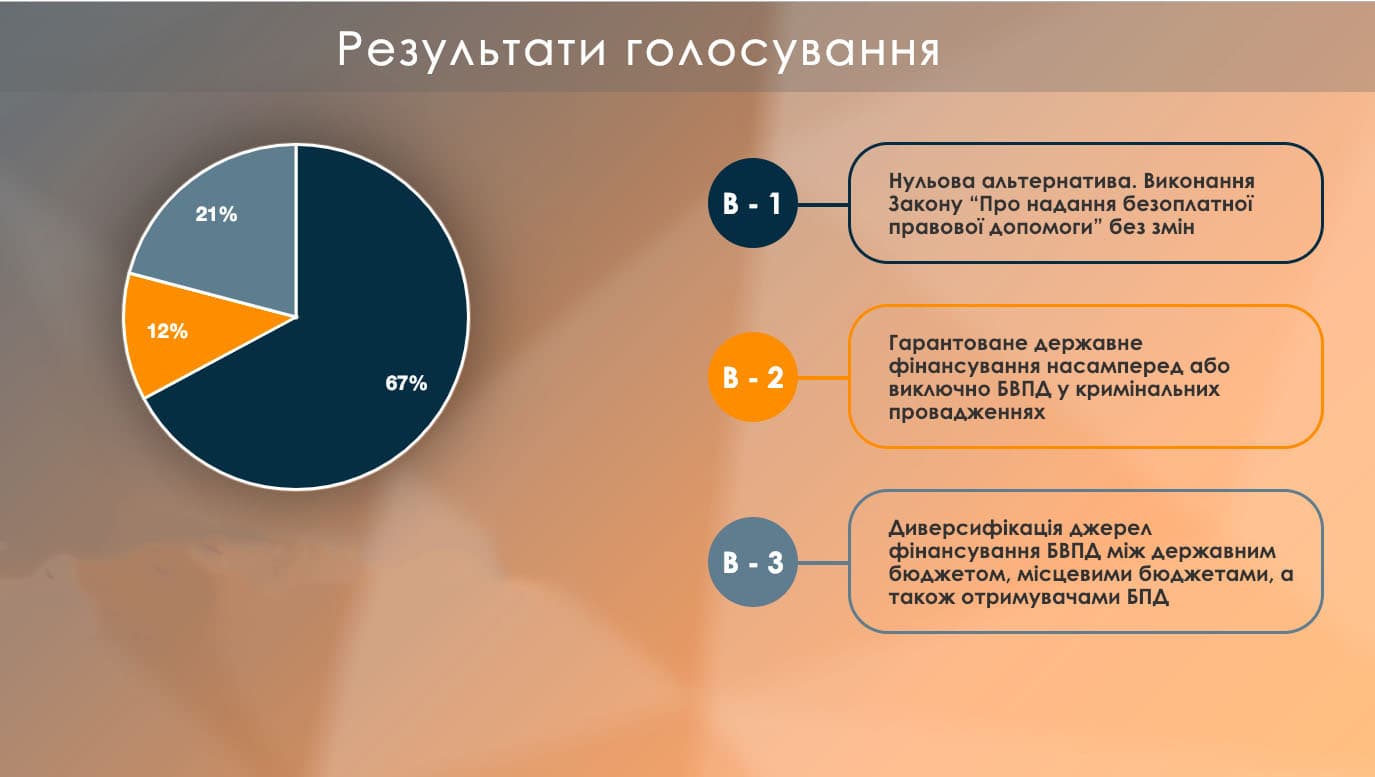
After the discussion on the system of financial and organizational basis for the provision of services, the status quo scenario, that is, the implementation of the law “On Free Legal Aid” unchanged, won the vote. For this option, 67% of the participants gave their votes. The option to diversify the sources of financing of secondary legal aid between the state budget, local budgets, as well as recipients of free legal aid came second (21% of votes).
The smallest number of votes (12%) was given to the version according to which state funding is guaranteed primarily or exclusively for secondary legal aid in criminal proceedings.
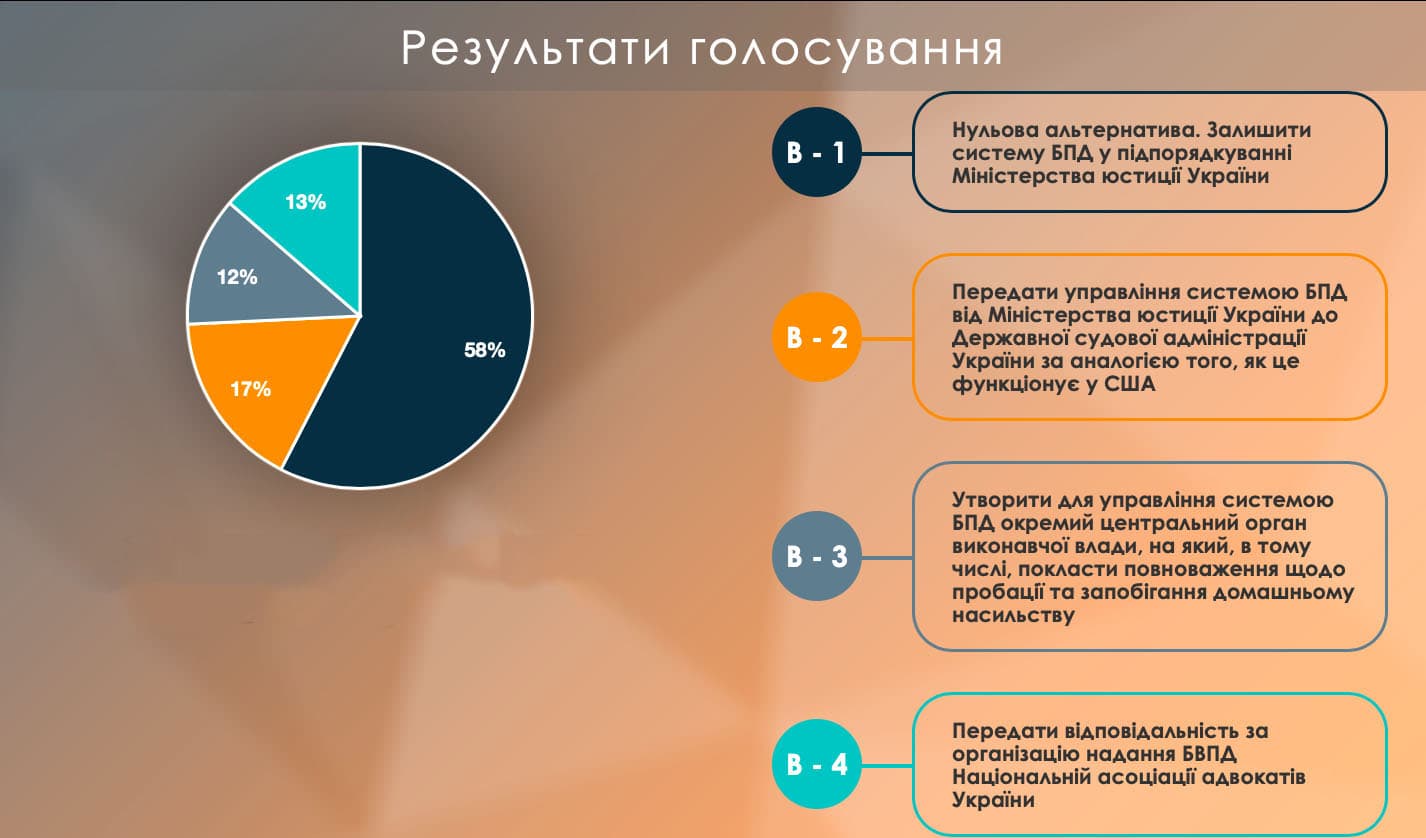
During the consideration of the problem of subordination of the legal aid system, according to the results of the voting, the status quo scenario also won the vote, which means the subordination of the legal aid system to the Ministry of Justice of Ukraine (58% of votes).
The second place (17%) was given to the option according to which the transfer of management of the legal aid system from the Ministry of Justice of Ukraine to the State Judicial Administration of Ukraine, as for example is in USA. Almost the same number of votes got the Scenario 4 (transfer of responsibility for the provision of secondary legal aid to the National Bar Association of Ukraine – 13%) and Scenario 3 (management of the legal aid system by a separate central executive body – 12%).
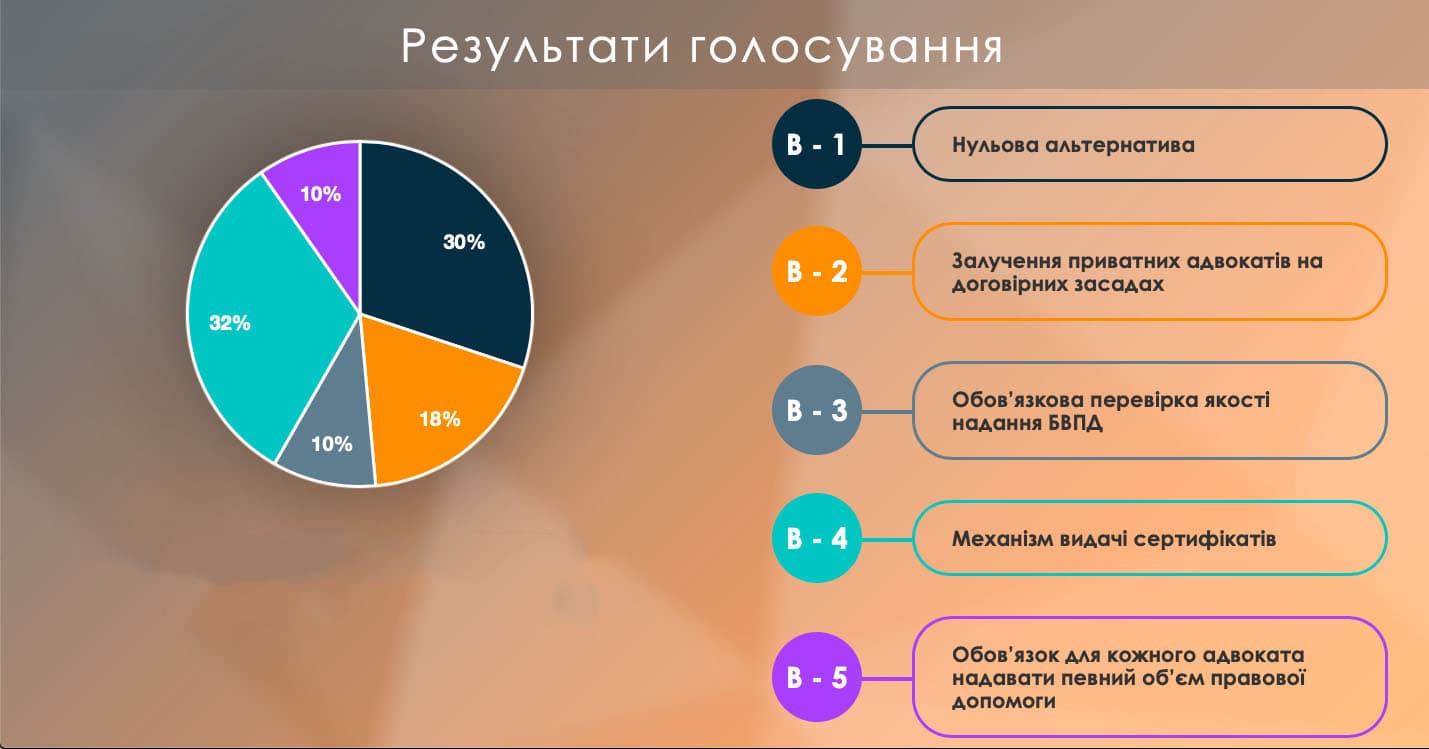
During the voting for the third problem (Improving accessibility and quality of the secondary legal aid), each participant had the opportunity to cast his or her vote for more than one option. This is due to the fact that the proposed options in their essence are not so much alternative as complementary, that is, they can be implemented in parallel or in a complex. The largest percentage of participants of the event voted for the option of introducing an additional mechanism for issuing certificates with the option of free choice of lawyer by the recipient of the secondary legal aid (32%). The status quo option took the second place, that is, to retain the existing mechanisms provided for by the Law of Ukraine “On Legal Aid” (30%). The third place was taken by the involvement of private lawyers on a contractual basis (18%). Scenario 5 (assigning a lawyer to provide a certain amount of legal aid pro bono) and Scenario 3 (mandatory verification of the quality of the legal aid) were the least popular (10% support each).
As well as during the discussion of problems related to the Rules of Legal Ethics(December 11, 2018 in Zhytomyr), the systemic problem of lack of open discussions about the prospects for development of legal aid system in Ukraine became obvious.
The opinions and proposals of the participants, the voting results, which were recorded during the discussions, after processing and including in the report, will be sent to each participant of the events in Chernihiv and Zhytomyr, as well as distributed among the wider range of stakeholders.
New Leaders: Politics can be different

The national television project “New Leaders” has ended, which came to existence with participation of the Ukrainian School of Political Studies and the Agency for Legislative Initiatives.
For over 13 years the Ukrainian School of Political Studies has been developing a network that connects successful and driven representatives of various fields (civil servants, lawyers, businessmen, scientists, politicians, journalists, activists and artists), leaders who determine the future of Ukraine.
In line with this mission, along with more than 30 key NGOs in Ukraine and the StarLightMedia group, USPS has launched the National Television Project “New Leaders”. This project’s goal is to find active, energetic and ambitious leaders who know how to change Ukraine and are ready to start implementing these changes today.
Guarding the project’s non-partisanship, transparency of rules and their compliance by all participants is Civil Supervisory Board, formed by leading NGOs of Ukraine. The Board is an independent and impartial supervisory authority and has formed the Selection Committee of the project.
The Selection Committee includes: Olga Aivazovska (Civic Network OPORA), Roman Bondar (Odgers Berndston Ukraine), Hlib Vyshlinskyi (Center for Economic Strategy), Andriy Vyshnevskyi (NGO “Lawyer of the Future”), Tetyana Durnyeva (Public Holding “Impact Group”), Svitlana Matviienko (Agency for Legislative Initiatives, Ukrainian School of Political Studies), Tamila Tasheva (NGO “Crimea-SOS”), Yaroslav Yurchyshyn (Transparency International Ukraine).
The project started in March. Altogether, nearly 1,400 applications were received from across the country, 854 of them passed the preliminary check and inspection. Following the principles of transparency and openness, the New Leaders site was screened for security, the votes were constantly checked, and several leaders were excluded from the project for certain violations of the Code of Conduct.
100 leaders were selected: 50 leaders received the largest number of votes from the voters and 50 leaders were selected by the Selection Committee. Of these 100 leaders, the Selection Committee selected 10 candidates who went onto the live shows. And among those TV viewers chose the winner of the project.
During the project the University of Leaders was organized for leaders and viewers online, which aimed to provide the project participants and other interested citizens with an educational platform for the learning and making new skills that modern leaders need. The lecture archive is available at https://novilidery.com/university-of-leaders.
The television part of the project started in October and lasted through November.
Among the participants of the project, there are 22 alumni of the USPS and 5 alumni of the School of Community Leaders. The first show was watched by over 2 mln viewers. Three USPS alumni went through to the top-10: Gennadiy Druzenko (2006), Oleksandr Slavskyi (2014) and Olga Matyushyna (2018). Many other alumni took high positions in the overall rating: https://novilidery.com/news/vidbirkovii-komitet-opriludniv-protokol-golosuvanna-za-prezentacii-usih-ucasnikiv-novih. Olga Matyushyna was a finalist of the project.
During the project period, almost 5000 commercials, stories in news blocks were shown and 7 shows were made. The audience on the Internet was about 8 million people and more than 300,000 viewers. Overall coverage (18+) was 26.3 million people. Every 4th Ukrainian among young people watched the show.
Statement of the NGO “Agency for Legislative Initiatives” on the attack on Kateryna Handzyuk

Today Kateryna Handzyuk, Manager of Affairs at the Executive Committee of the Kherson City Council, was assaulted. In severe condition, she was hospitalized and now stays in intensive care unit.
Kateryna Handzyuk has been working in local self-government since November 2016. She advocates the disclosure of all data held by the City Council and establishing communication between officials, the media and the community. Kateryna is a well- known as a Kherson activist who fights corruption in the ranks of police. In the autumn of 2017, she brought evidence of corruption of Artem Antoshchuk, Head of the Department of Economy Protection of the National Police in the Kherson Region.
The Agency for Legislative Initiatives has been working with Kateryna Handzyuk since 2015, when she joined the Ukrainian School of Political Studies’ Community. In 2017, Kateryna became an expert of the Agency for Legislative Initiatives after conducting the research and preparing an analytical paper “The Policy Proposals to Regulate the Status of the Local Council Members” on its basis.
The Agency for Legislative Initiatives’ team condemns the attack on Kateryna Handzyuk. We consider it unacceptable that in the 21st century in a democratic state, the struggle of citizens against corruption in state bodies is accompanied by intimidation of activists and brutal physical harassment, which usually remain unpunished.
It is necessary to draw attention to the fact that the recent attacks on journalist Sergiy Nikitenko in Kherson and activist Vitaly Ustymenko in Odesa remain unpunished. Our Community has not forgotten about the attack on Dmytro Bulakh (2014 USPS alumnus), a well-known Kharkiv anti-corruption activist. The lack of adequate investigation and punishment of the executors and organizers of these attacks is unacceptable. The brutal impunity of crimes generates an escalation of violence in society.
We appeal to the President of Ukraine Petro Poroshenko, the Minister of Internal Affairs of Ukraine Arsen Avakov, and the General Prosecutor of Ukraine Yuriy Lutsenko with the requirement of an immediate and objective investigation of the attack on Kateryna Handzyuk. The performers, possible organizers and customers of the assassination attempt should be brought to criminal justice. We also ask for assistance from our international donors and partners. Ukraine should be an example of adherence to the rule of law: only then we can talk about any reforms, when human life and health are supreme values and are protected by the state.
Guidelines for Conducting City Meetings in Town Hall Meeting Format
The guidelines summarize the experience of assembling Town Hall Meeting in different regions on the various topics that the Agency for Legislative Initiatives has been conducting since 2010. The manual summarizes the best practices of planning, organizing, and holding city meetings, as well as presenting materials that are examples of organizational and expert documents that were used during events organized by the Agency for Legislative Initiatives.
The preparation of studies is part of a project implemented by the Agency for Legislative Initiatives in co-operation with the Apparatus of the Verkhovna Rada of Ukraine within the framework of the USAID RADA Program: Responsible, Accountable, Democratic Assembly implemented by the East Europe Foundation.
9th Annual Assembly of the Eastern Partnership Civil Society Forum
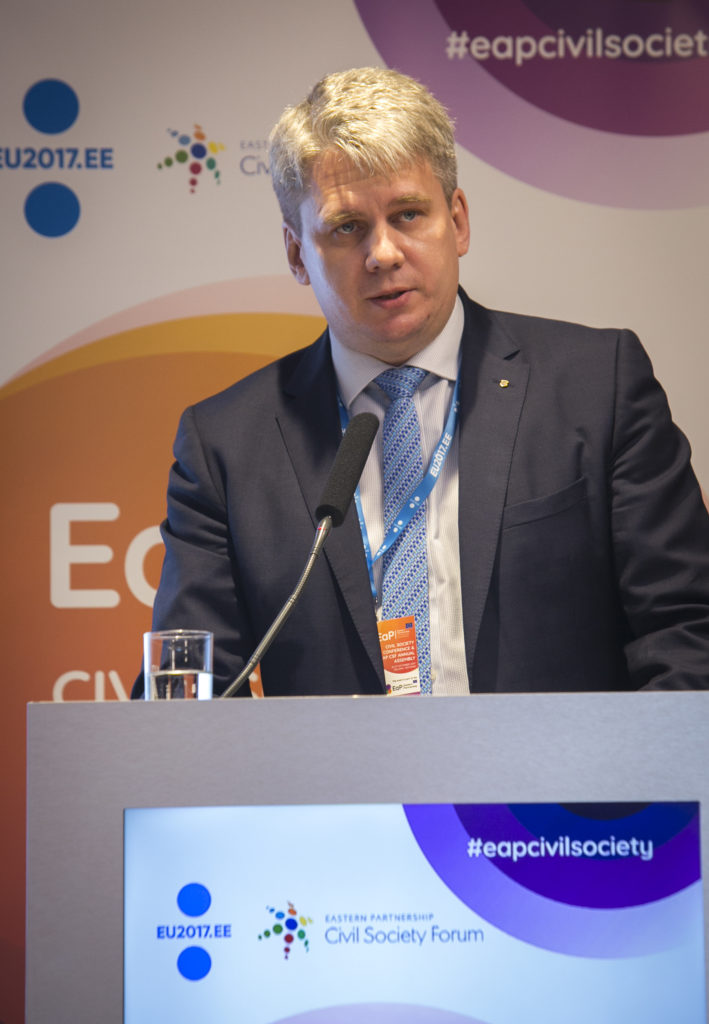
The opening speech was delivered by Jaan Reinhold, Estonia’s Ambassador-at-Large for the Eastern Partnership, and Hennadiy Maksak, Co-Chair of the EaP CSF Steering Committee, the alumnus of the Ukrainian School of Political Studies.
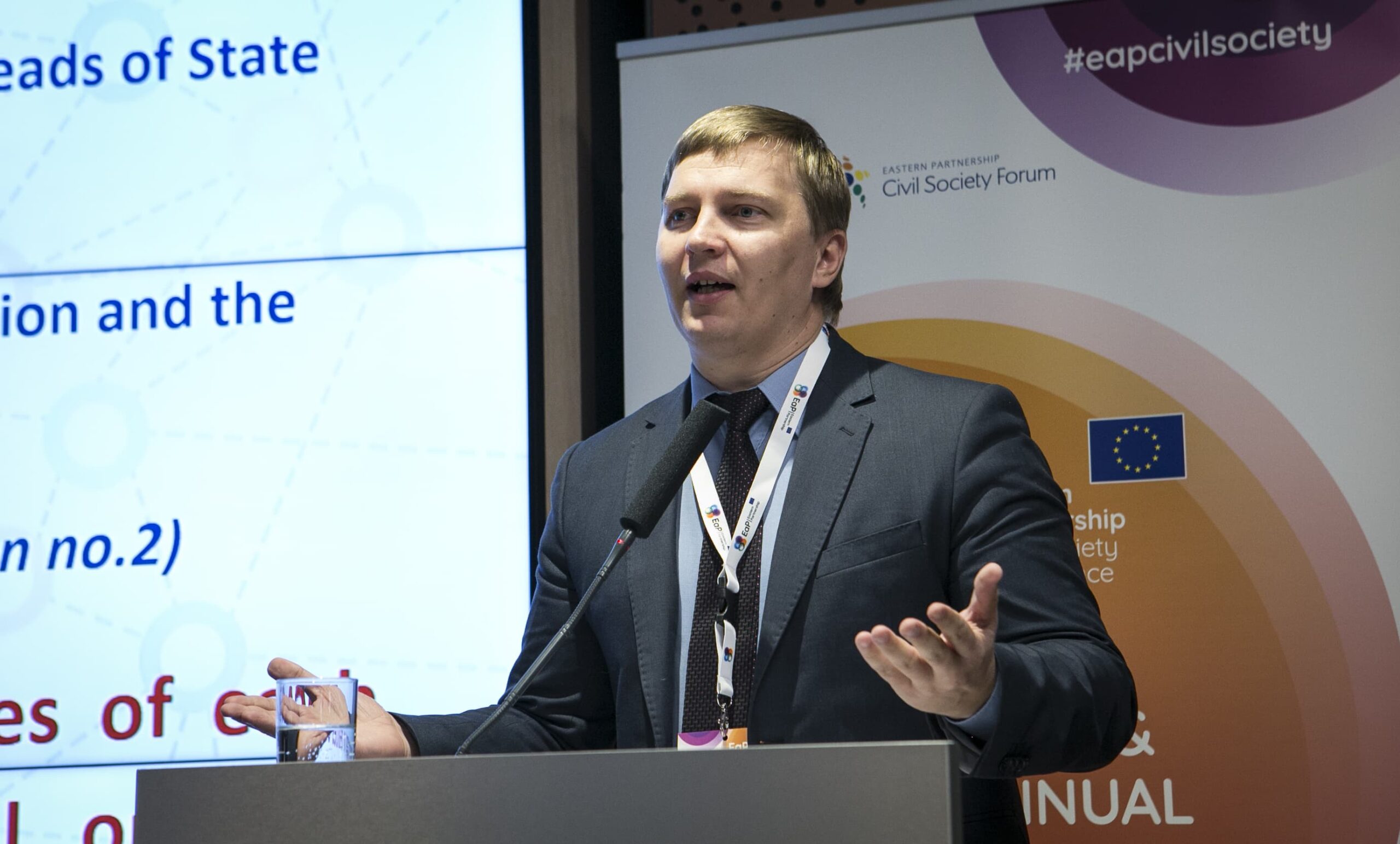
Hennadiy Maksak emphasized that the 9 years of the Forum’s work confirmed that it was an effective instrument for a multilateral dialogue between the EU, the governments of the Eastern Partnership countries and civil society. Public activists significantly contribute to overcoming regional challenges: fighting corruption, promoting respect for human rights and defending democratic values.
The first day of the Annual Assembly was devoted to outlining the agenda of the entire event. The greatest attention was paid to the cooperation of governments and civil society in the Eastern Partnership countries, which was discussed at the first plenary session. During the session, a number of issues were raised: the prospects of regional and economic integration; media and misinformation in the media; digital instruments as a means of democratic governance. Marian Lupu, Co-President for the Eastern component of the Euronest PA, Kakha Gogolashvili, member of the Steering Committee of the EaP CSF, and Diana Jablonska, representative of the EC Directorate General for Neighborhood and Enlargement Negotiation, expressed their opinions on mechanisms to strengthen and broaden civil society involvement in policy development in the Eastern Partnership region.
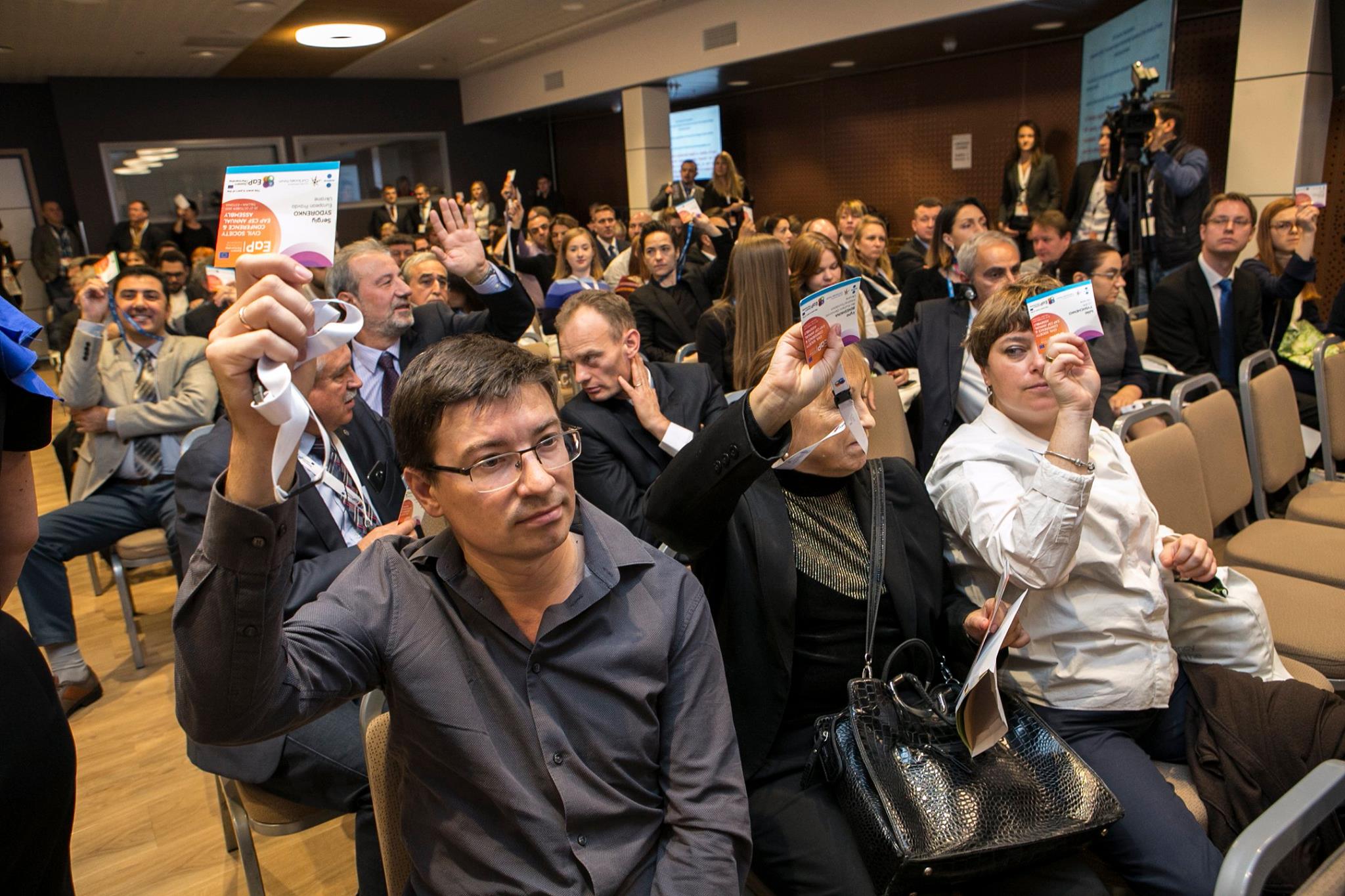
Working groups discussed the achievements of all national platforms of the Eastern Partnership Civil Society Forum, as well as the goals set in “20 Key Deliverables for 2020 for the Eastern Partnership”.
The first day culminated in the adoption of the Declaration of Civil Society. However, the Ukrainian and Georgian delegations opposed certain paragraphs of the Declaration concerning the presence of independent Russian media in the media sphere of the partner countries. Since the rules of procedure did not allow to introduce changes on the voting day, the consensus was reached via a separate opinion to the Declaration added by the delegations of Ukraine and Georgia: “Given the Russian-Georgian conflict and the Russian-Ukrainian conflict, the Russian occupation of the territories of the region and the enormous influence of the Russian media in the hybrid warfare, and taking into account the regulations of our countries, our delegations insist that the relevant paragraph should not apply to Georgia and Ukraine.”
The second day began with the ceremony of EaP CSF Pavel Sheremet Journalism Award. Last year, the award went to Mykola Semena, and this year the winner is the imprisoned Azerbaijani journalist Afghan Mukhtarli, who was kidnapped in Georgia during protests. Afterwards, representatives of the EaP CSF Steering Committee Hennadiy Maksak and Haykuhi Harutyunyan presented the adopted Civil Society Declaration upheld by 130 organizations from partner countries.
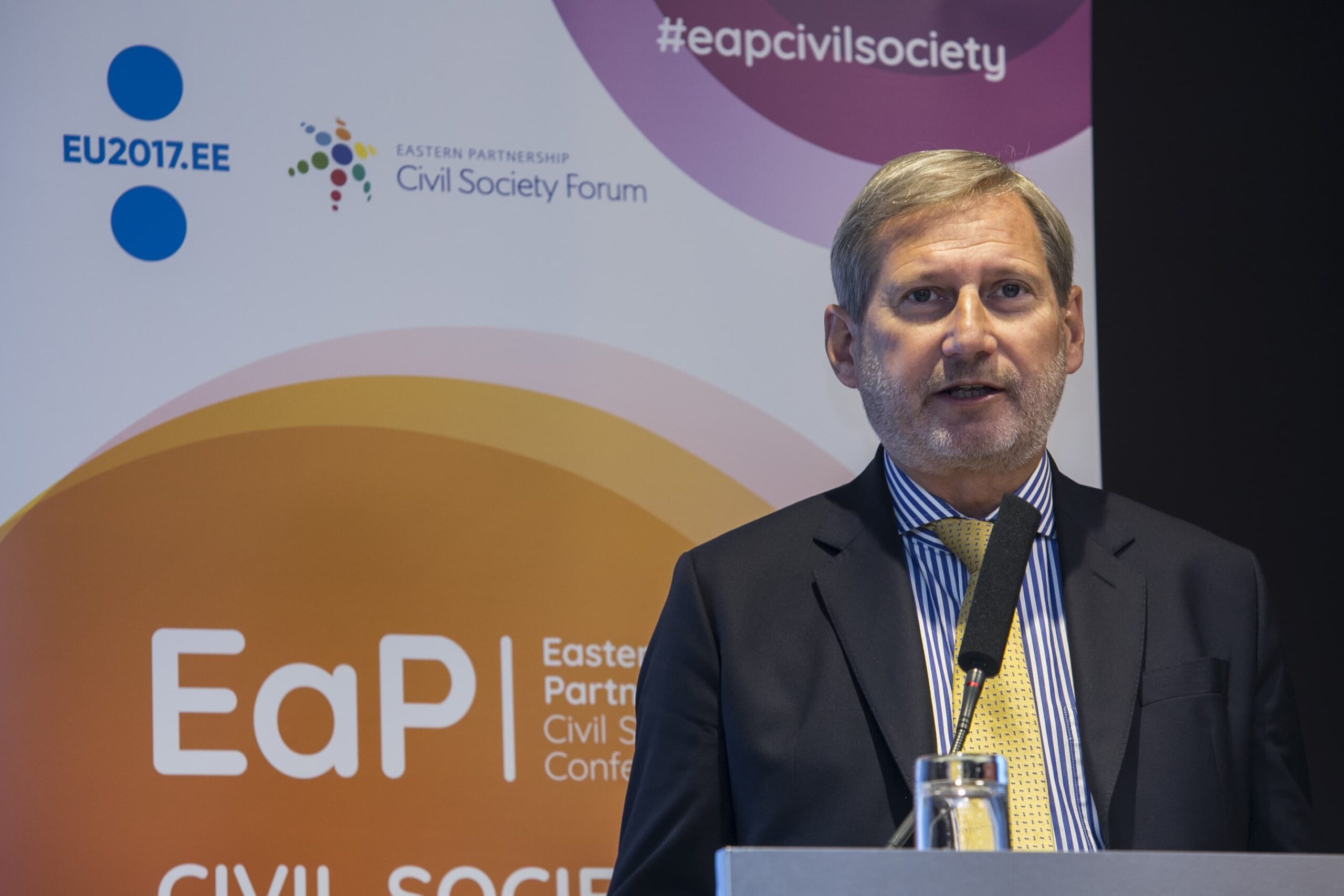
In his speech, Johannes Hahn, Commissioner for European Neighborhood Policy & Enlargement Negotiations, mentioned the achievements of Ukraine, Georgia, and Moldova in fulfilling their commitments under the Association Agreements and outlined plans for cooperation with other partner countries. The Commissioner also noted that “20 Key Deliverables for 2020 for the Eastern Partnership” could be viewed as a roadmap aimed at achieving the set goals and observed that the European Union and civil society had high mutual expectations: civil society had its vision of cooperation discussed at the Brussels Summit, while the European Union expected the maximum awareness of the population of partner countries, as well as close cooperation with a wide range of European institutions.
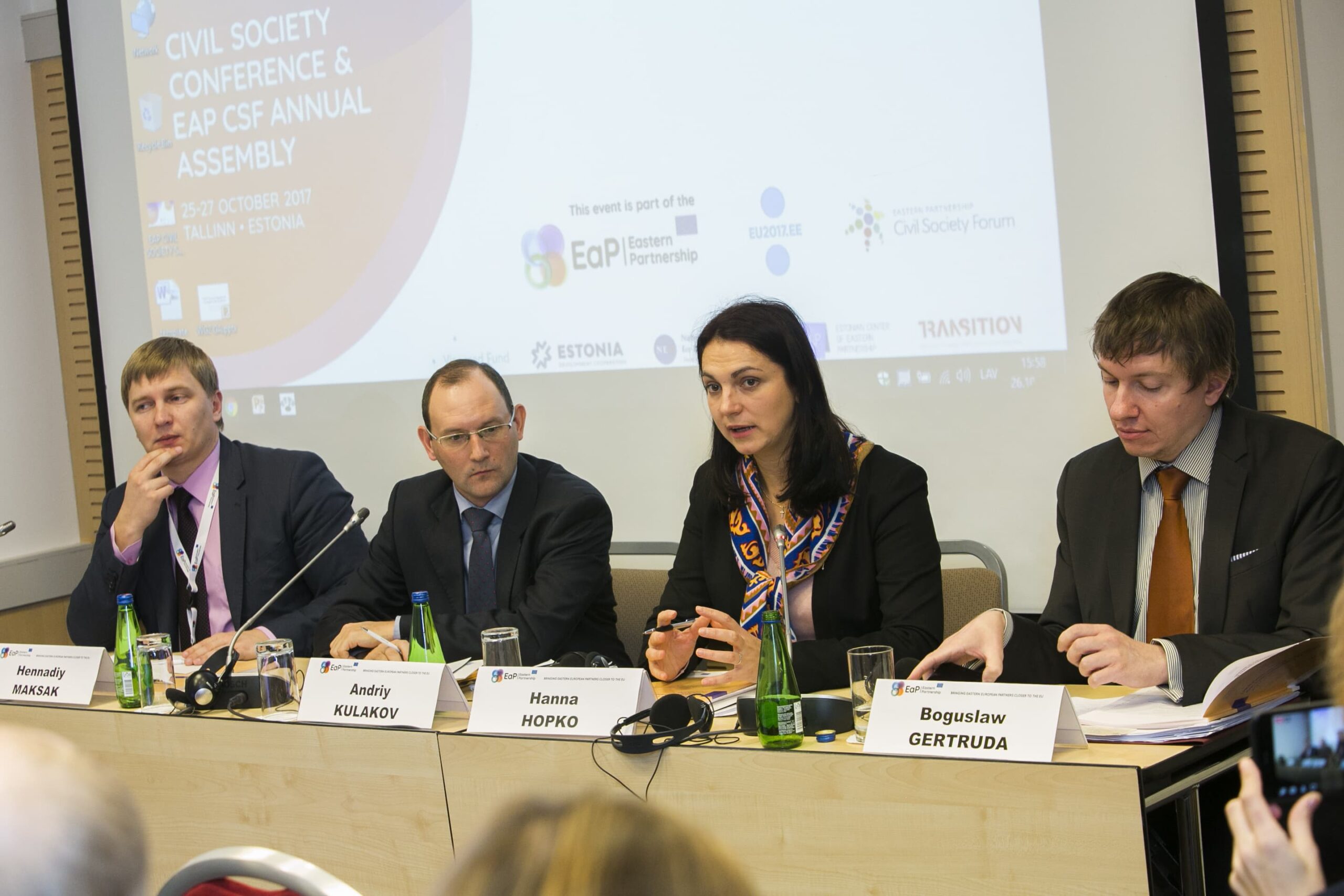
After several parallel discussions that were thematically distributed by working groups, the Ukrainian National Platform of the EaP CSF presented a study entitled “Ukraine in the Coordinates of the Eastern Partnership 2017-2020”, where UNP experts assessed the relevance and feasibility of the 20 deliverables and identified the priorities for Ukraine. The discussion was attended by Hennadiy Maksak, National Coordinator of the UNP, Hanna Hopko, Head of the Committee on Foreign Affairs of the Verkhovna Rada of Ukraine, and Bogusław Gertruda, Team Leader for Ukraine, Eastern Partnership Bilateral Division, European External Action Service. All the participants of the discussion agreed that without active participation and support of civil society, none of the reforms, including medical, pension and educational reforms, could succeed. The participants identified the key areas of sectoral cooperation, i.e. strengthening the energy component and security of the EU’s eastern borders.

The second day of the Annual Assembly concluded in the election of EaP CSF national platform coordinators and EU EaP CSF coordinators. The Ukrainian delegation unanimously elected Hennadiy Maksak Ukrainian National Platform Coordinator of EaP CSF.
The last day was devoted to discussing the EaP CSF strategy for 2018-2020, namely the importance of its advocacy function and organizational reform. However, because of the lack of a quorum, none of the documents was adopted, therefore the Working Groups will work on them during the year and vote remotely.
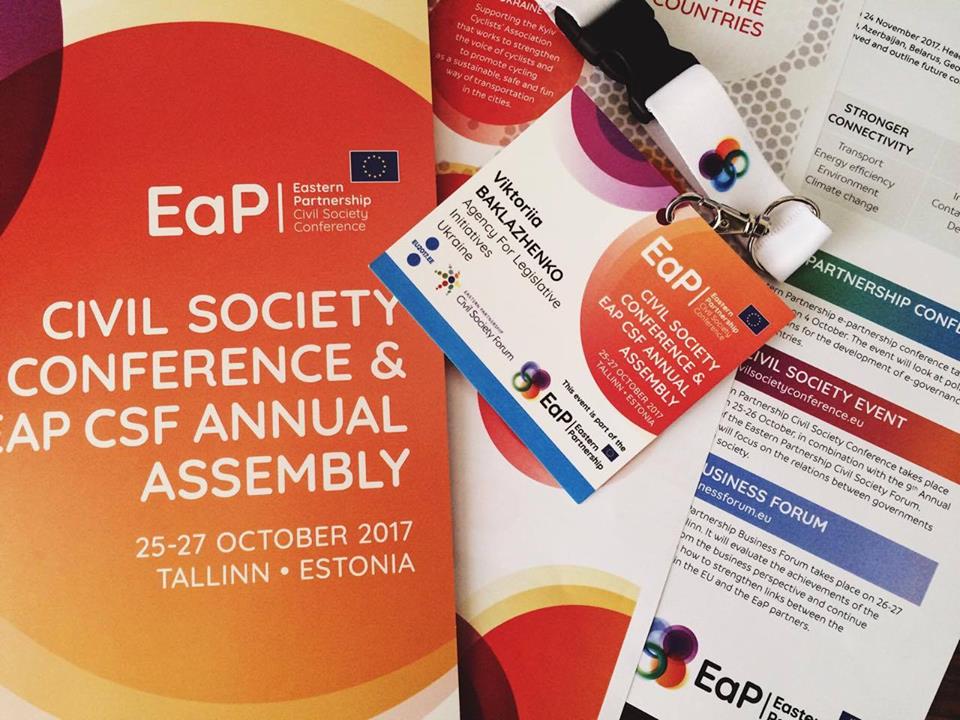
Photo: Civil Society Forum
Town Hall Meeting in Volnovakha on DoTeBe TV channel
Town Hall Meetings provide a platform for competent and effective discussion of any specific issues of public interest; it is a tool for ensuring citizens’ participation in governance. Town Hall Meetings are intended to highlight the role of public voices in the decision-making process by giving policy-makers opportunities to receive feedback from the public on key public issues.
DoTeBe TV channel on the Town Hall Meeting in Volnovakha organized by the Agency for Legislative Initiatives involving representatives of the youth centers of Donetsk region, young people of Donetsk region, Dmytro Lubinets, MP, and Oleksandr Yarema, Deputy Minister of Youth and Sports.
The event was organized by the Agency for Legislative Initiatives together with the Interns’ League and the Ministry of Youth and Sports of Ukraine on the initiative of Dmytro Lubinets, MP of Ukraine, in the framework of the Model District Project, supported by the USAID Rada Program: Responsible Accountable Democratic Assembly, implemented by the East Europe Foundation.
Town Hall Meeting on the Topic of “Strategies for the Development of Youth Policy in Donetsk Region”
The event was organized by the Agency for Legislative Initiatives together with the Interns’ League and the Ministry of Youth and Sports of Ukraine on the initiative of Dmytro Lubinets, MP of Ukraine, in the framework of the Model District Project, supported by the USAID Rada Program: Responsible Accountable Democratic Assembly, implemented by the East Europe Foundation.
The discussion took place in the Town Hall Meeting format, which implies competent and efficient discussion of any specific issues of public interest and serves as a tool for citizen participation in governance. Town Hall Meetings are intended to highlight the role of the public voice in the policy decision-making process by providing feedback from the public on key issues of public interest.
During the event in Volnovakha, we piloted a web app for holding Town Hall Meetings, developed by the Agency for Legislative Initiatives. This web app is designed to facilitate handling information both during the process of discussion, and during processing and analysis of data. Information is better structured and easier to perceive, which improves the level of discussion. The web app helps you quickly process and display voting results on monitors; it also summarizes discussion results in a download-friendly format for their further analysis and processing.
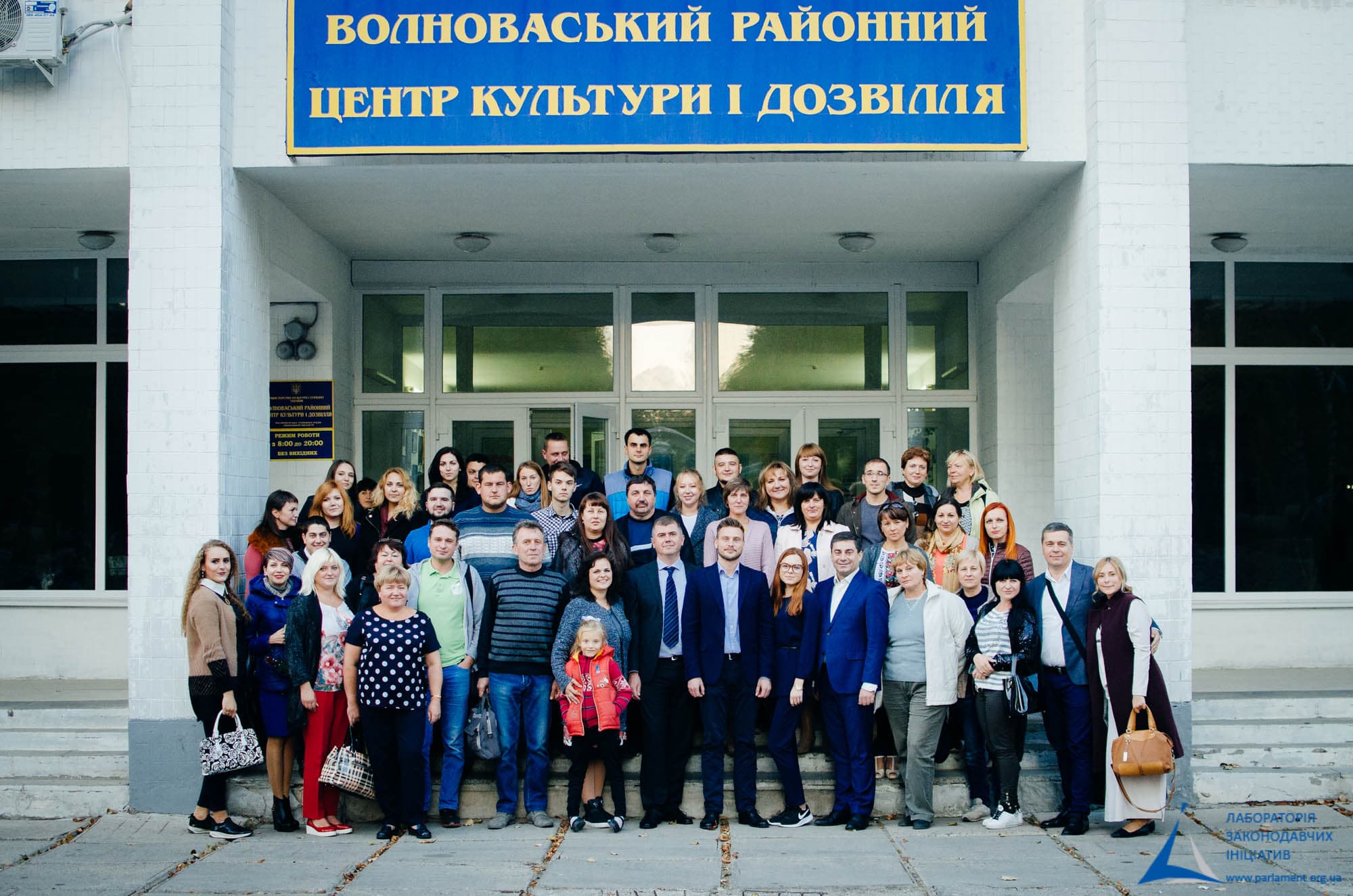
The event was attended by more than a hundred representatives of Donetsk oblast youth centers, representatives of the towns of Nikolske, Mangush, Dobropillya, Kramatorsk, Druzhkivka, Slovyansk and other towns of Donetsk oblast, students, and activists.
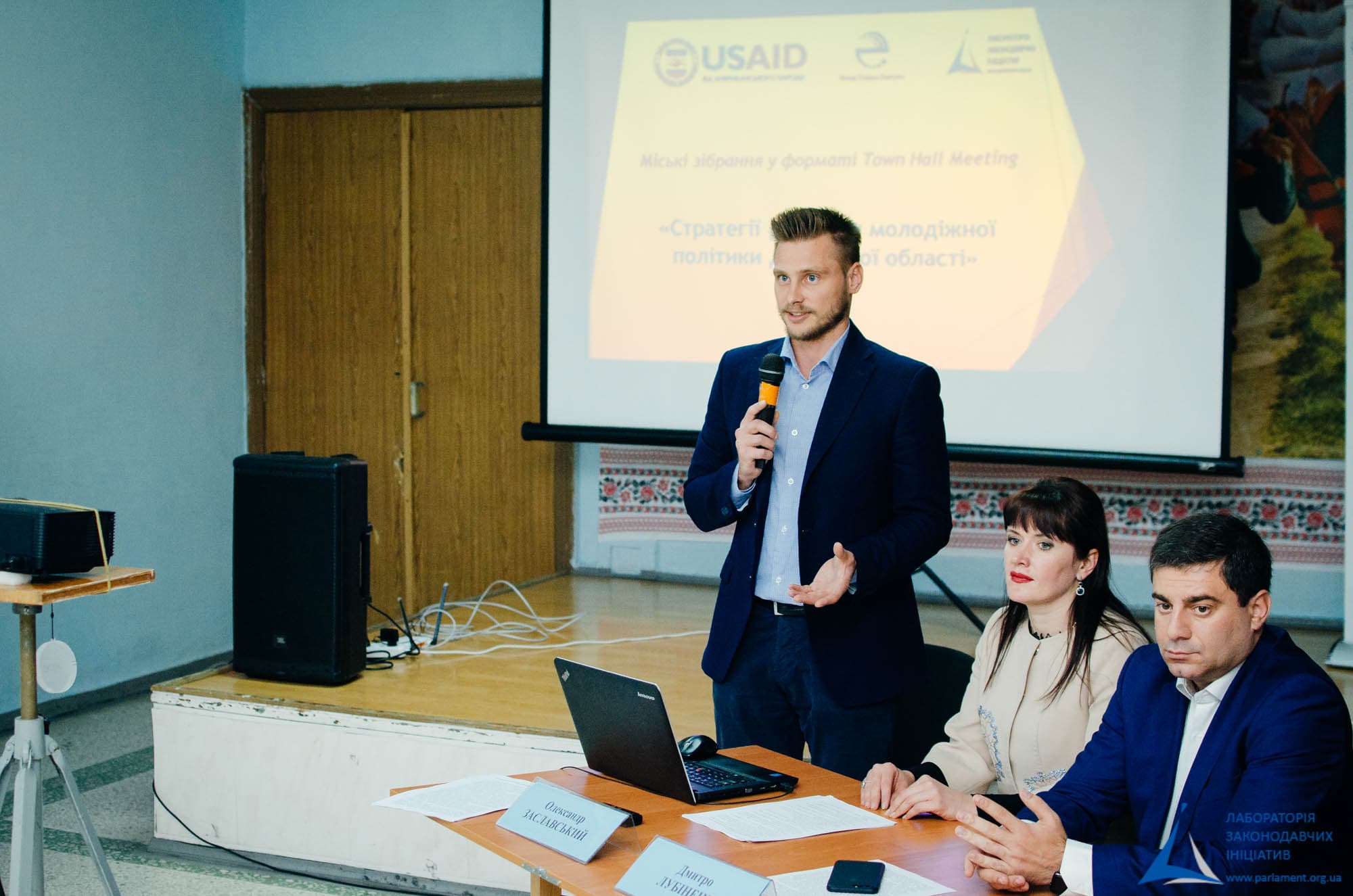
Photos by Oleksandr Kovalenko
Oleksandr Zaslavskyi, Deputy Chairman of the Board of the Agency for Legislative Initiatives, emphasized the advantages of the Town Hall Meeting format compared to other formats of public gatherings:
“First of all, this format gives everyone an opportunity to speak and be heard – it is a structured discussion. Secondly, the format involves the adoption of a decision – you will have the opportunity to vote for one of the options. Thirdly, the decision is made on the basis of preliminary expert work – the decision you make will be based on facts and rational arguments”
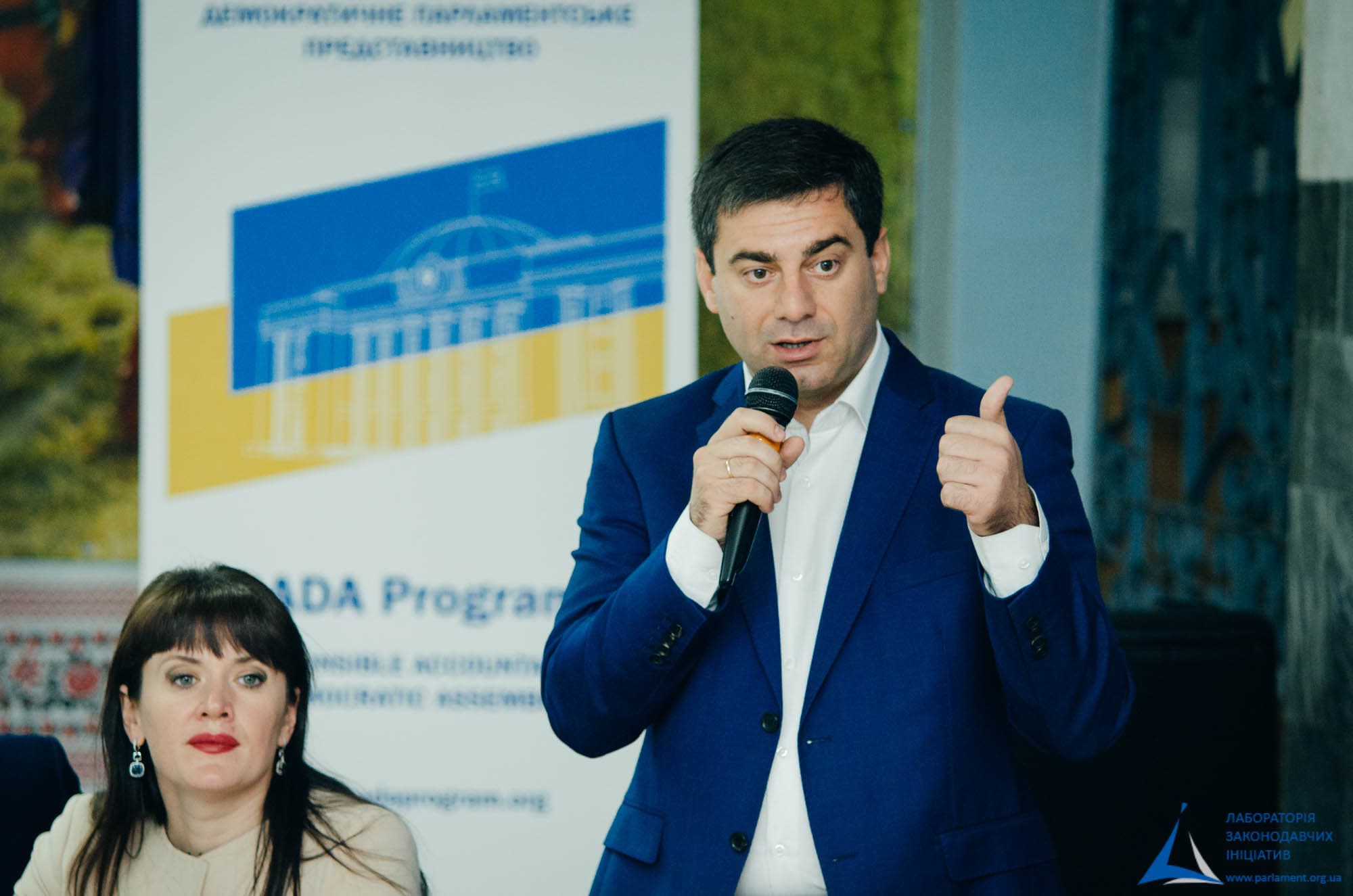
Photos by Oleksandr Kovalenko
Dmytro Lubinets, MP of Ukraine, said that the idea of addressing the youth is really a proper one. Because it is young people who will develop Donetsk region and influence the whole of Ukraine. It is appropriate that changes and initiatives should come from the youth on the ground; they are much better aware of their needs than MPs. Often MPs vote for a decision without clearly understanding how it will work and without understanding the problems of people who will then fulfil these decisions. The Town Hall Meeting format makes it possible to directly hear the opinion of people and make it known to decision-makers who have to vote.
What is the main problem of the events spawned in 2014? The problem is that nobody ever tried to develop civil society, public organizations, or youth movements in Donetsk region.
The example of young people working in “I am Volnovakha” fund demonstrates how by developing themselves they develop their town and region as a whole. The increase in the number of such towns, active involvement of youth, and development of civil society will contribute to the advancement of Donetsk region and the whole of Ukraine.
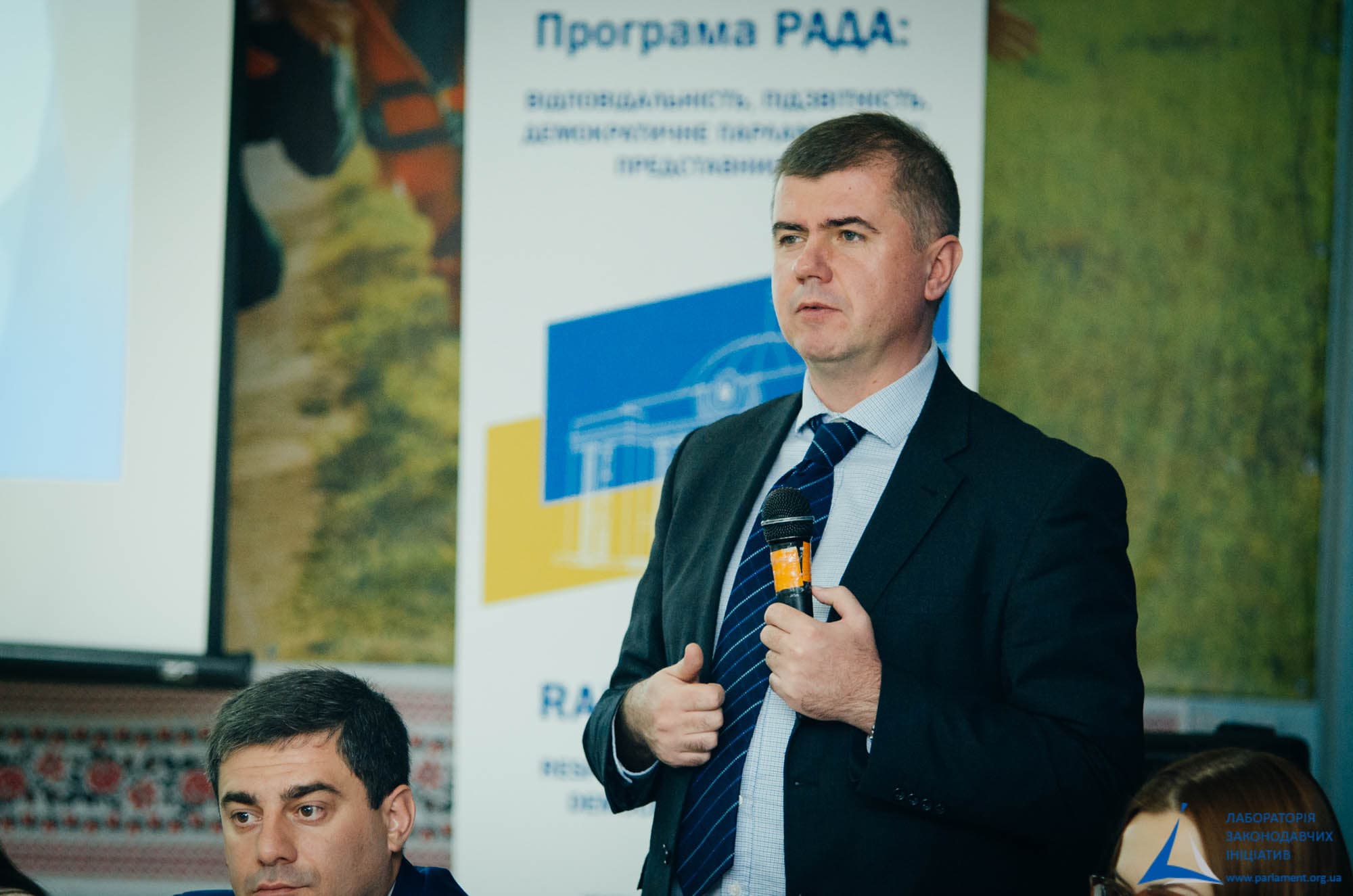
Photos by Oleksandr Kovalenko
Oleksandr YAREMA, Deputy Minister of Youth and Sport of Ukraine, emphasized the importance of establishing partnership relations with civil society. Only through such cooperation can we build something reliable, durable, and at the same time really interesting and needed for young people. A youth center should be a friendly space. It should work when young people need it; it should generate interesting ideas and initiatives that would attract young people, and make young people feel at home there.
The slogan of the Agency for Legislative Initiatives is “Think and act ahead of time”, and the Agency is ahead of time working to establish communication between MPs and civil society, which provides a solid foundation for further understanding and cooperation.
The most important thing is to strengthen horizontal relationships. The youth of all regions has to meet in different formats, on different platforms, and in different venues. It is important that the country develop, move ahead, and establish a better understanding between young people. It is very important that youth spaces become growth points for the region spawning new youth initiatives, new organizations, new ideas, points of view, etc.
“We have a lot in common. We just have to talk about these things, plan ahead together, and outline the steps that will help us move faster and faster”

Photos by Oleksandr Kovalenko

Participants of the Town Hall Meeting “Strategies the for Development of Youth Policy in Donetsk Region” discussed two issues: 1) institutionalization of youth centers, 2) organization of communication between youth centers of Ukraine.
When discussing the institutionalization of youth centers, the participants reviewed four scenarios: the first one involved creation of a municipal youth center (in the youth sector); the second ran on the establishment of a youth center under an NGO with financing from the local budget; the third scenario implied the creation of a youth center as a structural subdivision of an existing municipal educational, cultural, etc. institution; the fourth scenario was about setting a youth center by developing and implementing a project (based on a public initiative).
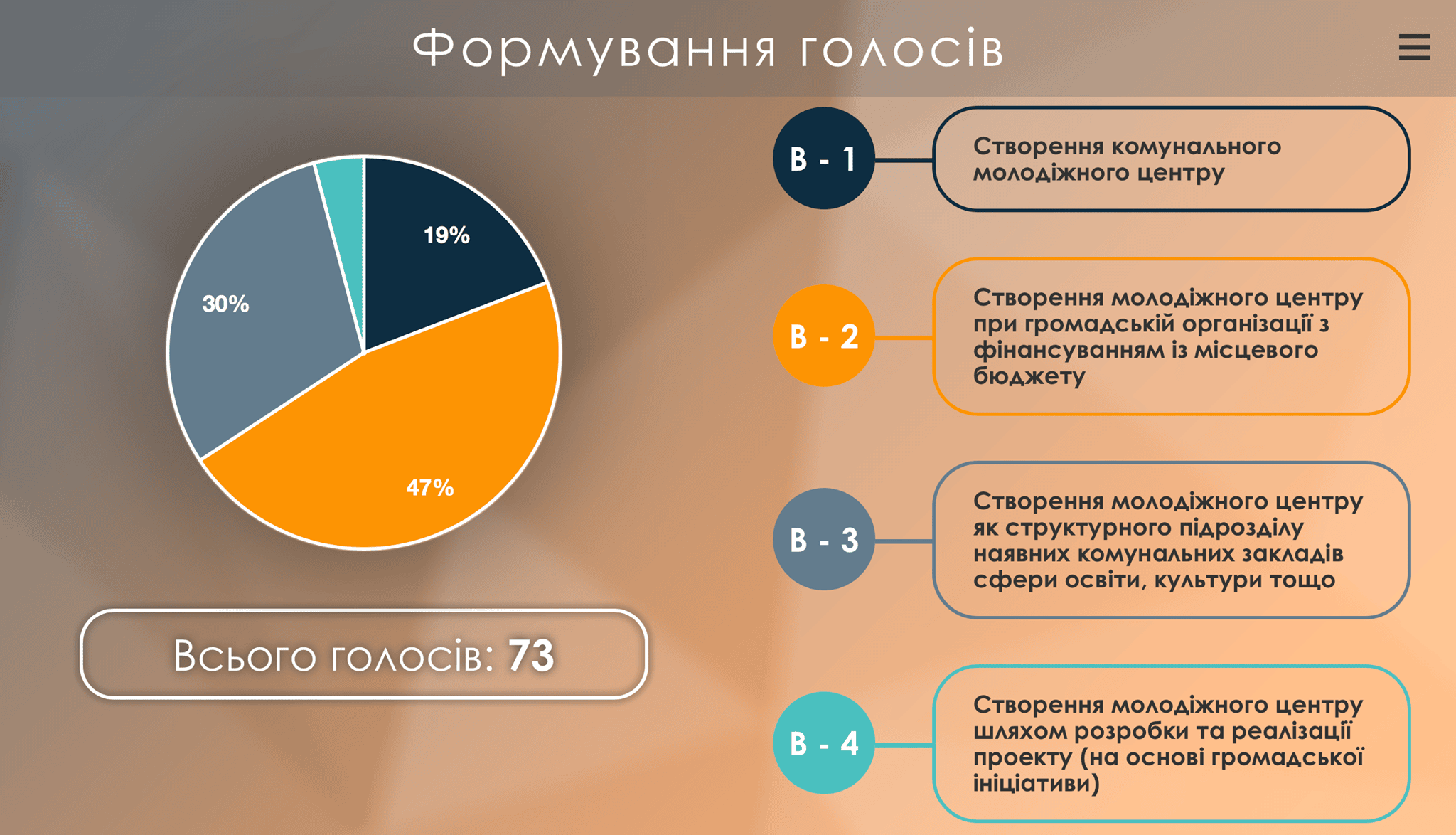
The results of the voting were as follows: the first scenario scored 19% of votes; the second amounted to 47%; the third scored 30%; the fourth numbered 4%. Thus, almost half of the participants of the discussion chose the option of creating a youth center under an NGO with financing from the local budget.
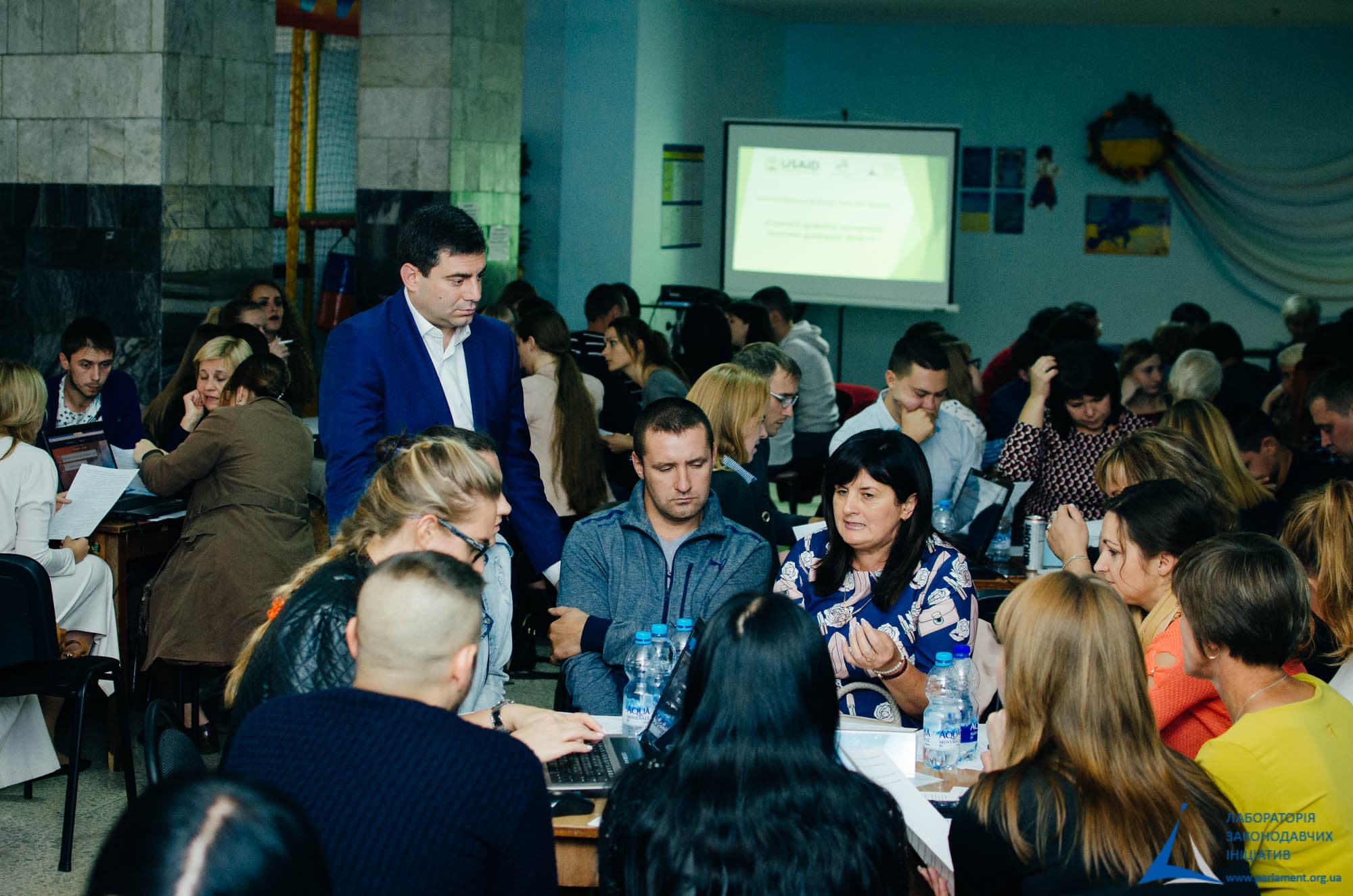
Photos by Oleksandr Kovalenko
Discussing the problem of organizing communication between youth centers of Ukraine, the participants reviewed 4 scenarios, the first of which implied establishment of a coordination council under the Ministry of Youth and Sports of Ukraine; the second suggested creation of an all-Ukrainian public organization of employees and activists of youth centers; the third was about establishing a professional communication network based on an Internet platform, website (volunteer initiative); the fourth involved creation of the institution entitled National Youth Center functioning as an organizational and methodological center of the network.
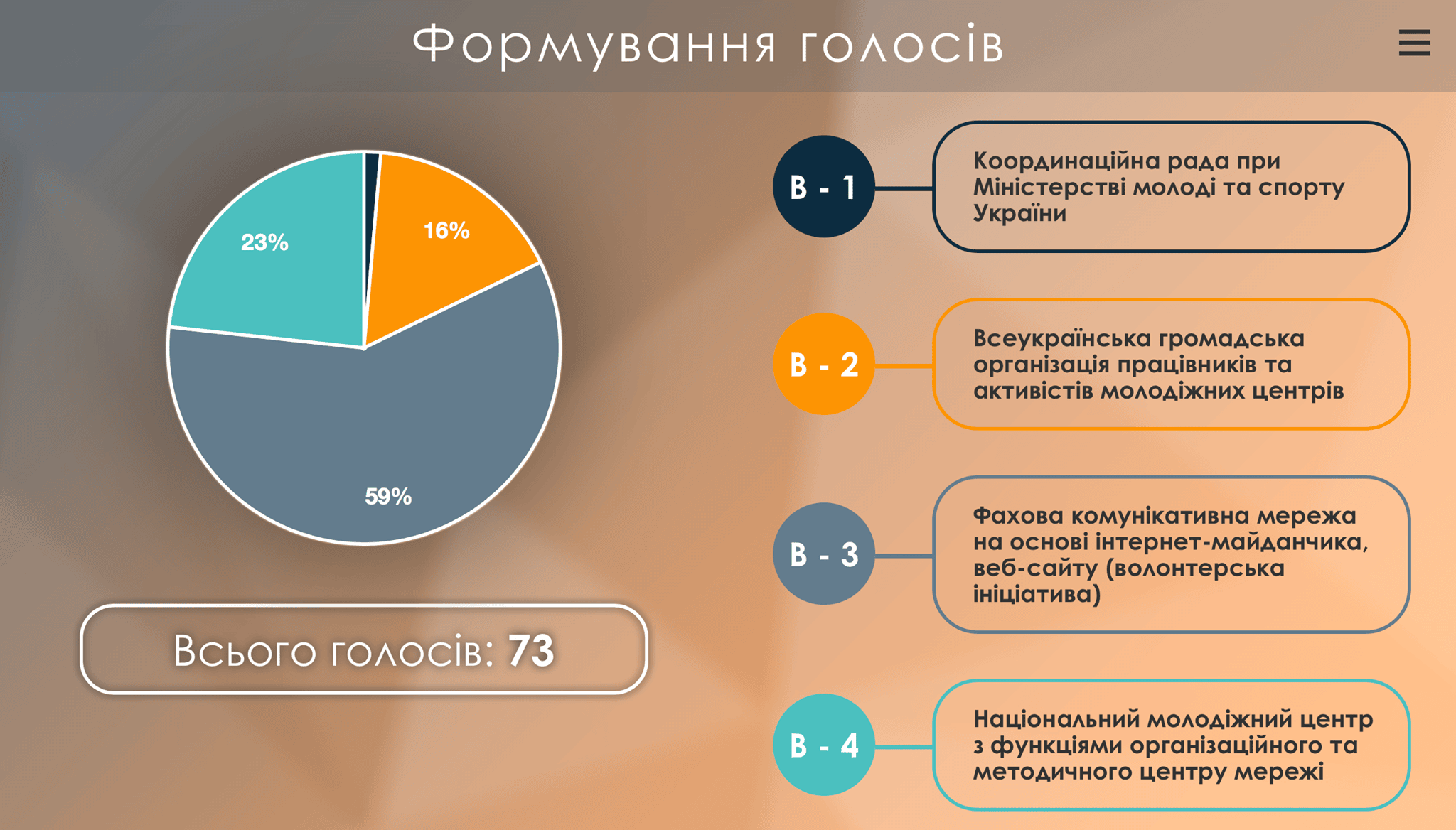
After the discussion, the participants voted in the following way: the first scenario scored 2%, the second scored 16%, the third amounted to 59%, and the fourth nembered 23%. Thus, more than half of the participants of the discussion preferred the third option, which involves the establishment of a professional communication network based on an Internet platform, website (volunteer initiative).
The results of town hall meetings carry no legal weight. The decisions approved within this discussion will be implemented by Mr Lubinets within his powers and capabilities as an MP.
Advocacy and its Aspects in Working with Parliament
During 2015 – 2016 the Agency for Legislative Initiatives supported the advocacy campaigns of the Reanimation Package of Reforms groups, in particular: “Pension Reform”, “Tax Reform”, “Health Care Reform”, and “Policy of National Memory”.
To support the campaigns a number of trainings and consultations on policy analysis were conducted and assistance in establishing communication with the parliament was provided through such tools as preparation and presentation of shadow reports and policy proposals, as well as discussing advocacy groups initiatives in the regions.
The guidelines aim to systematize and present existing experience in planning and holding advocacy campaigns. The proposed publication contains step-by-step instructions and strategies for civil society institutes on how to build effective communication with public authorities.
The guidelines aim to strengthen the civil society organizations’ skills in planning and implementing advocacy campaigns. To achieve this goal the guidelines explain what advocacy is and how it differs from lobbying; consider advocacy support for public policy implementation; teach the techniques of building coalitions and interaction with partners in advocacy campaigns; explore the main strategies of advocacy campaigns informational support, work with media and social networks, community and organization of protests of direct action; study the aspects of parliamentary advocacy and examples of successful parliamentary advocacy campaigns.
The preparation and presentation of analytical materials is part of a project implemented by the Agency for Legislative Initiatives within the framework of the USAID RADA Program: Responsible, Accountable, Democratic Assembly implemented by the East Europe Foundation.