Agency for Legislative Initiatives supports the people of Belarus
Ukrainian School of Political Studies and Agency for Legislative Initiatives support the people of Belarus, who have rebelled against the authoritarian regime, political repression, unfair elections, and government violence.
In recent days, the whole world has witnessed unacceptable human rights violations in Belarus against citizens who have shown their civil position and disagreement with injustice. The people of Belarus have the right to free democratic elections and peaceful protest – and we support their desire to defend these rights.
Belarus is the only territorially European country that is not a member of the Council of Europe. The authoritarian regime of the country significantly inhibits civil society development and the formation of a new generation of democratic leaders.
In 2007, the Ukrainian School of Political Studies helped create the Belarusian program – East-European School of Political Studies. It still exists, recruiting new participants to the program annually, creating conditions for the emergence and development of civil society in Belarus. However, most of the East- European School of Political Studies seminars are held outside Belarus. After all, the fundamental democratic principles – life as the highest value, freedom, the rule of law – have been ignored by the authorities. Everyone who has the courage to disobey the dictatorial regime is now in danger.
We believe that the people of Belarus can change this. We believe that values, principles, unity, and justice will prevail.
“Ukraine is a state whose people have forced themselves to respect themselves, proved that the government must either respect the rights of citizens or leave. Supporting people who have been able to prove that self-esteem and civic responsibility are bound to win is especially important. And their example is crucial”, – said Alexander Dabravolski, director of the East-European School of Political Studies (Belarus).
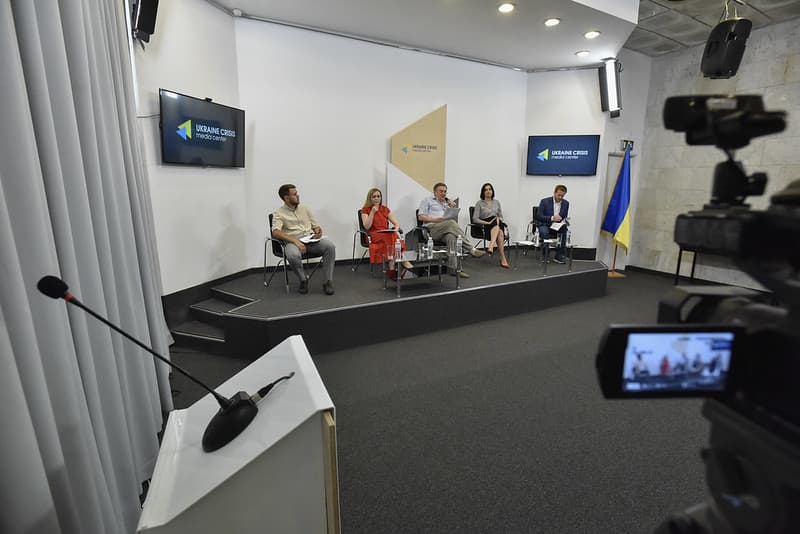
Svitlana Matviienko took part in the presentation of the expert survey “Political Quarter: Summer 2020”
On Thursday, July 30, Svitlana Matviienko, Chairwoman of the Board of the Agency for Legislative Initiatives, took part in presenting the results of the expert survey “Political Quarter: Summer 2020” conducted by the Ilko Kucheriv “Democratic Initiatives” Foundation.
During the event, the speakers discussed the main trends of the political process in Ukraine. Svitlana Matviienko spoke about the observation of the Agency for Legislative Initiatives regarding the work of the parliament and the president. We publish in full the speech of the Chairwoman of the Board of the Agency for Legislative Initiatives.
About the parliament
“There are some positive trends. However, not without a “BUT”. In the first half of the year, there was a noticeable decrease in the number of registered draft laws. That is, the amount of what Pete Cox’s Roadmap calls legislative spam or “legislative tsunami” has decreased. A total of 1,178 draft laws were registered during the 1-2 sessions of the Verkhovna Rada of the IX convocation. Accordingly, the number of registered draft laws decreased by almost a third compared to the same calendar period of the VIII convocation.
During the third session, 13% fewer draft laws were registered than during the first two sessions. Given that during the first two sessions of the IX convocation, almost a third fewer draft laws were registered than during the same period of the VIII convocation. It is tempting to talk about some dynamics of reducing the flow of draft laws. However, it is noteworthy that, along with the decrease in the number of parliamentary draft laws over the past six months, the number of registered government and presidential draft laws has also decreased. And such a synchronous decrease can rather be explained by a long socio-political lockdown during the strict quarantine.
Another positive trend. The share of draft laws adopted in the second reading has increased. In the first and second sessions, this share reached 74% compared to 38% for the same period in the VIII convocation. However, the trend was unstable, and in the third session, their share fell to 49%. We hope that this is due to the peculiarities of the work of the Verkhovna Rada during quarantine restrictions.
Along with this, consideration of draft laws started to take longer. Why is this good? Because the laws passed in the first reading and in general – almost guaranteed – will be of lower quality in terms of legal technique or will not consider all stakeholders’ positions. As a result, it will affect their implementation and effectiveness. Passing almost 75% of the approved draft laws through 2 readings (we don’t mention the third one) is at least a precaution against making people laugh (or rather resent) in a hurry.
Was there a “turbo mode”?
As for the turbo mode, which is still popular to mention among the majority. Six months ago, it was already obvious to us and all those who monitor the parliament’s work that this mode is not so “turbo”. As they say: everything is known by comparison. During the first two sessions (read six months) in the ninth convocation, 155 laws, or 13% of registered resent were adopted. In the VIII convocation for the same calendar period, 140 laws, or 9% of the registered ones, were adopted. At the same time, we must remember that the majority began to pass laws (including on amendments to the Constitution) on the first day, immediately after the opening ceremony, and taking the oath. While the MPs of the VIII convocation spent at least the first month on negotiations, working out a coalition agreement and forming the government. So, forget about the turbo.
We did not compare the 3rd session of the ninth convocation with the same period of the VIII session, because this would be irrelevant given the extraordinary circumstances in the form of strict quarantine. The parliament lost two working months.
About negative tendencies
During the first two sessions, it was noticed that the percentage of adopted laws, the subject of the legislative initiative of which is the government (17% vs. 35% in the VIII convocation) decreased. This trend may indicate a weakening of the role of government in shaping public policies. It also harms the principle of unity of decision-making.
During the 3rd session, the share of the accepted governmental projects is insignificant. Only 7 government draft laws were passed. Is this because the government has a weak position in policy-making, completely subordinate to the President’s Office? Or is it because the government does not see a need to be an independent player, instructing MPs to register the necessary draft laws? Both possible explanations are disappointing. There is a clear distortion of the constitutionally established system of checks and balances against the concentration of powers in one power entity in Ukraine. However, the tendency to weaken the government in the decision-making system is contrary to global trends.
How did the president work?
Volodymyr Zelensky, of the last four presidents, registered the largest number of draft laws in his first year – 76 (or 4% of all registered this year). His predecessors exercised the right of legislative initiative, respectively: 48 times – Poroshenko, 39 – Yanukovych, 50 – Yushchenko. The relative share of legislative initiatives of other presidents was not more than 2%. At the same time, the rate of adopted presidential draft laws during Zelensky’s first year of a presidency is twice lower – 38% – compared to previous presidents, where the share of adopted laws ranged from 76% to 82%. This situation is rather strange because the president had his “mono-majority” in parliament for the most calendar year, which became a unique situation in Ukrainian history. Given the frequent personnel changes during the year, as well as the results of a study by the Sociological Group “Rating”, this situation may indicate the active use of the model “good President – bad MPs / officials”, which in turn, leads to a positive image only of the president. Although it no longer helps. Another explanation may be that the “Sluga narodu” party was formed virtually and from people who were not connected with politics in any way before the election. After a while, this affected the weak factional discipline and led to multiple divisions.
According to Article 94 of Ukraine’s Constitution, the president must within 15 days sign the law adopted by the Verkhovna Rada or return it with his proposals. The average rate (median) of signing bills by Zelensky was 9 days, which is the fastest rate among Ukrainian presidents. For the rest of the presidents, this figure was 15 days. However, some of the laws were signed in violation of the 15-day deadline. Thus, Zelensky signed 13% of all adopted laws in violation of the deadline (for other presidents, the figure ranged from 8% to 17%). And while for many, such a violation may seem insignificant, it is still a direct violation of the Constitution, which may be grounds for declaring laws unconstitutional. It is also worth mentioning the situation with three draft laws that Volodymyr Zelensky “inherited” from Petro Poroshenko: №0975, №0976, №0977. These draft laws were neither signed nor vetoed by the new president for much more than 15 days, which directly violated the Constitution. Zelensky dragged on time until the new parliament was elected to prevent these laws from being passed”.
You can read more about the work of the parliament and the president of Ukraine in the other articles of the Agency for Legislative Initiatives.
Oleksandr Zaslavskyy on the amendments to the Constitution proposed by the current government
The Constitution of Ukraine was adopted 24 years ago, on June 28, 1996. Since then, every president has been trying to change it – to improve it for citizens or for themselves?
The sixth president of Ukraine, Volodymyr Zelensky, is no exception. On the contrary, he submitted the largest draft laws on amendments to the Constitution among all Ukrainian presidents.
This is confirmed by a study conducted by the Agency about the first year of Volodymyr Zelensky’s presidency.
Some of the president’s initiatives have already been accepted the Verkhovna Rada.
What is right – to constantly change the Constitution? And can this be a risk for the state?
Oleksandr Zaslavskyy, Director of the Analytical Department of the Agency for Legislative Initiatives, helped to understand the nuances for Channel 24.
“They (draft laws, -– Agency) can be described as unsystematic. These are the draft laws that were drafted quite closed, which affected their legal quality”, – commented Oleksandr Zaslavskyy on the president’s proposed amendments to the Constitution.
See the video for details.
“Unlike the Others”: Analysis of the First Year of Volodymyr Zelensky’s Work
From the very beginning of the election campaign, Volodymyr Zelensky positioned himself as a “non-systemic” candidate, and while already in office, at least in the media discourse, he tried to maintain such an image. However, the president is not only a media actor but also a subject of legislative initiative and a critical element of the system of power, the system of checks and balances. The president has his powers, clearly defined by the Constitution. He exercises these powers to a large extent, not independently, but in cooperation with the Government and the Parliament. Did the president manage to become “different from the old politicians” in terms of interaction with other subjects of the legislative initiative in the first year? The answer to this question can be given by the analysis of the legislative activity of Volodymyr Zelensky in comparison with his predecessors.

It is necessary to right away make a remark about the correctness of the analysis of the calendar year of the president’s work, as the head of state exercises his powers in cooperation with the parliament. At the same time, Volodymyr Zelensky received “his” Parliament and Government not immediately, but only at the end of August 2019. It should be reminded here that Ukraine is a parliamentary-presidential republic. The key role in Ukraine, according to the Constitution, is played by the parliament. It “determines the principles of domestic and foreign policy” (paragraph 5 of Article 85) and forms the government, which, in turn, ensures “the implementation of the domestic and foreign policy of the state, the implementation of the Constitution and laws of Ukraine, acts of the President of Ukraine” (paragraph 1 of Article 116). That is, the President of Ukraine, as a “guarantor of state sovereignty, territorial integrity of Ukraine, observance of the Constitution of Ukraine, human and civil rights and freedoms,” exercises his powers regardless of the presence or absence of “his” Parliament and Government. Besides, previous presidents have started their first year from diverse positions. Therefore, in our opinion, it is quite relevant to analyze the results of the work of the president’s calendar year, as well as to compare them with the “predecessors”.
President in the legislative process: illusory efficiency
The relationship between the president and the parliament can be discussed in different areas. The most interesting dimension, of course, is the degree of the president’s influence on parliament, but often such considerations are based on facts that are difficult to verify. Instead, we tried to analyze the president’s participation in the legislative process, based on formal indicators, and compare the indicators with previous presidents: with Petro Poroshenko, Viktor Yanukovych, and Viktor Yushchenko.
The right of legislative initiative
Zelensky, of the last four presidents, registered the largest number of bills in his first year – 76 (or 4% of all registered this year). His predecessors exercised the right of legislative initiative, respectively: 48 times – Poroshenko, 39 – Yanukovych, 50 – Yushchenko. The relative share of legislative initiatives of other presidents was not more than 2%. At the same time, the rate of adopted presidential bills of Zelensky is twice lower – 38% – compared to the previous presidents, where the share of adopted ranged from 76% to 82%. This situation looks rather strange because the president had his “mono-majority” in parliament for most of the calendar year, which became a unique situation in Ukrainian history. Given the frequent personnel changes during the year, as well as the results of the survey of the Sociological Group “Rating”, this situation may indicate the active use of the model “good President – bad MPs/officials”, which leads to a positive image of the president. Another explanation may be that the party “Servant of the People” was formed virtually and from people who were not connected in any way before the election. This, after a while, affected the weak factional discipline and led to multiple divisions.
Zelensky used his veto only 12 times in the first year. And this is the lowest number among the four presidents. It is logical given the presence of support in the parliament, which previous presidents could not boast of in the first year of their work. It may also indicate a significant influence of the president on the legislative branch and the lack of polarization of views on legislative activity in the party (at least during the first months of work). Given the possible split in the “majority”, it is likely that in the coming years, the president will use his veto more actively. For comparison, during the first year of his presidency, Poroshenko used his veto power 16 times, Yanukovych 30 times, and Yushchenko 58 times (!). Interestingly, the tactics of vetoing by presidents are quite different. Thus, Yushchenko and Poroshenko periodically vetoed bills two or more times.
According to Article 94 of the Constitution of Ukraine, the president must sign the bill adopted by the Verkhovna Rada within 15 days or return it with his proposals. The average rate (median) of signing bills by Zelensky was 9 days, which is the fastest rate among presidents. For the rest of the presidents, this number is 15 days. However, some of the bills were signed in violation of the 15-day deadline. Thus, Zelensky signed 13% of all adopted laws in violation of the deadline (for other presidents, the figure ranged from 8% to 17%). And while for many such a violation may seem insignificant, it is still a direct violation of the Constitution, which may be grounds for declaring laws unconstitutional. It is also worth mentioning about the situation with three bills that Volodymyr Zelensky inherited from Petro Poroshenko: №0975, №0976, №0977. These bills were neither signed nor vetoed by the new president for much more than 15 days. Zelensky dragged on time until the new parliament was elected to prevent these laws from being passed.

President and government: have two (three)
Another illustrative aspect of the president’s work is how often and under which conditions the government changed. Apart from the prime ministers appointed before the presidency, Volodymyr Zelensky, as of the first year, has the same figures as Viktor Yushchenko (2 newly appointed prime ministers). Zelensky resembles not only Yushchenko but also Kravchuk and Kuchma in the pace of change of heads of government. They all replaced the current prime minister with a new one on 9-11 months of their presidencies.
Eternally imperfect Constitution
Analyzing the activities of Ukrainian presidents, we cannot ignore the fact that every president of the independent Ukraine tried to change the Constitution. Volodymyr Zelensky is no exception.

The first President of Ukraine is Leonid Kravchuk. For Kravchuk, the change of the Constitution of the USSR to the Constitution of Ukraine seemed logical and natural: a new state – a new Constitution. Leonid Kravchuk started working on the new Constitution before his presidency when he was the Chairman of the Verkhovna Rada. The Constitutional Commission was established. The Concept of the new Constitution was developed. However, the turbulent events of the early 1990s prevented the Verkhovna Rada of the Ukrainian Soviet Socialist Republic of the 12th convocation, which was later renamed the Verkhovna Rada of Ukraine of the 1st convocation, from adopting the Basic Law.
Leonid Kuchma continued the constitutional process, and finally, in 1996, the Constitution was adopted. However, Leonid Kuchma did not limit himself to adopting the Constitution alone. At the end of his first term, he began talking about the need to revise the Constitution, and in 2000 held an all-Ukrainian referendum on reducing the number of MPs to 300 and introducing a bicameral parliament (remember how much this initiative was used in the last election race?). However, the results of the referendum were not embodied in the amendments to the Constitution. And in 2002, against the background of a possible election loss, Leonid Kuchma initiated another reform aimed at strengthening the Verkhovna Rada by reducing the powers of the president and moving to a parliamentary-presidential model. A temporary special commission was set up, and at the end of Leonid Kuchma’s term in 2004, the relevant amendments to the Constitution were adopted.
Viktor Yushchenko took office just after the 2004 constitutional reform (which gradually came into force during 2005-2006), so, unlike his two predecessors, he did not initiate constitutional changes in the first year of his presidency. However, without constitutional changes, Viktor Yushchenko could not hold out. In 2007, the National Constitutional Council was established, headed by the president himself. Maryna Stavniychuk became its secretary. However, Yushchenko did not have enough support in the Verkhovna Rada, so he wanted to amend the Constitution through a referendum, but failed to do so. In 2009, a draft amendment to the Constitution was submitted to the Verkhovna Rada. This project, among other things, provided for a bicameral parliament and an increase in the powers of the president. In the end, without the support of the Verkhovna Rada, Viktor Yushchenko could not make any changes to the Constitution.
Viktor Yanukovych has decided not to waste his first year of presidency within the constitutional powers in force at the time, which he inherited from his predecessors. Therefore, at the hands of his fellow party members in parliament, he appealed to the Constitutional Court regarding the illegality of the constitutional changes of 2004. In the fall of 2010, the CCU (the Constitutional Court of Ukraine) declared these changes unconstitutional. At the end of the first year of his presidency, Viktor Yanukovych made his first changes to the Constitution, again using the help of the Party of Regions faction in parliament. Among the significant changes, in particular, the president managed to increase the term of office of the Verkhovna Rada and local councils from 4 to 5 years.
After that, on February 21, 2011, Viktor Yanukovych formed the Constitutional Assembly. The Head of the Assembly was Leonid Kravchuk, and the secretary was Marina Stavniychuk. The Constitutional Assembly was to work out amendments to the Constitution regarding the powers of government and local self-government. The next amendments to the Constitution were the expansion of the powers of the Accounting Chamber, which was allowed to control revenues to the state budget.
The events of late 2013 – early 2014 led to the termination of the Constitutional Assembly. That is, the Constitutional Assembly had no results in the form of comprehensive amendments to the Basic Law.
After the victory of the Revolution of Dignity on February 21, 2014, the Verkhovna Rada restored the 2004 version of the Constitution.
Petro Poroshenko also did not hesitate to amend the Constitution. Already in June 2014, he submitted a draft law amending the Constitution (on the powers of public authorities and local self-government), but he withdrew it. And in March 2015 (in the 10th month of the presidency), he set up a Constitutional Commission. This commission was to work out amendments to the Constitution in three areas:
- Decentralization.
- Justice.
- Rights and freedoms of man and citizen.
The first results of the work of the Constitutional Commission appeared in the summer of 2015. At that time, amendments were proposed to the Constitution regarding the decentralization of power (draft law № 2217a). There were intentions to change the entire vertical of power at the local level and introduce a new administrative-territorial system. However, the bill was withdrawn after the presidency passed from Poroshenko to Zelensky.
The changes proposed by Petro Poroshenko in the field of justice proved to be more productive. As a result, the following was approved:
- The High Council of Justice elects judges.
- Instead of a 5-year term, judges are elected indefinitely.
- Neither the President nor the Verkhovna Rada can dismiss judges.
- A constitutional complaint mechanism has been introduced.
- Only lawyers can defend citizens in court.
At the end of his presidential term, Petro Poroshenko initiated two more amendments to the Constitution – consolidating the course of Ukraine’s integration with NATO and the EU.
The second draft of amendments to the Constitution (draft law № 9310 on renaming the Dnipropetrovsk region, actually initiated by a group of MPs) did not receive the necessary support in the hall and was withdrawn from consideration.
Volodymyr Zelensky has not yet set up commissions or assemblies. Still, in the first year of his presidency, he has already initiated eight draft amendments to the Constitution and made changes to the Constitution initiated by his predecessor.
Petro Poroshenko introduced the bill on the abolition of parliamentary immunity, but it was considered and adopted under Volodymyr Zelensky.
Zelensky’s legislative initiatives have not yet been implemented. Some are now under consideration, and some have already been rejected. Namely – it is:
- Amendments to the abolition of the lawyer’s monopoly (draft law № 1013), according to which citizens can represent themselves in courts, except for representation in criminal cases. The bill is pending.
- Changes in regulatory bodies (draft law № 1014), under which the president will be able to form new regulatory bodies, appoint and dismiss the National Anti-Corruption Bureau of Ukraine (NABU) and the State Bureau of Investigations chairpersons. The bill was rejected.
- Amendments to the legislative initiative of the people (draft law № 1015), according to which the people are given the right of legislative initiative. The bill is pending.
- Amendments to the Commissioners of the Verkhovna Rada (draft law № 1016), which introduce the position of the Commissioners of the Verkhovna Rada of Ukraine in compliance with the Constitution of Ukraine and regulations in certain areas. The bill received a negative opinion of the Constitutional Court. It is pending.
- Amendments to reduce the number of MPs and implement the proportional electoral system (draft law № 1017), which reduces the number of MPs to 300, and the Constitution establishes a proportional electoral system. The bill is awaiting consideration, although it has received an opinion from the Constitutional Court with reservations.
- Changes to expand the grounds for deprivation of an MP’s mandate (draft law № 1027), according to which it is proposed to take away an MP’s mandate in case of impersonal voting or absence of an MP for more than a third of sittings. The bill received a negative opinion of the Constitutional Court, pending.
- Amendments to additional bodies of the Verkhovna Rada (draft law № 1028), according to which the Verkhovna Rada receives the right to establish advisory and consultative bodies. The bill received a positive opinion of the Constitutional Court, pending.
- Changes in the decentralization of power (draft law № 2598), which introduces a new structure of local government and a new administrative-territorial system. The bill was withdrawn.
Thus, in the first year of his presidency, Volodymyr Zelensky submitted the most bills on amendments to the Constitution among all Presidents of Ukraine. But it is important to note that the draft amendments submitted by Volodymyr Zelensky are particular, although some of them have repeatedly been positioned, for example, as a “parliamentary” reform.
Also, unlike his predecessors, Zelensky, at least so far, has not created bodies or open and inclusive platforms for drafting amendments to the Constitution. Legislative initiatives of the sixth President of Ukraine can be summarized as follows:
- Among all the draft laws, only the draft law that was being developed during the time of Petro Poroshenko’s presidency was adopted.
- three draft amendments to the Constitution have already received the conclusions of the CCU. They have been preliminarily approved (although the draft amendments № 1017 received the opinion of the CCU with reservations).
- one draft amendment received the conclusions of the Constitutional Court with reservations and has not yet been considered.
- three draft amendments received negative conclusions of the Constitutional Court and, therefore, cannot be adopted.
- one draft amendment was withdrawn without being considered.
Instead of conclusions
The general conclusion of the comparative analysis is that Volodymyr Zelensky, as president, is not as different from his predecessors as it may seem from media discourse. At least, the frequency of changes in the government, violations during the legislative process, as well as attempts to “quickly” change the Constitution make him similar to other Presidents of Ukraine. And the active reflection of public discontent onto other constitutional subjects evokes an analogy with Leonid Kuchma, which, as a result, is confirmed by a poll by the sociological group “Rating”.
However, the differences that still exist can be reduced to the following aspects:
- Legislative (but not very effective) activity;
- Attempts to act as fast as the procedures allow;
- Attempts to avoid deliberation (discussion) in making important decisions – in particular, about changes to the Constitution.
Which results and consequences these similarities and differences will lead to – we will see and analyze later.
Lifebuoy: How Do Ukraine’s Neighbors Support the Economy During the Corona Crisis?
Newsfeeds and TV news stories have repeatedly covered information about how the world’s first economies (USA, UK, Germany, Spain, etc.) are facing the economic crisis caused by the SARS-CoV-2 pandemic. However, when Ukrainians hear about 200 billion aid in Spain, half a trillion aid in Germany, or 3 trillion aid in the United States, these figures seem almost unrealistic. After all, the GDP of our country is about $130 billion. Spain alone has allocated funds to overcome the crisis in the amount of one and a half times the annual GDP of Ukraine. In fact, any amount allocated from developed economies to Ukraine will seem fantastic.
Therefore, we decided to take a look at how the economic consequences of the coronavirus crisis are confronted by our neighbors – those countries whose economic indicators and living conditions are more relevant for drawing analogies with Ukraine.
Types of responses to the economic crisis caused by SARS-CoV-2
This review analyzes the direct economic measures Ukraine and its neighbors have conducted to confront the economic crisis caused by the SARS-CoV-2 epidemic. These are direct payments, compensations, interest-free loans, or credit guarantees. They can be compared relatively easily.
In addition to these direct measures, all countries implemented tax, monetary and macro-financial measures. These can be exemptions from fines, postponement of certain taxes, cancellation of taxes or reduction of certain taxes, fees, contributions, a moratorium on inspections, postponement of loan payments, change of the discount rate, revision of criteria for granting loans, etc. Their comparison is not as obvious, and a detailed examination requires a significant immersion in the specifics of the tax and banking systems of each state, so these measures are out of the scope of this material.
The SARS-CoV-2 epidemic is associated with the introduction of quarantine, restrictions on the movement of citizens, as well as the work of companies and sometimes entire industries. As a result, the demand for certain goods and services is declining, and the companies that provide them are reducing the amount of money to pay wages. If a person does not get a salary, he will not have the funds to buy other goods and services. Therefore, the lack of funds will hit the demand even after the end of quarantine. It turns out a vicious circle that was triggered by the introduction of quarantine: reduced demand → lack of funds for the payment of wages → reduced demand.
Declining demand means that companies lack operating funds, so they cannot sustain themselves. Thus, the production and supply chains are interrupted.
Therefore, government measures to combat the economic crisis caused by the coronavirus include (or should include) ensuring the functionality of the economy, namely – guaranteeing the payment of wages and providing companies with funds to continue the operation of supply chains.
If we consider Ukraine and its neighbors, we can distinguish three types of measures to support the economy during the crisis.

The first type, or the European answer
Poland, Slovakia, Romania, and to some extent, Hungary are following this path. In these countries, the state compensates the employer 50-80% of the employee’s salary. Even if a person is temporarily out of work (for example, the company has suspended its activities due to quarantine and epidemic) or if one parent is forced to stay at home caring for a child (who does not go to school / kindergarten), he/she is still paid 50-80% of salary. Medium and small enterprises that continue to operate but have lost part of their income receive additional funds to pay salaries to employees. The amount of these funds depends on the percentage of lost income.
In addition, the European Commission has adopted a framework document to support the economies of EU member states. It is on this basis that Poland, Slovakia, Romania, and Hungary build their policies to help the economy. This document provides the following:
- Direct grants, capital investments, selective tax benefits of up to 800,000 euros per company to meet the urgent need for liquidity.
- State guarantees of loans for companies. They can cover up to 90% of credit risks, and loans up to 800,000 euros – 100% of credit risks.
- Subsidized loans for companies to cover immediate working capital. For loans up to 800,000 euros – loans at 0% interest rate.
- Support in the form of salary subsidies.
- Support in the form of deferred payment of taxes or social security contributions.
There are other measures, but these are the fundamental ones.
The second type of answer
Ukraine, Russia, and, to some extent, Moldova belong to the second type of response. They have slightly increased unemployment benefits and can compensate for the minimum wage. In addition, one-time payments are made to certain categories of the population (pensioners and children). Business assistance programs in the form of interest-free loans for the payment of wages and working capital – either limited or absent.
The third type of answer, or the Belarusian answer
Is about the lack of direct state support. There are no special unemployment benefits or special forms of lending. Belarus has introduced some tax and monetary measures, but there is no direct assistance to provide the population with money or business in working capital.
Now, in details about each country
The review was written using IMF materials and separate sources (laws, analytical articles), links to which can be found at the end of a detailed description of each country’s activities.

- Small and medium-sized businesses can, in accordance with the Act. 471 of the Law “On Employment”, to receive funds to pay their employees, partial unemployment benefits. This assistance is provided in the amount of 2/3 of the tariff grid according to the number of hours for which the activity of the enterprise has decreased, but not more than the amount of the minimum wage (UAH 4,723).
- Pensioners with a pension of less than UAH 5,000 received a one-time benefit of UAH 1,000.
- Pensioners over the age of 80 and some other categories of the population received a pension increase of UAH 500.
- Unemployment benefits increased by UAH 170-350.
- Private individuals or groups 1 and 2 of single taxpayers receive UAH 1,779 per month per child under the age of 6 and UAH 2,218 per month per child aged 6-10.
- Doctors involved in the fight against SARS-CoV-2 receive a supplement of additional 300% of salary, and social workers involved in the fight against SARS-CoV-2 must receive a supplement of 100% of salary.
- For small and medium-sized businesses there is a program 3-5-7-9. The state subsidizes interest rates on loans up to the level of 3, 5, 7, or 9% for the fulfillment of certain conditions (such as the continuation of activities, preservation of jobs, etc.).
- Loans at 0% interest rate are provided to refinance existing debts in Ukrainian banks. This means that if the employer already has loans, he/she can take a new loan at 0% rate to repay the old loan. Therefore, the state seems to postpone the repayment of the old loan. To do this, the employer must maintain at least 60% of the wage level for at least 80% of workers.
- The total amount of state support should not exceed 200,000 euros per 1 company.
- Also, in accordance with paragraph 5 of the Final and Transitional Provisions “Fundamentals of Ukrainian Legislation on Health Care”, the Cabinet of Ministers together with the NBU should develop and approve a national program of targeted loans to provide a salary fund with a grace period by the end of April. This is the program that is being implemented in the EU and is in a limited form, even in Russia. But so far, such a program has not been approved.
- The total amount of funds allocated to support the economy during the coronavirus can be estimated at UAH 82.4 billion, or $ 3 billion, or 2.3% of GDP. The expenditure part of the budget was increased by this amount in accordance with the amendments to the Law of Ukraine “On the State Budget of Ukraine for 2020” of April 13, 2020. At the same time, part of the budget was redistributed. Key figures include the $65 billion for the Anti-Epidemic Fund, $15 billion for the Ministry of Health, and $ 10 billion for pension increases.
- Thus, in Ukraine there are unemployment benefits at the level of 2/3 of the tariff grid, but not more than the minimum wage, there are one-time benefits; there is a program 3,5,7,9 and refinancing at 0% interest rate, but currently there are no programs to reimburse wages provided its payment by the employer and there is no program to ensure the liquidity of companies at 0% rate and credit guarantees, as in the EU.
- In addition, other measures have been introduced, such as the abolition of certain fines for violating tax laws, the abolition of the single social contribution for certain categories, the ability to deduct funds spent on treatment from SARS-CoV-2, when paying PIT, the abolition of penalties for overdue loans for the time of quarantine, temporary abolition of taxes on land and real estate, other measures of indirect support of the economy.
-
- The state compensates 50% employer minimum wage (1300 PLN $ 345) per 1 employee. This assistance is paid to companies that have been forced to suspend work for the duration of the quarantine. The employer in this case has to pay the salary of 50% of the base rate of the employee, but not less than the minimum wage.
- Employers who have reduced working hours by 20-50% receive subsidies from the state in the amount of 50% of the employee’s salary, but not more than 40% of the average salary in the country (PLN 2,200, $ 525).
- In addition, small and medium-sized enterprises whose income has fallen may receive subsidies in an amount that depends on the amount of lost income:
- If sales have fallen by 30%, you can get 50% of the minimum wage per employee.
- If sales fell by 50%, you can get 70% of the minimum wage per employee.
- If sales fell by 80%, you can get 90% of the minimum wage per employee.
- Allocated additional funds for medical equipment.
- Childcare payments
- A program for loans at 0% and credit guarantees.
- Budgetary measures are estimated at 93 billion zlotys or 4.2% of GDP.
- The loans and loan guarantees program are estimated at PLN 75 billion, or 3.3% of GDP.
- The business liquidity program is estimated at PLN 100 billion, or 4.5% of GDP.
- Overall program to support the economy is estimated at nearly 300 billion zlotys, or $ 70 billion, or 12% of GDP.
- In addition to direct support, companies with 10-49 employees receive compensation of 50% of insurance payments, companies with up to 9 employees receive compensation of 100%. In this part of taxes and contributions canceled or postponed payment of their term, there are other taxes and monetary measures.
- Unlike other Ukrainian neighbors and Ukraine itself, Belarus has not implemented any direct economic support measures. President of Belarus does not consider the epidemic of SARS-CoV-2 significantly dangerous. Quarantine measures in Belarus are very limited (compared to other countries), moreover, on May 9 there was a parade.
- Tax benefits and deferred taxes were announced, but it is not clear how and when they will be implemented.
- Among the measures already taken are tax benefits and vacations. However, they were taken on April 24, after the deadline to pay taxes, so their influence is quite limited.
- Belarus has introduced some monetary measures (both fiscal and monetary measures are not the subject of this review, so details will not be discussed). Most of them are of a recommendatory nature. In general, even the monetary measures adopted in Belarus are significantly inferior to the monetary measures of other states.

- 2% of GDP (about $ 4.8 billion) is planned to be spent on:
- Compensation of 75% of the salary of workers who are technically unemployed – that is, when the company cannot work due to quarantine and the SARS-CoV-2 epidemic.
- 75% pay compensation to parents who care for children while the schools are closed.
- Compensation cannot exceed the average salary – 5429 lei ($1200).
- 1.5% of GDP (about $ 3.6 billion) is planned to be spent on a business support program: interest-free loans, coverage of up to 90% of credit risk, credit guarantees, etc.
- An expenditure totaling 35 billion lei, or $ 8.4 billion, or 3.5% of GDP.
- In addition to direct support, there are tax rebates on income tax, deferral of payment for utilities for three months, deferral of payment of property tax for three months, other tax and monetary measures.
- With the outbreak of the SARS-CoV-2 epidemic in Moldova, a state of emergency was declared and a number of payments were made. However, the political opposition appealed the decision to allocate these funds to the Constitutional Court due to the fact that the law was not approved by parliament. Therefore, on April 9, the constitutional court declared the law invalid, and the approved payments also became invalid.
- Later, on April 23, the government was able to pass a law in parliament amending the state budget. The parliament approved loan agreements with the IMF and Russia. However, on May 7, the Constitutional Court declared the agreement with Russia unconstitutional. Measures taken under the “first anti-crisis package” were partially transferred to the second package, and new measures were added to them.
- The “first anti-crisis package” allocated 700 million lei, or $ 39 million. 2,775 lei ($ 150) was planned to be paid as unemployment benefits, including payments to citizens who returned from abroad. It was also planned to pay the difference in unemployment benefits if it did not reach 2775 lei. Minimum social benefits were increased by 200 lei ($ 11) and child benefits were increased by 400 lei ($ 22). Farmers were to receive 800 lei ($ 44) in subsidies.
- After the first anti-crisis package was declared invalid, it was planned to send 300 million lei to help entrepreneurs, 6 million lei to help health workers, 168 million lei to unemployment benefits, 200 million lei to social assistance and 10 million lei to create new jobs.
- On April 23, the second anti-crisis package was approved. Then the expenditure part of the budget increased by 2 billion lei ($ 112 million), or almost 1% of GDP. 1 billion lei was spent on VAT refunds in the form of the difference between the amount of VAT paid and the amount of taxes paid on wages. It was a business support move. Another 90 million lei was used to subsidize interest on loans and pay salaries. The rest went to health care and social benefits.
- Thus, given the weekly changes in the distribution of budget funds, it is difficult to determine any constant for comparison with other countries. Therefore, we can only conclude that anti-crisis measures in Moldova consist of subsidizing interest on loans, unemployment benefits, one-time social benefits, and VAT refunds.
- In addition, tax and monetary measures were introduced: postponement of tax payments, change in the discount rate, and other measures.
- Employers who were forced to reduce working hours by 15-75% receive state compensation. This compensation covers 70% of the cost for these hours, but not more than 315 euros per month for a period of three months. This measure is somewhat out of line with the pan-European trend, as benefits are actually tied to the minimum wage, while in Romania, Slovakia, and Poland, benefits are tied to the employee’s normal (rather than minimum) wage and are limited to the national average.
- Doctors receive a bonus of 1360 euros.
- 1.5 trillion forints ($ 4.6 billion) has been allocated for a package of financial instruments to help businesses. These are three types of loans, two financial guarantee instruments, and four capital programs. All this includes interest-free loans and coverage of up to 90% of credit risk.
- HUF 450 billion ($ 1.4 billion) is allocated for investment with job creation.
- HUF 245 billion ($ 750 million) has been reallocated to the medical field.
- In total, it is planned to spend 2.2 trillion forints, or $ 6.75 billion, or 4.2% of GDP.
- In addition to direct support, Hungary also has tax rebates, exemptions from certain taxes, and other tax and monetary measures.

- Workers, of those companies that were forced to close temporarily due to quarantine and the epidemic, are paid 80% of their salaries. They are compensated by the state. These payments may not exceed 880 euros per worker.
- Under certain conditions, parents can take childcare leave. Then they are paid 55% of the salary.
- Depending on the amount of lost income, companies receive financial assistance:
- if the company has lost 20% of its income, the state pays 180 euros in benefits per employee;
- if the company has lost 40% of its income, the state pays 300 euros in benefits per employee;
- if the company has lost 60% of its income, the state pays 420 euros in benefits per employee;
- if the company has lost 80% of its income, the state pays 540 euros in benefits per employee;
- Payments are limited to 200,000 euros per company.
- A total of € 1 billion a month is allocated to help companies.
- € 500 million per month is allocated to provide loan guarantees to companies.
- EUR 150 million is allocated for financial instruments to provide liquidity.
- The total amount of financial assistance is about 2 billion euros per month or 2% of GDP. These measures were introduced in late March-early April. That is, the total amount spent on supporting the Slovak economy will have to be calculated at the time of termination of quarantine, and it will be more than the funds spent in one month in April.
- In addition to direct support, employers have an option of deferring social benefits (if they have lost more than 40% of income). A moratorium on the payment of rent until June 30 has also been introduced, tax rebates are in effect, the deadline for payment of part of the taxes has been postponed, and other taxes and monetary measures are in force.
- Unemployment benefits rose by 4,000 rubles – to the minimum wage of 12,130 rubles (about $ 160).
- 5,000 rubles ($ 68) paid on childcare allowance for the children under 3 years old.
- Families whose average income per family member does not exceed the subsistence level can receive child support for children aged 3-7 in the amount of 50% of the subsistence level for the region in which the family lives. The average income in Russia is 5,500 rubles ($ 75).
- Physicians working with SARS-CoV-2 patients receive additional social benefits:
- Doctors will receive 80,000 rubles ($ 1,088) a month;
- Nurses will receive 50 thousand rubles ($ 680) per month;
- Junior medical staff will receive 25,000 rubles ($ 340) per month.
- Companies in the areas most affected by quarantine and the epidemic can receive the following assistance:
- Payroll loans provided that the company has reduced its staff by no more than 10%. The loan is issued for up to 12 months, of which the first 6 months – interest-free.
- Assistance in the amount of 12,130 rubles (the minimum wage) per employee, provided that the company has reduced its staff by no more than 10%.
- These measures apply only to companies in those industries that have suffered the most from quarantine and the epidemic. Namely – the field of transportation, tourism, physical culture and health activities, culture, and entertainment.
- Subsidizing interest rates on loans to developers and up to half the amount of the contract rate for loans to small and medium enterprises under certain conditions.
- In March, 300 billion rubles were allocated to support the economy, later another 200 billion rubles were added to help the regions. Experts estimate the total amount of allocated (reserved) aid at almost 1.5 trillion rubles, or $ 19 billion, or 1.25% of GDP. Expert assessment of the whole set of measures, including indirect measures, is estimated at 2-2.8% of GDP.
- In addition to direct support, insurance payments for small and medium-sized businesses have decreased from 30 to 15%, social contributions are reduced or transferred, part of taxes and contributions is deferred, and other taxes and monetary measures are in place.
Conspiracy Theories and Coronavirus
With the coronavirus pandemic, which has claimed nearly a hundred thousand lives worldwide and caused unprecedented quarantine measures with radical restrictions on citizens’ rights, the question inevitably arises in the mass consciousness: who is to blame for the coronavirus epidemic? Bats? Pangolins?
The real answer can be much more difficult, as it requires considerable scientific effort. In addition, scientists usually do not give a 100% unambiguous and concise answer, but offer multi-page reports with hypotheses and a bunch of data that confirm or deny these hypotheses. If you want to know “exactly” and “immediately” who is to blame for the pandemic, the so-called “conspiracy theories” can be an alternative to long and difficult searches and explanations. They will “open your eyes” and tell the “real truth” not only about the coronavirus but also about the perpetrators of other historical epidemics. We offer you to get acquainted with some of these theories.
Plague pandemic
The black death of the 14th century. Who is to blame? As it was then considered – the Jews. They poisoned wells, rivers, and other water sources. It was sometimes added that the Jews did so at the request and with the financial support of the “king of the Moors”, who was tired of the constant defeats of the Christians. Or the Jews agreed with the “king of the Saracens” that they would get Jerusalem if they gave Paris to the Saracens. To do this, the Jews bribed people already infected with the plague to spread the disease and poison the ponds.
There are several recipes for the poison allegedly used by the descendants of Judas. For example, a mixture of a lizard’s head, a frog’s paws, a woman’s hair, and a stinking black liquid. Another “recipe” is a powder made from Christian hearts, spiders, frogs, lizards, human flesh, and consecrated bread. At the same time, Jews are accused of bloody slander, in which Jews use the blood of Christian infants in their religious rites and perform human sacrifices.
In fact, the plague spread to settlements where there were no Jewish communities, and where there were such communities, Jews died just like Christians. However, such beliefs resulted in a wave of Jewish pogroms.

Jewish pogroms during the plague (1356)
In the 21st century, accusations of poisoning wells with a mixture of frogs, lizards, and spiders and accusations of bloody bacchanalia look a bit wild. But conspiracy theories are alive and well today because they often give simple and clear answers that find echoes in the stereotypical mass consciousness. The difference is that conspiracy theories have now switched from ethnic-confessional groups to hostile governments or secret or not-so-secret organizations (some of which are still associated with the chosen people). The Pentagon, the CIA, NATO, the State Department, the Bilderberg Club, the Illuminati, Freemasons, Chinese or Soviet Communists, foreign agents, Rockefeller, Soros, aliens, reptiles from the planet Nibiru, and more. They all invent secret weapons or simply conspire to exterminate part of the population, gain global control, and so on. Such trends are typical for both the 20th and 21st centuries.
Spanish flu
The Spanish flu epidemic claimed the lives of more than 20 million people, including Germans. However, some newspapers claimed that the Spanish flu was a German weapon: the Germans brought the Spanish flu to Boston to win the war in their submarines. According to another version, the German pharmaceutical company Bayer added Spanish flu bacilli to aspirin: a person became infected with the flu when he/she tried to relieve a headache. It is also interesting that in different countries the “Spanish flu” was called differently: in Madrid – “Neapolitan soldier”, in Italy – “German disease”, in Germany – “Russian plague”, in Russia – “Chinese disease” and “Spanish flu”, and in Japan – “American disease”. It is noteworthy that almost every mass disease during the war was called “in honor of adversary”, as, for example, has repeatedly happened with syphilis.

Spanish flu. Photo: Universal History Archive
Socialist countries have often accused the United States of using biological weapons and spreading disease on its territory. During the Korean War, the United States allegedly targeted insects and spiders that spread plague, cholera, meningitis, and encephalitis throughout North Korea and northern China. Fidel Castro accused the United States of spreading tropical diseases (dengue fever and hemorrhagic conjunctivitis) in Cuba. Soviet newspapers reported in 1982 that the United States, under the guise of an anti-malarial program in Pakistan, was developing a particularly dangerous mosquito species that would be used as a biological weapon in Afghanistan. Following such allegations, Pakistan expelled the head of the American research center from the country.
HIV / AIDS
HIV / AIDS has also often been portrayed as a virus invented in the United States to kill black people. Soviet propaganda claimed that AIDS was invented at Fort Detrick and used as a biological weapon. In particular, the American vaccination program in Zaire was allegedly designed to spread AIDS. Such theories are still alive. In 2005, about half of African Americans believed that AIDS was a human creation. Both the Minister of Health of South Africa in 2000 and the first African Nobel Peace Prize winner in 2004 put forward the idea of the artificiality of AIDS.
Coronavirus conspiracy theories
And who invented the coronavirus? It would seem that in the age of nanotechnology and the unprecedented transparency of governments, conspiracy theories should have receded into the background and become a haven for the marginalized. However, as it turned out, neither mass education nor total coverage with information resources of almost every step of individuals and legal entities caused the extinction of the “Jews-Masonic archaism”. On the contrary, it seems that the number and variations of explanations in the spirit of “poisoned wells” in today’s globalized world are only increasing. We offer to get acquainted only with some such theories.

- The coronavirus was invented by the Pentagon and the CIA or USAID as a biological weapon to counter US geopolitical rivals – the Chinese and the Russians. Moreover, it was brought to China by American soldiers who took part in the World War Games, which took place in Wuhan in October 2019. Sometimes, it is attributed personally to Donald Trump, who previously presented crowns at his beauty pageant and then switched to the coronavirus. Trump is not necessarily to blame, according to another version – it is American bankers who have funded biolabs to create the coronavirus and use it as a weapon to achieve world domination. Then there will be chipping of people and a decrease in birth rates. Sometimes, on the contrary, Donald Trump and Vladimir Putin are portrayed as allies fighting against the New World Order, and the coronavirus is the final battle of this confrontation.
- On the other side of the ocean, the Chinese Communists are accused of inventing the coronavirus to weaken the world and become world masters. According to this version, the coronavirus was invented in a Level 4 research laboratory in Wuhan. Then it was whether used as a bioweapon, or it was released by accident due to a poor security system. Moreover, versions of the communist-Chinese origins of the virus are voiced by quite significant and close to Trump figures of American politics – Steve Benon and Rush Limbo. However, almost a quarter of Americans believe that the coronavirus was invented in the laboratory.
- Coronavirus was invented by pharmaceutical companies and manufacturers of face masks and antiseptics to make a profit.
- The coronavirus was created by the world’s most powerful people, including Bill Gates, Warren Buffett, and David Rockefeller, to solve the problem of overpopulation of the Earth. And sometimes the version of the conspiracy of pharmaceutical companies is combined with the version of the involvement of Bill Gates, who is funding a vaccination campaign in Africa.
- The coronavirus was invented by the leaders of a deep dark state (something like a secret world government). The aim is to bring people to a state of critical panic with subsequent vaccination, chipping, the establishment of total control. Sometimes a lighter version of this theory is used – the coronavirus is a large social experiment to see how the population will accept repression (restrictions on rights) without revolt.
- One of the means of spreading coronavirus is 5G communication. This was mentioned in one of the videos, which gained millions of views. The video was removed, and related gossips were blocked. And all in all, in early April alone, more than 20 communications towers were burned in the UK, some of which were equipped with only 3G and 4G.
In general, the coronavirus has not yet spawned a fundamentally new conspiracy theory. Conspiracies by laboratories, banks, pharmaceutical campaigns, secret governments, or the intrigues of a particular government of an unfriendly country are topics that existed during previous epidemics and did not require epidemics at all. These are more or less established objects of conspiracy theories, and the coronavirus epidemic simply adds coronavirus to other conspiracies.
But maybe really this virus is still a biological weapon? If the coronavirus was created artificially (and scientists have proven that this is not the case), then, as a biological weapon, the coronavirus is very ineffective. Mortality from it does not exceed 10%, according to the most pessimistic estimates. For comparison – anthrax (Anthrax) can lead to death in 50-90% of cases. The virus affects citizens of all countries, causing them huge losses (both human and economic), so the version that country A used the coronavirus against country B – also does not stand up to criticism, because both sides suffer. After all, both the United States and China are perhaps most interested in world trade, and the coronavirus is hitting trade.
The variety and depth of conspiracy theories are truly impressive. How do so many conspiracy theories arise, and why do they gain such influence in times of epidemics? There are many explanations, but in this article, it is worth mentioning two of them.
- Social paranoia. In the condition of uncertainty, in the presence of a significant threat, people try to create for themselves a holistic, consistent picture of the world, in which everything is clear and understandable, thus providing imaginary control over the epidemic. Here, conspiracy theories come to the rescue, offering simple, reasonable explanations to citizens (non-biologists, non-chemists, non-physicians, and other “no”).
- Political tool. Although the epidemic has quarantined part of normal life, politics does not know quarantine. Therefore, to increase their power, avoid responsibility or discredit political opponents, some politicians invent, launch, or simply support some conspiracy theories.
These two explanations are not mutually exclusive. Social paranoia does grow during epidemics, and politicians use it as a tool in their relentless struggle.
For illustration, you can look in the direction of Ukraine’s northern neighbor. Do Russian officials believe that Navalny’s FBK is spreading the coronavirus or even handing out masks infected with the coronavirus to doctors? Government officials themselves may not believe this, but the conspiracy theory, which consists of portraying a public organization as a foreign agent and spy, has now been adapted to the epidemic. And now, this conspiracy theory used to maintain power in non-epidemic times is being applied during a pandemic.
Conspiracy theories may seem like innocent tales. But this is not the case. In medieval Europe, bloody Jewish pogroms followed the spread of such tales, and in modern Britain – the destruction of communications towers. The belief that coronavirus is only infected, for example, by the Chinese, can lead to the spread of the epidemic among non-Chinese, i.e., to real human casualties. We should not forget about other effects, such as the strengthening of authoritarianism (if the country’s citizens are successfully convinced that democracy is a Masonic conspiracy, and Democrats are spreading US biological weapons – the coronavirus). Therefore, conspiracy theories are not innocent tales.
Thus, the spread of epidemics has always coincided with the spread of conspiracy theories. Social paranoia during outbreaks is skillfully used as a political tool. The poisoning of wells by a mixture of frogs and spiders is separated from biological weapons and chipping by a distance of 650 years. However, the idea that a conspiracy caused the epidemic is still alive.
P.S. It doesn’t matter if the coronavirus is invented or not. The government, under the control of reptilians, will soon destroy it by spraying chemicals from helicopters, so close the windows at night.
A Monitoring Study on the Implementation of the National Strategy for Civil Society Development in Ukraine (2016–2020)
A monitoring study on the implementation of the National Strategy for Civil Society Development in Ukraine (2016-2020) was carried by the Agency for Legislative Initiatives out upon the request of the Secretariat of the Cabinet of Ministers of Ukraine as part of the implementation of the Council of Europe project “Promoting civil participation in democratic decision-making in Ukraine”.
The study aimed at assessment of the progress and achievements in implementing the Strategy and at the examination of the work and the results of the executive authorities and the Coordinating Boards in the implementation of the Strategy.
Within this study, analysis of the main documents of the Strategy and related regulations was made.
Also, monitoring group conducted interviews with persons involved in implementation of the trategy and experts.
Presentation of the functional analysis of the gender mechanism in Ukraine
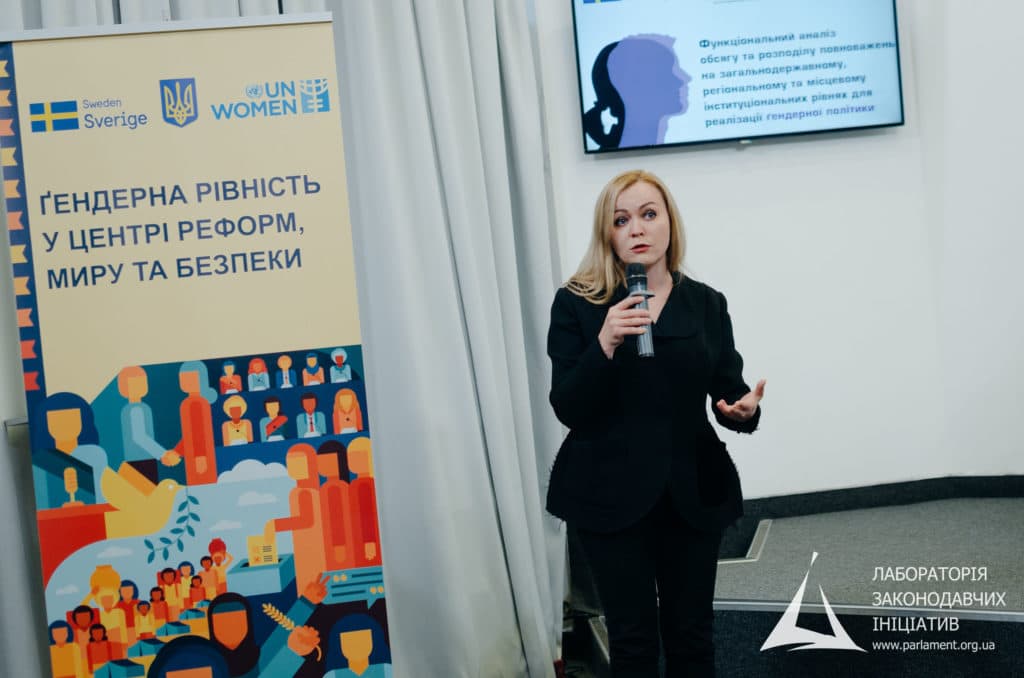
Agency for Legislative Initiatives presented the results of the analysis of the scope and distribution of responsibilities for the implementation of gender equality policy.
Svitlana Matvienko, the Chairwoman of the Council of the Agency for Legislative Initiatives, began the presentation.
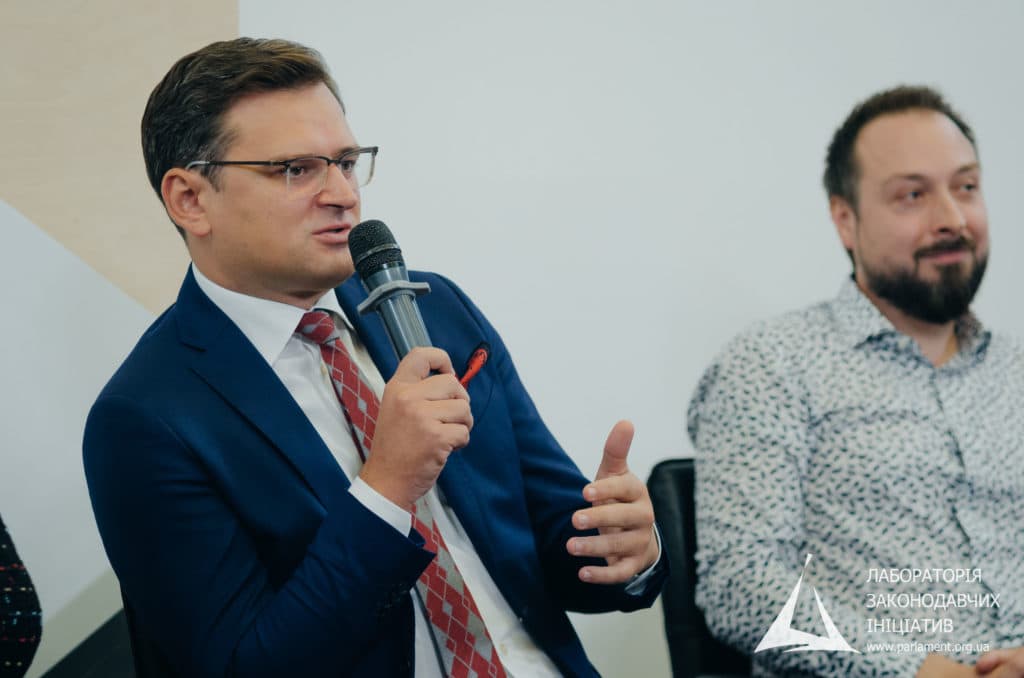
Dmytro Kuleba, the Deputy Prime Minister of Ukraine for European and Euro-Atlantic Integration, has attended the event. He said that the new government will continue to implement gender equality policies in Ukraine initiated by the previous government.
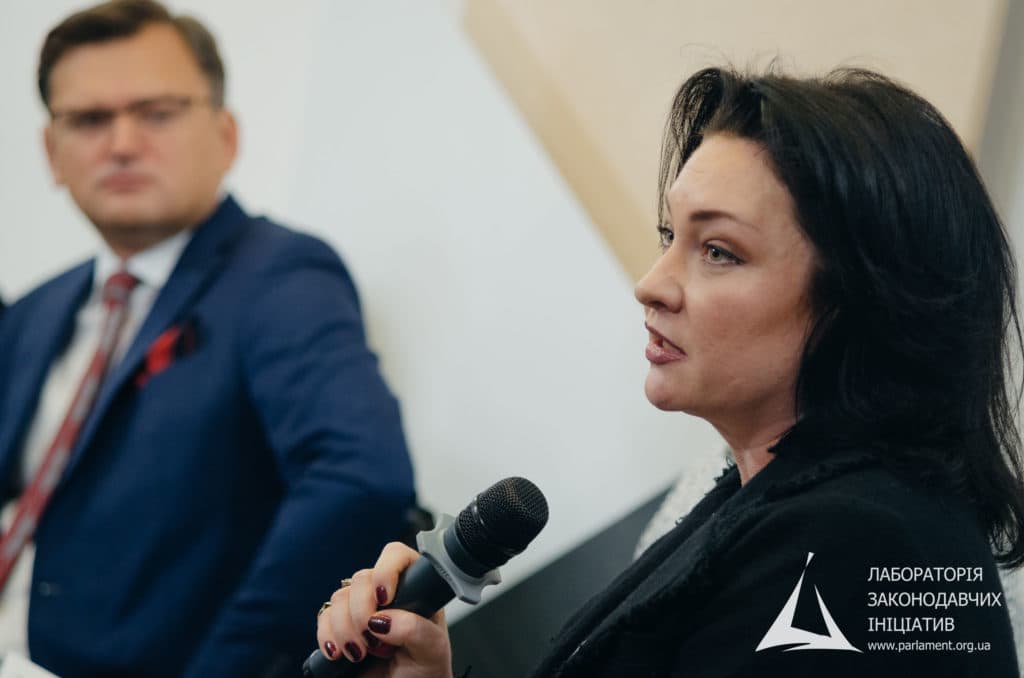
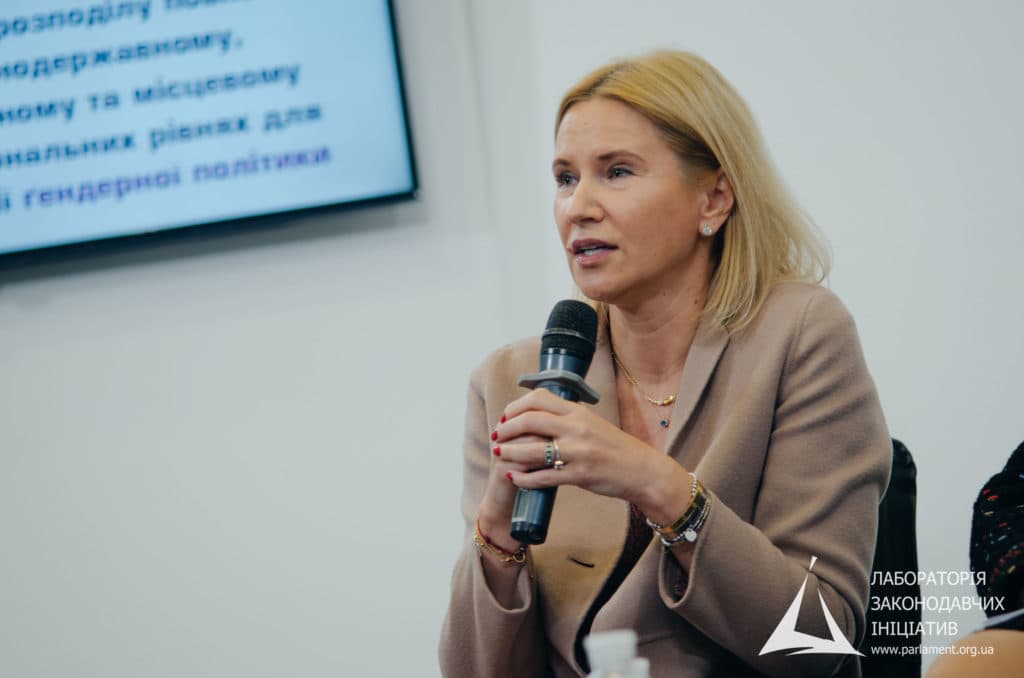
Ivanna Klympush-Tsintsadze, currently the Chairwoman of the Verkhovna Rada Committee on Integration of Ukraine into the European Union, and in 2016-2019 the Deputy Prime Minister for European and Euro-Atlantic Integration in Ukraine, said that to achieve gender equality there is still much work to be done in Ukraine.
“In spite of all the regulations and changes to the legislation that we have been able to adopt in recent years, there is still a lot of work to be done in order to say that our country ensures equality, makes it impossible to discriminate on the basis of sex and display sexism at the public level”, – said Ivanna Klympush-Tsintsadze.
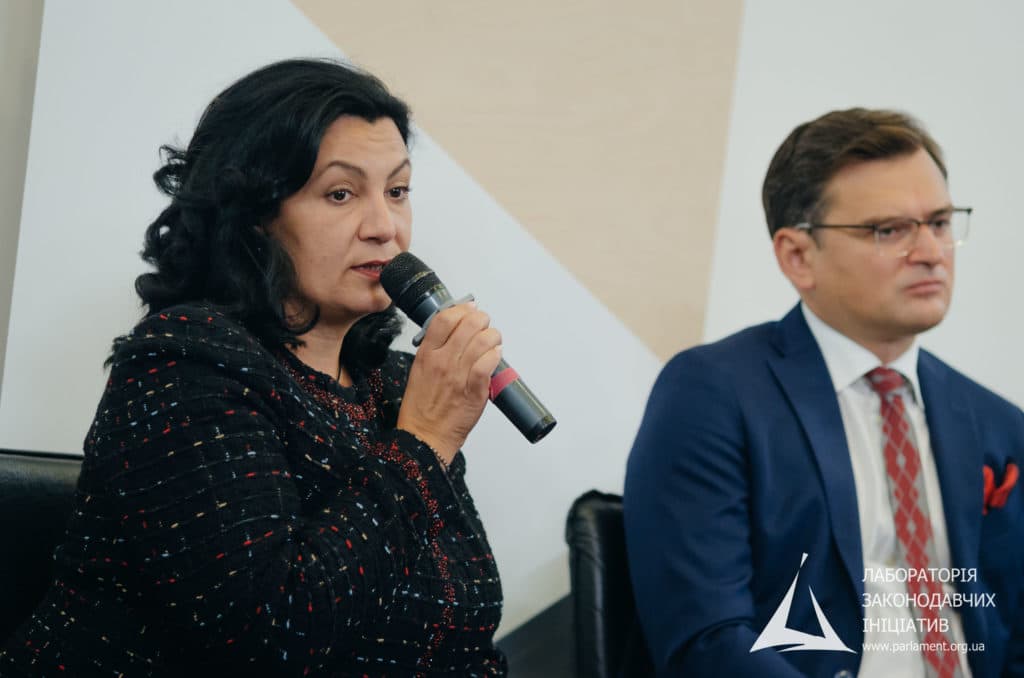
She also noted that it is necessary to work with the regions so that the national mechanism could ensure equal rights for men and women.
“Our society is full of stereotypes. All of us have seen the rush that has caused the introduction of feminitives in the Ukrainian language. It means that in society it is necessary to explain what equality is and why it is important”, – the politician emphasized.
The Head of the UN Office for Women in Ukraine, Anastasia Divinskaya, agreed with Ivana Klimpush-Tsintsadze. She noted that according to the Beijing Platform for Action, a national mechanism can only succeed if it is part of the government. But it must also be implemented at all levels of the country. It is important to engage with civil society organizations.
“The national mechanism should be able to influence all policies developed by the state so that all laws inevitably have a positive result equal for men and women, boys and girls living in this country”, – Ms. Divinska summed up.
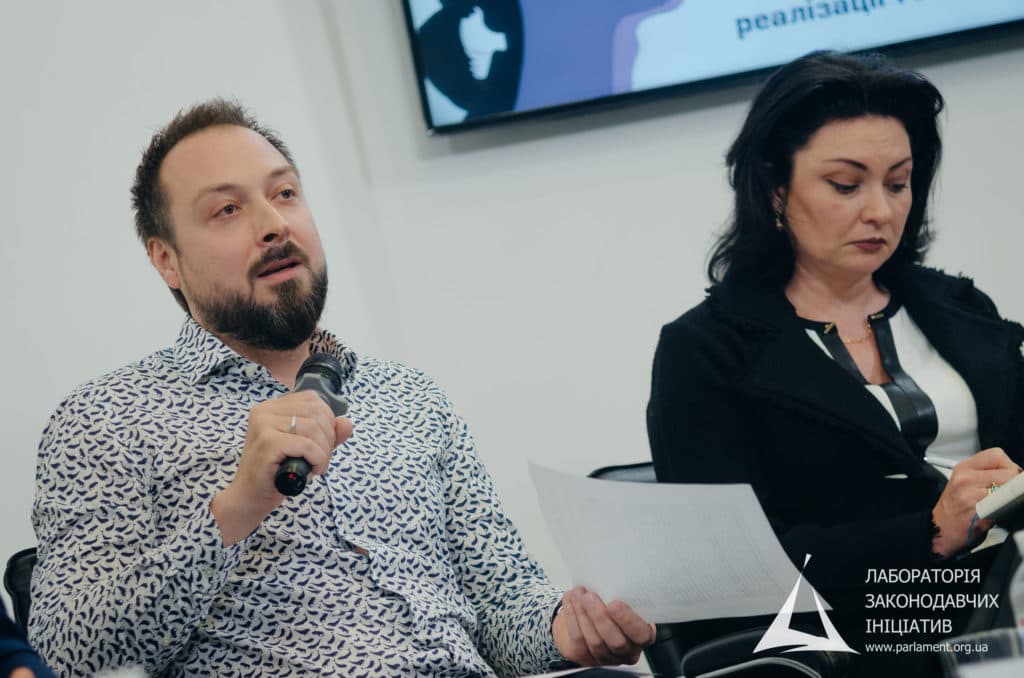
Andriy Vyshnevsky, a lawyer and public administration expert, emphasized that Agency had submitted a draft report that needs further public discussion. He described the methodology of the study, which took place in three stages.
“The main conclusion is that we have a gender mechanism and it is sufficiently developed. But that does not mean that there is nothing to improve. There are a lot of serious problems”, – said Andrey Vyshnevsky.
Finally, Olena Kondratyuk, the Deputy Speaker of the Verkhovna Rada of Ukraine, took the word. She said that the implementation of gender equality policies requires a coordinated work of government, public and legislative sectors.
You can watch the full presentation here.
Functional Analysis of the Scope and Distribution of Responsibilities for the Implementation of Gender Equality Policy
Agency for Legislative Initiatives presented the results of the functional analysis of the scope and distribution of responsibilities for the implementation of gender equality policy.
The study was presented by:
- Svitlana Matvienko, the Chairwoman of the Council of the Agency for Legislative Initiatives;
- Ivanna Klympush-Tsintsadze, currently the Chairwoman of the Verkhovna Rada Committee on Integration of Ukraine into the European Union, and in 2016-2019 the Deputy Prime Minister for European and Euro-Atlantic Integration in Ukraine;
- Anastasia Divinskaya, the Head of the UN Office for Women in Ukraine;
- Andriy Vyshnevsky, a lawyer and public administration expert;
- Dmytro Kuleba, the Deputy Prime Minister of Ukraine for European and Euro-Atlantic Integration.
In its study, Agency for Legislative Initiatives analyzed the world experience of building gender mechanisms at the state level and compared the practices of other countries with Ukrainian realities. Agency also studied in detail how the mechanisms for ensuring gender policy in Ukraine work. The study was conducted in several stages, including an analysis of legislation and a survey of government officials responsible for implementing gender equality policy.
At the end of the study, Agency made several recommendations to improve the organization of the mechanism in Ukraine – more effective implementation of gender policy.
The study was requested by the Deputy Prime Minister for European and Euro-Atlantic Integration of Ukraine in the framework of the UN Women’s Project “Strengthening Accountability for Gender Equality and Women’s Empowerment in National Reforms, Peace and Security”, which aims to support joint efforts of the government, parliament, women’s groups and civil society organizations in fulfilling state commitments on gender equality and women’s rights in the process of reforming and ensuring peace and security.
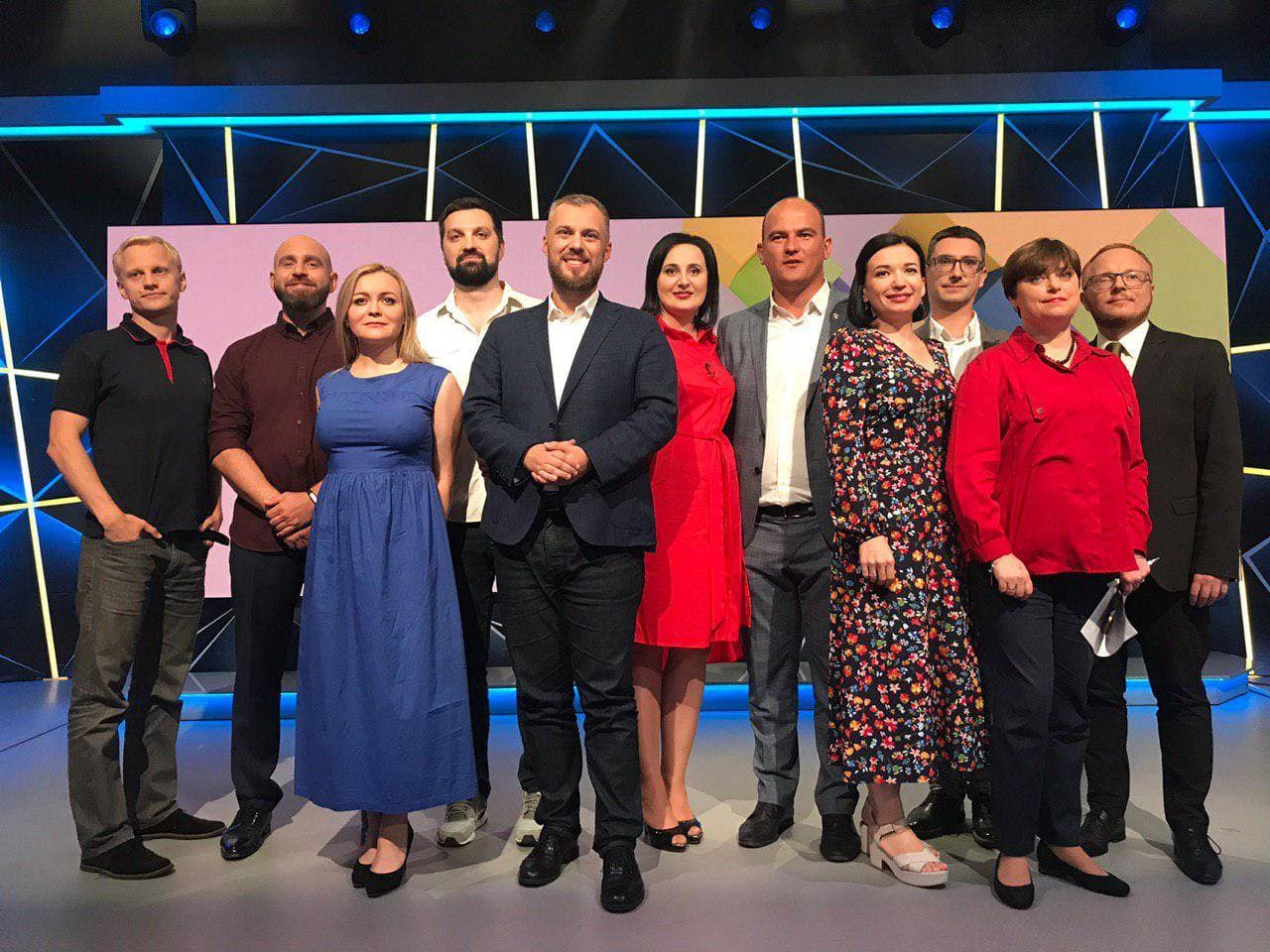
The second season of the TV project “New Leaders” has ended
The Agency for Legislative Initiatives was included in the Supervisory Board of the national television Project “New Leaders” for the second season. Chairwoman of the Council of the Agency and the curator of the Ukrainian School of Political Studies Svitlana Matvienko was part of the jury.
Thanks to the project Ukrainians have learned about a lot of initiatives and projects, each of which is worthy.
However, the winner is always one. This year, Ukrainians determined Volodymyr Shmatko’s idea as the best one. Volodymyr is the Mayor of Chortkiv and alumnus of the Ukrainian School of Political Studies. During the project, he fought for the implementation of his idea, which would contribute to the economic growth of communities throughout the country.
Decentralization is an extremely important reform for an economically successful Ukraine. Volodymyr has developed an action plan. The implementation of his project will allow to support local entrepreneurs and develop innovative projects such as business incubators, startups, and economic clusters in the communities.
We congratulate Volodymyr on victory and wish him success in the implementation of the project!