
I am waiting for the moment when all women will pass the appropriate certification to demonstrate their skills. By the results, they will receive those positions that will be precisely within their power. I’m sure there will be women who will be able to command units.
What Do Women Say About Gender Equality in the Security and Defense Sector?
March 8 is not a holiday of beauty and flowers. This is a day reminiscent of women’s long struggle for their rights. The Constitution of Ukraine guarantees all citizens equal constitutional rights and freedoms and equality before the law. However, gender equality is still a formal concept, enshrined in documents but not enforced in real life.
Especially gender balance is still lacking in the security and defense sector, where women are rarely able to hold leadership positions and don’t have the trust and respect of male colleagues.
The Agency for Legislative Initiatives is implementing the Parliamentary Accountability for the Security Sector in Ukraine project in partnership with the Canadian Parliamentary Centre, the Canadian Ministry of International Affairs, and the Peace and Stabilization Operations Program (PSOPs). One of the project’s essential components is researching the gender aspect in the security and defense sector.
We decided to delve deeper into the topic before International Women’s Day and ask parliamentarians, women in the armed forces volunteers about the problems of gender equality in the security and defense sector and how they can be solved.
The views expressed in this publication reflect the personal beliefs of the speakers and do not necessarily reflect the views of the Agency for Legislative Initiatives.

Ivanna Klympush-Tsintsadze, Member of Parliament of Ukraine, Chairwoman of the Verkhovna Rada Committee on Ukraine’s Integration into the EU
What is the impact of the presence of women in the Verkhovna Rada of Ukraine, particularly in your Committee, on the process of security sector reform?
When we talk about women’s representation in decision-making processes, we need to talk about human rights and justice. If to date we do not have equal representation of women and men in representative bodies (and I want to remind you that women make up almost 54% of the total population of Ukraine), then something is definitely “wrong.” Today, although the current Verkhovna Rada of Ukraine has the most significant representation of women MPs in the history of Ukraine, we still have a situation where of the 23 current Committees of the Verkhovna Rada of Ukraine, only three Committees are headed by women, in three more Committees, women hold the positions of first deputy chairwomen and are secretaries of Committees. Which means that representation of women in these positions is approximately 13% of the total number of posts.
But even women in leadership positions in the Verkhovna Rada may not always be able to influence decision-making. Their role is often nominal, and this needs to be changed.
To fully represent the interests of all groups of voters, both women, and men, it is necessary to guarantee the full participation of women MPs in parliament, including the opportunity to participate and hold senior positions in the Verkhovna Rada Committees, etc. It is also important to remember our international obligations. In particular, in the context of implementing the Sustainable Development Goals (Goal №5. Gender equality. Task 5.4. Ensure equal opportunities for representation at higher levels of decision-making in political and social life). In general, the always balanced representation of women and men at the decision-making level, including security and defense, means a better consideration of different groups of women and men’s interests and needs — accordingly more fair, effective and sustainable solutions.
Do you see progress on gender equality in your personal and professional life?
My family has a partnership from the very beginning, so I can realize myself professionally and develop. As for professional life, I see progress on the example of local elections. Many men were skeptical about quotas and whether there would be the required number of professional women. But finally, women have been able to compete effectively with men, and we must continue to provide women with this opportunity for self-realization and real influence over decisions.
What would you suggest to change to make the security and defense sector more gender-balanced?
The issue of gender equality in the security sector is complex, and it is essential to look at it that way. The point of equality is not only about numbers, statistics, and representation. It is also about skills and values, mechanisms, institutions, and, of course, legislative work.
Currently, there are about 57,000 women in the Ukrainian army. We must provide them with equal opportunities for promotion, equal pay, protection from sexual harassment.
And here we are inspired by the experience of NATO’s implementation of the “Women, Peace & Security” agenda. More than 90% of NATO countries have opened all military specialties and positions for women. For example, Norway did so back in 1985. The problems of harassment are spoken out loud, and precise mechanisms have been developed to combat gender-based violence in Norway since then.
Among the priority problems that need to be addressed are the following:
- the low representation of women in peace processes;
- cultural, value, infrastructural, and domestic barriers that prevent women from fully realizing themselves in the security and defense sector;
- the low representation of women in management positions in the security and defense sector;
- lack of effective systematic monitoring and control of the implementation of already approved documents;
- untimely adoption of legal documents aimed at ensuring gender equality in the security and defense sector (example – Annual National Program under the auspices of the NATO-Ukraine Commission for 2020, which was prepared in late 2019 but adopted in late May 2020) ;
- sexism and impunity for sexual harassment;
- lack of definition of sexual violence during the conflict;
- gender-blind programs for supporting veterans, IDPs, political prisoners, hostages, and prisoners of war which do not consider the specific needs and interests of women and men.
What is your message for girls and women on International Women’s Day?
Each year, the UN determines the theme of International Women’s Day. In 2021, it is “Women’s Leadership: Approaching an Equal Future in the World during a Pandemic.”
In Ukraine, nurses, doctors, social workers, postwomen, saleswomen, pharmacists, teachers – hundreds of thousands of women and girls overcome illness and circumstances every day and are already leaders of their lives.
I know that it can be difficult, and there is a need to make difficult decisions, that there may be many critics and “advisers” around, and not as many helpers as we would like. But I believe that we will succeed. Overcome the crisis, overcome restrictions and emerge victoriously. Each one in her field, in her way.
It is only necessary not to stop, study every day, improve, and set more ambitious goals, even if they seem unattainable to someone at the moment.
And it is essential to support each other. In our platform “Security. Women. Peace “we understand the value of such solidarity and networking. These faith and support give us the strength and inspiration to move forward.

Mariana Bezuhla, Member of Parliament of Ukraine, Member of the Verkhovna Rada Committee on National Security, Defense and Intelligence
What is the impact of the presence of women in the Verkhovna Rada of Ukraine, particularly in your Committee, on the process of security sector reform?
Numerous studies show that mixed groups are the most productive and balanced. Accordingly, the same applies to the parliament and our Committee. A particular focus, perception, uniqueness of experience, which differ in men and women, add value.
We focus on gender equality in the security and defense sector. In particular, a joint initiative was recently launched to correct certain inconsistencies in the legislation and to give women access to all positions and opportunities in the security sector. So that opportunities remained at the choice of the woman.
Do you see progress on gender equality in your personal and professional life?
Throughout my life, I did not experience any particular obstacles to work. However, there are additional challenges. I met with a biased perception from men, especially in 2014, when the mobilization took place, then while working in the Ministry of Defense, then in parliament. I am in charge of reforming the intelligence services of the Security Service of Ukraine, and this is a “secret caste” where there are no women in leadership roles. With one exception, the current Minister of Veterans Affairs. However, the exceptions only confirm the rule.
When we were preparing for the reform, I encountered bullying on Telegram channels from SSU officers. Most of the harassment was due to the emphasis on my gender and age. But we can work with it.
I do not believe that there are critical obstacles in our society, particularly in the security and defense sector, that need to be addressed. The main thing is gradual development.
What would you suggest to change to make the security and defense sector more gender-balanced?
Gender balance is needed everywhere. But it must be natural. I would also like more responsibility from the women themselves. Unfortunately, we often have situations in the security and defense sectors when the wife of the brigade commander holds a comfortable position that does not require particular activity. This kind of nepotism is common in the security sector. It forms prejudice and a particularly negative image of the woman. And those girls and women who have dreamed of being in military positions all their lives have additional obstacles because of that negative image.
In 2015, when I was mobilized, I met rejection of my active role from women. The responsibility for giving women more opportunities and rights in the security and defense sector lies with men, civil society organizations, and women themselves.
What is your message for women and girls on International Women’s Day?
Never give up!

Anna Gvozdyar, volunteer
What gender equality issues did you face while volunteering?
Personally, during the war, I mainly felt an increased level of care and desire to protect. The other side of the coin is the rejection of a woman who can be knowledgeable in military affairs. It is common, mainly in middle and senior command. It is more a tribute to the Soviet legacy that a girl cannot be competent in military affairs. Here everything is solved by time and examples of women who have achieved a high level of competence and real achievements during the war.
Is it the duty of everyone, regardless of gender, to defend their country?
Having experienced the events that began in 2014, we see that everyone has found a place in the “defense” of the Motherland. Some were engaged in medicine, some in providing, some in psychological support. Therefore, it is essential to be ready from school because it can help. For example, the bandaging skills I learned in medicine class in 10-11 grades helped me a lot.
In your opinion, how should the opportunities of women and girls in the defense sector be empowered? How can the situation in this non-gender balanced sector be changed?
I don’t think it’s necessary to force women into units, especially in combat or high-risk positions. The nominal presence of women in office solely for gender equality does not benefit the country’s defense capabilities. We have cases where women waive some of the Statute’s responsibilities, referring, for example, to “critical days” every week or something, thus taking advantage of ignorance and caution on the part of men.
The idea of equality in the army should open up equal conditions for selection. There should be no positions only for men or only for women. A selection must be of high quality. If a woman wants to be, for example, a sniper, she must be able to undergo full selection and training and perform all job responsibilities.
We have, for example, the experience of the Marines, when the girls, including Oleksandra Bezsmertna, overcame the obstacle course with everyone and received a “black beret” of Marines on equal terms with men.
What problems of women and girls in defense need to be solved?
It is necessary to provide separate regular barracks with facilities for women. The maternity leave of military personnel is also essential but this issue has not yet been resolved. If we are talking about equality in the army, these problems must be solved first.

Olga Benda, ATO veteran
What gender equality issues have you faced in the military?
As soon as I went to military service and studied in Starychi, I heard words from men: “Why did you come here? You have to cook borscht at home and take care of your husband and children”. The older generation of the military had prejudices that girls would be treated with concessions. But girls trained on an equal footing with everyone. We did everything we were told. We didn’t cry all the time, as the men expected. But that was in 2016. Then the attitude changed.
Is it the duty of everyone, regardless of gender, to defend their country?
Yes. Ukraine is our home, and we must defend it.
In your opinion, how should the opportunities of women and girls in the defense sector be empowered?
Women in the army are now treated much better. Previously, women held positions only as cooks, doctors, and liaison officers. Now the girls can be platoon commanders. In 2016, girls were very selectively admitted to military service because men did not want to take women to the anti-terrorist operation. When my training ended in 2016, and I had to be transferred to a permanent deployment for military service, I was not taken to one of the brigades because “the commander forbade taking girls”.
What problems of women and girls in defense need to be solved?
During the anti-terrorist operation, I began to work as a cook, then became the senior cook, and wanted to become the head of the cook’s department. But then this position was held by a guy who did not even know how to cook. He was a driver. I asked our commander if I could become the head of the cooks’ department. He answered: “Are you a guy? Can you drive a car? The head of the department should be a guy”. That’s how my ambitions were immediately “cut off.”
After the injury (which Olya received in 2017, after which her leg was amputated – ed.), I continued my military service at the military registration and enlistment office. I was a senior soldier. I had a great desire to study, get the rank of officer and continue to serve.
But it would be complicated for me to get to study with injuries because I have to take an exam on the level of physical training on an equal footing with everyone. I was told no one will take into account the lack of a leg. I wanted to connect my life with the army, but I was denied because of my disability. So I resigned.

Julia Hromova, servicewoman
What gender equality issues did you face during your military service?
I joined the army weighing 37 kg, but I never heard that I was a woman and “it’s none of my business”.
Is it the duty of everyone, regardless of gender, to defend their country?
Indeed, I believe that such questions should never arise at all. It doesn’t matter what gender you are, what kind of specialist you are.
In your opinion, how should the opportunities of women and girls in the defense sector be empowered? How can the situation in this non-gender balanced sector be changed?
Gender equality is not a position, not a title, not a gender. First of all, it is knowledge and skills.
Unfortunately, it happens that women usually (in the case of combat units) delegate their responsibilities to the platoon’s chief sergeants.
What problems of women and girls in defense need to be solved?
Women have long been able to hold various positions. It’s just that not all of them fully understand what gender equality is in the defense sector.
I would suggest changing the approach. You want to be a tank gunner – you go through 45 days of training, charge it by yourself, service the tank – and that’s all, you get a position. But will every woman be able to load a gun weighing 45 kg?
Currently, there is no problem for a woman to become a tank commander. There is a problem with physical and moral training. I want our personnel to be qualitatively selected, not because of beauty, but for understanding the responsibility you take on.
Analytics of the Day: What Are Europeans Asked About in Referendums?
The Agency for Legislative Initiatives has analyzed more than 200 referendums held in 25 European countries since 1992. Ukraine has signed an Association Agreement with the EU, has a visa-free regime, and the constitutional intention to integrate into the EU and NATO. It means that it is very likely that topics on which referendums have taken place in other European countries will one day be the subject of a referendum in Ukraine. So you should pay attention to them.

International issues related to the European Union are most often put to a referendum: for example, joining the EU by one more country or approving another agreement. Therefore, it can be assumed that Ukraine’s accession to NATO and the signing of an agreement with the EU have a good chance of being put to a referendum. Yes, Ukraine’s course towards NATO and the EU is enshrined in the Constitution, but historically, the Ukrainian Basic Law has been constantly changed in one part or another.
The second block of questions that are most often put to a referendum are issues related to family values, namely different variations on two topics:
- abortions (prohibition/permission, when, under what circumstances abortion can be performed)
- marriage (permission / prohibition of same-sex marriages).
Currently, abortions are allowed in Ukraine, and same-sex marriages are not. However, the intensification of right-wing conservative, traditionalist, or religious-political groups on the one hand or the activation of left-liberal political groups can lead to the actualization of these topics and, consequently, their submission to a referendum.
In Europe, referendums are held on very different issues, which can be grouped into 11 thematic categories:

Some topics that will be banned in Ukraine under the new law are being put to a referendum in European countries.
These include the death penalty, other justice or tax issues. It is also interesting to note that several financial issues are often put to a referendum.
If they do not concern taxes and the budget, such issues will be resolved in Ukraine as well. Among them are insurance, pension reforms, and privatization.
Legalization/prohibition of the free carrying of weapons, prostitution, gambling, and soft drugs seem to be ideal topics for referendums, as they relieve politicians of the responsibility to make the final decision on such sensitive issues. However, in none of the 25 states analyzed, these topics were put to a referendum. Thus, it can be assumed that in Ukraine, they will also not be the subject of a referendum in the nearest future.
The number of referendums is also interesting. Some say that there will be very few of them in Ukraine, while others, on the contrary, are afraid of the “storm” of popular initiatives. The number of referendums in European countries varies significantly from country to country. Some states have held only a few referendums in almost 30 years, and there are countries where the number of national referendums is measured in tens. Therefore, it is difficult to determine how frequent referendums in Ukraine will be, based on international experience, even though holding a referendum is a relatively expensive event. If we talk about the 25 states studied, then the number of referendums can be grouped into the following categories:
- A small number of referendums (1-4 referendums): Austria, Croatia, Czech Republic, Great Britain, Finland, Greece, Norway, Portugal, Spain, Sweden. Only ten countries.
- An average number of referendums (5-10 referendums): Bulgaria, Denmark, Estonia, France, Hungary, Iceland, Latvia, Poland, Romania. Only nine countries.
- Many referendums (11+ referendums) (most – 47 in Italy): the Netherlands, Ireland, Italy, Lithuania, Slovakia, Slovenia. A total of 6 countries.
Thinking about same-sex marriage and the abortion ban, we can assume that these are the problems of developed Western European democracies. Ukraine, for which the most pressing issues at present are peace, security, and territorial integrity (and the preservation of sovereignty in general, if we speak in a broad context), is far from them.
Therefore, we can look at the experience of countries more like Ukraine, at least in terms of the democracy index. We additionally looked at the experience of the following countries: Northern Macedonia, Albania, Armenia, Montenegro, Georgia, Serbia, Moldova.
All these states have had a small number of referendums (up to 5 in each country since 1992). Indeed, issues related to family values were not put to a referendum in any of these states. As in European countries, popular topics are international issues – joining NATO and agreeing to international treaties. Another block of issues put to a referendum in these states is the constituent issues – the adoption of constitutions, the approval of national symbols, or forms of government.
Thus, summarizing the review of international experience, we can draw the following conclusions for Ukraine:
- Initially, the topics of referendums in Ukraine will be international treaties and, possibly, issues of a constituent nature;
- If Ukraine is moving towards democracy and economic development, then after a while, the issues of abortion or same-sex marriage may be put to a referendum;
- Depending on the experience, referendums may remain exotic for Ukrainian political life or enter political weapons’ arsenal. If referendums would be used frequently, then their topics will be quite diverse – pensions, medicine, insurance, the electoral system, citizenship, the number of members in parliament, president authority, funding of political parties – these and many other topics will be put to referendums.
Analytics of the Day: Why Is Ukraine Still Not in NATO?
Why is Ukraine still not in NATO? Ukrainian President Volodymyr Zelensky wants to address this question to the new US President Joe Biden. But the American president is unlikely to have an answer to this question. After all, he cannot push the magic button for Ukraine to become a member of the North Atlantic Alliance. This button does not exist at all. Instead, for the issue of Ukraine’s full membership in NATO to be taken seriously, the country must accomplish many tasks.

Ukraine began cooperating with NATO almost immediately after independence. We were one of the first countries in the post-Soviet space to join NATO’s Partnership for Peace program. Since then, fruitful cooperation between Ukraine and the North Atlantic Alliance has begun, which could well have escalated into more serious membership talks in 2005-2008. Then Ukraine has officially announced its intention to become a member of the Alliance.
But in 2010, during Viktor Yanukovych’s presidency, Ukraine’s foreign policy was changed – the authorities changed their minds and chose a non-aligned status for Ukraine + distance from NATO + rapprochement with Russia. Ukraine could return to “joining NATO” only in 2014 when the war with Russia had already begun. In 2019, this course was enshrined in the Constitution. But this is not enough for the North Atlantic Alliance membership.
Ukraine must confirm its intentions with specific actions and indicators. To this end, Ukraine annually approves the NATO-Ukraine Annual National Program. This program sets out measures to implement reforms that meet Alliance standards. If Ukraine implements the Annual National Programs properly, it will be able to join the NATO Membership Action Plan to prepare for potential membership and demonstrate its ability to meet its commitments. But participation in this program is not a guarantee of membership for Ukraine or any other country.
The North Atlantic Council decides to invite a country to become a full member of NATO based on consensus among all Alliance members. That is, not the American president can make this decision.
Dialogues on reforms: How to further develop civil society?
What are the authorities doing to help civil society? Are government policies working in this direction?
During the forum “Dialogues on Reforms: Towards Vilnius” within #URC2020, Deputy Chairman of the Board of the Agency for Legislative Initiatives Uliana Poltavets moderated an expert discussion on how civil society should develop further. Despite the illusion that Ukraine has a strong civil society, the facts show that only 18.6% of citizens (according to a poll by the Democratic Initiatives Foundation) participate in NGOs’ activities, which is much lower than in European countries.
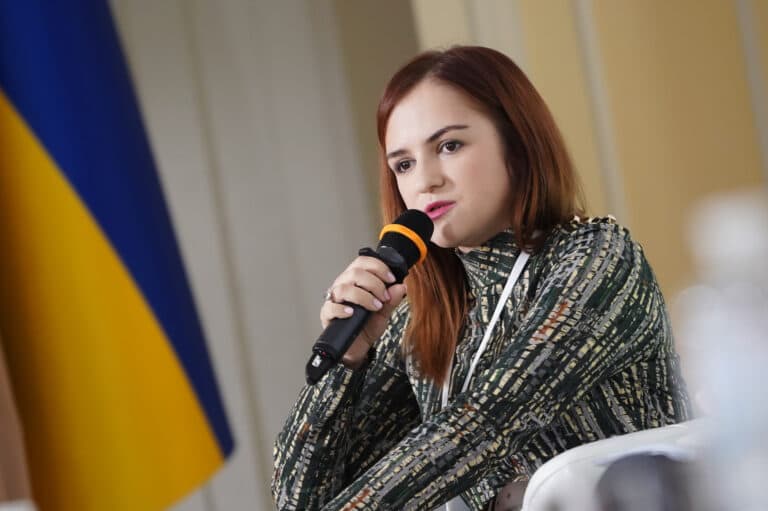
Photo: Reanimation package of reforms
For the development of civil society, there is a National Strategy for the Promotion of Civil Society in Ukraine for 2016-2020. However, we in the Agency for Legislative Initiatives together with the Council of Europe Office in Ukraine last year analyzed its implementation. We concluded that the strategy is far from perfect. In particular:
- there are no clear definitions of the term “civil society”,
- tasks are vaguely worded,
- there are no criteria for evaluating the implementation of these tasks,
- there is no allocated funding,
- regional plans are not in line with the strategy.
The results of the study are fully available here.
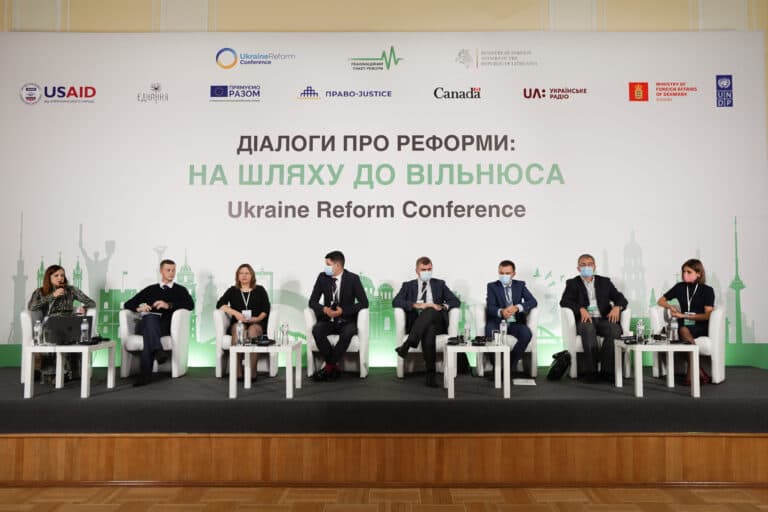
Photo: Reanimation package of reforms
The briefing on the development of civil society prepared for the Vilnius Conference also addresses the problems of the legal framework of CSOs and their financial stability, harassment of public activists and improper investigation of crimes against them, lack of dialogue with the authorities, coordination of the process.
What to do with all this – read in the brief.
“Holes” in American Democracy
Are you following the US election? Meanwhile, the situation with votes and results is only gaining momentum – we want to tell you about the most controversial and scandalous elections in America, which took place in 2000.
The Constitutional Court has caused a political crisis in Ukraine. But the courts influence politics not only in Ukraine. How are the decisions of the US Supreme Court and the US presidential election related?

On November 3, the election period in the United States ended. The results of this election will affect American citizens and political and economic processes in other countries. Therefore, the course of the campaign and the counting of votes will be monitored around the world.
Any election held in 2020 is special because of the challenges of the pandemic. However, in the United States, the electoral process has changed beyond recognition. A record number of voters voted long before election day by sending ballots by mail.
Because each state has its own laws, the counting process is different – several states allow ballots to be counted even after election day, provided they are sent in time. Some states have started counting votes in advance and will have results soon. Among the latter are several so-called swing states, states where candidates from the two main parties have an equal chance of being elected. In these elections, such states are, for example, Pennsylvania and North Carolina, where, by the time polls closed, about 80 percent of the ballots had already been counted.
In 2000, the gap between George W. Bush (Republican) and Albert Gore (Democratic) was less than 1 percent, and the election was decided in Florida, where the count showed that Bush would win Florida by such a small margin (537 votes in total), that the law required recalculation.
Recalculation was also required due to uncertainty about most of the ballots in the form of punch-cards in which automatic voting machines incorrectly punched (so-called “hanging, dimpled, or pregnant chads”) – there were disputes regarding the enrollment of such ballots or the degree of perforation that can be enrolled. Even after the election, experts estimated that if the count had taken place across Florida, most of the ballots with problematic perforations would have been counted, Al Gore would have won the election.
However, in the case of Bush v. Gore, the US Supreme Court has made a scandalous decision to cancel the recount, voicing a very political motivation to avoid an “unnecessary and unjustified cloud” over Bush’s legitimacy. Thus, under state law, all Florida votes (even those cast for Gore) passed to Bush, which determined his victory.
This decision is still considered controversial and has seriously damaged both the Supreme Court’s reputation and the legitimacy of the president-elect.
The scenario of 2000, when the fate of the US election was decided by small holes in the ballots and 9 judges, is unlikely, as the “fight” is unlikely to be reduced to one state. However, the results of this election are unlikely to be less scandalous, given the conditions of the election, as well as a large number of lawsuits. Electronic ones have since replaced voting machines, but the highly complex US election process is likely to require more serious change and reform in the future.
20th Anniversary of the UN Security Council Resolution “Women, Peace and Security”
Exactly 20 years ago, on October 31, 2000, UN Security Council Resolution 1325, better known as “Women, Peace and Security”, was adopted. We want to talk about its main provisions and importance for our country.
Although the resolution was adopted 20 years ago, the world community, namely the UN Security Council, is actively improving it. In support of the implementation of this resolution in 2008-2019, 9 more UN Security Council resolutions were adopted under the following numbers: 1820, 1888, 1889, 1960, 2106, 2122, 2242, 2467, 2493.

Ukraine, as a member of the UN, must also implement the provisions of the resolution. In particular, in February 2016, Ukraine adopted a National Action Plan to implement UN Security Council Resolution 1325 “Women, Peace and Security” for the period up to 2020. Before the 20th anniversary, Ukraine adopted the second National Plan.
What are the main provisions of the resolution?
- The special importance of taking into account the needs of women and girls in conflict situations and women’s special vulnerability to the negative consequences of conflicts are noted.
- The Security Council calls on UN member states to actively involve women in decision-making at all levels through national, regional, and international institutions and mechanisms for conflict prevention, management, and resolution.
- UN member states call for the inclusion of a gender component in field operations, particularly the greater involvement of women in the military and police forces.
Subsequent UN Security Council resolutions, in support of Resolution 1325, were aimed at combating sexual violence during conflicts, increasing women’s involvement in the conflict and post-conflict situations, and more.
Why is this resolution important?
The resolution became the institutional framework for the integration of women into the security sector. More than 60 countries (including Ukraine) have already adopted national action plans to implement Resolution 1325. NATO and the EU have also adopted action plans. Involving women in decision-making and increasing the representation of women in the military and police significantly increases the effectiveness of combating gender-based violence and improves the consideration of women’s needs in conflict situations.
Ukraine already has the first achievements from the implementation of Resolution 1325. Positions of gender advisers are created in educational institutions of security and defense, a law on equal rights and opportunities for women and men during military service in the Armed Forces is adopted, the list of military specialties that women can occupy is expanded, and more than 27 thousand women serve in the Armed Forces.
However, the Ukrainian implementation of the resolution is also criticized: women mostly hold feminized positions in logistics, logistics, and medical services. Despite the formal expansion of the list of military specialties, there is informal resistance to the increase in women’s number in the security and defense sectors. There are almost no women in the leadership (especially at the rank of “colonel” and above).
Resolution 1325 and other resolutions in support of it (the last of which was adopted in 2019), action plans, demonstrate efforts to integrate women into peacekeeping and security processes, but they are also a signal of the inadequacy of such efforts. The problems addressed by resolution 1325 have not yet been resolved. Therefore, 20 years after adopting the resolution “Women, Peace and Security”, it is necessary to increase efforts to implement it.
Constitutional Suicide, or How to Stop Anticipating the Consequences of Your Actions and Start Loving Chaos
The question of the ultimate truth in law is quite controversial. In the modern Ukrainian legal system, the Constitutional Court of Ukraine has the right to establish the ultimate truth.
However, the fact that the CCU made a decision does not make this decision entirely correct. In the case of the constitutionality of certain provisions of the Law on Prevention of Corruption, the Criminal Code of Ukraine, the CCU could have made a different decision while having a sufficiently strong legal basis. Such a justification is available in the Dissenting Opinion of CCU Judge Serhiy Holovaty and the Dissenting Opinion of CCU Judge Vasyl Lemak. The argumentation of the decision of the CCU itself is criticized by many experts. In particular, the President’s Representative in the Constitutional Court, Fedir Venislavsky, considers the Constitutional Court’s decision to be legally weakly motivated. Additional grounds for doubting the fairness of the decision are given by a possible conflict of interest of some judges of the Constitutional Court regarding whom the National Agency on Corruption Prevention has drawn up administrative reports or carried out inspections. The story about the undeclared house in the Crimea of the Chairman of the CCU caused a special resonance. In the text of the CCU decision, they found plagiarism from the collection of articles and essay “Federalist” by O. Hamilton.
The Constitutional Court should be the last bastion of the Constitution’s protection, but quite the opposite cases are common. The Constitutional Court acts as an instrument for the destruction of the constitutional order of the state. The Constitutional Court has often allowed the President of a country to be elected for a third, fourth, or fifth term, thus destroying the constitutional foundations of a democratic regime in the state. Thus, the Constitutional Courts allowed the presidents of Kyrgyzstan, Senegal, and Burundi to be elected for a third term, the President of Bolivia for a fourth term, and the President of Russia for a fifth term. In fact, the Constitutional Court of Ukraine also distinguished itself in this list, allowing Leonid Kuchma to be re-elected for a third term. Another example of a destructive decision is the decision in 2010 to repeal the 2004 amendments to the Constitution. All these decisions led to the destruction of the constitutional order and negative consequences for the state, and the constitutional courts played a major role in them.
What is wrong with the decision of the Constitutional Court?
Analyzing the decision of the Constitutional Court in the case of anti-corruption bodies, as well as in attempts to comprehend and somehow articulate the situation, the authors of this comment agreed on a conclusion no less absurd than the situation itself: a democratic institution makes an undemocratic decision in a democratic way. The paradox of this situation is that it is possible (because it has already happened) and impossible (due to the catastrophic consequences for state institutions) at the same time. The first intuitive way to take a critical stance on this catastrophe would, of course, be to find the culprits. After all, if the procedure was violated or there was a criminal conspiracy, it is not the system that is to blame, but specific people, specific judges. This way of criticism refers us to the modern version of obscurantism: instead of admitting that something is wrong with structure, we can look for particular culprits (this is how modern Ukrainian information space and political discourse mostly work). But for now, let’s assume that the Constitutional Court judges are sincerely convinced of the legality and legitimacy of their decision.
The Constitutional Court could have made another decision in this case. In addition to common sense, this is evidenced by the presence of two separate opinions and the unanimity of opinions of independent experts and representatives of very different political camps. That is, the Constitutional Court considered the relevant submission and understood that there were other ways to resolve the case. How did it happen that in a young and undoubtedly democratic state, where the fight against corruption is declared at all levels, the Constitutional Court makes such a contradictory decision?
Surprises and indignations have become a part of our daily lives lately. Unclear personnel policy, curtailment (or even outright repeal) of many reforms, confusing public statements with radically opposite actions and consequences – this is the political reality in which the judges of the Constitutional Court and we live. At the same time, the most horrifying thing is not even the decision itself, as a fait accompli. The most frightening thing about this decision is the level of (un)justification, as well as the fact that respected judges of the Constitutional Court generally consider it possible and acceptable to decide with such a level of justification. But in a country where the level of justification for any change is weak, and the most popular reason for the change (and very radical) is the results of the unknown in nature, level of legitimacy and possible political and legal consequences of answering the “President’s question”, can we expect judges that they will offer high standards of justification?
Another problem directly related to the level of justification is the (un)predictability of court decisions, especially of the Constitutional Court. It is the exhaustiveness of the justification that allows court decisions to be predictable. The unpredictability of the Constitutional Court decisions is a verdict on the reforms, as they are somehow aimed at changing the status quo. Here we can, of course, talk about cases of political involvement of judges, when under different conditions the Constitutional Court made completely opposite decisions/interpretations on the same issue (for example, decisions № 16-rp / 2008 and № 11-rp / 2010 on the principle of forming a parliamentary coalition), or when the decision not only contradicted the already established legal relations but also resulted in the destruction of the constitutional order and usurpation of power (decision № 20-rp / 2010 on the abolition of the Constitutional reform of 2004). With such a role of the Constitutional Court and with such an approach of judges to their decisions, there is no guarantee that in time some reforms, any new policies will not be canceled, no matter how much money international partners have spent on them or how many tens and hundreds of lives were lost in the requirements of their implementation.
On the other hand, we can talk about the abuse of MPs’ right to constitutional petitions. After all, these appeals should also be aimed primarily at protecting the Constitution rather than achieving political goals. The workload of the Constitutional Court with such decisions gives judges a certain idea of the political reality of today. Given the unpredictability of the Constitutional Court’s actions, such submissions pose a real threat to Ukraine’s democratic institutions, the rule of law, and national security.
You can disagree with the court decision, but the decision’s logic must be clear and unquestionable. The validity of the CCU’s decisions is one of the most important principles of its activity. However, it is difficult to understand how the judges came to the conclusions in this particular case.
Thus, according to the CCU, the judiciary’s independence entails recognizing unconstitutional norms that apply not only to judges but also to all subjects of declaration in general. The Constitutional Court also had alternatives to declare the norm unconstitutional, requiring the Verkhovna Rada to make appropriate changes, as, for example, the Court did in the case of the constitutionality of the provisions of part two of Article 392 of the Criminal Procedure Code of Ukraine. In this case, the Court declared the provision unconstitutional and ordered the Verkhovna Rada to bring the regulations in line with the Constitution and this decision. In particular, this method helps to avoid a situation of “legislative pause”, as Judge Lemak put it, in his dissenting opinion. Why hasn’t the Court done the same now? Annoying mistake? Deliberate sabotage of reform? Demonstration of the “strength” in a situation of real threat to the usual way of life and judges’ status?
On the issue of criminal liability, the Court considered that the establishment of criminal liability for declaring knowingly inaccurate information was excessive and that the negative consequences suffered by a person were disproportionate to the damage. However, the problem is that the Court did not put forward any additional considerations that allowed it to reach such a conclusion. Although even in its decision, the Court cites the Opinion of the Advisory Council of European Judges of November 9, 2018, which states that corruption among judges is one of the main threats to society and a democratic state’s functioning. According to Mr. Holovaty’s Dissenting Opinion, citing international treaties signed by Ukraine, corruption is one of the most dangerous threats to law and order, democracy, and human rights, destroying good governance, honesty, and social justice. Another problem lies in the theoretical space: can the Constitutional Court determine the expediency of punishment at all instead of analyzing the presence or absence of reasonable grounds for restriction of liberties, as is usually the case in constitutional proceedings.
Summarizing this part, the Constitutional Court could have made a less destructive decision for the anti-corruption system: both in terms of scope and providing adequate mechanisms for implementing this decision. However, the Court did not do that.
What are the consequences?
The CCU decision can have very serious consequences, so significant that the national security of Ukraine may be threatened. The NAPC has already stated that it has lost access to the registers. Accordingly, the NAPC cannot conduct special inspections of candidates for positions without which the heads of public authorities cannot be appointed, as “Decisions on appointment (election) or refusal to appoint (election) to a position related to the performance of state or local functions self-government, is accepted after a special inspection”
This calls into question the results of local elections and the state apparatus’s functioning as a whole. The EU considers that the CCU’s decision is a sufficient basis for the temporary suspension of the visa-free regime.
Anti-corruption reform is one of the main components of Ukraine’s agreements with Western partners: the IMF, the World Bank, and the European Union. The ambassadors of the G7 countries also expressed their dissatisfaction with the undermining of anti-corruption reform. Financial support in the form of loans or direct financial assistance is now also in question. And there is no better time to refuse financial support – the pandemic and economic crisis coincided very well with the CCU’s anti-corruption decision. We should not forget directly about the fight against corruption. The CCU’s decision will further weaken the rather weak fight against corruption: the public loses control over the lifestyle of officials, one of the main anti-corruption articles of the Criminal Code is removed, and the main anti-corruption body loses most of its powers. The CCU’s decision thus removes integral parts of the anti-corruption system. Even if a new law is passed, existing criminal cases under (already) unconstitutional articles will be terminated. For that spring, when the landings for corruption will begin, we will have to wait a very long time. Probably even longer than the release of J. Martin’s new book “A Dream of Spring”.
Is it possible to change the situation?
The Constitutional Court has created a stalemate for all anti-corruption reform, as well as for many state institutions. The Constitutional Court may try to use the provision of Part 2 of Article 95 of the Law on the Constitutional Court and, at the request of a participant in the constitutional proceedings involved in the case, explain the procedure of execution of the decision, explaining that the decision applies only to judicial staff. This wouldn’t be a very good explanation. On the other hand, the Verkhovna Rada is likely to have to try to adopt new provisions concerning the activities of the NAPC and in line with the decision of the Constitutional Court. As the rationale is very vague, in theory, any new laws on the NAPC can also be declared unconstitutional.

However, Volodymyr Zelensky decided to follow an even more illegal path than conducting a nationwide poll. The bill “On Restoration of Public Confidence in the Constitutional Judiciary” contradicts both the Constitution and the very essence of laws (which are not acts of individual action). A rhetorical question arises: what is worse – the decision of the CCU or this bill?
The Constitutional Court is one of the most independent bodies in the Ukrainian legal system. Such independence is guaranteed to him by the Constitution. Thus, the Constitutional Court’s validity of decisions and the issue of the presence of judges of the Constitutional Court in the office cannot be subject to regulation by law. According to legal doctrine, a legislative act that annuls a Constitutional Court decision or dismisses judges of the Constitutional Court cannot have any legal consequences. Even such a proposal causes natural indignation and is immeasurable for anyone with an education in law. However, we will try to model the situation that the bill was adopted and somehow legitimized.
Here is a rather unexpected scenario. Laws are, in fact, constitutional until the Constitutional Court rules that they are unconstitutional. If the law on the termination of the CCU powers is not declared unconstitutional, it will also be constitutional. However, as the CCU powers are terminated, the decision on unconstitutionality cannot be made by this composition of the CCU. There is a collision. After the termination of the powers of this composition of the CCU, a new composition of the CCU will be formed. Then a decision may be made on the unconstitutionality of this law. Here again, there is a conflict – will the recognition of the law on the termination of the powers of the CCU unconstitutional mean that the powers of the previous CCU will be renewed? However, CCU’s new composition is supposed to be formed according to the legal and constitutional procedures. The issue of the constitutionality of the Law “On Prevention of Corruption”, the Criminal Code of Ukraine, remains open because, in case of recognition of the President’s law (which is currently at the stage of the bill), these renewed laws will also be unconstitutional. The new composition of the CCU in its decision can resolve these conflicts by explaining the procedure for implementing its decision, but it is obvious that there are too many conflicts and the unknown. Even if the process of recognizing the unconstitutionality of the Law on Restoration of Public Confidence in Constitutional Proceedings (if it becomes law) is not launched immediately, the foundation of legality in the Law on Prevention of Corruption, certain provisions of the Criminal Code of Ukraine will be very shaky.
A much more legitimate way out of the situation would be to adopt a new version of the law, taking into account the CCU’s comments, as far as possible, given the rather abstract and vague nature of the justification of the decision.
We could outline some no less absurd options (for example, deprivation of judges of citizenship, recognition of their absence – and why not? After that, these judges do not “exist” for society), but no option will solve this situation. Moreover, such absurd choices undermine the constitutional order in our country even more. This situation must be accepted and the problem recognized in the system itself. This does not mean that nothing needs to be done. Protests, the adoption of a new law on the NAPC, media coverage of every step of the Constitutional Court, (possibly) reforming the Constitutional Court’s staff, and even law enforcement inspections to rule out “malicious intent” in judges’ actions (especially given the conflict of interest of some judges) – it is calm, democratic and confident.
Instead of conclusions
In general, this whole situation has happened because of the destructive processes of politicization of the judiciary that characterize young democracies and authoritarian regimes. Is it possible to recognize the actions of the CCU judges as treason and send them to Rostov, as activists suggest, or “just take and restore confidence in the CCU” by restarting it?
As part of a broader process, judges point us to the political problems that prevail in our state. The legitimacy of this decision is in doubt. Still, at the same time, the activity of the entire Constitutional Court is also in doubt, the decision or position of which in various cases provokes positive responses of some and resentment of others.
Modern politicians must be aware of the Constitution’s sacredness, as a document, as a social contract. Consequently, the appointment of CCU judges cannot be a contest for political influence or the result of political bargaining. Here, of course, we can mention appointing judges to the US Supreme Court, which is an important part of the political game. Moreover, in the United States, the appointment process is an important event in the information space, and each appointment is publicly debated. Ideally, the appointment of judges of the Constitutional Court should compete for which of them will appoint the most worthy and trustworthy person. After all, the Constitutional Court is the institution that has the power to dynamically interpret the Constitution, breathing life into it following modern reality.
Unfortunately, neither the political culture in modern Ukraine, nor the judicial reform that has been going on for more than a year, nor the system of training lawyers (and, accordingly, judges) still allow us to approach such a high constitutional ideal. And what is worse, the reaction of other branches of government, particularly the President with his new political force – is not something that can somehow change the situation. On the contrary, it drags us into a whirlpool of constitutional chaos and launching a snowball of unconstitutional coma, where each subsequent action seems even more unconstitutional and, as a result, undermining the legitimacy of state institutions.
Conversation over a cup with Svitlana Matviienko
Svitlana Matviienko, Chairwoman of the Board of the Agency for Legislative Initiatives and Director of the Ukrainian School of Political Studies, took part in the “Conversation over the cup” at the invitation of the Konrad Adenauer Stiftung in Ukraine. In particular, together with journalist Philip Dykan, Svitlana Matviienko discussed the topic of women in politics: how can women join the political process, what will help us to overcome stereotypes, and do we need gender quotas?
We gathered the most interesting from the conversation:
Who is a “woman in politics”?
A woman in politics does not necessarily hold a position. She is a woman who is a successful political journalist, a public intellectual, is involved in educational programs, develops what we call democracy in the broadest sense of the word, works in communities, and volunteers. If a woman is active anywhere, she usually has an impact. And then her path may end in political beau monde. It depends on the intention of this woman. Many women have had an extraordinary influence on world processes, especially ideological ones, in their daily work, such as Hannah Arendt, Simone de Beauvoir, and Susan Sontag. People have to come into politics to do something. Specifically. This can always be limited in time. You can’t get involved in politics for the sake of a job or a pension.
What threatens women in politics?
The worst thing I’ve seen over the years is the drug of having power. It replaces the accents of the personality so much that, having lost this power, a person feels “broken” and no longer sees himself outside this ritual, such as working in the Verkhovna Rada, voting for some laws, going on TV. But this is manifested not only in women. I saw a lot of men and women who, being one cadence, for example, as a member of parliament, then recovered for a long time that they no longer have this power.
Do gender quotas help in politics?
If you saw whom political parties include in their lists, you would be very surprised. The process, which must be completely adjusted by a person’s biography, life experience, plans, and ability to do something, is replaced by counting the number of women on the list to fulfill all the necessary formal features. It is very bad.
How to overcome stereotypes about women?
Most of our men and women grew up in patriarchal families. Only civic and political education will help to overcome these stereotypes. But we have to understand: kindergarten and school will never be enough if the patterns that a child perceives at home reflect the humiliation of women and girls compared to men and boys.
Women always have to work harder. Research shows that women can work much better and achieve better results simply because of social pressure. Because they know that they will be asked to do more, it is difficult for them to achieve recognition. This is happening not only in politics but also, for example, in academia. My university professor kept saying: “A woman who studies philosophy is something like a guinea pig”. It could and, of course, affected all the female students.
What do women need to win an election?
It is possible to increase women’s ability to win elections, first of all, through political education. We run programs such as the Party Innovation Hub, the School of Community Leaders, and the closed Parliamentary Program, where women can acquire skills they lack.
Education is the first. The second is not to be afraid, but to try. If you do not try yourself in the political process and elections but you say you always wanted to do it, nobody will know how to work with you: neither the best political technologist nor consultant.
The third is to go to people. Communicating properly, conveying your thoughts, and gaining support are possible only in personal communication. The Internet and various online tools will certainly help you. But your people need to know you. And the more they know you, the more chances you have to prove to them that they may trust you.
See more in the live recording of the conversation.
Thanks for the opportunity to the Konrad Adenauer Stiftung! We really appreciate our partnership.
Association of Schools of Political Studies criticized fake elections in Belarus
Association of Schools of Political Studies of the Council of Europe, which includes the Ukrainian School of Political Studies, condemned the unfair elections in Belarus and the Belarusian authorities’ attempts to suppress peaceful protests.
We publish the full text of the statement made by the Association of Schools of Political Studies:
“Strasbourg 15.08.2020: The Association of Schools of Political Studies of the Council of Europe (ASPS) voiced outrage at the rigged election and subsequent savage repression of protests in Belarus.
The use of violence by the country’s authoritarian regime against its own citizens shows its contempt for human rights, democracy, and the rule of law.
Calling for the release of all those detained during the election, the ASPS condemned the Lukashenko government’s attempts to silence opposition voices, undermine civil society, and prevent the emergence of a new generation of democratic leaders.
The people of Belarus must have the right to free and fair democratic elections as well as respect for human rights which are at the heart of the work of the Council of Europe’s Schools of Political Studies, the ASPS said.
The ASPS groups 21 Schools in Europe and North Africa including the East European School of Political Studies which was established in Ukraine in 2007 and works for Belarus. It promotes the emergence and development of civil society in Belarus but most of its activities have to take place outside the country”.
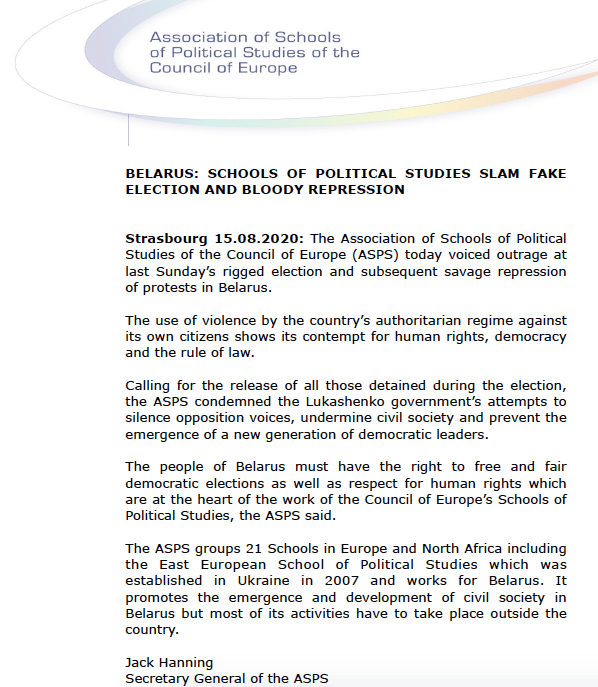
Ukrainian School of Political Studies and Agency of Legislative Initiatives also expressed support for the people of Belarus in their quest to defend their democratic rights and freedoms.
Interview with a spokeswoman of the Belarusian opposition
East-European School of Political Studies was established in 2007 to develop civil society and unite Belarus’ new democratic leaders. It belongs to the network in which the USPS works. However, the Eastern European School is registered in Ukraine, and most of its seminars still take place outside authoritarian Belarus.
In 2009, Anna Krasulina, now the spokeswoman for Lukashenko’s main rival Sviatlana Tsikhanouskaya, became the alumna of the East-European School of Political Studies. The opposition team managed to reach people and start a large-scale protest against authoritarianism. After the election, thousands of people protested to defend their right to fair elections. Police violence didn’t stop the people.
What is Belarus fighting for, and why is the regime of “Europe’s last dictator” rapidly falling apart? Anna Krasulina gave answers to the Ukrainian School of Political Studies.
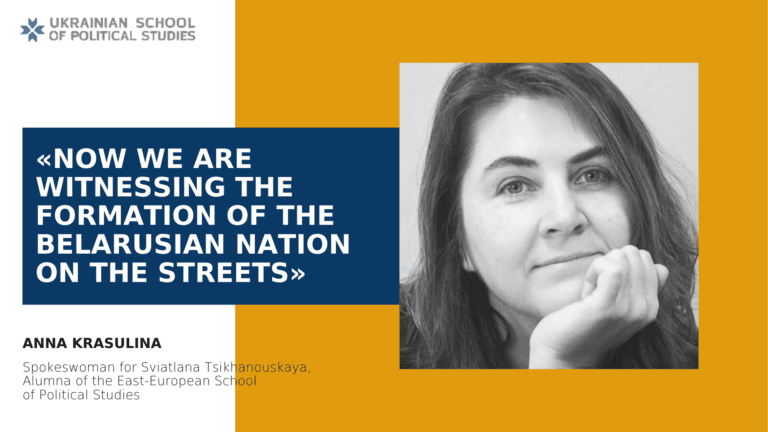
“Belarusian stability is a myth. This is stable poverty, stable starvation”
Do people in Belarus support Alexander Lukashenko as a president?
Lukashenko was supported when he had the resources to “buy” people: pensioners and state enterprises’ workers. You know, those state-owned enterprises that are extremely uncompetitive, their products are not sold – for example, the Tractor Plant. And people there receive higher salaries than university teachers. Of course, the workers were satisfied with this situation, plus or minus. But it was “bribing”. Lukashenko had enough money thanks to Russian infusions, oil transfers, and margins on oil products. We received oil at Russian domestic prices, and then it was processed at our plants and sold to Europe at European prices. Due to this margin, mostly, Lukashenko had support. Now, first, the price of oil has fallen sharply. Second, Russia has stopped selling at domestic prices because it has suffered severely economically itself. In the early 1990s, the Belarusian economy was quite competitive. We were a more economically developed country than Poland at that time. But during his presidency, Lukashenko destroyed the economy and science with his incompetent leadership. Russia has stopped supporting Lukashenko and his regime. And now the economy has collapsed. Lukashenko can no longer “buy” people. And “with him” remains only 20% of the population, who directly depend on him – it’s law enforcement agencies.
Why has such a large-scale resistance started now?
The economic situation is terrible. More than a million of the 4.5 million working population work abroad. Most of them earn money in Russia because they do not need visas and knowledge of a foreign language. Mostly, men go to work, and in villages and small towns, there are only women, children, and the elderly. People work for food and a roof over their heads. Recently, Belarus had a lower salary than Ukraine. And our prices have always been high. The standard of living has fallen sharply, even compared to Ukraine, which is at war. Belarusian stability is a myth. It is stable poverty, stable starvation.
People took to the streets against poverty, total disrespect from the authorities, against arbitrariness and injustice. During the coronavirus, the attitude of the authorities towards the people was especially clear. Lukashenko did not protect people, did not impose quarantine. So, people had to make horizontal connections. We learned to help each other during the pandemic. We sewed the costumes ourselves. We made the masks ourselves. There was no civil society in Belarus until last year. But the pandemic has shown people that they are capable of cooperating. People started to become a united nation. A clear example: the real statistics of deaths due to coronavirus in Belarus were silenced. Doctors were asked to sign a non-disclosure agreement. The paramedic from Lida (the city in the western part of Belarus, – Agency) dared to name the real figures in his district. He was immediately fired. But in three days, people gathered for him an annual salary. When Belarusians began to support those who opposed the system, who were not afraid to tell the truth despite everything, then civil society’s principles were established.
What is the difference between Belarus in 2010 and now? After all, then there were also protests, and the authorities managed to suppress them.
In 2010 only those who demanded respect, the rights, and freedoms acted. They are now joined by those on the lower tiers of the Maslow pyramid – people who need security and food. There is no satisfaction of the basic needs of physical existence in Belarus now. There is not enough food, we do not feel protected. In 2010, the intellectuals and the opposition took to the streets. And now even factories are on strike.
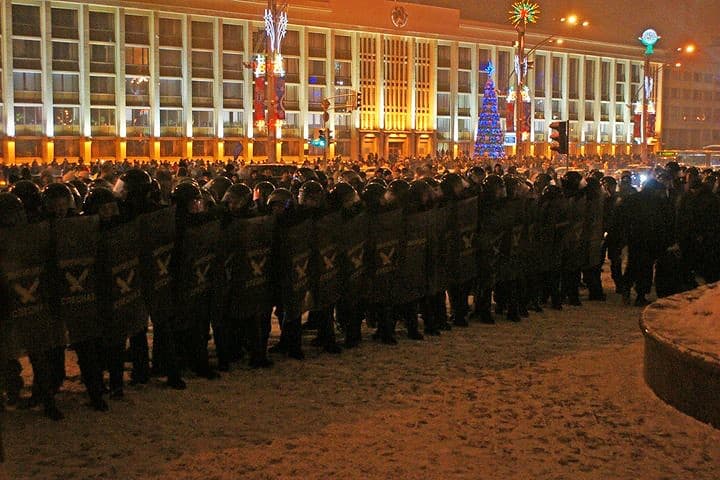
Protests in Belarus after the 2010 presidential election. Flickr / Isabel Sommerfeld
“Everyone is now responsible for their lives and future”
Now protests do not have a single leader. Do people organize themselves?
Yes. We set people up for this throughout the election campaign. At each meeting, we said: Sviatlana Tsikhanouskaya is just a symbol of hope. She will not lead people to the barricades. If there are one leader and one plan in our country, it will be very easily destroyed. We said that we should focus on decentralization. Everyone is now responsible for his/her life and future. And everyone must assess the possible participation in the protests: whether it is going to a demonstration, organizing a strike, posting leaflets or shouting from the window “Long live Belarus!”.
Thousands of security officers took to the streets together with people. How can you explain their aggression and violence against people from the very first minute of the protests?
Fear. Uncertainty. They understood perfectly well that they had lost. The security forces were tasked with intimidating very strongly and sharply. Otherwise, society will continue to fight. People were beaten and tortured at the Okrestyna detention center. This was done deliberately to try to intimidate society and return it to the “stall”. But the authorities will not succeed anymore. People began to respect themselves. Now we are witnessing the formation of the people on the streets of Belarus.
Which reaction and actions do you expect from the international community? How could other countries, including Ukraine, help Belarus?
We expect from the international community, at least, recognition of the victory of Sviatlana Tsikhanouskaya. Non-recognition of the fact of victory of the Belarusian people will be regarded as disrespect for their choice. We look forward to all possible diplomatic and moral measures to support the Belarusian people, as well as an end to violence on the country’s streets. We stand for personal visa and financial sanctions for those who falsified the election results and gave criminal orders to beat, injure, and detain civilians.
“The regime has no economic basis to maintain its power”
What is the strategy for further action if a transfer of power is carried out?
The transfer of power will be absolutely certain. Here the question is only in terms. This should happen as soon as possible to minimize consequences. This is in the interests of the authorities that will be held accountable. The regime has no economic basis to maintain its power. You can mismanage your farm if you have a lot of money. The current government will not be able to contain the situation either economically or in fact. This means that they will have to admit that people have won.
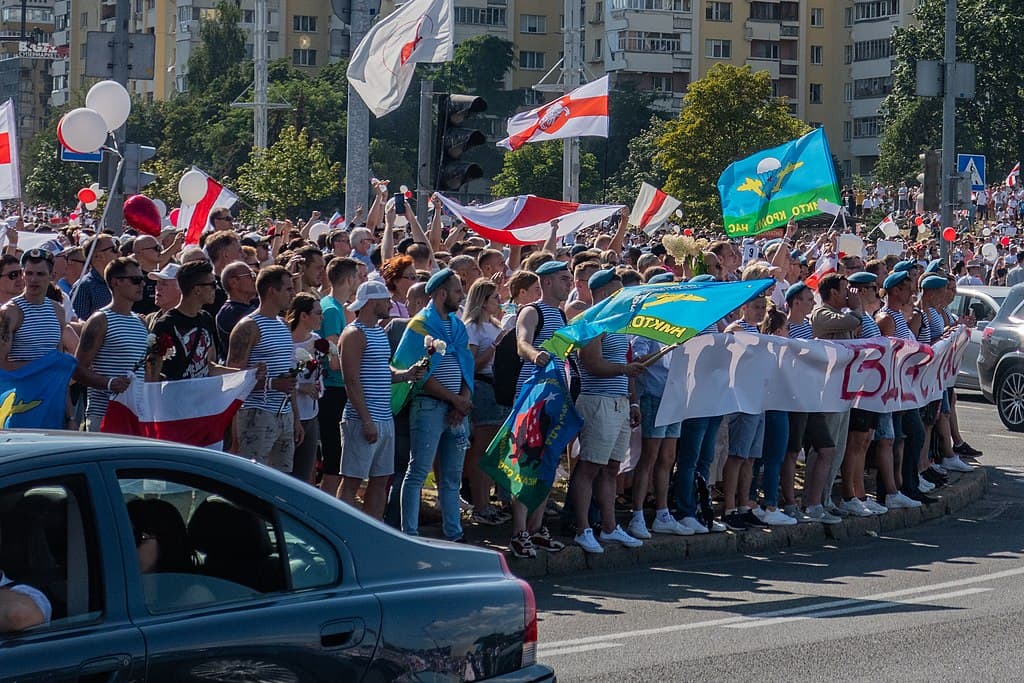
Belarus, 2020. Wikimedia Commons / Homoatrox
After that, Sviatlana Tsikhanouskaya promised three steps: the release of political prisoners, the restoration of the 1994 Constitution, which limits the president’s powers and term, and third, that conditions would be created for presidential elections to be held within six months. Everyone who wants will be able to take part in this fair election. Then the people, having evaluated the programs, teams, and personalities of the candidates will elect a new president.
Don’t you expect resistance from the parliament and the government?
Our government and parliament did not have any powers before. There are specialists in the government’s economic department, but they could not do anything without the approval of the president. A few years ago, Belarus negotiated with the IMF on serious loans and debt restructuring. All steps and draft reforms have been agreed with the IMF. It remained only to get a “yes” from the president and sign. But at the last moment, Lukashenko refused. Therefore, specialists in the government did not have the opportunity to work. To avoid serious shocks, we have decided that the average level of officials (from the Deputy Minister and below) is likely to remain in place. But the country’s top management needs to change. Thus, we will have the opportunity to build the government and parliament’s work in a completely different way. Those who systematically and seriously violated the law will be brought to justice.
“Belarus is a European country. Now it will return to its origins”
How does the Ukrainian Maidan differ from the protests in Belarus?
In Ukraine, the protest was concentrated, mostly, at one point. We have all the streets of the city, sleeping areas are a “springboard” for demonstrations. The protests are “decentralized” because we understood from the beginning that centralization would be broken, that there would be no Internet, that roads would be blocked. We tried to convey it to people – and we succeeded.
How did it happen in the country controlled by the authoritarian regime?
First, we gathered a huge number of people at meetings. Such a large amount of people has not been on protest since the early 90’s. We talked to the people there. Secondly, we used Telegram channels. Previously, it was not possible to reach such an audience. Besides, Sviatlana Tsikhanouskaya has a YouTube channel “Country for Life” created and developed by Sergei Tsikhanouskiy. We have learned to work with new digital tools. The desire for change enveloped the whole country, and our message spread very quickly.
What is the political future of Belarus without Lukashenko?
Democratic, European, civilized. In the twelfth century, the Grand Duchy of Lithuania already had the Magdeburg right and determined the European course of development. Belarus is a European country. Now it will return to its origins.
Ukrainian School of Political Studies and Agency for Legislative Initiatives support the people of Belarus in their intention to have a democratic country.
Solidarity with Belarus was also expressed by the Association of Schools of Political Studies, which covers a network of 21 schools in Europe and North Africa.