
Material prepared for Ukrayinska Pravda
On 29 August 2019, the 9th convocation of the VRU began its work. MPs have been working for five years, so after this anniversary, we want to recall what has been most memorable in the work of the parliament over the years. What was the 9th convocation surprised, pleased, and confused with?
Let’s start with the good things, namely with the achievements. There is indeed something to be proud of here.
About the good things
1. A “law on laws” was adopted
The “Law on Lawmaking” is among other important laws adopted by the Verkhovna Rada of the 9th convocation. This document is fundamental in the system of Ukrainian legislation: it sets the hierarchy of regulatory legal acts (RLAs) in order, i.e., clearly defines which of them have greater or lesser legal force in relation to each other; establishes basic definitions – we now have clear definitions of such concepts as “regulatory legal act,” “law,” “code,” and others; and governs the entire legislative process from draft law development to its adoption. An equally important innovation of the “law on laws” is the introduction of elements of public policy analysis into the lawmaking process: “white” and “green” books, impact assessments, and regulatory act concepts. Together with forecast and programmatic public policy documents, they should focus the Ukrainian decision-making system on ensuring that the adopted laws have a legally perfect text and a significant and traceable impact on society.
2. “Piano voting” was overcome
Non-personal voting, popularly known as “piano voting,” was a widespread crime in the Verkhovna Rada before the 9th convocation. Civil society activists have repeatedly documented such violations, and in 2019, they even found a record-breaking button-pusher: Volodymyr Kaltsev, an MP from the Opposition Platform – For Like (OPFL) who voted as many as nine times.
The situation changed in 2021, when a touch button was installed in the VRU: now MPs must use both hands to vote – one hand on the touch button and the other to press “for,” “against,” or “abstained.” A little earlier, in February 2021, MP Vladyslav Poliak (Dovira group) was notified of suspicion of piano voting. Although the case is still pending in court, and Poliak is still an MP, cases of piano voting, at least apparently, have stopped since the introduction of the touch button. However, most MPs who were caught piano voting have not yet received the punishment they deserve.
3. The moratorium on the sale of agricultural land was lifted
One of the greatest achievements of the 9th convocation was the adoption of Government Law No. 552-XI, which launched the land market in Ukraine and ended the twenty-year moratorium.
The moratorium was introduced in 2001 with the adoption of the Land Code. It was expected to be a temporary measure that would remain in place until legislation was developed to regulate the turnover of agricultural land. However, this issue was later made a subject of speculation, and the ban was extended annually for decades.
At the same time, both businesses and the Ukrainian government understood the need to introduce an agricultural land market, which, moreover, exists in a more or less liberal form in all countries of the world. Instead, the moratorium was in place only in Venezuela, Congo, the DPRK, Tajikistan, and Cuba. However, MPs submitted a draft law to the VRU only in 2019, and it was adopted three years later in 2021.
As of July 2024, three years have passed since the opening of the agricultural land market. According to Opendatabot, Ukrainians have purchased 567,322 hectares during this time and concluded more than 250,000 land sale agreements.
4. The functionality was maintained, and the operation continued at the beginning of the full-scale war
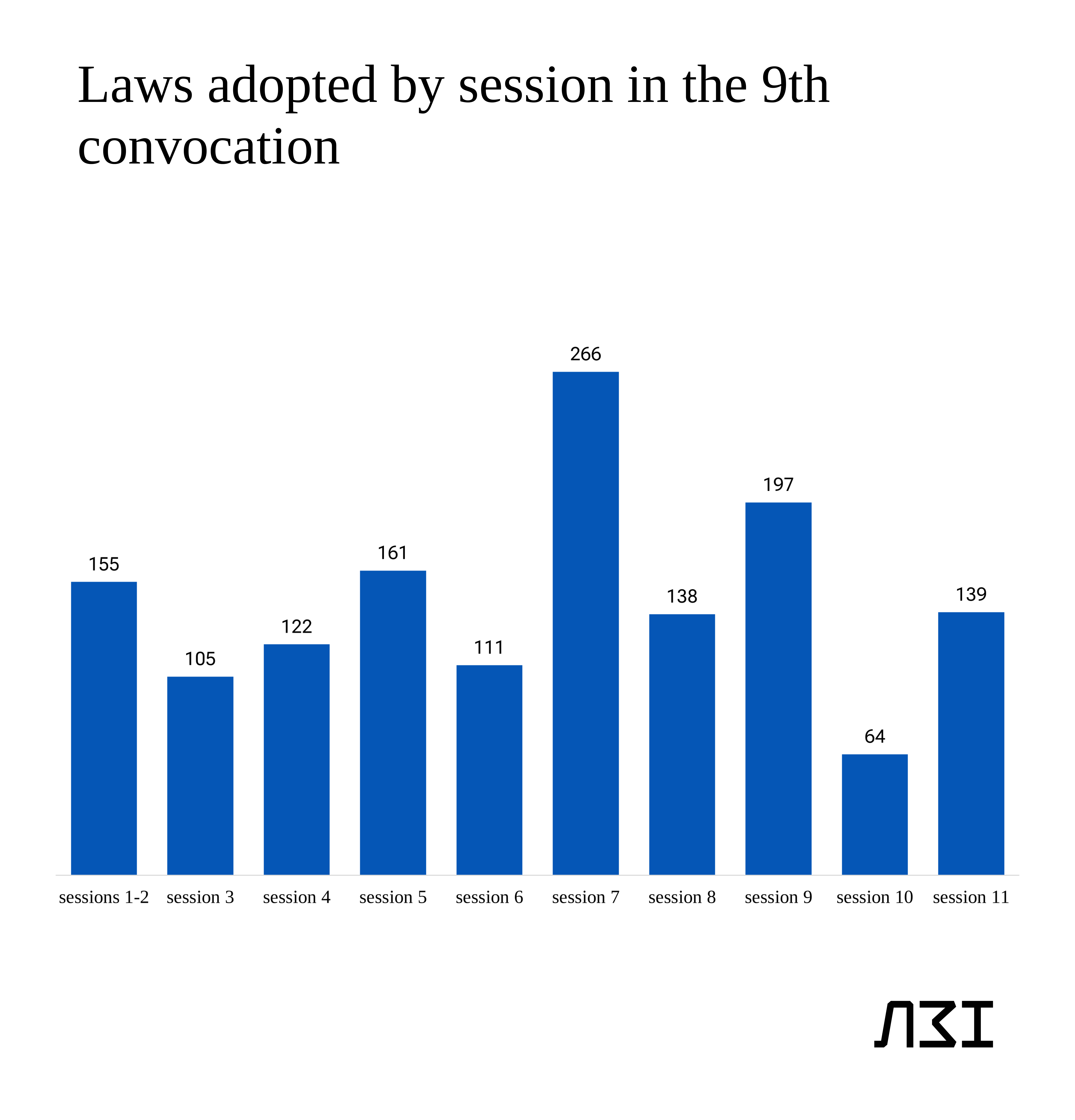
At the beginning of the full-scale war, the Verkhovna Rada not only managed to continue its work but also switched to a real “turbo mode.” During the seventh session (which covered the first six months of the full-scale invasion), the 9th convocation passed 266 laws, which is a record for laws passed in a session not only in this convocation, but also among all previous ones. In addition, the time for processing and passing draft laws has decreased – half were adopted in less than eight days.
But not everything is so good. There are some significant problems that the Verkhovna Rada of the 9th convocation can and should be reminded of.
About the disappointments of the 9th convocation
In situations where MPs violate basic standards of conduct, they demotivate their colleagues who do their jobs diligently and have a good public image and destroy trust in the Verkhovna Rada as a whole. As it stands, MPs cannot actually dissociate themselves from the unethical conduct of their colleagues. This issue could be resolved by adopting the Code of Conduct, a document that introduces uniform standards of conduct for MPs. In fact, this solution is ready, as the relevant draft law has been registered in the Verkhovna Rada. However, either internal resistance within the parliament or the desire to maintain a low level of trust in the Verkhovna Rada (and thus limit its subjectivity) has meant that this draft law is still pending.
2. MPs were made less protected from pressure from the executive branch
In August 2019, the VRU passed a law abolishing parliamentary immunity. Since then, law enforcement agencies have been able to prosecute MPs without prior approval of the parliament.
The issue of bringing MPs to justice is important in protecting the parliament from the executive branch, particularly law enforcement officers and prosecutors influenced by the President. Previously, if MPs did not want to pass a draft law that the government or the President wanted, they could not be threatened with criminal prosecution, but now all this is possible. With a weak judiciary, this is a direct threat to authoritarianism. International partners, primarily the EU, the Council of Europe, and its advisory body, the Venice Commission, have always had a negative attitude to initiatives to abolish parliamentary immunity.
3. The Verkhovna Rada became less open and transparent
The Verkhovna Rada of the 9th convocation has become much less open to society. On the one hand, this happened for objective reasons: first, the parliament restricted access for journalists during the COVID-19 pandemic, and then new, fully justified restrictions were introduced due to the commencement of Russia’s full-scale invasion on 24 February 2022. In addition to restricting journalists’ access to the Council, live broadcasts of its meetings were suspended for a month and a half (until April). Information about MPs also disappeared from the VRU’s website, and voting data was no longer updated.
Now, most of these restrictions have been lifted in one way or another, but they have already changed the work of the parliament, and it is unclear whether they will return to the old format. For example, journalists have been returned to the Verkhovna Rada, but in the format of a special room, not a press box. Meetings of the Conciliation Board remain closed (which is already a positive development, as it fulfils one of the recommendations given by the European Parliament Mission). Nevertheless, the Verkhovna Rada’s overall accessibility and openness have not been restored to pre-conflict levels.
4. Public trust was lost
In the 2019 elections, the presidential party Servant of the People received the highest support from citizens, winning 41.16% of the vote. The trust of voters helped the Servant of the People gain a mono-majority in the parliament, allowing them to make any decisions solely on the basis of their faction. However, due to internal disputes, corruption scandals and the unprofessional conduct of certain MPs, the ninth convocation lost the trust of the majority of voters by 2024. Thus, in December 2023, according to KIIS, only 15% of respondents trusted the Verkhovna Rada, while 61% did not trust it (another 24% chose the option “Uncertain”). In addition, according to another KIIS poll conducted in May 2024, one-third of respondents rated the performance of the Servants of the People as “very poor” and another 23% as “rather poor.”
Anti-records in terms of trust in the government are not new to the Ukrainian space. However, we would like to recall some of the records set by the 9th convocation.
About the records of the 9th convocation
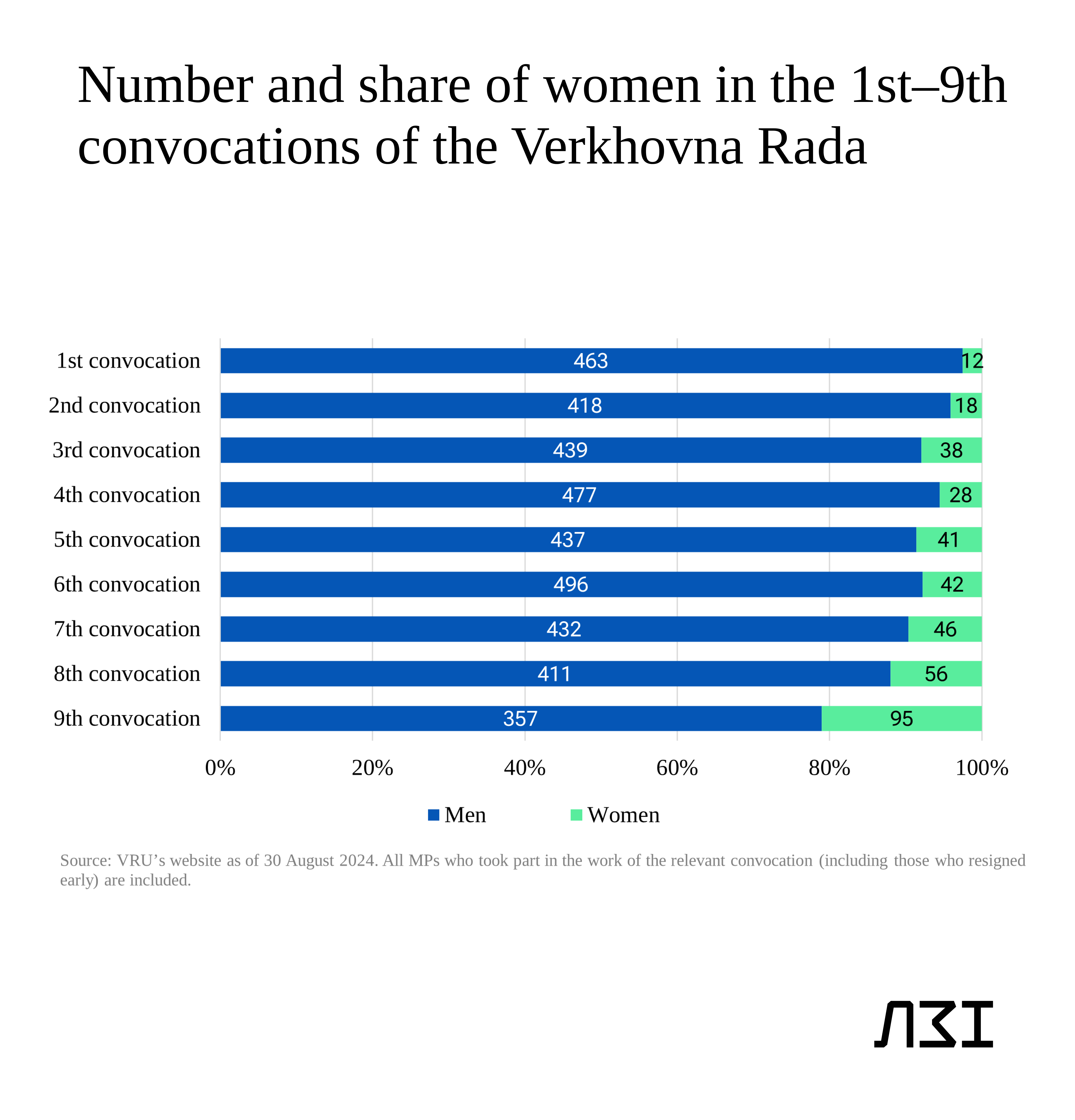
One of the important records of the Verkhovna Rada of the 9th convocation is the largest share of women among MPs, making almost 21%. In fact, the share of women in the Verkhovna Rada has been increasing with each subsequent convocation. For example, 12% of female MPs (56) were part of the eighth convocation, while the smallest number of women – only 12, or 2.5% – attended the first convocation.
2. Minimum number of MPs
As of the end of August, the number of MPs in the Verkhovna Rada is also at a record low, currently 401. This is due to the fact that 51 MPs resigned early, and only 30 “newcomers” replaced them, meaning that it was only partially possible to replace those who left. Although this situation is not catastrophic, and there have been worse situations in Ukrainian parliamentarians’ history (for example, the 2007 parliamentary crisis), this trend is worrying because the more MPs leave the parliament, the more difficult it is for those who stay to find votes to pass important draft laws.
3. Potentially the longest term of the Verkhovna Rada of Ukraine
The term of the Verkhovna Rada of the ninth convocation lasts exactly five years. Although the ninth convocation has not yet become the longest (the 6th convocation lasted 1,846 days, while the current one lasted 1,833 days as of 4 September 2024), it has every chance of breaking this record, as it will continue until martial law is lifted. Of course, there is also a less optimistic scenario: if MPs resign early in a massive way, the VRU may lose its decision-making capacity. However, the parliament still has 69 possible resignations of MPs away from this situation.
4. Record number of medals at the Olympics
Finally, sporting achievements in the Verkhovna Rada are also shaping up to be record-breaking. The parliament has a two-time Olympic champion for the first time. This is Zhan Beleniuk. During his time as an MP, he took part in two Olympic Games: in 2016, he won gold in Greco-Roman wrestling at the Summer Olympics in Rio de Janeiro, and in 2024, he won bronze in Paris.
These records are real. However, the 9th convocation was shrouded in some more legends and myths, without mentioning which the portrait of this term would be incomplete. So here are the popular myths about the VRU of the 9th convocation.
About the myths of the 9th convocation
One of the most memorable myths about the 9th convocation was the so-called “turbo mode”. Its emergence can be attributed to the then Speaker of the Verkhovna Rada, Dmytro Razumkov, who used this term to explain the alleged acceleration of the procedure for adopting reformist draft laws. However, Razumkov himself later retracted the term, adding that journalists invented and spread the term “turbo mode.” He acknowledged that the number of draft laws passed by the Verkhovna Rada had not increased significantly compared to previous convocations. The data of the Agency for Legislative Initiatives also confirm that there was no “turbo mode.” During the first and second sessions, the VRU adopted 155 draft laws. In comparison, 140 draft laws were adopted in the 8th convocation during the same time. It is worth noting that the 9th convocation, unlike the previous one, did not have to spend time forming a coalition thanks to its mono-majority. The situation was more appropriately described by another loud expression that was in use by political journalists at the time – “mad printer.” After all, during the first two sessions, MPs managed to register more than a thousand new draft laws (this number gradually decreased in all other sessions).
We can add that it is not entirely correct to evaluate the effectiveness of the VRU by the laws registered and adopted because, first, the legislation provides for a clear and rather lengthy procedure for adopting laws, the acceleration of which will lead to violations of the Rules of Procedure, and, second, the desire to adopt as many draft laws as possible in a short time may lead to their lack of elaboration and even erroneous decisions, which may require new amendments to the legislation to correct.
2. Unity of the mono-majority
While the unity of the Servant of the People’s mono-majority faction was possible to discuss at the beginning of the 9th convocation, the situation changed in the following years. This happened mainly due to internal disputes, where some MPs left the faction on their own, and some were expelled due to scandals (e.g., Bohdan Torokhtii or Anatolii Hunko). Thus, already in 2021, according to the Opora network, the “servants” passed only about a quarter of the laws with the votes of their faction alone. This situation only got more complicated, and in 2024, the Servants of the People increasingly had to look for situational allies in the factions of Restoration of Ukraine and PFLP, which were formed by members of the banned OPFL. Their votes are also used to pass quite important laws, such as the law on fair lobbying.
3. Loss of legitimacy
The myth about the loss of legitimacy of the 9th convocation can be attributed to Russian propaganda. The myth is that this convocation’s term of office is supposed to expire in August (after all, five years have passed), and therefore, it is losing its powers. However, this statement is refuted by the Constitution of Ukraine, which (specifically in Article 83) states that if the powers of the Verkhovna Rada expire during martial law, it still continues to work until it is lifted. Only after martial law is lifted can regular parliamentary elections be held.
4. The largest number of new faces
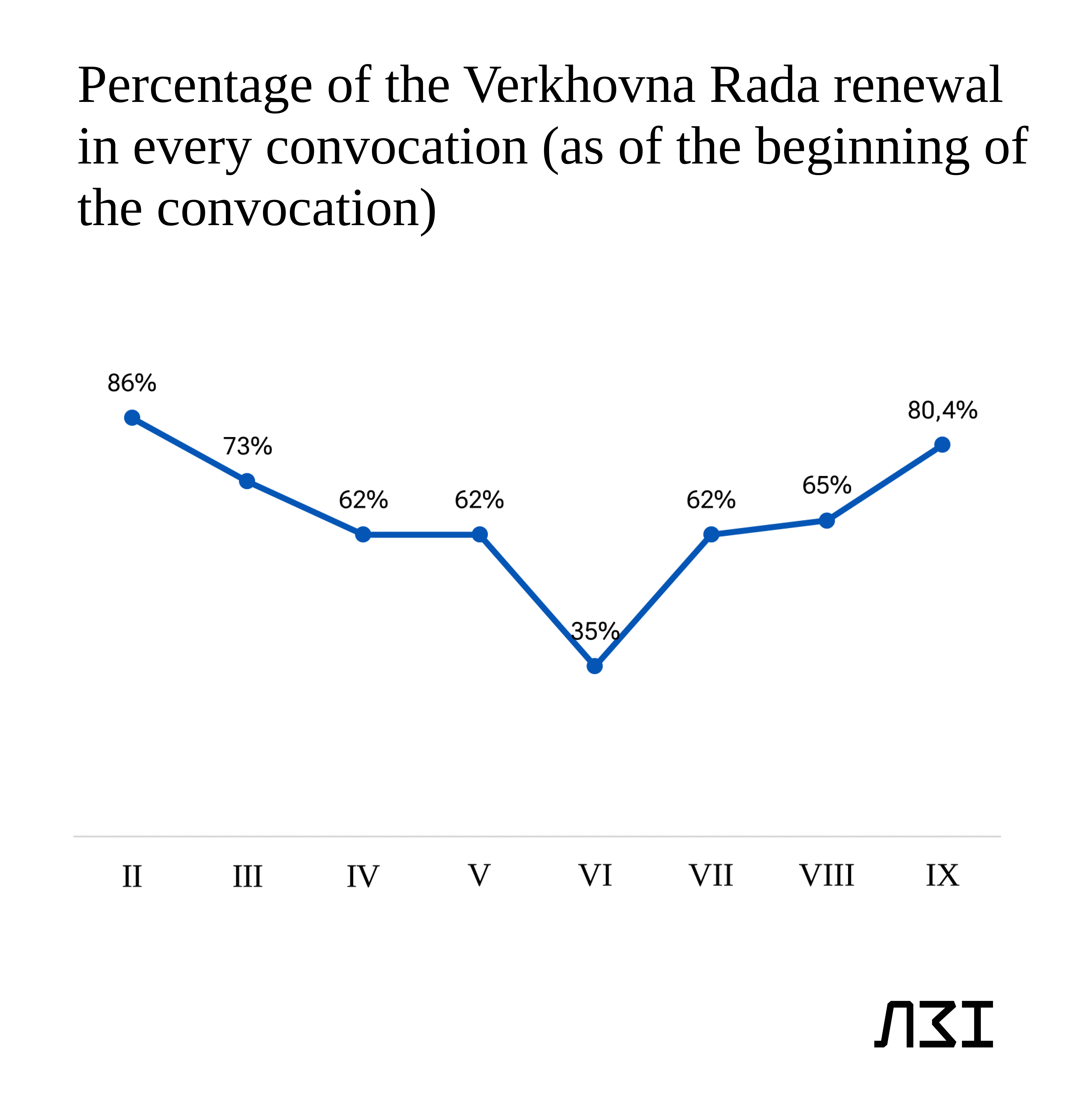
Although in 2019, the President and his Servant of the People party placed perhaps the biggest stake on “new faces” and presented it as a complete renewal of the Verkhovna Rada, in reality, the parliament was renewed by 80.4%, mainly due to the Servant of the People (which, indeed, included MPs with no previous experience of this kind). At the same time, the Verkhovna Rada was renewed the most after the first convocation – by 86%.
Finishing touches to the portrait
MPs of the 9th convocation have to work in one of the most difficult times for the country. This requires full involvement and dedication from MPs. They do a lot: pass important draft laws, including European integration draft laws (although not without “additional motivation” from international partners), continue reforms, etc.
As we have seen, this VRU also has its own records, and some of the theses spread in the information space are nothing more than myths inspired, not least by Russian propaganda. Of course, MPs have also managed to disappoint their voters over the past five years. They delay the resolution of many problems while addressing others at an accelerated pace, often leading to new mistakes.
However, the VRU remains a legitimate and functioning institution, and this should not be underestimated.