


Preparation of the analytical materials is a part of a project implemented by the NGO Agency of Legislative Initiatives with the support of USAID RADA Program: Responsible Accountable Democratic Assembly, implemented by East Europe Foundation.
Assessment of Internal Reform and Capacity Building of the Verkhovna Rada of Ukraine
Exactly three years ago Verkhovna Rada started the parliamentary reform with the adoption of the Resolution no. 4219 committing to take measures to implement 52 recommendations of the Roadmap on Internal Reform and Capacity Building for the Verkhovna Rada of Ukraine proposed by the European Parliament Needs Assessment Mission to the VRU. Today the Parliament is still overwhelmed with legislative spam, and the level of Ukrainians’ trust in the Verkhovna Rada reaches the historic minimum. This situation is accompanied by insufficient quality of draft laws and analytical support of legislative initiatives. The Agency for Legislative Initiatives decided to analyze the progress of the parliamentary reform.
In the document “Assessment of Internal Reform and Capacity Building of the Verkhovna Rada of Ukraine” we evaluate the status of the implementation of all 52 recommendations using own developed methodology, as well as provide recommendations on way forward.
The status of implementation of all 52 Roadmap recommendations is estimated at 87 of 208 points, which is 41,8%.

Презентація Тіньового аналітичного звіту від громадськості (Shadow Report) на тему «Реформа державної служби та державного управління в Україні у 2017 році» – Copy
On May 16, 2018 at the Committee meeting on State Building, Regional Policy and Local Self-Government the presentation of the Shadow Report “Civil Service and Public Administration Reform in Ukraine in 2017” was held.
The shadow report was presented by Tatiana Chernukha, Program Coordinator of the Agency for Legislative Initiatives. The study was prepared within the framework of the USAID RADA Program: Responsible, Accountable, Democratic Assembly implemented by the East Europe Foundation.
The report is includes the process assessment of key reforms implementation in the area of public administration and public service of Ukraine, as defined by the new edition of the Law of Ukraine “On Civil Service”, adopted on December 10, 2015, which came into force on May 1, 2016, along with the relevant key policy documents of the Government on public administration reform, approved in 2017. The report studies the policy assessment in the field of civil service reform and public administration reform (PAR), including its compliance, retrospective progression and internal concurrence, integrity, planning, co-ordination and resource provision of implementation.
This report does not analyze the Verkhovna Rada and the President of Ukraine role in shaping the public policy and their coordination with the Cabinet of Ministers; local state administrations role and their coordination with central executive bodies; independent regulators role; local self-government role; budget process efficiency and reformation state of the public finance management system.
Tetiana Chernukha noted that the report prepared by the Agency for Legislative Initiatives is an alternative to the government report for 2016-2017 on the implementation of public administration and civil service reform of Ukraine.
“This report is prepared to support the Committee on State Building, Regional Policy and Local Self-Government control functions. We also pursue the goal of supporting the reform itself in such a way that it takes place as efficiently as possible and in order to respond in time to certain challenges, problems that may arise in the process of its implementation.
The Government’s report for 2017 contains a detailed description of the activities implemented during the year in areas covered by the Strategy, but does not reveal the state of objectives achievement, implementation of performance indicators and, in particular, the impact on problem solving. The reports also do not provide a clear understanding which planned measures were not implemented and why, and do not fully address the real challenges and risks associated with the PAR implementation, which are currently crucial and critical”
The Government’s report for 2017 contains a detailed description of the activities implemented during the year in areas covered by the Strategy, but does not reveal the state of objectives achievement, implementation of performance indicators and, in particular, the impact on problem solving. The reports also do not provide a clear understanding which planned measures were not implemented and why, and do not fully address the real challenges and risks associated with the PAR implementation, which are currently crucial and critical”
The report presents a qualitative assessment of the reform implementation, based on the Public Administration Principles developed by SIGMA:
- Coordination of implementation of public administration reform;
- Formation and coordination of government policy and strategic planning of government activities;
- Development of civil service and personnel management;
- Accountability and institutional architecture of the central executive authorities system.
Problematic aspects of public administration reform implementation are:
- Weak political management;
- Uncertainty in resource provision and sustainability of PAR funding;
- Insufficient and uncoordinatedPAR communication;
- Low level of introduction of modern information and communication technologies in public administration system.
Among the problematic aspects of the formation, coordination of state policy and strategic planning, the following should be singled out:
- Low coherence and coordination of state policy at the political level;
- Low capacity to formulate state policy at the administrative level (at the civil service level);
- Inconsistency between the planning of government activities and the planning of budget expenditures.
The problems of civil service development and human resources management are:
- Low ability to manage civil service personnel management;
- Low professional level of organization and holding competitions for civil service positions;
- Inconsistency of the evaluating system of civil servants performance with the government goals and between different categories of civil service. Lack of connection between the assessment system and financial motivation;
- Lack of an effective system of civil servants professional development of all categories.
Among the problematic aspects of accountability and institutional architecture of the central executive authorities system, the following should be singled out:
- There is no clear distinction between political and administrative functions at the level of ministries;
- The subjects’ functions of the policy formation and implementation are not distinctly specified;
- The optimization and centralization of ministry functions were not held.
Summing up the presentation and discussion of the Shadow Report, Serhiy Vlasenko, Chair of the Committee on State Building, Regional Policy and Local Self-Government, noted that the Committee takes note of the information, taking into account the comments expressed by MPs during the discussion.
Civil Service and Public Administration Reform in Ukraine in 2017 (Shadow Report)
The report is devoted to the evaluation of the progress on key reforms in the field of public administration and public service of Ukraine, as defined in the revised Law of Ukraine «On Civil Service», adopted on December 10, 2015, which came into force on May 1, 2016, with the relevant key policy documents of the Government on the Public Administration Reform that were approved in 2017. The evaluation of policy in the field of reforming the civil service and public administration, including its relevance, consistency in retrospectives and internal consistency, integrity, planning, coordination, and resourcefulness of implementation are researched.
The research examines the progress of implementing the corresponding State policy measures from January 2017 to May 2018, as well as the analysis of the specific challenges of reforming and specific suggestions for the required steps in this area.
Only existing normative legal acts in the field of public administration from January 2017 to May 2018, primarily the Civil Service Law, have been studied with a view of preparing the publication.
The publication focuses on reforming the public administration system, mainly at the level of the CMU and CEB, especially as regards the coordination of the reform implementation, the development of capacity in relation to the formation of public policy, the development of personnel management in the civil service and the organization of the Government architecture and its accountability.
For this publication, the above-mentioned issues and essential elements of the public administration were not analyzed. They should be included in the comprehensive harmonization of the Public Administration Reform, still, they are insufficiently covered by the key Government policy documents:
- Roles of the VRU and the PU in the formation of the state policy, and their coordination with the Cabinet of Ministers;
- The role of the MDA and their coordination with the CMU and the territorial offices of the CEB;
- The role of independent state bodies regulating certain spheres (independent regulators) and their coordination with the CMU;
- The role of local self-government;
- The effectiveness of the budget process and the state of the public finance management system reform.
The preparation and presentation of analytical reports in the Shadow Report format is part of the project embodied by the Agency for Legislative Initiatives, supported by the USAID Rada Program: Responsible Accountable Democratic Assembly, implemented by the East Europe Foundation.
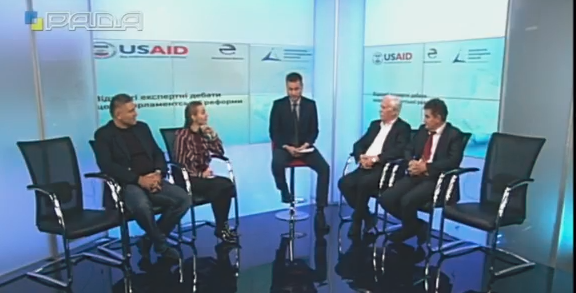
The First Open Expert Debate on Parliamentary Reform
The debate was broadcast live on the RADA TV channel, which made it possible to engage a wide range of viewers of the RADA TV channel as well as the online audience to discuss the topic of parliamentary reform. Besides, the Facebook page of the Agency for Legislative Initiatives invited to take part in a survey on key issues of parliamentary reform through online voting.
The event was organized by the Agency for Legislative Initiatives within the framework of the USAID RADA Program: Responsible, Accountable, Democratic Assembly implemented by the East Europe Foundation.
Moderator: Oleksandr Zaslavskii, Deputy Chairman of the Board of the Agency for Legislative Initiatives.
Speakers:
- MP Olena Sotnyk, member of the parliamentary faction of the political party Samopomich (Self Reliance), secretary of the VRU Committee on European Integration;
- MP Yuriy Miroshnychenko, member of the parliamentary faction of the political party Opozytsiynyi Blok (Opposition Bloc), Chairman of a Subcommittee of the Committee on Legislative Support of Law Enforcement.
Experts:
- Yuriy Hanuschak, MP of Ukraine of the 6th convocation;
- Volodymyr Kryzhanivsky, MP of Ukraine of the 1st convocation, Senior Advisor to the USAID RADA Program.
The debate focused on discussing specific proposals outlined in the Roadmap on Internal Reform and Capacity-Building for the Verkhovna Rada of Ukraine prepared by the European Parliament’s Needs Assessment Mission led by Pat Cox.
There are a number of challenges that hinder the effective work of the Verkhovna Rada of Ukraine. From October 2015 through January 2016, the European Parliament’s Needs Assessment Mission led by Pat Cox was working in the Verkhovna Rada to identify and analyze these challenges. Based on this work, the Mission drafted the Report and the Roadmap on Internal Reform and Capacity-Building for the Verkhovna Rada of Ukraine. On March 17, 2016, the Verkhovna Rada of Ukraine adopted a Resolution based on this document, which contains 52 recommendations on improving the work of the Verkhovna Rada of Ukraine as regards institutional capacity, improving the quality of the legislative process, ensuring compliance of legislation with EU regulations, etc. Since then, a number of legislative initiatives have been registered to implement the relevant recommendations, which, however, have not been adopted, not even as a basis. A year ago, the Working Group on Parliamentary Reform was established under the leadership of the Chairman of the Verkhovna Rada of Ukraine; its task is to ensure coordination of the positions of parliamentary factions on specific decisions in the process of implementation of the 52 recommendations. Besides, there is an additional platform for finding a political compromise – i.e. the Monnet Dialogue Platform.
The first set of issues discussed by MPs and experts concerned the organization of the process of discussing and aligning political decisions on parliamentary reform and search for a political compromise. Another important aspect concerned the issue of how effective this process is.
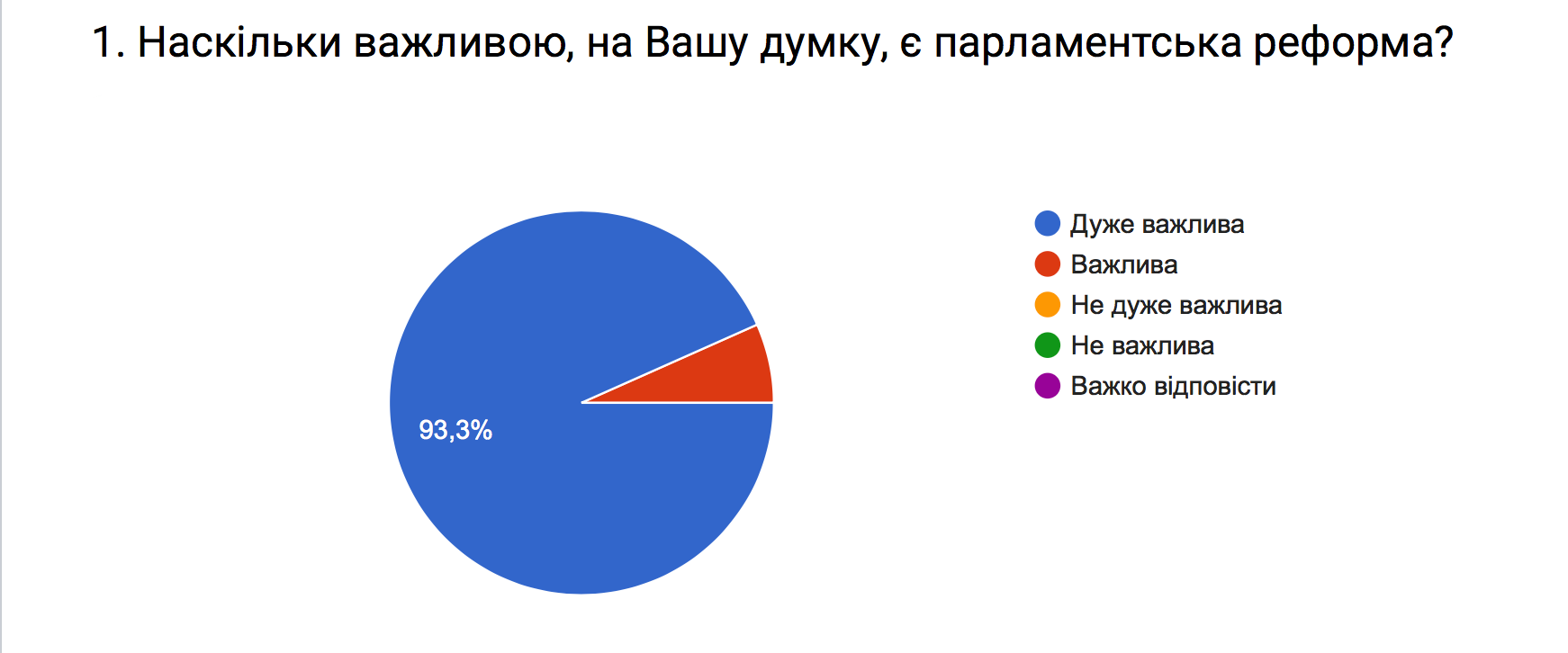
Результати онлайн-голосування
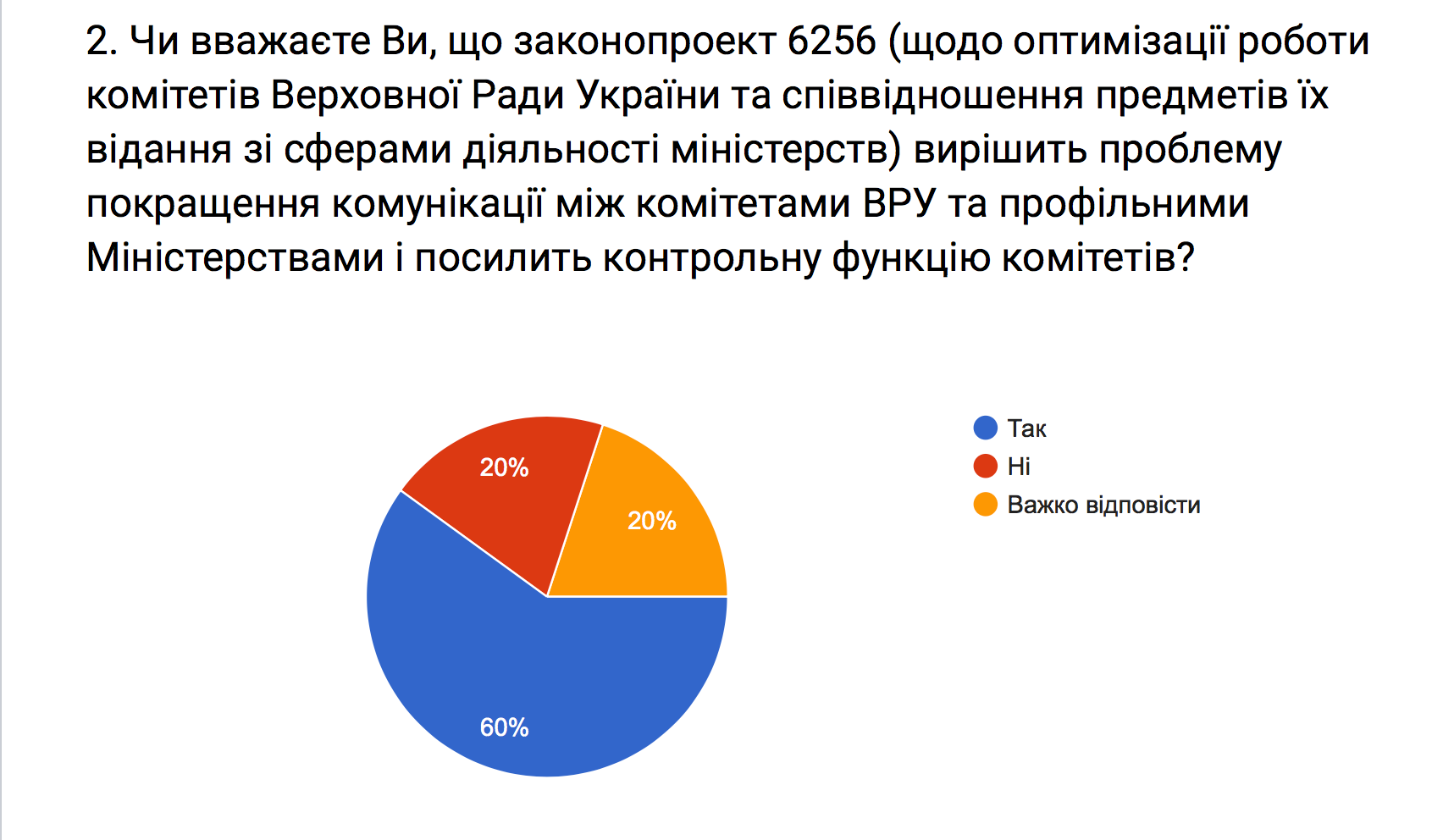
The second set of issues focused on the bills approved within the framework of the working group and the Monnet Dialogue Platform. These are the Draft Law “On Amendments to the Laws of Ukraine “On Committees of the Verkhovna Rada of Ukraine” and “On Central Executive Bodies” regarding the optimization of the work of the committees of the Verkhovna Rada of Ukraine and relation between their areas of competence and the ministries’ fields of activity.
This bill was drafted in pursuance of recommendation 17 of the Roadmap stipulating the need to strengthen the monitoring role of committees due to improved communication with specialized committees. Yet, why has it not been approved? Do the provisions set in the bill comply with the recommendations? To what extent can this bill solve the problem described in the Roadmap?
Результати онлайн-голосування
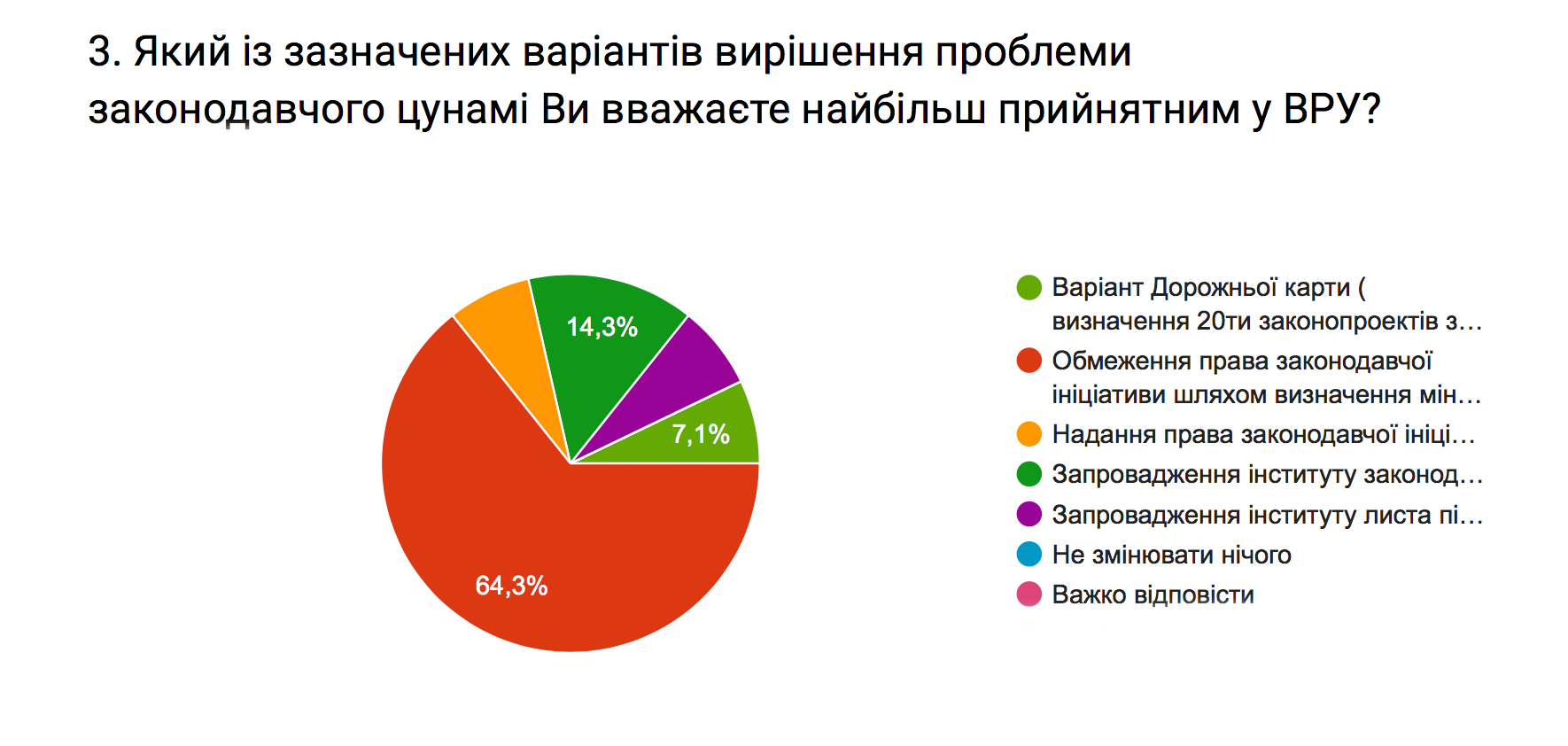
The third set of issues focused on the problem of the “legislative tsunami” or, to use parliamentarians’ term, “legislative spam”, which the European Parliament’s Assessment Mission recognized to be a major problem of the Parliament’s work. This term is used to describe the huge number of legislative initiatives registered by MPs that become a burden for the expert departments of the Secretariat, for the parliamentary committees and Parliament as a whole. Accordingly, recommendation 6 of the Roadmap stipulates that 20 top-priority legislative initiatives of MPs should be selected and considered based on the “float principle” – i.e., Parliament will go on to consider the next parliamentary initiative only after adoption of one of these 20 as a whole. During the numerous discussions, the participants inter alia voiced the following options: setting of the minimum number of MPs to execute the right of legislative initiative; introduction of the institution of legislative proposal as a way to enforce the MPs’ right of legislative initiative; introduction of the institution of support letters for legislative initiatives of individual MPs; granting the right of legislative initiative to the committees of the Verkhovna Rada.
Which of these options, according to MPs and experts, are the most acceptable for the Verkhovna Rada? How significant is the problem of “legislative tsunami”? Can it be solved in one of these ways?
Результати онлайн-голосування
Presentation of the paper “Problem of Creating Parliamentary Service. Principles of Reform, Foundation of Functioning, Guarantees of Activity”
The event involved 10 procedural discussions aimed at promoting the implementation of parliamentary reform.
The discussion covered the following issues:
- Analysis of current practices and international experience in regulating the parliamentary service.
- The problem of creating a parliamentary service. Principles of reform, foundation of functioning, guarantees of activity.
- Legislation on parliamentary service: the preferred format:
- a separate law;
- a section of the law on civil service.

Presenting the paper, Tetyana Chernukha, Program Coordinator of the Agency for Legislative Initiatives, drew attention to the principles of reforming the parliamentary service, including reinforcement of the institutional autonomy of the Secretariat of the Verkhovna Rada of Ukraine; development of a staffing strategy of the Secretariat; codification of internal parliamentary policies; and drafting of the law “On Regulatory Legal Acts”.
Outlining the functions of the parliamentary service of Ukraine and its role in decision-making, Ms. Chernukha noted that the VRU Secretariat carried out organizational, expert and analytical, financial and technical support of the work of the Verkhovna Rada of Ukraine; prepared draft decisions important in planning the work of the VRU (i.e. estimates, plans of legislative work, draft agenda, draft assessment of bills for the main committees, draft opinions of the Scientific and Expert Department and Legal Department, and registration of draft laws).
Ms. Chernukha emphasized that based on the results of the survey of Secretariat employees (anonymous poll of the expert department and committee secretariats), 100% of respondents indicated that their political views did not affect their work in the VRU). However, 40 % of respondents noted that they had witnessed political pressure on their colleagues.

According to Ms. Chernukha, the possible ways of reforming the parliamentary service include designing an effective mechanism that would enable the Main Scientific and Expert Department and the Main Legal Department to suspend inadequate bills; development and introduction of a mechanism of protection against political pressure on employees of the relevant departments; as well as creating an anonymous online platform for employees to complain about political pressure on themselves or their colleagues. Each complaint should be dealt with and investigated.
Having analyzed the current personnel policy of the VRU Secretariat, Ms. Chernukha proposed a number of ways to improve the work of the parliamentary service, including elaboration of clear job descriptions; standardization of the form and establishment of clear-cut requirements for the expert opinions and legal reviews prepared by the Secretariat, the relevant job descriptions must contain references to them; classification of professional positions; appropriate training of the members of the competition commissions; elaboration of test tasks, which should vary depending on the job description and the grade level of the job. The selection of the VRU Secretariat employees and their further work may greatly benefit from the following: arrangement of selection planning so that specific requirements should be checked at each stage of the selection; reducing the scope of subjective assessments of commission members by introducing answer-keys to situational tasks; improving data collection and reporting on human resources in the civil service with a view to effectively supporting HR planning, HR management activities and monitoring can also significantly improve the process of selecting the staff of the Verkhovna Rada staff and their further work.

As of today, 37 % of the polled representatives of the Verkhovna Rada Secretariat state that they do not think that the regulations and procedures of the organization of the work of the Verkhovna Rada of Ukraine are clear and understandable. 52 % of the representatives of the Verkhovna Rada Secretariat emphasize that they do not consider the legislative process in the VRU to be of high quality and effective (at the same time, 48 % consider it to be sufficiently effective).
According to Ms. Chernukha, the measures aimed at improving the legal framework for the work of the VRU Secretariat include consolidation of the legal and regulatory framework for the documents regulating the work of the VRU Secretariat into a single set of internal rules, including those on the implementation of personnel policy (Roadmap on Internal Reform and Capacity-Building for the Verkhovna Rada of Ukraine); as well as adoption of a law on regulatory legal acts that could facilitate the regulation of the status of regulatory acts, as well as acts adopted by officials of the VRU Secretariat.

Civil Service Reform in Ukraine: Specialised Law Implementation in 2016–2017 (Shadow Report)
The Shadow Report assesses implementation of key civil service reforms in Ukraine as defined by the new version of the Civil Service Law adopted on 10 December 2015 and enacted on 1 May 2016. It focuses, primarily, on the civil servants’ political neutrality and professionalism, as well as their remuneration and performance.
The paper traces the progress made in the implementation of the above public policy measures between May 2016 and May 2017, as well as suggests certain further steps in this area.
This report is based only on the current civil service laws and regulations valid in the period between May 2016 and May 2017, in particular the Civil Service Law.
Even though the civil service associated bills and draft regulations, as well as related laws, such as on the Cabinet of Ministers and on the Central Executive Authorities, the legislation on local administrations and local self-governance were not in the focus of this publication, a comprehensive and high quality civil service reform is not possible without their amendment.
The preparation and presentation of analytical reports in the Shadow Report format is part of the project embodied by the Agency for Legislative Initiatives, supported by the USAID Rada Program: Responsible Accountable Democratic Assembly, implemented by the East Europe Foundation.
Shadow Report “Public Service Reform in Ukraine: Implementation of the specialized law in 2016-2017”
On May 17, 2017 Shadow Report “Public Service Reform in Ukraine: Implementation of the specialized law in 2016-2017” rpesentation took place.
The Shadow Report “Public Service Reform in Ukraine: Specialized Law Implementation in 2016-2017” is an alternative to the governmental report on the implementation of the key results of public service reform in Ukraine. The report examined the development and adoption of the Law On Public service; exhaustively analysed the provisions of the law with a focus on potential shortcomings and recommendations; formulated a new vision of public service in Ukraine; and suggested modern tools of personnel management in the public service.
“USAID RADA Program continues to monitor the situation around the draft law On Public Service. Today the format of this meeting of the committee in terms of performing the control function is of critical importance to us. The Report prepared by the Agency for Legislative Initiatives represents a politically neutral position that balances those of the government, of the committee, and the position of independent experts. The practice of such reporting format is very useful and we would like to introduce it in the contemporary Ukrainian parliament. Such reports should take place at meetings of this kind”

“Amendments to the Law on Public Service came into force a year ago, but we can already talk about the first successes, as well as single out the main directions for further work. These include determining a comprehensive vision of the target model of the public service of Ukraine (career-based or position-based), harmonisation of the public service reform with other elements of the public administration reform and improving communication and public awareness of competition for senior civil service positions”
Preparation of the Shadow Reports is a part of a project implemented by the NGO Agency of Legislative Initiatives with the support of USAID RADA Program: Responsible Accountable Democratic Assembly, implemented by East Europe Foundation.
Interview with Svitlana Matviienko, Chairwoman of the Board of the Agency for Legislative Initiatives
“MPs are looking for excuses to avoid work”, said Svitlana Matviienko, Chairwoman of the Board of the Agency for Legislative Initiatives, on Channel 5 talking about the professional standards of MPs, parliament reform mission led by Pat Cox, failure to vote on the Accounting Chamber, inter-party dialogue, and prospects for early parliamentary elections.

Presentation of the Shadow Report in the Verkhovna Rada Committee on Education and Science
An extended meeting of the Committee on Science and Education dedicated to topical education issues took place at 18/2, M. Hrushevsky Str. on December 21, 2016.
The meeting was attended by MPs Oleksandr Spivakovsky, Ivan Kyrylenko, Oleksiy Skrypnyk, Taras Kremin, academics, experts, representatives of NGOs, and members of committees of the Verkhovna Rada of Ukraine.


To implement the supervision functions of the Committee on Science and Education, the following issues were addressed:
• the status of implementation of the Law of Ukraine On Higher Education,
• the status of implementation of the Law of Ukraine On Academic and Scientific Research Activities
• the implementation of the Decision of the Committee on Science and Education of April 12, 2016 On the Activities of the State Enterprise Inforesurs.
ALI experts and authors of the studies, Yevhen Nikolayev, PhD, Assistant Professor of Political Economy at KNEU named after V. Hetman, and Oleksandr Dluhopolskyi, PhD., Professor of Economics at the Ternopil National Economic University, presented the Shadow Report “Reform of Higher Education in Ukraine: Implementation of the Specialized Law in 2014–2016”

The study examines the issues of developing a new quality assurance system for higher education, developing academic and financial autonomy of higher educational institutions, ensuring fair conditions for admission to higher educational institutions, and integrating Ukraine’s higher education into the European educational and scientific environment. The report also contains some suggestions concerning further necessary steps in this area.
Shadow reports are a method whereby NGOs present alternative information to the periodic government reports concerning the implementation of government programs.
Based on the results of the presentation, the committee members initiated a roundtable discussion of the results of the submitted report pre-scheduled for January 2017.

Presentation of the shadow reports to the Committees of Parliament is part of the project implemented by the Agency for Legislative Initiatives with the support of USAID RADA Program: Responsible, Accountable, Democratic Assembly implemented by the East Europe Foundation.
Roundtable: “Reforming Parliamentary Procedures: Constitutional and Legal Analysis”
On November 22, 2016, the Verkhovna Rada Committee on Legal Policy and Justice held a roundtable discussion on “Reforming Parliamentary Procedures: Constitutional and Legal Analysis”.
The event was held jointly by parliamentary Committees on Legal Policy and Justice and on Rules of the Parliamentary Procedure and Support to Work of the Verkhovna Rada of Ukraine in cooperation with the Agency for Legislative Initiatives and USAID RADA Program: Responsible Accountable Democratic Assembly, implemented by the East Europe Foundation.
The roundtable was attended by MPs of Ukraine, representatives of state authorities, NGOs and associations, academics, and experts.

The roundtable discussion focused on the necessity of reforming the Ukrainian Parliament, present-day challenges, and possible ways of improving the work of the Verkhovna Rada of Ukraine.
The event was coordinated by V.P. Yanitskyi, Deputy Chairman of the Verkhovna Rada of Ukraine on Legal Policy and Justice. The People’s Deputy drew attention to the fact that the effectiveness of the legislative function of the Verkhovna Rada in Ukraine tended to be evaluated solely by quantitative indicators.
“At the moment, the prevailing approach is based on the idea that the more laws are adopted and the sooner amendments are introduced (which is not properly enforced), the more effectively Parliament operates. People are trying to solve the problem of the lack of governmental control over the implementation of laws, as well as a failure to apply sanctions for violations, by reviewing adopted legislative acts, creating new supervisory bodies, and increasing punishment for offenses. However, many of these problems can only be resolved by proper enforcement of existing laws”

Ihor Kohut, Director of USAID RADA Program: Responsible Accountable Democratic Assembly, pointed out to the significance of the event which brought together the two Parliamentary Committees to advance the parliamentary reform. He drew attention to donors’ assistance in strengthening the Committees’ capacity, through the use of electronic tools for public involvement in particular.
The following main problems of the legislative process in Ukraine were singled out:
• poor predictability,
• MPs’ abuse of the right of legislative initiative combined with their insufficiently active role in the legislative process,
• increase in the functional load on the Verkhovna Rada’s Secretariat due to the increase in the number of bills being put to the vote,
• “necessity” of prompt adoption of bills, which results in their low quality,
• adoption of instruction-like laws,
• disregard of the provisions of the Constitution when adopting laws, and
• continuous violations of the Rules of Procedure (ad hoc solutions, or even neglect thereof).
The participants exchanged views on the possibility and feasibility of restricting MPs’ right of legislative initiative, as well as setting a maximum fixed number of legislative initiatives which can be considered by the Parliament of Ukraine during its regular session.
Dmytro Lubinets, Secretary of the Committee on Rules of the Parliamentary Procedure and Support to Work of the Verkhovna Rada of Ukraine, said in his speech that the recommendations of the European Parliament Mission served as a basis for improving the institutional capacity of the Verkhovna Rada of Ukraine.
He said the following:
“At the same time, we have repeatedly drawn attention to the fact that the Rules of Procedure of the Verkhovna Rada of Ukraine is a constitutional law which serves as the source of the parliamentary law of Ukraine and specifies relevant procedures to regulate the work of the Verkhovna Rada of Ukraine, its bodies and officials, as well as the practices of fulfilling its functions and different parliamentary procedures. Therefore, the Committee on Rules believes that the reform of parliamentary procedures should begin with bringing the provisions of the Rules in compliance with the relevant provisions of the Constitution of Ukraine. At the same time, although it is necessary to introduce certain measures specified in the above recommendations, some of them can be implemented only by amending the Constitution of Ukraine”
According to the information contained in the report and the Roadmap on Internal Reform of Parliament, from October 2014 to October 2015 MPs registered two thousand draft laws, of which 626 were discussed but only 140 passed. The coefficient of efficiency is only 7%. We can compare this to 45 draft laws submitted by the President with the efficiency coefficient to be 84% and 215 legislative initiatives of the Cabinet of Ministers with the coefficient to be 40%.

Oleksandr Chernenko, MP, said,
“Each of the items discussed has merit, but one needs to proceed from the realities of the VRU of this convocation. Bizarre bills have unfortunately become rather common nowadays. I’m not sure that the tie-in of the number of signatures to the size of the smallest faction (now 19 deputies) will be acceptable for subsequent convocations. Maybe there will be 40-50 deputies in the factions, and it will be extremely difficult to collect signatures. Probably, it is a good idea to take a certain constant value, which will not be discriminatory. In addition, I would not rush to impose the 20 bills limit per session – there will be laws from the President and the Government anyway. This rate is suitable for more stable societies”
During the roundtable, representatives of state authorities, experts, and academics discussed the quality of bills registered by the Verkhovna Rada of Ukraine and expressed their vision of how to improve the legislative process in Ukraine. The roundtable also raised the question of expert opinions on draft laws, as well as the advantages and disadvantages of conducting examination of bills.