
Цей матеріал підготовано за фінансової підтримки Швеції.
A Long Way to the Completion of the Parliamentary Reform
Parliamentary reform was initiated in 2016 with the Roadmap for Internal Reform and Increasing the Institutional Capacity of the Verkhovna Rada of Ukraine. This reform is still incomplete and has been implemented in less than half. Therefore, we can welcome the statements of the leadership of the Verkhovna Rada regarding the need to implement this reform by at least 70-80%. But to what extent has the reform been implemented so far?
Our methodology estimates its implementation at 45.7% (95 points out of a possible 208) as of July 2021System monitoring has not been carried out since that time. However, superficial monitoring shows a lack of noticeable progress in reform implementation. On some points, regression is observed, for example, at the end of the 6th session, the Verkhovna Rada once again postponed the transition to electronic document management.. Compared to March 2019, progress has advanced by only 4%. Following the Ukrainian tradition, this can be called “stomping in place”. Therefore, the recommendations given in 2019 are still relevant today:
- Formation of a single coordination centre for parliamentary reform.
- Implementation of systematic work on implementing recommendations: updating the Roadmap and the priority action plan for its implementation.
- Approval of the Concept of ‘End-to-End’ Legislative Process (agreed with all subjects of the legislative initiative), which would show the target system of development and decision-making, would determine the critical stages of the implementation of the reform and would outline the effective ways of implementing individual components of the reform to ensure the coherence of efforts of all subjects of the legislative initiative.
- Ensuring effective communication regarding parliamentary reform within parliamentary factions and groups and between dialogue platforms.
- Establishing communication with the Cabinet of Ministers of Ukraine for better coordination of reformation processes in the parliament and the government.
- Bringing the Regulations of the Verkhovna Rada into compliance with the Constitution of Ukraine.
- Adoption of the Law “On Parliamentary Service” as a whole.
- Adoption of the Code of Conduct.
The main problem is the lack of systematicity in reforming the Verkhovna Rada. This especially applies to the MPs themselves. If the reforms that concerned the Apparatus of the VRU and depended on the decision of the leadership of the Apparatus (as well as on the political leadership of the VRU) were advanced more or less comprehensively and considering the recommendations of the Road Map, then the directions that relate to the rules and formats of the work of the MPs themselves have either deteriorated comparing with 2019 or remained approximately at the same level. And where improvements did occur, they were more a response to current challenges and not overly based on the recommendations of the Road Map.
A clear indicator of this is that the Reform Road Map was not revised in the 9th convocation and was not updated according to today’s challenges. Although in some directions, the Road Map is outdated and has lost its relevance.
The main improvements regarding the state of implementation of the Road Map recommendations concerned the VRU’s Apparatus. It can be noted here:
- Approval of the Personnel Potential Development Strategy;
- Introduction of electronic document management (although still in parallel with paper management);
- Audit of activities carried out by the Accounting Chamber;
- Communication strategy implementation activities;
- Adoption of the draft law “On Parliamentary Service” in the first reading.
The improvement in the overall assessment of the state of implementation of the recommendations can be explained by the fact that the spheres related to the Apparatus improved more than the spheres directly related to the MPs deteriorated.
Some positive changes were also related to the work of parliamentarians: amendments to the Regulations of the Verkhovna Rada and implementation of the practice of preparing the Plan of legislative works, publication of parliamentary requests, reduction of the number of committees (although there are problems with their areas of responsibility), attempts to improve the control function.
It is worth remembering that our methodology considers the process of implementation of recommendations, so the reform is estimated by as much as 45.7%.
However, if we considered only fully implemented recommendations (that is, focused on the result, not the process), then the state of implementation could be estimated at only 10%.
There are only five fully implemented recommendations (that is, less than 10% of the 52 recommendations), and all of them concern the Apparatus of the Verkhovna Rada. These are the recommendations:
- 23 (Implementation of Information and Communication Technologies strategy);
- 26 (the Verkhovna Rada of Ukraine must develop and approve a “digital” strategy);
- 35 (audit by the Accounting Chamber);
- 39 (Implementation in the VRU of the personnel potential development strategy);
- 40 (Short-term internship should be separated from the internship of public servants due to employment conditions).
What to implement in the first place?
The resource for increasing the assessment of the implementation of the Road Map recommendations, with the assistance of the spheres relevant to the Apparatus of the VRU, has been primarily exhausted (since most of the recommendations have been implemented or almost implemented). Therefore, to increase the share of implemented recommendations at the next evaluation, it will be necessary to implement other Road Map recommendations. In particular, the blocks “Legislative capacity and law-making process”, “Coalition, opposition and dialogue”, and “Adherence to ethical norms and standards of conduct” have a significant potential for implementation because less than a third of the recommendations in them have been implemented.
First of all, it is necessary to implement the main recommendations that concern the main function of the Verkhovna Rada – the law-making process. Of course, it is easier to implement the recommendations that concern the form of work of the Verkhovna Rada, such as electronic, instead of paper, form of document circulation.
But such formal recommendations should not replace more important ones – implementation of the Concept of ‘End-to-End’ Legislative Process, improvement of expert and analytical support of draft laws, improvement of the control function and many other recommendations.
What Is Happening with Public Administration Reform?
Last week, Ukrainian Prime Minister Denys Shmyhal said the Cabinet of Ministers of Ukraine takes important steps to complete public administration reform.
Step 1. Reduce the number of civil servants by 10%
Step 2. Draft law on reforming the system of remuneration of civil servants based on job classification. At the same time, the concept of wage reform was approved by the Government in 2020.
We have been following this reform from the beginning and have prepared several reports. Reforming the remuneration system was indeed one of the recommendations included in the Public Administration Reform Strategy, but the issue of personnel is somewhat more difficult.

The main problems in implementing public administration reform are, rather, not the number of civil servants, but the training system that does not meet the needs of the time and the real tasks. Changes in this direction are happening but too slow. In our latest report in 2019, we emphasized that professionals who had no experience in the civil service assessed the training programs as relatively useful. However, even basic training is delayed (6-8 months). This often undermined the educational value of training because professionals have already acquired the necessary knowledge in the workplace. Experienced civil servants, in turn, were critical of both the teachers and the content of the trainings.
In addition, there is a problem of “staff shortages” in the market of civil servants. Although it is worth noting the positive changes. National Agency of Ukraine for Civil Service Affairs managed to ensure transparent and professional competitions for certain positions, which created a social elevator in the ministries. National Agency of Ukraine for Civil Service has also started to develop unique training programs for civil servants and even launched an online course, “Personnel Management in the Civil Service”, at Prometheus.
Therefore, it is important to create a system and programs for in-service training of civil servants and reduce, and better yet completely close, the gap between existing programs and the real needs of public administration and civil service.
Reducing the number of civil servants is also an important step, but at the same time, it is necessary to accelerate the changes related to the training of “old” staff and increase the attractiveness of the civil service for the “new”.
Corporatization of Defense Enterprises in the Draft Law №3822 — What and Why?
What are the purpose and main tasks of the draft law “On the peculiarities of reforming the enterprises of the military-industrial complex of the state form of ownership” (№3822)?
As stated in the preamble, the main purpose is to determine the features of legal, economic, and organizational regulation of the transformation of the State Concern “Ukroboronprom” into a joint-stock company, state unitary enterprises, including state-owned enterprises that are part of “Ukroboronprom” – into companies, as well as the introduction of a corporate model of management of state-owned objects in the military-industrial complex (hereinafter – MIC).
In other words, draft law №3822 introduces the idea of expanding the powers of Ukroboronprom as a managing economic structure in the defense industry together with expanding the powers of its Supervisory Board.

This draft law will be the first but very important step in the transformation of the defense industry, as it will provide a legal basis for the transformation of defense companies into state joint-stock companies.
The project regulates how the Concern and its members should be reformed in three stages:
- the first stage of reform involves preparing the members of the Concern for reorganization.
- the second stage of reform envisages the formation of companies in two alternative ways: the transformation of a member of the Concern into a company in the organizational and legal form of a joint-stock company or limited liability company; or joining the members of the Concern to another participant and simultaneously transforming such participant into a business company according to a special procedure.
- the third stage of reform envisages the transformation of the Concern into a joint-stock company, which will include the following actions:
- The Cabinet of Ministers of Ukraine must decide on the reorganization of the Concern through its transformation into a joint-stock company and approval of the charter;
- On the basis of the decision of the Cabinet of Ministers of Ukraine – introduction into the authorized capital of the joint-stock company of blocks of shares (shares) of the companies formed at the second stage;
- With the Cabinet of Ministers’ consent based on the joint-stock company’s decision, the shares of companies formed in the second stage may be contributed to the authorized capital of another company formed as a result of the transformation of a Concern.
On January 19, 2021, the Central Scientific Experts Office (CSEO) of the Verkhovna Rada published a negative conclusion on this draft law.
CSEO believes that the draft law №3822 needs to be refined from terminology to conceptual provisions that could lead to negative consequences. The conclusion consists of 12 points, which indicate the creation of special conditions for Ukroboronprom and the provision of unjustified benefits to enterprises or officials of Ukroboronprom, which are not in accordance with applicable law.
“Such a disposition of state property creates opportunities for the actual privatization of state-owned defense enterprises and companies formed on their basis outside the Law of Ukraine “On Privatization of State and Municipal Property” – it is stated in conclusion.
Besides, CSEO recommends that the parliament obtain an expert opinion from the Cabinet.
On January 20, 2021, the Verkhovna Rada Committee on National Security, Defense and Intelligence considered the draft law and recommended that it be included in the agenda of the session and adopted as a basis. It is noted that, according to the draft law, a modern model of corporate governance is being introduced at the Concern’s enterprises, which will protect them from corruption risks, conflicts of interest, and direct political influence. In addition, Ukroboronprom’s enterprises will be rehabilitated at all levels: financial, social, and production-technological.
On the last day of the fourth session of the Verkhovna Rada, January 29, the parliament adopted the draft law in the first reading. Now the draft law awaits amendments from MPs.
Ukroboronprom itself believes that the draft law can be passed by April 30, 2021, after which, by the end of June 2021, the Concern will be liquidated. A new defense holding company in the form of a joint-stock company will be created on the basis of its 65 most promising enterprises. In addition, branch business units will be established in the form of joint-stock companies, united in the areas of aircraft repair, armored vehicles, radar systems, marine systems, high-precision weapons, ammunition, and special chemicals.
The corporatization of Ukroboronprom is a step in line with the OECD Guidelines (Organization for Economic Co-operation and Development, with which Ukraine cooperates).
The OECD Guidelines define generally accepted international standards of corporate governance. Transforming Ukroboronprom in line with these OECD recommendations, in particular through the adoption of draft law №3822 and the implementation of the prescribed steps, will mean that Ukraine will have opportunities for transparent and accountable governance in the defense industry and, consequently, for cooperation with international partners and investors.
Dialogues on reforms: How to further develop civil society?
What are the authorities doing to help civil society? Are government policies working in this direction?
During the forum “Dialogues on Reforms: Towards Vilnius” within #URC2020, Deputy Chairman of the Board of the Agency for Legislative Initiatives Uliana Poltavets moderated an expert discussion on how civil society should develop further. Despite the illusion that Ukraine has a strong civil society, the facts show that only 18.6% of citizens (according to a poll by the Democratic Initiatives Foundation) participate in NGOs’ activities, which is much lower than in European countries.

Photo: Reanimation package of reforms
For the development of civil society, there is a National Strategy for the Promotion of Civil Society in Ukraine for 2016-2020. However, we in the Agency for Legislative Initiatives together with the Council of Europe Office in Ukraine last year analyzed its implementation. We concluded that the strategy is far from perfect. In particular:
- there are no clear definitions of the term “civil society”,
- tasks are vaguely worded,
- there are no criteria for evaluating the implementation of these tasks,
- there is no allocated funding,
- regional plans are not in line with the strategy.
The results of the study are fully available here.
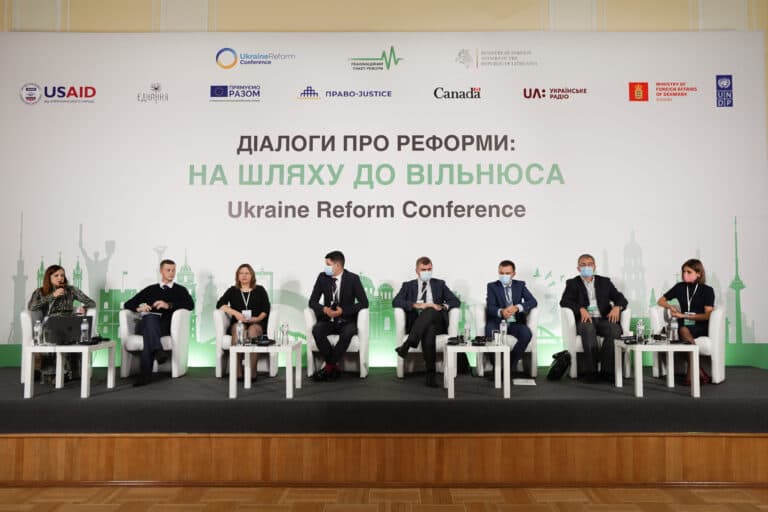
Photo: Reanimation package of reforms
The briefing on the development of civil society prepared for the Vilnius Conference also addresses the problems of the legal framework of CSOs and their financial stability, harassment of public activists and improper investigation of crimes against them, lack of dialogue with the authorities, coordination of the process.
What to do with all this – read in the brief.
Update on Parliamentary Reform from the Agency
The Agency for Legislative Initiatives continually monitors the progress (and regress) of parliamentary reform in Ukraine. We currently have an update for you for 2020. Oleksandr Zaslavskyy, Director of the Analytical Department of the Agency, told during the Ukraine Reform Conference 2020/2021 (#URC2020) what happened to the parliamentary reform last year.

Photo: Reanimation package of reforms
We have the results: from 2016 to 2019, less than 42% of the reform and recommendations of the Roadmap were implemented. When the Verkhovna Rada of the ninth convocation was authorized, we suggested to the MPs to continue the implementation of the reform:
- review 52 Roadmap recommendations;
- adopt the Law “On Peculiarities of Civil Service in the Office of the Verkhovna Rada of Ukraine”;
- develop and adopt a Code of Conduct for MPs.
None of these three recommendations have been implemented in a year. However, the reform continued in some respects.
- For example, the number of committees was reduced to 23, which was one of the recommendations.
- Meetings of representatives of parliamentary factions and groups in the format of Jean Monnet Dialogues continued.
- Work on the draft law “On Legal Acts” and the draft law on the opposition and the relationship between the coalition and the opposition has begun.
- The first audit of the Accounting Chamber on the activities of the Verkhovna Rada is done. Of course, the audit results are not very positive, but the very fact of its conduct is the implementation of the Roadmap recommendation.
One of the main problems affecting the implementation of parliamentary reform is the imbalance of power. With the declared parliamentary-presidential form of governing, the real influence on the government’s formation and its policy is not the Verkhovna Rada of Ukraine, but the President. How to further implement parliamentary reform, and what mistakes should be corrected?
Read our brief for more detail.
Reform of the Verkhovna Rada of Ukraine: Way Forward
The experts of the Agency for Legislative Initiatives have conducted an assessment of the parliamentary reform analyzing the key achievements and shortcomings in implementation. As a result, ALI proposes the Parliamentary Reform Agenda for coming new members of the parliament.
Today, the Verkhovna Rada enjoys the least trust from citizens among public institutions. This situation is clearly linked to a whole range of problems that have not been resolved within parliamentary reform over the past three years. The presentation of the Roadmap on Internal Reform and Capacity Building for the Verkhovna Rada of Ukraine by the European Parliament’s Needs Assessment Mission in the end of February, 2016 marked the beginning of a comprehensive reform of the Ukrainian Parliament.

Although much has been done to increase the institutional capacity of the parliament and to ensure its transparency, the problem of “legislative spam” has not been solved, the status of opposition and coalition has not been regulated, the Parliamentary Ethics Code has not been developed and adopted, and no effective internal procedures for approximating Ukrainian legislation to EU law have not been introduced.
ALI experts propose 7 first priority steps to ensure successful implementation of the parliamentary reform.

Organizations that joined the Reform of the Verkhovna Rada of Ukraine: Way Forward: Civil Network OPORA, NGO “Interns` League”, Centre of Policy and Legal Reform.
The round table “When and how will land reform end?”
Dzerkalo Tyzhnia (Mirror Weekly), Agency for Legislative Initiatives and Internews held the round table “When and how will land reform end?”. Among the speakers were experts who are engaged in the implementation of the open land market and experts with alternative views on this process.

Photo: Dzerkalo Tyzhnia
According to Oleg Nivievsky, Assistant Professor of the Kyiv School of Economics, Ukraine is ready to open the agricultural land market. Studies of the Kyiv School of Economics show a significant macroeconomic impact of the land market opening. In particular, Ukraine could expect accelerating economic growth by 1.5-2% of GDP each year. But Mr. Nivievsky thinks that without the introduction of effective mechanisms for the development of farming this effect will not be so sustainable. In his opinion, there should be a special guarantee fund that would provide loans for the farmers. The government and the World Bank are working now together to create it.
According to Hlib Vyshlinskiy, Executive Director of the Center for Economic Strategy, Ukraine needs other transformations to strengthen investment protection and property rights, simplify business for farmers.

Photo: Tatiana Unkovska / Dzerkalo Tyzhnia
Tatiana Unkovska, Director of the Optima Expert-Analytical Center, said that the launch of free land markets without the necessary regulation to the loss of land, which was in possession of the citizens of rural areas, and increased food risks in several countries. According to her colleague Vitaliy Lomakovych, a free market of agricultural land, which is controlled and regulated by the state preventing abuse and manipulation in the market, is good for Ukraine. Mr. Lomakovych reminded the audience that the land cadaster is now filled by only 70% and until this indicator reaches 100%, it will be impossible to avoid abuse.
Almost all the experts agreed that the main purpose of opening the market should be stimulation of the farms’ development in Ukraine since it is the easiest way to increase productivity in the agriculture and it has a direct impact on the development of rural areas.
However, Ivan Fursenko, Deputy Chairman of the All-Ukrainian Association of Rural and Settlement Councils, is convinced that until territorial communities don’t have the opportunity to dispose of agricultural lands on their territories (including lands outside settlements), it is difficult to say about the development of farming and the positive effect for the development of territories.

Photo: Andriy Martyn / Dzerkalo Tyzhnia
The experts think that the right of priority purchase of land by the agrarians, who are now renting these lands, is a doubtful solution because in the vast majority the renters are large producers. According to Andriy Martyn, Senior Project Manager for Land Reform in the Reforms Delivery Office (RDO) of Ukraine’s Cabinet of Ministers, the large agricultural companies now have both the will and the financial resources needed to buy the land they are currently renting.
The experts agreed that the land market is necessary for Ukraine. However, hurry and lack of public discussion can hamper the process of its implementation.
Сivil Assessment of Public Administration Reform (Shadow Report)
The Shadow report proposes the assessment of results of the reform in pilot ministries (in particular in relation to introduction, recruitment of employees and integration of directorates). It aimed at 1) identification of key causes of the problems faced by the responsible individuals and institutions in the process of the reform implementation, and 2) development of recommendations for further implementation of the reform. Within this report a comparative analysis of the updated Strategy of Public Administration Reform in Ukraine in the wording of the CMU Decree No. 1102-p, dated December 18, 2018, and the old version of the Strategy was made in the context of consideration of the recommendations and comments developed by the SIGMA and the Agency for Legislative Initiatives (ALI) experts. Also, ALI experts analyzed relevant regulations and conducted in-depth interviews (with the Directors General, heads of expert groups and government experts from 6 pilot ministries and SCMU) and expert interviews (with the heads of structural subdivisions of NACS).

The preparation of the research is part of the project implemented by the Agency for Legislative Initiatives within the Civic Synergy Project under the auspices of the Ukrainian National Platform of the Eastern Partnership Civil Society Forum with the financial support of the European Union and the International Renaissance Foundation.
Press Briefing «Parliamentary Reform: Assessment of Results and Agenda for the New Authorities»
On May 23, 2019, in the Ukrainian Crisis Media Center hosted a press briefing «Parliamentary Reform: Assessment of Results and Agenda for the New Authorities».
The experts of the Agency for Legislative Initiatives presented its assessment of the implementation of parliamentary reform and proposed its agenda for parliamentary reform for the new authorities:
- Svitlana Matviyenko, Chairwoman of the Board of the Agency for Legislative Initiatives;
- Oleksandr Zaslavskyi, Director of the Analytical Department of the Agency for Legislative Initiatives.
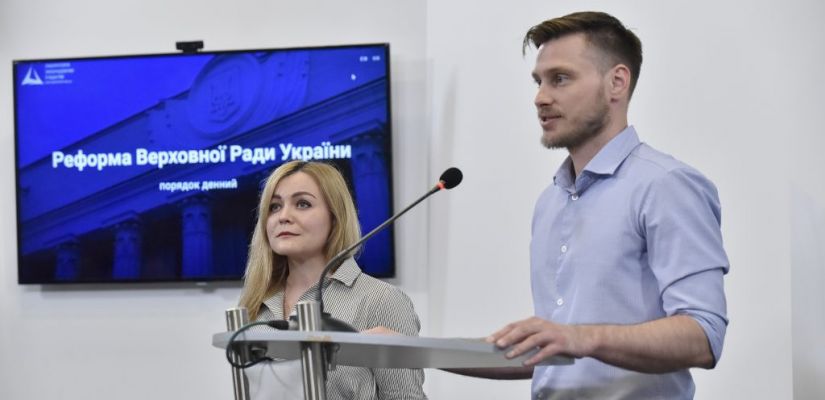
Oleksandr Zaslavskyi, Director of the Analytical Department of the Agency for Legislative Initiatives, said that the reform of the Verkhovna Rada was completed only by 41.8%. Alexander evaluated the status of implementation of key recommendations of the Roadmap on Internal Reform and Institutional Capacity Building for the Verkhovna Rada of Ukraine and stressed:
“Those of reforms that depend on MP`s implemented slowest. About 50 initiatives were registered. None of these documents has been adopted as a whole, only 2 – passed the first reading. Initiatives are more advanced, which did not depend on MP`s and could be resolved by the efforts of Apparatus of the VRU”

Svitlana Matviyenko, Chairwoman of the Board of the Agency for Legislative Initiatives, presented Reform of the Verkhovna Rada of Ukraine: Way Forward and 7 immediate steps of the parliamentary reform to be taken:
“This is not an exhaustive list of steps to be taken to ensure the implementation of parliamentary reform and further development of parliamentarism in Ukraine. Without these steps, the parliament will continue to be in the orbit of the President’s influence, whoever he is, whatever political forces he represents and goals he pursues. A strong parliament is a parliament with a modern parliamentary service, with high ethical standards of people’s deputies, with clear, transparent and effective legislative procedures”
The experts of the Agency for Legislative Initiatives noted that it was possible to implement the Roadmap recommendations in a year and a half. The reason for the inhibition of parliamentary reform is the lack of political will and the general coordination of all those who depend on decision-making.
Video of the press briefing «Parliamentary Reform: Assessment of Results and Agenda for the New Authorities»
Learn about Reform of the Verkhovna Rada of Ukraine: Way Forward
Working Meeting and Discussion of the Research Design “Civil Assessment of Public Administration Reform in Ukraine”
On April 12, 2019 working meeting and discussion of the research design “Civic Assessment of Public Administration Reform in Ukraine” was held.
The preparation of the research is part of the project implemented by the Agency for Legislative Initiatives within the Civic Synergy Project under the auspices of the Ukrainian National Platform of the Eastern Partnership Civil Society Forum with the financial support of the European Union and the International Renaissance Foundation.

The main goal of the project is to strengthen the permanence of the reform in the scope of all European-oriented reforms by conducting the civic assessment of the implementation of EU-Ukraine agreements in the field of public administration.
The working meeting finalized the initial project phase, which involved developing a civic assessment design. Representatives of the Ukrainian National Platform of the Eastern Partnership Civil Society Forum were invited to participate in the discussion.
During the meeting, the issues of the relevance of civic assessment in the proposed format were discussed, as well as research focuses that could have changed in connection with the Government’s adoption of the new version of the Strategy of Public Administration Reform.
Among other things, civic experts suggested that they go beyond the performance indicators set by the Strategy of Public Administration Reform, and try to propose more qualitative criteria for assessing the real impact of reform on end-users – citizens.
The next step in the implementation of the project is to hold consultations with key stakeholders, government agencies involved in the process of reform, professional NGO, etc.
The preliminary results of the Сivic Assessment of Public Administration Reform will also be presented and discussed at the expert platform of the Ukrainian National Platform for the Eastern Partnership Civil Society Forum.
The Civic Assessment of Public Administration Reform in Ukraine will become the third ALI’s analytical report in the Shadow Report format, which assesses progress in implementing key public administration and civil service reforms in Ukraine.
Read the results of previous reports:
Civil Service Reform in Ukraine: Specialised Law Implementation in 2016 – 2017 (Shadow Report)
Civil Service and Public Administration Reform in Ukraine in 2017 (Shadow Report)
Its contents are the sole responsibility of the ALI and do not necessarily reflect the views of the European Union and the International Renaissance Foundation.