
Maksym Savanevskyi, Managing Partner of PlusOne Digital Communications Agency, media trainer, founder and Editor-in-Chief of the online periodical Watcher, told the training participants why Ukrainians enter the Internet; which sites are the most visited ones in Ukraine; which social networks should be preferred when working with voters; the specific features of Facebook in Ukraine; how to use social networking algorithms in favor of their party; the specific aspects of email marketing; what should be taken into account in order to work efficiently with video and online broadcasts; how to work with negative matters in social networks; the basic rules of safety on the Internet.
Seminar “Legislative Process in the United States: Procedures, Steps and the Role of Public”
The event was organized by the Agency for Legislative Initiatives in co-operation with the The Center for Innovation Development and the Interns’ League under the Professional Fellows Program, administered by the American Councils for International Education with the support of the Bureau of Educational and Cultural Affairs of the United States Department of State.
Jacob Ventura has an extensive work experience at the Massachusetts Legislative Office (USA); he also provided legal assistance in reforming the ethical standards of the French judicial system. In addition, Mr. Ventura was a member of the rule-making teams of elected representatives both at the state level and at the federal level.
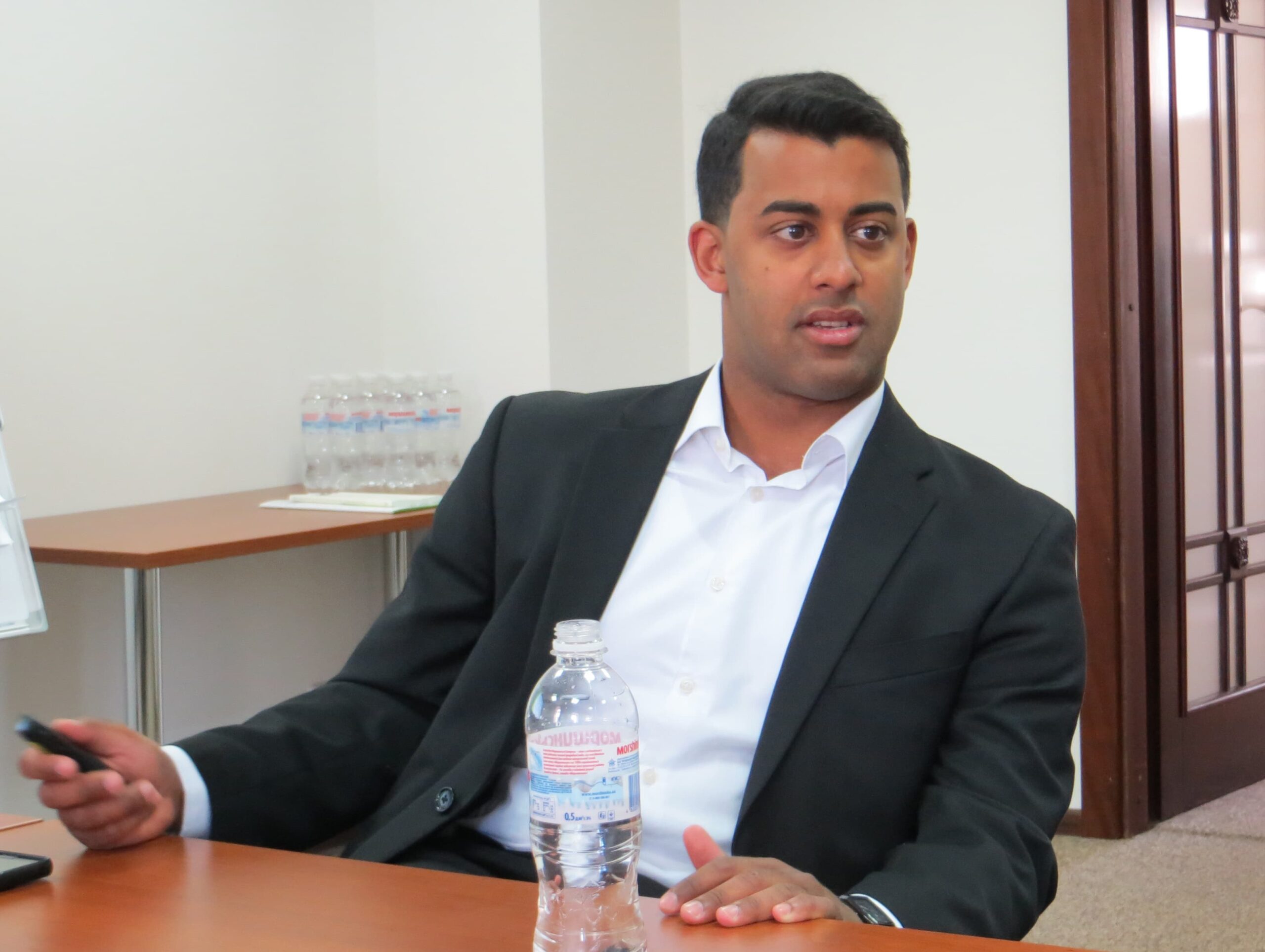
During the seminar, Jacob Ventura outlined the peculiarities of governance in the United States, key competences and principles for the functioning of the executive, legislative and judicial branches of government; he also described in detail the legislative process in the United States: from the idea for a bill and until its final vote. In addition, he revealed the peculiarities of work and interaction of the government with the non-governmental organizations in the United States.
“The separate but equal branches of government was derived from the Massachusetts Constitution, approved in 1780 and drafted by John Adams. It is the oldest written constitution in continuous effect in the world”
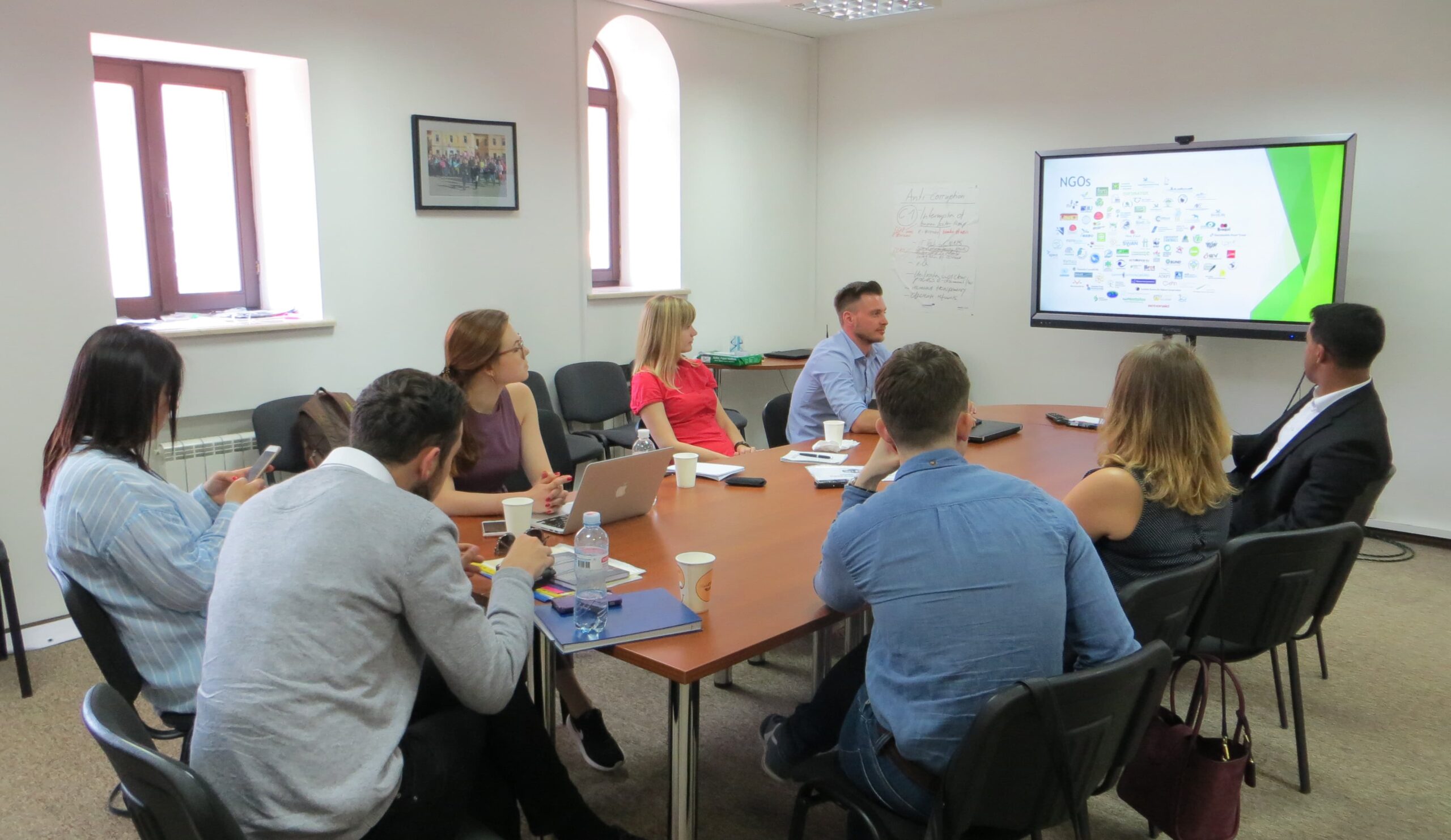
Idea for a Bill
Someone will have an idea for a bill as a result of a public policy need or a need to update or repeal a current law already in existence. Often times members of the legislature and their staff (House or Senate) will have the idea. Other times, a constituent, a citizen of the district will have an idea based on a societal or individual need. NGOs, lobbyist, businesses, non-profits, health care, industry, education, transportation and other groups will have an idea for the bill and propose it to a member of the legislature.
Generally, NGOs, lobbyists, constituents and organizations will directly lobby their Representative or Senator. Often times, larger organizations will lobby many legislators to get the necessary support for or opposition to a bill. Depending on the issue, and in many cases, just as many people are for a bill as are against the same bill. In this case, a particular legislator must weigh the pros and cons to voting ‘yes’ or ‘no’ for the bill. Considerations include how their particular district feels about the bill and the prospects of re-election during the next cycle; special interest political funding; personal relationships with the particular parties lobbying; the merits of the bill and the likelihood of legislative success; influence from party leadership in the legislature.
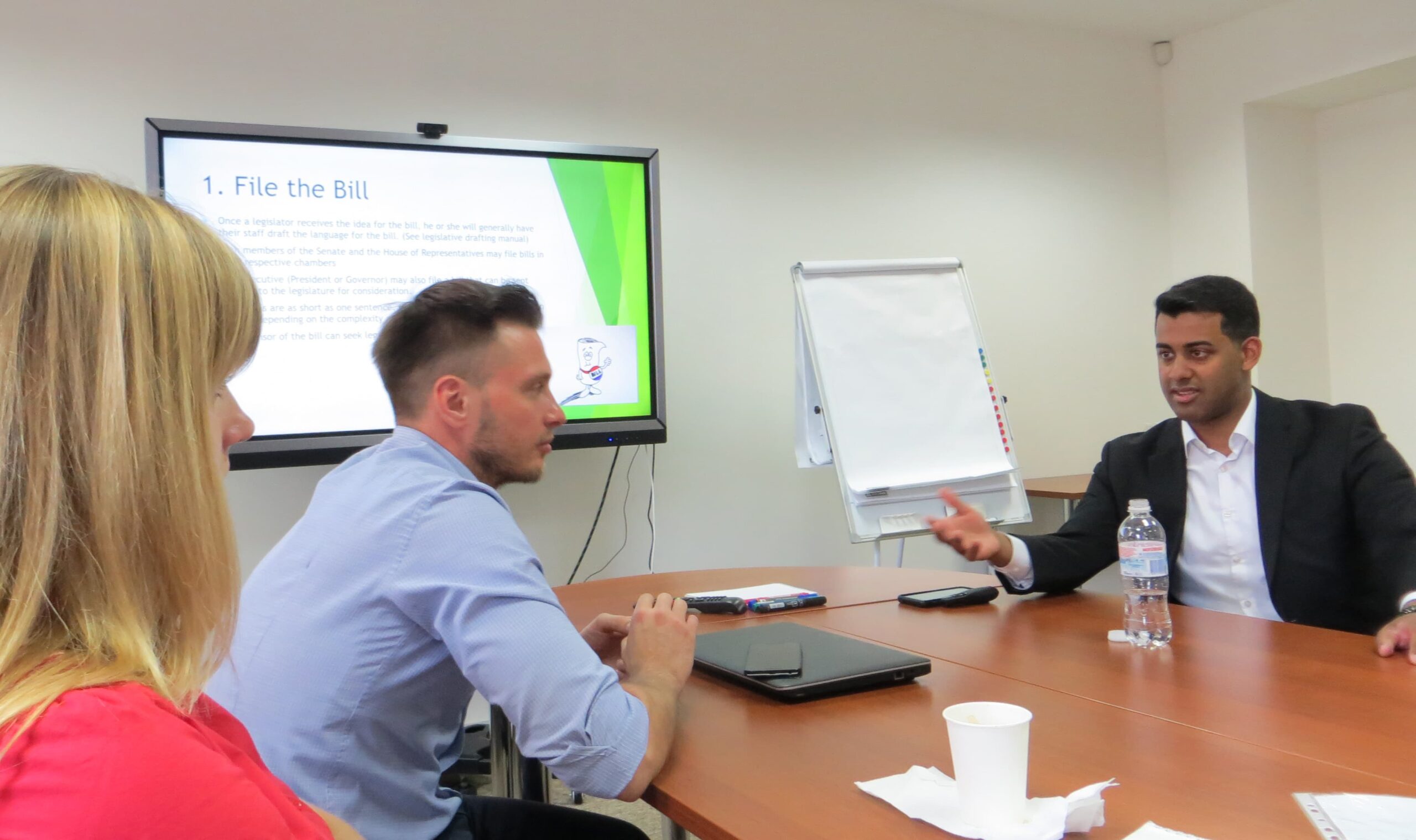
Components of the legislative process
- File the bill. Once a legislator receives the idea for the bill, he or she will generally have their staff draft the language for the bill. Both members of the Senate and the House of Representatives may file bills in their respective chambers. The Executive (President or Governor) may also file a bill that can be sent directly to the legislature for consideration.
- Committee Hearing. Many bills that are filed never make it to a hearing. In some states, every bill filed must have an opportunity to be assigned to a committee for pubic testimony. Bills are assigned to committees based on issue areas. Once a bill has been assigned to a committee, the committee leadership will schedule a hearing on the bill sometime during the legislative session. Hearing rules are determined by committee membership. Generally, experts and concerned parties will be allowed to testify to the committee on the bill at hand, either for the bill or against the bill. After a bill has been heard at a committee hearing and all testimony has been submitted, the Committee will often take a private poll of the members and leadership to determine the level of support for the bill.
- Debates.
- Conference. In the U.S. Congress, there are 435 members of the House of Representative apportioned by population throughout the states. There are 100 U.S. Senators in the upper chamber, each state getting equal representation in this body, 2 Senators per state. In State Legislatures, the number of House and Senate members may vary. Generally, simple majorities are required for bill approval however there are hundreds of procedures and rules in each body that could lift the requirements for particular actions.
- Final Legislative Vote. Once a bill has finally passed both chambers for final approval after conference, the House and the Senate, it is sent to the Executive Branch.
- Executive Approval / Veto. The President of the United States owns the right of legislative approval or a veto at the Federal Government level. In any of the state governments, the executive is the Governor. The Executive is prescribed a certain amount of time to sign a bill in to law. The President has 10 days to sign the bill in to law or veto. Many governors have line-item veto power which allows them to change only portions of the bill or budget. The President does not have line-item veto power. The President must sign the entire bill in to law, or veto it, sending it back to the Congress for reconsideration. The President can also refuse to sign a bill but still allow it to become law.
- Legislative Override of Veto. Usually, if the Executive fails to sign a bill, the bill is automatically vetoed. If the legislature disagrees with the executive’s veto, both chambers must re-vote to override the veto (usually by a 2/3 majority in each chamber). This is a very tough task and high threshold at the federal government level and in many states.
- Constitutional Challenges. Once a bill becomes a law, citizens, members of the legislature and even the executive may challenge the law on constitutional grounds. The third, and often times most important branch of the U.S. government, the Judicial branch will decide if the law is to remain valid and if people’s constitutional rights are violated.
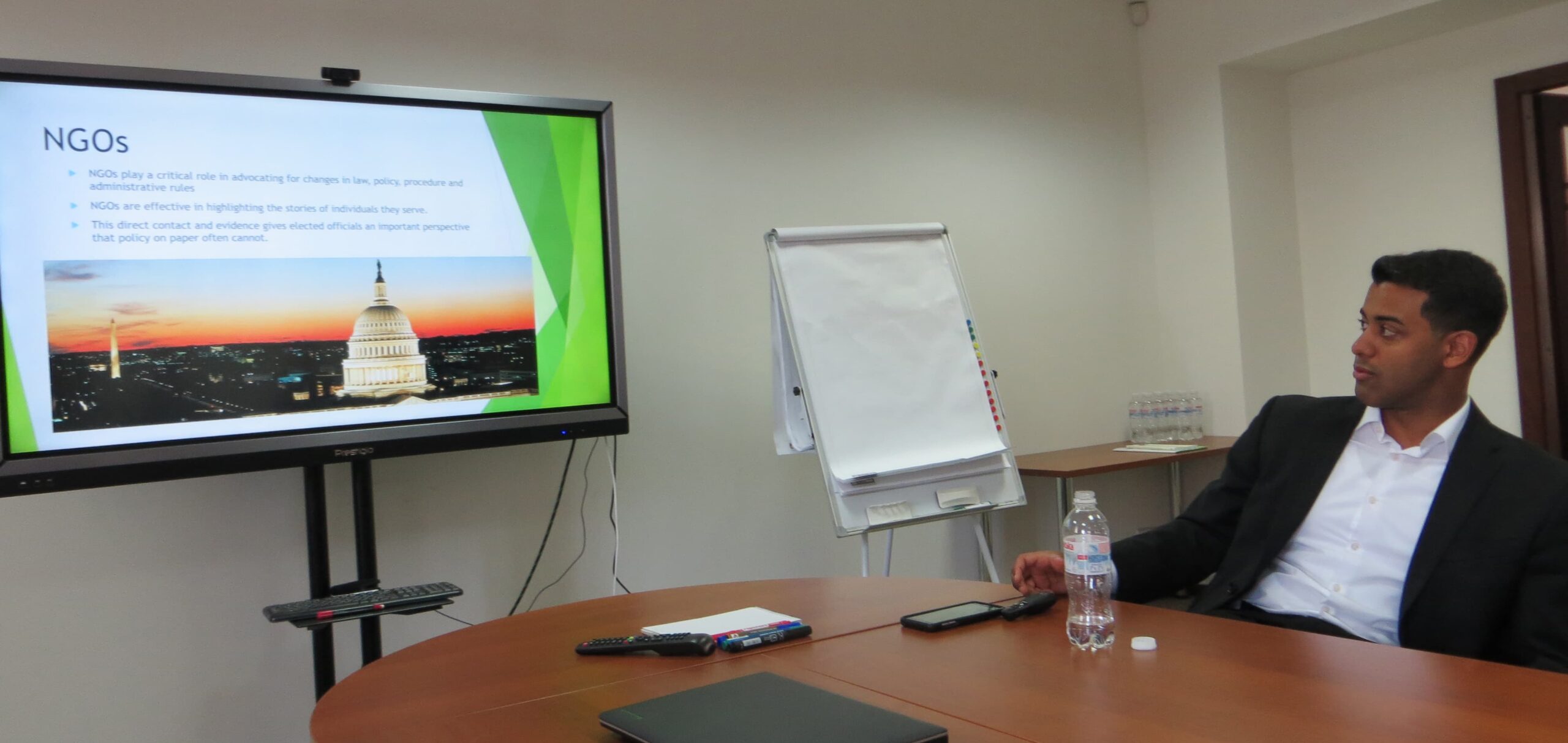
NGOs in the United States
Article 71 of the Charter of the newly formed United Nations first defined ‘non-governmental organization’ in 1945. An NGO can be any kind of organization so long as it is independent from government influence and it is not-for-profit. There are approximately 10 million NGO organizations world-wide. Global Journal. There are 1.5 million NGOs in the United States that employ approximately 11.4 million Americans. According to the CAAF World Giving Index, nearly 31.5 percent of people worldwide donated to a charity/NGO in 2015 and 24 percent volunteered for one. According to Walden University, 80 percent of citizens across the globe believe that NGOs make it easier to be involved in positive social change.
NGOs address a variety of issues including women’s rights, human rights, economic development, political rights, health care, environmental regulation, the battling of disease, and increasing the standards of living for the most vulnerable populations.
NGOs play a critical role in advocating for changes in law, policy, procedure and administrative rules. NGOs are effective in highlighting the stories of individuals they serve. This direct contact and evidence gives elected officials an important perspective that policy on paper often cannot. NGOs must determine the ability of its organization to be a successful advocate for its cause. NGOs must strategically ‘pick their battles’ to determine if a cause should become a legislative priority (considerations are timing, funding, will of Congress, current events, and likelihood at success).
Party Innovation Hub
Party Innovations Hub is an initiative of International IDEA and Ukrainian school of political studies, Agency for Legislative Initiatives’ project.
Opening of the new program of Party Innovation Hub

Oleksandr Iakymenko, Program Coordinator for Ukraine, International IDEA, emphasized that the idea of Party Innovation Hub has emerged as a response to global challenges: the crisis of representation, populism, and mistrust. Transparency and accountability of political parties, the development of effective communication with voters, dialogue between political parties and internal party dialogue are steps to overcome these challenges.
Oleksandr Zaslavskyi, Deputy Chairman of the Board, Agency for Legislative Initiatives, emphasized that the Party Innovations Hub is a logical continuation of the Agency for Legislative Initiatives, which is the formation of a qualitatively new level of political culture.
“Vasha Dumka”, “CiviCRM”

Yevhen Barshchevskyi, Research & Innovation Program Officer at National Democratic Institute, told the participants of the training about survey systems that allow to organize public consultations, quickly communicate with party centers, receive feedback, conduct quantitative and qualitative surveys of public opinion in real-time with the help of SMS or smartphone.
Public monitoring as an instrument of competitive advantage in the elections

Iryna Fedoriv, Chief editor of CHESNO Movement’s website, told the participants of the training about the methodology, which CESNO Public Movement uses to conduct research on the activities of political parties; also Iryna presented the CHESNO Movement’s tools for assessing politicians and parties that are designed to help citizens make a rational and informed choice.
Openness of political parties

Yaroslav Yurchyshyn, Chief Executive Officer at Transparency International Ukraine, discussed the openness of political parties with the participants of the training. What is the attitude towards political parties in the world? Why openness and accountability are essential for political parties? What do representatives of key stakeholders expect from political parties?
Arrangement of forces before the elections

Oleg Medvedev, political consultant, discussed with the participants of the training the ratings, organizational capacities of political parties, and probable political strategies.
Open Source Participation Tools

Raoul Kramer, Thinker & Innovation Manager, Founding partner at Enabl.ist, told the participants of the training about the open source tools, their features and benefits. Why in the 21st century political parties need to go online? What is the fundamental difference between engagement and participation? How parties should engage voters in effective cooperation? How political parties from all over the world use digital instruments?
Digital campaigning

Michael Babyak, Former Director of Marketing Technology, Trump campaign, Partner of Dome Compass Inc., told participants of Party Innovation Hub about the Trump’s campaign. Why the Republican Party has invested in dgital? How to organize and conduct an extremely effective fundraising campaign? How to involve volunteers in your campaign? What is the positive impact of digital technology on the work of political parties?
Rapid prototyping

Oleksandr Iakymenko, Program Coordinator for Ukraine at International IDEA presented the concept of rapid prototyping and explained the way this methodology can be used by political parties.
Participants of Party Innovation Hub tested the technique later on and discussed its benefits with Michael Babyak.
Effective party communication

Sergiy Gaiday, Director for strategic planning, social engineering agency Gaiday.com, told participants of Party Innovation Hub about the the basis of effective communication and the real PR. What is populism? Why is it useful? What is the main task of the elite? Why do we need political parties? What is the most important communication channel in the modern world? Why Ukraine can be divided into “facebook world” and “TV world”? How to develop a discipline of thinking? Why is it important to be able to give clear definitions?
Role of Internet and social media in electoral campaigns: international experience and options for Ukraine

Oleksandr Bondarenko, Head of Special Projects at Digital Communications Agency PlusOne, told the participants of Party Innovation Hub about how many people in Ukraine use the Internet. What is a “Generation of Titles”? What are the most visited sites in Ukraine? How do the facebook posts rank? What are the rules of behavior for politicians in social media? How does email marketing work? What are the secrets of successful video on social media? What Ukrainian politicians are looking for on the Internet?

First National Session of the XIII Program of the Ukrainian School of Political Studies
Opening of the First National Session of the XIII Program of the Ukrainian School of Political Studies

Svitlana Matvienko, Chairwoman of the Board of the Agency for Legislative Initiatives, welcomed the participants of the XIII Program, emphasized that the main values on which USPS is based are human rights, freedom of expression, tolerance and democracy.
Marten Ehnberg, Head of the Council of Europe’s Office in Ukraine, spoke about key values of the Council of Europe and also focused on reforms and initiatives supported by the Council of Europe in Ukraine.
Katerina Ryabiko, Co-ordinator of the project “Strengthening the Dialogue between Civil Society and Key Public Authorities and Institutions in Ukraine in the Human Dimension”, OSCE/ODIHR, stressed that peace cannot be achieved without human rights protection.
Responsible judgment: Hegel, Kant, Arendt and us

What is the responsibility? Who should we be responsible to? What is an authentic life and how does it relate to responsibility? What is abstract thinking and who thinks in an abstract way? What is an absolute? What is judgment by taste? What is common sense and how to build judgments based on it? What does it mean to think independently? What is identity? How do political judgments form? Yevhen Bystrytsky, PhD, Head of the Department of Philosophy of Culture, Ethics and Aesthetics of the Institute of Philosophy of the NAS of Ukraine, member of the USPS Supervisory Board, talked about the basics of responsible judgments with the participants.
Rules for building democracy in the 21st century. Why don’t they work in Ukraine?

Are there objective laws for the development of society? What are the laws of democracy? What socioeconomic and political conditions are necessary for building an effective democracy? What is the role of the army in democracy? What is the role of civil society and the level of political culture of a voter in democracy? These and other questions were answered by Igor Smeshko, Ph.D., Head of the “Power and Honor” NGO, former Head of the Security Service of Ukraine (2003-2005), Ambassador Extraordinary and Plenipotentiary.
The discussion was moderated by Zoryan Kis, Senior Program Officer, National Democratic Institute, USPS alumnus.
European integration: diplomacy or reform?

Ivanna Klympush-Tsyntsadze, Vice-Prime-Minister for European and Euro-Atlantic Integration of Ukraine, talked frankly with the participants about her work in the parliament and government of Ukraine.
National Health Service of Ukraine: change of the system of financing of healthcare in Ukraine

Healthcare reform, or rather reform of the system of financing of healthcare, has been the subject of fierce discussions in the recent months. The manipulations and rumors surrounding this reform, in particular, the National Health Service, have become a reflection of the resistance of those players who are the most disadvantaged by the change of status quo. But what will the reform really change? Will the new system, even after the change of government, hold? What are the biggest risks of the new system? Ulana Suprun, Minister of Healthcare of Ukraine, and Oleg Petrenko, Head of the National Health Service of Ukraine, USPS alumnus, discussed these topics with the participants.
Public finances

What are public finances and what is their nature? What are the risks of financial abuse? Can budget expenditures be unprotected? What are the sources of financing a budget deficit? What is the subsistence minimum? What is the budget deficit monetization? What is the dynamics of active operations of the banking sector? These topics were raised by Victor Pynzenyk, PhD, Member of the Parliament of Ukraine, member of the Committee of the Verkhovna Rada of Ukraine on Budget.
External Migrations of Ukrainians: Scales, Causes, and Implications

What are the demographic problems facing Ukraine today? What is depopulation? What is the average life expectancy of Ukrainians? What are the migration processes in Ukraine today? What professions are lacking in Ukraine? What are the components of external migration in the country? What motivates Ukrainians to migrate? Who do employers need? Which countries are the most attractive for labor migration of Ukrainians? What are the consequences of labor migration for Ukraine and how can we minimize risks? Ella Libanova, PhD, Director of the Institute of Demography and Social Studies, National Academy of Sciences of Ukraine, spoke about external migrations in Ukraine.
Peaceful Donbass: Are There Preconditions for the End of the Conflict?

For four years now, Ukrainians are starting their day with the latest news on loss at the frontline. Millions of people have been forced to seek new homes. Hundreds of thousands are involved in the formation of a new Ukrainian army. Forecasts and even promises to end the conflict have been heard from many Ukrainian politicians on a number of occasions, but there is currently no single strategy to get out of the situation, and the Minsk negotiations leave many issues open. What are the ways to resolve the conflict? Are there any preconditions for an end? Participants discussed these issues with Oleksandr Lytvynenko, Deputy Secretary of the National Security and Defense Council of Ukraine, and Olga Ayvazovska, Chairwoman of the Board, coordinator of election and political programs of the Civic Network OPORA, a representative of Ukraine in the political subgroup of the Tripartite Contact Group Donbass, USPS alumna.
How to unite not to destroy, but to create?

In a constant search for simple answers to complex questions, we imitate reforms. We move on to European ideals, demanding ready-made recipes. However, we need to find 18these recipes ourselves. Professionalism, trust, consistency are something that can drive us into the future. How to unite not to destroy, but to create? How to stop simulating change? Yulia Mostova, the editor-in-chief of the newspaper Dzerkalo Tyzhnia, member of the USPS Supervisory Board, spoke about the reality of Ukrainian politics.
Media framework of the country: can public broadcasting change the status quo?

Why watch TV? What needs to be done to change the TV world for the better? Why are there so many news channels in Ukraine? Why communicate with the media? What are the benefits of radio compared to other media? How to provide funding for public broadcasting? Witnesses of what media revolutions have we become? Can public broadcasting change the media scenery of Ukraine? This discussion was held among Oleksandr Bogutsky, Director-president of the ICTV channel, board member of the investment and consulting group EastOne, USPS alumnus, Andriy Kulykov, Chairman of the Public Broadcasting NGO “Hromadske Radio”, and Yuriy Makarov, member of the Board on educational issues of public broadcaster “NSTU”.
The panel was moderated by Olga Sedova, Coordinator of National Programs of the Embassy of Sweden in Ukraine.
In search of a trigger mechanism: driving and restraining factors of modernization of Ukraine

What are the objective laws and circumstances governing the world? What factors help us become a European country? What hinders the realization of the European choice of Ukraine? What strategies of survival are practiced by Ukrainians? What are the reasons for the immaturity of the revolutionary minority? What is the new ethics? What is the forecast regarding the future development of Ukraine? Oleksandr Paskhaver, PhD, President of the Center for Economic Development, Corresponding Member of the Academy of Technological Sciences of Ukraine, Honored Economist of Ukraine, spoke about modernization of Ukraine.
The panel was moderated by Katerina Venzhyk, Editor and Project Leader of Prostonomics, USPS alumna.
Occupied Crimea: What does it mean for the world?

The annexation of Crimea marked the beginning of a break in the established system of global security. Having challenged international law, Russia has not received the proper resistance, and hundreds of thousands of Ukrainians are in a “gray zone” both in terms of law and security. At the fourth year of occupation, there are no definite strategies for reintegrating Crimea. How to make Crimea the key issue on the agenda again? How to turn the focus not to the territory, but to people? How to attract world attention to Crimea? Refat Chubarov, Member of the Parliament of Ukraine, Head of the Mejlis of the Crimean Tatar people, talked about this with the participant.
The conversation was moderated by Aliim Aliyev, Program Director of Crimean House Kyiv.
How to overcome intolerance in society?

How do we perceive the Other? What are the stereotypes and how do they affect our perceptions? Why not rely on the first impression? Why are stereotypes so persistent and pervasive? What is tolerance? How does hatred for otherness begin? What is hate speech? How can bias be overcome? Larry Olomofe, a former OSCE ODIHR’s adviser on combating racism and xenophobia, had an interactive discussion on these issues with the participants.
Value orientations of Ukrainian society in the historical perspective

What are the values and what role do they play in society? What is a communicative code of culture? Are values stable and unchanged? What is identity? What is historical memory and how does it work? How does a tradition form? What ideological guidelines does wartime need? What are the value orientations of Ukrainian society in the past and today? Do we repeat our history? Natalia Yakovenko, Professor of History Department of the National University “Kyiv-Mohyla Academy”, spoke about value orientations of Ukrainian society in the historical perspective.
The discussion was moderated by Andriy Vyshnevsky, a lawyer, executive director of the Tomorrow’s Lawyer NGO, USPS alumnus.

Hub for Party Innovations

The Hub for Party Innovations provides a unique platform for spreading knowledge about the use of modern technologies and innovations for the development of party democracy in Ukraine. The Hub for Party Innovations was initiated by International IDEA and the Ukrainian School of Political Studies, a project of the Agency for Legislative Initiatives.
The Hub included training sessions on communication with voters, party transparency, and accountability, intraparty democracy and effective management, as well as on the Democracy Labs tool developed by International IDEA to introduce innovation and digital technology into the daily practice of political parties.

Oleksandr Yakymenko, Program Coordinator for the Great Europe Program of the International Institute for Democracy and Elections, noted that the Hub emerged as a response to the challenges of global processes, specifically the crisis of representation (representation of interests), the gap between what voters want and what their elected representatives do.
Svitlana Matviienko, Chairwoman of the Board of the Agency for Legislative Initiatives, emphasized the relevance of political education and establishment of inter-party dialogue. Ms. Matviienko also drew attention to the importance of transfer from the leader-based model of party construction towards the development of intra-party democracy.
Kyrylo Tretiak, the Netherlands Institute for Multiparty Democracy, observed that the Institute provides educational and advisory assistance to political parties, contributing to their democratic development and inter-party dialogue.

Yevhen Barshchevskyi, the Research and Innovation Program at the representative office of the National Democratic Institute in Ukraine, informed the participants of the training about the “Your Opinion” polling system, which gives political parties, NGOs and NGO networks the opportunity to organize online consultations through voting via text messages or a website; as well as CiviCRM – a system for tracking relations and interactions.

Oleksandra Kuziv, Project Manager of Political Memory project, Civic Movement CHESNO, and Vita Dumanska, Coordinator of the ‘Follow the Money’ Campaign, Civic Movement CHESNO, presented the resources of E-Reporting, Political Memory and Party Gold to the participants of the training. These are innovative tools for assessing politicians and parties designed to help citizens make a rational and informed choice. The resources include data from the CEC, VRU, local councils, party websites, NAPC, propaganda archives of Istorychna Pravda and media archives.

Yaroslav Yurchyshyn, Executive Director of Transparency International Ukraine, discussed both external and intraparty openness of political parties with Hub participants. Openness generates voters’ confidence in political parties and is the most important resource. To what extent are representatives of the main stakeholders in the political process prepared to openness?

Sam van der Staak, Head of the Wider Europe program of International IDEA, told the training participants about the role of technologies in restoring communication between political parties and the public; the attitude of young people to technologies in the context of the political process; how digitalization can help parties overcome the crisis of representation; why the onset of the technological era means that political campaigns never end; which online resources should be preferred; what political parties should remember using technologies.

Gefion Thuermer, University of Southampton and the German Green Party, elaborated on the opportunities that digitalization opens to political parties; how to use online resources for management of knowledge, suggestions, discussions and communication; the positive effects of digitalization; the risks political parties can face when using online resources; things political parties should take into account in order to achieve the best result using digital instruments.

Digital technologies provide a large-scale coverage that gives people a sense of engagement and involvement in political processes. Decentralization helps political parties build personal relationships with voters, even without interacting with them in person.
Michael Babiak, Co-founder and CEO of ArrowIQ, a former Director of Marketing Technologies during the Trump campaign, told participants how technologies could help build a successful campaign starting with just one Twitter account.

Digital technologies help parties build effective work in different areas: during elections and voting; finance sourcing and fundraising; general party management; networking and communication; policy development – training participants discussed these topics with Gary Klaukka, Programme Officer in the Political Parties, Participation and Representation Programme, International IDEA.

Sergey Gaidai, Director of Strategic Planning of the Social-Engineering Agency Gaidai.Kom, elaborated on such topics as the worlds included in Ukraine; the main political technology of the Ukrainian political class; the real PR and approaches to carrying it out; the essence of the technology of real action; the events Ukraine needs; and ways to form the discipline of thinking.

XII Annual Conference of the Ukrainian School of Political Studies

The conference of the Ukrainian School of Political Studies is quite an event for the USPS community. It is the 12th time that School alumni of different years, guests, partners, and friends have gathered together to congratulate this year’s alumni, involve in professional discussions with renowned experts from around the world, share their ideas concerning topical current issues, and, of course, chat with old friends.

At the opening session, welcoming remarks were made by Svitlana MATVIIENKO, Chairwoman of the Board of the Agency for Legislative Initiatives; Arturas ZUOKAS, City Mayor of Vilnius (2000-2007, 2011-2015), Member of the Supervisory Board of the USPS; Hugues MINGARELLI, Head of the EU Delegation to Ukraine, and Morten ENBERG, Head of the Council of Europe Office in Ukraine. The event was moderated by Oleksandr BOHUTSKYI, CEO of ICTV TV Channel, member of the Board of the EastOne Investment and Consulting Group, USPS alumnus.

Svitlana MATVIIENKO, welcoming the USPS community, stressed that only responsible citizens with critical thinking could make changes valid.

Yevhen BYSTRYTSKYI, Ph.D., Executive Director of the International Renaissance Foundation, addressed words of welcome to the alumni and guests of the School. Mr. Bystrytskyi emphasized that a rational approach was not enough to enable changes, you need a will and a mood. That is why he wished graduates to have a strong will to change, a will for a new Ukraine.
At the conference, it was announced that Mr. Bystrytskyi had become a member of the Supervisory Board of the Ukrainian School of Political Studies.

Another speaker addressing the USPS community was Andrius KUBILIUS, Member of the Lithuanian Seimas, Chairman of a temporary pro-Ukrainian group, co-initiator of the Marshall Plan for Ukraine, and Prime Minister of the Republic of Lithuania (1999-2000; 2008-2012). Mr. Kubilius drew attention to the decisive role of personal energy in the process of achieving desired changes. It is energy – the ability to generate energy for others, as well as personal energy and passion – that can ensure success. Mr. Kubilius emphasized that Ukrainians need to have confidence in their own future, need to be longing for success.
Global civics

Judging by some important indicators, our generation is the most fortunate in the history of mankind. However, we also have to deal with some of the most difficult issues humanity has ever faced: how to cope with our growing interdependence? Can civics, as understood by many different cultures, help us in our attempts to breed a centripetal civic culture, pushing us all together and mixing our lives? – the USPS community discussed these issues with Hakan ALTINAI, President of the Global Civics Academy, Director of the European School of Politics (Turkey).

The second day of the conference started with a presentation by Yuliya MOSTOVA, Editor-in-Chief of the Mirror Weekly (Dzerkalo Tyzhnya), member of the Supervisory Board of the USPS. Ms. Mostova came up with a critical analysis of Ukrainian society, the ruling elite and socio-political processes and trends currently taking place in Ukraine, with a focus on the threats facing our state.
Reforms or destruction: what’s first? What should be destroyed to construct a New Ukraine?

The primary question of any public policy is whether this policy is needed at all? In post-Soviet countries, government intervention tends to be harmful. During the latest three years, Ukraine has made numerous attempts to reform various fields, but only some of them manifest signs of future success. The government’s inability to develop and implement quality policies is often put down to a lack of political will. However, even if there were political will, there is no capacity to implement the necessary reforms. The state machinery mainly engages in “manual control”, that is operational issues. In this situation, weak institutions are obstacles rather than incentives for advancement. What institutions have to be destroyed or built for successful reforms? How to introduce true politics into our political games?
The discussion was attended by:
- Bohdan KRAVCHENKO, Ph.D., Director General of the University of Central Asia;
- Ivanna KLYMPUSH-TSINTSADZE, Vice Prime Minister for European and Euro-Atlantic Integration of Ukraine;
- Oleksandr DANYLIUK, Minister of Finance of Ukraine.
Moderated by Olena MAKEIEVA, Chairwoman of the Board of Directors, Audit Company Aksonova & Associates, Geneva Group International, USPS alumnus.
Framework of the New Ukraine

We can easily identify the main obstacles on the path to the “New Ukraine”. But most of us find it hard to imagine what this “New Ukraine” should be like. Undoubtedly, advanced independent institutions, including anti-corruption bodies, free legal aid, CEC, courts, and media that set the frame for the political discourse in the country, prevent the spread of corruption and degradation. How to make these institutions truly independent in Ukraine? How to shift public attention from populism to important aspects of the framework of the New Ukraine?
The discussion was attended by:
- Serhiy LESHCHENKO, MP of Ukraine;
- Olga AYVAZOVSKA, Chairwoman of the Board, Coordinator of Electoral and Political Programs of the Civil Network OPORA, a representative of Ukraine in the political subgroup of the Trilateral Contact Group on Donbas, USPS alumnus;
- Andriy STELMASHCHUK, President of the Ukrainian Bar Association, Managing Partner of Vasil Kisil & Partners, USPS alumnus;
- Andriy VYSHNEVSKY, Program Leader of the Tomorrow’s Lawyer, Director of the Coordination Center for Legal Aid Provision (2012-2017), USPS alumnus.
Moderated by Oleksandr KHORUZHENKO, Director of the Sumy Department of the Center for Local Self-Government Development, USPS alumnus.
Destruction of reality

Liberal democracy requires a “pure” public sphere for democratic debate. But what are the conditions for a pure public sphere? John Stuart Mill believed that in a pure public sphere any views, however contradictory, should receive full public attention. Thus, Mill would be happy with the Russian TV channel Russia Today, whose motto is “Question more”. Based on the lessons of modern information wars, we can argue that there are grounds for revising Mill’s arguments and their conclusions. How does propaganda work? How can we win the information warfare? – School alumni and guests discussed these and other issues with Jason STANLEY, Ph.D., Jacob Urowsky Professor of Philosophy at Yale University.
Moderated by Olga MALCHEVSKA, BBC Ukraine Desk Editor, USPS alumnus.
Post-Soviet identity: an imperialist-vs.-nationalist axis. What is the moral basis of our agency?

Social ambivalence is a hallmark of any transitional period – a period of collision between different political cultures. This ambivalence is similar in many post-Soviet countries – our hybrid identities corrupt every aspect of our lives. We strive to gain a foothold in the new world, but it is extremely difficult to find a basis for our agency. Nation, language, myths seem to be transitional pillars of our new identity in the context of escape from our imperial and nationalist personae. How to demythologize contemporary Ukrainian discourse? Has Ukraine’s identity changed after the Revolution of Dignity compared to other post-Soviet states? Is Ukraine taking the lead in escaping from its post-Soviet identity?
The discussion was attended by:
- Myroslav MARYNOVYCH, Vice Rector for the Mission of the Ukrainian Catholic University;
- Andrei SANNIKOV, Belarussian activist and politician;
- Mykola RYABCHUK, Ph.D., President of the Ukrainian Center of International PEN-Club.
Moderated by Andriy BAUMEYSTER, Ph.D., Associate Professor of the Department of Theoretical and Practical Philosophy of the Faculty of Philosophy, Taras Shevchenko National University of Kyiv.
On development, demography and climate change: the end of the world as we know it?

Modern economic growth was mainly based on the combustion of fossil fuels. Countries couldn’t avoid poverty if they had no access to oil, coal and natural gas. The atmospheric CO2 is increasing every year, and 2016 was the hottest year ever recorded. In addition, the population of the Earth is growing faster than ever, and due to the development of technologies, the humanity faces new challenges of unemployment. However, the humanity responds to these events with a mixture of denial, avoidance, and accusation. There is considerable uncertainty about what will happen to the world as we know it. How will humanity respond? Are we ready for what we have created? – USPS community spoke about the fate of the world with Timothy DYSON, Ph.D., Professor of Population Studies at the London School of Economics.
Moderator: Olena MASLYUKIVSKA-SAMBERG, Ph.D., Program Analyst in Environment at UNDP Ukraine, USPS alumnus.
The Conference included the presentation of social and volunteer projects of USPS alumni:

– NewFashionZone Community (Maria TEREKHOVA);
– International Music Festival FAINE MISTO; Educational and Analytical Center for Community Development (Maksym CHERKASHYN);
– #SOSFuture (Kateryna SMAGLIY);
– Batteries, Give up! (Lyudmila KOLOSOVSKA);
– It’sInterestingHere! (TutTsikavo!) (Oleksandr SHATKOVSKYI);
– Ukrainian Institute for the Future (Anatoliy AMELIN);
– Pirogov First Volunteer Mobile Hospital (FVMH) (Gennadiy DRUZENKO);
– Public holding GROUP OF INFLUENCE (HRUPA VPLYVU) (Tetyana DURNEVA);
– Competition ‘The Best Public Initiative of Ukraine’ (Pavlo PUSHCHENKO);
– Initiative E+: I See Hope, Children’s Camps (Dmytro STRYHUN).

The conference ended with the presentation of diplomas to the alumni of the XII Ukrainian School of Political Studies. Igor KOHUT and Svitlana MATVIIENKO wished the alumni inspiration and motivation for new achievements.

Photo credit: Oleksandr Kovalenko, Arsen Fedosenko, and Oksana Sushko
This year the Conference was made possible thanks to:

Third National Session of the Ukrainian School of Political Studies in Lviv
Rules for building democracy in the XXI century and why they do not work in Ukraine

Do the objective laws of nature and human development have an impact on the state as a complex social system? What are socioeconomic and political conditions necessary to build a functioning democracy in the country? What are the role of the army in democracy? What is the role of civil society and the level of the political culture of a voter in democracy as a feedback system to achieve the goal of public administration: to ensure freedoms, rights and high standards of living for ordinary citizens in the country? – these are the issues discussed with the School participants by Ihor SMESHKO, Head of the NGO Strength and Honor, former Head of the Security Service of Ukraine (2003-2005).
Local development as a driver of transformation in the country

Discussion of the participants of the Ukrainian School of Political Studies on local development as a driver of transformations in the country with Andriy SADOVYI, Lviv Mayor.
Morality of the political process

People tend to believe that politics and morality are incompatible each other. This tradition dates back to Machiavelli. The polar opposite position is that of Kant: people in their behavior must be guided by moral motives rather than practical needs (moral imperative). Not every successful policy is highly moral, but any immoral policy is devastating. Ukrainian realities provide a lot of illustrations of the devastating effects of immoral power. Is moral politics possible in Ukraine? Can politics be moral? Should we talk about a moral movement? – these are the topics raised by Myroslav MARYNOVYCH, Vice-Rector for University Mission, Ukrainian Catholic University, in his conversation with the School participants.
Ukraine: unfinished revolution and transition to the third Ukrainian Republic

The Maidan of 2013-2014 was aimed at an anti-oligarchic revolution – a leap from an oligarchic state with limited access to a democratic state with wide access. What was the purpose of the Maidan of Dignity of 2013-2014? What is happening in Ukraine – a social revolution, civil war as a war of the middle class against Ukrainian oligarchs, or Putin’s aggression? – Taras VOZNIAK, Editor-in-Chief of the Ї journal discussed these issues with the participants of the Ukrainian School of Political Studies.
Myths about the Ukrainian liberation movement of the twentieth century

What was and what was not the Ukrainian liberation movement of the twentieth century? Who were its heroes? Why was it mythologized? Why is its legacy attracting so much attention today? – the School participants talked over these topics with Ruslan ZABILY, Director of the National Memorial Museum of Victims of the Occupation Regimes ‘Prison at Łąckiego Street’ (Tyurma na Lontskoho) in Lviv.
Gender equality in political and public life

We live in the 21st century when women and men in Ukraine’s democratic society enjoy equal rights and opportunities, equal access to political life, equal pay and professions of their choice. Is this myth or reality in modern Ukraine? Empirical tendencies manifest deepening differences between women and men who enjoy the same rights de jure and de facto. What progress has been made and what are the ongoing challenges in the context of achieving gender equality in Ukraine? – the School participants had a chance to discuss these issues with Kateryna RYABIKO, Project Coordinator, OSCE Office for Democratic Institutions and Human Rights (OSCE/ODIHR).
Political corruption and transparency of funding of political parties
Money in politics is a necessary component of any democratic process that helps express political support, political participation, and actively compete in elections. At the same time, political funding also bears specific risks for any democratic and economic system. What are the issues at the crossroads of funding rules for political parties, public procurement procedures, role of politically aware persons and declaration of assets and revenues of political and civil servants? What measures do relevant authorities undertake to combat corruption in these areas and what mechanisms can be used to facilitate these efforts? – Dr. Marcin Walecki, Head of the Democratization Department, OSCE Office for Democratic Institutions and Human Rights (OSCE/ODIHR), discussed these topics with the members of the Ukrainian School of Political Studies.
Political parties

How should modern parties function? What is a modern election campaign like in the era of social media? What can we learn from the latest elections in the East and West? Is there a chance to create large-scale parties or are niche parties the thing of the future? What awaits Ukraine with politics again dominated by oligarchs? How can one organize an ideal campaign? – the School participants reflected on these questions with Jacques MONACSH, a former MP of the Kingdom of the Netherlands, an associate partner of the consulting company GKSV.
UlianaCare

Uliana Suprun, Acting Minister of Healthcare, is the 21st head of this sector (since September 2016), who, for the first time since independence, has made attempts at radical change (ULIANACARE). Why do significant changes seem to be possible for the first time now? What is the current healthcare system in Ukraine like in terms of who and when pays for it and what he receives in return? What are the risks associated with the positions held by the parties to the conflict? Is there a “white book” on the development of the healthcare system in Ukraine? What is better: 5 years of change and mistakes or 50 years of “stability” and sabotage? Is there a separate “Ukrainian” way as regards the healthcare system in Ukraine? How can we make up our mind concerning which side to take? As a matter of fact, are there only two irreconcilable opposing sides? What do we lack to make an informed choice? – the participants of the Ukrainian School of Political Studies discussed these subjects with Oleh PETRENKO, Deputy Director General for Strategic Development of the ISIDA Clinic, USPS alumnus.
Can Ukraine have an economy of $ 1 trillion in 2030?

What is the current state of Ukrainian economy? What is the position of Ukraine on the global economic map? Do we have a potential for development? What are the conditions for reaching an economy of $ 1 trillion and what are the consequences for the public? – the School participants discussed these questions with Anatoliy AMELIN, Director of Economic Programs of the Ukrainian Institute of the Future, USPS alumnus.

Lecture by Serhiy Holovatyi “Culture of Lawfulness: Rule of Law”
Speaker: Serhiy Holovatyi, founder and President of the Ukrainian Legal Foundation, Minister of Justice of Ukraine (1995-1997, 2005-2006), Honorary Partner of the PACE. His scholarly interests include international public law, theory of law, constitutional law, and human rights. He has published over 200 scholarly works, the main of them being the monograph (in three books) The Rule of Law (2006).
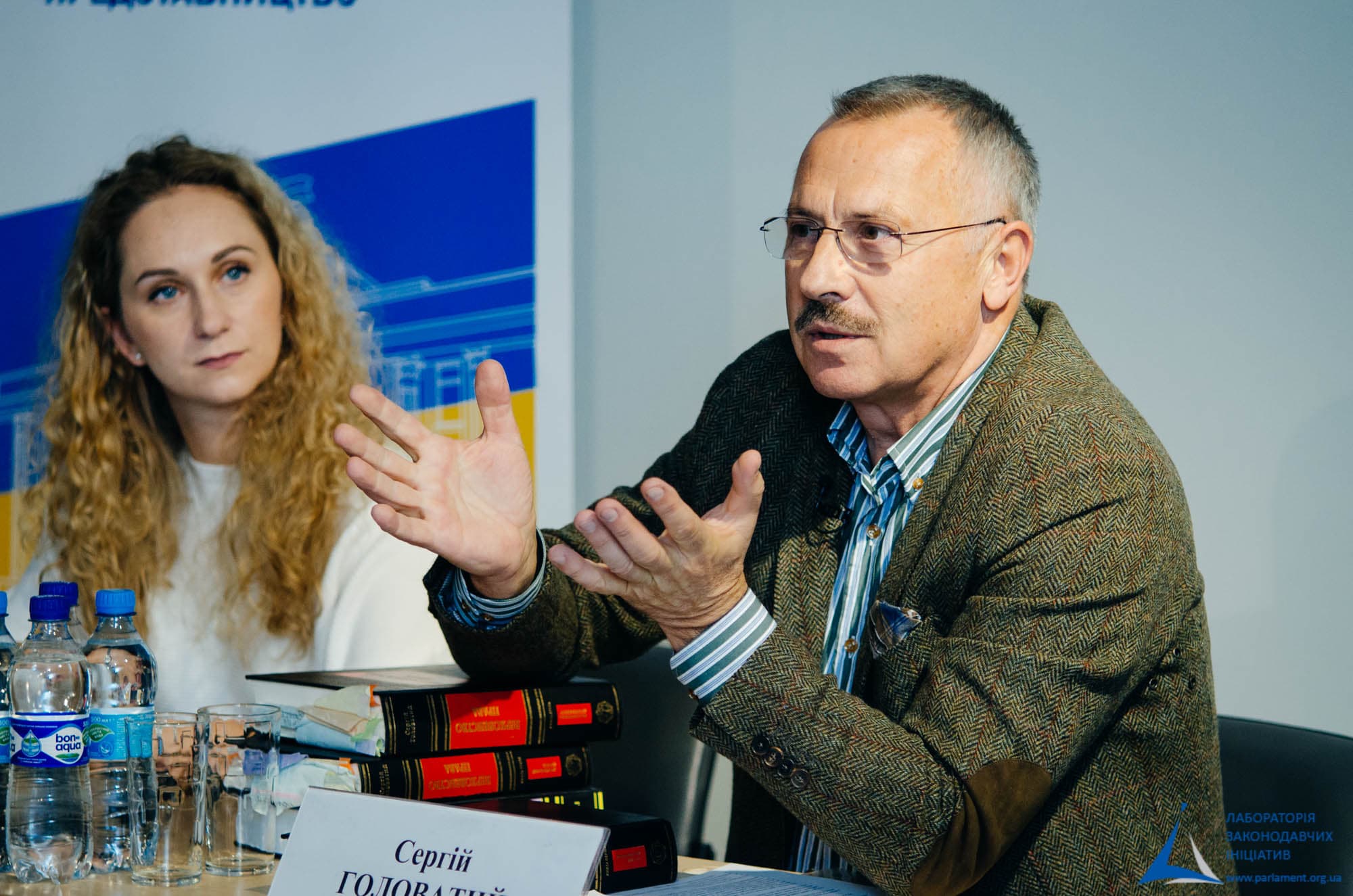
Photographer: Oleksandr Kovalenko
The event was attended by over 30 people: students and postgraduate students from Kyiv universities (the National University of Kyiv-Mohyla Academy, the Taras Shevchenko National University of Kyiv), instructors of the National Academy of Internal Affairs, graduates of the Internship Program in the Verkhovna Rada, MPs’ aids, and representatives of NGOs.
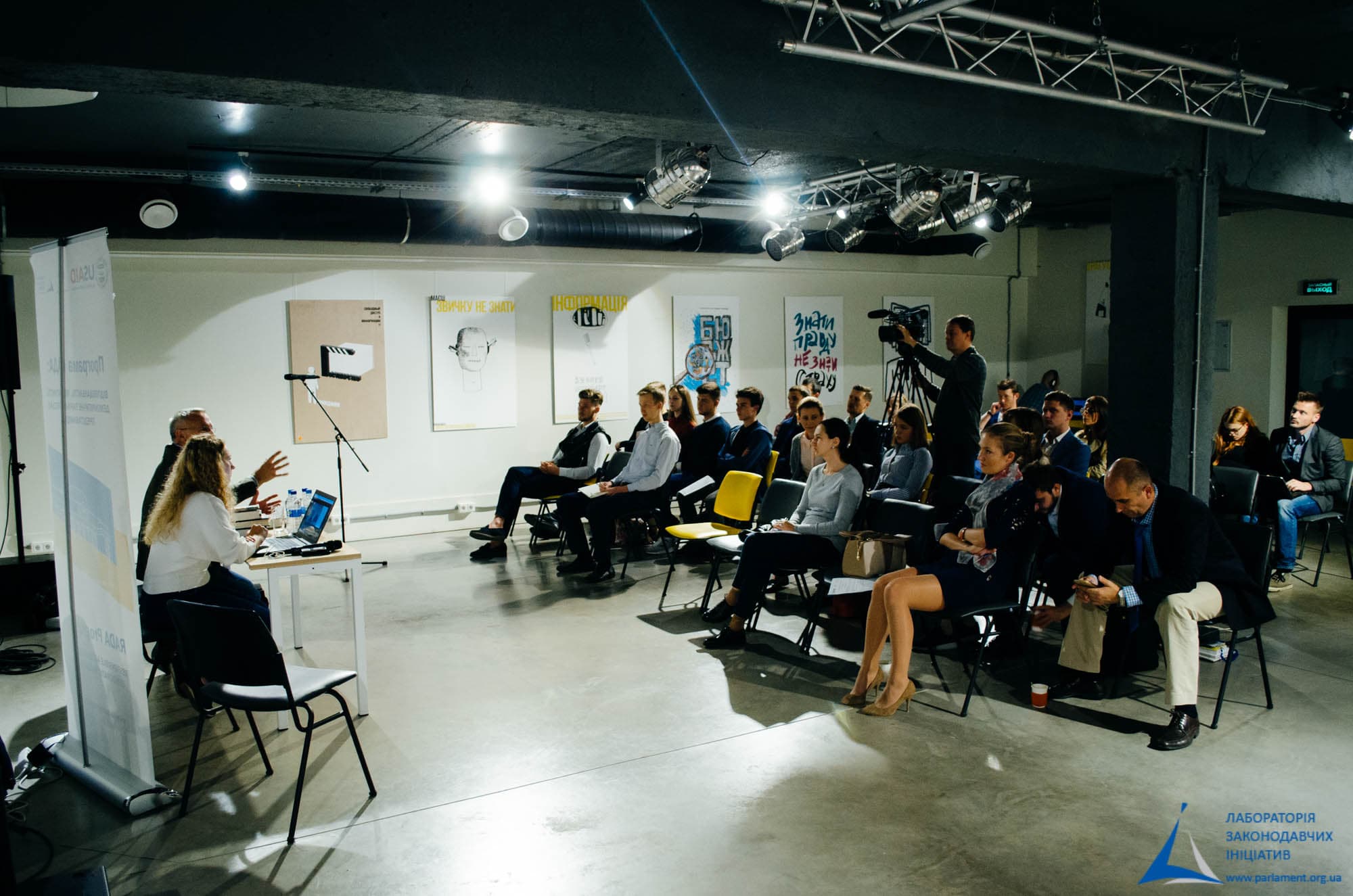
Photographer: Oleksandr Kovalenko
The rule of law serves as a litmus paper that demonstrates whether a society has the standard without which genuine democracy and human rights are unattainable. Assessing the actions of the state (its bodies and officials) in relation to a person based on such formulas as “in a society which has undertaken an obligation to adhere to the rule of law”, “in a state that recognizes the rule of law”, “in a state governed by the rule of law”, etc., courts clearly indicate that this or that action of the state is incompatible with the rule of law principle.
Due to the fact that the principles of true democracy, human rights and the rule of law as “fundamental European ideals” belong to the values that make up the common heritage of European peoples, the actualization of the issues of the rule of law is important in the light of Ukraine’s Eurointegration aspirations.
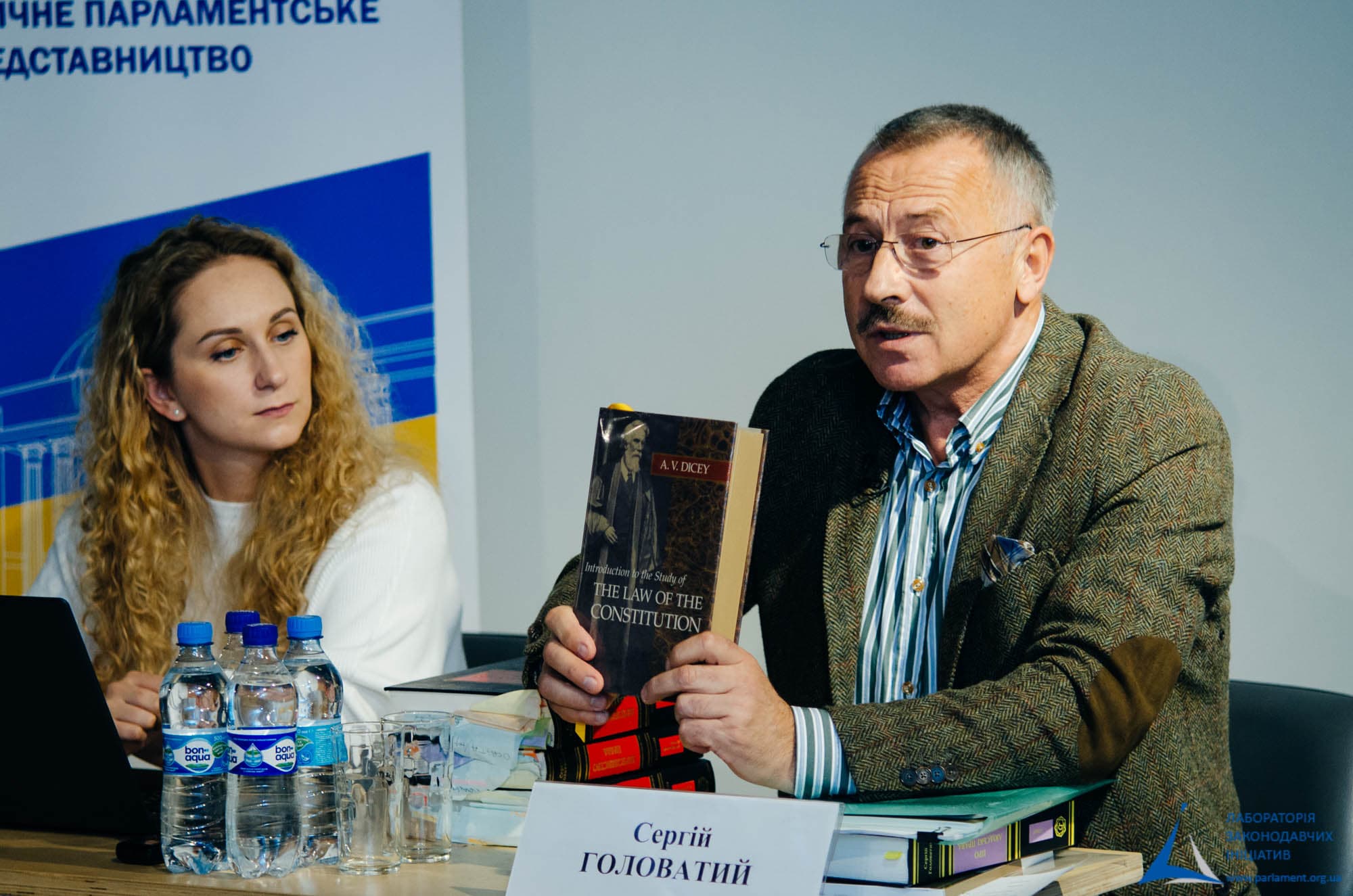
Photographer: Oleksandr Kovalenko
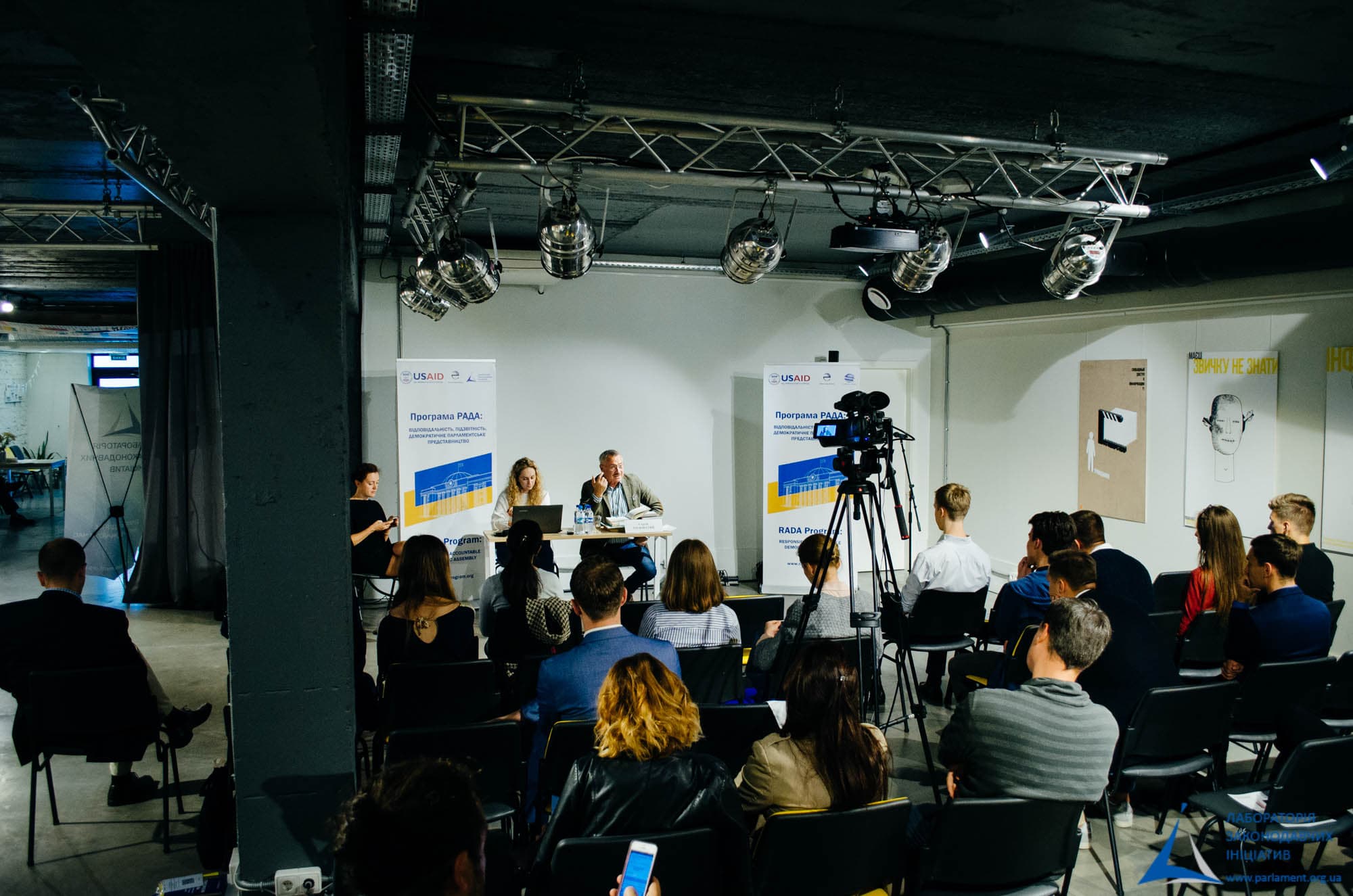
Photographer: Oleksandr Kovalenko
What is the “rule of law” and what are the values behind this principle? Why the translation of the “rule of law” principle as “верховенство права” is wrong? Why should we prefer the term “правовладдя” and what senses and connotations does it involve? What are the milestones of the idea of the rule of law? What is a measure of the rule of law? What is the difference between soft law and hard law? What is justice? What are the natural rights and how are they secured? Why does everyone need to study philosophy? What are the strengths and weaknesses of the Constitution of Ukraine? These and other questions were discussed during the lecture.

The event was organized by the Agency for Legislative Initiatives together with the Internews Ukraine and the Interns’ League, supported by the USAID Rada Program: Responsible Accountable Democratic Assembly, implemented by the East Europe Foundation.
Oksana Syroyid’s Lecture “Legality for Legislators”
Lecturer: Oksana Syroid, Deputy Speaker of the Verkhovna Rada of Ukraine.
More than 40 participants took part in the event: students of Kyiv universities (National University of Kyiv-Mohyla Academy, Borys Grinchenko Kyiv University, National Pedagogical Dragomanov University), graduates of the Verkhovna Rada Internship Program, MPs’ aids, and representatives of NGOs.

Photographer: Oleksandr Kovalenko
Tetiana BIBIK, Deputy Director of the USAID RADA Program: Responsible Accountable Democratic Assembly, outlined the opportunities provided by the RADA Youth Program, focusing on the tools and mechanisms of the Program that promote parliamentary reform, such as the service of electronic petitions, the portal for public discussion of draft laws, the internship program in the Verkhovna Rada as well as educational components for youth.

Photographer: Oleksandr Kovalenko
“Disseminating information on the activities of the Verkhovna Rada of Ukraine and the Government, as well as on available mechanisms for communication of civil society and authorities, we are trying to strengthen the public control over these institutions by increasing the monitoring capacity of NGOs and active youth. It is necessary to do this because the not-so-pleasant image of the government created in the media due to the statements and actions of some politicians dramatically diminishes trust in the authorities. However, people who represent the Verkhovna Rada of Ukraine, VRU secretariat, committees, and committee secretariats do not deserve such a low level of trust. This is exactly why we organize such events in order to raise awareness about what is actually happening in the Verkhovna Rada of Ukraine”

Photographer: Oleksandr Kovalenko
Oksana SYROYID, Deputy Speaker of the Verkhovna Rada of Ukraine
Why do people unite in states?
The state emerges as a social contract between people in order to protect three fundamental rights: life, liberty, and property. In natural circumstances that precede the state, a person cannot individually enforce these rights.
Why do people need government authorities?
People can protect their fundamental rights only by imposing penalties for their encroachment. For example, the protection of the right to life is ensured through the delegation of representatives to the relevant bodies that, on behalf of the people and in the interests of the entire society, establish what a crime is and how it should be punished. Courts must ensure that the fundamental rights and rights derived from them be protected in accordance with laws adopted on behalf of the people.
When we create a state and delegate our rights to it, we must maintain it. To ensure protection of our rights, we allocate resources and create a government.
The function of the government is to collect and redistribute people’s money. Governments have no function other than that. They have to redistribute the funds in such a way as to perform the functions of the state and ensure fulfillment of what people agreed upon. The government is closed by its nature; under such conditions, it is very convenient to spend money.
Therefore, an extremely important function of the parliament is to control how the government collects and distributes money.

Photographer: Oleksandr Kovalenko
When does the parliamentary control over the government emerge?
The prime minister reads a report in parliament: Can we view it as a kind of control over the government? Perhaps we cannot. Both the current and the previous Prime Minister actually believe that just by coming to the Parliament and telling something from the rostrum, they report on their work.
The Ukrainian Parliament does not fulfill its control function and cannot fulfill it because it does not know what the government spends money on.
A vivid example of the government’s non-transparency is the vote on the state budget. The lack of a detailed budget, various inherent preferences, and non-transparency give rise to the phenomenon of the budget night when MPs vote for the state budget at night because they do not trust each other. Since everything is non-transparent and described in “broad-brush terms”, MPs sit at the table and agree on the allocation of funds. If they go to sleep, overnight, all arrangements may be reshuffled and in the morning everyone can come up with new wishes. That is why they vote for the budget “hot on the trail”.
This will continue until there is a detailed and very specific budget.

Photographer: Oleksandr Kovalenko
How do people in power make money?
The people who were in power in the first years of independence created a number of preferences for themselves:
– privatization and management of state-owned enterprises;
– non-transparent extraction of natural resources;
– non-transparent government contracts (budget).
These are the origins of the oligarchic economy of the 1990s.
Corrupt schemes will continue to function until people start to control their money themselves. The first step to this objective is local self-government that teaches people to manage their money and resources.
The next step should be personal tax payment. People seem to believe that the state gives them money without realizing that in reality it is they who maintain the state.
Taxes are a tool that guarantees the state unity and the quality of state institutions. The only mechanism for ensuring the payment of taxes is the inevitability of punishment for a failure to pay them.
The state will cease to exist if people stop paying taxes and controlling how their money is spent.

Photographer: Oleksandr Kovalenko
The quality of the Constitution and the quality of laws
The statement that we have one of the best constitutions in the world is a myth.
From laws people expect information on how they should regulate their behavior and predict consequences for themselves and others in case of non-compliance. If a law meets these requirements, it is of high-quality.
People suffer because of the state. Laws are written to protect people from violations by the authorities and to curb the state’s tyranny.
Laws have to protect human rights and must contain information about the responsible authority that should protect these rights and specify the ways to do this. A law is bad if it does not contain these elements.
Laws are voted in violation of the procedure; laws are not discussed beforehand. The process of voting laws as a whole has many defects; laws adopted based on this principle always contain a lot of mistakes. The main research and expert administration might be politically biased and dependent.

Photographer: Oleksandr Kovalenko
Key tips for young people:
- always look for the nature of things;
- always ask “Why?”
- never take anything at face value;
- study philosophy, think.

Photographer: Oleksandr Kovalenko

The event was organized by the Agency for Legislative Initiatives together with the Internews Ukraine and the Interns’ League, supported by the USAID Rada Program: Responsible Accountable Democratic Assembly, implemented by the East Europe Foundation.
USPS School of Community Leaders – 2017
Opening of the USPS School of Community Leaders

At the opening of the USPS School of Community Leaders, the participants were welcomed by Ihor KOHUT, Founder and Honorary Director of the Ukrainian School of Political Studies, Svitlana MATVIIENKO, Chairwoman of the Board of the NGO Agency for Legislative Initiatives, Stanislav LIYACHYNSKYI, Director of the International Renaissance Foundation’s Program Initiative “Civic Initiatives of New Ukraine”.
In her welcome speech Svitlana MATVIIENKO, Chairwoman of the Agency for Legislative Initiatives, stressed the critical importance of values in the process of shaping the leader. Svitlana emphasized that we should be ready for the future with new knowledge and new values, which can be achieved only through critical thinking, reading and constant self-development.
Human Rights Defense. Legal Humaneness. Legal Solidarity

Human rights are an integral part of the philosophy of law, and human rights protection is an instrument that everyone can and must be able to use, regardless of whether they have legal education or not. How can ordinary people protect their rights? How can we defend the rights of vulnerable groups? How can we change laws and influence legislation? These are the questions raised by Larysa DENYSENKO, human rights activist, lawyer, media personality, and author, in discussions with the participants of the USPS School of Community Leaders.
Medical Decentralization: Reformation of the Healthcare System of Ukraine

Ukraine medical reform is an important component of decentralization of power. The old model of operation of medical institutions, especially in villages and regions, is extremely ineffective. Therefore, it needs to be reorganized through the adoption of appropriate decisions by local communities. How can we make the healthcare reform effective at the local level? How shall we provide communities with access to a high-quality healthcare system? The participants of the USPS School of Community Leaders discussed these questions with Uliana SUPRUN, acting Minister of Healthcare of Ukraine.

Yurii DZHYHYR, advisor to the Minister of Healthcare of Ukraine, a USPS alumnus, told the participants of the USPS School of Community Leaders how much money the government would spends on Ukrainians’ healthcare and how the money would be distributed.
Legal Capacity of Territorial Communities and Responsible Citizenship

What is responsible citizenship? What is the significance of satisfying legal needs for the implementation of responsible citizenship? What are the individual and social consequences of a failure to satisfy legal needs? What is the consolidation of the legal capacity of territorial communities and why is it important? Why is the position of local self-government bodies unique in strengthening the legal capacity of communities? What are the technologies for strengthening the legal capacity of communities? The participants of the USPS School of Community Leaders debated on these issues with Andriy VYSHNEVSKYI, Director of the Coordination Center for Legal Aid Provision in 2012-2017, a USPS participant.
Responsible Judgments

What is the basis of any responsibility? When and why do we start asking? Why cannot we use ad hominem arguments and why do we have to address the subject matter? Who thinks abstractly? What is the role of common sense in constructing responsible judgments? What are the essential components of critical thinking? These questions were answered in the conversation of the members of the USPS School of Community Leaders with Yevhen BYSTRYTSKY, PhD, Head of the Department of Philosophy of Culture, Ethics and Aesthetics of the Institute of Philosophy of NAS of Ukraine, Executive Director of the International Renaissance Foundation.
Town Hall Meeting: Public Participation in Decision Making

A Town Hall Meeting is a competent and effective discussion of any specific issues of public interest and an instrument for ensuring citizens’ participation in governance. The key benefits of this format are its clear structure and efficiency.
Victoria BAKLAZHENKO, Program Coordinator, Agency for Legislative Initiatives, told the participants of the USPS School of Community Leaders about the benefits of Town Hall Meetings, as well as the successful experience of their organization by the Agency for Legislative Initiatives.

Participants of the USPS School for Community Leaders tested the effectiveness of town hall meetings.
Human Centered Design

Why do all bureaucratic decisions regarding urban design come under criticism for poor quality? The methodology of Human Centered Design yields sustainable results and is accessible to all decision makers. The methodology is absolutely universal, based on Design Thinking and suitable for finding solutions to any problems related to human interaction: from the design of a “No Smoking” sign to projects of entire city districts. How can one make a city comfortable? How can you make changes in your city? The participants of the USPS School of Community Leaders discussed this topic with Ihor SKLYAREVSKYI, Art Director of the initiative “Agents of Change”.
Creative City

The Creative City is a concept of urban development pioneered by the British author Charles Landry at the end of the 1980s and later developed by sociologists and economists from around the world. The concept has been implemented in more than one hundred cities around the world; for example, Dublin, San Francisco, Portland, Vancouver, Hanoi, Tel Aviv, Katowice, etc. This approach is gaining popularity in Ukraine. What should a creative city be like? How can we devise a strategy for a creative city? These issues were discussed by the participants of the USPS School of Community Leaders with Pavlo SHEREMETA, Managing Partner at the PRORYV Strategies Workshop, Supervisory Board Member of the City Institute (Lviv), Minister of Economic Development and Trade (2014).
How can we achieve a GDP of $ 1 trillion by 2030?

What makes a country successful? What should you do to make an economic miracle happen? How can we attract investment? Which sectors of economy are most promising? The participants of the USPS School of Community Leaders discussed these topics with Anatoliy AMELIN, Director of Economic Programs, Ukrainian Institute for the Future, a USPS alumnus.
Successful City


How can you make your city successful? What are the effective city development strategies? Why is it necessary to develop a general plan of the city? What unites communities? How can you effectively attract investment? Hanna HERASHCHENKO, Head of Vvedenka Village Council, an alumnus of the USPS School of Community Leaders, Yuriy BOVA, Mayor, Trostyanets Town Council, a USPS alumnus, and Oleksandr KORINNYI, Mayor, Novoukrainka Town Council, Head of the Associations of Local Communities, a USPS alumnus, discussed these issues with the participants of the USPS School of Community Leaders.
Presentations of the Home Task “City Development Strategy”

At the beginning of the training, the participants of the USPS School of Community Leaders received their home task, i.e. they had to collectively develop a strategy for the development of a city: to reason out ways to use its strengths, to attract investment, and to unite the community of the city. At the end of the training, they presented their designed projects.
Past and the City: Between Memory Spacing and Visualization of History

Modern urban communities find themselves in an ambiguous situation: between cultural amnesia and hypermnesia. On the one hand, we are losing ground under our feet feeling that the past and memory are almost tangibly slipping away from us; on the other hand, we have an unprecedented memory boom. How can we preserve the “past” in the city and do we have to do it at all? Doesn’t it hinder renewal? How is it possible to develop a “conservation concept” and apply the practice of “using history as a discourse to find identity”? The participants of the USPS School of Community Leaders conversed about these topic with Svitlana SHLIPCHENKO, PhD, theoretician of urbanism, Docent of the Department of Cultural Studies, National University of Kyiv-Mohyla Academy, Lecturer in History and Theory of Architecture.
Scenarios of Territory Development

To create and implement a policy, the most interesting resource is an image of the future that it offers. The methods of political forecasting are applicable at the local level in the process of creation of scenarios for city and village development. What is the difference between a development scenario and a strategy? What are the methods of political forecasting? Mykhailo KOLTSOV, PhD, Senior Lecturer at the Department of Philosophy and Religious Studies, National University of Kyiv-Mohyla Academy, discussed these issues with the participants of the USPS School of Community Leaders.

SECOND USPS SEMINAR TOOK PLACE IN ODESA
The Second USPS Seminar is aimed at developing skills for critical thinking and analysis of basic ideas and principles that underlie modern social, political, economic and cultural processes. The Seminar took place in Odesa on June 7 – 11, 2017.
Svitlana Matviienko, Chairwoman of the Board of the Agency for Legislative Initiatives, greeted the participants and wished them inspiration and a fruitful seminar.
Values: what are they, actually? Personal and societal aspects

Values underlie any social, political and economic process. But what do we mean when we talk about values? What is the etymology of the word “value”? What is the nature of human as a value bearer? What are values depending on the perspective – neuropsychological, philosophical and sociological? All these and other aspects of axiology were raised during the talk with Denys Poltavets, Programme Director, Aspen Institute Kyiv.
On Council of Europe and its role in Ukraine

Council of Europe is a key organization for human rights protection of the continent. It includes 47 state members, 28 of which are EU members. All Council of Europe members, including Ukraine, signed under the European Convention for Human Rights – an agreement targeted to protect human rights, democracy and rule of law. But are these principles and standards adhered to in Ukraine at the times of war? How can the Council of Europe guarantee enforcement of these principles? What can the Council of Europe do for Ukraine in the time of conflict in the East and annexation of Crimea? These questions were answered by Mårten Ehnberg, Head of Office, Council of Europe in Ukraine.
Political forecasting

During policy planning and implementation one of the most interesting resources is an image of the future which it proposes. However, often political forecasts in Ukraine can be manipulative and overly subjective which negates their importance in good policy making. Mykhaylo Koltsov, PhD, Senior Lecturer of Philosophy and Religious Studies at the National University of Kyiv-Mohyla Academy, talked about methods of political forecasting, spheres of its use, forms of forecasts, principles of short-term and long-term forecasting and ways to implement forecasts.
Justice and politics

Andrii Baumeister, PhD, Associate Professor at Theoretical and Practical Philosophy Department at Taras Shevchenko Kyiv National University, answered the questions of what the state is, why we need it, how tightly we are connected with it, what we think of justice and what it really is.
Art of improvisation in politics

Every day every one of us is an actor of the improvisation genre. Politics, business, love, childcare etc are all acting where we only have one choice to make: either we are being “played”, or we “play”. Improvisation is creation of an act during its performance. How to use improvisation in politics? How to talk to the audience? These questions were answered by Anatoliy Neyolov, Head of the “Black Square” Theatre.
Freedom of expression and modern constitutionalism

What is freedom of speech in modern Ukraine, at the time of war? We often draw upon the examples of freedom of speech and expression in Western countries, but what are peculiarities of freedom of expression in the context of cultural and constitutional differences in the US, EU and Ukraine? How do human imagination, laws of physical world, functions of intellectual freedom, modern art, science and education relate? Vsevolod Rechytskyi, PhD, Associate Professor of Constitutional Law at the Yaroslav Mudryi National Law University of Ukraine, talked about this.
Aesthetics, personality, philosophy of understanding of the aesthetic object

Volodymyr Rafeenko, Ukrainian Writer and Poet, talked about who modern writers and artists are, what is the actuality of a literary means of recognizing reality for a citizen, human, individual. It is the phenomenon of an individual that underlies most key modern developmental processes.
Design thinking and business modeling for social change

Svitlana Khutka, Founding CEO: U.World Foundation; Program “Democracy. Development. Education” (Ukrainian Civic IT Hub in SF) Country Director (Ukraine), Board of Directors Member: coderGirls (Stanford, USA); ProjectCSGIRLS (Harvard, USA). Board Member, “Global Ukraine”, talked about the method of design thinking popular in the States. Design thinking as innovate social problem solution allows for a more effective projection of possible solutions from a point of view of end consumer.
Human body and politics

How do human body and politics relate? Does the body influence politics? Where is the line between “seeming to be” and “being”? What is the body of a politician like? Are flirt, erotica and sex levers of political influence and power? Does this help or vice versa? All this was discussed during the seminar with Svitlana Matviienko, Chairwoman of the Board of the Agency for Legislative Initiatives.
Society, politicians and political parties of the future

What is the main activity of the politician based upon? According to Sergiy Gaiday, Director of Strategical Planning of Social Engineering Agency “Gaiday.com”, on ability to build a political organization and its effective communication with the society. Changes and new technology in the last 30 years, first of all, influenced spheres of information and social communication. However, Ukrainian politicians, as always before, still build copies of the Communist Party. What should modern parties be like? Do we need new ideas and ideologies? How to build a dialogue with the society?
Conflicts in Ukraine: causes, dynamics and transformation

Violent conflicts have their own dynamics and logic. They unfold in time and space accumulating vast human and material resources. They ruin social institutions and destroy social capital. At the same time, conflicts create new opportunities, give a push for transformations, make people change. In the last 20 years just a small number of violent conflicts were resolved. Majority of these conflicts are still in active phase or under the threat of escalation. Can humanity find ways to transform violent conflicts? Are we destined to repeat our history over and over again? Igor Semyvolos, Executive Director, Centre of Middle East Studies, talked about these issues.
Media gallery of the Second USPS Seminar here
Photographer Oksana Sushko