
The School of Community Leaders is a program of the Ukrainian School of Political Studies and the Agency for Legislative Initiatives, which is implemented with the support of the International Renaissance Foundation.
Training Seminar for Parliamentarians within the Project Parliamentary Accountability of the Security Sector in Ukraine
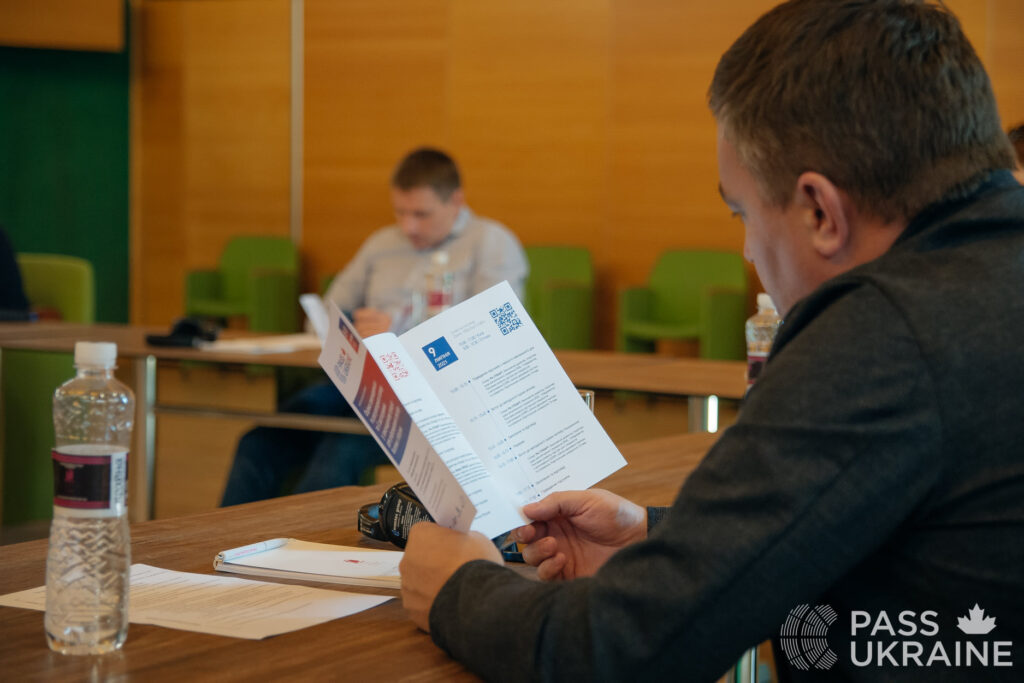
The security and defense sector is certainly one of the most important, especially in a country that has been at war for eight years. Therefore, the Agency for Legislative Initiatives is trying its best to familiarize parliamentarians and staff of the secretariats of the Verkhovna Rada Committees with new tools and methods for reforming the sector.
Last week, as part of the Parliamentary Accountability of the Security Sector in Ukraine (PASS Ukraine) project, the Agency for Legislative Initiatives, in partnership with the Parliamentary Center (Canada), held a training seminar on “Legislative and Regulatory Impact Assessment and its Application in the Security Sector Reform Legislation and defense”.
Members of the Verkhovna Rada Committee on Law Enforcement, the Verkhovna Rada Committee on National Security, Defense and Intelligence, and the Verkhovna Rada Committee on Ukraine’s Integration into the European Union were invited to participate in the seminar. Staff from the secretariats of the above-mentioned committees were also invited.
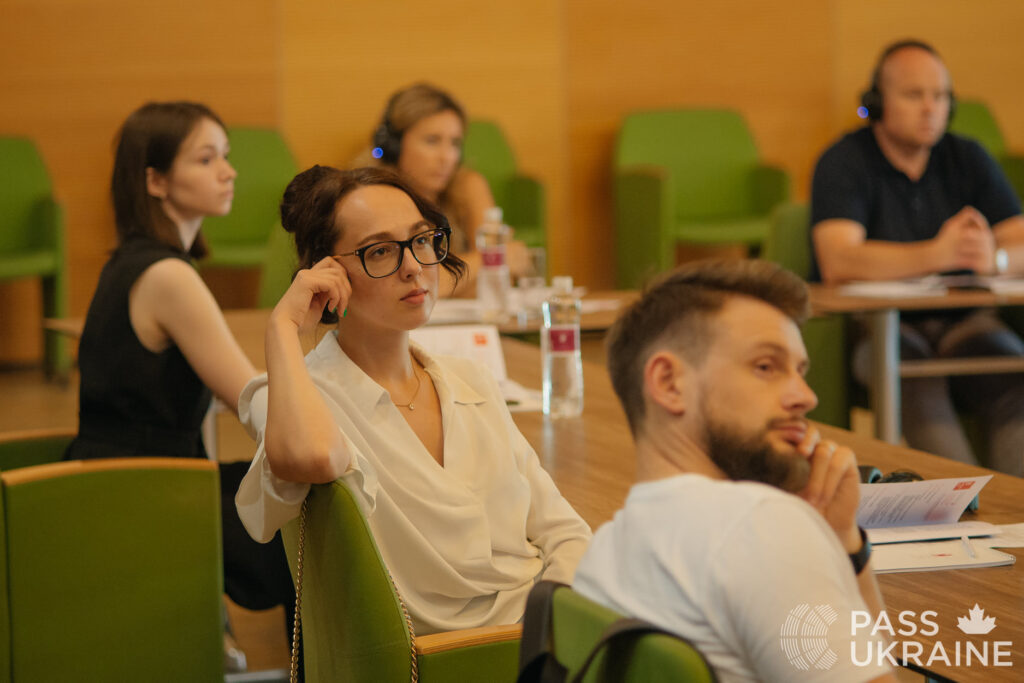
The purpose of the training seminar was to familiarize MPs, committee members, and their staff with Canadian and international experience in assessing legislative and regulatory impact and its application in the legislative process of security and defense sector reform, including assessing the different effects of legislation on women and men.
Nicola Kim, First Secretary, Embassy of Canada in Ukraine, made a welcoming speech at the opening of the training seminar.
The speakers of the training seminar were Canadian experts with many years of experience in regulatory and legislative influence:
- Daniel Trnka, Deputy Head, Regulatory Policy Division, Public Governance Directorate, Organisation for Economic Co-Operation and Development (OECD);
- Rick Stewart, Executive Director of the Regulatory Governance Initiative (RGI) and Co-Director of the Career Development for Regulatory Professionals (CDRP) Program in the School of Public Policy and Administration at Carleton University, Ottawa;
- Michael Presley, Director, Certificate Program in Regulatory Leadership, Centre for Public Management and Policy, University of Ottawa; Former Assistant Deputy Minister (Regulatory Affairs) at the Treasury Board Secretariat, Canada.
- About the experience and practice of Ukraine in applying legislative and regulatory impact assessment in the legislative process, participants were told by Ivanna Klympush-Tsintsadze, MP, Chairwoman, Verkhovna Rada Committee on Ukraine’s Integration into the European Union, Member of the Interparliamentary Relations Group with Canada.
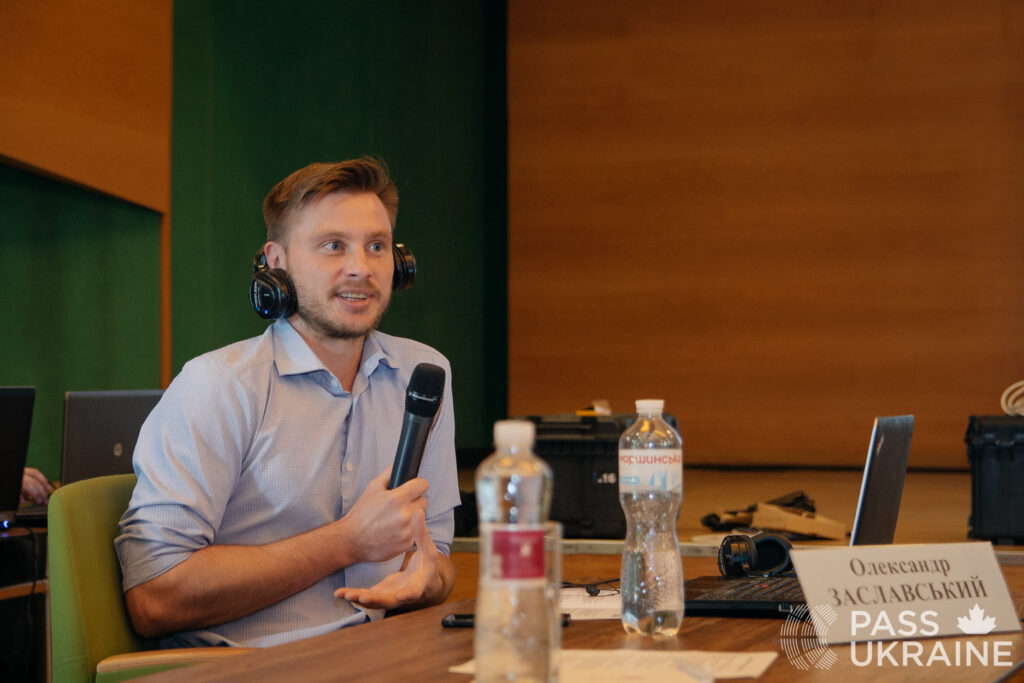
The seminar was held in an unusual format – combining offline and online, which allowed to simultaneously engage Canadian partners who shared their experiences and establish communication between members of different committees.
As part of the project, we plan to hold more such meetings in order to continue involving MPs and Canadian partners in close cooperation in various formats.
The Parliamentary Accountability of the Security Sector in Ukraine (PASS Ukraine) project is a joint project of the Agency for Legislative Initiatives and the Parliamentary Center (Canada), supported by the Canadian Ministry of International Affairs under the Peacebuilding and Stabilization Program (PSOPs) and in partnership with the Verkhovna Rada Of Ukraine.
Results of the First Session of the School of Community Leaders

The School of Community Leaders began its work on June 24. 29 local government representatives, community leaders, civil society representatives, and volunteers joined our community.
Svitlana Matvienko, Executive Director of the Agency for Legislative Initiatives, congratulated the participants on opening the School of Community Leaders. She stressed the extraordinary value of civic education in general. Projects such as the School of Community Leaders are the seeds of concrete action and real steps for change throughout Ukraine. The School of Community Leaders aims to push Ukrainian communities to change and provide them with the necessary knowledge to implement these transformations.
Political Saturnalia: Carnivalization of Politics in the Postpolitical Age

The School participants immediately plunged headlong into learning, and Ivan Gomza, Candidate of Political Science, Associate Professor, Head of the Department of Public Administration at the Kyiv School of Economics, helped them with this. He held a discussion about political saturnalia and what to do when politics turns into a carnival? In politics, there is no division into good and bad, there are facts. Today, the fact is that carnivalization of politics is a global trend: when “clowns” and “pseudo-politicians” come to power, and the political process turns into a show. Is there a danger in this? Certainly. But this is the reality in which we live. And there are opportunities in it too.
Decentralization reform and local self-government

The reform started rapidly and received support at home and abroad. However, in its implementation, naturally, difficulties arose: the decentralization of power dictates us the need for sectoral reforms – in education, medicine, culture, sports, civil protection, and security. Without accompanying reforms, decentralization loses its meaning.
Today, decentralization has lost its priority for the Government and is not going according to the vector as originally planned. But this does not mean that it should not be continued or rethought further action plan. Ukraine needs strong self-government and successful communities. This is how Oleksandr Khoruzhenko, Deputy Chairman of the Board of the Agency for Legislative Initiatives and an expert on local self-government, describes the reform.
Political responsibility and responsible policy: fair elections, good governance and responsible management of public finances

Why are the citizens in democratic societies mostly dissatisfied with representative authorities? Will the reform of the election legislation consider the interests of local self-government and what to do about it? To what extent is political corruption the norm? The discussion panel participants discussed all these issues with the Chairman of the Board of the International Renaissance Foundation and the Chairman of the Board and Coordinator of Political Programs of the OPORA Civic Network Olga Aivazovska.
Elections and political indifference of voters, use of administrative resources for “dirty game”, subventions for socio-economic development of territories, and problems with political parties in the regions – participants of the School spent the whole evening in an active dialogue and exchanged experiences and interesting cases on these topics.
Health care reform in Ukraine. The impact of the pandemic on the implementation of the second stage of medical reform.
Health care reform always raises many questions for people, especially in the regions, because it has started well not everywhere. Therefore, it is important to communicate to community leaders what changes are needed in the health care system and what can be done to save people on the ground – in the pandemic and beyond – and provide quality health services to community members.

Oleg Petrenko – the first head of the National Health Service of Ukraine (2018-2019), an independent director of strategic development in the medical network “Dobrobut”, an alumnus of the 2006 USPS program, told the participants about the beginning of the reform, the concept of health care development, and the importance of strong institutions. How health care is financed, what are the difficulties in carrying out the reform, and how people are fighting to keep unprofitable and inefficient hospitals – participants could talk about all this with the person who was at the origins of the reform.

Kateryna Bulavinova, a doctor, pediatric infectious disease specialist, and medical expert at the United Nations Children’s Fund (UNICEF Ukraine) in Ukraine, took the discussion to a more practical level. She told participants about the punctures during the COVID-19 pandemic, the maintenance and provision of hospitals on the ground, and medical infrastructure in general.
Breakthrough strategy: how communities can master the wave of “creative destruction”

Why is the community the third pillar, and how have innovation, education, and entrepreneurship been the drivers of productivity growth? The answers to these questions were given by the founder of the proryv.in.ua think tank, a member of the Supervisory Board of the Institute of the city, the Minister of Economic Development and Trade (February-September 2014), Pavlo Sheremeta. Using the examples of the Eastern countries, he told how to move from constant stagnation to constant prosperity and explained the specifics of the development of the Ukrainian economy through the prism of culture and demography.

The discussion continued on whether there would be further damage to business from the pandemic and how the Ukrainian economy could catch up with its western neighbors. Hlib Vyshlinsky, Executive Director of the Center for Economic Strategy, explained the structural changes that have taken place since the start of quarantine and how the pandemic has affected the economy as a whole. He also spoke about the “Great Construction”, low level of investment, prospects for Ukrainian GDP growth, and the role of human capital in economic development.
Continuation of the reform of the general secondary education system

How is the education reform going, and is the “New Ukrainian School” concept being implemented in the regions? What to do with schools? And what is more important – the quality of education or logistics of schools? We talked about all this and more with the Educational Ombudsman Sergii Gorbachov and the co-chair of the public association PARENTS SOS, an alumnus of the USPS 2016 program Alena Parfenova.

To ensure quality education, it is necessary to reorganize the educational network and establish communication with communities. Education is a large infrastructure system that is difficult to optimize due to several problems. One of them is the staffing problem. Often, principals or field officials are more preoccupied with solving infrastructure problems than managing the educational process. However, the situation has changed due to the pandemic. The beginning of quarantine drew the attention of educators to the need for changes in distance education and providing schools with high-speed Internet and technology. However, this is not enough to implement effective education management in communities.
Environmental policy of communities: how to preserve an environmentally safe environment for your community

The right to safe life and environment is enshrined in the Constitution of Ukraine. And the topic of environmental protection is more relevant than ever, so this year’s program pays much attention to the development of local environmental policy and its integration into the community development strategy. The environmental discussion panel consisted of two dimensions: theoretical and practical. For the first of them responsible was Olena Maslyukivska, associate professor of ecology at the National University of Kyiv-Mohyla Academy, a 2008 alumnus of USPS, who told the participants about the most pressing environmental issues and how to prioritize the sequence of their solutions in communities properly.


In the more practical part of the discussion, the two experts shared their own cases on implementing change and improving the quality of the environment of their own cities. Artem Myrhorodskyi, CEO of GreenAge, CEO of BioBin, a 2007 alumnus of USPS, spoke about waste recycling and his successful experience of how a socially important business can not only benefit people but also be monetized. And Artem Romaniukov, the co-founder of Saveecobot, director of SaveDnipro, a 2018 alumnus of USPS, spoke about the problems he faced during the struggle for clean air in his hometown and how communities can improve local air quality on their own.
Aesthetics and architecture. Influence on consciousness

Why is it important to organize the space in which you live and how it affects people’s quality of life and consciousness, how to make “buildings for people, and not people for buildings”? Is there a connection between architecture and democracy? And how do aesthetics and architecture affect consciousness? Participants were able to talk about all this with the architect, Deputy Chairman of the Architectural Chamber of the National Union of Architects of Ukraine, founder and CEO of the Architectural and Design Group Anna Kyrii, an alumnus of USPS 2016 program Anna Kyrii.
Ukraine inherited many authoritarian “political” buildings from the Soviet Union. Rebuilding the past for a new quality of the future, creating “transparent” institutions, and comfortable and aesthetic spaces for people, thereby raising the level of culture of citizens – a new symbolic task for all of Ukraine and communities in particular.
Legal capacity of the community and its sustainable development

The legal capacity of a community is one of the fundamental aspects of its development. But how to strengthen it and give communities access to justice?
MPP (Oxon), lawyer, director-founder of the national system of free legal aid, Deputy Minister of Justice of Ukraine (2012-2017), Honored Lawyer of Ukraine, and Chairman of the Board of Transparency International Ukraine Andriy Vyshnevsky told the participants about the concept of two types of justice, the impact of decentralization on access to justice and meeting the legal needs of citizens.
The level of dissatisfaction with legal needs in Ukraine is high. This is partly due to the fact that communities do not identify legal problems and ignore their solution. At the same time, unmet legal needs fuel the cycle of decline and slow down community development.
Tools of democratic influence

In order to develop democracy, it is necessary to involve citizens in the decision-making process. However, how can local governments become closer to the people in the digital age? The participants talked about this with the coordinator for digitization of the regions of the Swiss-Ukrainian EGAP program implemented by the Eastern Europe Foundation, Serhiy Hunko. The expert told the participants how to change the process of providing services, digitize paperwork and why the digitalization of business and the state is important for public participation.

The second part of the discussion concerned more traditional tools that the Agency for Legislative Initiatives has long been “lobbying” in Ukraine. Maria Sokolova, an analyst at the Agency for Legislative Initiatives, shared the insights and mechanisms for conducting a social audit and a Town Hall Meeting with participants.
Social audit is an effective means of ensuring government accountability through the study of the opinion of the final recipients of the service or public policy. Simply put, it is a way to verify compliance with government obligations. Another tool introduced to the participants was the Town Hall Meeting – an informal public gathering of residents of a certain area. Discussed the mechanisms of holding meetings and their scenarios. And, of course, shared the experience of the meetings already held.
Closure of the School of Community Leaders

The first session of the School of Community Leaders was closed by Oleksandr Sushko, a Ukrainian political scientist and public figure, executive director of the International Renaissance Foundation, an expert in international relations and civil society development.
Democracy starts from the bottom. A mature democracy cannot be established without a stratum of people who have both values and practical knowledge of how to implement it. We need people who know how to work with people, gain trust and have managerial skills. Community leaders are just such people. Thanks to such leaders, people get a sense of involvement, and then a real democracy is formed. Real democracy is not to come and vote once every 5 years. It is to be a constant participant in a certain process, which forms the background of the state.
The answer to the question of whether Ukraine has chosen the right course is formed on the ground. Course on decentralization, on local self-government. And local leaders are the number one human resource for public administration at the national level. With these words, Oleksandr Sushko congratulated the participants on the completion of the first session.
This year we will continue to work with communities in the format of environmental mentoring. Each of the participating communities will receive a separate mentor to help them address pressing environmental issues.
Meanwhile, the selection of environmental mentors who will have separate training is underway.
Selection for the Program of Environmental Mentoring of Amalgamated Territorial Communities
The Agency for Legislative Initiatives and the Ukrainian School of Political Studies with the support of the International Renaissance Foundation have launched a selection for the Environmental Mentoring program! You can fill in the application form from June 24 to July 14 inclusive.

With the beginning of the decentralization reform, Ukrainian amalgamated territorial communities have gained more power, but many of them lack experience in solving urgent problems. This is especially true of environmental problems, for which communities need knowledge, the help of qualified personnel and an integrated approach.
What is the Environmental Mentoring Program?
The Environmental Mentoring Program is the first and unique project of its kind in Ukraine. This is part of the School of Community Leaders project, which aims to deepen cooperation with amalgamated territorial communities and provide them with long-term support to address environmental issues.
At this stage of the project, we will hold a three-day workshop for mentors on environmental issues. The objectives of this session are to teach mentors the basics of amalgamated territorial communities environmental impact assessment, waste management strategies, sustainable natural resource management, and adaptation to climate change.
The next stage after the seminars is the work of mentors directly with the amalgamated territorial communities. After the training, environmental mentors will be able to advise communities on environmental issues and approaches to solving them. Each participant in the environmental mentoring program will work with a specific amalgamated territorial community in Ukraine.
We are looking for people who:
- are ecology students, environmentalists, local activists or volunteers;
- have research interest and work on solving environmental problems in Ukraine;
- take an active position in life and are ready to use the acquired knowledge for the benefit of society and the community;
- are ready to work with one of the communities selected at the first stage with the help of tools obtained during the training, during the third stage – September-December 2021.
Approximate dates of the program:
| until July 14 | Application process for participation in the program |
| by July 28 | Announcement of final selection results |
| August 18-20 | Seminars for participants (Kyiv) |
| September-December | Environmental mentoring of amalgamated territorial communities |
Therefore, do not miss the opportunity to join a large-scale project that will help start solving environmental problems at the local level! The selection will last until July 14!
Selection for USPS 2021: Who Are Our Applicants?
The Selection Committee has completed the formation of a group for the XV-XVI Ukrainian School of Political Studies program, which will take place in 2021. The First Session of the USPS program will begin very soon, and our Community will become even bigger.
Every year we monitor our applicants and observe the dynamics of selection. So this year, we also prepared some interesting data on people who filled out the application form to participate in the USPS 2021.
In particular, this year, we have almost equal applicants among men (51%) and women (49%). The average age of applicants is 34 years. Among those wishing to join the USPS program, 58% are from Kyiv or the region, 42% – from other regions.

More than half of the applicants in 2021 (62%) filled out the application form for participation in the School for the first time. For us, this indicates, first of all, that the interest in the Ukrainian School of Political Studies is not waning. And this motivates us to improve the program every year and work more and more on developing civil society in Ukraine.
Interestingly, this year we have a huge number of applications from representatives of the political and civil service sector, compared to last year. In 2020, by contrast, most applicants were from the business and legal community. Unfortunately, the media and creative professions are traditionally the least represented, but we are constantly working to increase this industry’s interest in the USPS program.
This year, we also analyzed applicants’ responses to the virtual interview, which is a regular part of the application for USPS. Thus, we received data that almost a third of our applicants consider themselves suitable for the position of Minister/Deputy Minister. Another 28% have the ambition to be a Member of Parliament of Ukraine.
Almost all applicants (96%) approve of the Law of Ukraine “On Ensuring the Functioning of the Ukrainian Language as the State Language”. 84% of applicants want to get vaccinated against COVID-19.
We continue to unite people by common values and views. Thanks to everyone who submitted their applications this year. We value every applicant.
Selection for the School of Community Leaders 2021
Selection for the fourth School of Community Leaders is now opened! You can fill in the application form and apply for participation in the program from April 15 to May 10.
The School ща Community Leaders is a project designed to bring together local leaders from all regions of Ukraine and help them develop their communities. Decentralization reform has initiated an irreversible process of change. That is why it is now essential to strengthen Ukraine on the local level, to help new leaders from the regions to take responsibility and implement further changes.
The School of Community Leaders Program was launched in 2015 under the auspices of the Ukrainian School of Political Studies and the Agency for Legislative Initiatives with the support of the International Renaissance Foundation.
During this time, we have results that prove the need for further work with communities:
- 3 programs of the School of Community Leaders have been conducted since 2015. 2 of them were dedicated to the preparation for the local elections.
- > 250 representatives of local self-government and civil society became Alumni.
- 48% of Alumni of the program of different years ran in the 2020 local elections. 40% of them won.
The School of Community Leaders 2021 will differ from the programs of previous years, responding to the challenges that communities from different regions of Ukraine face on a daily basis. Community issues cover a wide range – from safety and clean environment to problems with access to quality medicine and education. And we will work together to find solutions for all these problems.
This year’s training will focus not only on good governance skills, decentralization reform, and community participation tools. We plan to deepen our cooperation with communities and provide long-term mentoring to address the urgent needs of communities.
Special attention will be paid to environmental mentoring, during which program participants will learn more about environmental impact assessment for communities, adaptation to climate change, disposal of household and other waste. Issues related to environmental safety, access to medicine, and education will be explored in detail through public participation tools – Town Hall Meetings and social audit.
We encourage to apply people who:
- are representatives of local self-government at all levels, heads of the amalgamated territorial communities, local activists, and volunteers;
- have significant professional achievements and demonstrate leadership qualities;
- take an active position in life and are ready to use the acquired knowledge for the benefit of society and community;
- have trust and support of the community;
- will be able to involve their community in an environmental mentoring program and work with an environmental consultant;
- ready to work with the community using the tools learned during the training after completing the program.
The School of Community Leaders 2021 is planned to be held offline. However, due to quarantine restrictions, the program dates may change (participants will be notified in advance). Participation in the program is free, as the International Renaissance Foundation supports the project.
Approximate dates of the program:
| until May 10 | Acceptance of applications for participation in the program |
| May 11 – 21 | The announcement of results of the I round |
| May 24 – June 4 | The II round of selection |
| by June 7 | The announcement of results of the II round of selection |
| June 25 – 27 | Seminars for participants (Kyiv) |
| September-December | Environmental mentoring of communities |
More details of the program and answers to important questions about this year’s program are here. For any other questions, please contact the e-mail address info@usps.org.ua or the Facebook page of the USPS.
Selection for Participation in the USPS 2021 Program
On March 1, the Ukrainian School of Political Studies opened the selection for the 2021 program. Applications will be accepted from March 1 to 21.
The Ukrainian School of Political Studies is one of the most successful educational and network projects in Ukraine. USPS belongs to a network of schools of political studies established under the auspices of the Council of Europe. The Ukrainian School was established in 2005 as a joint project of the Council of Europe and the Agency for Legislative Initiatives.

In 16 years, we have brought together more than 500 successful leaders from various fields – civil servants, lawyers, businessmen, scientists, politicians, journalists, representatives of creative professions, and public figures. The Ukrainian School of Political Studies is not just about studying, we are creating a Community of like-minded people united by common values and a mission to develop a democratic Ukraine.
If you share the School’s values and want to join the largest Community of value-oriented leaders in Ukraine – be sure to apply.
WE ARE LOOKING FOR PEOPLE WHO:
- have significant professional achievements in the field of political, social, scientific, creative, and entrepreneurial activity, journalism, politics, jurisprudence;
- take an active civil position and can apply the acquired knowledge in their daily activities;
- are citizens of Ukraine under the age of 40 who have higher education; if your age exceeds the requirements, we encourage you to apply in any case;
- knowledge of foreign languages is an additional advantage.
YOU CAN LEARN ABOUT THE TERMS OF ADMISSION AND COMPLETE THE APPLICATION FORM HERE.
Online Discussion “If the State Fails: Civic Participation in Environmental Policy”
On December 8, as part of the World Forum for Democracy, the Ukrainian School of Political Studies held an online discussion “If the State Fails: Public Participation in Environmental Policy”.
The World Forum for Democracy is an integral part of the USPS program. Every year, in Strasbourg, the Council of Europe holds a large-scale discussion on a particular issue. However, this time, due to the COVID-19 pandemic, the World Forum for Democracy was moved online. But this does not mean that the discussions have stopped and the problems have ended. This time the Forum will last for the next 12 months, during which participants will try to answer one question – can democracy save the environment?
In the online discussion from the Ukrainian School of Political Studies participated civic activists who have created large-scale environmental projects for Ukraine and government officials. Together, they tried to decide how the state and the public should interact to solve environmental problems. The conversation was moderated by Denys Kazanskyi, Journalist and environmental activist.
Experts agreed that today, unfortunately, environmental initiatives in Ukraine replace the functions of the state.

Olena Maslyukivska, Associate Professor of the Department of Ecology at the National University of Kyiv-Mohyla Academy and USPS alumna
“This is not the job of a civic organization to deal with the disposal of toxic waste. A non-governmental organization should not monitor air quality, nor should it dispose of any, even solid household waste. Nevertheless, these initiatives exist in Ukraine”
According to the speaker, environmental initiatives in Ukraine are similar to startups. Their goal is to create a certain public good. And society must decide how to support these organizations to ensure their sustainability.
In turn, Maksym Borodin, Environmental activist and member of the Mariupol City Council, spoke about his environmental protest experience in the struggle for clean air with industrial enterprises in Mariupol. Due to the pressure, Mariupol residents managed to force large industrial facilities to start modernizing their equipment. However, the speaker is sure that protests are a temporary means of influence.

Maksym Borodin, Environmental activist and member of the Mariupol City Council (on the right screen)
“NGOs cannot constantly replace the state system of monitoring and control because activists do not have the authority to do this. We monitor and see excess pollution, but there is nothing we can do as activists. Until the legislation changes, there are no opportunities for environmental changes”
The next speaker, Artem Romanyukov, is USPS alumnus and co-founder of the environmental chatbot Saveecobot, which already has more than 1 million active users. After several years of working to make it easier to breathe in his hometown, Dnipro, the speaker is convinced that environmental activities should start with education.

Artem Romanyukov, USPS alumnus and co-founder of the environmental chatbot Saveecobot
“We have created a demand for air quality data in Ukraine. But now, the state must intervene in this process. The most logical step should be the state monitoring of emission sources. The state can be our partner here. State monitoring is an important next step. We are ready to help the state in this”
Lyubov Kolosovska, co-founder and director of the organization “Batteries, surrender!” (a project that collects batteries and organizes the recycling process) and USPS alumna, noted the importance of the financial component of environmental activism.
“Someone has to pay for environmental sustainability, decisions, and changes. However, many people do not understand this. The first idea in Europe was that the state takes money from polluters and uses it to change the situation for the better. However, this idea is outdated”

Lyubov Kolosovska, co-founder and director of the organization “Batteries, surrender!”
According to the expert, if the polluter can simply buy off, it is the avoidance of responsibility because responsibility relies entirely on the state. Instead, the state should delegate responsibility and authority to other entities, such as garbage-producing businesses, so that they can contribute to solving the problem themselves. The state should only control this process.
Head of Ukraine’s state ecological inspection service (2019-2020) and Head of the “Environmental Alternative” political party Yegor Firsov, in contrast, is convinced that neither democracy nor activism can solve environmental issues.

Yegor Firsov, Head of Ukraine’s state ecological inspection service (2019-2020) and Head of the “Environmental Alternative” political party
“Activists cannot be relied on to solve, and not just actualize, environmental problems. Activism is like an antibiotic. It only works when there is an acute problem. Professional non-governmental institutions engaged in environmental activities could help. The environmental agenda in the world and in Ukraine is now very complex, especially if it is needed to be synchronized with European legislation. This task also covers the economy, energy, infrastructure. Energy and activism are simply not enough to solve these problems. We need professional people”
Lesya Vasylenko, Member of the Verkhovna Rada Committee on Environmental Policy and Nature Management and USPS Parliamentary Program alumna, noted that synergy, coordination, and cooperation are needed to solve environmental problems.

Lesya Vasylenko, Member of the Verkhovna Rada Committee on Environmental Policy and Nature Management and USPS Parliamentary Program alumna
“Our task is always to use the opportunities we have at a particular time. There are tasks for the government, for the parliament, and the civil society. Besides, it is necessary to involve local governments, media, business representatives. The latter make money by using resources, and therefore it also depends on them whether the decisions will be implemented. Roles must be clearly assigned. We have to play these roles to the end and ensure, within the limits of our capabilities and responsibilities, the rules and observance of the rules that will allow us to live in a safe environment”
Oleksandr Marikovsky, Deputy Chairman of the Verkhovna Rada Committee on Environmental Policy and Nature Management and USPS alumnus, also participated in the discussion. According to him, the fight against environmental problems depends on values.

Oleksandr Marikovsky, Deputy Chairman of the Verkhovna Rada Committee on Environmental Policy and Nature Management and USPS alumnus (on the left screen)
“The vocation to protect the environment is based on values. Through activism and civic organizations, these values can be revived in the population. This is what is happening in Ukraine. With a critical mass of people who share these values, civic participation in environmental policy is a very great force”
In turn, Oleksiy Ryabchyn, Adviser to the Minister of Environmental Protection, Adviser to the Deputy Prime Minister on European Integration, and USPS alumnus, shared his experience of cooperation between civil society and the state in environmental issues.

Oleksiy Ryabchyn, Adviser to the Minister of Environmental Protection, Adviser to the Deputy Prime Minister on European Integration, and USPS alumnus
“NGOs do not always know how to incorporate their initiatives into the state mechanism properly. If cooperation with civic organizations is successful, great things can happen. However, some aspects, such as environmental externalities, must be tightly controlled by the state. Such questions cannot be left to chance”
The discussion participants concluded that it is necessary to look for new ways of interaction between environmental activists and the state to achieve results not only through pressure, protests, demands, and crowdfunding initiatives. The state must provide support to civic environmental organizations and take over the functions of monitoring and control over Ukraine’s environmental situation, as no one else in the country has the authority to do so.

The state should be a partner for civic initiatives. This is not happening yet, but we must strive to share environmental pollution responsibility, not to avoid it. Representatives of civic organizations expressed readiness to assist the state on environmental issues.
School of Community Leaders – 2020: Participants
The program of the School of Community Leaders – 2020 is over, and now our Alumni and participants are actively preparing for local elections.
In the meantime, let’s introduce you a little closer to those who participated in the School of Community Leaders. This year we received more than 400 applications. Despite the quarantine restrictions, we managed to conduct the program online and involve the maximum number of people who needed it. Over 200 leaders from all regions of Ukraine have gotten the opportunity to study. More than 50% of them successfully completed the School’s program before the election.

61% of the School of Community Leaders – 2020 Alumni are running in local elections. 79% of them are candidates for local councils, and 21% want to be head of territorial communities. We wish success in the elections to all participants and Alumni of the School of Community Leaders!
We promise that this will not end our cooperation with Alumni.
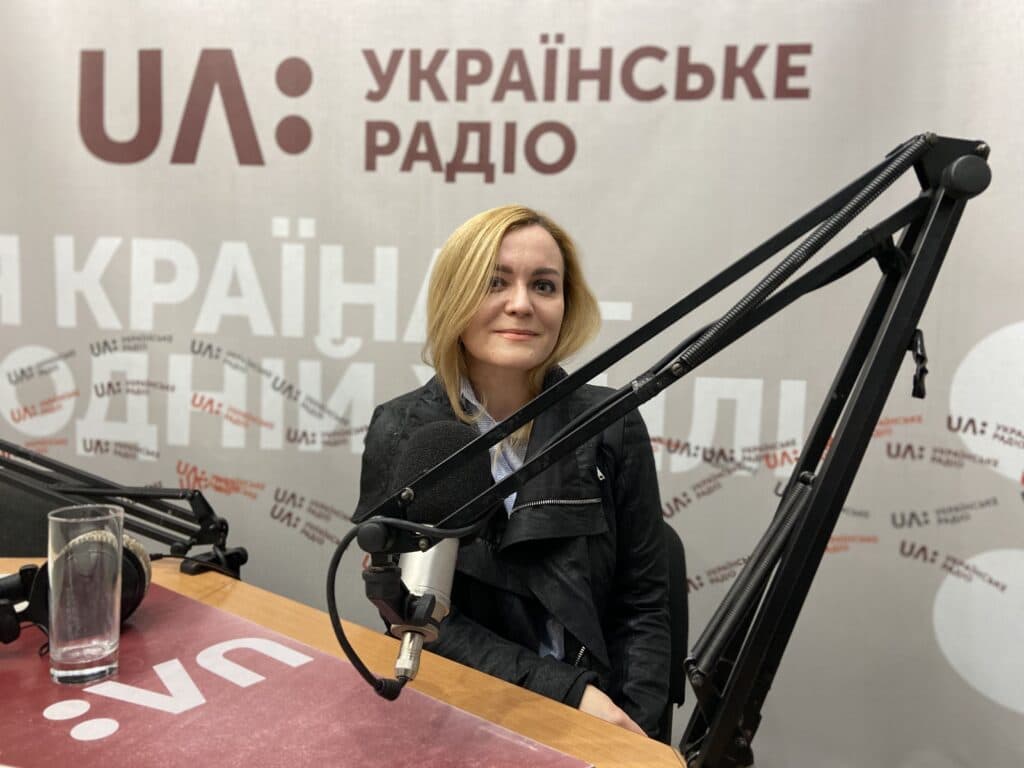
Svitlana Matviienko on Ukrainian Radio: “Activists in political parties are a trend”
A recording of the broadcast is available here. And we publish the full conversation:
You and your team have been involved in forming leaders for 15 years. How many of your alumni are already in politics?
We have a lot of educational programs: the School of Community Leaders, the Party Innovation Hub, and the Ukrainian School of Political Studies. We also practiced women’s education programs, some seminars for MPs. We do not aim to look for people who will definitely go into politics. Ukrainian School of Political Studies brings together people from very different fields and promotes public dialogue. When these people decide to become political players, we talk to them, we consult. The most important thing for us is for a person to do what they have a vocation for. It is impossible to become a politician without an inner desire. But the most important thing is readiness and understanding of what you will do there and why you are going there. Our Alumni have held a variety of positions since 2005, including mayors, MPs, ministers, deputy ministers, and even the prime minister of Ukraine. Everyone came to power and came out with different indicators. Our task is to show during this studying, communication, discussion, a real picture of what can await them, what responsibility they can take, and what they can share with others for the public good.
How do you evaluate the results of Alumni’s work? Can these young people, who have public dialogue and your support, somehow influence policy change in the country?
When we started the School in 2005, the first group included very different people, who then, 10-15 years later, held responsible positions. We saw them grow. We tried to support them and be there where we could. When a person does something all his/her life, he/she becomes a professional. We have good examples at the local level, when our Alumni – mayors, village mayors – test themselves, engage in this activity all their lives, and election to election check how much the community trusts them. There are cases when our people were re-elected 3-4 times. This is a smooth growth. People who fell sharply into what is called politics of national scale, with different losses and gains, came out of it. Reputational losses are insane. Achievements depend on talents, values , and what life plan a person has.
Should we move from a sphere of activism, where there is a little less authority, to a sphere where you have more authority and more responsibility?
Just before this local election, we had an exciting project – the School of Community Leaders. More than 200 people from all over the country took part in this program. We prepared people for the local elections. First of all, we tried to convince them: if they are worthy, they should try themselves in the election.
Taking part in the election race and losing is not scary. It’s scary not to get involved in politics later because it will mean that you took part in the elections as a candidate to win, not to work for years to come. People feel it very much. Going into politics is a serious and long process.
We encourage people who are aware of this to try and start with community change. I will say without any pathos: activists are also different. The word “activist” is now very “stale”. It’s like a trend. There was a trend for singers and stars in politics. Now the trend in the local elections is for activists. Why? Because civil society has a much higher level of trust than political parties and political players.
But it is necessary to realize: to be the mayor or the member of the local council – means that people won’t like you automatically. Understanding how you want to build your political career is a determining factor in whether you should start at all.
Compromises are also a problem. Which party to go from? How to deal with your reputation? How to convert it correctly? The fact is that there are no strong parties in Ukraine. Some projects appear and disappear like butterflies. We must move towards building normal parties. I would not envy the activists who are taking part in the election race now. There are two options: either they have a clear plan of what they will do in one term, they know how they will do it, they have a team of like-minded people and professionals; or they go into the unknown – and this unknown can be very cruel to them.
Would you recommend them to go into politics?
The question of whether activists should go into politics is wrong. It forms two camps: there are such as “good activists” who go somewhere and try to change something, and there are “bad” ones who stay away and just sit and philosophize. Many of the people we call activists are involved in professional NGO activities. This is exactly the same professional activity as baking bread, cleaning the streets, being a radio host. A lot of people from civil society became officials – so they wanted it and worked for it. Therefore, it is a question of vocation. The person should feel comfortable. You need to be clear about where you are going, with whom, and why. Once you compromise and don’t know how to defend and rebuild yourself, it won’t end well.
I know that many of the activists running in the elections have been offered autonomy in their work and decision-making. But it doesn’t work that way. When voting takes place, everything changes very dramatically.
You can’t quickly switch to another field of activity: here you are engaged in civic activity, and then become a member of the local council – it’s a good story, if it was planned for two years or 20 years, if you were preparing for it, you have your plan, and better – your party, you head its list and lead other wonderful activists, not scattered on the existing map of Ukrainian parties.
In 2014, many young professionals from various fields who were not previously in power became members of parliament. As a result, any attempt to do something together was successful until a certain point, until the party battles began. For example, the project “EuroOptimists”. The Agency for Legislative Initiatives and the Ukrainian School of Political Studies have worked with them for a long time. We believe that these were MPs who did a lot of good, but they also had a lot of transformations. The main problem is not in people. They were good professionals, but they all came from different parties. Did they manage to create something of their own? We see now. Another question is how much support it would have.
“EuroOptimists” have managed to do a lot of good things in lawmaking. But they also showed that it’s not enough to gather a small group of good and motivated people.
It was a good experience for “EuroOptimists”, and we will see these people in politics. The most impress me those engaged in themselves, think what to do, and try themselves in other areas. The main thing is not to focus on the fact that you always have to be in politics.
There should be no end to the world if you are left out of politics due to new elections.
Agency for Legislative Initiatives did a study “Life after Parliament”. We studied what happens to MPs after their convocation is over, and they are not re-elected. Power is a drug that people then constantly need. Understanding your balance – when to go and when to stop in time – is extremely important.
Do you agree that sometimes activists should stay in their role and be more effective in the public sector?
Activism is when a person in his/her free time is engaged in socially useful work, protects people’s interests, fights for justice. Often this is not a person’s place of work. It’s hard to imagine a place of work where you fight for a clean square. This is a civic activity. The parties are now trying to attract both professionals from civil society and people who are street activists. Among the latter, there are also many influential people, leaders of public opinion. We are in constant contact with such activists, whose values we share.
If a person feels that he/she can do more being an activist than being an official, then the desire to go to power can be caused only by excessive ambitions or the desire for status.
For example, my work is related to the formation of inter-party dialogue. I am hardly able to join any of the existing political forces. I am responsible to the people for whom we work and that our work will not be politically engaged. I have enough authority. I see many opportunities to work in the civil society sector. Everyone chooses their own path.
Where to get leaders and new faces?
I do not think that Ukraine only needs new faces. We see that new faces are sometimes worse than already known ones. Politics should be a professional activity. We need to build strong political parties and educate leaders.
I‘m afraid I have to disagree with the president’s opinion that there is a lack of professionals in Ukraine. There are a lot of good people. And they are worthy not only to hold some positions but also to reform entire areas. But often, these people are not loyal and comfortable for the authorities. The main question is why none of the decent people wanted to go to the second government with the current authorities? The situation will only get worse. But there are professionals in Ukraine. They graduate from schools, universities, engage in social activism, crystallize, seek themselves.
It isn’t easy to plan a national leader. What happened a year ago in the presidential and parliamentary elections is just the journey. We had to go through it. Society had to show its trust in the previous government and give the famous comedian a chance to become president. Volodymyr Zelensky had every chance to go down in history. He probably doesn’t have any anymore. But there was a chance. Ukrainian society can provide these chances.
Then we elected the Verkhovna Rada with 80.4% of new faces. These are often people who do not have the necessary training to go to work every day and perform their duties well. We also live with this now, remembering that the Verkhovna Rada, like any public institution, is a mirror of society.
What opportunities does politics open for activists? And which closes?
It is possible to do specific things when you have power. The opportunity to communicate with a much higher level of public trust than politicians is closed. There is a loss of a certain circle of communication. A person can be influential both in politics and in the third sector. The main thing is for everyone to be in their place and do their job well. Opportunities are equal in politics and the third sector.
My advice to those who go from the civil society to politics is just one – not to forget all the campaign slogans and references to the word “values” that they used and will use during the campaign.

The School of Community Leaders has come to an end
The election campaign officially started in Ukraine on Saturday, September 5. And the program of the School of Community Leaders, which lasted a month and a half, has just ended. And this means that the program participants are ready to plunge into the election race to fight for their chance for honest leadership.
We devoted the third module to practical tools for involving citizens. After all, it is impossible to be a leader without the community’s support, without uniting people around a common big idea. Community residents are not just voters. And winning an election with a successful strategy is just the beginning. After the election, the most challenging part begins – you need to interact with citizens, find the problems, and solve them together. Only in this way, we have a chance for the emergence of civil responsibility, which will not allow those who are not worthy of it to come to power over the years.
During the third module, students of the School of Community Leaders learned how to work with the community.

In particular, as part of the program, we conducted a live motivational session together with the finalists of the national TV project “New Leaders” for students of the School of Community Leaders. Mariupol City Council Member Maksym Borodin, Kotsyubynske Town Council Chairwoman Olga Matyushyna, and Mayor of Chortkiv City Volodymyr Shmatko talked about how they turn difficulties into opportunities and develop communities. Each of the speakers has extensive experience in local government. Facing new obstacles daily is a reality for those who undertake community development. But our speakers prove that the main thing is to go to the goal sincerely and devotedly, without stopping and without doubting it.

Oleksandr Slavsky during the lecture
Oleksandr Slavsky, Director of the Odesa Regional Development Bureau and a USPS alumnus, shared his experience in establishing cooperation between local governments, communities, and civil society. In Ukraine, citizens have legal means of influencing the government. The main thing is to know and use them correctly.

Ruslan Deinychenko during the lecture
Ruslan Deinychenko, the co-founder of the Stopfake project, told all about countering fakes and manipulation, which can hinder communication between society and government.

Live event with Nicole Ruder
Nicole Ruder, Director of the Swiss Cooperation Office in Ukraine, met with participants online to discuss the basic principles and possibilities of decentralization, which is an effective tool for overcoming global challenges. Each community can contribute to developing not only autonomously, but also to benefit the world, for example, by caring for environmental issues.

Backstage with Olexandr Yarema
Olexandr Yarema, State Secretary of the Cabinet of Ministers of Ukraine and a USPS alumnus, spoke about the experience of holding a Town Hall Meeting – a useful tool for involving citizens. The Agency for Legislative Initiatives and the Ukrainian School of Political Studies have been holding Town Hall Meetings for several years, during which citizens have the opportunity to discuss community issues. In the meantime, government officials can better understand citizens to overcome challenges together.
We managed to hold one training Town Hall Meeting with participants online! During the meeting, students tried to find a solution to the problem of a large number of outdoor advertising in cities, which, on the one hand, can spoil the appearance of buildings, and on the other – can bring money to the city budget. So at Town Hall Meeting, they learned to understand different stakeholders and look for consensus for all community members.

Results of our online Town Hall Meeting
The latest video lectures of the School of Community Leaders were dedicated to innovative methodology. Oleksandr Zaslavskyy, Director of the Analytical Department of the Agency for Legislative Initiatives, and Uliana Poltavets, Program Director of the USPS and Deputy Chairwoman of the Board of ALI, introduced participants to a unique for Ukraine tool of public control – social audit. We developed the methodology of social audit in the Agency for Legislative Initiatives with the support of the Kingdom of the Netherlands. We will soon implement it in Ukrainian communities, particularly with the School of Community Leaders’ alumni.

Uliana Poltavets and Oleksandr Zaslavskyy during the shooting of a lesson
Although studying at the School of Community Leaders-2020 is over, the community of people united by values and “armed” with knowledge remains. And this is the most important thing. We hope to continue working with alumni of the School of Community Leaders in the future!