Introduction Concept and methodology
Dear friends,
This is a concluding publication of pilot results produced by the Voter Guide project. With this project our experts continued their efforts of monitoring legislative processes in the Verkhovna Rada (the Ukrainian Parliament), analyzing legislation, and fulfilling the idea of raising voter awareness of how those whom they elected back in 2002 meet their campaign commitments.
The first such efforts were made in the same 2002, the year of parliamentary elections when we prepared the initial analysis, assessment, and interpretation of how public policies were implemented at the legislative level. The Voter Guide 2002 became a primary attempt to inform the broad public, professionals, and politicians on operation of political factions in the Rada in terms of solving the existing problems of public policies in various areas.
The project, the first stage of which is accomplished with this publication, aims at continuous and efficient update of voters and all other interested parties on the progress made by Ukrainian elected representatives in terms of fulfilling their campaign obligations for the purpose of implementing their party and personal programs. With this project we stand for the right to information or the right of any voter to be aware of activities and affairs of political forces delegated by such voter to the national legislature.
Through this project we also express our sincere belief in the necessity of the political reform that would provide political parties with the right and legislative possibilities to influence public policies through formation of the government and fulfillment of their campaign programs.
Sincerely yours,
Ihor Kohut
Chairman of the Board
Laboratory for Legislative Initiatives
* * *
The main idea of the Voter Guide project is to provide as many voters as possible with a regularly updated information and analysis resource for them to estimate objectively election obligations generated by members of parliament. Since the key parliamentary business is legislation, our attention shall focus on monitoring legislative initiatives or bills filed for deliberation in Rada. In view of considerable volumes of comprehensive information on legislation, we rely on the Internet as the main tool for dissemination of this information.
The Laboratory for Legislative Initiatives has its own web-site (parlament.org.ua) with a Voter Guide Section in it where you can find a news line covering main parliamentary developments, analysis of legislative initiatives, comments of politicians, professional assessment of pivotal parliamentary decisions, positions of parliamentary factions and members of Ukrainian parliament in relation to the most pressing social problems.
However, since the majority of voters have no Internet-access, we have used mass media and NGO possibilities to update the public on the progress made by their elected representatives.
At the beginning, the concept of the project provided for analysis of legislation that was related only to campaign programs produced by parties and blocs. However, it appeared that such limitation would hinder procurement of comprehensive and complete information on the legislative process. Therefore, the concept was adjusted with extension of the monitoring to bills drafted by majoritarian members of parliament and by the government.
The project methodology is based on the following approaches. To analyze the relevance of legislative initiatives to election commitments, we examined the programs of members of parliament elected in one-seat constituencies and programs developed by parties and election blocs. The analysis covers both specific commitments (e.g. to pass specific acts, to raise pensions to the cost of living level etc) and declarative ones that do not envisage any specific result (e.g. to raise public well-being, to improve free public health care etc). There are certain peculiarities associated with assessment of declarative commitments. For example, if any member of parliament promises “to provide young families with residential property”, such a commitment does not refer to specific terms and ways of its fulfillment, therefore it cannot be assessed simply as fulfilled or not fulfilled in 2006. That is why any bills initiated by such member of parliament to solve the residential problem shall be assessed as partially relevant to program commitments. If the analysis reveals no positive effective of the bill in any specific area (e.g. provision of young families with residential property), a conclusion may be that it contradicts program commitments).
Any bill is also deemed partially relevant to the program if it is compatible with certain provisions, but runs counter others. The same conclusion is also made if objective reasons prevent a bill from solving the problem it is aiming at. For example, a program provides for raising minimum wages to the cost of living level. However, with due consideration of state budget potential, the legislator proposes to increase wages only to 50% of the cost of living. Since this increase does not meet the program commitment, it may be regarded as partially relevant to the program. However, this conclusion shall be seen more as an indicator, rather then a verdict. Members of parliament may fulfill their commitments before 2006 when all bills related to minimum wages will be analyzed, and such analysis may yield positive results then.
To sum it up, specific election commitments in terms of their timing (e.g. over the term of parliamentary powers), method (e.g. state funding) and final aim (e.g. 100% increase of health care funding) may be assessed as fulfilled or not fulfilled, while declarative (not specific) commitments may be defined as partially fulfilled or not fulfilled. Conclusions shall be proved by direct quotations of program provisions.
There may also be cases when MPs file a bill aiming to solve a problem not mentioned in the program. Such bills are taken as irrelevant to the program.
First, there are interim reports prepared on the results of each session. The interim reports are then revised altogether for the purposes of a general report on fulfillment of each election campaign program. The final report is based on final versions of initiated bills. This means that if between the interim and final reports a bill is amended in the way that runs counter the program, the final results may differ from the initial ones.
It is important to note, however, that it is quite difficult to preserve univocal objectiveness of conclusions due to the nature of election commitments per se. Therefore, the presented conclusions shall be used only as a voter guide. For these purposes, this information resource provides original texts of election programs and bills for the voters to make their judgments about them.
Implementation of election commitments in legislation General Characteristic of Election Program
The election campaign program developed by Victor Yushchenko Our Ukraine Bloc defines responsible, professional, and fair government as a guarantee of public well-being. Consequently, ethics is described as the main principle of politics.
The concept of the program is developed on the necessity to pursue efforts initiated by Yushchenko government. Our Ukraine divides its key parliamentary tasks into long-term priorities and short-term moves.
Strategic priorities and tasks are grouped into four sections. The first section includes transparency of relations between the public and the government through introduction of arrangements for civic oversight of public spendings, civic discussion of public decisions, and continued law-enforcement and judicial reforms.
The second section aims at making the economy work for the well-being of every individual though a transparent and comprehensive tax system, simplified licensing procedures, introduction of the property tax, as well as improved quality and decreased cost of public health care. This implies that the program is bases on the following economic policy principles: support to legal business, secured social justice in relevant relations, and improved quality and accessibility of health services.
The third section targets recovery of traditions of individual development through introduction of innovative forms of education, involvement of the youth in politics, support to business activity among the youth, and introduction of simplified taxation for domestic publishers. In other words, Our Ukraine youth and education policies should be aiming at modernization of education, encouragement and promotion of political and business activity among the youth.
The forth section embraces international activity priorities for development of transborder cooperation, Ukraine’s accession to the World Trade Organization, introduction of the European environmental standards, and establishment of cooperation with the Ukrainian Diaspora.
The Our Ukraine program provides for ten top priority moves that aim at bringing professional officials to power, repaying depreciated individual savings, increasing salaries and pensions, setting up the system of target social assistance, mother and child care, legalizing Ukrainian labor migration by international treaties, ensuring efficient lending of the agrarian sector, eliminating bribery, securing transparency of the budget process, and preventing youth violence and drug addiction.
Characteristically, though, the program features almost no provisions that could be measured exactly in terms of their fulfillment or failure. The text abounds with evaluative notions like “efficacious”, “efficient”, “coherent”, “fair” etc, as well as vague and slogan type of verbs like “increase”, “activate”, “enhance” and others. This makes the Our Ukraine program look like that of objectives, as it defines practically no measures or moves required for their achievement.
In terms of the content, the program:
– Describes no vision of the system of government development;
– Tacitly avoids issues related to development of priority economic sectors (excluding the publishing business); and
– Touches on social issues only in the most general and declarative sense.
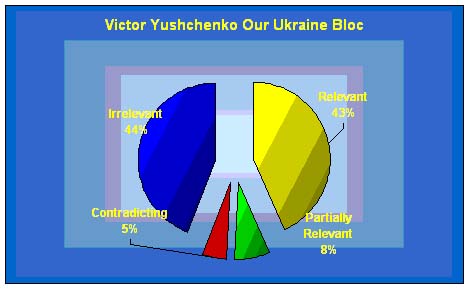
106 bills were analyzed as to their relevance to the Our Ukraine program. Out of them, 41 bills were filed by MPs elected on the Our Ukraine list, and 65 – jointly with MPs elected in one-seat constituencies and on other lists.
Out of the total number, 45 bills are relevant to the program, 8 are partially relevant, 5 contradict the program, and 46 are irrelevant.
Legislation by Communist Party of Ukraine General Characteristic of Election Program
The Communist Party program is distinguished by its clear structure with aims and tasks followed by results that the Communists strive to achieve if they win elections. However, this did not prevent them from including countless demagogic statements (“The earth will burn under the feet of criminals”, “Ukraine’s prosperity in the equal union of fraternal peoples of sovereign states” etc) and populist promises (“Workers and not criminals or criminal authorities shall become the masters of life”, “Let’s set up decent conditions for the woman, guardian of the humanity”, “The Ukrainian black earth shall yield generous harvests for all people, and shall not serve for enrichment swindlers” etc).
The program features certain legislative plans, which, even if unlikely to be implemented, can be easily assessed in terms of their accomplishment. Such plans are:
– To cancel the Land Code in the version that was adopted illegally;
– To establish state monopoly for production, use and sale of alcoholic beverage and tobacco products, foreign trade, use of power supply networks, railroad, pipeline, maritime, and aircraft transport;
– To cancel the VAT and set a flat sale tax for volumes of goods and services;
– To make Russian the second official language;
– To set minimum wages and pensions at the level not less than the cost of living in 2003;
– To repay indexed individual savings over the period of five years;
– To provide proper funding to science and education as required by law; and
– To transform Ukraine into a parliamentary-presidential republic.
Out of the 17 Communist tasks, 8 deal with economic policy, 4 with social policy, and 2 tasks are set for foreign policy and law-enforcement. At the same time, almost all results that the Communist Party is planning to achieve after winning elections concern solution of social problems.
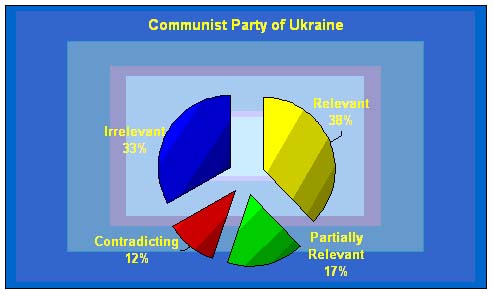
69 bills were analyzed as to their relevance to the Communist Party program. Out of them, 21 bills were filed by MPs elected on the Communist Party list, and 48 – jointly with MPs elected in one-seat constituencies and on other lists.
Out of the total number, 26 bills are relevant to the program, 12 are partially relevant, 8 contradict the program, and 23 are irrelevant.
Legislation by For United Ukraine Bloc General Characteristic of Election Program
There is quite a number of provisions in the campaign program developed by the For United Ukraine bloc that are purely declarative making it impossible to define the general trend that the Bloc may follow in Parliament to implement the program. Such provisions, in particular, include commitments to strengthen the efficiency of the system of government; recover Ukrainian family values; develop efficient systems of social and pension security, and public health care; provide the youth with realistic prospects; ensure cooperation between the government, political parties, and civic society; modernize science and education; rejuvenate official public authorities; set up a continuous dialogue between the government and the public; speed up the administrative and the judicial reforms; harmonize the interests of the center and the regions; counteract extremism and intolerance; and support respect of constitutional human rights.
There are, however, a few provisions that suggest general guidelines for the Bloc to follow in Parliament. These provisions are also quite abstract and include the following commitments arranged by areas:
Economy:
– To ensure stability of the national currency; to increase the real income of the population by 1,5; to lead economy out of the shadow; to support entrepreneurship, small and medium business; and to stimulate development of the internal market;
Environmental Protection:
– To ensure environmental security of the country and to overcome the consequences of Chernobyl disaster;
Social Policy:
– To protect Chernobyl victims; to guarantee social rights of military servants, pensioners, and disabled individuals; to ensure productive employment; and to create 1,5m of new jobs;
Foreign policy:
– To support complex European integration of Ukraine; to strengthen relations with CIS countries; and involve Ukraine into the international coalition of combating terrorism;
Development of Government System and Local Self-Governance:
– To set up the parliamentary majority that shall be responsible for the results of economic and social development; to introduce civic oversight of the system of government; to support development of municipal and regional democracy and local self-governance;
Agrarian Policy:
– To develop the agrarian market infrastructure; to set up an efficient system of legal protection of land title and its holders; to provide state support to farms, family, small and medium agricultural companies.
There are also certain provisions suggesting specific actions to be taken in Parliament. In the economic sector, it is a promise to in crease the GDP by 6-7% annually, to pass the Tax Code and to decrease a tax burden; in development of government system and local self-governance, it is an obligation to set up a second parliamentary chamber, the House of Regions, and introduce a new system of interbudget relations where no less than 40% of taxes shall stay in regions; in the agrarian sector, it is a commitment to introduce mortgage lending.
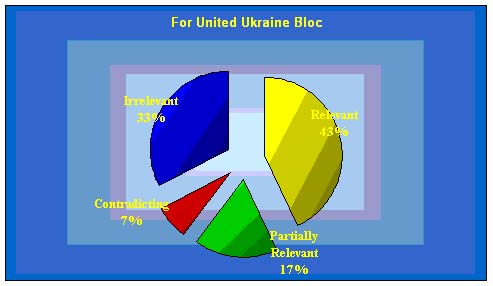
58 bills were analyzed as to their relevance to the For United Ukraine program. Out of them, 13 bills were filed by MPs elected on the For United Ukraine list, and 45 – jointly with MPs elected in one-seat constituencies and on other lists.
Out of the total number, 25 bills are relevant to the program, 10 are partially relevant, 4 contradict the program, and 19 are irrelevant.
Legislation by Yulia Tymoshenko Bloc General Characteristic of Election Program
In general terms, the Yulia Tymoshenko Bloc’s program is quite specific and well-structured. Its text is based on listing key conflicts and contradictions in various public sectors and proposals of their solutions.
The top priority is given to the ethics area where it is proposed, inter alia, to combine the efforts of the government and religious confessions to fight drug addiction, AIDS, children homelessness, prostitution, crime and other social diseases. Quite indicatively, the program lists “the birth of true freedom of speech” as one of the ways to overcome problems in the ethics area.
To solve problematic issues in politics, the program advocates introduction of systemic trainings for efficient public management, legislative regulation of impeachment procedures for all “unconscionable elected officials”; and definition of the status of the opposition in the Basic Law and provision of the opposition with certain important oversight powers over operation of the government. In addition, it is proposed to transfer part of the personal income tax to the account of the party/bloc elected and supported by each specific individual. This also means that, the general tax volume shall be decreased.
There is a special part of the program that is dedicated to the legal policy where a number of measures are proposed to improve legal culture and education of citizens in line with simplified procedures and enhanced efficiency of judicial protection of civic rights. The Bloc also suggests differentiation and mitigation of punishments for criminally liable actions.
The program contains extensive and detailed provisions on measures proposed in the economic sphere. Such measures aim to solve the existing conflicts and include inspection of legality of privatization and inventory description of public property; development of “openly protectionist conditions” for the national capital at the stage of its establishment; prohibition of tax inspections more than once in three years; use of economic levers to decrease loan rates to 5-6% etc. The program contains an important proposal of limiting land title holders only to the Ukrainian citizens “living and working on the land”. Besides, there is a proposal to exclude corporate bodies from the agents entitled to hold agricultural land titles.
The program suggests a few comparatively specific measures for social policies, including preservation of the existing pension age definitions and repayment of depreciated and “stolen” saving over four years. One of the most interesting measures, however, is reimbursement of material and moral damages to deported individuals (including those deported from Kholmshchyna, Pidlyashshya, Lemkivshchyna, and Nadsyannya).
Irrelevance of the “low” status of Ukraine in international relations to its huge potential possibilities is defined as the key conflict in the foreign policy area. The program, however, lacks clearly defined trends of Ukraine’s foreign policies. Instead, it pronounces implementation of national foreign policies in relation to all countries with which Ukraine has common interests.
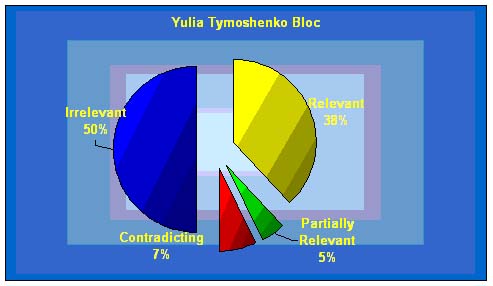
42 bills were analyzed as to their relevance to the Yulia Tymoshenko Bloc program. Out of them, 18 bills were filed by MPs elected on the Yulia Tymoshenko Bloc list, and 24 – jointly with MPs elected in one-seat constituencies and on other lists.
Out of the total number, 16 bills are relevant to the program, 2 are partially relevant, 3 contradict the program, and 21 are irrelevant.
Legislation by Socialist Party of Ukraine General Characteristic of Election Program
The Socialist program seems to be maximally precise and concise. It is developed on the principle of very specific commitments combined with measures necessary to achieve the defined objectives. For example, it is proposed to raise teacher salaries to 350 UAH by introduction of 1.5% of tax for imported cars that cost more than 50,000 UAH and residential property valued at over 500,000 UAH. The program also requires that children allowances paid to parents form the state budget shall be no less than 200 UAH per month. These are the type of specific commitments that dominate the program.
The Socialists advocate transformation of the system of government. Their efforts aim at enhanced role of Parliament and independence of the Cabinet of Ministers (the Ukrainian government). The program provides for adoption of the Presidential Impeachment Act and promotion of direct election of oblast and district public authorities.
In terms of support to the rural areas, there are both specific and declarative statements, like “Ukraine shall trade bread, not land!” that can be understood in a number of different ways. It is proposed to keep a fixed flat land tax, provide long-term loans and guarantee “beneficial” governmental orders.
The program suggests introduction of a flat fixed tax for small and medium business and commits to eliminate “bandit racket, tax authorities raids, and bribers “in law”. There are also protectionist measures proposed to protect domestic producers.
Despite of other provisions, however, the key emphasis is made on various aspects of social policies, which is rather characteristic of leftist parties. In particular, the following commitments are made:
– Average salary fixed in legislation at the level of no less than double cost of living and mandatory governmental enforcement of this norm;
– Pensions and other social payments not less the cost of living (342 UAH);
– Guaranteed preservation of privileges, free health care, moral peace and respect of the society for the older generation.
By using Ukrainian natural gas and “cheap” nuclear power, the Socialists undertake to decrease utility charges by 30% and establish a legislative limit of 12% of the family income on such charges.
Young men can become interested in the promise to decrease the term of military service to 12 months.
One of the important aspects of this program is that it is absolutely void of provisions that would characterize the party’s foreign policy aspirations not counting the reference to the bill on principles of domestic and foreign policy developed, according to the program, by the Socialists.
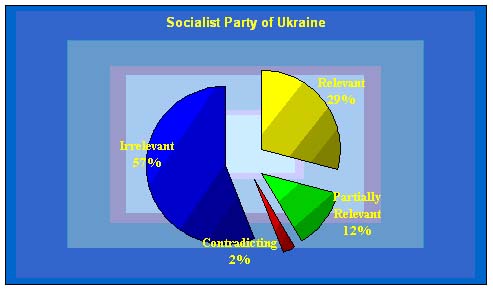
41 bills were analyzed as to their relevance to the Socialist Party program. Out of them, 9 bills were filed by MPs elected on the Socialist Party list, and 30 – jointly with MPs elected in one-seat constituencies and on other lists.
Out of the total number, 12 bills are relevant to the program, 5 are partially relevant, 1 contradicts the program, and 23 are irrelevant.
Legislation by Social Democratic Party of Ukraine (united) General Characteristic of Election Program
The program of the Social Democratic Party (united) features clear and logic structure. It states key program priorities and sets certain tasks for the party.
Government Development and Local Self-Governance
The program objectives are to overcome legal nihilism of the government system; to establish a party political system; to ensure public oversight of the government; to form the majority in Parliament and a politically responsible government. At the same time, the program covers no issues related to local self-governance.
Legal Policy
This area also does not get enough attention in the program. The program only mentions that there is need to prevent Ukraine’s transformation into a “shadow society” governed by illegal norms.
Economy and Industry Policy
The program defines the following priorities in this area: development of efficient and socially oriented economy; stabilization of economic legislation; state enforcement of mandatory execution of commercial agreements and strict compliance of all business agents with their commitments; protection of the internal market and domestic producer by all means that are compliant with international rules including moderate protectionism; support to development of small and medium business; creation of strategic planning systems to ensure continuous efforts of the state aiming at long-term problems. The program sets elimination of consequences of the exhausted social and production infrastructure as the top strategic task. It also stresses the urgent need to pass the Tax Code and a set of laws to support full-fledged implementation of the Land Code.
Social Policy
The program is quite focused on the issues of social policy, culture and ethics development. The priorities in these areas include: stable job supply (through creation of new jobs); possibility of free and high quality medical treatment; decreased gap between the richest and the poorest social groups; simplified and less bureaucratic social security arrangements; provision of the young people with a possibility of getting modern education, profession, and residential property; ensured state support to families, mothers, and children; elimination of beggary and children homelessness. Achievement of these tasks provides for development and adoption of a number of important legislative acts and codes: a new Labor Code and trade union legislation; a set of laws to guarantee reformation of the public health care system through improvement of budgetary funding arrangements combined with gradual introduction of social health care; amendment of the tax and labor legislation to decrease differentiation of incomes.
In culture and ethics area it is planned to recover traditions of high Ukrainian culture, spirituality, and ethics; ensure and multiply intellectual potential of the society; harmonize interethnic and inter-confession relations; develop national, language, and religious originality; ensure full-fledged and free development of the Russian language and culture.
Information Policy
No reference is made in the program.
National Security and Defense
No reference is made in the program.
Foreign Policy
The Program provides for strengthening national sovereignty and active participation in international division of labor; Ukraine’s accession to world and European international organizations; development of relations with Russia under the conditions of partnership, equality and mutual benefits; setup of the all-European collective security system together with Western European and Central and Eastern European countries and Russia.
All in all, the program focuses on such areas as development of the system of government, economic and social policies. At the same time, it pays no proper attention to such important issues and legal and information policies.
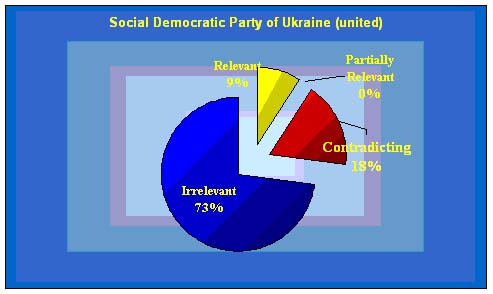
11 bills were analyzed as to their relevance to the SDPU(u) program. Out of them, 2 bills were filed by MPs elected on the SDPU(u) list, and 9 – jointly with MPs elected on lists of other parties and blocs.
Out of the total number of bills only 1 bill is relevant to the program, 2 bills contradict the program, and 8 bills are irrelevant to any provisions of the program.