Article by the Agency for Legislative Initiatives for Dzerkalo Tyzhnia
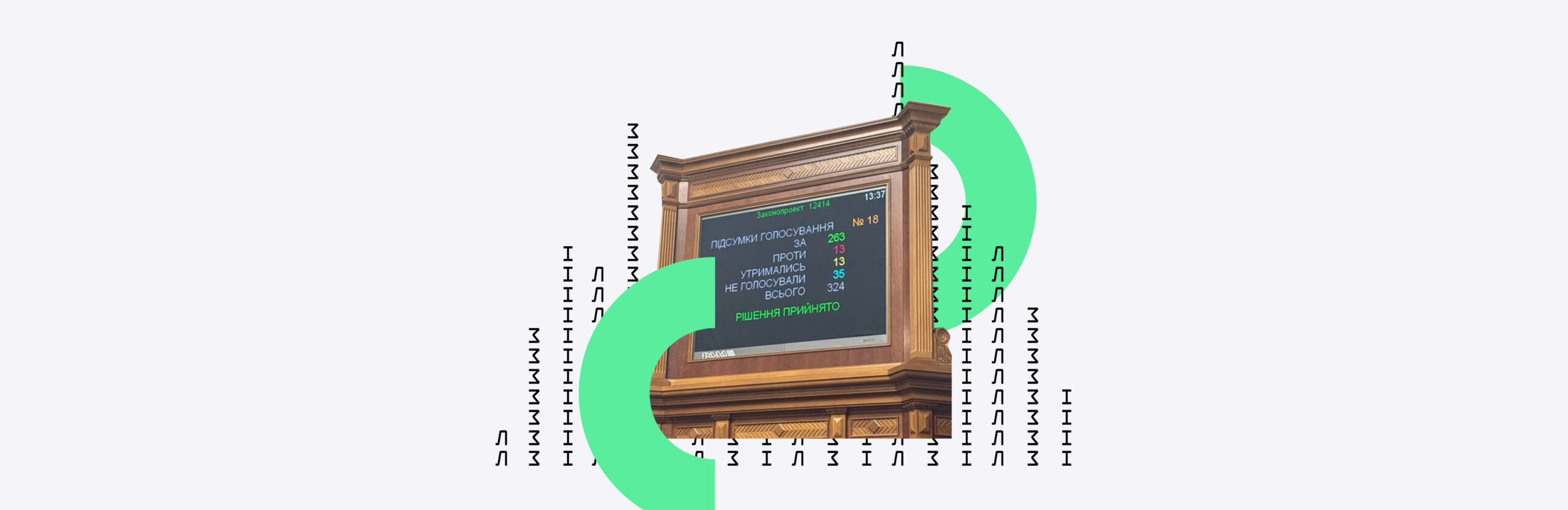
The adoption of the controversial Law No. 4555 concerning the NABU and the SAPO became a turning point, when, for the first time since the start of the full-scale war, society so openly and decisively opposed the actions of the authorities. The speed of the draft law’s passage — from the moment the comparative table was provided to its signing and publication — was staggering: everything took place within a single day.
Law No. 4555 is a telling (though unfortunately not the only) example of how deliberate and now habitual violations of the Rules of Procedure of the Verkhovna Rada affect the most important political processes in the country.
Excuses for Members of Parliament to breach the Rules of Procedure abound: from ‘the requirements of wartime’ to ‘threats to national security’. Moreover, this is not aligned with the Constitution of Ukraine, which automatically makes it problematic.
Already in the first months of the full-scale invasion, it became evident that the Rules of Procedure were not suited for application under martial law — the relevant procedures for such circumstances were simply not prescribed. At the same time, for over three years, Parliament has failed to amend them to ensure the legitimacy of procedural decisions — instead, it resorted to half-measures in the form of resolutions that only slightly simplified organisational procedures.
Using Law No. 4555 as an example, the Agency for Legislative Initiatives recalls the most common violations of the Rules of Procedure.
Proposals Supported at Second Reading Are Unrelated to the Subject of the Draft Law
As an exception, the lead committee may decide to consider proposals and amendments introduced into the provisions of a draft law that were not the subject of consideration at first reading. This is possible if the lead committee and/or the expert unit of the Secretariat of the Verkhovna Rada indicated the necessity of their inclusion in their conclusions, and the chair announced this at the plenary session during the consideration of the draft law at first reading.
In other words, between the first and second reading, the text of a draft law must not change so radically (through the appearance of entirely new provisions that were neither discussed nor elaborated at the stage of first reading) that it would in fact need to be reconsidered afresh. The Rules of Procedure contain a direct prohibition on such procedural acrobatics.
There was no mention of the need to introduce proposals unrelated to the subject of Law No. 4555 either in the conclusion of the lead committee at first reading or in the conclusion of the Main Scientific and Expert Department. This is reflected in the draft law’s profile. The inclusion of proposals limiting the independence of the NABU and SAPO even forced one of the initiators to abstain from voting for his own legislative initiative.
The lead committee should already have rejected these proposals at the stage of their consideration at its meeting, since they were unrelated to the subject matter of the initial draft law. Instead, the ‘nested doll draft law’ was recommended for adoption at second reading and as a whole as law.
Nothing fundamentally new occurred. The long-standing practice of ‘nested doll laws’, which became particularly popular in the first months of martial law, has evidently once again been applied. This was how the Research Service of the Verkhovna Rada was established and how the regulatory impact analysis was dispensed with. This scheme makes it possible to avoid registering a new draft law that would otherwise have to comply with the requirements of the Rules of Procedure, include justification, and undergo mandatory reviews in the structural units of the Secretariat of the Verkhovna Rada and in committees. Such proposals would hardly have secured the support of the parliamentary committees on Anti-Corruption Policy or European Integration, whose review is mandatory for all registered draft laws.
MPs Were Unable to Familiarise Themselves with the Content of the Draft Law Before the Second Reading
MPs are supposed to receive the draft law prepared for second or repeated reading, together with the lead committee’s conclusion and other supporting documents, at least ten days before the date of its consideration at a plenary sitting of the Verkhovna Rada.
This period is necessary so that MPs can at the very least carefully read the draft law — and preferably also analyse its text, the mandatory expert and analytical conclusions, and the positions of stakeholders, among other things.
The Rules of Procedure prescribe precisely such a period to ensure that MPs have at least the opportunity to familiarise themselves with what they will have to vote for or against.
In the case of Law No. 4555, however, the committee meeting took place on the same day, 22 July, just a few hours before the start of the plenary sitting, while MPs received what was in effect a new text only a few minutes before the sitting began. They simply had no physical time to familiarise themselves with the committee’s version of the draft law. This does not, however, absolve MPs of responsibility, since voting for an unknown text is still a choice — and one that they make at almost every plenary sitting. For instance, with regard to 45 (60%) of the draft laws adopted at second reading during the 12th session of the Verkhovna Rada, the deadlines for familiarisation with the committee conclusions and the comparative table before consideration in the plenary hall were violated. Overall, since the start of the full-scale invasion, in each session, more than half of the draft laws have been adopted in breach of MPs’ lawful right to familiarise themselves with the texts.
In Parliament, this practice has long been perceived as a standard ‘working process’. It emerged and became entrenched well before the start of the ninth convocation of Parliament. The situation in which most MPs do not, in fact, know what they are voting for is more the rule than the exception. Given the existing practice of registering, processing and considering hundreds of legislative initiatives during a session, such a situation is hardly surprising. Yet when a whole series of procedural norms are ignored, failure to observe the time limits for familiarisation can play a decisive role in the adoption of initiatives such as Law No. 4555 or the so-called ‘dictatorial laws’ of 16 January 2014.
Immediate Signing by the Speaker of the Verkhovna Rada
The Speaker of the Verkhovna Rada signs a law within two to five days of its submission (after preparation in the lead committee and the legal unit), except in cases provided for by the Rules of Procedure. This period is justified by the fact that MPs have two days in which to challenge the results of a vote if it was conducted in violation of the rules. In the case of Law No. 4555, immediately after the vote, at the proposal of MP Maksym Buzhanskyi, the Verkhovna Rada instructed the Speaker to sign the draft law without delay and send it to the President for signature. While carrying out instructions of Parliament is one of the Speaker’s powers, the procedure of immediate signing is not provided for by the Rules of Procedure. Nevertheless, this has become a fairly common practice during martial law, often justified by the need to accelerate certain stages of the legislative process.
The Authorities Complain, the Constitutional Court Shrugs, Society Acts
The regular breach of the Rules of Procedure by MPs has already become part of parliamentary culture (and MPs of the ninth convocation — also known as the ‘new faces’ — very quickly adapted to this process).
If anyone wishes to challenge a law on the grounds of violations of the procedure for its adoption, the Constitutional Court consistently adheres to its own legal position. It holds that a normative act may be declared unconstitutional only if the procedural requirements established directly by the Constitution of Ukraine, and not by other legal acts (the Rules of Procedure of the Verkhovna Rada), have been violated.
Previously, for these reasons, laws were declared unconstitutional only in cases where MPs had not voted in person or if a law had not received a committee conclusion. The first reason is no longer relevant due to the introduction of the touch-sensitive voting button in March 2021, and as to the second — in the case of Law No. 4555, a committee meeting, albeit only formally, did take place. Breaches of the Rules of Procedure have not yet constituted grounds for declaring a law unconstitutional. It is unlikely that anyone in their right mind would wish to open this ‘Pandora’s box’ by declaring an act unconstitutional on the basis of violations of the Rules of Procedure, given the number of acts adopted in this way.
Only under pressure from engaged public and international partners did the President register, and the Verkhovna Rada adopt in full, a new draft law that effectively restored the procedural independence of the NABU and SAPO, rescinded by Law No. 4555. In other words, it was only public oversight of Parliament and other institutions that compelled the authorities to correct what had been done. Yet this, unfortunately, was also achieved in breach of the Rules of Procedure. However, in this case, the public importance of adopting the President’s draft law as swiftly as possible was indisputable.
How to Deal with This?
Clearly, persuading MPs of the need to comply with the Rules of Procedure — or comprehensively reviewing it so as to bring it into line with the Constitution (!) and ensure the basic principles of transparency and public participation in the legislative process — is a task marked with several stars. The Agency for Legislative Initiatives is convinced, however, that there are several critically important steps that can be taken here and now to at least minimise the risk of a repeat of the lightning-fast adoption of Law No. 4555.
First and foremost, the problem of the closed nature of the decision-making process must be addressed. This is manifested in several ways — most notably the absence of live broadcasting of plenary sittings of the Verkhovna Rada.
The ban on live broadcasting of plenary sittings no longer makes sense — it carries no sanctions, which means individual MPs quite readily inform the public about the decisions taken at a plenary sitting and the dates of upcoming sittings, without any negative consequences either for themselves or for their faction.
Nor can the absence of broadcasting be justified by the content of the issues discussed at a plenary sitting — the Verkhovna Rada itself uploads recordings to its YouTube channel, and transcripts are published on the official website. The ban on live broadcasting means that the public learns of the most important decisions only after the fact. More than 90 civil society organisations and media outlets have called for the restoration of online broadcasting of plenary sittings. A group of MPs registered the relevant resolution, yet neither it nor any other similar proposal received the support of the Verkhovna Rada.
Another manifestation of closedness is the fact that for six months, the President has not signed Draft Law No. 11321. This legislative initiative obliges open sittings of committees to be broadcast and the recordings permanently posted on their webpages, as well as requiring the agenda of sittings and the draft acts scheduled for consideration to be published no later than 24 hours before the start of a committee sitting. Even some members of the committee were unaware of the sitting at which Law No. 4555 was prepared for second reading — let alone journalists having open access.
The sabotage of parliamentary transparency has also affected the Law of Ukraine ‘On Public Consultations’. As a result of proposals by MPs, this law:
- will enter into force only one year after the lifting or termination of martial law, instead of six months as envisaged in the draft law at first reading;
- has established an exception allowing MPs and parliamentary committees not to conduct public consultations at all.
All this creates the impression that MPs are doing everything possible to avoid dealing with policy and instead concern themselves solely with politics. Ultimately, unsubstantiated and hasty political decisions lead to mistakes, with the authorities once again stepping on the same rake they themselves had laid in their path.
The habitual condescending attitude of MPs towards violations of the Rules of Procedure — which manifests itself at critical moments (as in the case of Law No. 4555) — threatens the democratic foundations of parliamentarism and sends a signal to this and future convocations of the Verkhovna Rada that the Rules of Procedure can be violated — and that such violations will go unpunished.