
For the Verkhovna Rada, the fourth half-year of the full-scale Russian invasion ended with the appearance of such crisis signs in the work of the parliament, which were not observed even in the first half-year of the war.
In our monitoring report of the 10th session of the parliament’s 9th convocation, we detected five principal trends:
- a complete change of the agenda,
- the president formally distancing himself from domestic policy issues,
- further strengthening of the role of the Cabinet of Ministers in the legislative process
- a rise in legislative spamming,
- and an increase in the number of violations of the constitutional procedure.
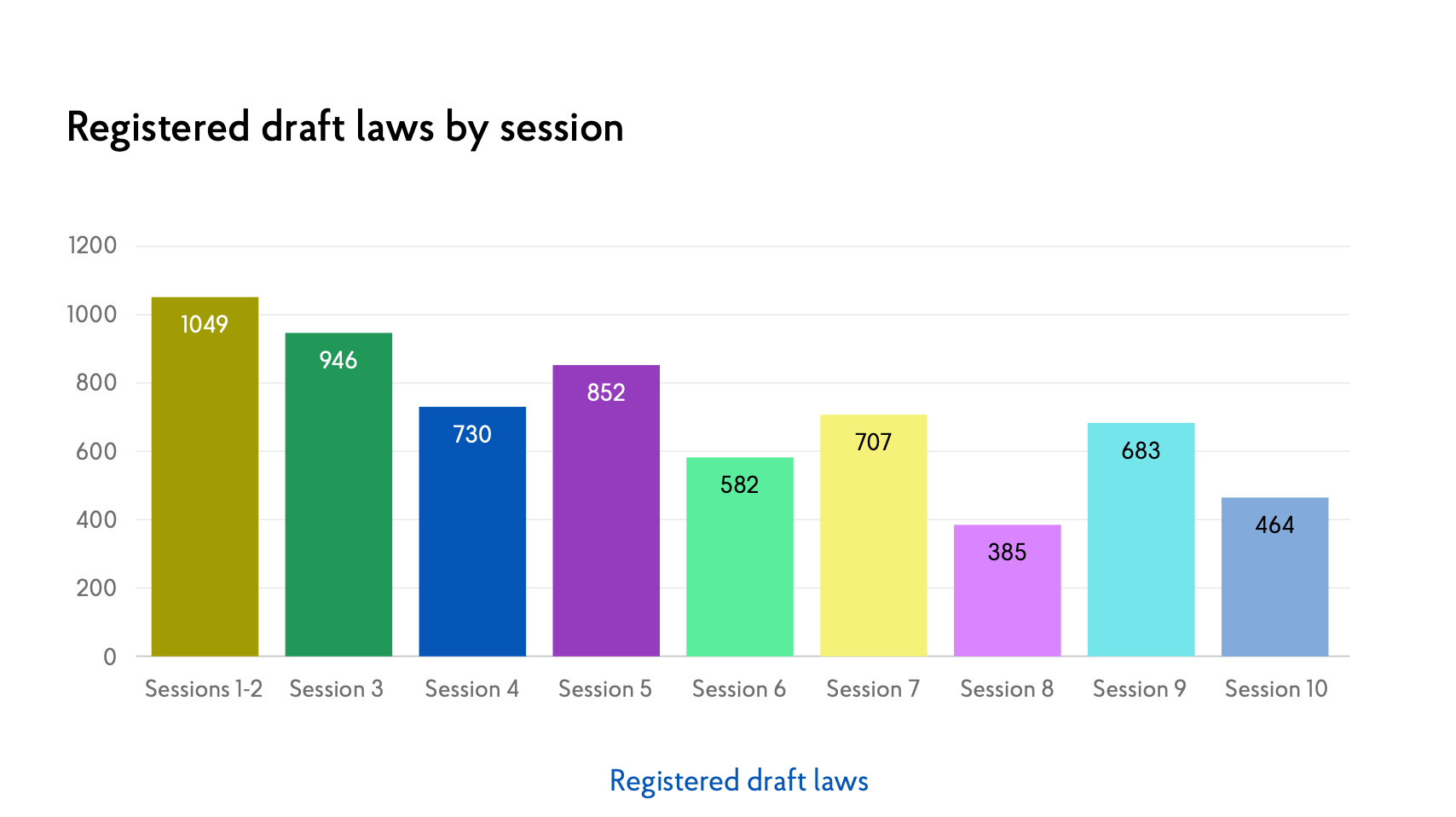
Overall, 464 draft laws were registered during the 10th session.
During the 10th session, the agenda of the parliament underwent a complete change. 97% of all draft laws passed during the session were registered already after the start of the full-scale invasion.
The new agenda currently focuses on finance, security and order, and welfare issues.
The busiest committees of the parliament during the 10th session were the Finance Committee, the Legal Policy Committee, the Organisation of State Power Committee, the Law Enforcement Committee, the National Security Committee and the Social Policy Committee.
In the same period, the president formally distanced himself from domestic policy issues. Even against the background of a small total number of adopted laws, the share of the President as their originator is low. During the 10th session, the number of adopted presidential draft laws was the lowest for the entire studied period of the 9th convocation: just one “regular” law was adopted, with other six concerning ratifications of treaties and decrees.
The only law going against this trend was adopted in the second reading and in its entirety. This draft law was adopted in the first reading back in the summer of 2021, and it “sat on the shelf” waiting for the second reading throughout that time.
During all the sessions held during the martial law period, the president remained detached from domestic policy issues and concentrated on international politics and defence.
An equally prominent feature of the 10th session is the Cabinet of Ministers of Ukraine strengthening its positions in the legislative process. The Cabinet of Ministers increased its share of registered draft laws to 17.2% and showed the second-highest share of registered governmental draft laws for all sessions of the 9th convocation.
For the third session in a row, the Cabinet of Ministers had more success promoting its draft laws
This applies to the second reading
in the Verkhovna Rada than Ukrainian MPs.
The monitoring study of the 10th session also picked up signs of a resurgence in legislative spamming.
There are three main signs of it:
- an overall increase in the number of registered draft laws;
- an abnormally high number of draft laws registered by one of the parliamentary groups;
- an increase in the share of draft laws with a small number of sponsors.
The 10th session demonstrated an increase in the number of registered draft laws compared to the previous similar session 8th session, September 2022 - February 2023 .
This, in turn, is one of the signs of legislative spam – the registration of many poorly developed draft laws that have no real prospect of being adopted. This unbalances the agenda and increases pressure on the expert and analytical units of the Verkhovna Rada Secretariat.
Among parliamentary groups in this session, one may single out the indicators of the Restoration of Ukraine, which, despite having few MPs, registered 86 draft laws, surpassing most factions and groups and even the Cabinet of Ministers of Ukraine. This group improves its performance for the third session in a row.
This session also continued a trend set by the previous ones, as the share of draft laws with one, two or three signatories increased. Also, for the second session in a row, draft laws with one signatory outnumbered all other draft laws. These trends are indirect evidence of the increased legislative spamming.
The number of violations of the constitutional procedure kept growing during the 10th session as well. During this session, the deadline for signing (or submitting proposals) was missed for 34% of the adopted laws 22 of the total 64 drafts passed . In addition, five more laws were neither signed by the President nor vetoed or returned with proposals for improvement.
In total, violations were recorded for 42% of the approved draft laws, that is, four out of ten laws were passed with violations of the constitutional procedure.
Meanwhile, the volume of “usual” violations of the VRU Rules of Procedure neither increased nor decreased. The situation resembles that of the last session when violations were committed during the consideration of 54% of laws.
A positive development is that the practice of adopting draft laws “on the fly”, when draft laws are adopted in the first reading and in their entirety on the day of their registration, was not used during the 10th session.
Overall, our monitoring of the 10th session of the parliament’s 9th convocation recorded several signs of crisis processes unfolding in the VRU. Only 64 laws were adopted during the 10th session.
This is the fewest number of laws adopted in a session during the entire 9th convocation, half the number compared to the previous similar autumn session and much lower than the previous “anti-record” of 111 laws passed during the 6th session, the last one before the full-scale invasion.
At the same time, the number of passed laws is at its lowest despite the increase in the registration of draft laws and legislative spamming. Another sign of the crisis is the lowest-ever rate of draft law registration by MPs from the Servant of the People faction.
The president’s distancing from domestic policy issues is quite understandable against the background of a full-scale invasion when the head of state deals primarily with international politics and defence issues. On the one hand, it is possible that the president “surrendered” the domestic policy issues to the discretion of the government and parliament.
At the same time, this may indicate that the Cabinet of Ministers and MPs act according to the president’s political vision, making only decisions that suit him because the president has a decisive influence on domestic political processes. That is why the President does not even need to exercise the formal right to submit legislative initiatives. This allows the President to avoid being formally involved in unpopular legislative initiatives in the field of domestic policy.
More details on the Ukrainian parliament’s activity under conditions of the full-scale invasion are available in the ALI analysts’ monitoring report.