
The Verkhovna Rada continues to work under conditions that emerged after the start of the full-scale Russian invasion, which put the very existence of the state and the state administration system in particular at risk. But despite all the challenges faced by the parliament, we are seeing stabilisation of legislative processes, which allows MPs to respond to the demands of the times.
Overall, our monitoring of the 5th session of the 9th convocation of the Ukrainian Parliament detected five key trends:
- agenda being updated,
- the President of Ukraine distancing himself from domestic policies,
- stronger role of the Cabinet of Ministers in the legislative process,
- legislative spamming revival,
- and an increase in the number of violations of the constitutional procedure.
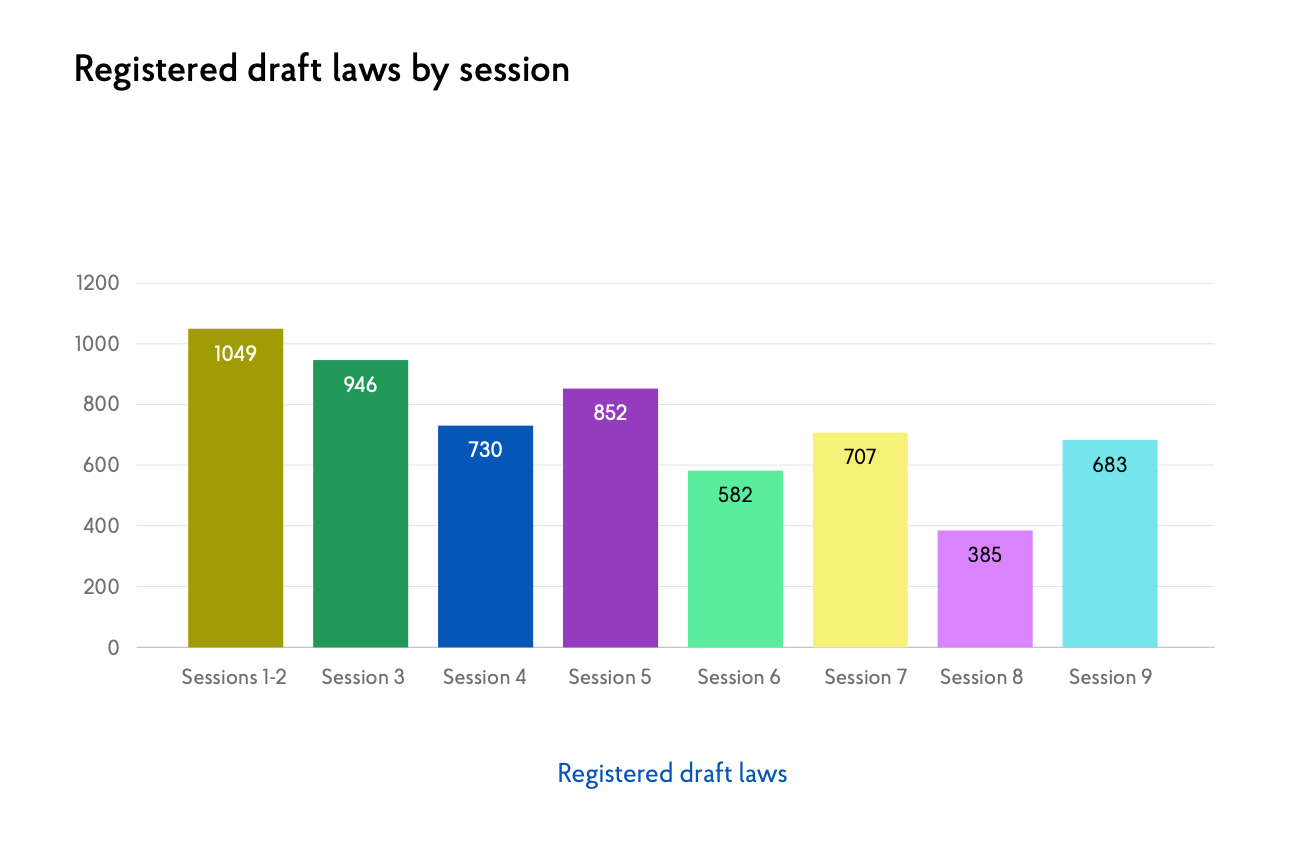
Six hundred eighty-three draft laws were registered during the 9th session.
The new agenda can be determined by looking at which parliamentary committees were the busiest. There are five of them: the Law Enforcement Committee, the Finance Committee, the Legal Policy Committee, the Social Policy Committee, and the National Security Committee.
That is, after the initial financial and economic adaptation to martial law and full-scale war conditions, lawmakers focused on adapting the legal system, as well as on establishing new and amending old sanctions for violations of the law. This situation clearly demonstrates which domestic policy instruments MPs favour most: they regulate the level of punishment for unlawful behaviour by amending the Criminal Code and the Code on Administrative Offences.
During the 9th session, it became clear that the president formally distanced himself from influencing domestic policies, as the parliament did not adopt a single ”ordinary” presidential draft law. All laws initiated by the president involved ratifications, approval of decrees, or changes in the calendar of important dates.
The president’s focus on defence and foreign policy is increasingly typical for the martial law period.
During this session, the Cabinet of Ministers of Ukraine strengthened its positions in the legislative process. For instance, the Cabinet of Ministers registered 114 draft laws 16.7% of the total , one of the highest numbers for the entire 9th convocation. The share of laws initiated by the Cabinet among adopted laws is the highest ever at 37.1% of the total.
Government draft laws also moved from registration to adoption in the first reading and in their entirety rather quickly: on average, it took 71 days. This is the fastest passage of government-sponsored draft laws in the period encompassing the 4th to 9th sessions. Furthermore, the speed of passage from registration to adoption in the second reading and in their entirety for government-sponsored draft laws was the best in the period encompassing the 6th to 9th sessions.
Overall, these processes align with the idea of a cabinet-centric model of decision-making.
Legislative spamming seems to have revived during the 9th session.
Even against this background, the activity of the Restoration of Ukraine MP group is particularly noticeable, as they were twice as active as The figure is 5.18 drafts per MP. On average, 1 MP initiates between 1 and 1.44 drafts. For MPs who are members of parliamentary groups, this figure is less than 0.5 drafts per MP. This situation is quite standard any other faction or group during the previous sessions . This number of draft laws per MP is another sign of legislative spam.
Another indirect feature is the increase in the number of draft laws with one, two, or three signatories. For the first time since the 4th session, the share of draft laws with only one signatory is higher than all other draft laws combined.
Also, in contrast to the previous session, we again saw the ultra-speedy adoption of draft laws, both in the first reading and in their entirety on the day of their registration.
During the 9th session of the 9th Rada, a record number of violations of the constitutional legislative procedure were committed.
For instance, almost a third of the adopted draft laws (that is, 61 of them This is 31% of cases ) were not signed by the president on time. Another eight draft laws were neither signed by the president nor vetoed with appropriate proposals, and one was not even signed by the Chair of the Verkhovna Rada. Combining all the aforementioned violations, 36% of all laws adopted during the 9th session were signed in violation of the Constitution. That is, it concerns every third law.
The Rules of Procedure were violated for 56% of all laws adopted during the 9th session.
Overall, the ninth session of the current parliament’s convocation can best be characterised as “adaptive”. In the third half-year of the full-scale war, the Verkhovna Rada finally started working steadily. The number of adopted laws, which is among the highest in this convocation, shows that the parliament is trying to respond to the changing circumstances associated with martial law and the increasingly active process of Ukraine’s European integration.
The government’s role also increased, as the speed of adoption of the government-sponsored draft was the best over the last sessions, and their share among the adopted laws hit a record.
More details on the Ukrainian parliament’s wartime activity are available in the ALI analysts’ monitoring report.