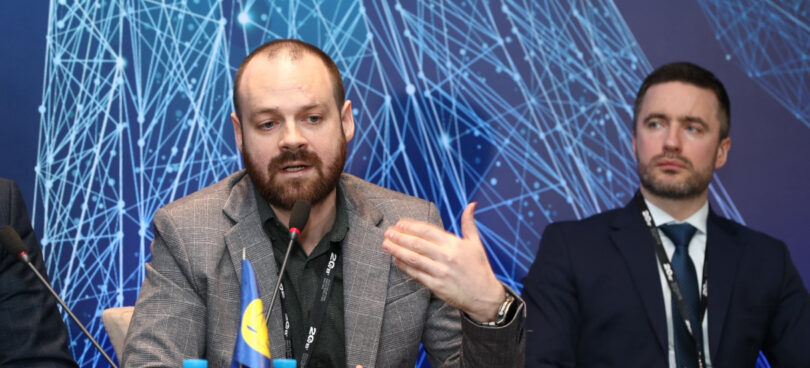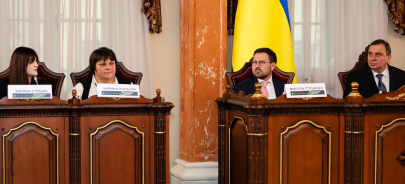
The Ukrainian School of Political Studies (USPS) has created a video course together with Oleksandr Zaslavskyi, Deputy Executive Director of the Agency for Legislative Initiatives.
The Ukrainian School of Political Studies is the educational and networking institution of the Agency for Legislative Initiatives, which brings together leaders through learning for the development of Ukraine. For over 25 years, the Agency has remained committed to and consistently implemented its educational mission, in particular through its flagship project in this field — the USPS.

The main purpose of the video course is to familiarise participants with the tools of public policy analysis and to promote the establishment of a tradition of evidence-based decision-making.
Course Overview
Thematically, the lectures follow the policy cycle — from problem definition and the implementation of a solution to evaluation and, if necessary, policy change:
- Lecture 1: ‘What is Public Policy?’: An introduction to the terminology of the course: ‘policy vs politics’, ‘public vs state policy’, ‘public administration’, ‘the policy cycle’, ‘zero option’, ‘legislative tsunami’ and more. We outline the distinctive features of the Ukrainian decision-making system.
- Lecture 2. ‘Why Do We Need Public Policy Analysis?’: We highlight the value, key concepts, principles and approaches of policy analysis itself. We consider how to choose the most appropriate solution, how to calculate its expected and unexpected consequences, how to assess its effectiveness and ultimately understand why a decision was made and how it can be improved.
- Lecture 3. ‘How to Define a Problem?’: We begin with the first stage of the policy cycle and examine what constitutes a public problem, how it reaches the agenda and the relevance of the ‘three streams’ model; who the ‘stakeholders’ are; and what ‘framing’ means.
- Lecture 4. ‘Policy Formulation’: Using examples, we explore how to design and select a relevant policy option in such a way that it does not fall into policy capture. In other words, we follow the algorithm of the second stage of the cycle — policy formulation. We share tools that help to determine how and whether a particular decision should be implemented at all.
- Lecture 5. ‘Who Makes Decisions and How is Policy Implemented?’: This lecture moves through the third and fourth stages of the cycle: who makes decisions and how they are implemented. Overall, the fifth lecture reflects the real process of decision-making and assesses its impact from the beginning to the end of the cycle.
- Lecture 6. ‘Monitoring, Evaluation and Revision of Policy’: This lecture covers the final stages of the cycle — monitoring, evaluation, revision and communication of policy. In other words, we examine the tools that help to build a picture of a policy’s impact and make informed decisions on whether to continue, transform, scale up, revise or discontinue it. From the perspective of the last stage, we discuss when decision-makers should communicate the content, objectives and pathway of a policy. We also set out the principles of public policy communication that help to legitimise and, subsequently, improve policy initiatives.
Who should take this course?
These lectures are designed to benefit people from different walks of professional life, including:
- current and aspiring politicians, civil servants and representatives of the judiciary;
- analysts and experts involved in political processes and public administration;
- the civil society sector and media representatives;
- educators and students of relevant disciplines.
The video course is available via the link and on the USPS YouTube channel.