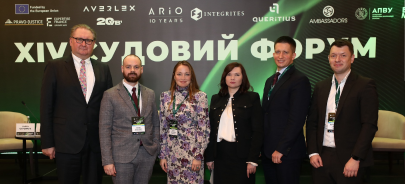
Interview with Svitlana Matviienko, Chairwoman of the Board of the Agency for Legislative Initiatives for Novoie Vremya

The Chairperson of the Agency for Legislative Initiatives believes that before the first personnel decisions are announced, there is no reason to say that one of the candidates for the post of prime minister is better.
When people need to make a choice between their own purses and democracy, it is difficult to persuade them to “tighten the belts” for the sake of reforms according to Svitlana Matviienko, Chairwoman of the Board of the Agency for Legislative Initiatives.
The Analytical Center of the Agency for Legislative Initiatives was created 16 years ago at the initiative of graduates of the Kyiv-Mohyla Academy. It focuses on democratic transformations and political and legal issues of parliamentarism, as well as functioning of political institutions and electoral processes; its experts are directly involved in the parliamentary legislative process.
In an interview for NV, Svitlana Matviienko, Chairwoman of the Board of the Agency, supported by the Council of Europe in Ukraine, talks about the lack of trust between politicians and in politicians as the main cause of the parliamentary crisis and explains why early election is inevitable and disastrous.
First, we need to elaborate on the reasons. The roots of the current crisis are twofold. First of all, this is the lack of trust – both between those involved in the political process and people’s trust in the institutions of power. Secondly, it is the unwillingness of politicians to assume responsibility.
Unfortunately, the number of “rigged game” cases and the history of relations between the current politicians in the parliament and government makes any renewal of mutual trust seem unlikely. The best argument to force politicians in power to assume responsibility is the threat of elections. However, given the geopolitical and security challenges, common sense urges us to be very careful with this instrument. In addition, surveys show a significant increase in populists’ ratings; therefore, we can hardly expect the next Verkhovna Rada to be more responsible and better in terms of quality. That is why we can pin our hopes only on pressure: if the public and experts can “put the squeeze on” the current politicians, we must use the entire arsenal of available means, to make sure that the processes underway cannot be halted.
Recently there have been a lot of discussions about the government’s renewal and its new format: whether there will remain the “evil” of political quotas, or whether the executive power can be headed by nonpartisan professionals – so-called “technocrats”.
I believe that the “technocratic” government is a transitional stage too, because any government must sooner or later get a mandate of confidence via election. However, under conditions of a political crisis, experts and activists support the idea of a “technocratic” government, which Natalie Jaresko ultimately agreed to head. The idea is simple: to compile a short list of priority reforms, to find an experienced non-partisan manager for each of the priorities and set strict deadlines for assessment of their implementation. The lack of political ambitions of the members of such a government is supposed to ensure support of the Parliament and to “calm down” politicians. Obviously, the key players did not like this approach.
The second option is to restore the Coalition in this or that format, which in turn will restore a “political” government. Unfortunately, this option will only postpone the political crisis, as the seats in such a government will be distributed by the quota principle or political loyalty rather than by professional criteria. The only alternative candidate for such a government was the acting speaker. However, Groysman’s announcement that his government will include some “technocratic” ministers (for example, some of the current deputy ministers of economy) does not make it consolidated and independent in decision-making. Therefore, this option also does not remove the issue of early elections from the agenda. Whatever the actions of such a government, most of the responsibility for everything that will happen will be borne by the Coalition that delegates it.
In the current economic conditions, we need a candidate who will ensure results. If the degree of resistance to political influences and the independence of the PM will mean blocking his initiatives in parliament, one may ask the question: Will this situation differ from the current one, with Yatsenyuk? If the new head of government will serve as another “lightning rod”, wasting time on explaining why there are no reforms, the effectiveness of any ministers’ team will be low.
At the moment, the greatest fear of our Western partners is concentration of power in the hands of one political group. Therefore, of course, investors and creditors are more accepting of Jaresko as a candidate.
Whoever heads the government, if the new prime minister fails to communicate with the parliament in support of reforms, the prospect of early elections will reappear. The parliament perceives Groysman as a more predictable political figure, although some draw attention to his proximity to the president. Society in general can view this situation as usurpation and alternation of the “old faces”, even if a representative of the Popular Front is appointed new speaker for the balance. Under the present conditions, any PM must conduct rapid structural reforms and establish a dialogue with society. Restoration of public confidence is the only resource that can be relied upon in the current parliamentary situation.
No, not until we see the first decisions of the new prime minister, for example, personnel decisions.
I have already mentioned the crisis of trust and responsibility. If they are not restored, early election are unavoidable. Some politicians say it can be held this autumn. If politicians can restore the interaction between the government and the Verkhovna Rada and demonstrate real changes to society as a result of their synchronized work, the term of office of this parliament might be longer than the pessimistic forecasts.
However, from what we see, so far the discussion is at the level of personalities and political slogans. This applies not only to the government, but also to political forces. The third sector should encourage citizens to demand that politicians should communicate with society not only in the language of populism and the rhetoric of separation. Otherwise, the next parliament will be of the same quality, and will turn into a source of destructiveness even sooner.
It is impossible to examine the situation out of context: as if there is no war, no Russia’s desire to see Ukraine bleeding and helpless. Frequent elections could work out well amid economic growth and well-being. But when people need to make a choice between their own purse and democracy, it will be increasingly more difficult to persuade them to “tighten the belts” if there are no tangible results of reforms. Grassroots democratic parties can evolve only if people have money for this, and small and medium-sized businesses see that such parties can protect their interests and become ready to finance them. In the end, citizens themselves should not sit and wait for a new generation of politicians – they have to struggle for seats of authority and become the “new faces” in contrast to the ballyhooed political brands.
Parties become parties not because of their registration and participation in elections, but because of the common stance of many active people and leaders who can agree on joint actions and organized participation in elections. Without powerful horizontal self-organization, Ukraine has no chance to develop democratic parties. It’s good that Ukrainians already have such experience in view of the two Maidans. It’s bad that it is a union against someone, often against a certain person, rather than systematic defense of common interests and work at the level of your own home and street. I can think of but a few parties with intraparty democracy, debate and respect for minority opinions that are actively present in the public field. If you can become a member of such a party, democracy has a chance.
The Law on State Financing is a positive phenomenon, but it will only work when all information about those who finance political parties is open. It can potentially stimulate intraparty democracy, if regional centers receive an adequate share of the “financial pie” instead of being bit-part actors for the party leadership. Parties should have real regional centers, create vertical mobility means for active citizens, and serve as a channel to “big politics” for their active members.
At the same time, without restrictions on election campaigning and tightened control of paid journalism, the prospects of entirely getting rid of the influence of big business on politics seem unlikely. Public activism, independent media, and other monitoring mechanisms are integral components of the greater transparency and accountability of political parties, regardless of their budget financing.
When this law on local elections was adopted, experts had already prepared an alternative version of the law in line with the best world practices. However, politicians did not support it and fixed everything behind the scenes. We have not yet really tested the system of open lists in conditions where we have a mixed proportional-majority system.
Of course, every electoral system has its disadvantages and susceptibility to corruption risks. As long as society is affected by the “epidemic” of corruption and poverty, education and perfect legislation are not enough to improve the situation.