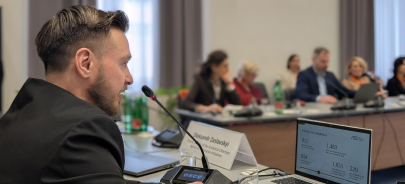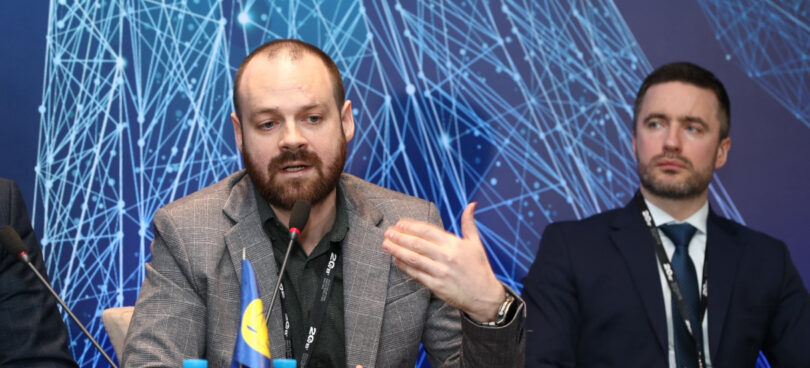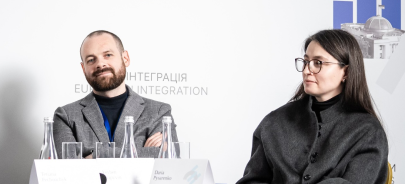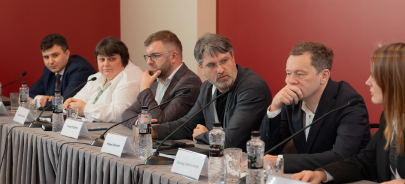
On 18 November 2010, a round table “Regulation of Political Parties in Ukraine: Current State and Direction of Reforms”, arranged by the Agency for Legislative Initiatives, took place in Lviv.
During the round table, the Agency presented the study “Regulation of Political Parties in Ukraine: Current State and Directions of Reforms”, which is based on the discussions of the key problematic issues related to the regulation of the activities of political parties in Ukraine, including those related to the participation of political parties in elections, campaign funding, internal political party democracy, gender balance, complicated procedures set for the establishment and termination of political parties. The report also offers recommendations on the ways and prospects to improve the Ukrainian legislation regulating the functioning of political parties on the basis of the best European practices. The study was undertaken by Denys Kovryzhenko, Director for Legal Programmes of the Agency for Legislative Initiatives, with the financial support of the European Union within the framework of a joint EU-OSCE/ODIHR project.
The round table was opened by Marcin Walecki, Chief of OSCE/ODIHR Democratic Governance Unit, who defined the main aim of the national report on the legislation regulating the political parties in Ukraine – implementation of democratic transformations in the area of political party regulation. On behalf of ODIHR, Mr Walecki also expressed gratitude to the Agency for Legislative Initiatives for the fruitful cooperation during the project implementation.
After Mr Kovryzhenko presented the report, the following issues were discussed: (a) general principles for the regulation of establishment, functioning, and liquidation of political parties; (b) internal political party democracy; and (c) state and private funding of political parties and election campaigns.
Mykhaylo Shelep, Executive Director of the Centre for Political Analysis and Election Consulting, noted that timeliness of the study for the Ukrainian society. The expert, however, believes that the focus should be shifted from the ways to improve the legislation to the mechanisms for the implementation and observance of laws, since whatever imperfect the legislation may be, it will not be able to solve any problems if it is not observed.
Taras Plakhtiy, Member of the Male Kolo Society, emphasised the necessity to solve the problems of the internal political party democracy. The political scientist believes that political parties should deliver the following final product: (a) acquisition of public powers, which requires existence of a rigid hierarchical structure, and (b) generation of creative solutions for the current problematic issues, which requires developed horizontal links within the political party. In such a way, solution of this contradiction should become the starting point in the reform of the political party regulation in Ukraine.
Yuriy Kuzhelyuk, Member of Lviv City Council, believes that the main reason behind the degradation of the political party system in Ukraine is the constantly changing legislation, which not only sets additional barriers to political parties, but also undermines the voters’ trust to the political parties. Mr Kuzhelyuk also considers that the recent amendments, made to the law on local elections, had both positive and negative consequences. Thus, the positive changes included a ban on participation of political blocs, which often destabilise the functioning of the elected bodies, while cancellation of the possibility for the self-nomination of the mayoral candidates is regarded as a negative change.
Oles Starovoyt, Head of the Ideology Section of Our Ukraine Lviv Oblast Office Executive Committee, noted that the main problem of the imperfect political party regulation in Ukraine was lack of the public demand for such political parties, that would reflect the interests of specific voter groups, when a political party only strives to get the power without any general prospects and detailed action plans for the future.
Anatoliy Romanyuk, Director of the Centre for Political Studies, generally supported the recommendations presented in the report, having stressed the necessity to introduce state funding of political parties with efficient public control. The expert also referred to the European experience in termination of political parties: if a political party does not participate in elections a number of times in a row, it is cancelled automatically. Mr Romanyuk considers that members of political parties are not sufficiently interested in the proposals expressed by experts in terms of improvement of legislation related to the regulation of political parties.
Yuriy Shveda, Senior Lecturer of the Political Sciences Department of the Faculty of Philosophy of Lviv National Ivan Franko University, noted that the presented report meets the recommendations of the Venice Commission and reflects all aspects where the Ukrainian legislation is incompliant with the European standards. In the expert’s opinion, the legislative regulation of the political parties should ensure the balance between the liberal approach (whereby a political party is part of the society) and the public power paradigm (where a political party is identified with the government, while it is the government that regulates the activities of political parties). Mr Shveda considers that in any case competition should be ensured at the local level with the possibility of self-nomination, as well as a simplified procedure for the registration of political parties on the basis of an application should be introduced.
Certain round table participants, such as Vasyl Pasichnyk, Assistant Professor of the European Integration and Law Department of Lviv Regional Public Administration Institute, Olha Batyshcheva, Senior Lecturer of the Document Studies and Information Activities of the Ostrog Academy National University,Vasyl Marchuk, Director of Precarpathian Centre for Political Studies and European Integration Studies of Ivano-Frankivsk, were generally positive about the report, but noted that the study lacked the methodological basis – it was focused only on the normative side of the regulation of political parties omitting the substantial, from the political studies perspective, aspects of the functioning of political parties.