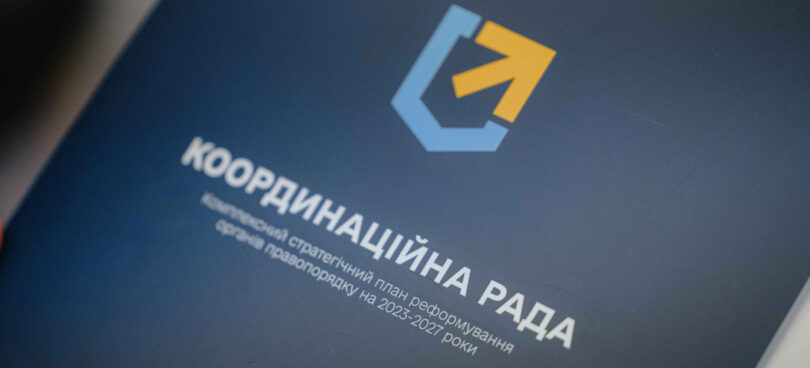
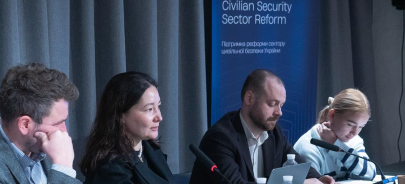
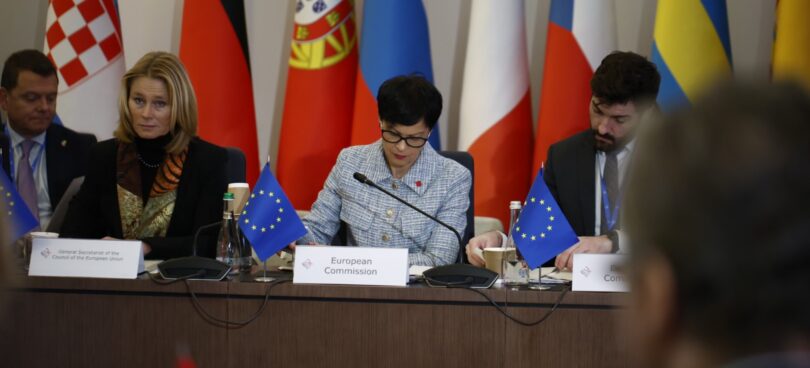
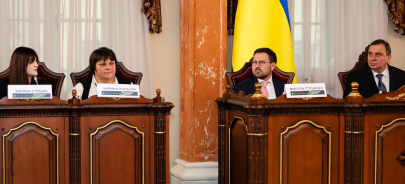
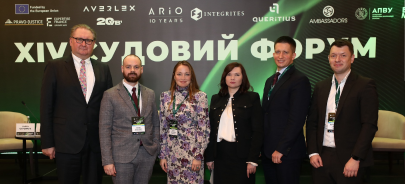
A coalition of CSOs — Agency for Legislative Initiatives, Transparency International Ukraine, Human Rights Center ZMINA, Tomorrow’s Lawyer Program and Ukrainian Bar Association — presented the Shadow Report to the European Commission on Chapter 23, “Justice and Fundamental Rights” of the European Commission’s Report on Ukraine in 2023.
This is the first report that Ukraine’s civil society sector has prepared for the European Commission since Ukraine became an EU candidate. The Shadow Report highlights the views of Ukrainian civil society, representatives of the legal community and experts active in the field of justice. The report analyses the progress made in the areas of the rule of law, the fight against corruption and the protection of fundamental human rights and freedoms, identifies weaknesses and gaps, and provides recommendations on what needs to be done on the Ukrainian side.
“This Shadow Report offers a more holistic and transparent vision of the progress of reforms in Ukraine. It is an important tool for preparing for the EU accession negotiations — for both the Ukrainian side and the EU. The Shadow Report has been made available to the Ukrainian authorities and the Ukrainian delegation that will participate in bilateral meetings on Chapter 23 next week”
Oksana Tsymbrivska
Team Leader of the EU Project Pravo-Justice
Representatives of the European Commission praised the level of preparation of the Shadow Report, noting that its findings would definitely be used.
“I have never seen such a solid report prepared by civil society — not in any country I have worked in before. We will use this report when formulating our recommendations for the screening report, as well as when considering the draft roadmap of rule of law reforms that Ukraine will need to prepare to move forward on the path to EU accession. And, of course, these materials will be used to set benchmarks for the accession negotiations. So the report is very timely in terms of our work with Ukraine”
Manfredas Limantas
Sector Manager for Rule of Law and Anti-Corruption with the EU Delegation to Ukraine
In its part of the report, the Agency for Legislative Initiatives emphasised the need to adopt a judicial reform strategy. Today, unfortunately, Ukraine does not have it as a single approved document. The reform is being implemented under pressure from the public and international partners. Only now, the Presidential Office of Ukraine has developed and sent a draft Strategy for the Development of the Justice System and Constitutional Justice for 2024-2029 to the main judicial bodies and some representatives of the non-governmental sector for suggestions and comments. This draft Strategy needs to be substantially revised, and the ALI is already preparing its proposals.
“We made a brief analysis of this document and identified problems. First and foremost, the document violates the independence of the judiciary in some areas of reform. Secondly, it does not contain a list of current problems but instead describes how and what needs to be reformed. But what is the purpose of such changes if it does not specify what specific problems they solve? And thirdly, many of the Strategy’s points are not really a strategy”
Karyna Aslanyan
Judicial Reform Project Lead of the Agency for Legislative Initiatives
In his turn, Manfredas Limantas expressed hope that the recommendations of civil society would be taken into account by the Presidential Office of Ukraine to improve the Strategy.
Yevhen Krapyvin, an Expert of Tomorrow’s Lawyer Program and the Center for Political and Legal Reforms, focused on problems and recommendations for solving them in Ukraine’s prosecution system. The speaker emphasised the need for the prosecutor’s office and the Prosecutor General to be independent, particularly from political influence, and the development of institutions that should ensure this independence.
“The prosecutor’s office in Ukraine has developed significantly since the Revolution of Dignity — prosecutors have become more independent, in particular through the functioning of prosecutorial self-government. At the same time, there are still issues of quality recruitment, especially for senior positions, responding to threats to independence, depoliticising the procedure for appointing/dismissing the Prosecutor General, etc. All of these things are found in the recommendations of the EU, the Council of Europe, GRECO and other organisations. The Shadow report should provide the European Commission with a broader picture of the state of development of the prosecution service as an institution of justice, complementing the report of the official delegation”
Yevhen Krapyvin
Expert of Tomorrow’s Lawyer Program and the Center for Political and Legal Reforms
Daria Pysarenko, Director of the Tomorrow’s Lawyer Program, presented the main conclusions, problems and recommendations to the section on the Bar reform. In particular, she covered the issues of the legal status of the Bar, bar self-government, disciplinary liability — all aspects that characterise the current structure of the Bar.
“The Bar is an important element of the judicial system as such, but it is currently not transparent, accountable and controlled by the public and the legal community. Issues related to the election of representatives to the High Council of Justice, the need to re-elect bar self-government bodies and change the rules of election, monopolisation of continuous professional development, non-transparent procedures for access to the profession, and the risks of disciplinary abuse — in the current environment, the independence of lawyers is declared rather than respected. At the same time, the legal profession is a component of the justice sector, which will not be fully successful without an institutionally developed, independent bar association. Therefore, a detailed analysis of this area should become the necessary driver of change”
Daria Pysarenko
Director of the Tomorrow’s Lawyer Program
A full-fledged reform of the justice system is impossible without addressing the problems with legal education in Ukraine. Every year, Ukrainian universities graduate thousands of lawyers, but the quality of this education does not meet European standards. Ivan Gorodissky, Vice President of the Ukrainian Bar Association, presented civil society’s recommendations on the necessary changes in education.
“The irrelevance of legal education in Ukraine is primarily due to the special post-Soviet heritage, which, even in modern conditions, does not leave the projection of an outdated Soviet vision of the Law. Today, we must promote modern education focused on people — on the goal of justice. Of course, we should not forget about optimising the legal education system. That is why we propose to reform the financing of education in favour of grant proposals. This will not only reduce the burden on state resources but also increase the motivation of talented students who are the basis of the modern legal process”
Ivan Horodyskyy
Vice President of the Ukrainian Bar Association
Kateryna Ryzhenko, Deputy Executive Director for Legal Affairs of TI Ukraine, presenting the section on anti-corruption, stressed the need to improve anti-corruption legislation and the urgent need to take into account the shortcomings of the previous State Anti-Corruption Strategy and the State Anti-Corruption Programme in the process of developing new documents, as this process will begin very soon. As part of her presentation, Kateryna also mentioned the importance of fully restoring e-declaration and reporting by political parties.
“The fight against corruption is a complex issue. The recommendations we have provided are very specific and applied, but they comprehensively cover the areas related to preventing and fighting corruption. We have been talking about some of the issues raised for a long time, but there are also those that have arisen in the course of negotiations with the European Union”
Kateryna Ryzhenko
Deputy Executive Director for Legal Affairs of TI Ukraine
Tetiana Pechonchyk, Head of the Human Rights Center ZMINA, spoke about the main challenges to the observance of a wide range of human rights in Ukraine, which Ukraine will have to overcome on its way to the EU.
“The peculiarity of the Ukrainian situation is that the country is undergoing a European integration transformation during a full-scale war, and in this regard, we have many problems that are unique to Ukraine and that other countries have not faced — how to ensure justice and punishment of war criminals given the enormous scale of the crimes committed, how to protect the rights of victims of russian aggression, including residents of the occupied territories. We hope that the issues of human rights in the context of deoccupation and reintegration will also be in the EU's focus”
Tetiana Pechonchyk
Head of the Human Rights Center ZMIN
Tetiana Pechonchyk also drew attention to negative trends in the field of human rights protection, in particular, the intention to restrict access to information and decisions of the Unified State Register of Court Decisions through the draft law No. 7033d, which, despite the criticism of human rights activists, was adopted by the Verkhovna Rada as a basis.
The monitoring, analysis and preparation of the Shadow Report were carried out in February-August 2024. The full text of the report has already been published in Ukrainian and English.
The report has been prepared with the financial support of the European Union within the framework of the EU Project “Pravo-Justice”. Its contents are the sole responsibility of the Agency for Legislative Initiatives and other civil society organisations and do not necessarily reflect the views of the European Union.