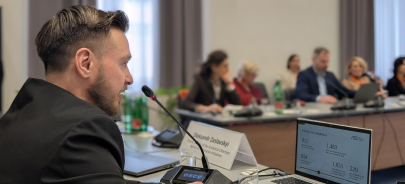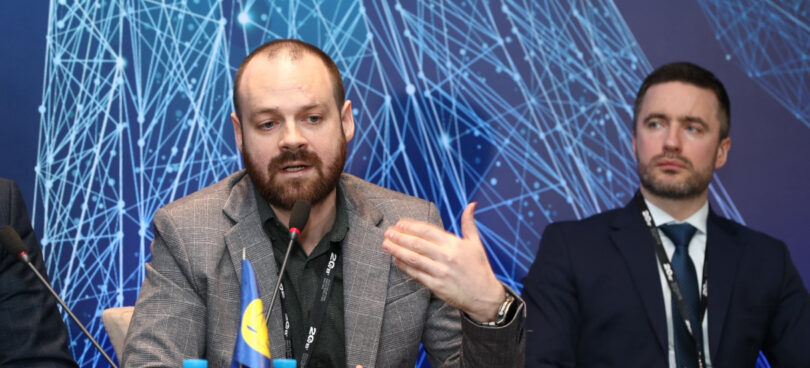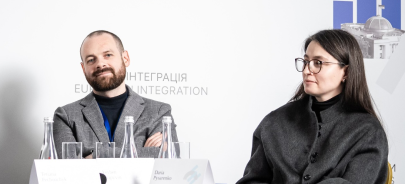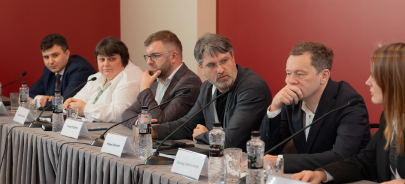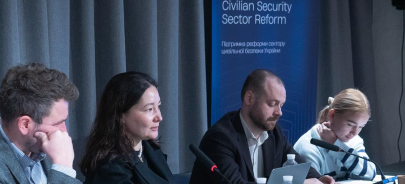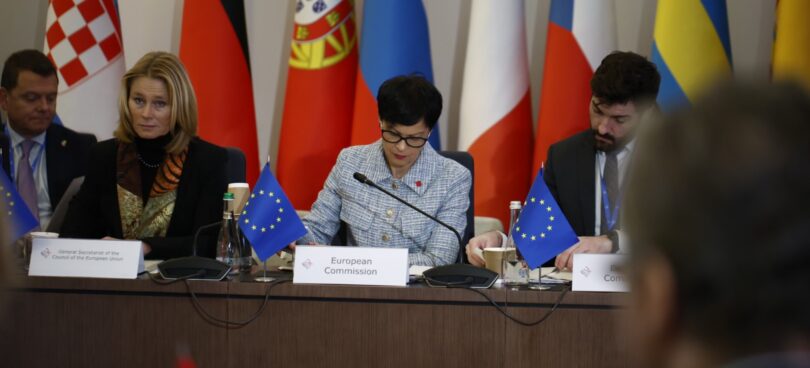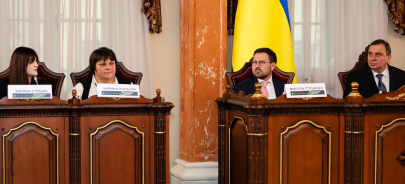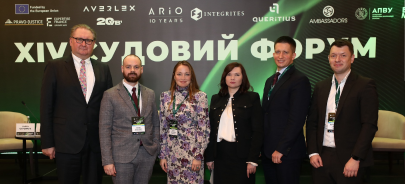
On 21 November, the Agency for Legislative Initiatives took part in a meeting of the Verkhovna Rada Committee on Ukraine’s Integration into the EU, dedicated to discussing the European Commission’s Report on Ukraine’s progress. During the meeting, representatives of the coalition of civil society organisations, led by ALI, also presented their own findings and recommendations within the Shadow Report on Chapters 23 and 24, drawing attention to key challenges in the reform process.
The discussion focused on the state of implementation of the criteria under Cluster 1 ‘Fundamentals’, with participation of the First Vice-Speaker of the Verkhovna Rada of Ukraine, Oleksandr Korniyenko; the Deputy Prime Minister for European and Euro-Atlantic Integration, Taras Kachka; the EU Ambassador to Ukraine, Katarína Mathernová; Members of Parliament; and civil society representatives from Transparency International Ukraine, the Human Rights Centre ZMINA, Tomorrow’s Lawyer, Europe Without Barriers and the Ukrainian Bar Association.
According to Karyna Aslanian, Head of the Rule of Law area at ALI, several priority tasks in judicial reform require Parliament’s involvement:
Participation of international experts in selection processes.
In June 2025, the Verkhovna Rada registered Draft Law No. 13382, which would reinstate international experts in the selection of members of the High Qualification Commission of Judges of Ukraine (HQCJ). However, no progress in considering the draft law has been made to date.
Filling vacancies in the Constitutional Court of Ukraine (CCU) and the High Council of Justice (HCJ).
In addition, the expert drew attention to the need to revise the approach to financing the judiciary: ‘Each year the judiciary is funded at roughly 60%, which makes it impossible to ensure adequate remuneration in local courts. As a result, court secretaries and judges’ assistants earn less than cleaning staff in a supermarket’.
Karyna Aslanian also touched on the latest scandals surrounding the work of the parliamentary Temporary Investigative Commission (TIC):
A significant part of renewing the justice system is the reform of law-enforcement agencies, which requires more systematic and consistent work.
Yevhen Krapyvin, Head of ALI’s Law and Order area, noted that establishing a practice of dialogue between Parliament and the Government on Ukraine’s implementation of its European integration commitments is essential and should become regular. This reflects the political agency of both Parliament and the Government in this process. The expert also stressed that Parliament and the Government’s decision to involve civil society in such meetings is crucial, as it enables all sides to assess Ukraine’s progress on the path to EU integration objectively.
The Head of ALI’s Law and Order area stressed the need to reinstate mandatory competitive procedures for appointments to prosecution offices at all levels, and that the selection of the Prosecutor General must take place through a transparent and merit-based procedure that eliminates any risk of politicisation.
He noted that draft laws No. 13601 and No. 13699 are already before the Verkhovna Rada, giving Parliament the opportunity to swiftly meet the EU’s recommendations.
The Shadow Report was prepared by a coalition of civil society organisations led by the Agency for Legislative Initiatives, under a grant provided by the EU Project Pravo-Justice, implemented by Expertise France. Its contents are the sole responsibility of the authors and do not necessarily reflect the views of the European Union.