
Preparation of the analytical materials is a part of a project implemented by the NGO Agency of Legislative Initiatives with the support of USAID RADA Program: Responsible Accountable Democratic Assembly, implemented by East Europe Foundation.
Presentation of the Policy Paper “Proposals for Policy on Cybersecurity Reform in Ukraine”
On December 14, 2017, the Committee hearings on “Principles of E-Governance in the Electoral Process” were held including presentation of the Policy Paper “Proposals for Policy on Cybersecurity Reform in Ukraine”.
The event was organized by the Agency for Legislative Initiatives in cooperation with the Committee on Informatization and Communications of the Verkhovna Rada of Ukraine with the support of the International IDEA.
The Hearings were attended by 42 people, including representatives of the Cabinet of Ministers, specialized parliamentary committees, a representative of the Central Election Commission and representatives of NGOs working on the improvement of the electoral process in Ukraine.
The Policy Paper “Proposals for Policy on Cybersecurity Reform in Ukraine” identifies and describes the problem; examines the regulatory principles of cybersecurity; analyzes the respective reform of EU legislation and its implications for the cybersecurity of Ukraine; offers alternatives and analyzes the barriers and ways to overcome them.
The paper was presented by one of its authors – Yegor Aushev, Project Manager of the Cyber Guard, co-founder of HACKEN.
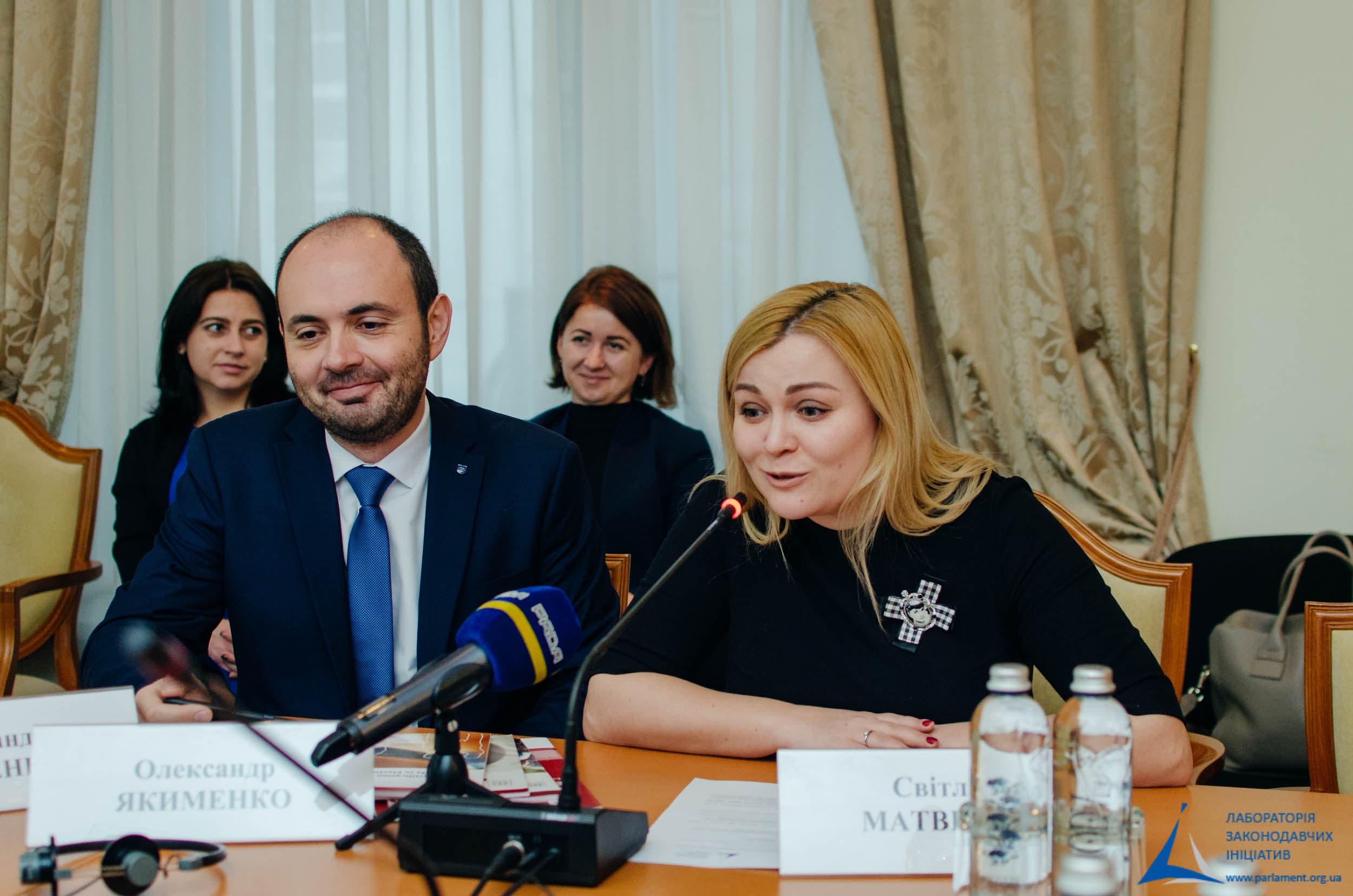
Svitlana Matviienko, Chairwoman of the Board of the Agency for Legislative Initiatives, noted that changes taking place around the world were encouraging Ukraine to change too. In particular, this concerns the prospect of the introduction of an electronic electoral process in Ukraine by 2024. However, it would be a great exaggeration to claim that our country is ready to this process. The Green Paper on the Information Security of the Electoral Process, which will be finalized following today’s discussions and recommendations, aims to at least partially fill this gap.
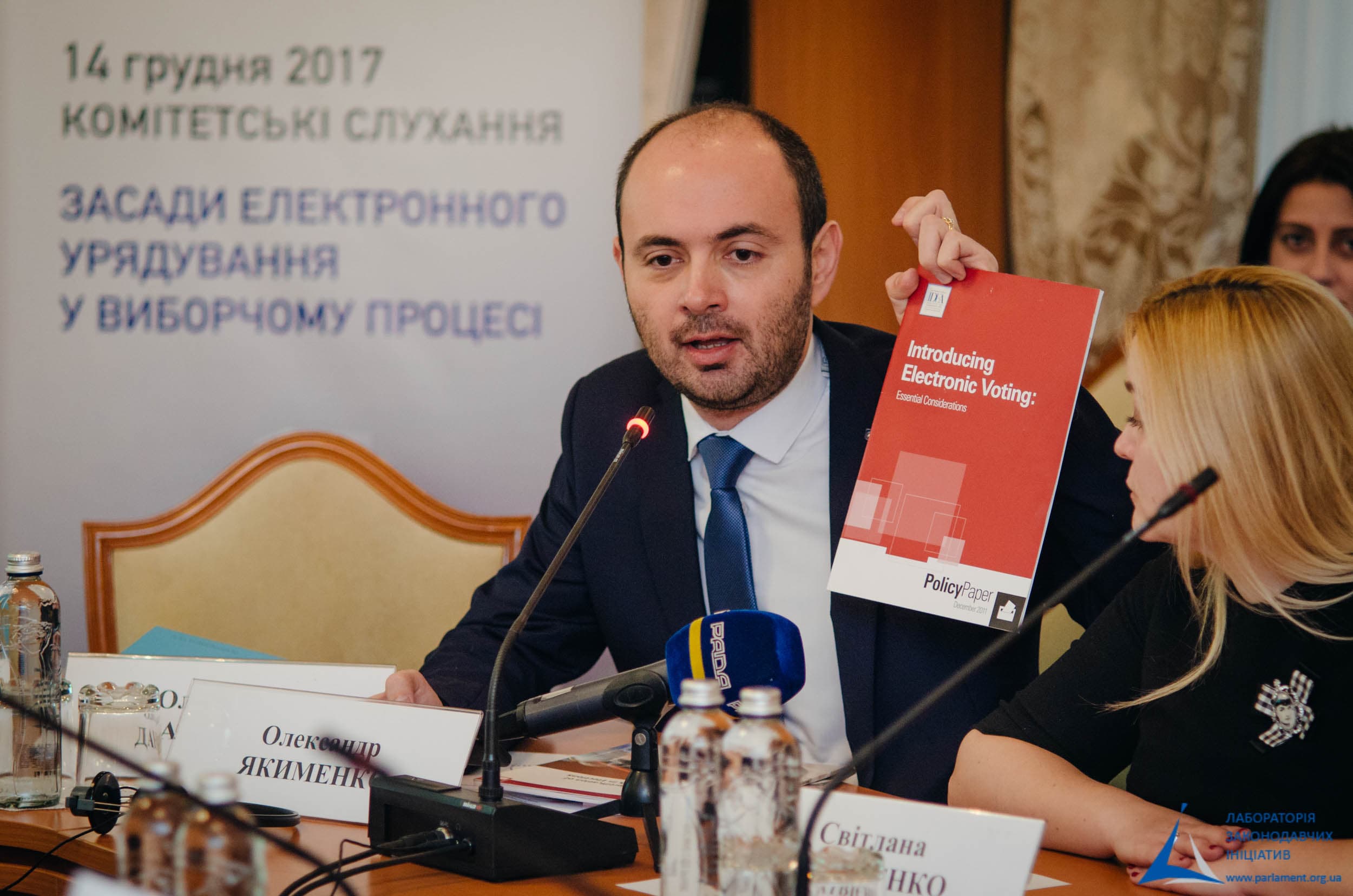
Oleksandr Yakymenko, Program Coordinator in Ukraine, International IDEA:
“We believe that the issue of introducing e-voting, the challenges and risks associated with it, as well as a number of other related and important issues, are extremely topical for Ukraine.
E-voting is not only a tool one can use to find out the result of the popular vote, we see it as a tool that makes the entire electoral process more effective and increases the level of trust in managing this process.
When correctly applied, solutions in the field of e-voting, can step up the protection of vote, accelerate the processing of results, and simplify the voting process. However, such decisions are fraught with significant problems. If they are not properly planned and carefully designed, they can undermine confidence in the entire election process.”
E-voting is not only a tool one can use to find out the result of the popular vote, we see it as a tool that makes the entire electoral process more effective and increases the level of trust in managing this process.
When correctly applied, solutions in the field of e-voting, can step up the protection of vote, accelerate the processing of results, and simplify the voting process. However, such decisions are fraught with significant problems. If they are not properly planned and carefully designed, they can undermine confidence in the entire election process.”
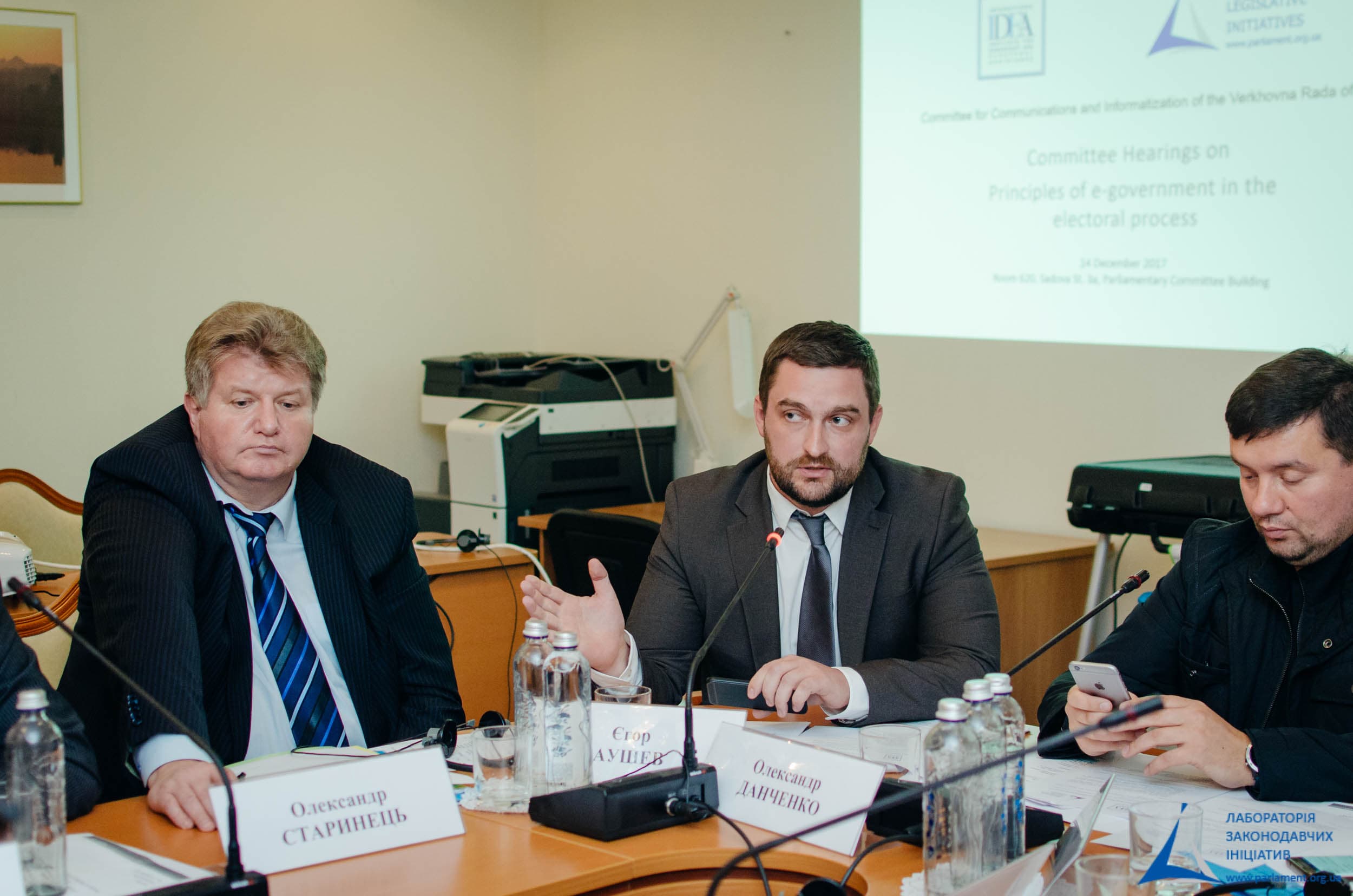
“The Internet, the Internet of Things (IoT) and information technologies open up boundless opportunities for mankind, but also generate new, very serious threats. More and more information is being transferred online; and according to recent estimates, presently more than 20 billion devices are connected to the Internet, which is several times more than the Earth’s population. Billions of gigabytes of different data are being accumulated on servers. The world is becoming open, and this rapid growth requires that “rules of the game” should be set forth”
“Under conditions of hybrid warfare, lack of a legislative framework for cybersecurity in Ukraine significantly increases the risk of collapse of the national cybersecurity system (if any) and challenges the possibility of integration of Ukrainian cybersecurity components at European and world levels. To date, Ukraine has established no single center for coordinating the work on legislative and regulatory support to ensure effectiveness of the system of cybersecurity based on a comprehensive analysis of the current state of affairs in this area, challenges, existing and potential threats that would take into account the interests of all stakeholders, would be integrated into the European and global international cybersecurity system, and would have sufficient financial, organizational, technical, and personnel support”
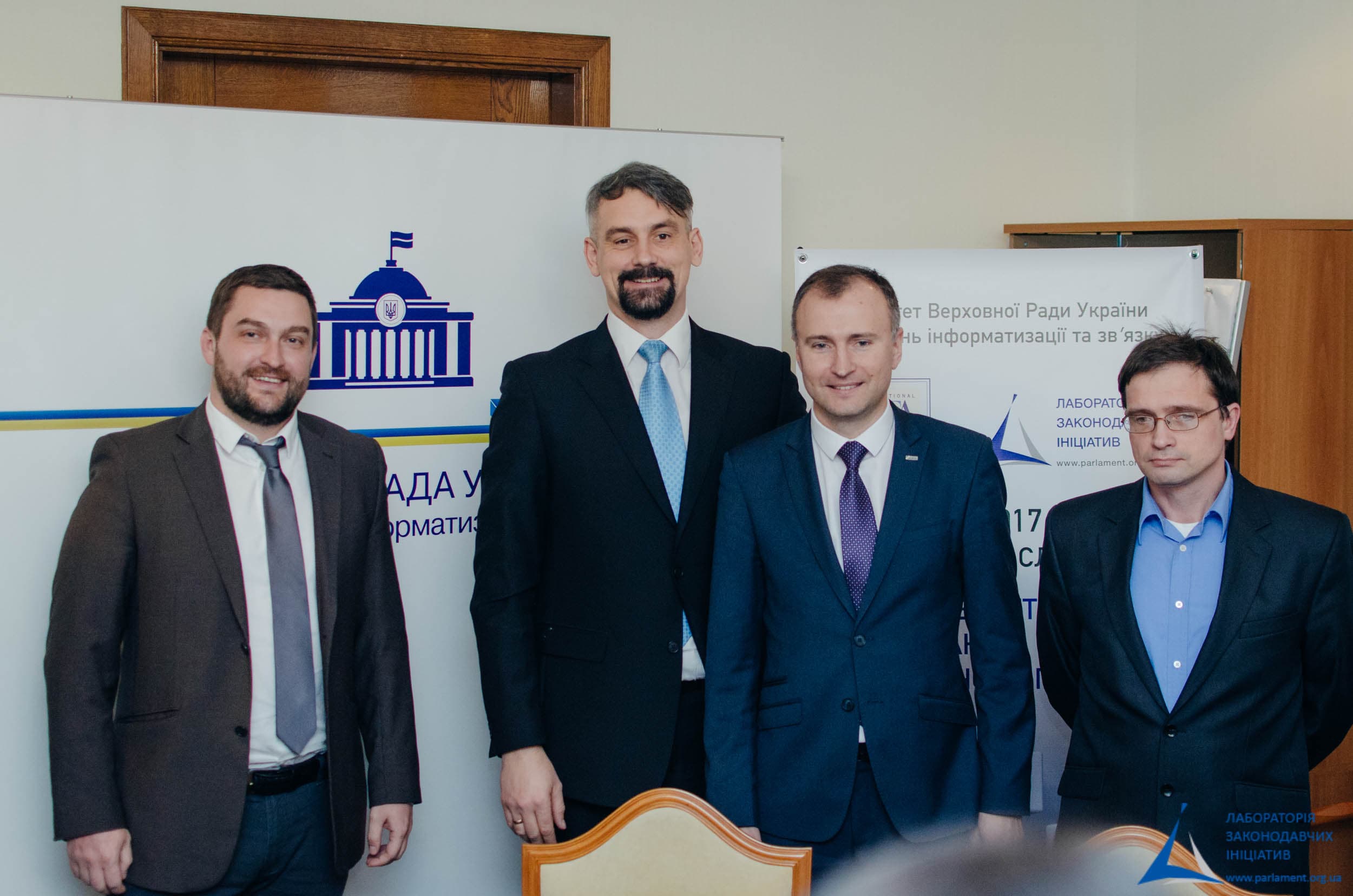
Presentation of the Concept Paper “Concept of End-to-End Legislative Process” at the conference “Role of Parliament, Heads of State, Government and the Public in Improving the Quality of the Legislative Process”
During the period from October to November 2017, the USAID RADA Program held five discussions on parliamentary reform involving MPs of Ukraine, the staff of the Secretariat of the Verkhovna Rada of Ukraine, representatives of Government, experts and the public, aiming to develop recommendations for their further implementation within parliamentary reform. Specifically, the discussion covered such issues as performing parliamentary oversight functions, interaction of the legislative and executive branches of power in the legislative process, strengthening of the role of committees and the VRU Secretariat, creation of a separate parliamentary service, tackling of the problem of the voting procedure, and the role of support documents in the legislative process.
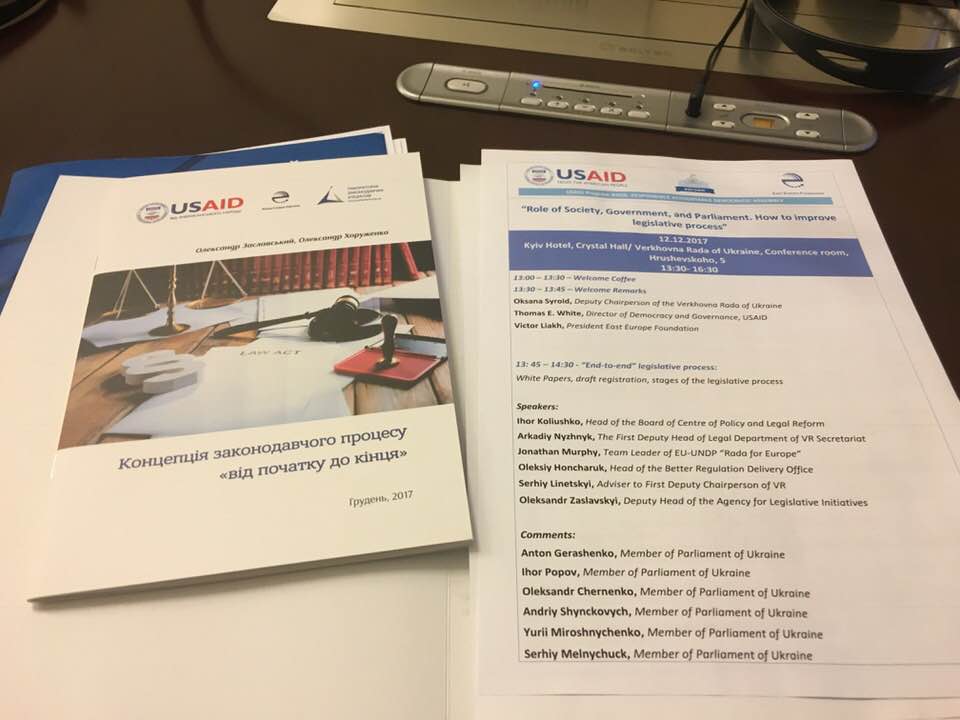
Based on the results of discussions on parliamentary reform, the USAID RADA Program organized the conference “Role of Parliament, Heads of State, Government and the Public in Improving the Quality of the Legislative Process”.
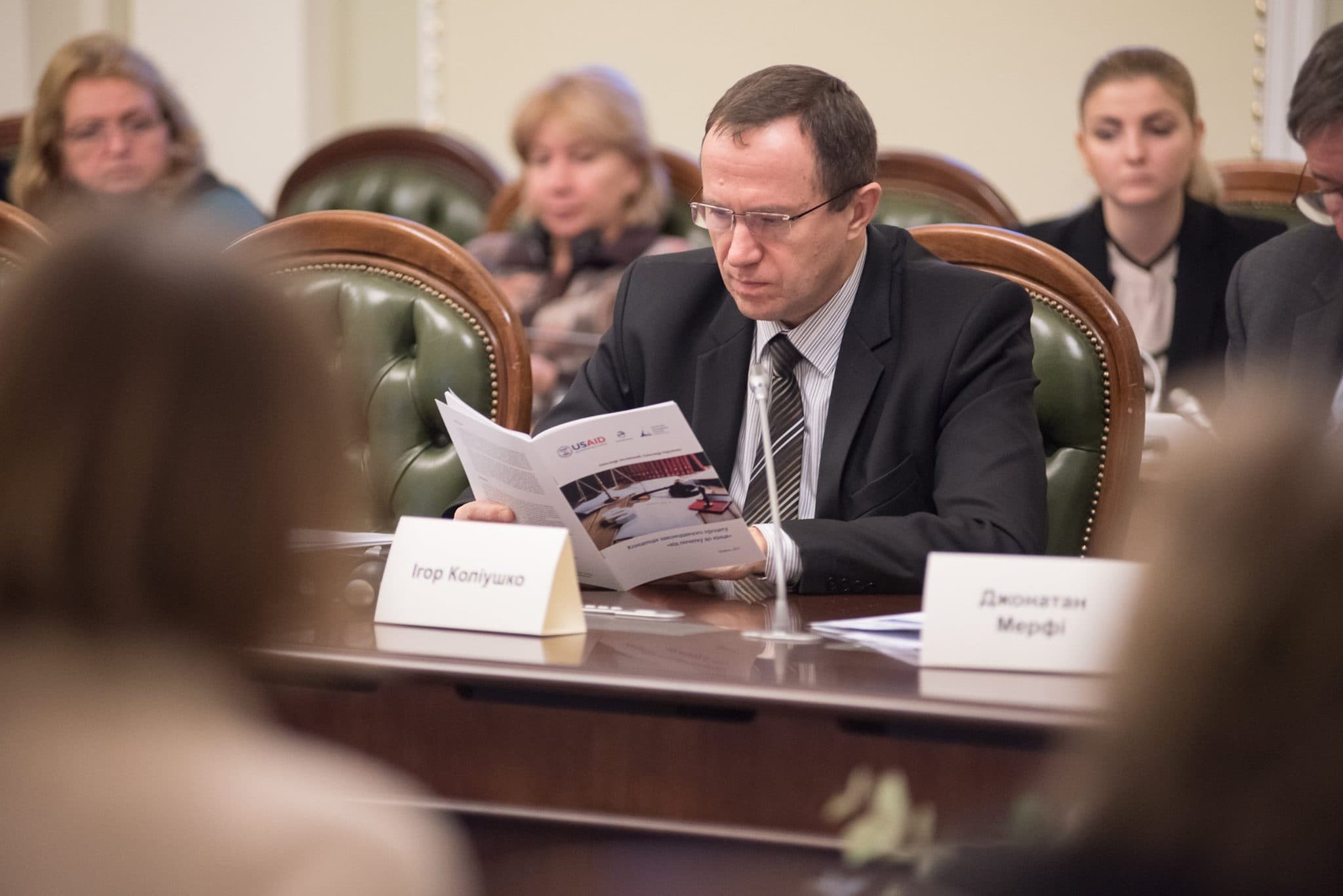
Within the framework of the conference, the Agency for Legislative Initiatives presented the paper “Concept of End-to-End Legislative Process”.
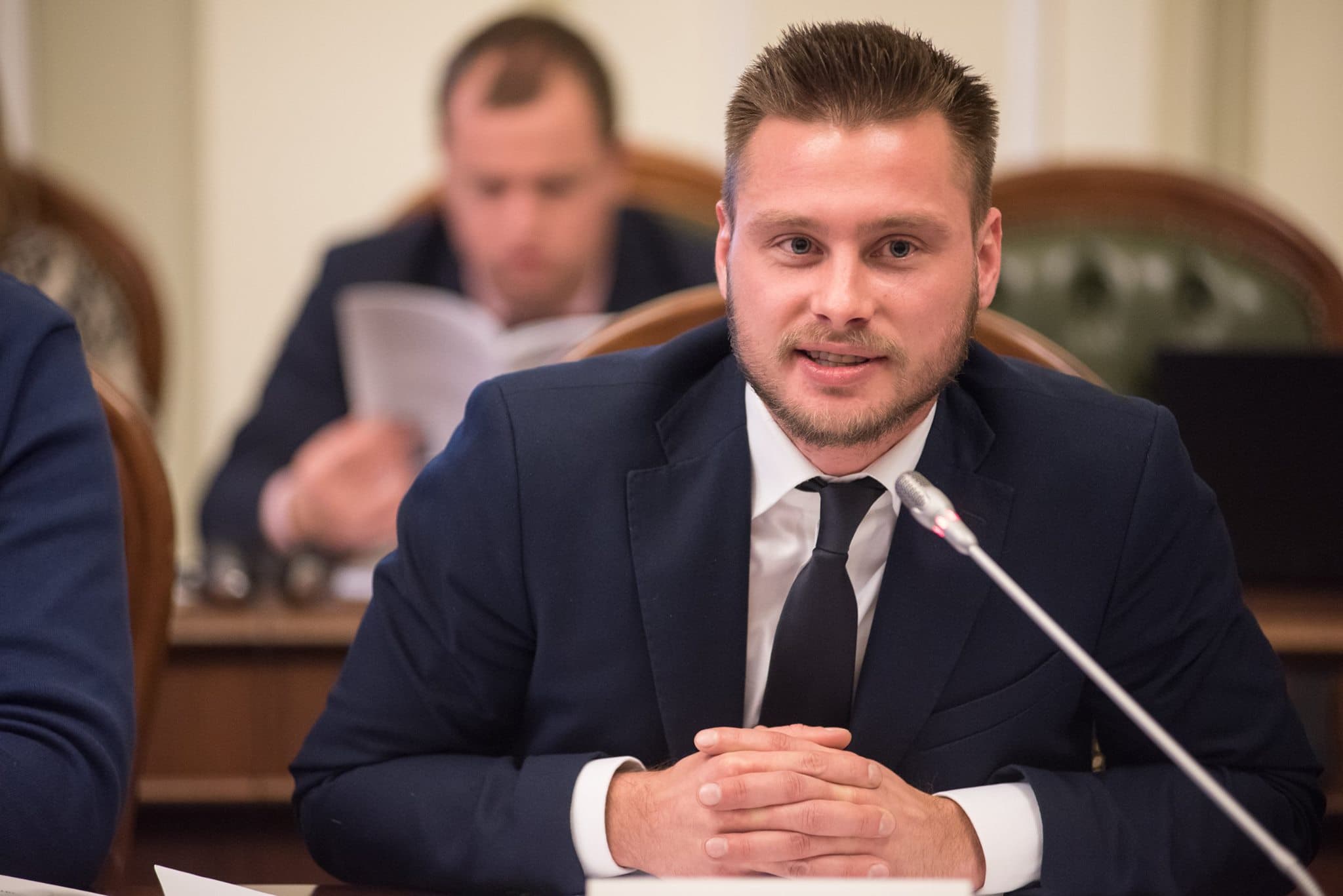
Oleksandr Zaslavskyi, Deputy Chairman of the Board of the Agency for Legislative Initiatives:
“Of all the flaws of the legislative process, the most conspicuous are the ones associated with the consideration of draft laws in the session hall. I am not talking about “piano voting”. For instance, the widespread practice of considering bills under an abridged procedure (which according to the rules of procedure should be an exception rather than the “standard”) in the first reading degrades the level of discussion of legislative initiatives. Moreover, sometimes at the proposal of the initiator of the bill or the Chairman of the Verkhovna Rada there is no discussion whatsoever, that is, even the abridged procedure is not observed”
Thus, the first reading as a key stage in the consideration of bills is reduced. However, according to the logic of the Rules of Procedure the VRU, it is the first reading stage that should guarantee a comprehensive discussion of the problem, its relevance, proposed solutions, and expected results. The flaws of draft laws start becoming manifest during the further work on preparing it for the second reading which, due to its limitations, does not allow for opportunities to improve the key idea of the bill, making possible only pinpoint and technical changes.
Moreover, during the 4th and 5th sessions (February 2016 – January 2017), most of the bills were adopted in the first reading, and in total 116 out of 187 were approved as a whole (62%). At the same time, 51 out of the 116 above bills (44%) were adopted contrary to the opinions or comments of the Central Scientific Experts Office of the Verkhovna Rada of Ukraine, which prepares expert opinions for the first reading. Obviously, this attests to the poor quality of the bills, at least in terms of the regulation design mechanism, internal consistency of the text of acts, or compliance with the current laws, the Constitution or international agreements. What’s more, these bills are adopted almost without discussion and without prospects of improvement during the second reading.
This is coupled with the situation around transitional provisions of bills adopted as a whole. Such provisions often contain instructions for the Government to align relevant subordinate acts in pursuance of the adopted laws. Such transitional provisions with instructions (specific or general) are contained in 91 laws approved as a whole during the 4th and 5th sessions (47%). Obviously, the Government should be ready to comply with the laws. However, it is difficult to imagine how one can prepare for such a situation when it is impossible to predict stage and form of adoption of a draft law.
As a result, the Government faces the problem of enforcement of “imperfect” or poorly-prepared laws, which spawns the need to initiate more changes to the already adopted legislation. As a result, these parliamentary practices are one of the reasons why 60% to 75% of the bills adopted as a whole during the 8th session are secondary, that is, they amend existing laws. For the presently registered bills, this figure is even greater. To sum up, it can be argued that the lack of thorough work on draft laws and attempts to quickly adopt them without comprehensive discussion produce the need to register even more bills. This, in turn, is one of the sources of the very “legislative tsunami” referred to in the Roadmap of the European Parliament’s Needs Assessment Mission.
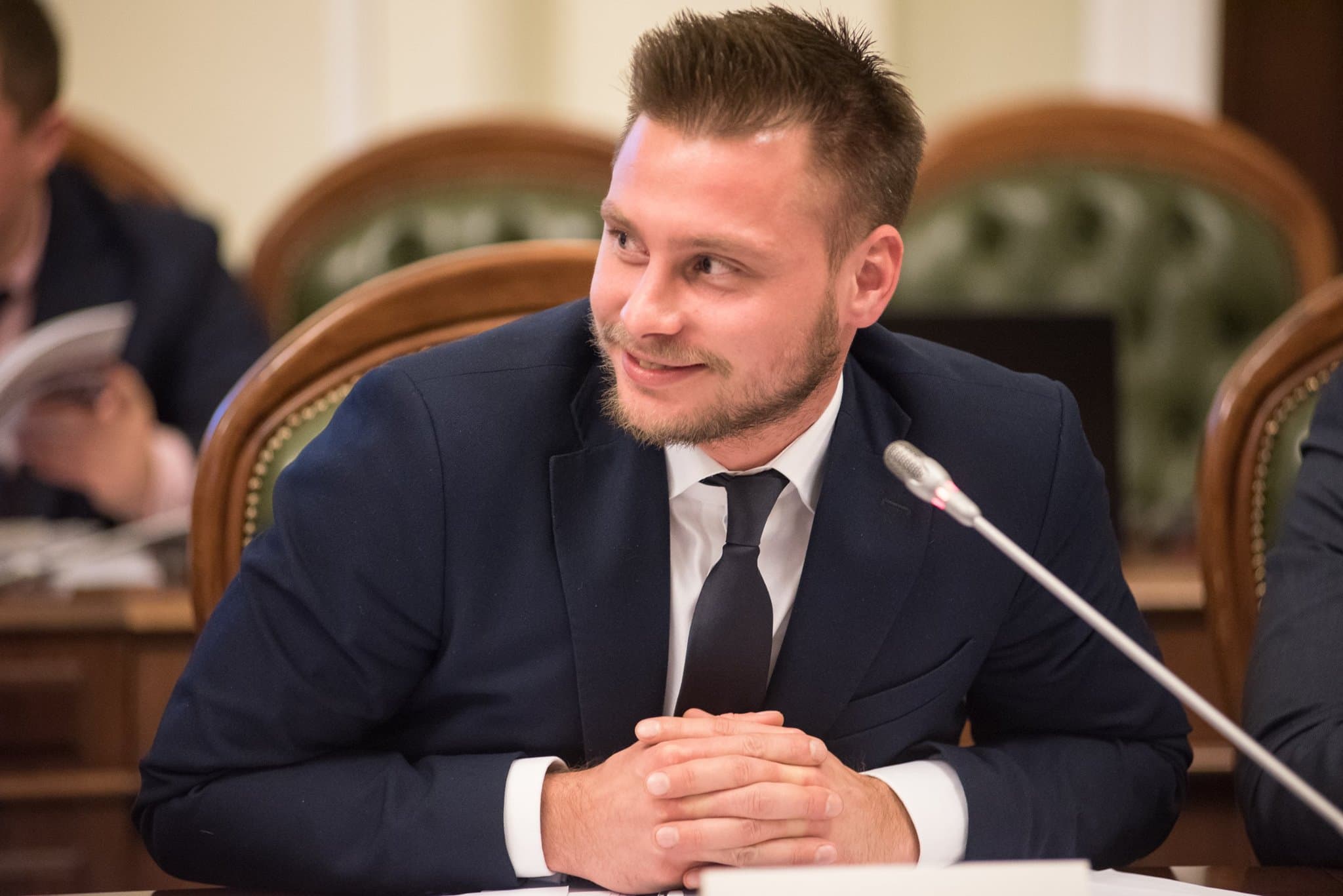
Mr. Zaslavskyi also focused on the recommendations that need to be implemented to improve the law-making process.
Including:
- drafting and adopting the Law “On Regulatory Acts” introducing appropriate amendments to the Constitution of Ukraine in order to ensure the effective distribution of the sphere of regulation of laws and by-laws, as well as to establish common rules for drafting bills, their coordination among the involved parties, the procedure of interaction of the entities of legislative activity, enactment of laws, enforcement, monitoring and evaluation of the enforcement of laws, etc. Moreover, this will help to introduce the procedure of voting for ordinary laws by a majority of those present in the session hall;
- setting forth in the Rules of Procedure of a certain number of 20 MPs’ signatures necessary to register bills or introducing letters of support for registered bills for them to be considered in the session hall (Draft Law No. 6640);
- introducing the mechanism of MP’s individual legislative proposal;
- limiting the right of MPs’ legislative initiative in financial and economic matters;
- review of the status of the Government’s Program of Activity. In the event of the Government’s failure to provide this document, it should resign (introduction of a constructive confidence vote). The session agenda should be drawn up on the basis and in pursuance of the Government’s Program of Activity;
- limiting the number of bills to be submitted for discussion within a week. For example, up to 10 bills. In this context, priority should be given to the government initiatives aimed at implementing the Government’s Program of Activity;
- introduction of a mechanism for political co-ordination (first of all with regard to compliance with the Coalition Agreement and the Government’ Program of Activity) of legislative initiatives (submitted as a brief analytical note containing primary information on the current policies in a particular area or symptoms of a problem). Only after examining this initiative for compliance with the government’s program of activity (and, possibly, the coalition agreement) and its approval by representatives of political factions and groups, can preparation of analytics be launched and the text of the bill be drafted;
- ensuring that the Government should prepare regulations for the enactment of the law before the law is adopted as a whole or that Government should give a reasoned explanation why no such regulations need to be drafted;
- ensuring that bills should be discussed under the full procedure in the first reading and that bills should be considered under the full-fledged procedure of three readings (as stipulated by the Rules of Procedure of the VRU);
- introduction of monitoring and evaluation of the enactment of a particular law or the state of legal regulation of a particular field of social relations based on any legislative initiative. Any legislative initiative should come with a monitoring and evaluation plan that should be agreed with the Main Committee of the Verkhovna Rada;
- introduction of a single platform for all legislative initiative entities to register, log and track all regulations. The Computerized Systems Department is developing a resource tentatively entitled “Electronic Draft Law” – a single platform for all legislative initiative entities to register draft acts, which will make it possible to track the status of the bill.
Preparation of the analytical materials is a part of a project implemented by the NGO Agency of Legislative Initiatives with the support of USAID RADA Program: Responsible Accountable Democratic Assembly, implemented by East Europe Foundation.
Presentation of the policy paper “Concept of ‘End-to-End’ Legislative Process”
On December 06, 2017 the Ukrainian Crisis Media Center (2, Khreshchatyk Str.) hosted a presentation of the Policy Paper “Concept of ‘End-to-End’ Legislative Process”.
The event was organized by the Agency for Legislative Initiatives within the framework of the USAID RADA Program: Responsible, Accountable, Democratic Assembly implemented by the East Europe Foundation.
The event was attended by:
- MP Dmytro Lubinets, Secretary of the Verkhovna Rada Committee on Rules of Parliamentary Procedure and Support to Work of the Verkhovna Rada of Ukraine;
- Oleksandr Zaslavskyi, Deputy Chairman of the Board of the Agency for Legislative Initiatives.

During the 4th and 5th sessions of the Verkhovna Rada of Ukraine of the VIII convocation, 1506 bills were registered, of which only 12% have been approved. This testifies to the fact that the parliament is overwhelmed by the “legislative tsunami”, i.e. a situation where so many bills are registered that deputies are physically unable to deal with them.
The ease with which MPs of Ukraine can register bills, regular violations of parliamentary procedures, lack of established long-term planning practices and stable communication between the legislative power actors result in the wide-ranging chaos of policymaking that hinders Ukraine’s sustainable and steady development.
Thus, the development of an effective system for policy formulation, approval, harmonization, assessment, and review remains extremely topical for both the political leadership and Ukrainian society as a whole.
The policy paper “Concept of ‘End-to-End’ Legislative Process” contains an analysis of existing practices, an overview of international experience, as well as proposals as to the concept of the “end-to-end” legislative process reform focused on strengthening coordination between legislative initiative actors. This is set out in the first recommendation of the Roadmap on Internal Reform and Capacity-Building for the Verkhovna Rada of Ukraine prepared by the European Parliament’s needs assessment mission led by Pat Cox.

MP Dmytro Lubinets, Secretary of the Verkhovna Rada Committee on Rules of Parliamentary Procedure and Support to Work of the Verkhovna Rada of Ukraine, argues that “legislative spam” is a result of every MP’s desire to submit his personal legislative initiative, because for the public perceives the number of bills registered by an MP as the indicator of his effectiveness. One way out of this situation is to restrict the legislative initiative so that a bill could be submitted only by a group of MPs consisting of at least as many persons as the smallest faction of the current convocation of the Verkhovna Rada.
“This safeguard will automatically ensure a decrease in the number of draft laws, hence the effectiveness and quality of the Verkhovna Rada will ipso facto increase”
“The problems of the legislative process in Ukraine to a large extent stem from wrong practices of enforcement of framework regulations rather than from imperfections of these regulations”
According to Mr. Lubinets, one of the factors undermining the effectiveness of the legislative process is political PR – a situation where committee hearings (especially when attended by the media) turn into a political show instead of a meaningful discussion. This results in significant delays in the process of reviewing bills, taking years for a bill to be submitted to the session hall after its registration. As a result, a large number of critically important draft laws are ping-ponged from one deputy committee to another for years. Another problem is posed by the process of considering amendments when amendments already approved for voting are again put to vote in the session hall by MPs.
“There are no mechanisms to prevent this MP “spam”, hence important bills are not adopted, as a result people expect radical changes from parliament but the changes do not happen”

Presenting the study, Oleksandr Zaslavskyi, Deputy Chairman of the Board of the Agency for Legislative Initiatives, pointed out that from October 2015 to January 2016, European Parliament’s needs assessment mission headed by Pat Cox had been working in the Verkhovna Rada and had come up with the Report and Roadmap on Internal Reform and Capacity-Building for the Verkhovna Rada of Ukraine. On March 17, 2016, the Verkhovna Rada adopted the Resolution based on this document containing 52 recommendations for improvement of the work of the Verkhovna Rada of Ukraine in terms of its institutional capacity, improvement of the quality of the legislative process, ensuring compliance of the legislation with the EU regulations, etc. The first and most important recommendation is to develop an “end-to-end” concept of the legislative process.
The policy paper “Concept of ‘End-to-End’ Legislative Process” examines the legislative process in the context of communication of legislative initiative entities. Special attention is given to the problem of delimitation of the powers of legislative initiative entities, as well as gradual disturbance of the balance of the constitutionally mandated design of policy development. The study analyzes the mechanisms of cooperation of legislative initiative entities in the legislative process, as well as observance of procedures for consideration of bills. It examines the role of committees and mechanisms for monitoring, assessing and reviewing approved decisions. Much attention is given to alternative variants of improving the legislative process.
Mr. Zaslavskyi elaborated on the changes needed to improve the legislative process “end-to-end”, including:
- drafting and adopting the Law “On Regulations” involving the introduction of relevant amendments to the Constitution of Ukraine in order to ensure the effective distribution of the sphere of regulation of laws and by-laws;
- stipulation in the Rules of Procedure of the requirement to get the set number of 20 signatures of MPs for the registration of bills or introduction of letters of support for registered bills so that they could be considered in the session hall;
- limiting the number of bills to be submitted for discussion during the week, for example, to 10 bills;
- introduction of a mechanism of the political harmonization (first of all for compliance with the Coalition Agreement and the Government’s Program of Activity) of legislative initiatives;
- ensuring that Government should draft regulations for implementation of the law before the law is adopted as a whole or that Government should give a reasoned explanation why no such regulations need to be drafted;
- ensuring that any legislative initiative should include a monitoring and evaluation plan approved by the Main Committee of the Verkhovna Rada;
- introduction of a single platform for all legislative initiative entities to register, log and track all regulations.
Presentation of the Policy Paper “Proposals for the Policy of Rehabilitation for People with Health Problems”
On November 21, the Kyiv hotel hosted a presentation of the policy paper “Proposals for the Policy of Rehabilitation for People with Health Problems”.
The event was organized by the Agency of Legislative Initiatives with the support of USAID RADA Program: Responsible Accountable Democratic Assembly, implemented by East Europe Foundation.
As of now, the public system of rehabilitation services does not ensure an adequate coverage, which makes access complicated for people in need of such services. This issue requires public attention.
The study examines the capacity of the rehabilitation system to ensure the further implementation of the UN Convention on the Rights of Persons with Disabilities and the International Classification of Functioning, Disability, and Health (ICF). The purpose of the policy paper is to elaborate proposals for the public policy in the field of rehabilitation of persons with health problems based on the implementation of the UN Convention on the Rights of Persons with Disabilities and promote their maximum independence. It focuses on the international and national standards for rehabilitation of persons with disabilities, as well as gaps in Ukrainian legislation and law enforcement practice as regards access to rehabilitation services and auxiliary aids.
Proceeding from the analysis results, the paper suggests possible ways to improve the public policy in this area, outlines the prospects for introducing an alternative system that would be based on the ICF implementation.
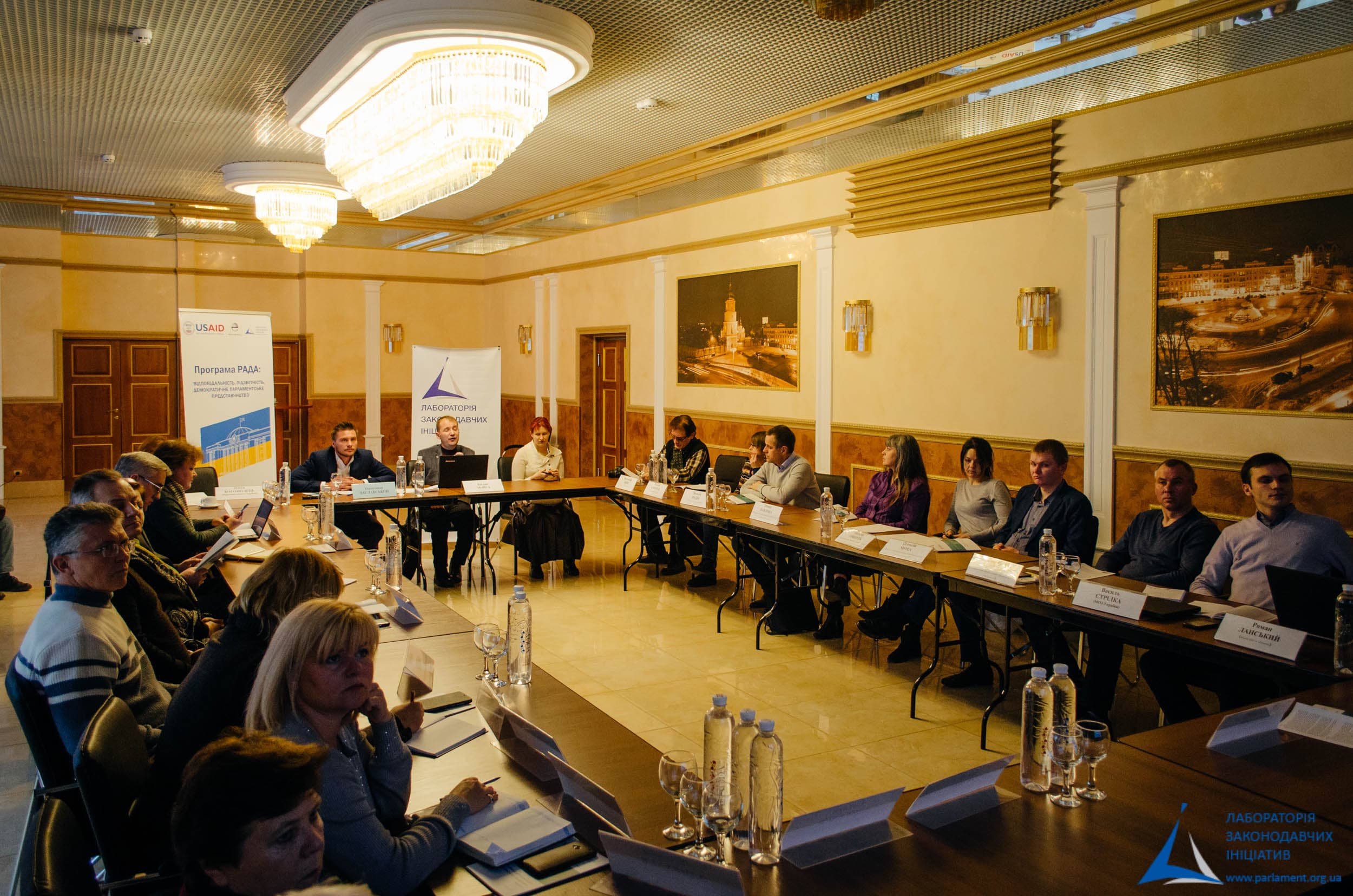
Photo by Oleksandr Kovalenko
The event was attended by around 3o participants, including MPs’ assistants, representatives of the Secretariat of the VRU Committee on Health Care, the Secretariat of the VRU Commissioner for Human Rights, the State Service of Ukraine for War Veterans and Anti-Terrorist Operation Participants, the Institute of Social Technologies, International University of Human Development ‘Ukraine’, eHealth, Clinical Hospital ‘Feofaniya’, and representatives of the public.
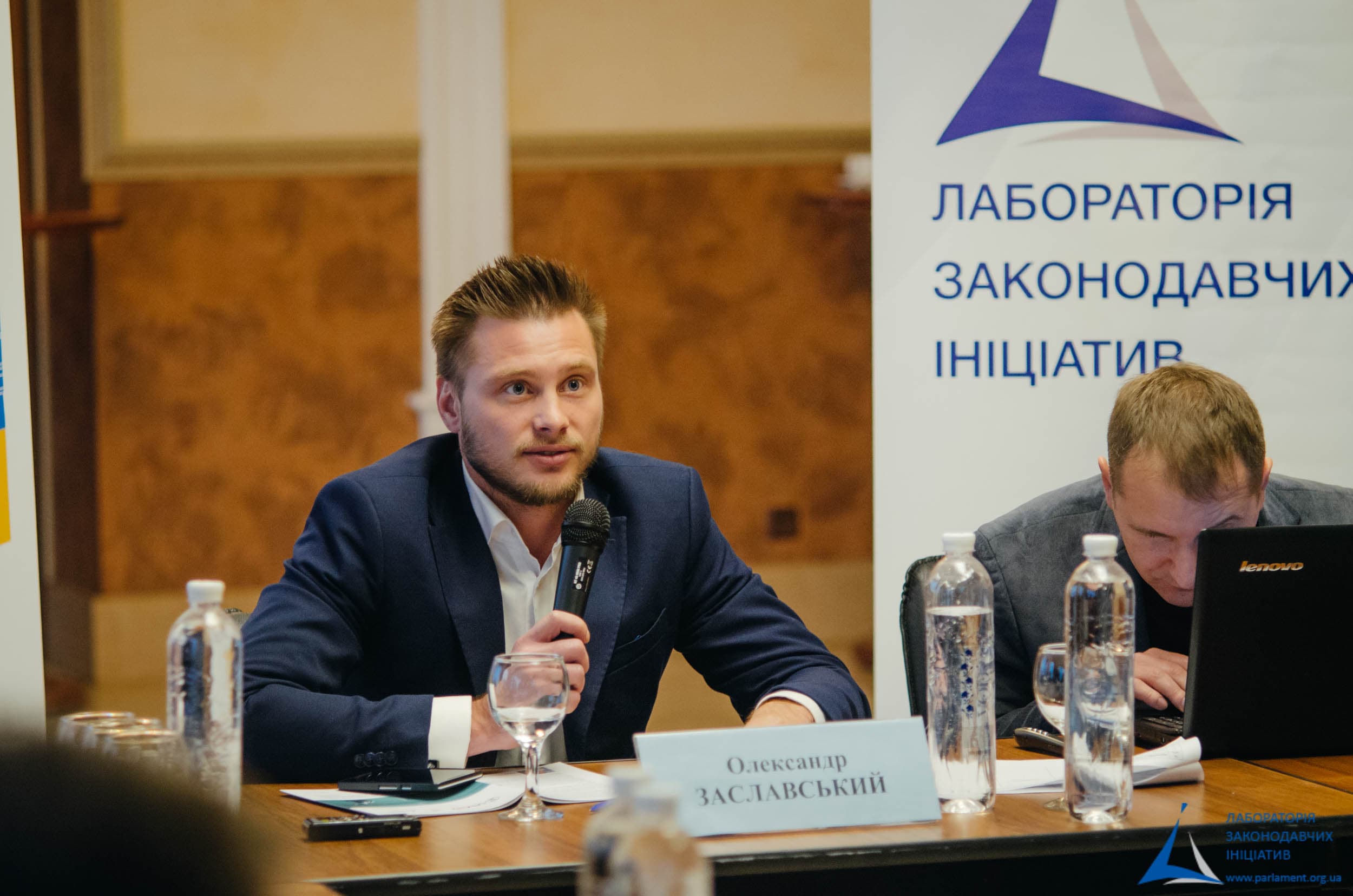
Photo by Oleksandr Kovalenko
Oleksandr Zaslavskyi, Deputy Chairman of the Board of the Agency for Legislative Initiatives, pointed out that the Agency for Legislative Initiatives, within the framework of the RADA Program, promotes the strengthening of the analytical capacity of the Verkhovna Rada of Ukraine in the legislative process. Specifically, the Agency resumed the activity of the European Information and Research Center, which currently operates autonomously preparing policy briefs and responses to MPs’ requests. The Agency for Legislative Initiatives proposes two types of documents for consideration by committees: Policy Papers and Shadow Reports. Shadow Reports are aimed at strengthening the oversight function of committees and focus on analyzing certain laws; Policy Papers are documents that should be considered first and foremost within the policy cycle, prior to the bill itself. The Agency for Legislative Initiatives intends to introduce the practice of consideration of analytical papers that examine the outlined problem, the current policy, its effectiveness and flaws, provide stakeholder analysis and alternative solutions to the problem. Such documents are considered at committees’ meetings, during roundtables involving the broadest number of stakeholders; besides, they are handed out to MPs in the session hall. All these measures are aimed at improving the quality of legislation.
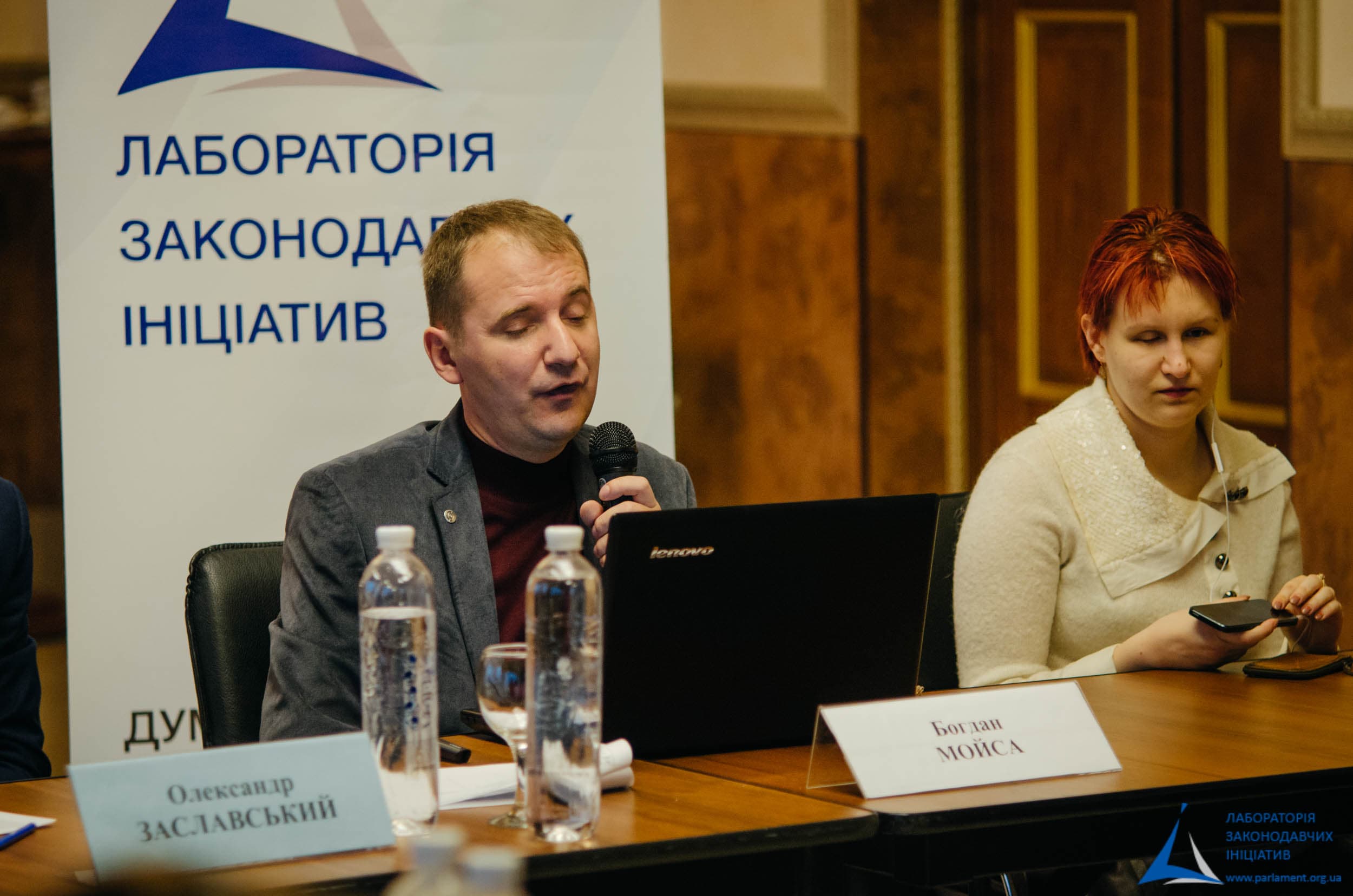
Photo by Oleksandr Kovalenko
Bohdan Moisa, Coordinator of the analytical division of the Ukrainian Helsinki Human Rights Union, said that the existing rehabilitation system could not effectively respond to current challenges. Moreover, its legal framework does not comply with the international commitments undertaken by Ukraine in 2009 when it ratified the UN Convention on the Rights of Persons with Disabilities. The World Health Organization (WHO), whose mission carried out an assessment in December 2015, also confirmed that Ukraine’s rehabilitation system did not meet the international standards.
“Unfortunately, Ukraine lacks any tangible interagency coordination of healthcare, education and social protection as regards the issues of rehabilitation of people with disabilities, while the established system of rehabilitation does not meet the needs of people with disabilities in terms of access to services, especially in rural areas. The current rehabilitation industry lacks a comprehensive system for assessing needs, interdisciplinary work in providing services and their direct focus on the client”
Mr. Moisa elaborated on the groups of people in need of rehabilitation services, outlined problems associated with ascertaining disabilities, and examined the responsible organizations and institutions. Mr. Moisa also covered the topic of availability and diversity of rehabilitation centers, drawing attention to the fact that the lack of such centers affects most people with psychosocial and intellectual disorders. Speaking about positive initiatives, the author mentioned the launching of the pilot project “Creation of a System for Early Intervention Services”, as well as the introduction of professions such as physical rehabilitation physician, physical therapist, and ergotherapist into the Occupational Classification.
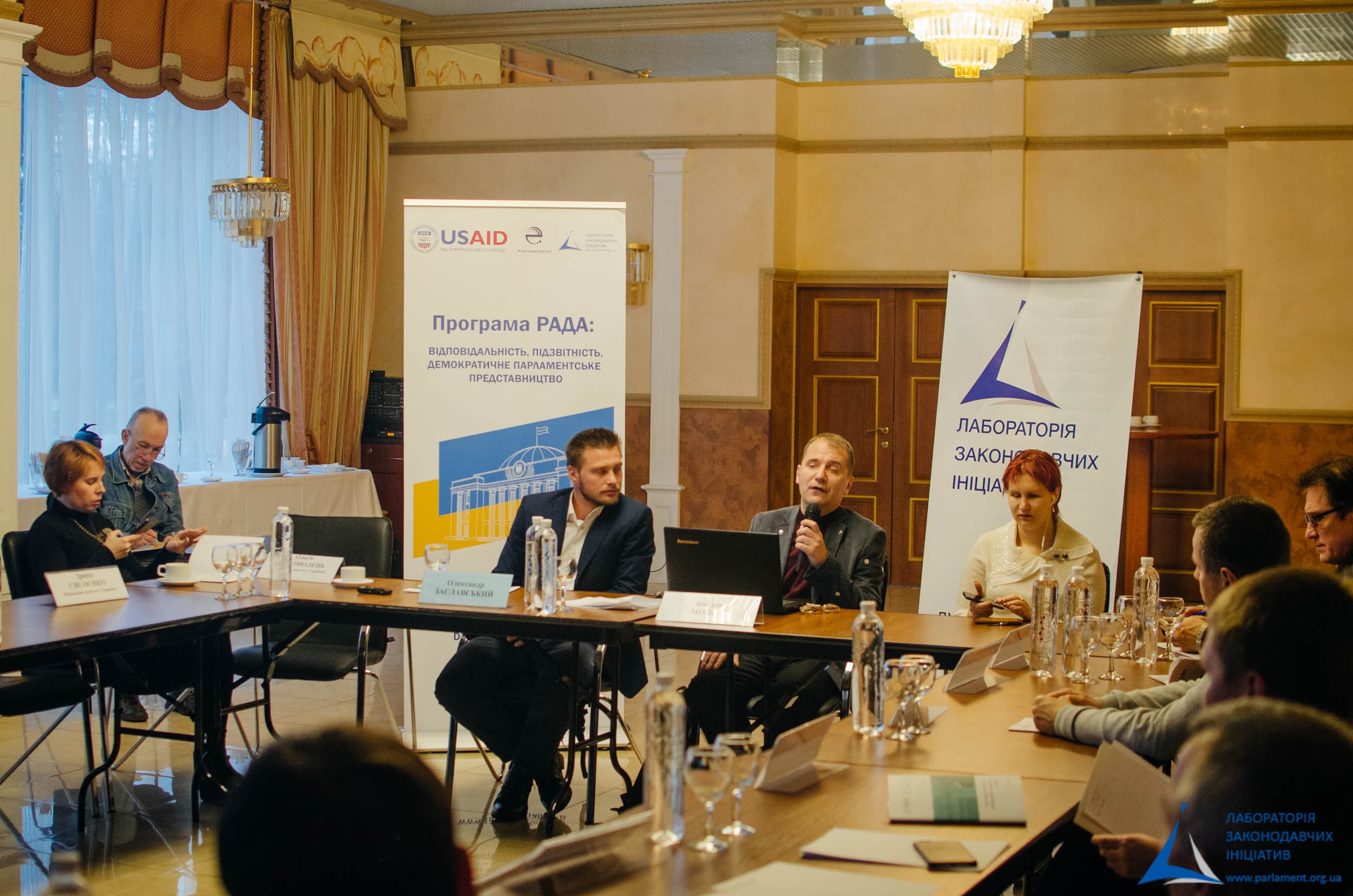
Photo by Oleksandr Kovalenko
Mr. Moisa also elaborated on the international experience of providing rehabilitation services, focusing on the gradual transition from inpatient rehabilitation facilities to service provision at the place of residence and day care facilities. He described the British, Swedish, Czech, Polish and Israeli models of rehabilitation services. Mr. Moisa concluded his presentation with the proposal to adopt the ICF implementation approach proposed by the Ministry of Health while preserving the current achievements of the rehabilitation system for persons with disabilities.
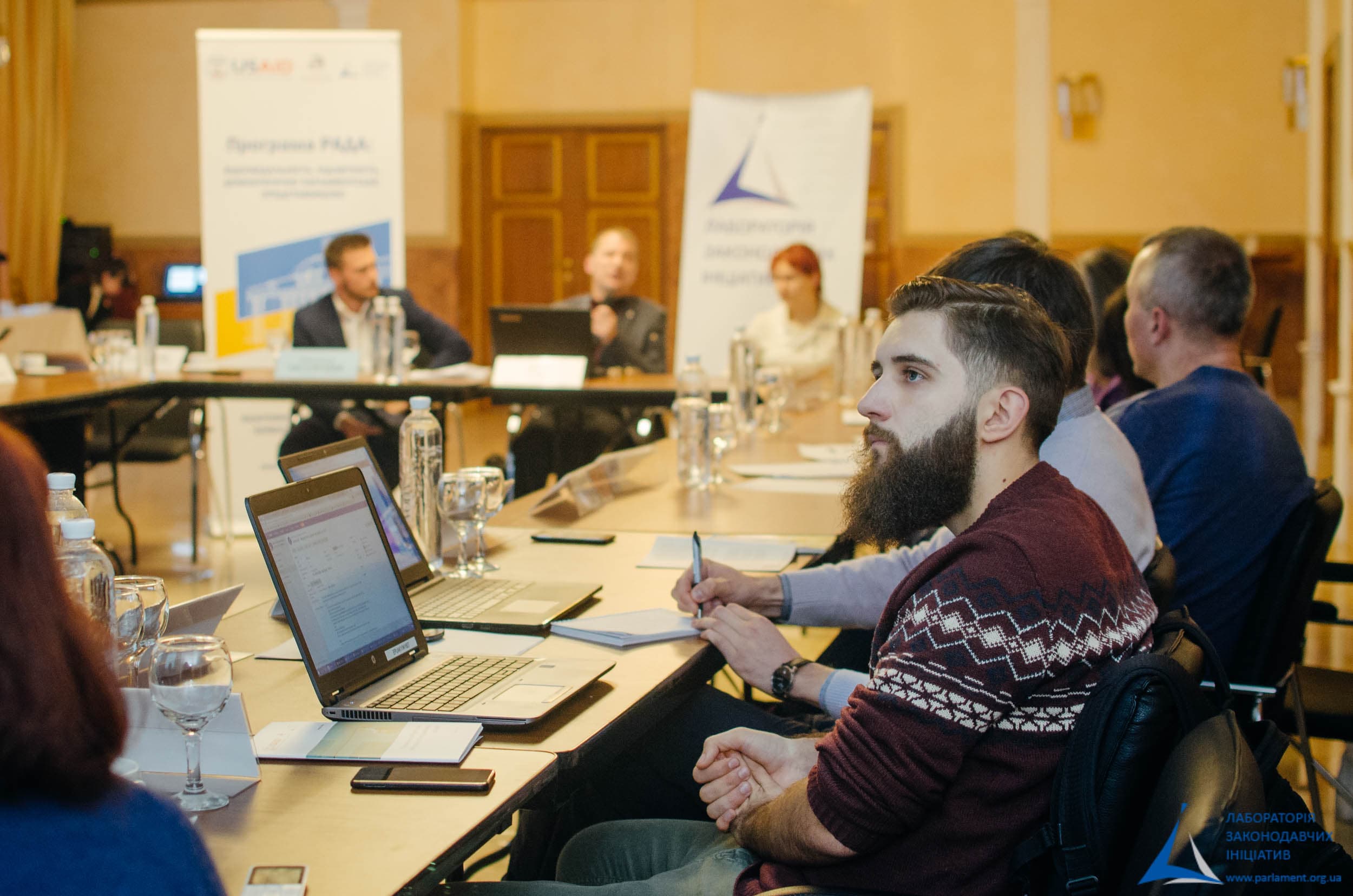
Photo by Oleksandr Kovalenko
The discussion focused on such issues as financing the provision of quality rehabilitation services; social protection of persons taking care of persons with disabilities (guardians); bias in disability assessment; limited possibilities of the ICF for adequate assessment of disability; staffing schedule of specialists providing rehabilitation services; clarification of the terms “physical rehabilitation”, “social rehabilitation” and “psychological rehabilitation”; and building multidisciplinary teams in rehabilitation institutions.
Presentation of the Policy Paper “Proposals for the Policy Concerning Supporting Documents in the Legislative Process”
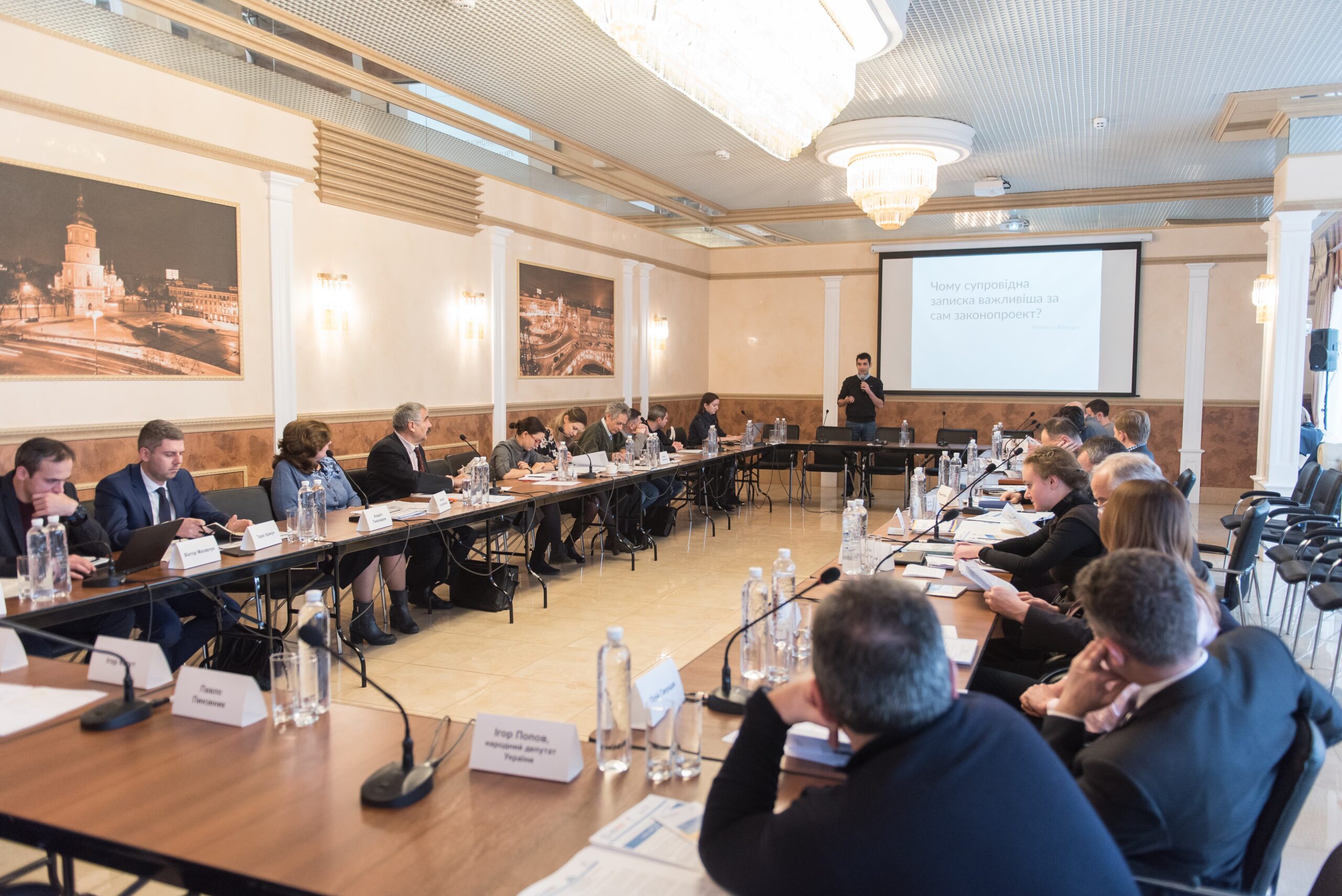
The round table was organized within the framework of events aimed to support parliamentary reform by the USAID RADA Program in cooperation with the Agency for Legislative Initiatives.
The discussion focused on the following issues:
- Support documents: types and requirements for drafting.
- Role of support documents in the registration of bills.
- Explanatory note to the bill as a gist of the concept of the bill.
- Financial feasibility study: its role, significance, specific features of preparation.
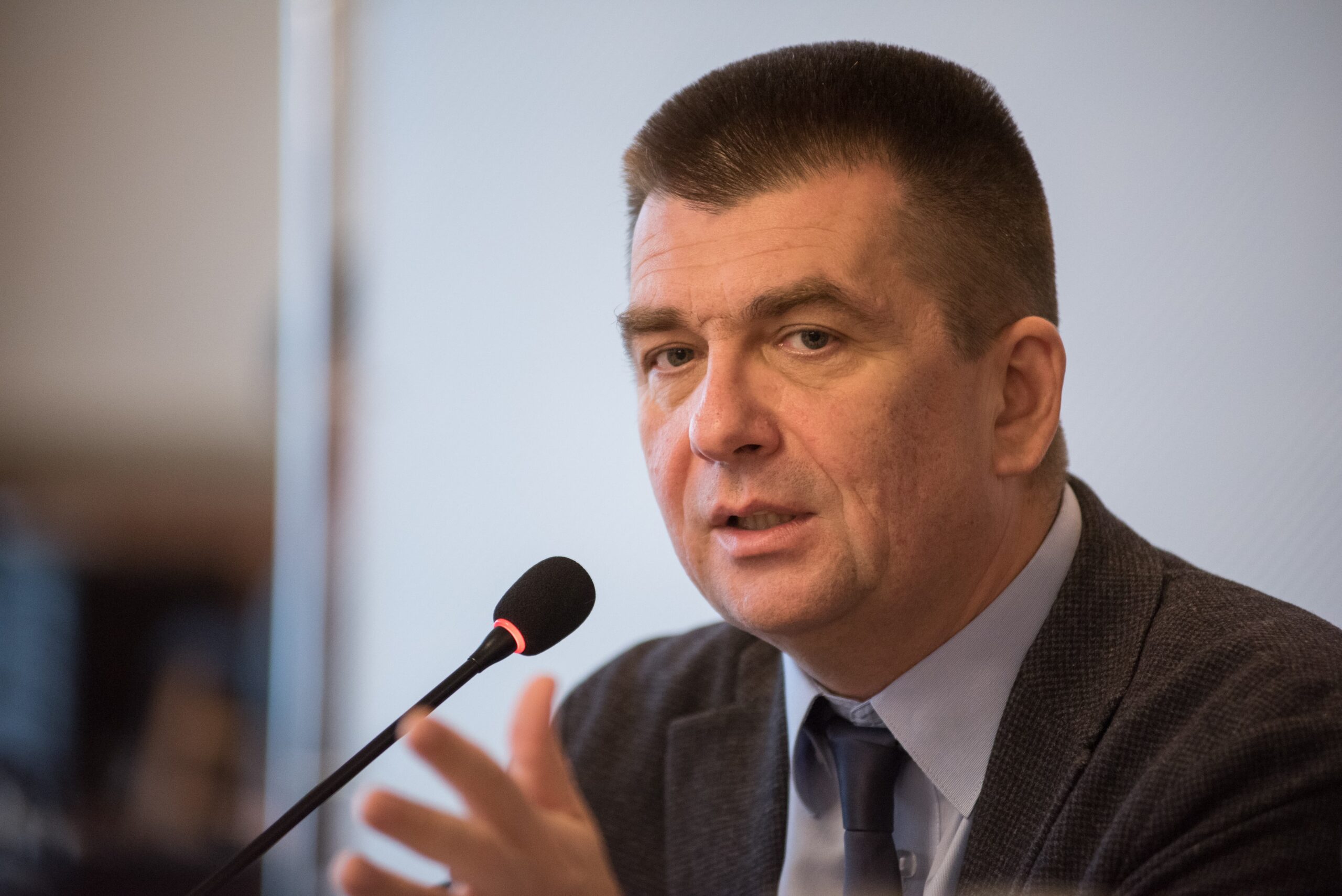
Ihor Kohut, USAID RADA CoP, made an introductory speech, encouraging all participants of the roundtable to a free exchange of views. Mr. Kohut observed:
“When it comes to parliamentary reform, there are many different components, but for the public, for citizens, it is important to understand that without a well-established, conforming to the rules of procedure, and maximally open legislative process that includes the full cycle of policies, monitoring, and assessment of these bills, without proper parliamentary oversight, we are doomed to flawed legislation for many years to come”

Presenting the Policy Paper “Proposals for the Policy Concerning Supporting Documents in the Legislative Process”, Mykhailo Koltsov, expert of the Agency for Legislative Initiatives, emphasized that the problem of “legislative spam” affected, first and foremost, MPs themselves and the Secretariat of the Verkhovna Rada of Ukraine. The load on the latter is particularly tough since its work is strictly regulated and there are no additional resources to solve the problem by increasing the staff or by amending regulations.
In the current situation, the most suitable of the several possible solutions to the problem is the one involving improvement of the mechanism of drafting supporting documents, in particular, the cover note. At the moment, it is but a formality and has little impact on the process of the procedural passage of the bill or on the evaluation of the document by various groups of stakeholders. Increase in the number of supporting documents due to additional opinion paper does not improve the situation either; it only worsens the load on the system.
But if we change the role of the cover note, formalize its structure, and introduce checklists in the practice of the Secretariat’s work, it can both improve the situation with a large number of bills and optimize the work of the departments.
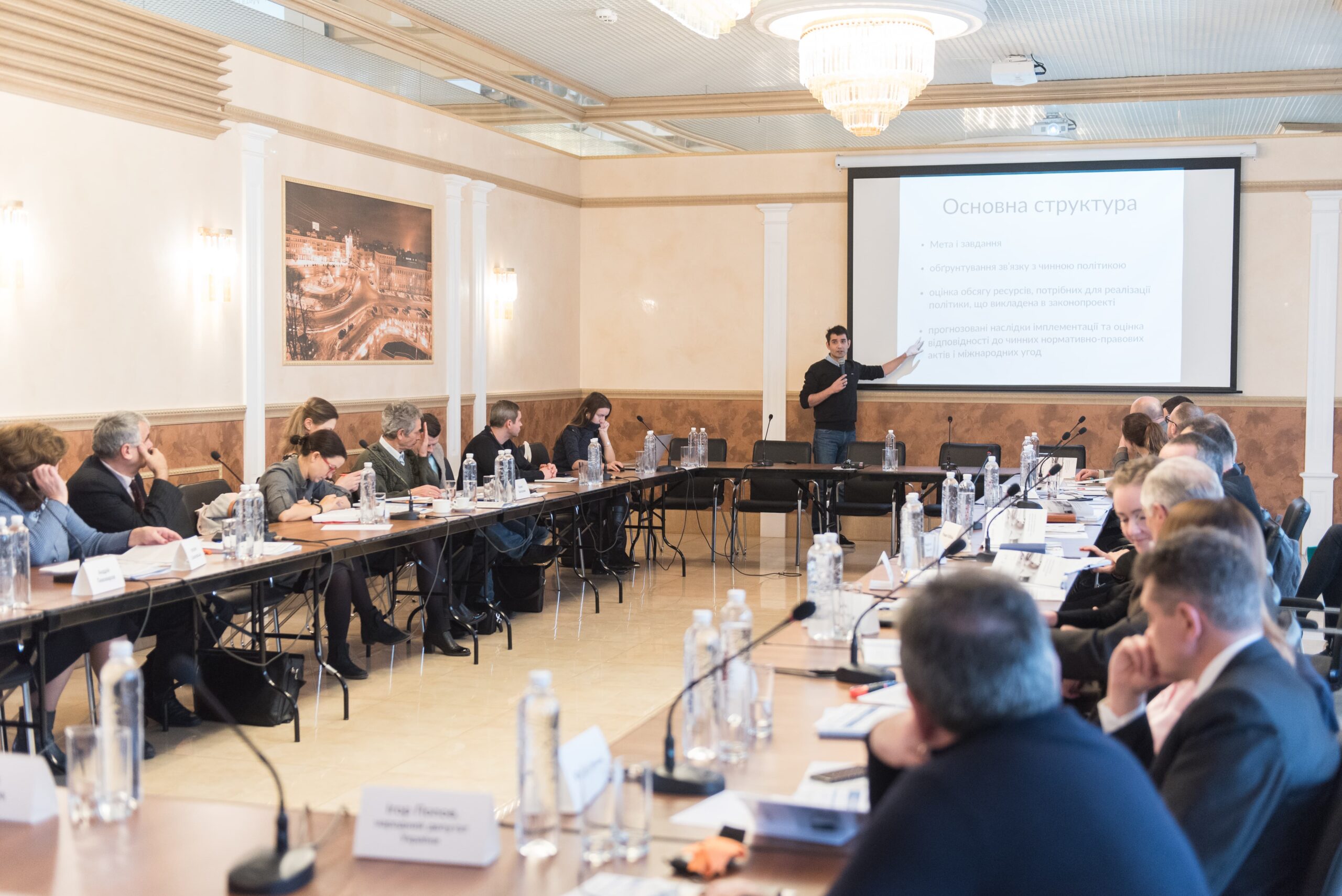
The cover note is not intended for lawyers. It is intended for the stakeholders – MPs, civic leaders, and experts – who are not lawyers, and who need an explanation of the practical consequences of enactment of a law.
The main changes in the structure of the cover note stem from its role as a document aimed to clarify the goals and objectives of the draft law. It is supposed to contain: the explanation of its connection with the current policy, estimation of the number of resources required to implement the policy envisaged by the draft law, expected effects of the implementation and assessment of compliance with the provisions of the Constitution of Ukraine, current regulations and international agreements. To implement this suggestion, it is only necessary to make changes to the methodological recommendations for the legislative mechanism in order to spell out the role and structure of the explanatory note. The oversight of compliance with these requirements can be performed via checklists since they make it possible to check documents based on a single structure and can be applied by employees with different levels of qualification.
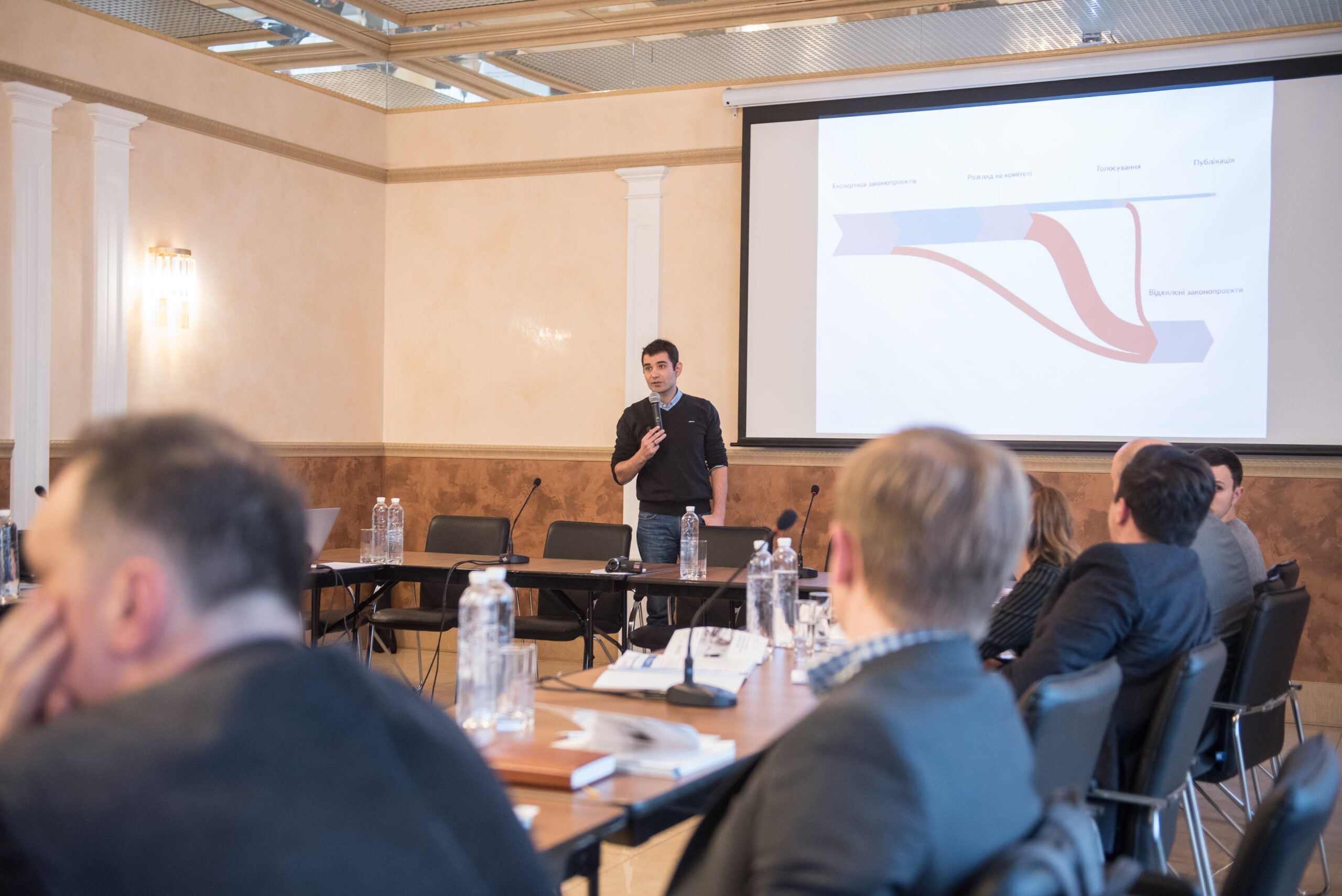
It is expected that by focusing on the structure and new requirements when preparing the cover note legislative initiative entities will be able to clarify the problems the bill is supposed to resolve, the ways of tackling them, and the consequences of its enforcement. Consequently, the content of the cover note may be the subject of discussion both during the first and second readings, as well as in communication with various groups of stakeholders. This, without a doubt, will help increase confidence in both the legislative process and laws themselves.
Preparation of the analytical materials is a part of a project implemented by the NGO Agency of Legislative Initiatives with the support of USAID RADA Program: Responsible Accountable Democratic Assembly, implemented by East Europe Foundation.
Press briefing “Presentation of the Policy Paper ‘Proposals Concerning Policy on Conflict of Interests of MPs of Ukraine’”
The paper was presented by MP Serhiy Leshchenko, Svitlana Matviienko, Chairwoman of the Board of the Agency for Legislative Initiatives, and Ulyana Poltavets, author of the study, Program Director of the Agency for Legislative Initiatives.

“This briefing organized in cooperation with the Agency for Legislative Initiatives is dedicated to the notion that lies at the heart of political corruption, this is especially true for parliament. This notion is a conflict of interests, that is, the phenomenon when people who have business in the area they regulate as officials are elected to parliament or to a public office. A typical example is Mr. Dubnevych, Chairman of the VRU Committee on Transport, who has business in the field of supply to Ukrzaliznytsia. That is, on the one hand, he chairs the Committee and, therefore, can influence Ukrzaliznytsia, the Ministry of Infrastructure and his deputies; and, on the other hand, he supplies equipment and is making a lot of money, which makes it possible for him to capitalize, design his political projects, engage in acts of corruption, and so on. I know that the Anti-Corruption Bureau has launched an inquiry into some of his affairs.
Why does it happen? Because we do not have any safeguards against conflicts of interest, although it is much easier to keep such people out of office than to investigate their actions, study their schemes, spend investigator resources, resources for travel to offshore zones and abroad to collect documentation, press charges, and spend years in court to punish these corruptors and confiscate stolen money in the future (possibly!). It is easier to prevent them from access to these positions. If you chair a committee, you should engage in something else in life. Dubnevych is a specialist in transport, he has a transport business, let him deal with issues of culture or spirituality, for example, or youth and sports. That is a sphere that has nothing to do with his personal business. This is precisely how European politicians are appointed to positions to avoid conflicts of interest. We are implementing the same initiative in parliament so that we could use a draft law, a Code of Conduct to bar politicians with conflicts of interest from holding public offices in the area of their private business interests”
Why does it happen? Because we do not have any safeguards against conflicts of interest, although it is much easier to keep such people out of office than to investigate their actions, study their schemes, spend investigator resources, resources for travel to offshore zones and abroad to collect documentation, press charges, and spend years in court to punish these corruptors and confiscate stolen money in the future (possibly!). It is easier to prevent them from access to these positions. If you chair a committee, you should engage in something else in life. Dubnevych is a specialist in transport, he has a transport business, let him deal with issues of culture or spirituality, for example, or youth and sports. That is a sphere that has nothing to do with his personal business. This is precisely how European politicians are appointed to positions to avoid conflicts of interest. We are implementing the same initiative in parliament so that we could use a draft law, a Code of Conduct to bar politicians with conflicts of interest from holding public offices in the area of their private business interests”

“We want to present our proposals for a policy on conflicts of interests of MPs of Ukraine. This is a continuation and analytical lead-in of the Agency for Legislative Initiatives to the work on adoption of the Code of Conduct in the Ukrainian Parliament. Settlement of conflicts of interest is one of the main cross-cutting issues that will make it possible to overcome corruption as well as provide an important safeguard. This analytical material with concrete proposals, which Ulyana Poltavets will elaborate on, is handed out to MPs, faction leaders and, in fact, the Chairman of the Verkhovna Rada of Ukraine. As an organization that cooperates with numerous international foundations and donors, such as USAID, the Kingdom of the Netherlands, OSCE/ODIHR, we urge to adopt the Code of Conduct in Parliament with a list of so-called safeguards, possibly even including penalties, since it is the only thing that will help Ukraine get out of this corruption pit mentioned previously by Mr. Leshchenko”

“Parliament’s role in combating corruption is not limited to adopting anti-corruption laws. First of all, a democratic parliament must conform to its own standards of openness and transparency. Of course, the main obstacle to adhering to these principles is MPs’ conflicts of interests. The Ukrainian parliamentary practice abounds in examples when a representative of a particular industry is a member or the head of the specialized parliamentary committee. According to the analysis of the 2016 electronic declarations of 422 MPs of Ukraine of the 8th convocation, 131 MPs (31%) have equity rights, and 108 MPs (25.6%) are the final beneficiaries of legal entities. At the same time, the analysis revealed that 38 MPs have a conflict of interests, including two chairpersons of committees (Chairperson of the VRU Committee on Health Care and Chairperson of the VRU Committee on Transport). The record holders in terms of the number of members with conflicts of interests are the Committee on Agrarian Policy (20 MPs) and the Committee on Construction, Urban Development and Housing and Communal Services (7 MPs). Some enterprises may belong to family members rather than MPs themselves, which anyway is contrary to the provisions of the Law of Ukraine “On Prevention of Corruption”: rights cannot be transferred to the benefit of family members.
Given the above, it is advisable to introduce a comprehensive conflict-of-interest policy. In particular, it is proposed to clarify the provisions regarding the inadmissibility of MPs’ business activity and availability of equity rights, by aligning the Commercial Code and the Law of Ukraine “On Prevention of Corruption”. Another extremely important element, according to Ms. Matviienko, is the adoption of the Code of Conduct, which would take into account MPs’ opinions and best international practices. A separate element of the legislative regulation of conflicts of interest is the adoption of a law on lobbying. The NAPC as the main tool for managing conflicts of interest should begin to operate independently and impartially.
This study attests to the need to include the issue of conflicts of interest in the political agenda. We hope that MPs, and in particular the Chairman of the Verkhovna Rada, as well as the Committee on Rules of Procedure, will take this into account and, in cooperation with the NAPC, will manage to implement an effective comprehensive policy on conflict of interests”
Given the above, it is advisable to introduce a comprehensive conflict-of-interest policy. In particular, it is proposed to clarify the provisions regarding the inadmissibility of MPs’ business activity and availability of equity rights, by aligning the Commercial Code and the Law of Ukraine “On Prevention of Corruption”. Another extremely important element, according to Ms. Matviienko, is the adoption of the Code of Conduct, which would take into account MPs’ opinions and best international practices. A separate element of the legislative regulation of conflicts of interest is the adoption of a law on lobbying. The NAPC as the main tool for managing conflicts of interest should begin to operate independently and impartially.
This study attests to the need to include the issue of conflicts of interest in the political agenda. We hope that MPs, and in particular the Chairman of the Verkhovna Rada, as well as the Committee on Rules of Procedure, will take this into account and, in cooperation with the NAPC, will manage to implement an effective comprehensive policy on conflict of interests”

Preparation of the analytical materials is a part of a project implemented by the NGO Agency of Legislative Initiatives with the support of USAID RADA Program: Responsible Accountable Democratic Assembly, implemented by East Europe Foundation.
Presentation of the Shadow Report “Memory Policy Reform: Interim Results of Enforcement of the ‘Decommunization Laws’”
On November 1, 2017, the Shadow Report “Memory Policy Reform: Interim Results of Enforcement of the ‘Decommunization Laws’” was presented within the framework of the roundtable on “Legislation on Condemnation of the Communist and National Socialist (Nazi) Totalitarian Regimes in Ukraine: Enforcement Status”.
The event was organized by the Agency for Legislative Initiatives in co-operation with the Subcommittee on Decommunization of the Verkhovna Rada Committee on Legal Policy and Justice within the framework of the USAID RADA Program: Responsible, Accountable, Democratic Assembly implemented by the East Europe Foundation.
De-communization is one of the Ukrainian reforms implemented thanks to the joint work of the public and the legislative and executive branches of government. The initiators and supporters of the law held a lot of public discussions and roundtables in the specialized committees of the Verkhovna Rada, examined the expert opinions of commissions consisting of historians, ethnographers, archivists, sociologists and other researchers. Such programs as “Open Archives” and “Leaving the USSR” (the study of the experience of Central and Eastern European countries), launched by the Center for Research of Liberation Movement as far back as in 2010, helped to formulate proposals for policy and eventually made up its basis. National memory issues were included in one of the sections of the Coalition Agreement, signed by the parliamentarians of the VIII convocation, as well as in the Action Plan for Implementation of the Program of Activities of the Cabinet of Ministers and the Coalition Agreement for 2015, Plan on Legislative Support to Reforms in Ukraine and Action Plan of the Cabinet of Ministers for 2016.
In late 2016, the Ukrainian Institute of National Remembrance, the central executive body for implementing the policy of national memory, published the first results of decommunization in Ukraine. The Verkhovna Rada adopted 13 decrees on the renaming of settlements and toponymic sites in settlements. All in all, 52,480 objects were renamed (51,493 streets, 987 settlements (including 32 towns) and 25 districts) and 2,389 monuments (including 1,320 Lenin monuments) were dismantled. There are still 2 oblasts and one district to be renamed. Oblasts can be renamed only by introducing changes to the Constitution of Ukraine.

The Shadow Report “Memory Policy Reform: Interim Results of Enforcement of the ‘Decommunization Laws’” summarizes the interim results of the decommunization reform and highlights the issues that need to be further elaborated. The document examines the objectives of the reform (what was planned and what has been implemented at the legislative level); analyzes the reform planning at the level of Parliament and Government; discusses the principles for renaming toponyms and dismantling monuments; refers to the stages and persons who perform decommunization in Ukraine; provides official statistics on the implementation of the tasks within the decommunization package; examines the reform stakeholders, public perception of the policy and litigation; and suggests steps that need to be taken to complete the reform.

Svitlana Matviienko, Chairwoman of the Board of the Agency for Legislative Initiatives, emphasized that reform in the field of memory policy is one of the key humanitarian reforms that can change the fundamental ideological principles of Ukrainian society.

Anna Oliynyk, Analyst of the Center for Research of Liberation Movement, member of the National Remembrance Policy group of the Reanimation Package of Reforms, focused on the steps that need to be taken to make the decommunization reform comprehensive. Thus, in the legislative area, it is necessary to adopt the social part of the amendments to the law on the rehabilitation of victims of political repression; to adopt a law on the principles of national remembrance policy; to adopt a separate law to settle the issue of celebrating official public holidays; to amend the Law of Ukraine “On Protection of Cultural Heritage” in order to reconcile it with the decommunization laws. It is important to complete the work on the Branch State Archive of the Ukrainian Institute of National Memory. Ms. Oliynyk also pointed out the need to complete the establishment of museum institutions such as the Museum of Monumental Propaganda of the USSR and the Maidan Museum. Another critically important element is an outreach campaign to promote and make known new names among the public.

Volodymyr Vyatrovych, Head of the Ukrainian Institute of National Remembrance, emphasized that the success of decommunization was due to the efforts of the public because the potential, resources, and funds of the Ukrainian Institute of National Remembrance would not be enough to carry out such a large-scale reform.

The roundtable participants discussed a wide range of issues related to the state policy in the area of decommunization; examined the status of enforcement of the Law of Ukraine “On Condemnation of the Communist and National-Socialist (Nazi) Totalitarian Regimes in Ukraine and Prohibition of Propaganda of Their Symbols”; analyzed measures aimed at raising public awareness of the crimes committed by representatives of the communist and/or national-socialist (Nazi) totalitarian regimes; analyzed alternatives of the state policy in the area of decommunization; and discussed the ways to improve the legislation on condemnation of the communist and national-socialist (Nazi) totalitarian regimes in Ukraine.
«Reform in the Field of Memory Policy: Intermediate Results of the Implementation of “Decommissioning Laws”» (Shadow Report)
Decommunization was one of the reforms in Ukraine that took place thanks to the joint work of the public and the legislative and executive branches of government. The initiators and proponents of the law held many public discussions and round tables in the relevant committees of the Verkhovna Rada worked with the conclusions of expert commissions, which were composed by historians, archivists, sociologists, and other researchers. The programs «Open Archives» and «Leaving the USSR» (studying the experience of the countries of Central and Eastern Europe), which the Center for Research of the Liberation Movement started in 2010, were able to form proposals to the policy and eventually become its basis. Issues of national memory were included in one of the sections of the coalition agreement signed by the parliamentarians of the VIII convocation, as well as in the «Plan of Activities for the Implementation of the Program of Activities of the CMU and the coalition agreement in 2015», «Plan of Legislative Support of Reform in Ukraine» and «Action Plan of the Cabinet of Ministers for 2016».
The Ukrainian Institute of National Remembrance, the central executive body for the implementation of national remembrance policy, released the first results of the decommunization process in Ukraine at the end of 2016. The Verkhovna Rada passed 13 decrees on the renaming of settlements and toponymic objects in settlements. Altogether 52 480 renaming (51,493 streets, 987 settlements (including 32 cities), 25 districts), dismantled 2389 monuments (of which 1320 «Lenin»). There are two other regions and one district that remain unclarified. It is only possible to give new names to the regions through changes in the Constitution of Ukraine.
Shadow Report «Memory Policy Reform: Intermediate Results of the Implementation of “Decommunization Laws”» summarizes the intermediate results of the decommunization reform and highlights the problematic points that should be further developed. The paper analyses the objectives of the reform (what was planned and what was successfully defended at the legislative level) reviews reform planning at the level of Parliament and Government; explores the principles of the name change and the dismantling of monuments; Examines the stages and actors of decommunization in Ukraine; analyses official statistics on the fulfillment of the tasks of the decommunization package of laws; studies the stakeholders of reform, public perception of policy and judicial processes; Proposes steps to be taken to complete the reform.
The preparation and presentation of analytical reports in the Shadow Report format is part of the project embodied by the Agency for Legislative Initiatives, supported by the USAID Rada Program: Responsible Accountable Democratic Assembly, implemented by the East Europe Foundation.
Returning the occupied territories of Donbas. Ukrainian plan
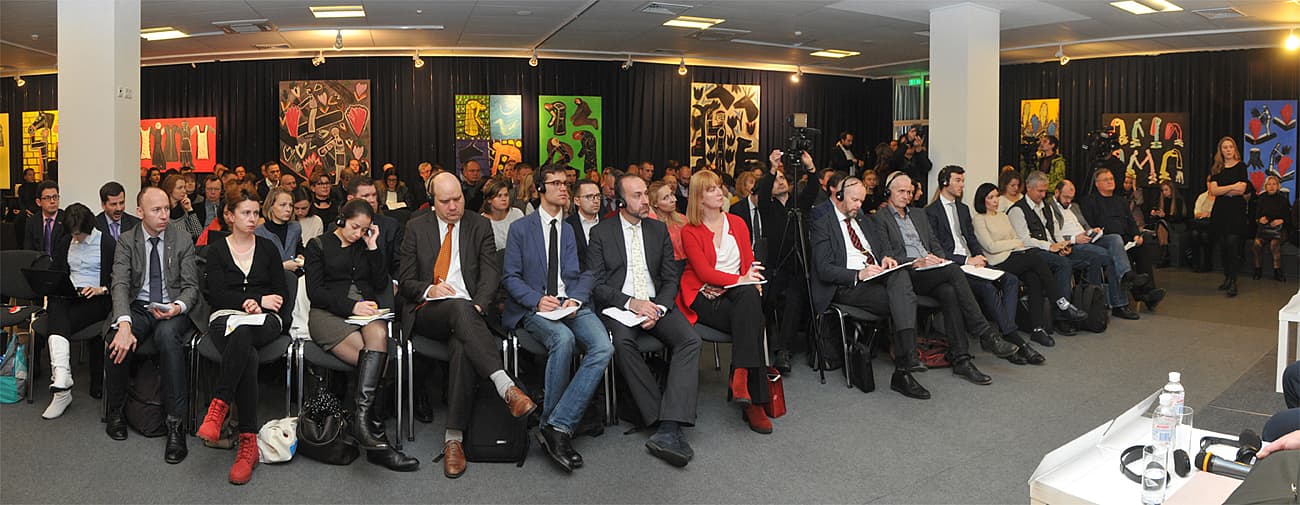
The conference, organized by the Ukrainian School of Political Studies in co-operation with the Mirror Weekly, was designed as a platform for exchanging views and an open discussion on the socio-political situation in the liberated and occupied territories of Donbas, on the issues of return and reintegration of the territories of Donetsk and Luhansk regions, management of the de-occupied territories, and development of a new economic model of Donbas.

Svitlana MATVIIENKO, Chairwoman of the Board of the Agency for Legislative Initiatives, addressed the guests and participants of the conference with a welcoming speech, pointing out to the fact that only through the large horizontal networks could things change in our country.
“he Agency for Legislative Initiatives, with the support of many international donors, has been building up various networks for 12 years and it seems to us that we have a more clear idea of the atmosphere in the country. Because we can feel the beat of change throughout the country and alteration of approaches to socially important issues due to the network of the Ukrainian School of Political Studies, supported by the Council of Europe for many years, and the network of the School of Community Leaders, launched in co-operation with the International Renaissance Foundation, that has been proving its extraordinary capacity in recent years”
“It seems to us that speaking about the Donbas problem we must, first and foremost, rely on very deep senses without the slightest flavor of any emotions. Most of all we need an analytical ability to talk about important things”

The conference began with a report by Iryna BEKESHKINA, Director of the Ilko Kucheriv Democratic Initiatives Foundation, senior researcher at the Institute of Sociology of the National Academy of Sciences of Ukraine, on the topic “Socio-Political Public Sentiment in the Liberated and Occupied Territories of Donbas: Expectations and Priorities”. Ms. Bekeshkina focused on the specific features of Donetsk and Luhansk regions and used sociological data to show why the concept of Novorossiya is not viable. In particular, she emphasized that the stereotypes concerning the uniform nature the Southeast are wrong since Donetsk and Luhansk oblasts strikingly differ from the rest of the region. The speaker elaborated on the attitude of Ukrainians to different solutions to the issue of returning the occupied territories of Donetsk and Luhansk regions and highlighted the difficulties of reintegration of these territories, given the entrepreneurial inertia of the region.
Discussion panel 1: Occupied territories of Donbass – return or farewell? The panel focused on issues of reintegration of the occupied territories of Donbas; a possibility of their separation; feasibility of a purely political way of settling of the problem of Donbas de-occupation without resorting to military force; and whether the possible deployment of UN peacekeepers can contribute to such settling.

Oksana SYROID, Deputy Chairman of the Verkhovna Rada of Ukraine, observed that to discuss the issue of return of the occupied territories we should have a clear idea of our vision of victory in this context. Ukraine does not seek to defeat Russia through military means, but by returning only the occupied Donetsk and Luhansk regions we will surrender Crimea, and in no way is it a victory. For Ukraine, a way to return its territories is by strengthening our armed forces. It is absolutely unacceptable to return these territories at the expense of a loss of sovereignty.
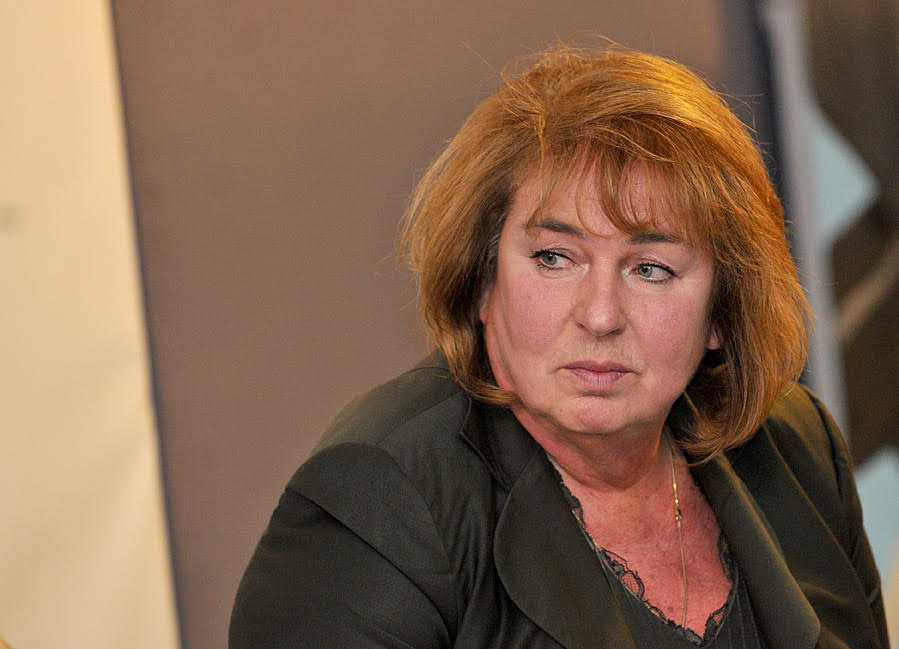
Ella LIBANOVA, Director of the Institute for Demography and Social Studies of the National Academy of Sciences of Ukraine, emphasized that the politician seriously speaking about “cutting off” Crimea and Donbas is suicidal, because this variant is unacceptable even to those who are not against it today. This solution is a compromise that Ukrainian society will never accept. Also, Ms. Libanova elaborated on the cost of returning the territories, noting that Ukraine, already actually living without the ORDLO territories, managed to adjust to the torn ties. Donbas development will require both significant financial infusions and saturation with the new workforce since the most competitive residents of the region were the first to leave it and are not going to come back.
“Today, we do not have a split society, but we have a division of society. The main task of today’s meeting is to awake to the need to prevent transformation of the divided society into a split society”
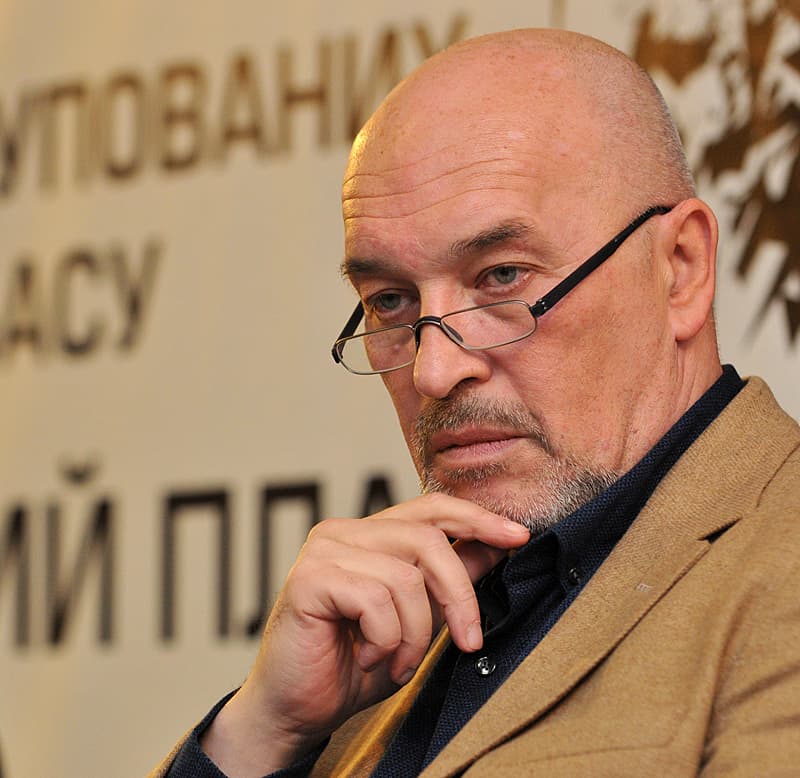
Heorhiy TUKA, Deputy Minister for Temporarily Occupied Territories and Internally Displaced Persons of Ukraine, drew attention to the fact that it is necessary to counter the “separation infection” – i.e. the idea that we should not return the occupied territories of Donbas, which permeated entire Ukrainian society. Instead, we should focus on the opportunities and initiatives that help engage young people from the ORDLO in nationwide events. In addition, Mr. Tuka believes that Ukraine can rely on the European Union’s economic assistance in the development of Donbas.
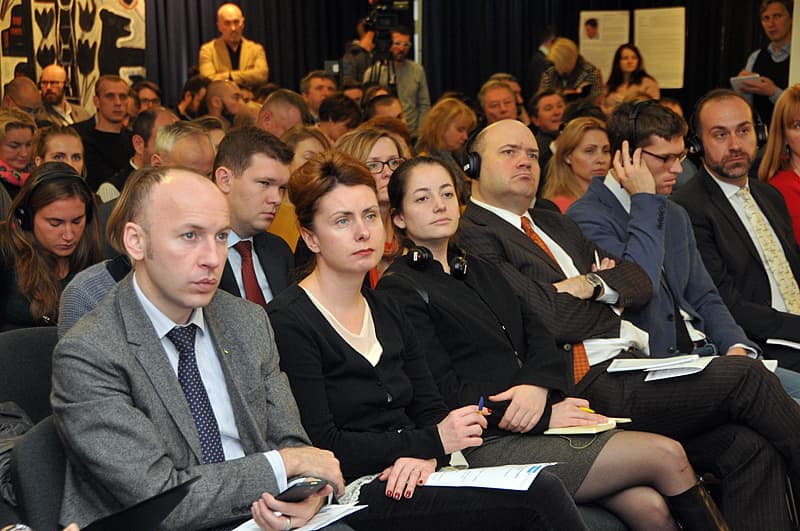
Discussion panel 2: What should be the model of administration in the de-occupied territories during the transition period? The panel focuses on the issue of the temporary administration system in the formerly occupied territories during their reintegration, distribution of powers during this period and its duration. It raises the issues of a special self-governance regime in the de-occupied territories, which is enshrined in the Constitution, and of the risks this measure entails.
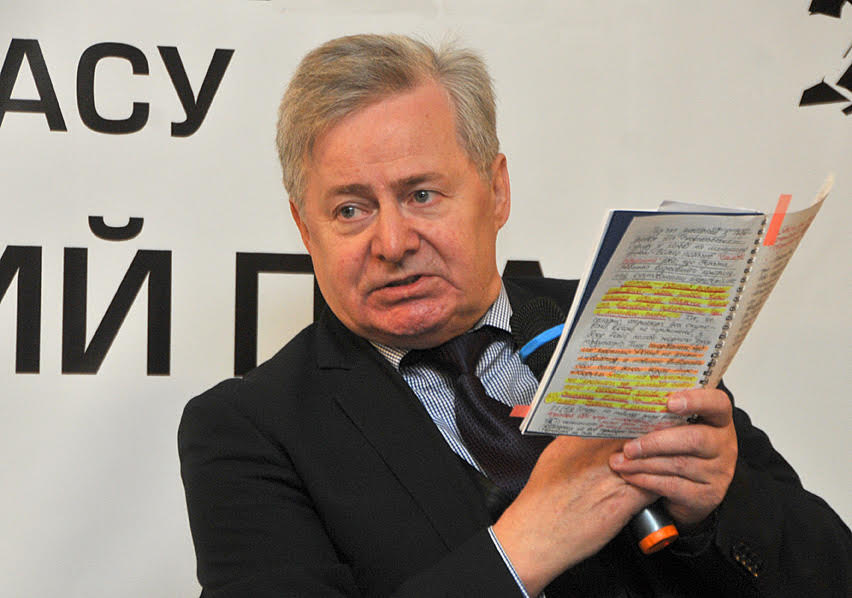
Viktor MUSIYAKA, Professor at the Kyiv-Mohyla Academy, elaborated on five possible scenarios for de-occupation of Donbas and focused on the threats posed by certain provisions of the Minsk agreements, equating fulfillment of the Minsk agreements to planting a bomb under Ukraine’s sovereignty.

Olga AYVAZOVSKA, Chairwoman of the Board, Coordinator of the election and political programs of the Civic Network OPORA, Representative of Ukraine in the political subgroup of the Trilateral Contact Group on Donbas. Ms. Ayvazovska observed that we should first of all deal with the fundamental question of what we are after: people or territory; what is of value to us: human rights, the Constitution, international standards; is there a political consensus within the country as regards returning of the occupied territories of Donbas and Crimea.
Another important thing is refraining from generalizations since the generalization is an adversary of truth; and when we talk about the people staying in the occupied territories, claiming that they are ignorant, inert and incapable of commerce, we betray them.
Ms. Ayvazovska paid special attention to the need to resort to various platforms and means to solve the problem of de-occupation, otherwise, the process will fall apart.
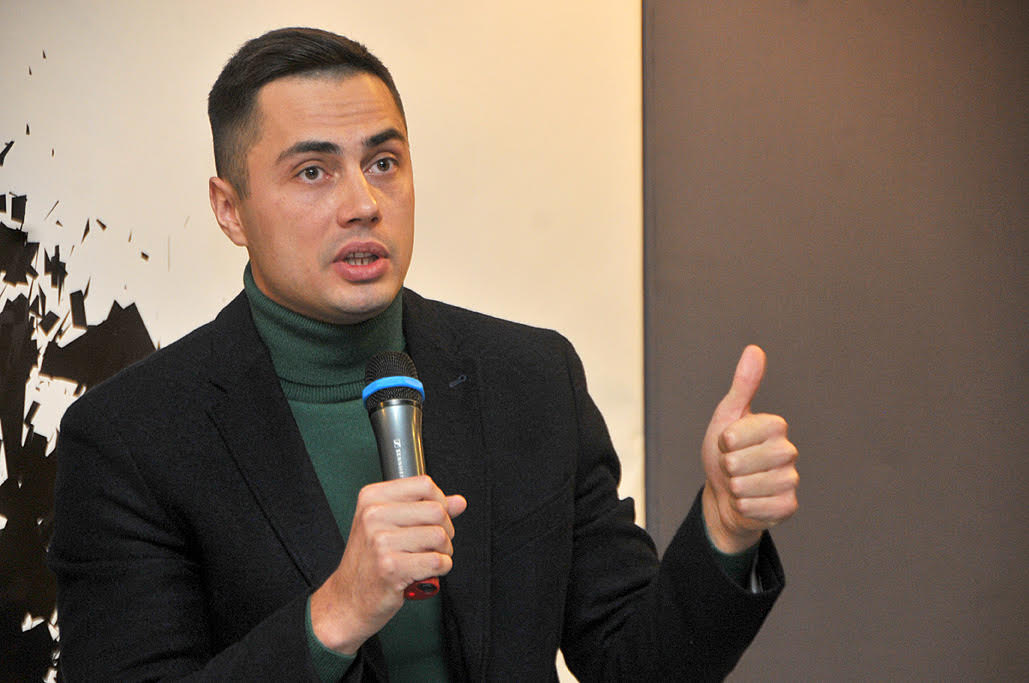
Yegor FIRSOV, Head of the Alternative Initiative, presented a detailed plan for administration of the de-occupied territories during the transition period, emphasizing the need to establish military civilian administrations for the first three years to ensure law and order and help come back to the norm.
The moderator of the first and second panels was Serhiy RAKHMANIN, first deputy editor-in-chief of the Mirror Weekly. Ukraine.
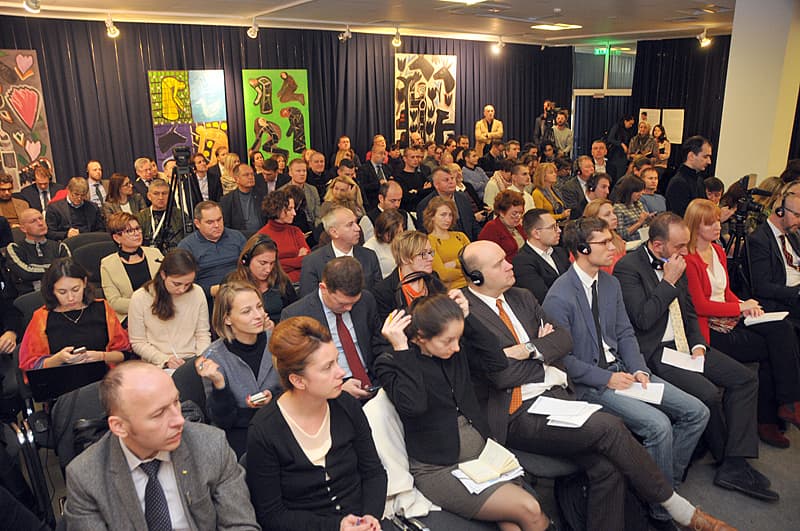
Third discussion panel: What should be the new economic model of Donbas? The panel focused on the potential first steps towards the economic reconstruction of the de-occupied territories, restoration of economic ties and infrastructure; as well as on sources of financing for reconstruction of the de-occupied territories.
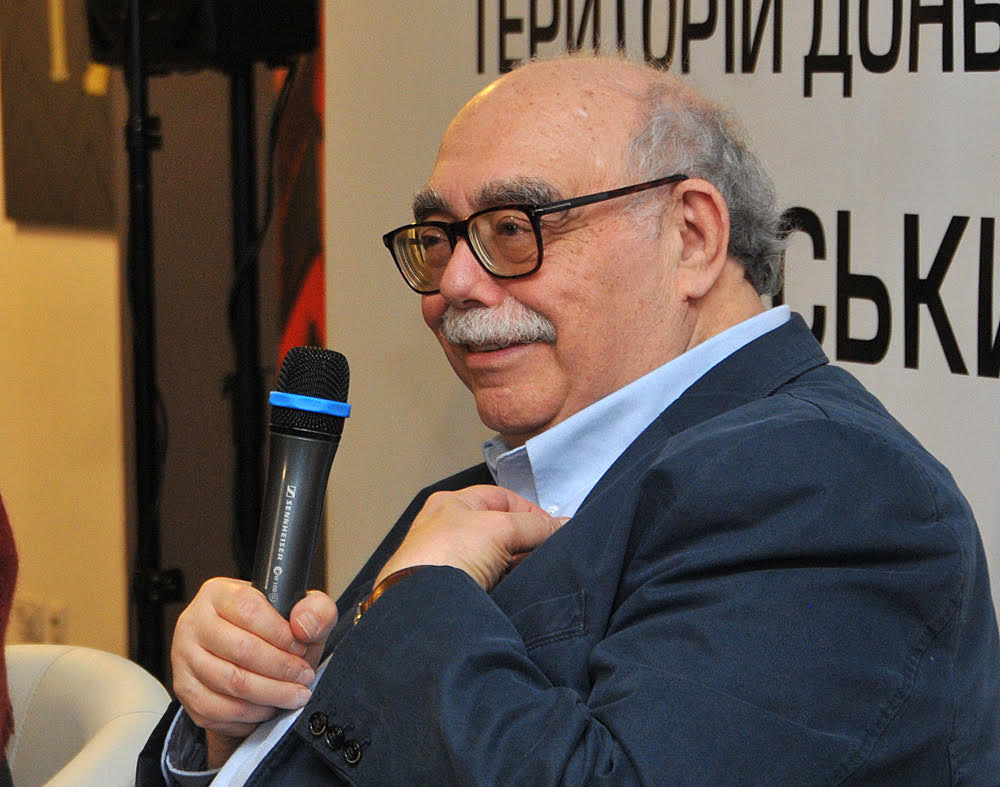
Alexander PASKHAVER, Advisor to the President of Ukraine, outlined the economic issues Ukraine is bound to face when rebuilding the de-occupied territories. Mr. Paskhaver suggested creating free economic zones, like the ones at one time established in China with their special laws, preferential terms for investors and restrictions on migration for the population.
“A ‘swampy’ reintegration without Stalin’s methods will simply pull our country down”
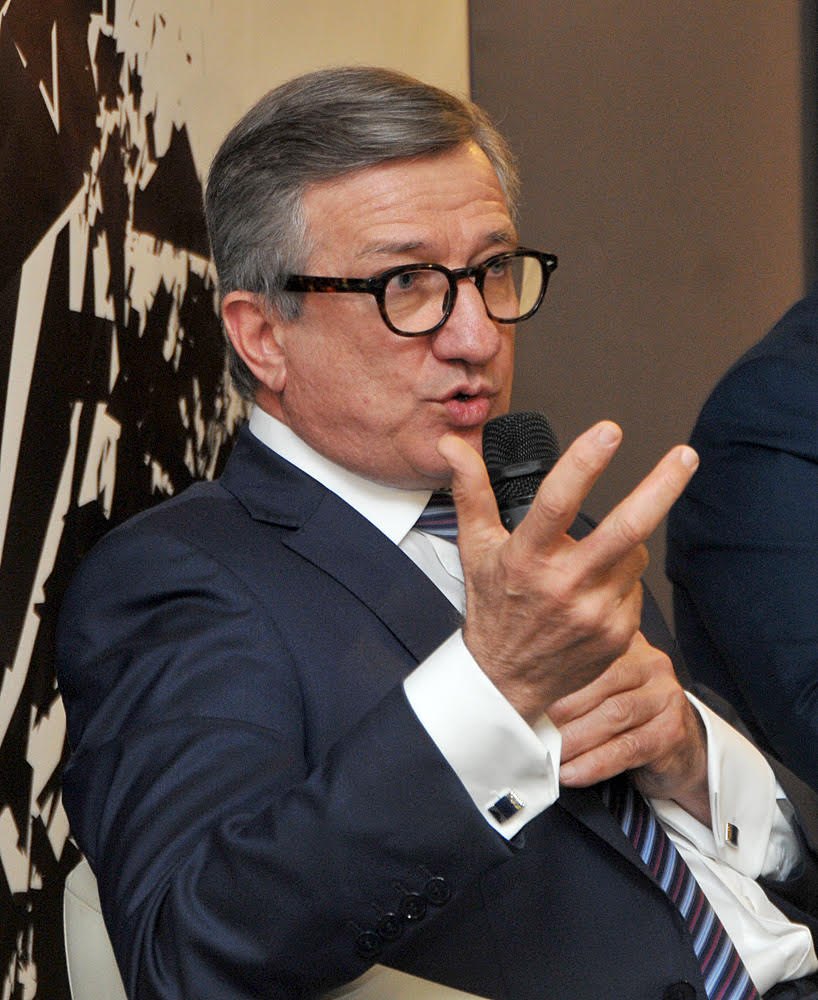
Serhiy TARUTA, MP of Ukraine, also supported the idea of creating a free economic zone in Donbas. Mr. Taruta emphasized the need to create a strategy for the development of the de-occupied territories of Donetsk and Luhansk Oblasts. The strategy is key, then a team should be selected based on the strategy, and money should be found for the team. We should not ignore natural resources, because only an idiot will back off from turning them into opportunities. Besides, Mr. Taruta noted that the future of Donbas depended on human resources.
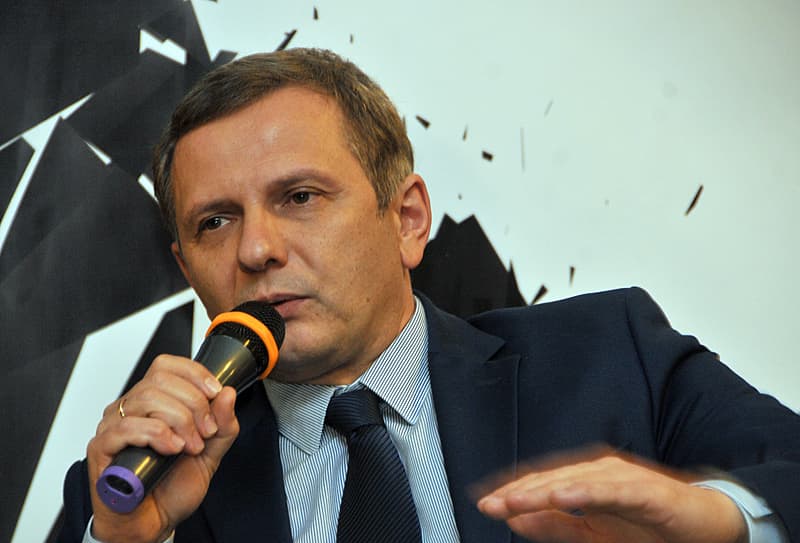
Oleg USTENKO, Executive Director at the Bleyzer Foundation, gave special attention to the impossibility of solving the Donbas problem while maintaining the status quo. He warned against focusing on commodity markets and outdated economic models. The speaker pointed out that the most important issue is the investment attractiveness of the region for investors and introduction of fiscal privileges. One of the ways to attract investors can be increased sensitivity – i.e. resolving conflicts in London and Stockholm arbitration.
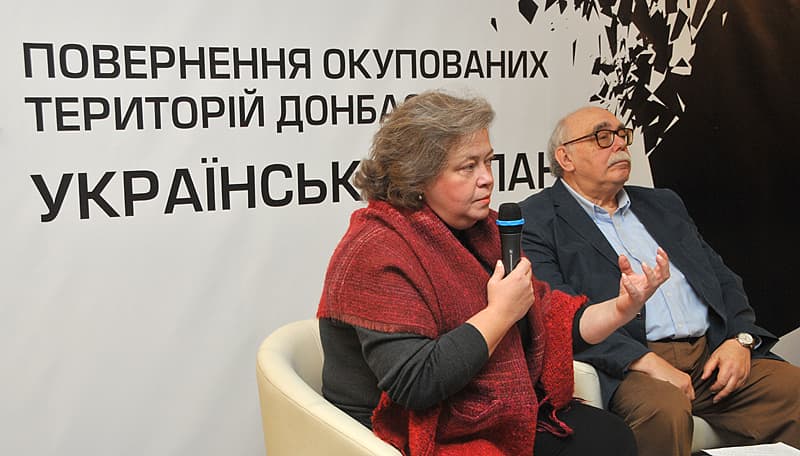
The moderator of this panel was Yuliia MOSTOVA, editor-in-chief of the Mirror Weekly. Ukraine, who summed up the discussion and observed that we need a plan to construct the future:
“We must understand what we want from ourselves, from our country, including from its occupied part. We have to watch our step to avoid falling, but just as important is to look forward in order to get off the ground. Because, marking time and hiding stones in our pockets, we will simply vanish. I don’t mean just one or two regions, the country will disappear, we will not become what we could be”
Proposals for Policy on Cybersecurity Reform in Ukraine (Policy Paper)
The paper is devoted to the analysis of problems with cybersecurity in Ukraine and to the search for ways to solve them. The authors’ attention was focused on improving the regulatory framework, creating the proper infrastructure, developing the cybersecurity industry, ensuring conditions for the fruitful cooperation of all Ukrainian and international stakeholders, and developing a culture of network and information security. According to the authors, the construction of effective state policy in the field of cybersecurity is possible only if there is a single control center, a clear agreed program of action, and increased confidence among the main stakeholders.

Preparation of the analytical materials is a part of a project implemented by the NGO Agency of Legislative Initiatives with the support of USAID RADA Program: Responsible Accountable Democratic Assembly, implemented by East Europe Foundation.