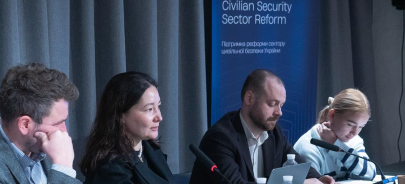
On 21 July 2025, the Agency for Legislative Initiatives (ALI) presented Ukraine’s first systematic study dedicated to court staff—the Green Paper on the Functioning of Civil and Patronage Service in the Judiciary.
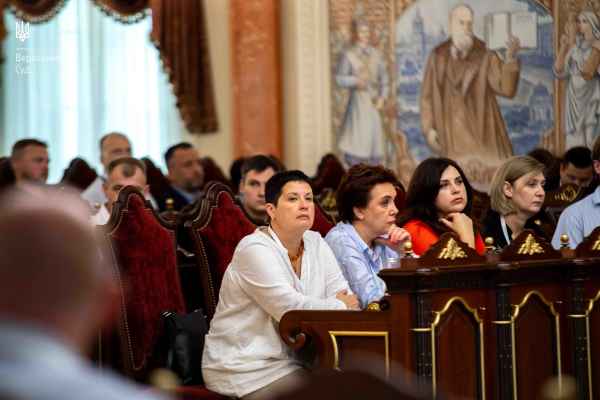
The presentation gathered the leadership of the Supreme Court, heads of staff from appellate courts across Ukraine and district courts in Kyiv, representatives of the High Council of Justice, the High Qualification Commission of Judges, the State Judicial Administration of Ukraine, and members of judicial associations.







Rasim Babanly, First Deputy Chief of Staff of the Supreme Court, emphasised that ALI research marks a crucial step toward constructive dialogue between civil society and the judiciary. He noted that the Green Paper is not just a critical assessment of existing problems but also a commitment to joint solutions grounded in thorough analysis and respect for institutions.
The Green Paper focuses on civil servants, judicial assistants, and technical staff who ensure the daily functioning of courts — from record-keeping and technical support to public communication. The research is based on a survey of more than 1,000 court staff members and 42 in-depth interviews covering all jurisdictions of first-instance and appellate courts.
Stanislav Kravchenko, President of the Supreme Court, stated in his address:
However, Karyna Aslanian, Head of the Rule of Law area at ALI, pointed out that court staff remain overlooked in reforms: ‘Court employees are systematically undervalued — in terms of status, pay, HR policy, and professional development’.
The Green Paper also highlights long-term risks to institutional memory, ethics, and the independence of the judiciary. A significant share of court staff (judicial assistants) is not covered by anti-corruption policies, face substantial disparities in social guarantees and career advancement, while training and professional development often remain merely formal.
ALI experts not only analyse problems but also propose institutional solutions. Key challenges include:
- Overtime work: According to the survey, 21% of court staff work overtime almost daily, 19% often, 22% occasionally, 17% rarely, 16% very rarely, and only 5% never;
- Underfunding and out-of-pocket expenses for court needs: More than 70% of respondents reported having to purchase office supplies, refill cartridges, or even repair court premises at their own expense. Specifically, 696 respondents bought paper and stationery, 424 refilled cartridges, 231 purchased furniture and equipment, 218 paid for postage, 175 carried out office repairs, and 61 covered other expenses;
Oleksandr Sasevych, member of the High Council of Justice, emphasised:
Maksym Pampura, Acting Head of the State Judicial Administration of Ukraine, highlighted low salaries in the judiciary as a critical issue:
- Lack of a clear HR strategy: More than 3,000 vacancies in court staff positions remain unfilled;
Viktor Kapustynskyi, the Supreme Court’s Chief of Staff, added that without a sustainable vision for personnel development, we cannot build an effective strategy for the judiciary. According to him, it is crucial to lay the groundwork for tomorrow’s solutions by rethinking HR philosophy and revising approaches to job classification, remuneration, and digitalisation.
- Low salaries: 74% of court staff consider their pay demotivating. Respondents also identified it as one of the key factors affecting their professional independence;
Taras Neshyk, Head of the Secretariat of the High Qualification Commission of Judges, emphasised that low salaries and outdated functional models prevent the judiciary from attracting a new, qualified workforce. According to him, the current work format is also incompatible with the digital era.
- Unsatisfactory working conditions: Most courts lack bomb shelters or stable internet access.
Nataliia Fulei, a representative of the National School of Judges of Ukraine, noted that the Green Paper is not only an analytical document but also a tool for shaping state policy that should serve as a starting point for systemic changes in the treatment of court staff.
The Agency for Legislative Initiatives hopes the Green Paper will lay the groundwork for reforming the court staff, and its recommendations will help improve the efficiency of the judiciary in Ukraine. Key findings are published in the presentation, and the full report is forthcoming.
The event took place as part of the Improvement of Governance in Ukraine: Enhancing Policy Making for Social Progress Project, with the support of Switzerland and the organisational assistance of the Supreme Court. The content of the research and presentation is the sole responsibility of the Agency for Legislative Initiatives. The views expressed in the presentation and research do not necessarily reflect those of the donor and the Supreme Court.